
Our readers keep the lights on and my morning glass full of iced black tea. As an Amazon Associate, I earn from qualifying purchases.
Specs are compiled from manufacturer listings and verified buyer reviews and can change over time — please confirm the key details on the product page before buying.
Every docking mistake you have ever made shows up in the same place: the gel coat along your rub rail. To pick the right boat bumpers for dock duty, match three things: your boat’s length, how low your hull sits in the water, and whether the boat stays tied up overnight or just touches the dock while you load passengers.
I’m Min — the founder and writer behind Gadgets Feed. This guide is built by comparing the manufacturers’ published specifications and the patterns across verified customer reviews, so you get each pick’s real strengths and trade-offs instead of marketing spin.
Boat length drives every fender decision, so this guide leads with size, hull height, and the mounting style that actually stays put. The Seachoice kit is the crowd favorite, rated 4.8 out of 5. So here is exactly how to choose the boat bumpers for dock that fit your hull without any guesswork left over.
Our Picks at a Glance


How To Choose The Best Boat Bumpers For Dock Duty
Buying bumpers is easier once you decide whether the bumper lives on the boat or lives on the dock. A fender that hangs off your cleat travels with you and works at unfamiliar marinas. A bumper screwed along the dock’s edge only protects that one slip — but it protects it every single time you come in, even in a bad tide.
Match the fender to your boat’s length first
The most useful number on any fender listing is the boat length it is rated for, written as a range like “15-20 feet” or “boats up to 25 feet.” Buy a fender rated for a shorter boat than yours and it will ride too high or too small to cushion the impact point. Several of these picks also publish a spacing rule — one fender for every 10 feet of boat length — which tells you how many to buy in one go.
Check how low your hull sits
If you run a bass boat, a jon boat, or a shallow-hull jet boat, your gunwale sits close to the waterline and the dock can ride up above your rub rail. Flat, low-freeboard fenders are shaped to sit against that low profile instead of rolling off. Round fenders tend to spin away from a low hull. If your boat sits high, any shape works.
Decide between inflatable and foam
Inflatable vinyl fenders arrive flat, take a few pumps to firm up, and can be tuned softer or harder depending on conditions. Solid foam fenders never need air, so there is nothing to leak, but they are bulkier to stow. Both work; the choice usually depends on if you want to carry a pump or forget about inflation entirely.
Quick Comparison
| Model | Best For | Boat Length | Fender Size | Inflatable | Amazon |
|---|---|---|---|---|---|
| Seachoice Twin Eye Ribbed Fender Kit★ Best Overall | All-round first kit | 15-20 feet | 5 ½” x 20″ | Yes | Amazon |
| attwood SoftSide Long-Edge Dock FenderBest Dock Edging | Dock-edge mounting | — | 45″ x 6″ x 4″ | No | Amazon |
| KEMIMOTO Straight-Edge/Corner Dock BumperBest For Jet Skis | Jet ski and small craft | up to 25 feet | Two-part foam kit | No | Amazon |
| JYINCPED Low Freeboard Boat Fenders | Shallow-hull boats | Low freeboard | 5″ x 16″ | Yes | Amazon |
| Ehaho EVA Boat Fenders | No-pump mounting | 15-25 feet | 17.2″ L x 8.1″ W x 4.5″ H | No | Amazon |
| AWEMUFA Boat Fenders | Knot-free locking | Boats under 30 feet | 17.12″ x 8.27″ | No | Amazon |
| KEMIMOTO Upgraded Boat Fenders | Low-freeboard flat fit | 15-25 feet | 17in x 8in | No | Amazon |
| Dreizack Boat Fenders 4 Pack | Complete starter kit | Pontoons and more | 6.5 inch | Yes | Amazon |
| HULL HUGR Marina Bumper | Commercial dock edge | Commercial marinas | 48″ x 8″ x 6″ | No | Amazon |
In‑Depth Reviews
1. Seachoice Twin Eye Ribbed Boat Fender Kit
Our pick — over 4.5★ from 700+ verified ratings; the strongest balance of quality and price.
A ribbed vinyl classic that comes with the lines most kits make you buy separately.
For a boat between 15 and 20 feet, this is the kit to start with. Each fender measures 5 ½ inches across by 20 inches long, a size that sits neatly against a midsize hull without crowding your cleats. The pair ships with two 3/8-inch by 5-foot double-braided MFP fender lines, and each line has a reinforced nylon mesh loop on one end — an eyelet-like ring that holds up better against wear than a plain stitched end.
What wins people over is the build quality, and it is the thing owners single out more than any other trait. The body is roto-molded marine grade vinyl — spun inside a heated mold so the wall thickness comes out even — with a high-gloss finish and a ribbed surface that keeps it from sliding along the hull. The valve plug housing is molded into the fender rather than glued on, and the valve itself sits recessed so the lug cannot get snagged and pulled away. Between the fenders and the lines, this is the best value-per-fender in the group.
The one honest catch: the fenders arrive needing a little air. Buyers report “I had to add a little air, no big deal.” It takes a minute, and after that the seam and valve hold fine, so plan on a short setup session before your first trip rather than hanging them from the box.
Where It Pulls Ahead
- Fender lines included with reinforced nylon mesh loops — no separate rope purchase.
- Roto-molded marine grade vinyl with recessed valve and molded-in plug housing.
- 5 ½” x 20″ size rated for boats 15-20 feet, with a high-gloss finish that resists dock scuffs.
What To Plan Around
- Arrives lightly inflated, so you add air before first use.
- Only covers boats 15-20 feet unless you buy more than one kit.
Go with this: a 15-20 foot boat owner who wants a complete hanging kit in one purchase, lines included.
Look elsewhere: if your hull runs longer than 20 feet, step up to a kit with a longer boat rating.
2. attwood SoftSide Long-Edge Dock Fender
The long white strip you screw along the dock so every landing hits something soft.
Most fenders hang from your boat and travel with you. This one installs on the dock itself. At 45 inches long by 6 inches deep by 4 inches tall, it runs a long, continuous cushion down the edge of your slip rather than covering a single contact point. It is a one-piece molded polymer — no glued seams to split — and the material is soft to the touch so it cushions the hull instead of scraping it.
The trade-off is worth knowing up front. This is a rigid plastic, not the squishy rubber you might expect. Owners mention: “I thought they were going to be more of a rubber material. These are a rigid plastic. But they are nice quality.” That rigidity is what lets it resist UV rays, chalking, splitting, and crushing, and it means the bumper keeps its shape for years of sun exposure instead of going soft and gummy. Plan on bringing a longer drill bit and driver to set the screws.
The recurring gripe is the mounting hardware — screws and washers are not in the box, so budget for a trip to the hardware store. It screws permanently into a dock face, so it stays in one slip rather than traveling with the boat. For a fixed home slip, it pads the dock once instead of hanging fenders every trip: 4.7 stars across 441 ratings, with repeat buyers like “This is the 2nd time we have ordered these!”
Who it genuinely suits: a boater with a fixed dock who wants a long, permanent cushion on the edge and does not want to haul fenders on and off every trip.
The honest caveat: installation calls for a screwdriver, longer drill bits, and your own screws and washers — deep holes and tight dock angles make mounting fussy, especially if you cannot get in the water.
Made for: dock owners with a dedicated slip who prefer a permanent, low-maintenance padded edge.
Skip if: you trailer your boat or tie up at different marinas — you want a fender that travels with the hull.
3. KEMIMOTO Boat Bumpers for Docking (Straight-Edge or Corner)
No inflation, no leaks — foam that folds over a low gunwale and stays put.
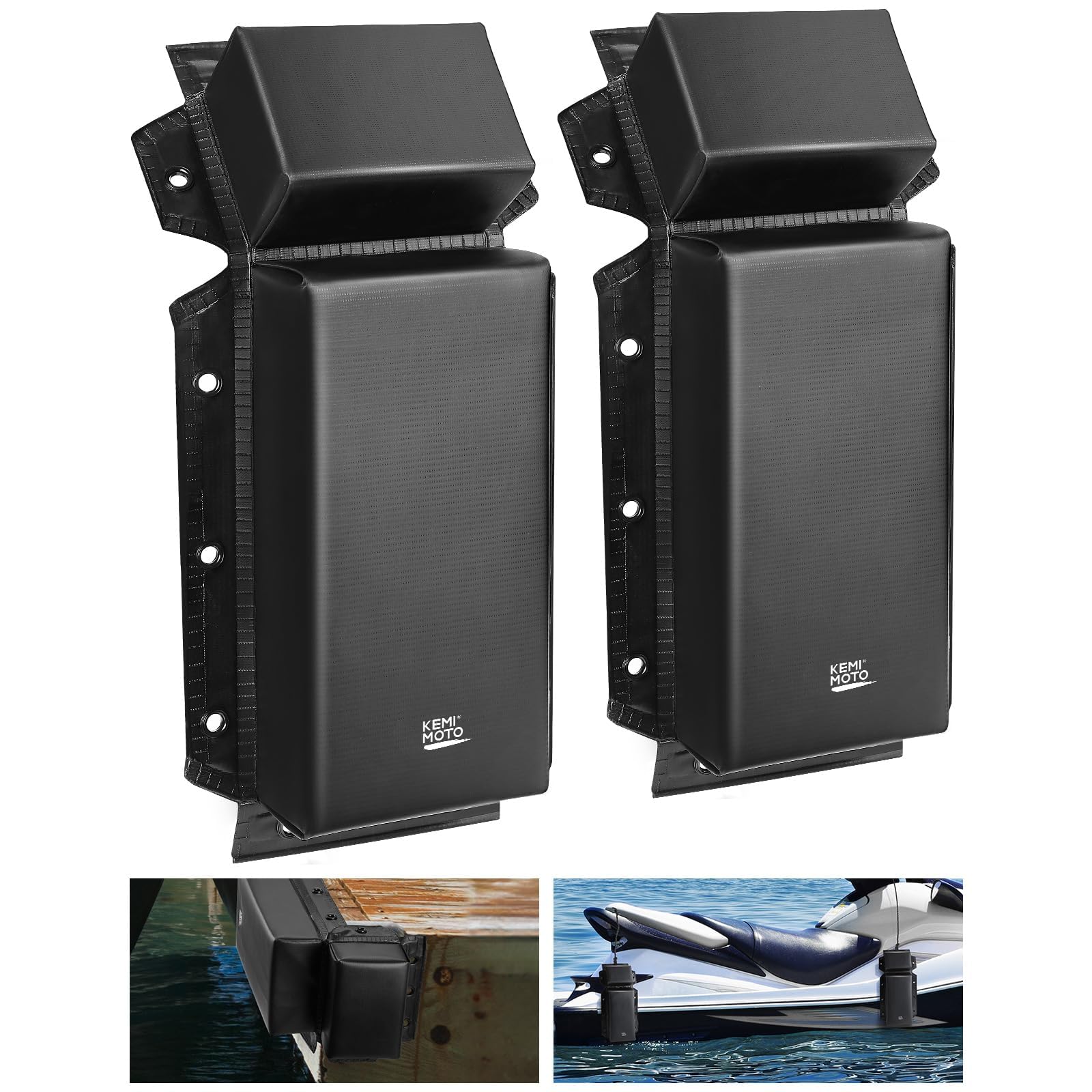
If you run a jet ski or a small low-profile boat, the dock is the enemy. This two-pack is built for exactly that: high-impact closed-cell foam that never needs air, so there is nothing to leak and nothing to pump. The two-part design — one large and one small piece — lets you fit it to either the hull or the dock, and ropes run through the holes for hanging. Screw it down horizontally, or loop the ropes through and hang it.
The boat-length rating matters if yours is bigger than a personal watercraft: KEMIMOTO lists these up to 25 feet, but on a full-size boat they are small. Customers note they seemed larger in the photos than in person, and one flat declined to keep them because they were too small for a permanent dock fixture. The spacing guidance is worth following — two per jet ski, or one for every 10 feet of boat length — because a single small bumper on a long hull leaves gaps.
There is a durability caveat for the wrong application. In a covered dock with no lift, where a boat repeatedly bumps the same spot, one owner noted the grommet flaps tore from repeated impacts — and flagged that it may have been the wrong application. On a lift or a personal watercraft, the load is different and the foam holds up. For a jet ski slip or a jon boat at the ramp, this set does its job and stays where you put it.
The real-world read: owners keep repeating the same theme — these fold over the gunwale of a low jon boat or a jet ski and stay put, exactly where they are needed.
Size honestly matters: rated for boats up to 25 feet, but they run small on a full-size hull, so this is a personal-watercraft and small-boat pick, not a large-cruiser one.
Best matched to: jet ski owners and low-gunwale jon boat operators who want a fold-over foam bumper with zero inflation fuss.
Not your pick: if you tie a 24-foot cruiser against a concrete wall and need cushioning across a long hull — upsize to a longer foam fender.
4. JYINCPED Low Freeboard Boat Fenders
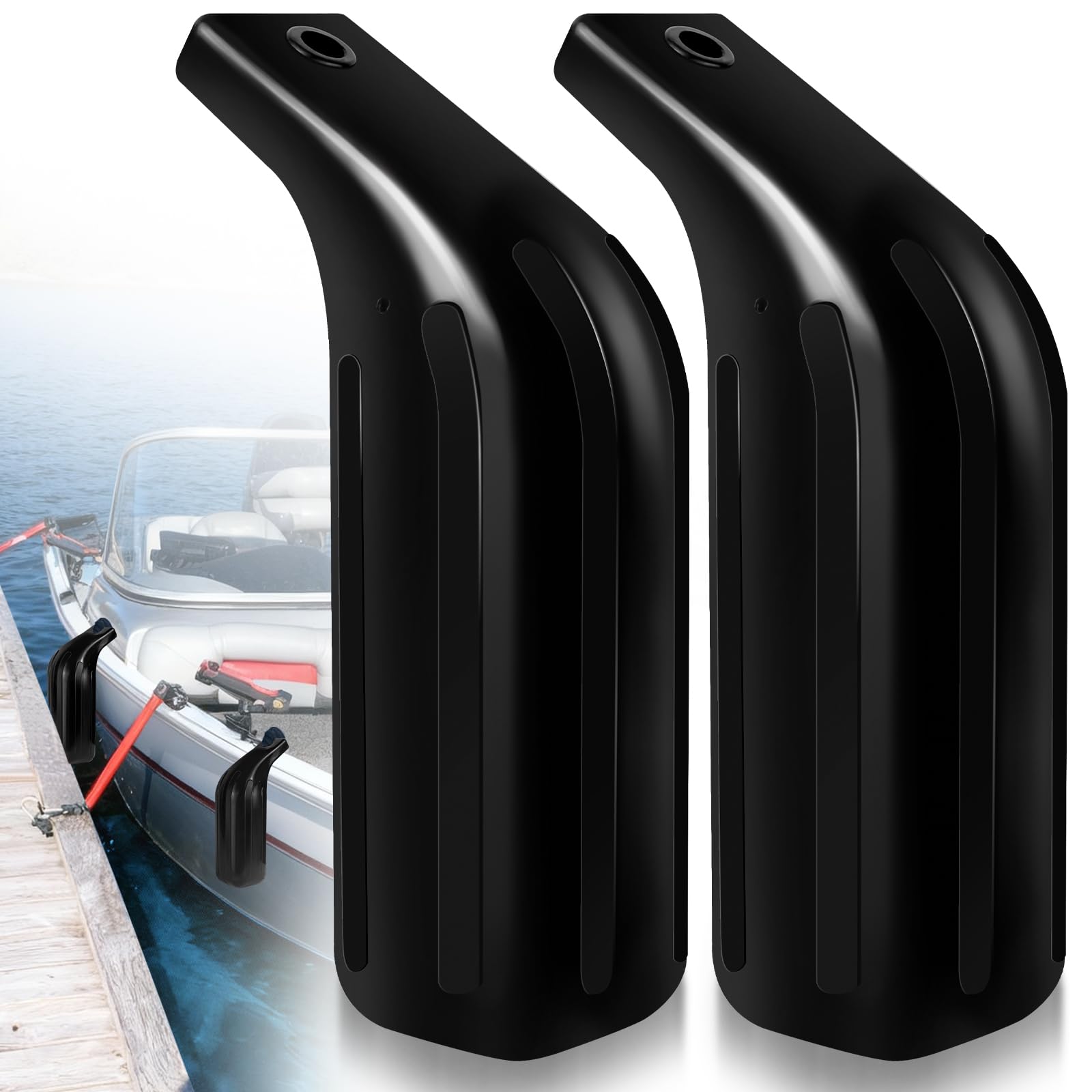
The curved flat fender built for hulls that sit low and try to slide under the dock.
Bass boats, ski boats, bay boats, and shallow-hull jet boats all share the same problem: sit low enough and the dock rides up over the rub rail. This fender is shaped to fix that. It measures 5 inches by 16 inches, molded with a curve that keeps it seated against the hull instead of rolling out of position, and it pads the sides, the rub rail, and the gunwale in one piece. The marine grade vinyl is built to shrug off UV rays and seawater corrosion, and it softens the impact between hull and dock.
Owners keep coming back to the same point: it stays where you tie it and does not spin away like a round fender. On a shallow-hull jet boat, a pontoon, and an 18-foot center console, the recurring theme is the same — tied to a cleat, tied to a dock cleat, it holds and protects. It comes with a molded needle-nose inflation valve for quick fill or deflation, and an eyehole at the bent end for the line. You get two fenders per pack, and shoppers note the price runs about half what a comparable name-brand fender costs.
If there is a limitation, it is simply that these are not meant for big-boat docking. The pair suits low-profile hulls perfectly; a 28-foot cruiser with high freeboard would need a larger, deeper cushion. For bass boats, jet boats, and other shallow hulls, its curved 5″ x 16″ profile keeps the dock from riding over the rub rail: 4.7 stars across 112 ratings.
Worth Buying For
- Curved 5″ x 16″ profile seats against low gunwales and resists rolling out of place.
- Marine grade vinyl rated for UV and seawater exposure.
- Fits bass boats, ski boats, bay boats, and shallow-hull jets.
Set Your Expectations
- Two per pack — a longer hull needs more than one set for full coverage.
- Not intended for large, high-freeboard cruisers.
Reach for these: shallow-hull and pontoon owners whose rub rail keeps getting caught under the dock edge.
Overkill avoided: if your boat has tall freeboard and a high rub rail, a curved low-freeboard fender solves a problem you do not have.
5. Ehaho EVA Boat Fenders
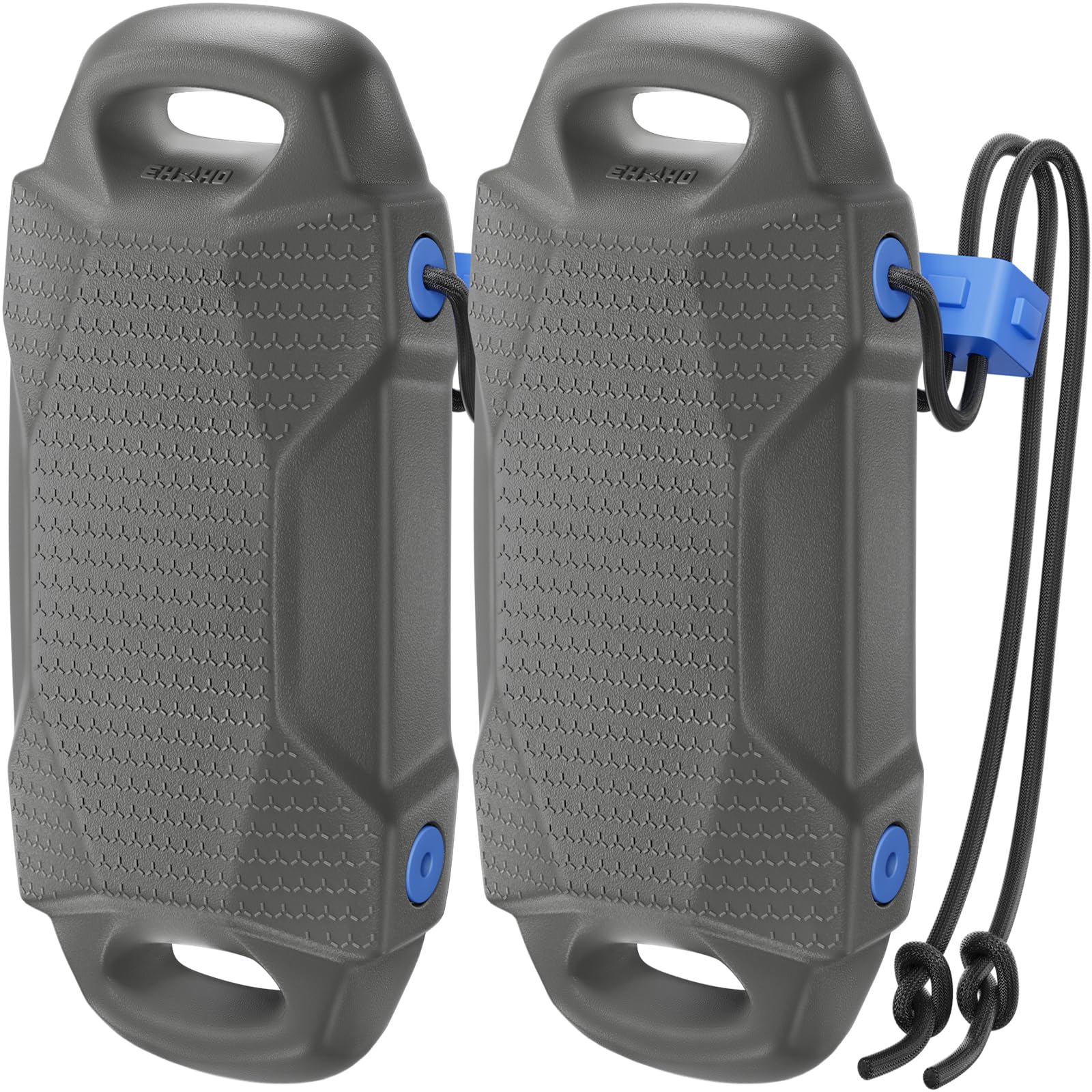
The X-back foam fender that hangs in seconds and never needs a pump.
Ehaho solves the two annoyances that come with every fender: knotting rope and adding air. The body is EVA foam — a dense, rubbery closed-cell foam — with an X-shaped face and a multi-grid support structure on the back that spreads the impact out instead of taking it in one spot. It needs no inflation at all, and it resists UV rays and seawater corrosion without the cracking you get from cheap PVC.
The included rope handles the mounting. It is a reinforced extra-long nylon rope with an integrated locking line, so you hang it vertically or horizontally through either set of holes and adjust the length to suit the dock — no complicated knots. At 17.2 inches long, 8.1 inches wide, and 4.5 inches tall, it is rated for boats 15 to 25 feet. The spacing guide says one fender for every 10 feet of boat length, and for boats under 30 feet, at least three fenders for full coverage.
The grip is the real reason people keep these around. It stays put and does not roll — a fender that spins away from the hull is useless no matter how big it is, and this one holds its position from cleat or dock post. Owners also note it stores compactly on the boat and does not mar the hull when it rubs. Reviewers point out it covered a docked boat in choppy water without leaving marks on the hull.
What it does well: the four-hole, double-handle design hangs vertically or horizontally and locks in place without a single knot, and the extra-long rope adjusts to different dock heights.
What to weigh: the size suits boats 15-25 feet, so if you want one fender to cover a larger boat, you will need several to reach full coverage.
Pick this if: you want a knot-free, pump-free fender you can hang and adjust in seconds at any dock.
Look past it if: you prefer an inflatable you can tune softer or harder for custom cushions.
6. AWEMUFA Boat Fenders
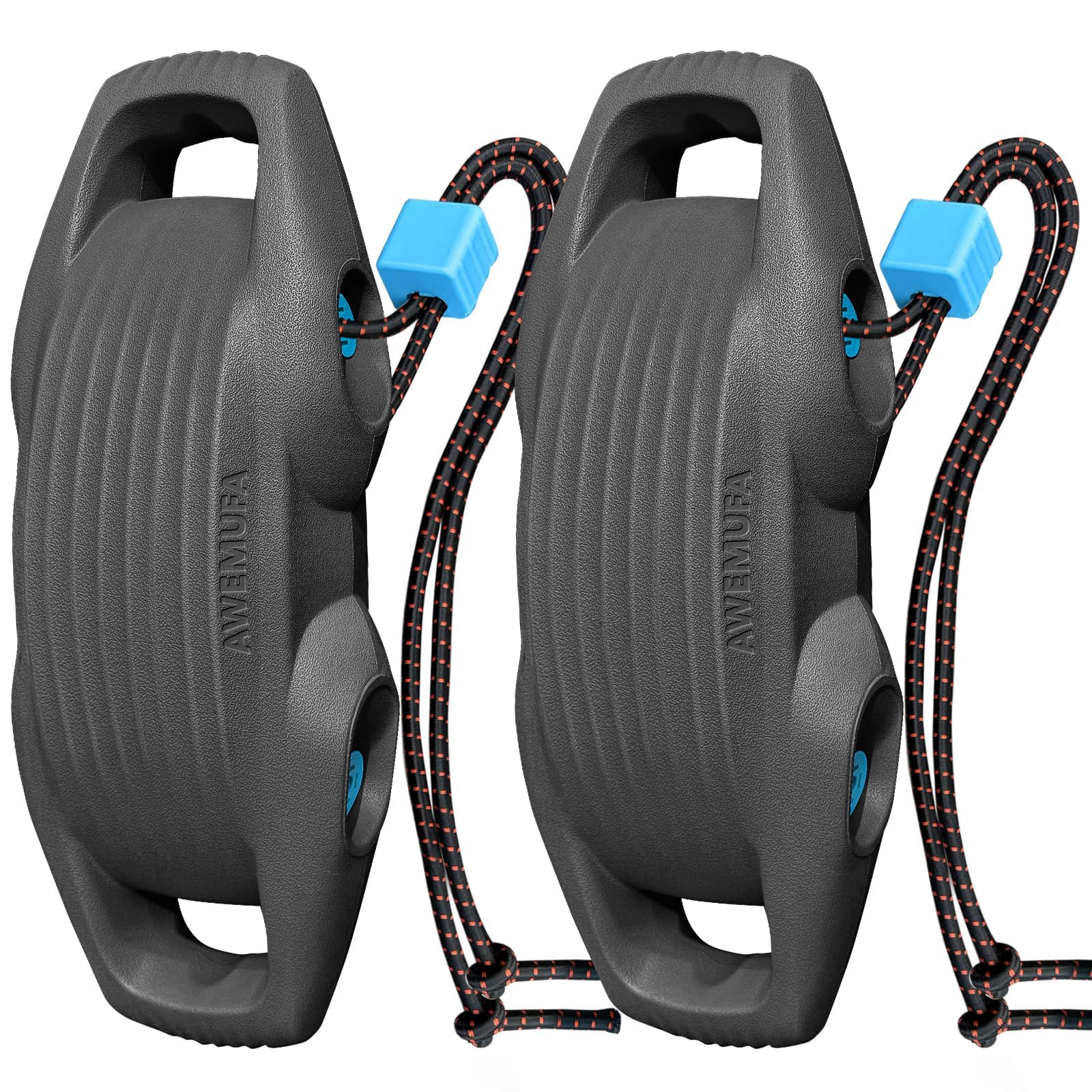
A wedge-shaped foam fender with an automatic locking strap — no knot tying, ever.
AWEMUFA approaches the problem differently. This fender is built from EVA shockproof foam in a wedge shape with a streamlined exterior, and the wedge is the point: instead of hanging loose and bouncing, it sits flat against the hull and stays there. Each fender measures 17.12 inches by 8.27 inches, large enough to cover a real contact strip on a pontoon, bass boat, or fishing boat.
The install is where it shines. Instead of the knots every traditional inflatable fender demands, the wedge sits flat, the extra-long strap runs over the rail, and a built-in automatic locking system grabs it. There is no knot to learn and no fender bouncing around during use. The mounting point adjusts up or down so you can set the height just where your hull meets the dock.
The one thing to know is that the flat-fit design has an ideal size window. Some buyers find the fenders perfectly proportioned, while others find them a touch small for their hull. AWEMUFA recommends one fender for every 10 feet of boat length, and at least three for boats under 30 feet, which is a fair starting point for full coverage. Well made, easy to deploy with the adjustable line, and it stows compactly — a practical choice for someone who wants the fender to stay flat instead of swinging.
What Earns Its Place
- Integrated automatic locking system removes knot tying entirely.
- Wedge shape stays flat to the boat and resists bouncing during use.
- Adjusts up or down to suit different rail heights.
The Catch To Consider
- Fit varies — some buyers find the 17-inch size small for larger hulls.
- Needs three or more fenders on boats under 30 feet for full coverage.
Made for: owners who hate tying knots and want a fender that locks onto the rail and holds flat.
If it is not you: bigger hulls may want the larger KEMIMOTO fender instead — this one favors pontoon and bass-boat scale.
7. KEMIMOTO Upgraded Boat Fenders

Closed-cell foam shaped for low freeboards — no air to leak, no seam to fail.
This is the larger of the two KEMIMOTO foam sets, and it fixes the small-size complaint that dogs the jet ski version above. These fenders measure 17 inches long by 8 inches across and are rated for boats 15 to 25 feet — the same length band as the top Seachoice pick, but in a solid foam body rather than an inflatable one. There is no air inside to leak, and the cross-linked closed-cell foam is built not to degrade under prolonged sun exposure.
Owners consistently come back to the same trait: it stays where you place it. The integrated strap loops over higher attachment points and locks, and the whole thing fits snugly against a low gunwale instead of bouncing. The recurring note is that getting the right rope length takes a little trial and error — too long and the fender will not lay flat, too short and you need a new rope. Once you dial it in, it works, and owners deploy it on flat-hull boats, pontoons, and bow riders specifically because it sits flush.
Size is the honest limitation. Even at 17 inches, some owners find it smaller than expected on a big hull. The guidance is one fender for every 10 feet of boat length, and no fewer than three on boats under 30 feet — which is worth following, because skimping on count leaves gaps no single fender can cover. For a low-freeboard boat that needs flat, no-fuss coverage, it is a strong, durable pick.
Why it earns the rank: owners describe sturdy, pliable rubber that does not move, with an adjustable bungee-style rope that fits different boat heights.
What to accept: the 17-inch body is smaller than some buyers picture, and the rope length takes a couple of tries to dial in before it lies flat.
Choose it when: you want the low-freeboard flat fit of foam without any inflation step, on a boat 15-25 feet.
Then move on if: you tie a 26-foot-plus boat and need the extra coverage of the Hull Hugr below.
8. Dreizack Boat Fenders 4 Pack

Everything you need to protect a pontoon in one box — four fenders, ropes, pump, bag.
If you are starting from nothing, this kit removes the shopping trip. You get four fenders, four 3/8-inch nylon ropes at 5 feet each, four inflating needles, one storage bag, and one air pump. The fenders are rotomolded from marine vinyl — the same process that gives a fender an even, strong wall — with a 3.8mm-thick PVC body and an oval profile that adds shock and abrasion resistance. They are UV and chemical resistant, so salt water and boat cleaners will not discolour them.
The double-hole reinforcement molding lets you hang them vertically or horizontally, so they fit whatever rail you have. Inflation takes about 35 seconds per fender, which means a full set is done in a few minutes — no pump assembly, no fuss. Four fenders also means you can cover a longer hull: with four on hand, a 30-35 foot boat can run one at each key contact point.
A couple of honest notes. The supplied lines are not the standout — they unravel when spliced, even with melted ends, so many buyers swap in their own rope. And a small number of fenders arrive not holding air perfectly. The majority inflate and hold without trouble; if one does not, it is worth a quick check before your first trip. For the price of a four-pack with a pump included, it is the most complete package here.
Why It Works
- Four fenders, four ropes, four needles, a storage bag, and an air pump in one purchase.
- 3.8mm-thick marine vinyl with an oval shape for shock and abrasion resistance.
- Fast inflation — a full set is ready in minutes.
Know Before You Buy
- Included ropes are on the thin side; consider swapping for sturdier line.
- A few units arrive losing air — check them before the first trip.
The full-package pick: new boat owners who want four ready-to-hang fenders plus a pump without buying anything else.
Not the one for: someone who already owns fenders and just wants a single spare pair.
9. HULL HUGR Marina Bumper
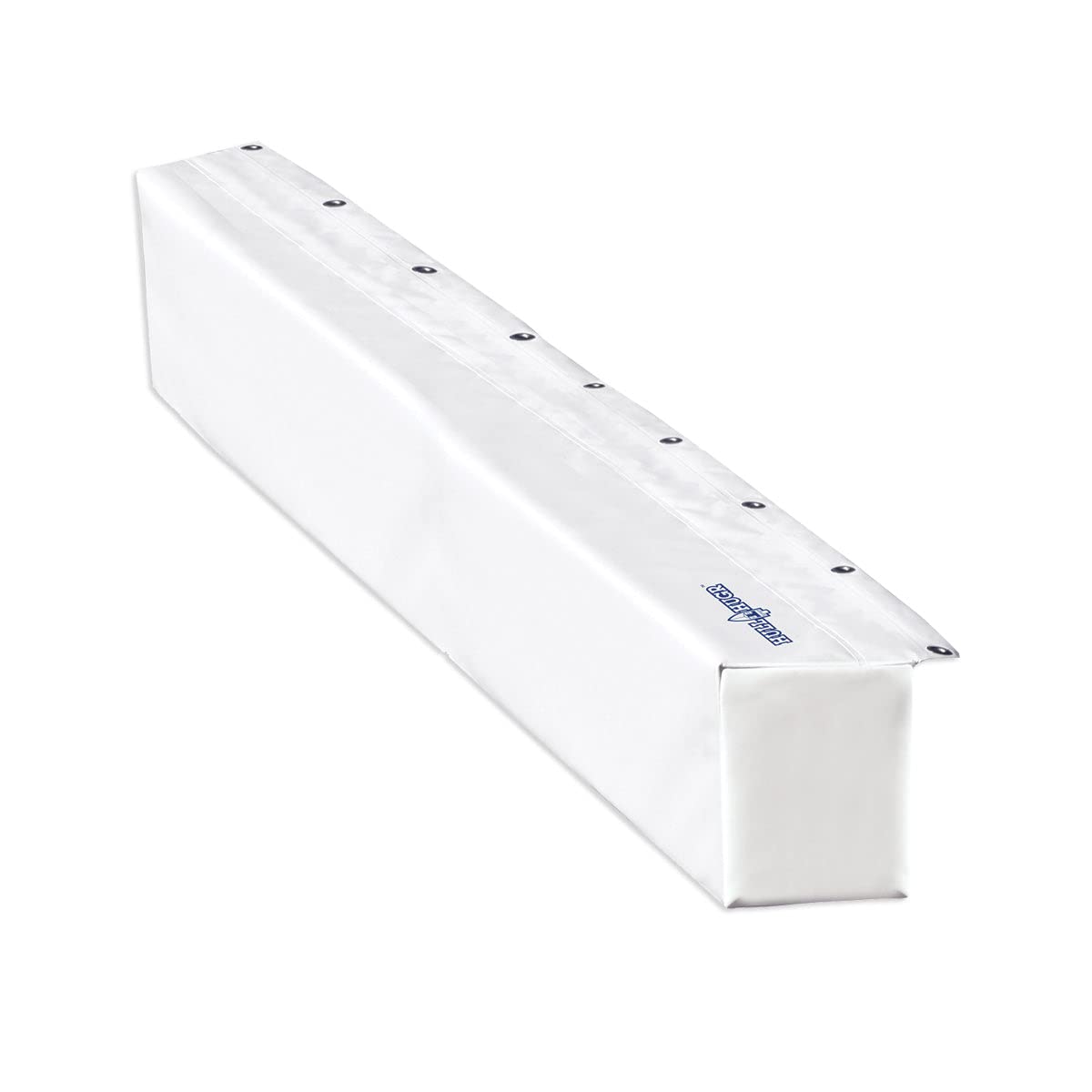
A four-foot commercial-grade bumper that barely notices a rough landing.
This is the one built for marinas and heavy use. At 48 inches long by 8 inches deep by 6 inches tall, it pads a huge stretch of dock edge in a single piece. The cover is a UV- and tear-resistant vinyl and polyester tri-laminate — three bonded layers — over high-density closed-cell foam, so it is padded rather than hollow. Stainless steel grommets run along the full length for screwing it to the dock edge, and the whole thing is rated commercial grade.
Owners deploy it in the conditions that find out whether a bumper works. It cushions the impact when a boat comes in on its motors to counter a heavy tide, protects a 20-foot inboard, and does not leave the black marks that old rubber bumpers do. It stands up to a hard landing and still looks clean after.
The practical notes are worth knowing. The included screws get mixed reviews — several buyers swap in their own hardware — and it takes a few extra attachment points beyond the grommets to mount it truly flat on a dock corner. The tri-laminate cover is built tough, but it works best when screwed to a solid dock face rather than flexed around a sharp corner. For a permanent home or commercial slip, its 48-inch tri-laminate cover over closed-cell foam holds up: 4.7 stars across 695 ratings.
Where it earns its keep: a full four feet of padded coverage and stainless grommets down the length make it ideal for a dock that takes a pounding.
The hardware reality: the supplied screws disappoint, so plan to supply your own, and add extra attachment points for a truly flush fit.
Built for: permanent dock owners and commercial marinas that want one long, tough, always-there padded edge.
Better served elsewhere: if you trailer your boat and need fenders that travel with it, a hanging foam set makes more sense.
Understanding the Specs
Boat length rating
Every fender lists the feet-of-boat range it is designed for, like “15-20 feet” or “boats up to 25 feet.” This is the manufacturer’s calibration for how much cushioning force one fender provides, so it is the fastest filter to apply. If your boat sits at the top of the range, buy the next one up. Most makers also publish a spacing rule — commonly one fender for every 10 feet of boat length — so a 22-foot hull wants at least two fenders, and three for full confidence.
Freeboard and shape
Freeboard is how much hull sits above the waterline. Low-freeboard boats — bass boats, jon boats, shallow-hull jets — ride close to the water, so a round inflatable can roll up and let the dock edge over the rub rail. Flat, curved, low-freeboard fenders and wedge shapes stay seated against a low hull. High-freeboard boats can use either shape. Matching the fender shape to your freeboard is the difference between protection that holds and protection that slides away.
Inflation versus foam
Inflatable vinyl fenders arrive flat, inflate in under a minute, and can be tuned by air pressure. Their service life depends on the valve and seams holding. Solid fenders use closed-cell foam or EVA — a dense rubbery foam — that never goes flat and carries no valve to fail, but they are bulkier to stow and more expensive per unit. If you want zero maintenance, foam wins. If you want compact storage and tunable cushioning, inflatable vinyl wins.
Mounting method
There are two homes for a bumper: on the boat or on the dock. Hanging fenders use a rope or strap looped over a cleat or rail, so they travel with you to any slip. Screwed dock edging attaches permanently along the dock’s edge and protects the same spot on every approach. Foam wedge fenders often come with locking straps that hold them flat without knots. Pick the mounting style first, then match the size.
FAQ
How many boat bumpers do I need for my dock?
Will a round fender work on my low freeboard boat?
What size boat bumper fits a 20-foot boat?
Are inflatable or foam boat bumpers better?
Can I leave boat bumpers on the dock permanently?
How long do boat bumpers last in the sun?
Do boat fenders need to be inflated hard or soft?
Will a dock bumper scratch my boat hull?
What is the difference between a boat fender and a dock bumper?
Can small foam bumpers protect a large boat?
Final Thoughts: The Verdict
For most boaters, the boat bumpers for dock winner is the Seachoice Twin Eye Ribbed Fender Kit, because it pairs roto-molded marine grade vinyl with the fender lines most kits make you buy separately, all in a single package rated for boats 15-20 feet. If your boat sits low and the dock keeps riding over your rub rail, grab the JYINCPED Low Freeboard Boat Fenders, whose 5″ x 16″ curved shape stays seated against shallow hulls. And for a permanent slip you would rather pad once than fiddle with every trip, the HULL HUGR Marina Bumper lays 48 inches of commercial-grade cushion along the entire dock edge.
The Seachoice kit’s 4.8-star rating across 700+ ratings makes it the safest single buy here for a 15-20 foot hull. Match your boat length to the printed range first, then decide whether your bumper should hang from the hull or live on the dock — get those two choices right and the dock stops leaving its mark on your gel coat.
How We Picked
We do not accept paid placement. Every pick is matched to a real buyer and a real use-case; we do not hands-on test units.
Sources & Methodology
Specifications: manufacturer listings and product documentation. Review insights: verified customer reviews, as of September 2026. Pricing: not shown on this page (it changes often); check the current price via the retailer link.
As an Amazon Associate, Gadgets Feed earns from qualifying purchases. This does not affect which products we feature.