
Our readers keep the lights on and my morning glass full of iced black tea. As an Amazon Associate, I earn from qualifying purchases.
Specs are compiled from manufacturer listings and verified buyer reviews and can change over time — please confirm the key details on the product page before buying.
If you camp within earshot of anyone else, the loudest thing in your site is usually your own generator. That is the whole reason the inverter style exists: it produces household-quality power while keeping the noise down to conversation level instead of lawn-mower level. This guide sorts nine quiet inverter generators by what actually matters once you own one — measured decibels at distance, clean power for sensitive gear, running watts against your real appliances, and carry weight.
I’m Min — the founder and writer behind Gadgets Feed. This guide is built by comparing the manufacturers’ published specifications and the patterns across verified customer reviews, so you get each pick’s real strengths and trade-offs instead of marketing spin.
Quiet camping power has one real currency: decibels at distance, and everything else is secondary. If you want the short version, the Honda EU2200i is the safest bet — 4.7 stars and the numbers back it up. But the right match for you might be a lighter, cheaper unit if you’re only powering a coffee maker and phones. Keep reading to see which quiet camping generator matches your site and your gear.
Our Picks at a Glance

How To Choose The Best Quiet Camping Generator
Most first-time buyers walk into this category asking “how many watts do I need” and stop there. The spec that actually decides whether you enjoy your trip is the noise rating at distance — usually quoted as something like 53 dBA at 23 feet — because the difference between a whisper machine and a loud one is the difference between a happy neighbor and a complaint. Once you have that sorted, the rest falls into shape fast.
Start with the dBA-at-distance number, not the marketing word “quiet”
Every generator here is marketed as quiet, so ignore the adjective and look at the number that follows it. Manufacturers list noise as decibels at a set distance, often 23 feet, and the spread across this list runs from a backpack-friendly 53 dBA up to 64 dBA. A lower figure means quieter at your campsite and the campsite next door.
A lower dBA reading is a compound benefit. For every three decibels you drop, that is the difference between a light hum and a clearly audible engine tone across the distance. Chasing the lowest number you can afford is one of the smartest moves in this category.
Match running watts to the appliances you will actually run
Look at two figures on every label: running watts (what it produces steadily) and starting watts (the brief surge it handles when a motor kicks on). A fridge, a small air conditioner, or a coffee pot each pull a big initial punch before settling to a lower continuous draw. If your intended gear’s start-up surge exceeds the unit’s starting watts, you will trip it constantly.
This is where the buyer’s real math lives. Running a small air conditioner on a 2500-watt unit works comfortably for some owners and strains for others; a 4000-watt unit gives noticeably more headroom for the same appliance. Match the number to your specific camping routine rather than a “more is better” reflex.
Weigh the carry burden before you fall in love with the specs
A generator that lives in your truck bed and never moves is a different purchase to one you hoist onto your shoulder. Weight in this category ranges from the high-30s up to roughly three figures, and that difference decides whether one person can move it alone. If a partner, an older parent, or you solo need to lift it, that gap matters more than another few hundred watts.
Quick Comparison
| Model | Best For | Noise | Running Watts | Weight | Amazon |
|---|---|---|---|---|---|
| Honda EU2200i 2200 Watt Inverter Generator★ Best Overall | The proven all-rounder | 48 to 57 dB(A) | 2200 watts | 46.5 pounds | Amazon |
| PowerSmart 2500 Watt Portable Inverter GeneratorBest Value | Budget-friendly home backup | 59 dBA at 23ft | 1900 running watts | 39.7 pounds | Amazon |
| Pulsar PGD40ISCO 4000W Portable Inverter GeneratorTop Performer | Running an RV A/C on a budget | 59 dB | 3200 rated watts | 47.3 pounds | Amazon |
| Champion 2500-Watt Ultralight Portable Inverter Generator | One-person carry camping | 53 dBA at 23 ft | 1850 running watts | 39.7 pounds | Amazon |
| maXpeedingrods 4000 Watt Inverter Generator | RV power with app monitoring | Super Quiet | 3200 running watts | 48.5 pounds | Amazon |
| WEN 56360i 3600-Watt Inverter Generator | RV-ready value | Super Quiet | 2900 rated watts | 46 pounds | Amazon |
| WEN 56477i 4800-Watt Inverter Generator | Whole-essentials home backup | Super Quiet | 4000 rated watts | 72.7 pounds | Amazon |
| Champion 4000-Watt RV Ready Inverter Generator | Light big-output RV unit | 64 dBA at 23 feet | 3000 running watts | 48.1 pounds | Amazon |
| Westinghouse iGen5000c Inverter Generator | Remote-start convenience | As low as 52 dBA | 3900 rated watts | 105.8 pounds | Amazon |
In‑Depth Reviews
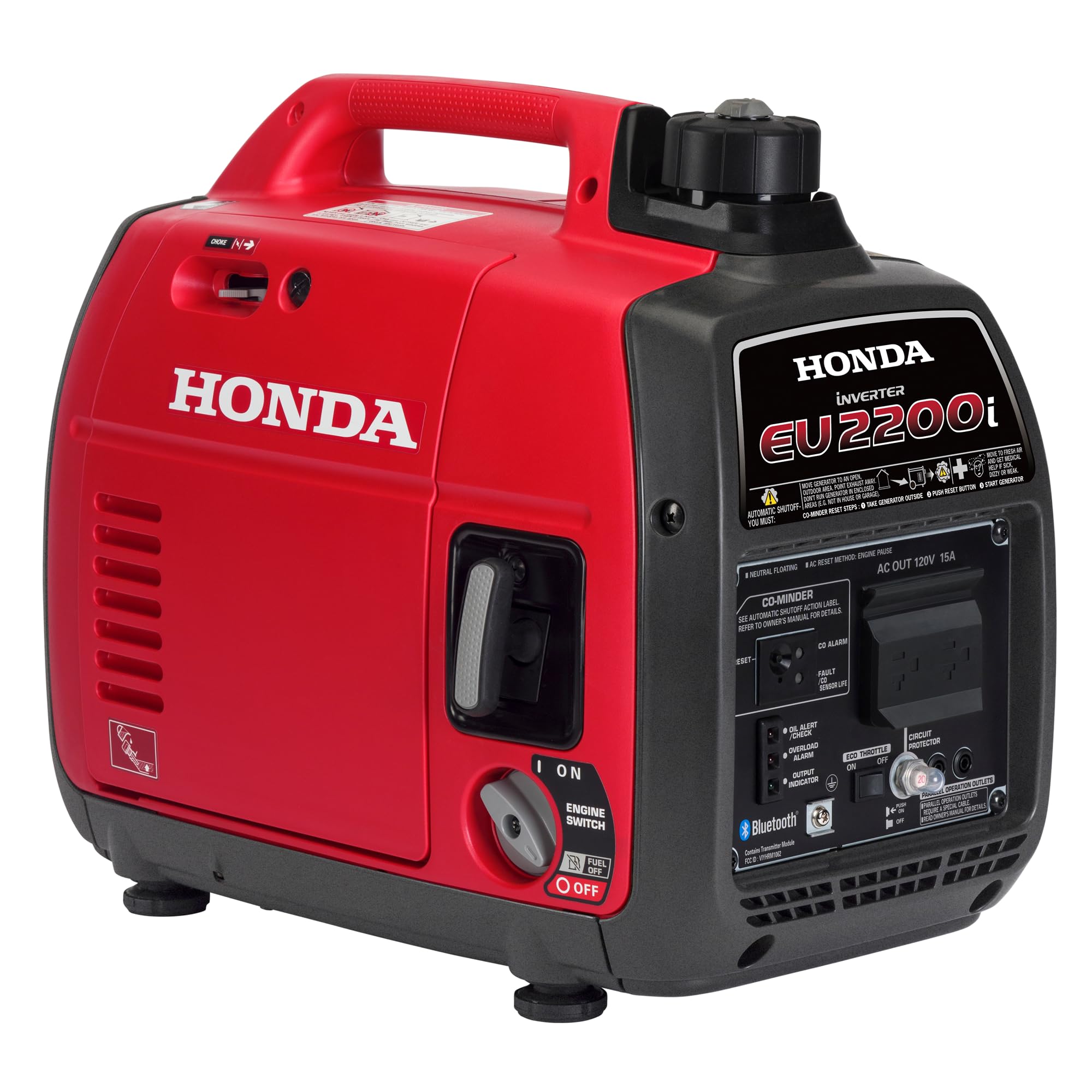
1. Honda EU2200i 2200 Watt Inverter Generator (EU2200ITAN)
Our pick — over 4.5★ from 3,000+ verified ratings; the strongest balance of quality and price.
The quiet-generator benchmark — 48 to 57 dB(A) is softer than a normal conversation at the fire pit.
If you want the generator that removes the whole worry, this is the one. Honda rates the EU2200i at 48 to 57 dB(A) — decibels measured on the A-weighted scale, which mirrors how the human ear hears mid-range sound. In plain terms, at its lowest it is quieter than two people talking across a picnic table. Out on a campsite, that means you can keep a normal voice at the fire pit instead of raising it over a drone.
This is where it separates from cheaper options. The EU2200i runs a 121-cc four-stroke engine, and its inverter technology cleans the current to a level safe for computers — buyers report it happily runs an 11,000 BTU RV air conditioner and small appliances. Honda’s CO-MINDER system (a carbon monoxide sensor that trips when exhaust builds up near a tent or camper) shuts the unit down automatically. The companion app adds Bluetooth monitoring and remote stop, plus service reminders. A 3-year residential warranty covers it, and the engine is the well-worn Honda recoil-start design that fires up in a pull or two.
Against the lighter PowerSmart, the numbers cut both ways. Honda’s 46.5 pounds and 21″L x 20″W x 13″H footprint is heavier and bulkier than the PowerSmart’s 39.7 pounds, though the chassis still fits a truck bed or the back bench of an RV. The recurring trade-offs are small: no electric start, an oil-fill point tilted in an awkward spot, and a 12-volt charge port that owners caution is unregulated — fine for a jump, risky for a battery you care about. Honda skips a fuel gauge and hour meter, so you track tank level by feel.
What wins people over
- 48 to 57 dB(A) at conversation volume — quiet enough for a campsite at dusk
- Inverter-cleaned power safe for laptops, CPAP units, and RV A/C
- CO-MINDER auto-shutdown removes a real safety blind spot for tenting
- Bluetooth app for remote stop and service reminders
Where it asks patience
- 46.5 pounds with no wheel kit means a straight lift, not a roll
- No electric start — you pull it every time, cold morning or not
- 12-volt charge port is unregulated; skip it for sensitive batteries
Reach for this if: you want the safest, quietest, most-proven 2,200-watt-class unit and don’t mind the price tag.
Look elsewhere if: you need one-person rolling convenience or an electric push-button start — that is not this machine.
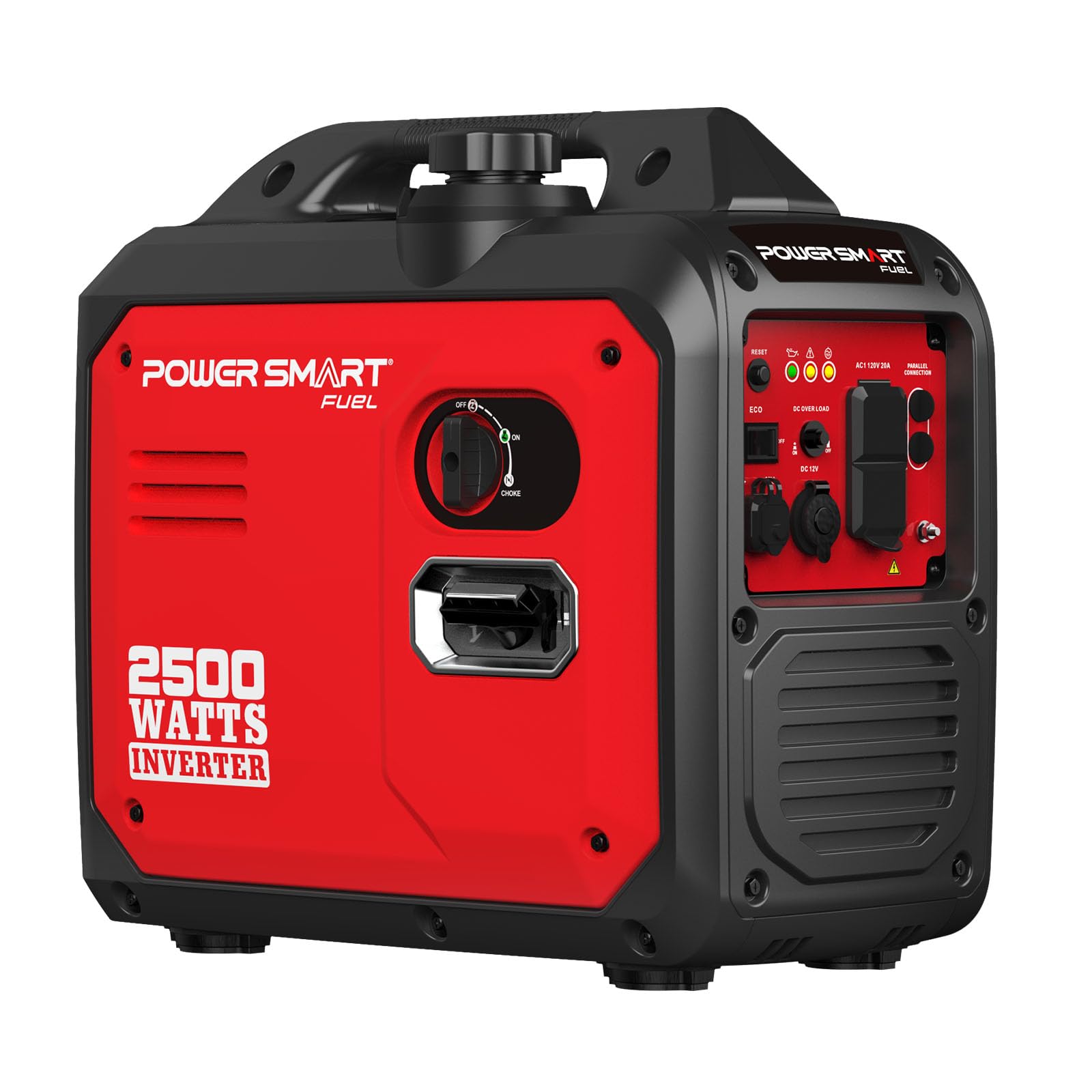
2. PowerSmart 2500 Watt Portable Inverter Generator for Camping
39.7 pounds with 2500 starting watts — the budget pick that powers the fridge and the phones.
The PowerSmart’s headline number is its 2500 starting watts and 1900 running watts, but its standout quality is efficiency. Its 1.06-gallon tank is rated for 7.5 hours at 25% load, and owners consistently report stretching a full tank much further than the spec sheet implies. It is one of the lightest units here at 39.7 pounds and a 20.5″L x 12.8″W x 21.6″H frame, which puts it squarely in easy-solo-carry territory. Its inverter design produces what PowerSmart calls clean power — safe enough for phones, tablets, and a CPAP.
Quiet operation is rated at 59 dBA at 23 feet — audible but far from intrusive on a campsite. The control panel is generous for the price: a 120V 20A duplex household outlet, a 12V 8A DC port, two 5V 2.1A USB ports, and an Eco mode that drops the engine revs when the load is light. Cold Start Technology and a low-oil shutdown round out the convenience.
Moving from the Honda down to this unit, you trade 300 running watts but pick up a 6.8-pound weight saving and a friendlier price. The recurring gripe is honest: a couple of owners find the stated wattage optimistic and report tripping on larger loads like a full-size A/C, so this is not a heavy-appliance unit — treat the running watts as your real ceiling. The 2-year limited warranty and free lifetime phone support are a fair safety net for the price tier.
What it gets right: cheap, light at 39.7 pounds, and genuinely stingy on fuel — 7.5 hours at quarter-load on a single gallon-plus tank.
Fit check: if your camping load is a fridge, a coffee pot, phones, and a fan, this covers it. If you expect it to carry a large RV A/C alone, choose a bigger unit.
Great fit for: tent campers and weekend RVers who want the most generator for a lean budget.
Skip if: your checklist includes running a high-wattage appliance like a full-size A/C as a hard requirement.
3. Pulsar PGD40ISCO Ultra Light Quiet 4000W Portable Gas Inverter Generator, White
A 4000-watt inverter at 47.3 pounds — enough muscle for a 13,500 BTU RV air conditioner.
The Pulsar refuses the usual trade-off between power and portability. It produces 4,000 peak watts and 3,200 rated watts — enough that it can personally run a 13,500 BTU air conditioner with a soft-start — yet the whole unit weighs 47.3 pounds. That is remarkable for a 4000-watt-class box, and comparable to some 2,200-watt units. Its 145-cc four-stroke engine drives a 1-gallon tank rated for 4 hours at half load.
Where it outperforms the lighter PowerSmart, it does so by a wide margin. The Pulsar’s engine displacement is 145 cc against the PowerSmart’s 79.8 cc, and the chunky engine is the reason for its higher wattage ceiling. The trade is weight: the Pulsar is 47.3 pounds versus the PowerSmart’s 39.7, and its 18.9″L x 11.4″W x 17.3″H chassis is taller, so it takes more trunk space. Owners haul it in one hand and still run travel-trailer appliances simultaneously. Quiet operation rates at 59 dB, and automatic voltage regulation protects electronics from dirty current.
The honest limits are real but sit inside an otherwise strong unit. Amazon’s own buyer summary tags both reliability and noise as mixed — the correct way to read that is “most do great, a few do not” — so it is a fit-note, not a warning. A few owners find the Pulsar notably louder than a Honda under load, and one engine ran 36 hours straight powering a 13,500 BTU A/C plus a microwave, though the same reviewer called it twice as loud as a Honda EU2000. It is parallel ready, which lets you chain two for higher output.
The Pulsar’s real claim: 4000-class power at 47.3 pounds — a rare combination that puts big RV A/C within one-person reach.
Manage expectations on noise: 59 dB puts it in the middle of this list, and heavy loads push it into “audible in the next campsite” territory.
Worth it for: travel-trailer owners who need to run one big A/C and want to haul the generator alone.
Not the pick for: tent campers chasing the very lowest decibel reading — lighter, quieter options exist above.
4. Champion 2500-Watt Ultralight Portable Inverter Generator

At 53 dBA from 23 feet, this is the quietest unit in the roundup by a clear margin.
For the camper who cares about neighbor relations above all else, this is the pick. Champion rates the 2500-Watt Ultralight at 53 dBA from 23 feet — the lowest noise figure in this list, and a meaningful step down from the mid-50s and above where much of the class sits. The engine runs 2500 starting watts and 1850 running watts with up to 11.5 hours of runtime at lighter loads. Its 79-cc four-stroke powerplant sips fuel quietly, and a CO Shield carbon monoxide auto-shutoff system cuts the motor if exhaust gathers in a confined space. The included 120V 15.4A duplex outlet and 12V automotive-style outlet cover small electronics and lighter camping appliances.
Weighing 39.7 pounds with a 17.6″L x 12.6″W x 18.1″H frame, it sits at the lightest end of this roundup — the same weight as the PowerSmart above, but with a much lower noise rating. The trade is running watts: 1850 is the smallest headroom in this list, so a full-size A/C or a vacuum cleaner will push it. The parallel kit lets you add a second Champion 2500-watt unit for double the output, which is the move for buyers who need more kick later. Champion throws in a 3-year limited warranty and free lifetime tech support.
The biggest honest gotcha here is the CO Shield itself. Champion’s carbon-monoxide sensor is a real safety feature, but owners who run the unit in cold, wet, or windy conditions report frequent auto-shutdowns — sometimes within 15 minutes, even outdoors. For a mild-weather camper this rarely triggers; for someone who uses a generator through a windy snow season, it is a real frustration that has pushed buyers to look for a disable option. Weigh that against how rarely you camp in those conditions.
The quietest unit here at 53 dBA, and 39.7 pounds for solo carry
- 53 dBA from 23 feet — the lowest noise rating in the roundup
- 39.7 pounds makes solo carry realistic for most adults
- CO Shield shuts the unit down if carbon monoxide builds
- Parallel-ready for doubling output later
Watch these before buying
- 1850 running watts is the smallest headroom on this list
- CO sensor can nuisance-trip in cold, rain, or high wind
- Only 120V and 12V outlets — no RV-ready TT-30R plug
Choose this if: you want the quietest, lightest 2500-watt unit for tent camping and easy solo carry.
Pass if: you need to run big RV air conditioners or work in constant wet, cold weather that trips the CO sensor.
5. maXpeedingrods 4000 Watt Inverter Generator, Bluetooth App Data Monitor

A 4000-watt RV generator with a Bluetooth app for real-time output, fuel level, and Eco mode.
This maXpeedingrods packs 4000 peak watts and 3200 running watts from a 145-cc engine, but its talking point is the companion app. Through Bluetooth the app surfaces real-time power output, fuel level, voltage, frequency, running time, and — usefully — lets you toggle Eco mode from the couch. It also includes a NEMA L5-30R RV outlet plus an L5-30P to TT-30R adapter, so plugging a trailer in is straightforward. It is a lot of generator for a mid-tier price, and its 18.89″L x 12″W x 17.32″H chassis is compact for the output class.
Against the Honda above, the maXpeedingrods wins on raw capacity — 3200 running watts versus 2200 — and cost. It loses on the finishing details: the app is the star feature but also the recurring weakness, with some owners reporting it becomes buggy or breaks after updates, and there is no oil filter, so maintenance is oil-change-heavy. Owners who run it on propane to avoid carburetor gunk report success at altitude; owners who run gasoline and do careful break-in work report clean, stable power for RV A/C loads. Startup reliability is the single most-discussed area, tagged mixed by Amazon’s own readers — most fire up first pull, some deal with harder starts. If you can do basic maintenance and accept app quirks, the value is high.
A value-first call: on paper, 3200 running watts at a mid-tier price is one of the strongest output-per-tier ratios here.
The caveat that matters: the Bluetooth app is a genuine convenience when it works, but its reliability is the recurring complaint, and the fuel-gauge-by-app idea is only helpful if the connection holds.
Ideal for: RVers who value app monitoring, want RV-ready outlets, and are comfortable with DIY maintenance.
Not for you if: you want a no-fuss, no-app appliance where you just pull the cord and go.
6. WEN 3600-Watt Portable Inverter Generator (56360i)

A 3600-watt RV-ready inverter at 46 pounds with a TT-30R outlet — the pick that fits under a camper bunk.
The WEN 56360i is the answer for campers who want more than 2500 watts and less bulk than a 4000-watt box. It produces 3600 surge watts and 2900 rated watts from a 149-cc engine, delivers clean power for phones and laptops, and carries a 3-year warranty. Owners love the small package: it fits under a camper bunk, and the 46-pound body and 17.9″L x 11.6″W x 19.7″H frame make solo transport realistic. Two 120V three-prong receptacles, one TT-30R RV receptacle, one 12V DC receptacle, and two 5V USB ports cover nearly every camping load.
The fuel shut-off valve is a quiet hero of the design. It burns off the leftover fuel in the carburetor on every shutdown, which is one of the best protections against gummed-up jets in a generator that sits for months. Against the Pulsar above, this WEN runs 2900 rated watts versus 3200 and 149 cc versus 145 — close enough that the choice is really about price tier and the RV-ready outlet. Starting is reliable on one or two pulls; owners note a first-pull start most days. Quiet operation is a frequent praise point, with users reporting it quieter than the air conditioners it powers.
Be honest about the ceiling here: this is not a heavy-duty unit. One owner needed an altitude kit above 2,000 feet — a real note for high-elevation camping — and another reported an overload on a vacuum or microwave. That is a fit-note, not a defect: if your loads include serious tools, you want a higher-wattage model. If your checklist is a camper A/C, a fridge, and a coffee pot, this WEN handles them and starts on the second pull.
Why RVers like it
- TT-30R RV outlet means plugging a trailer in directly
- 3600 surge / 2900 rated watts — real overhead for a small A/C
- 46 pounds and 17.9-inch length fit under a camper bunk
- Fuel shut-off protects the carburetor between trips
Hold the expectations
- Not for high-amperage tools or a full-size A/C plus microwave together
- At elevation above roughly 2,000 feet, an altitude kit is effectively required
- No electric start and no app — a pull-cord-only control panel
Best for: camper and small-RV owners who want RV-ready outlets in a compact, lightweight package.
Look past it if: your trips run at high elevation or you expect to run big power tools.
7. WEN 4800-Watt RV-Ready Portable Inverter Generator (56477i)

Rolls on wheels at 72.7 pounds — the 4800-watt workhorse for a house-worth of essentials.
This WEN is the biggest unit in the quiet roundup that still moves like a portable. Its 224-cc engine produces 4800 surge watts and 4000 rated watts, and it wears onboard wheels plus a telescoping pull handle so the 72.7 pounds rolls instead of lifts. A Watchdog CO Shutdown Sensor automatically turns the generator off if carbon monoxide builds near people — the safety feature you actually want on a big-output machine. Four three-prong 120V receptacles, one TT-30R RV receptacle, one 12V DC receptacle, and two 5V USB ports give it the widest outlet lineup here. WEN backs it with a 3-year warranty.
Owners use it as whole-house-in-a-can. The frequent scene: a multi-day outage where it runs the fridge, freezer, wifi, TV, chargers, and a cappuccino machine, then gets one heavy appliance at a time unplugged in turn to keep the load in range. A pair of 56477i units connected through a Phase Sync Box is reported running an entire house including a 4-ton A/C. Runtime lands around 8 hours per tank under real load. This beats the smaller WEN 56360i on output and outlets, and it beats the Honda on raw capacity — clear wins on this list on both fronts.
The honest catch with a 4800-watt unit is weight and logistics: at 72.7 pounds it is not a carry-in-a-tote machine, even with the wheel kit. The reliability aspect shows mixed patterns — some owners mention hundreds of hours without issue, a couple report premature mechanical problems and slow warranty contacts. If you want a machine you can move to a job site weekly rather than roll around home, a lighter model serves better.
The standout: 4800 surge watts with a wheel-and-handle kit and a CO sensor — the rare big-output unit that’s still road-friendly.
The trade: at 72.7 pounds it lives on a driveway or campsite slab; do not plan to lift it solo out of a truck bed without wheels.
Made for: home backup and big-trip campers who need four-wall appliance power in a rolling package.
Think twice if: you need a hoist-and-carry generator for true solo camping.
8. Champion 4000-Watt RV Ready Portable Inverter Generator

A 4000-watt inverter that stays under 49 pounds — a rare combo of big output and real portability.
Champion calls this one of the lightest 4000-watt inverters on the market, and the numbers support it: just 48.1 pounds with a compact 17.9″L x 11.7″W x 19.7″H frame. It produces 4000 starting watts and 3000 running watts from a 149-cc engine, running up to 10 hours on a tank at moderate load. Its 64 dBA rating at 23 feet is the loudest number in this list, though owners routinely describe it as “quieter than expected” — most of that gap is the heavier load it pulls. It ships with a 120V 25A TT-30R RV outlet, a 120V 20A duplex household outlet with clean electricity under 3% THD, a 12V automotive-style outlet, and parallel-ready terminals. CO Shield auto-shutoff is included, along with a 3-year limited warranty and free lifetime tech support.
As a direct comparison against the smaller Champion 2500-Watt Ultralight, this 4000-watt machine trades a light noise penalty — 64 dBA versus 53 — for a much bigger utility: 3000 running watts versus 1850, and a 25A RV outlet the lighter unit lacks. Owners haul it on campouts and run a 30-gallon air compressor and heavier RV loads without tripping. Weigh-in at 48.1 pounds is remarkably close to the smaller unit’s 39.7, which makes the upgrade the value proposition.
The single most common complaint is honest and simple: the Champion is heavier on noise than the ultra-quiet units at the top of this list. Users also report needing more fuel per hour at high load (~5 gallons per 24-hour day), which is normal for this class. If your priority is a full-size air conditioner plus the ability to shave weight, this is the pick; if you are chasing the lowest decibels, look higher up.
4000 starting watts in a 48.1-pound chassis
- 4000 starting / 3000 running watts in a 48.1-pound package
- RV-ready TT-30R outlet for direct trailer plug-in
- Clean power under 3% THD — safe for sensitive electronics
- CO Shield plus 3-year warranty and lifetime tech support
Know before you buy
- 64 dBA at 23 feet is the loudest figure in this roundup
- Full-load fuel use runs high for this output class
- No electric start — recoil-only on cold mornings
Great for: RVers who need maximum output at minimum weight and don’t need the quietest unit on the block.
Consider options above if: stealth-quiet camping within earshot of neighbors is your top priority.
9. Westinghouse iGen5000c 5000 Peak Watt Super Quiet Inverter Generator

Start it from your key fob and let it run up to 18 hours on quiet power — the luxury pick for RV and home backup.
This is the top of the roundup and behaves like it. The Westinghouse iGen5000c delivers 5000 peak watts and 3900 rated watts, and it is the only unit here with a remote-start key fob in addition to electric and recoil start. It is rated as low as 52 dBA and runs up to 18 hours on a 3.4-gallon tank in Economy Mode — the longest single-tank runtime in this group. The rotating digital data center clearly shows fuel level, power output, remaining runtime, voltage output, and lifetime hours, which covers the anxiety points of using a generator blind.
The convenience angle is the whole point here. Beyond the remote start, a telescoping handle and wheel set make transport workable despite its heft, and the TT-30R 30A RV outlet handles a travel trailer directly. Owners who have taken it past 300 hours report zero performance issues, original spark plug, regular oil changes, and steady output running a fifth wheel plus solar backup. As a comparison to the Champion 4000-watt above, this Westinghouse runs higher peak (5000 versus 4000) and ships with electric start — but it does so at 105.8 pounds, the heaviest unit in this list by a wide margin.
That is the honest price of all the output: 105.8 pounds is a genuine two-person lift. Weight reads mixed in owner reviews — some call it manageable on the built-in handle, others say it feels heavy in practice. Reliability also has some mixed signals — a few customers note autostart problems or the unit shutting off on smaller loads after months of use — so treat it as an appliance that benefits from care, not as a set-and-forget box. For campers who value remote start and the longest runtime here, the trade is worth it.
Where it wins: remote-start key fob, longest listed runtime here (up to 18 hours on 3.4 gallons), and the highest peak wattage in this list.
Where it costs you: 105.8 pounds means this one rarely gets moved alone — it lives on a concrete pad or in a trailer bay.
Choose this if: you want remote electric start, maximum runtime, and serious RV or household output in one unit.
Choose lighter if: you genuinely need to lift and reposition the generator alone on a regular basis.
Understanding the Specs
Decibels at distance — the honest quiet spec
Manufacturers rate generator noise as decibels (dB) at a stated distance, often 23 feet, and that pairing is what makes the number useful. Sound falls off as it travels, so a 53 dBA unit and a 64 dBA unit at the same distance are worlds apart at a camping site. The lower the number, the softer the hum — and every 3 dB roughly halves the perceived loudness. Ignore any marketing “quiet” without a dBA figure next to it, because that is the only spec that predicts your trip.
Running watts vs. starting watts — the appliance math
Running watts are the continuous power the generator supplies steadily; starting watts are the brief spike it can absorb when a motor or compressor kicks on. Fridges, air conditioners, and coffee makers all pull a heavy surge at startup before settling down to a lighter continuous draw. If a generator’s starting watts cannot cover the surge, it trips or shuts down. That is why a 4000-watt class unit comfortably runs an air conditioner that a 2500-watt unit struggles with. Read both numbers together.
FAQ
Can a quiet inverter generator power a small RV air conditioner?
Will an inverter generator charge my phone and laptop safely?
Can I run two generators together for more output?
How long can I run a generator on a single tank?
How heavy is a quiet camping generator to move alone?
Do I need an electric start on a quiet generator?
What is THD and does it matter for camping appliances?
Can I run a generator on propane instead of gasoline?
What safety features should I insist on for a camping generator?
Is a quiet generator good for home backup during a power outage?
How loud is quieter compared to a normal conversation?
Final Thoughts: The Verdict
For most campers who want the safest, quietest, most-proven pick, the winner is the Honda EU2200i — 4.7 stars across thousands of owners, a 48-to-57 dB(A) noise rating that keeps the neighbors friendly, and an inverter design that protects your electronics. If you want lighter camping power at a lower tier, the PowerSmart 2500 Watt gives you a 39.7-pound frame and 7.5-hour runtime at quarter load. And for a big-output unit that still rolls, the WEN 56477i is the one to reach for with its 4800 surge watts and CO shutdown on wheels. Whatever you choose, check the dBA-at-distance number and the starting watts against your specific gear — those two specs decide whether a generator disappears into your campsite or dominates it.
How We Picked
We do not accept paid placement. Every pick is matched to a real buyer and a real use-case; we do not hands-on test units.
Sources & Methodology
Specifications: manufacturer listings and product documentation. Review insights: verified customer reviews, as of September 2026. Pricing: not shown on this page (it changes often); check the current price via the retailer link.
As an Amazon Associate, Gadgets Feed earns from qualifying purchases. This does not affect which products we feature.