
Our readers keep the lights on and my morning glass full of iced black tea. As an Amazon Associate, I earn from qualifying purchases.
Specs are compiled from manufacturer listings and verified buyer reviews and can change over time — please confirm the key details on the product page before buying.
If you are shopping for balanced armature earphones, the single most useful thing to know is this: the number of armature drivers inside each earpiece tells you how much of the sound range gets its own dedicated engine. A pure balanced armature pair runs the whole show with small, efficient drivers instead of the big dynamic cone found in ordinary earbuds. That is why these earphones tend to sound cleaner and more detailed, and why they isolate outside noise so well. Below you get nine real picks, sorted by what each one actually does best.
I’m Min — the founder and writer behind Gadgets Feed. This guide is built by comparing the manufacturers’ published specifications and the patterns across verified customer reviews, so you get each pick’s real strengths and trade-offs instead of marketing spin.
Every pick here is wired, most use a detachable two-pin or MMCX cable, and the driver count on each one changes what you hear. Here is what to check before you commit to any set of balanced armature earphones.
Our Picks at a Glance


How To Choose The Best Balanced Armature Earphones
Balanced armature earphones are not built like ordinary earbuds, so the way you shop for them is different too. A balanced armature is a tiny driver that makes sound by vibrating a small iron plate with magnetic force. It is small and very efficient, which is why makers can stack several of them in one earpiece. The number of drivers per side, the impedance, and the connector type are the three things that decide what these earphones sound like and how easy they are to live with.
Driver count sets the ceiling
More drivers per earpiece usually means each part of the music gets a dedicated driver instead of one driver stretching to cover everything. The KZ AS16 packs 8 balanced armature drivers per side, while the Kiwi Ears Orchestra Lite uses 8 across a three-way setup. A crossover — the electronic circuit that routes low, mid, and high notes to the right driver — is what keeps those drivers from stepping on each other. More drivers is not automatically better, but it is the clearest signal of how much separation the maker is aiming for.
Impedance and sensitivity decide your source
Impedance is the electrical resistance of the earphones, measured in ohms, and it tells you how hard your phone has to push. Low numbers like 15Ω are easy to drive straight from a phone or laptop. Sensitivity, measured in decibels, tells you how loud they get for a given push. Some balanced armature sets stay clean on a motherboard output, and others only wake up with a separate DAC (a small digital-to-analog converter). That is a real spending decision, so read the impedance line on each pick before you buy.
Fit, tips, and connector type
These are sealed in-ear designs, so a proper tip seal is what gets you the isolation. Most sets ship with several sizes of silicone or memory foam tips, and swapping the stock tips for the right size often changes the bass and the comfort more than anything else. A detachable cable matters too — two-pin and MMCX are the two common styles, and the connector you pick decides which replacement cables or Bluetooth adapters will fit later.
Quick Comparison
| Model | Best For | Driver Type | Connector | Noise Isolation | Amazon |
|---|---|---|---|---|---|
| Linsoul Kiwi Ears Orchestra Lite★ Best Overall | Studio-tuned balanced listening | 8 Balanced Armature drivers | 2-pin detachable | Sealed isolation | Amazon |
| Linsoul x KZ AS10 PROBest Value | First IEM on a budget | 5 Balanced Armature drivers | 2-pin detachable | Sealed isolation | Amazon |
| Linsoul KZ AS16 ProTop Performer | Max drivers per dollar | 8 BA per side (16 total) | 2-pin detachable | 26 dB | Amazon |
| CCA KZ AS16 PRO | Musicians who need detail | 8 BA per side (16 total) | 2-pin detachable | 26 dB | Amazon |
| KZ ZAR | Bass-forward live monitoring | Hybrid (7BA+1DD) | 2-pin detachable | 35 dB | Amazon |
| TRUTHEAR Hexa | Competitive gaming imaging | Hybrid 1DD+3BA | 0.78 mm 2-pin | Passive isolation | Amazon |
| BASN Bmaster5 | Stage and worship bands | Hybrid 5 drivers | MMCX detachable | Sealed isolation | Amazon |
| Xvive T9 | Pure balanced armature clarity | Dual Knowles BA | Detachable | 25 dB | Amazon |
| HiFiGo AFUL Performer 5+2 | Serious listening sessions | Hybrid 2DD+4BA+1 planar | 0.78 mm 2-pin | Sealed isolation | Amazon |
In‑Depth Reviews
1. Linsoul Kiwi Ears Orchestra Lite Performance Custom 8BA in-Ear Monitor IEM
Our pick — 4.5★ from 600+ verified ratings; the strongest balance of quality and price.
Eight armature drivers doing the work of a studio monitor you wear in your ears.
The Orchestra Lite is a pure balanced armature design, and it splits its eight drivers into three dedicated jobs per side. Two ultra tweeters handle the treble, four mid-range drivers cover vocals and instruments, and two subwoofer drivers carry the low end. For you, that difference shows up as instruments landing in their own space instead of crowding each other.
A three-way passive crossover is the circuit that sends each note to the right driver, and Kiwi Ears tuned it to keep distortion low. The bass is deliberately held to sub-bass frequencies with an 8dB peak from 20Hz to 200Hz, so anything below roughly 200 cycles stays in its own lane and never bleeds into the vocals. The mids sit neutral, varying only 1dB from 200Hz to 800Hz. The treble is shaped with a 7dB peak at 2.5kHz and a slow fade toward 10kHz — that is the maker matching the response to how your ear naturally picks up high notes, so nothing turns harsh.
Owners keep pointing to the sound quality as the headline, and the tonal balance lands right where studio reference listening wants it. Buyers report that after two to three months of daily use it exceeded expectations, which matches the broad pattern of long-term satisfaction here. Isolation is strong because the shell seals off the canal, though some ears notice a suction feel because the cavity is unvented. The stock white tips work fine, and the cable is a 4-core 7N oxygen-free copper design with a removable 2-pin connection, so you can swap it. The 3.5mm plug fits any modern phone or laptop, and a player with its own DAC brings out more depth.
What owners rave about
- Eight armature drivers split across lows, mids, and highs for real separation
- Neutral mids with only a 1dB difference from 200Hz to 800Hz
- Detachable 4-core 7N oxygen-free copper cable for easy swapping
- Each unit gets two rounds of quality-control inspection with left and right channel matching
Where it needs care
- The unvented shell can create a suction feeling, and aftermarket tips often make it worse
- The stock cable is short for some desk setups
- A separate DAC or amp open up the full sound — a weak laptop jack holds it back
Settle here if: you want the most complete balanced armature sound in this list and you already own, or plan to buy, a dedicated DAC or amp.
Look elsewhere if: you are a sub-bass-first listener or you want to run straight from a basic phone jack.
2. Linsoul x KZ AS10 PRO 5BA Wired Earbuds HiFi in-Ear Earphones
Five armature drivers, an around-ear hook, and a price that makes the leap easy.
You get studio-style clarity for less money with the AS10 PRO, which runs five balanced armature drivers (tiny motors that vibrate iron plates with magnetic force to make sound) inside each earpiece. Each driver handles a different job: a 22955 for the low end, a 29689 for the mids, a 31736 handling high and ultra-high together, and a 30019 for the high range. That five-driver setup pushes detail and density that simpler drivers miss, so busy tracks stay separated instead of turning into a blur. Compared to the Orchestra Lite above, you get 5 drivers instead of 8, and the AS10 PRO’s real strength is how much of that studio-style clarity it keeps at a fraction of the outlay.
The wiring matters as much as the drivers here. The stock cable is silver-plated oxygen-free copper, and the silver plating lowers resistance so the electrical signal travels with less loss than a plain copper cable. The gold-plated 2-pin socket is detachable, so a damaged cable is a quick swap and a better cable is a real upgrade. An around-ear wearing style holds them securely, and the ergonomic shell follows the shape of the ear rather than forcing a generic fit.
Sound quality is the thing people bring up over and over — owners mention that this was their first set of IEMs and they are not going back to over-ear headphones. Foam tips give the best seal, so swap the stock rubber ones if the fit feels loose. Two honest notes: the microphone only works through the cable, so there is no built-in mic, and the cable itself is short enough that some owners near the edge of their desk want more length. The over-ear loop also takes a little practice to seat. For a first serious pair, though, the upside is real.
The case for it: five separate armature drivers plus a silver-plated oxygen-free copper cable is a lot of spec for the money, and the around-ear hook keeps them planted during movement.
What to plan around: the short cable and the cable-only microphone are the two things to accept going in, and a set of foam tips fixes both the seal and the comfort.
Jump in here: this is the cleanest entry into balanced armature sound if you want real drivers without a big outlay.
Hold off if: you need a built-in microphone or you plan to move around far from your device.
3. Linsoul KZ AS16 Pro 16BA Balanced Armature Drivers HiFi Bass Wired Earbuds
Sixteen armatures stacked into a shell built for the stage and the studio desk.
The AS16 Pro puts 8 balanced armature drivers in each earpiece, 16 across the pair, and the frequency response stretches from 20Hz to 40000Hz. That range means the low end and the very top of the treble both get covered without either end of the music thinning out. Four 31736 high-frequency drivers bring resolution and extension, two 29689 mid drivers keep vocals and instruments clear, and one 22955 low driver carries the bottom with dynamic range.
Because so many drivers share the load, KZ uses a three-channel conduit and an electronic crossover to route air and signal precisely to each one. This is where the isolation figure comes in too: the passive noise reduction reaches more than 26dB, which is enough to shut out a noisy practice room or a loud commute. On the sound itself, the thing that wins people over is the clarity, and the quality of the build matches it — both rank among the most praised traits here.
The set suits people who make music as much as people who just love listening. Drummers, guitar players, and worship-band players all get mentioned as happy users, and the tonal signature is flat enough that players hear their own instrument honestly. The included ear tips are the weak spot; several owners swapped to a different brand of tips for comfort, so budget for that. A more recent complaint flags one monitor failing after about a year of careful use. Upgrade the thin stock cable and fit better tips, and this set punches well above what you pay.
The strongest parts
- 8 BA drivers per side, 16 total, covering 20Hz to 40000Hz
- More than 26dB of passive noise reduction from the sealed fit
- Three-channel conduit and electronic crossover for precise driver routing
- Detachable 2-pin cable lets you upgrade without replacing the whole set
Set your expectations
- The stock ear tips are the first thing most people replace
- The included cable is thin and short for some setups
- Bass is accurate rather than heavy — sub-bass hunters may want more
Built for: working musicians and detail-chasing listeners who want 16 drivers and a flat reference tone.
Not the pick if: you want a boosted low end or you refuse to swap the stock tips.
4. CCA KZ AS16 PRO in Ear Monitor Headphones 16BA Balanced Armature Drivers HiFi IEM

The same 16-armature platform as the AS16 Pro, tuned for gaming and studio work.
If you game or monitor audio in a shared room, this CCA-built version of the AS16 PRO is tuned for exactly that. It carries the same 8 balanced armature drivers per side and the same 20Hz to 40000Hz span (the range of low to high pitches it can reproduce), with 4 high-frequency 31736 drivers, 2 mid-range 29689 drivers, and 1 low-frequency 22955 driver doing the work. The ergonomic cavity is molded to sit like a custom earphone, so it stays put through long sessions. Because the shell seals the canal, it cuts noise by 26dB, quieting a shared room or a noisy commute.
You hear clean directional audio because of how the sound is routed inside. A three-channel conduit plus an electronic crossover is a routing system that sends each band of sound down its own path, so the highs never smear the lows. Gamers describe hearing gunfire and footsteps above, below, and level with them, with crisp highs and mids that do not turn mushy. The same precision helps anyone mixing music or tracking a live band.
Where the fit lands is a personal matter. The shell is on the larger side, and the nozzle is wide, so smaller ears can find the seal tricky — one drummer had to rotate the earpieces forward to ease pressure. Reliability is the other honest note: most units hold up, but a few customers note theirs lasting only a few months. The detachable 2-pin cable lets you swap it or add a Bluetooth module to go wireless — rare at this price. Reviewers point out these sound clearer than the AS10 in the mids and lows.
Tuned to game and mix: the four-way detail and 26dB of isolation make this a strong pick for competitive shooters and band monitoring alike.
Mind the shell size: wide nozzles and a bulky body are the recurring fit gripe, so smaller ears should expect to experiment with tips.
Suits you if: you want directional gaming audio and studio-grade isolation from 16 armature drivers.
Pass if: you have small ear canals or you want a fully wireless setup with no cable at all.
5. KZ ZAR in-Ear Monitor 7BA+1DD Wired Earbud Headphones IEM

Seven armatures and a dynamic driver combining for the strongest isolation in the group.
The ZAR is a hybrid, which means it pairs balanced armature drivers with a 10-millimeter dynamic driver instead of relying on armatures alone. Seven balanced armatures handle the range while that dynamic driver adds the physical push you feel in the low end. The payoff is up to 35dB of noise blocking, the highest isolation figure in this list, and enough that a live player can drop the monitor loudness and protect their hearing. The aluminum shells are milled, and despite carrying more drivers than the older ZS10 Pro, the ZAR weighs less.
What buyers talk about most is the sound quality, and the pattern is consistent: this set performs like earphones costing several times more. A bassist or drummer gets deep, articulate low end without the mids turning stuffy, and the soundstage places instruments with real precision. The 8-strand high-definition cable resists wear and tangling, and every part is replaceable. An owner recovering from an injury chose these over a pair costing many times more and found the sound far outdid the price.
Now the trade-offs you should weigh. The cable is on the short side, which a few players note when they want to move around the stage. The highs sit back a touch, so if you like a bright, sparkly top end you may want a small EQ nudge. Ear hooks occasionally press on the ear, and rotating the earpiece forward tends to fix it. Kick-heavy genres and live monitoring are where this set shines most.
Why it stands out
- 7 balanced armatures plus a 10mm dynamic driver for layered lows
- Up to 35dB of noise isolation, the highest here
- 8-strand high-definition cable that resists wear and tangling
- Aluminum shells that weigh less than the ZS10 Pro despite more drivers
Trade-offs to know
- The cable runs short for stage movement
- Treble is slightly recessed — a light EQ helps if you like brightness
- Ear hooks can press on some ears until you rotate them forward
Made for: drummers, bassists, and anyone who wants deep low end with the quietest possible fit.
Think twice if: you want a bright treble from the start or you need a long cable for a large stage.
6. TRUTHEAR Hexa 1DD+3BA Hybrid in-Ear Headphone Gaming Earbud HiFi IEM

A hybrid that trades driver count for a neutral tuning gamers and engineers both rate.
The Hexa pairs one dynamic driver with three balanced armature drivers. The dynamic driver uses a polyurethane suspension composite liquid crystal dome diaphragm and a dual-cavity internal magnetic circuit built around an N52 magnet, which is the part that gives the low end its weight. Three armatures cover mids and highs, and one custom driver handles the treble. The shell is made with DLP 3D printing, a precise process that forms complex internal sound channels in one piece, and the aluminum faceplate is locked down with screws and glue.
What wins people over here is how the tuning lands: balanced and clean, with detailed highs that stay smooth rather than harsh. For competitive shooters that translates to accurate directional audio with no bass muddying the cues. Players match it against big desktop headsets for staging and clarity, and the compact shell fits small ear canals once you fit memory foam tips, so hour after hour stays comfortable. The passive isolation seals out the room, which matters for both gaming and casual listening.
Two things deserve a straight look. Durability is the one weak signal — a few shoppers say a channel fading after about a year of regular use, and one set arrived dead, which is why this is a fit pick rather than a certainty. The other is that this is a neutral, reference-style earphone, not a bass cannon; listeners who want a big low-end lift may prefer the KZ ZAR instead. If your priority is precision and a natural tone, the Hexa delivers.
Where it delivers: the DLP 3D-printed cavity and screw-locked aluminum faceplate give it a precise, durable-looking build, and the neutral tuning suits both gaming and mixing.
The honest catch: a neutral signature and a few reports of one channel failing over time mean this is best for listeners who prize accuracy over thump.
Grab it for: competitive gaming and neutral reference listening with strong passive isolation.
Skip the Hexa if: you want a heavily boosted bass or you expect years of trouble-free service without a backup pair.
7. BASN Bmaster5 Hybrid 5 Driver in Ear Monitor, Wired IEM Earbud for Musicians
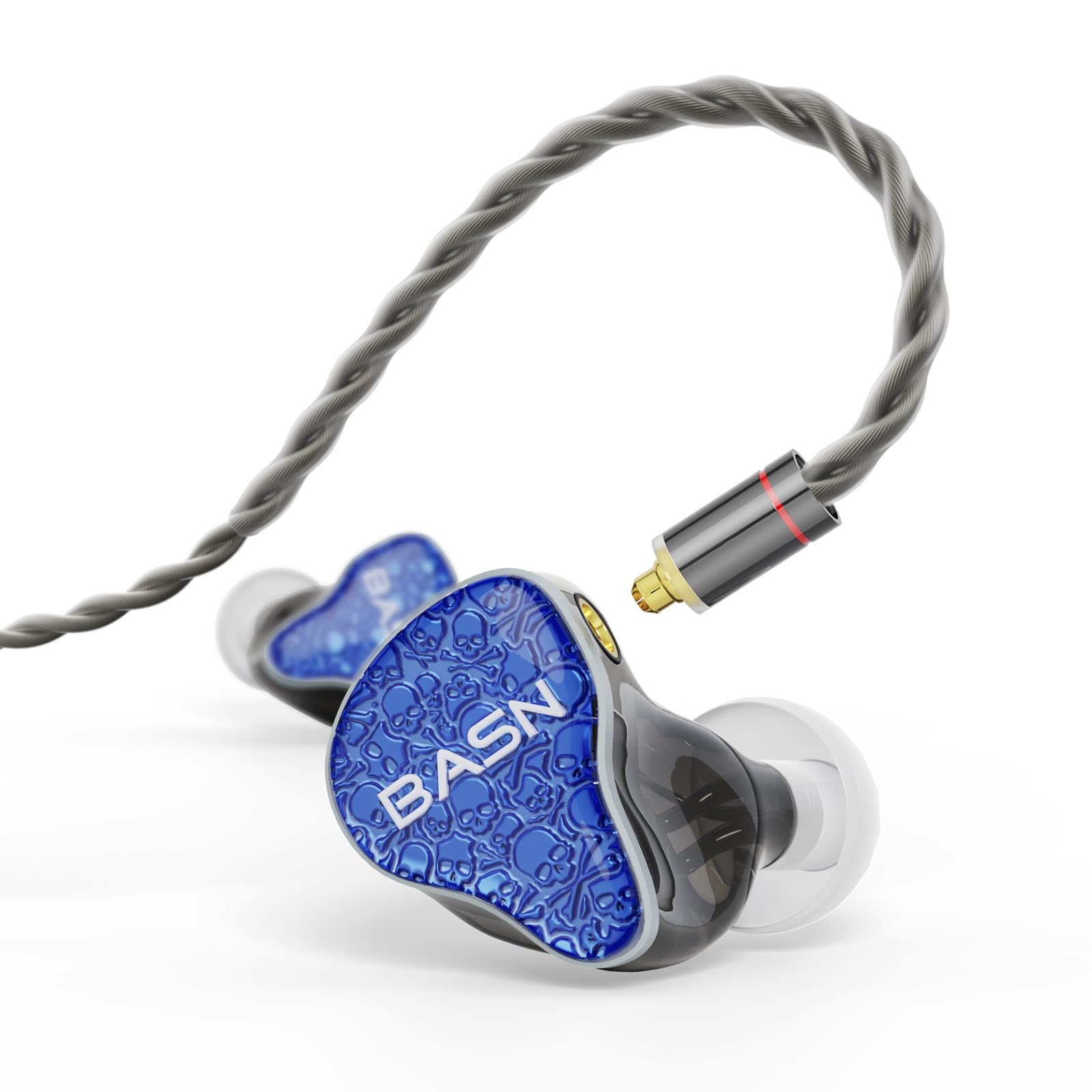
A five-driver hybrid built for the player who needs one set for the stage and the commute.
The Bmaster5 combines four balanced armature drivers with an 8mm liquid silicone diaphragm dynamic driver. Those four armatures handle the mid and high range with the smooth, extended detail musicians expect when they monitor their own instrument, while the dynamic driver adds deeper bass extension and a wider soundstage. MMCX connectors — a twist-lock cable style — mean the cable pops out cleanly if it snags and you can swap it in seconds. That reliability is the whole point on a stage.
BASN ships two cables with the Bmaster5, which is genuinely unusual. The 4-core oxygen-free copper audio cable is meant for clean monitoring, and a woven microphone cable with in-line volume control covers everyday calls and phone use. The box also holds 12 pairs of ear tips in silicone and memory foam, so almost any ear can find a seal, plus a hard aluminum case, a cleaning brush, and a 1/4-inch adapter. For band and worship players, that kit covers rehearsal and gig without a single add-on purchase.
Owners who play bass and drums report that instruments and vocals come through clearly and that the fit holds during performance. Fit is the point to check, though — a few owners found the side cap popped loose, and one bassist felt the low end fell short of the promise. The adjustable ear hooks let you dial in the placement, and the noise-blocking design keeps stage bleed out. Support is a bright spot: when one ear failed early, BASN shipped a replacement right away.
What earns its keep
- Four balanced armatures plus an 8mm dynamic driver for wide-range monitoring
- Two cables in the box — a 4-core OFC audio cable and a microphone cable
- 12 pairs of silicone and memory foam tips cover nearly any ear shape
- Upgrade MMCX connectors make cable swaps quick and secure
Where it wobbles
- Some owners found the side cap coming loose on the shell
- Bass did not satisfy one low-end-focused player
- The plastic enclosure feels less premium than the aluminum case suggests
Right for you if: you play live and want one set that covers monitoring plus everyday calls with the included cables.
Not ideal if: you need the deepest low end in the list or a metal-shelled build.
8. Xvive T9 in-Ear Monitor Headphones Dual Knowles BA Drivers IEM

Two Knowles armature drivers proving that count is not everything when the tuning is right.
Knowles is one of the best-known makers of balanced armature drivers, and the T9 uses a pair of them plus a custom-ported micro tweeter joined by a unified crossover. That crossover matches the two drivers so their output blends instead of fighting, and the headroom lets you boost or cut frequencies with EQ without flattening the sound. The result is a balanced, detailed signature that is not hyped or colored, so it sounds honest from the start. That balance is what keeps owners coming back — sound quality is by far the most praised trait here, and the fit ranks high too.
On stage, the T9 blocks up to 25dB of noise through its isolating design, so you can hear your own mix over a loud band. It ships with small, medium, and large pliable rubber tips plus a 48-inch cable, a 1/4-inch adapter, a cleaning tool, and a case. A keyboard player ran it for four-hour shows and stayed comfortable throughout. The clear body shows the internal build, which is a nice touch, and the low-latency design (minimal delay between the sound and what you hear) suits real-time monitoring. One player noted a large sound tube that makes earwax cleanup simple, which anyone who has wrestled with a clogged nozzle will appreciate.
The main thing to plan for is the deep fit. The stems extend far into the canal, which feels odd at first and is why picking the right tip size matters most — some users moved down to smaller tips for a better seal. Tip size changes the sound more than you would expect, so budget a little time to find the right pair. A couple of owners also received a defective set, though replacements resolved it. Get the fit dialed and the clarity is the payoff.
Two drivers, done right: the dual Knowles armatures and unified crossover deliver accurate, non-fatiguing sound that responds well to EQ.
Plan for the deep fit: the long stems demand the right tip size, so a little patience in the first days pays off.
Best for: musicians and audiophiles who value balanced, EQuable sound over a big driver count.
Reconsider if: you dislike deep-fitting earphones or you want a closed-fit feel with minimal tip trial-and-error.
9. HiFiGo AFUL Performer 5+2/7 IEMs, 1 Micro Planar+2DD+4BA in-Ear Monitor

Seven drivers a side, including a planar tweeter that reaches into the top of the range.
The Performer 5+2 stacks 2 dynamic drivers, 4 balanced armatures, and 1 micro planar driver in each earpiece. The two dynamic drivers handle the bass, the four armatures cover mids and highs, and the planar driver extends the treble cleanly from 10kHz to 30kHz. That is a different recipe from the single-tune balanced armature sets above — it is designed to combine the physical low-end push of a dynamic driver with the precision of armatures and the openness of a planar. An enhanced four-way electronic crossover plus 3D-printed acoustic tubes give every driver its own sound path, so bass never muddies the vocals.
It is also built to be easy to drive. At 15Ω impedance and 109dB sensitivity, it runs straight from a phone or laptop without an amp, though a clean DAC will reveal tighter bass and a wider stage. The air-pressure balance system vents trapped canal pressure, which eases fatigue over long sessions — useful if you mix, game, or just listen for hours. A high-purity silver-plated copper cable with a 0.78mm 2-pin connector, plus nine pairs of silicone and foam tips and a carry case, round out the box.
What owners note first is the build and the sound together — both land among the most praised traits here. The detail and separation suit mixing and detailed listening, and the fit works well for small ears with the right tips. A couple of caveats: the flat nozzle can let tips slip off if you are not careful, and one buyer found the sound lost some composure at higher volumes. A gamer review flagged the soundstage as narrower than dedicated gaming picks, so this is a music-first set.
top-tier versatility: the 15Ω impedance (a low electrical resistance that lets it play from almost any source, including a phone or laptop) means you do not need a separate amp, and the air-pressure balance keeps long sessions comfortable.
The one caution: the flat nozzle means picking secure tips matters, and the tuning rewards moderate volume over heavy cranking.
Choose this for: detailed, fatigue-free listening from a laptop or phone, with bass weight from the dynamic drivers and open treble from the planar.
Pick something else if: your chief use is competitive gaming and you need the widest possible soundstage.
Understanding the Specs
Balanced Armature Drivers
A balanced armature is a tiny driver that makes sound by vibrating a small iron plate with magnetic force rather than moving a large cone. They are small and very efficient, so a maker can fit several in one earpiece. A set with 8 drivers per side, like the KZ AS16 Pro, splits lows, mids, and highs across dedicated drivers instead of one driver stretching to cover everything. The trade-off is that pure armature bass often sounds tight and controlled rather than big, which is why some makers add a dynamic driver alongside them.
Impedance, Sensitivity, and Crossovers
Impedance is the electrical resistance in ohms, and sensitivity is how loud the earphones get per unit of power, measured in decibels. Low impedance like 15Ω is easy for a phone to drive. A crossover is the circuit that sends each note to the right driver, and a well-tuned one keeps bass from bleeding into the vocals. Both impedance and sensitivity are easy to overlook, yet they decide whether the earphones sound their best from your phone or only from a dedicated amp.
Noise Isolation and Fit
These are sealed in-ear designs, so the tip seal is what blocks noise. Passive isolation ratings here run from 25dB on the Xvive T9 to 26dB on the KZ AS16 Pro and 35dB on the KZ ZAR — all from the seal, not from electronics. That means the right tip size often changes the sound and the quieting more than any other single thing. A proper seal also improves bass, so spend time fitting tips before you judge the earphones.
Connectors and Cables
Most balanced armature earphones ship with a detachable cable, and the connector type decides what you can swap later. Two-pin connectors, like the 0.78mm style on the TRUTHEAR Hexa and the 2-pin on the KZ AS16 Pro, are common and easy to replace. MMCX connectors, like those on the BASN Bmaster5, twist and lock. A detachable cable means a snag or worn wire does not end the pair, and you can add a Bluetooth module to go wireless.
FAQ
Do balanced armature earphones need an amplifier?
How many balanced armature drivers do I actually need?
Are balanced armature earphones good for gaming?
What is the difference between a balanced armature and a dynamic driver?
How well do balanced armature earphones block outside noise?
Can I replace the cable on balanced armature earphones?
Why do some balanced armature earphones feel like they suck onto my ear?
How long do balanced armature earphones usually last?
Will balanced armature earphones work with my phone?
Are balanced armature earphones worth it over regular earbuds?
Final Thoughts: The Verdict
For most people, the balanced armature earphones winner is the Linsoul Kiwi Ears Orchestra Lite because its eight armature drivers split across a three-way crossover deliver a genuinely neutral, studio-style sound with the strongest overall detail in this list. If you want the deepest low end and the highest isolation, reach for the KZ ZAR with its 7BA+1DD hybrid build (7 balanced armature drivers plus 1 dynamic driver) and up to 35dB of noise blocking. And if you are buying your first pair and want maximum drivers for the money, the KZ AS16 Pro is the one to grab. Whichever you pick, the Orchestra Lite’s eight-driver, three-way crossover tuning is the safest place to start.
How We Picked
We do not accept paid placement. Every pick is matched to a real buyer and a real use-case; we do not hands-on test units.
Sources & Methodology
Specifications: manufacturer listings and product documentation. Review insights: verified customer reviews, as of September 2026. Pricing: not shown on this page (it changes often); check the current price via the retailer link.
As an Amazon Associate, Gadgets Feed earns from qualifying purchases. This does not affect which products we feature.