
Our readers keep the lights on and my morning glass full of iced black tea. As an Amazon Associate, I earn from qualifying purchases.
Specs are compiled from manufacturer listings and verified buyer reviews and can change over time — please confirm the key details on the product page before buying.
If you are tired of squinting at the TV to work out what anyone is saying, the fix is a single soundbar that already has its bass built in. That is the whole point of an all in one soundbar: one bar under or on the wall, no separate subwoofer box to hide, and a cable count you can count on one hand. The picks below all follow that rule — every one of them ships with its own internal bass driver.
I’m Min — the founder and writer behind Gadgets Feed. This guide is built by comparing the manufacturers’ published specifications and the patterns across verified customer reviews, so you get each pick’s real strengths and trade-offs instead of marketing spin.
One bar with a built-in bass driver fits a cramped living room, study or bedroom without a second box on the floor. That is what separates a useful all in one soundbar for tv from a home theater build with a separate subwoofer.
Our Picks at a Glance

How To Choose The Best All In One Soundbar For TV
What separates this category from a normal soundbar is where the bass driver sits. A conventional bar pushes the bass into a separate box that needs its own power socket and its own patch of floor. An all-in-one unit puts that bass driver inside the bar itself, so the whole system lives in one place.
Start with your room, not the wattage number
A bar with a huge peak wattage rating can still sound thin in a large open room, while a modest one fills a bedroom. Ask where the bar will sit first. If it is going under a 43 to 55 inch TV in a study, a shorter bar is easier to fit. If it is going in a living room where you watch films with a group, a longer bar with a dedicated centre channel gives voices their own lane.
Decide if you need height channels
Dolby Atmos is a surround format that treats each sound as a separate object and can place it anywhere around you. Some bars fake that effect with processing alone. Others add upward-firing drivers — speakers angled at the ceiling so sound bounces back down as if it came from overhead. If you want the overhead feel, look for a channel count with a third number in it, like 3.1.2 or 5.2.2. The middle number is the subwoofer, and the last number counts the height speakers.
Check the ports before you buy
HDMI eARC is the best connection here. It is a two-way audio channel over HDMI that carries high-bitrate formats like Dolby Atmos from the TV to the bar and lets the TV remote control the volume. HDMI ARC does the same job with a narrower audio pipe. Optical is the old reliable fallback — nearly every TV has one, and it will not carry Atmos. And here is the important part: all-in-one means the subwoofer is inside the bar, so you do not need a spare socket for a bass box, but you do need one for the bar itself.
Quick Comparison
| Model | Best For | Channels | Rated Power | Bass Delivery | Amazon |
|---|---|---|---|---|---|
| Samsung S60D (HW-S60D/ZA)★ Best Overall | Small rooms and Samsung TV owners | 5.0 | — | Built-in subwoofers | Amazon |
| BESTISAN 2.1ch Sound BarBest Value | Tight budgets and small spaces | 2.1 | 120W peak | Built-in down-firing sub | Amazon |
| Westinghouse 3.1.2Best for Roku TVs | Roku TV owners wanting height sound | 3.1.2 | 210W | Built-in low frequency driver | Amazon |
| Hisense A620 | Film night in a mid-size room | 2.1 | 240W | Visualized built-in subwoofer | Amazon |
| Hiwill WoNoble A502 | Buyers who want a wooden cabinet | 5.2.2 | 400W | Dual 2.5-inch built-in subs | Amazon |
| Denon DHT-S218 | Dialogue clarity in a small living room | 2.1 | — | Two down-firing subwoofers | Amazon |
| Yamaha SR-B30A | Long-term reliability and sub pre-out | 2.1 | — | Two built-in subwoofers | Amazon |
| Bose Smart Soundbar | Smart-home streaming and voice control | Dolby Atmos | — | Five transducers, two up-firing | Amazon |
| Bose Smart Ultra Soundbar | Big-brand spatial audio in a compact bar | Dolby Atmos | — | Six transducers, two up-firing dipoles | Amazon |
In‑Depth Reviews
1. Samsung S60D 5.0ch Soundbar (HW-S60D/ZA)
Our pick — over 4★ from 450+ verified ratings; the strongest balance of quality and price.
Five channels of sound and two built-in woofers, in a bar short enough for a small shelf.
This is the pick for anyone who has a Samsung TV and a room that will not swallow a bookshelf speaker setup. It is a 5.0-channel bar, which means five speakers spread across the front and the sides, with the bass handled by built-in subwoofers rather than a separate box. Five channels with no dedicated subwoofer dot is unusual in this category, and it is the reason the bar stays compact. What owners bring up more than anything else is the sound itself — the body of it, not one showy effect. Setup is the second thing they notice, because pairing takes a few seconds rather than a configuration session.
The dialogue work here is genuinely useful. Adaptive Sound analyses a scene in real time and pulls the important audio forward, which is the difference between following a quiet drama and rewinding it. Active Voice Analyzer takes that further by breaking down room noise so onscreen voices stay optimised. On a Samsung TV, Q-Symphony lets the TV speakers and the bar run as one system instead of two competing sources, and SpaceFit Sound Pro calibrates the output to the shape of your room. Game Mode Pro pushes up-firing speakers and an acoustic beam for a wider spread, and Bluetooth range runs to 10 meters if you want to stream from a phone.
Compared to the cheaper budget pick further down, this one gives you the third dimension the simpler bar cannot — five channels instead of 2.1. The honest catch is the display. There is no numeric readout for volume or settings, only LED patterns, so you learn the light language or you install the SmartThings app. Buyers also flag the auto-on behaviour: as owners put it, “Once volume is above 15 sound bar activates and you are good to go.” Connectivity between sources is the most discussed mixed point, and the aux input is missing if you run an external streamer through a 3.5mm cable.
What owners keep coming back to
- Voices stay intelligible at low volume, which is the whole reason people buy a bar in the first place
- Setup measured in seconds, not evenings — pairing is the part reviewers rank second only to sound
- Built-in subwoofers mean no second box, no second socket and no floor space given up
- Q-Symphony turns a Samsung TV’s own speakers into part of the system rather than a wasted pair
Where it asks for patience
- No numeric display for volume or settings, just LED patterns
- No 3.5mm aux input for an external streamer
- Source switching is the most-discussed mixed point among owners
- Auto-on works over HDMI and optical, not over Wi-Fi
Buy this one when: your TV is a Samsung in a small room and dialogue clarity at low volume is the whole job.
Think twice when: you need a front-panel volume reading or you plan to feed it from a streamer over a 3.5mm cable.
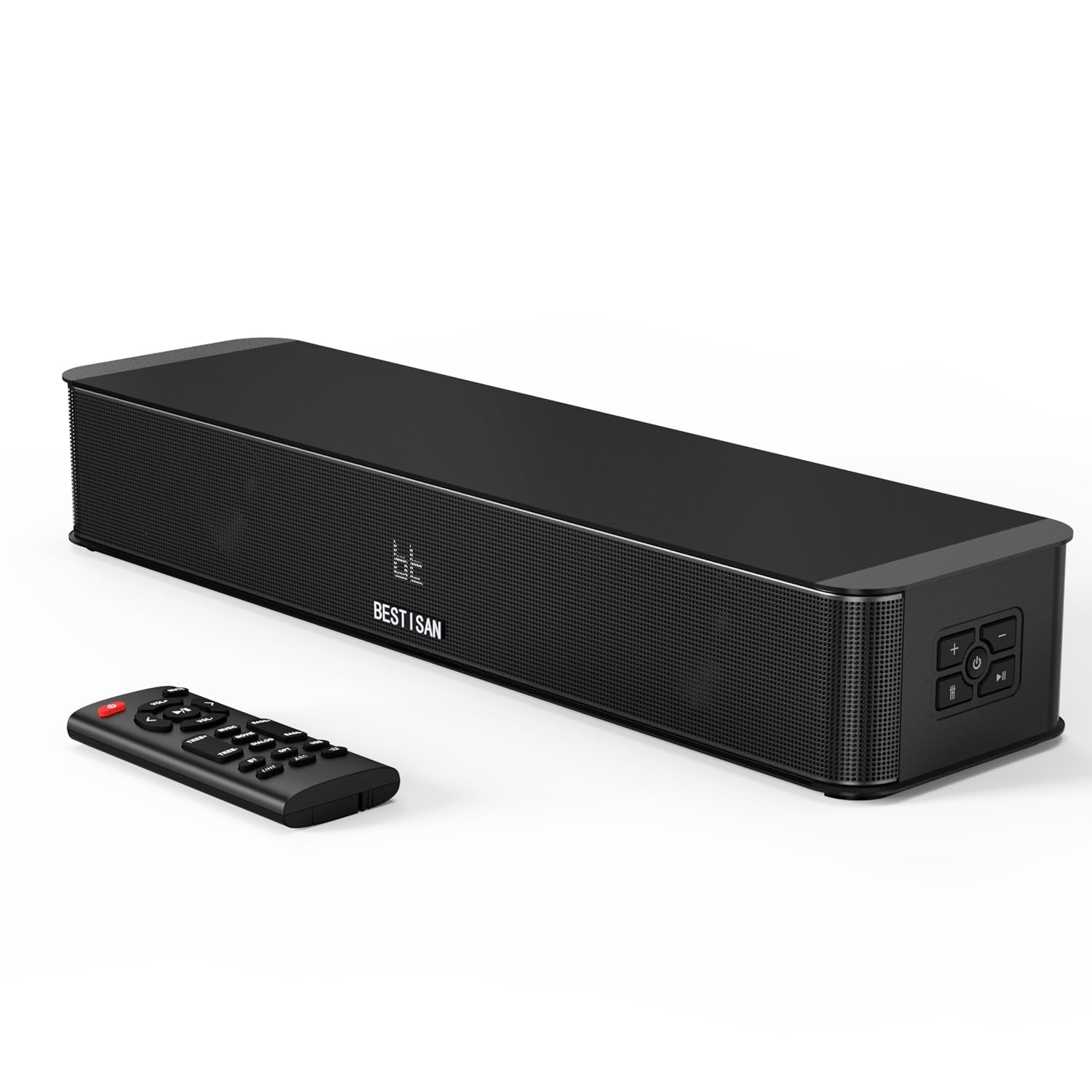
2. BESTISAN 2.1ch Sound Bar with Built-in Subwoofer
A plug-and-play bar that fits on a shelf you had written off as too narrow.
Nothing in this article costs less, and almost nothing gets closer to the point of the category. This is a 2.1-channel bar — two stereo channels plus a dedicated subwoofer channel — and the subwoofer is a down-firing driver built into the cabinet. Peak power is rated at 120W, and the whole thing measures 16.5 inches wide by 2.8 inches tall, so it slides in front of a TV without stealing the picture’s bottom edge. For a small place, that combination is hard to argue with, and the general verdict from the review pages is exactly that: a lot of the same complaint about big soundbars never even comes up here.
Where it earns its place is the port list. You get HDMI ARC, optical, aux, USB and Bluetooth for connectivity, and ARC lets the TV remote drive the volume so you never hunt for a second handset. Three DSP modes split the listening: Movie for a wider spread, Music for deeper bass, and Dialogue to isolate speech for news and podcasts. Bluetooth 5.3 keeps the wireless pair stable, and the enclosure mixes ABS plastic with metal rather than relying on plastic alone.
Temper your expectations on two things. First, this is a small bar with a small driver, so a large open living room will find its limit faster than the Samsung or the Bose units above. Second, the input setup trips people up: buyers report that on some TVs the optical and RCA paths simply did not work, and the bar only came alive once it was connected to the streaming box instead. The fix is straightforward — match the input you pick to the source you plugged into — but it is a step worth reading the manual for. Volume control is the other most-discussed mixed note, and no optical or HDMI cable arrives in the box, so have one ready.
Straight from the review pages: the phrase that keeps surfacing here is value — owners routinely say they replaced a far more expensive bar and did not feel like they lost anything for a bedroom or study setup.
Reach for this if you want a one-box upgrade for a bedroom or a small apartment TV and you are happy to check the ports before you plug in.
Look elsewhere if you need the bar to fill a big open-plan room, where the built-in driver simply runs out of headroom.
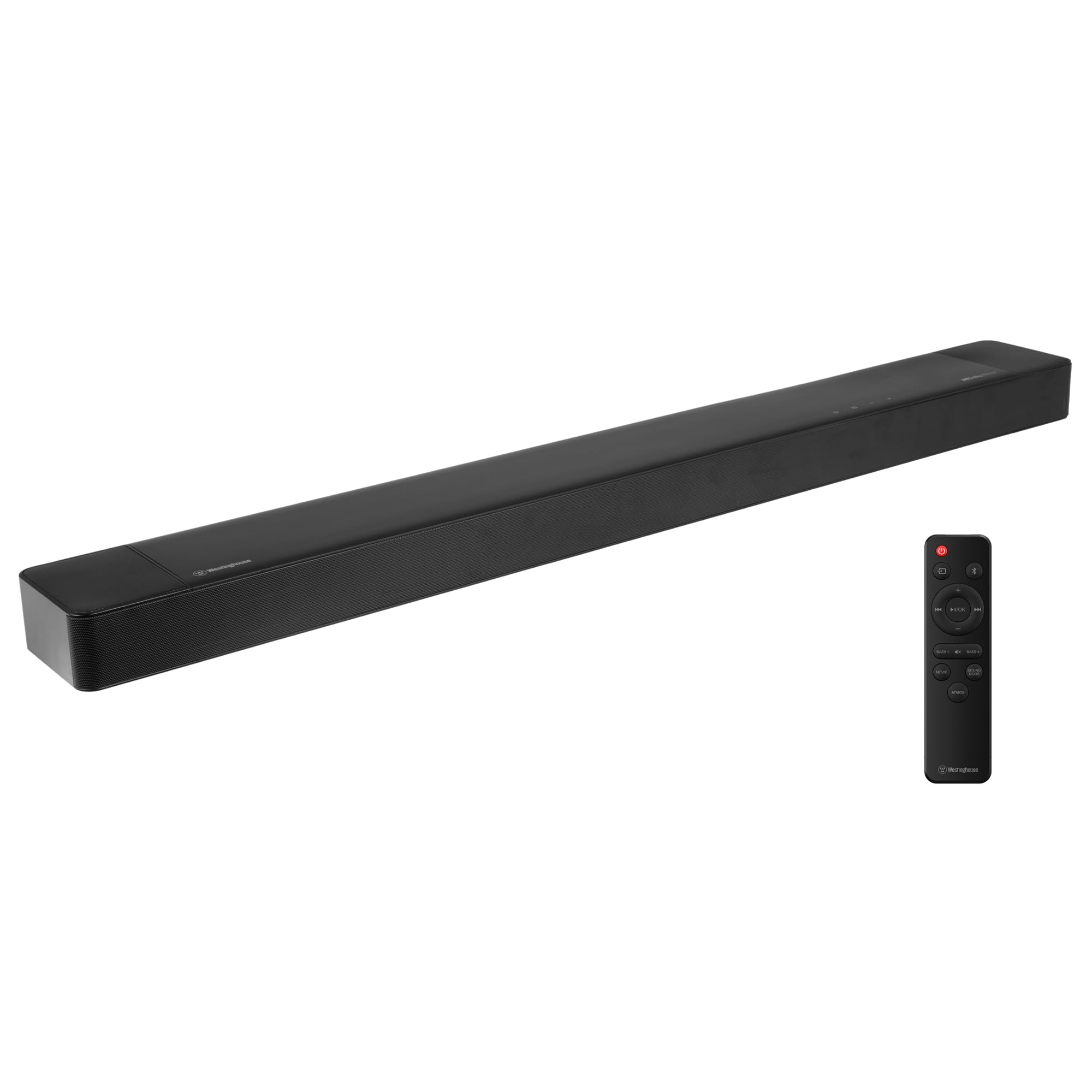
3. Westinghouse 3.1.2 All-in-One Soundbar with Built-in Subwoofer
Three front channels, two height drivers and a built-in woofer — Atmos without the extra boxes.
Roku TV owners should start here. The bar is Roku TV Ready certified, which means setup is quick and any Roku remote can reach the sound settings without a second controller. The channel layout is 3.1.2, and that middle dot matters: the.1 is the integrated low frequency driver, and the.2 counts the upward-firing height speakers that bounce sound off your ceiling for the overhead part of Dolby Atmos. Power is rated at 210W, and the frequency response reaches down to 50 hertz. Compared with the Samsung bar above, you are trading channels on the front for channels pointing at the ceiling — a real Atmos layout rather than a five-channel spread.
The daily experience is office-friendly. Turn-on and turn-off follow the TV over HDMI eARC, and the included HDMI cable gets you there in one run. Bluetooth streaming handles phone audio, and the connections cover HDMI, optical, USB and a 3.5mm aux jack. A dedicated centre channel handles the voice track, which is the reason wording stays legible even when the soundtrack swells.
Now the part worth being honest about. In this bar’s own review record, sound quality comes back mixed rather than glowing — some listeners find it great for the outlay, others find the deep bass sits over the dialogue until they tune it. If you watch a lot of talk-heavy content, expect to spend a few minutes in the settings menu. There is also a well-documented gripe about the display light: it cannot be dimmed or switched off, and it comes on unprompted. A buyer with an older non-eARC Samsung TV reported the optical path worked fine, so you are not locked out if your TV predates the newer standard.
Pick this if you want genuine height channels in an all-in-one cabinet and your TV is a Roku model that will set itself up in one pass.
Skip the upgrade if your living room doubles as a cinema and you care about tuning the bass down for dialogue — the adjustment range here is limited.
4. Hisense A620 2.1ch All-in-one Sound Bar

A transparent window onto the driver that is doing the thumping.
The number that defines this bar is the subwoofer itself: a 75 by 160 millimeter driver behind a clear acrylic panel, so you can watch the woofer move when the bass hits. It is rated at 240W across a 2.1-channel layout, and it decodes both Dolby Digital Plus and DTS Virtual:X, the second of which is an audio codec that creates the impression of sound moving around and above you. The bass is not a subtle thing here — buyers describe it as the kind that makes a shelf vibrate, which is why wall-mounting comes up in the same breath as praise.
Setup is about as simple as this category gets. One HDMI ARC run to a Hisense or Roku TV and the bar comes alive, often playing a demo clip on its own to prove the connection. There is also a TV mode that borrows your Hisense TV’s Dolby Atmos decoding and plays it back through the bar over HDMI ARC or eARC — a clever workaround for an entry-tier bar. EzPlay puts the soundbar’s own settings menu on the TV screen, so you are not squinting at the bar for feedback.
The trade-offs sit around the edges. Bass is over-eager at times: a few owners note a constant low-level thump that persists even with the bass dialled down and News mode selected. A spoken confirmation announces power on and off with no way to silence it, which is fine in a living room and less fine next to a sleeping housemate. Sticker residue on the cabinet finished one buyer’s unit cosmetically, and Bluetooth has been reported to drop out on some setups. None of that touches the core performance, which is why the bar’s own sound-quality record reads strongly positive overall.
The honest read: if you want chest-thump from a single bar with no external box, this is the value flagship of the mid-range group. If you want a bar that whispers when it powers on, it is not this one.
Best fit: a mid-size room, a film-heavy watchlist, and a wall you are willing to mount to so the bass has something solid to push against.
Not the fit: a bedroom where the power-on chime and the persistent low-end would be noticed at midnight.
5. Hiwill 5.2.2ch Wooden Dolby Atmos Soundbar (WoNoble A502)

Nine drivers, a wooden cabinet, and 400W of ambition in a 33-inch bar.
On paper this is the most elaborate bar here: a 5.2.2-channel layout rated at 400W with nine precision-engineered drivers, including dual 2.5-inch built-in subwoofers, side-firing tweeters and up-firing drivers for the vertical part of Dolby Atmos. The cabinet is wood rather than plastic, and the maker’s own claim is that the density of the material supports the low end and reduces distortion at volume. The bar measures 33.1 inches long, 4.7 inches wide and 3.1 inches tall, and weighs 11 pounds — enough mass that you notice it when you lift it from the start, and a look that reads as furniture rather than electronics.
The connectivity set is generous for the money: HDMI eARC, optical, USB, aux and Bluetooth 5.3, with cables for both optical and HDMI eARC in the box. Bluetooth reaches 33 feet, which is further than the Samsung and Yamaha bars manage, so you can leave a phone on the far side of the room. The dual subwoofers mean no bass box on the floor, which is the entire promise of this category delivered in a wooden wrapper.
Here is the part a careful buyer should weigh. This bar asks for patience. The maker notes that memory function is not supported in the current batch and recommends a firmware update, and owners echo that — the update is described as improving the sound and the indicator light. Bass is the recurring weak point: even with two built-in subwoofers, listeners comparing it against a bar with a real external sub find the low end polite, and the advice is to run it over optical where possible. Rooms with hard, flat walls get the best result from the surround effect; irregular rooms get less. It is also the least-established name in this list, so you are buying on specification and a firmware promise rather than a long track record.
What makes it interesting
- Nine drivers and a 5.2.2 layout put it well beyond the channel count of anything cheaper here
- A wooden cabinet that reads as furniture instead of another black plastic slab
- Every cable you need for optical and HDMI eARC is in the box
- Bluetooth reaches 33 feet, the longest wireless range in this roundup
What to plan around
- Firmware update is advised out of the gate, and it changes how the bar sounds
- Bass is the recurring gripe — fuller with an external sub, which the all-in-one format rules out
- The surround effect depends on your room having flat, reflective walls
- DTS decoding is not supported
Go here if you want the biggest driver count and the most distinctive cabinet in the mid-range group, and you do not mind running a firmware update first.
Stay clear if you want deep, physical bass from a bar alone — the built-in subs here are refined rather than forceful.
6. Denon DHT-S218 Sound Bar for Smart TV

Two down-firing subs and a dialogue booster built for people who keep reaching for the volume.
Denon built this bar around one problem: hearing what is being said. The DHT-S218 is a 2.1-channel design with two built-in down-firing subwoofers plus dual midrange drivers and tweeters, and the headline feature is Dialog Enhancer — a control that sharpens speech without you having to raise the overall level. You get four sound modes to work with: pure, movie, music and night. Pure strips the surround processing out entirely for straight music listening, which is a useful switch most bars in this price band do not offer. Compared with the Hiwill bar above, this one gives up channel count and keeps the clarity.
Connection is standard and quick. HDMI eARC over the included cable carries the audio and lets the TV remote take over, and 4K passthrough means you can route a source through the bar without losing picture quality. Bluetooth works over Low Energy Audio and supports multi-point, so two devices can be paired and swapped between without re-pairing. One buyer who runs a PC alongside the TV reports the bar jumping to Bluetooth when the computer boots and cutting the TV sound — a quick remote fix rather than a fault, but worth knowing if your desk and your couch share a room.
The one thing to accept is the volume feedback. There is no numeric readout, only a subtle brightness change in the light, and a few owners describe chasing the right level between sources because of it. Reliability shows up as a mixed note in the bar’s own record, though nothing in the review history suggests a pattern serious enough to steer you away from a genuinely well-reviewed bar.
Where it wins: dialogue. Set against a plain 2.0 bar, the two down-firing subwoofers and the Dialog Enhancer do the work of a much larger system in a small living room.
Suits you if your main complaint is that you cannot make out the words, and you want a bar that fixes it without a separate box or a big footprint.
Look at other options if you need an on-screen or numeric volume readout to dial in matching levels.
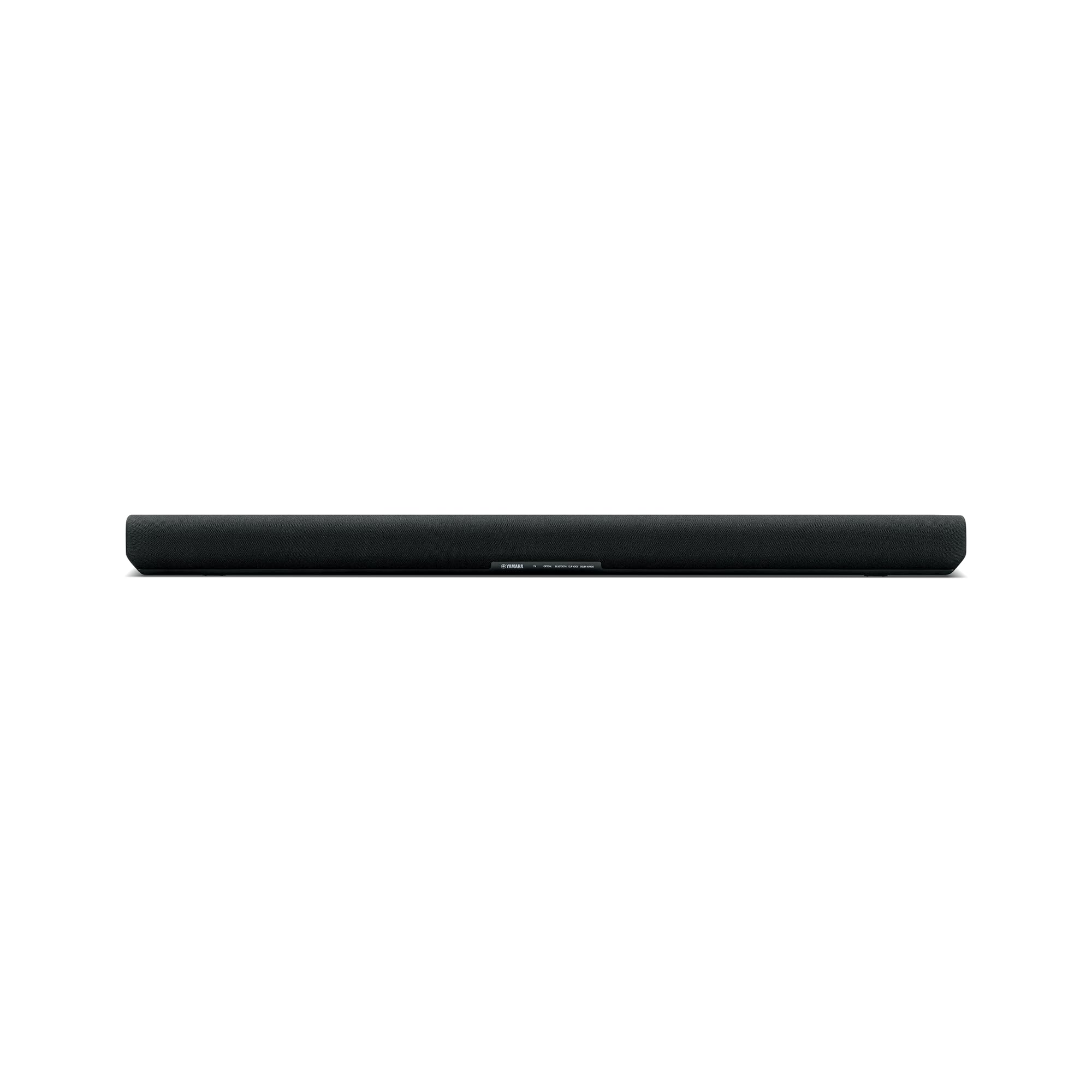
7. Yamaha SR-B30A Sound Bar with Built-in Subwoofers
Two built-in subwoofers, Clear Voice processing, and a name that has been doing this for a while.
If you want a bar that behaves the same in year two as on day one, this is the candidate. The SR-B30A pairs two built-in subwoofers with Clear Voice technology, a processing mode that lifts dialogue above background music and effects. It handles Dolby Atmos along with Dolby TrueHD 7.1, and HDMI eARC carries uncompressed, high-bitrate audio straight from the TV. Four preset modes cover Movie, Stereo, Standard and Game, and True Sound processing handles the spatial field. Bluetooth multipoint lets you switch between two paired devices — genuinely useful if two people in the house both stream to it.
What stands out in the owner experience is consistency. The bar connects cleanly over eARC, the TV remote handles power and volume, and the bass and voice controls do what the labels say. For anyone with what they describe as hearing trouble, Clear Voice is the feature that keeps them from riding the volume button all night. Sub configuration is a frequently praised detail — people pairing an old external subwoofer through the pre-out say the result is the best of both worlds, and that older Yamaha subwoofers integrate without fuss.
The honest limitation is the control layer. The companion app is basic, and the Bluetooth source gets disabled while the TV is on via eARC CEC, so you cannot casually switch to your phone mid-programme. There is no Bluetooth headphone support, and the controls are the one aspect owners describe as mixed. A one-star review objects to the missing night mode and dynamic range control — worth knowing if you watch late at night with neighbours above you. None of that changes the core verdict: this is a bar people keep and recommend.
Choose this if you want proven long-haul reliability, a real subwoofer pre-out for later expansion, and voice clarity that works without fiddling.
Pass if you need a full app experience, Bluetooth headphone output, or a dedicated night mode for late viewing.
8. Bose Smart Dolby Atmos Soundbar

Five transducers in a small frame, two of them firing at your ceiling.
This bar is for the person who wants the streaming to be as clever as the sound. Inside its compact frame Bose fits five transducers, two of which fire upward for the overhead layer, and TrueSpace is the processing engine that analyses non-Atmos sources like plain stereo or 5.1 and upmixes them into a multi-channel spread. A.I. Dialogue Mode balances the voice track against the surround, and Alexa is built in for hands-free control.
Streaming is where it pulls ahead of the field. You get Bluetooth, Apple AirPlay 2, Spotify Connect and Chromecast built in, so whatever is on your phone can reach the bar without a cable or a menu. Voice control extends to your TV and cable box through Bose’s Voice4Video feature, and if you later add Bose’s open earbuds they can act as rear surround speakers. The sound itself earns the most praise by far in this bar’s own record — owners describe hearing details in quiet scenes that they had never caught before.
The caveat is honesty about the smart layer. Connectivity and the Bose app come in for the most criticism in this bar’s own review history, and reliability reads as mixed — most owners are perfectly happy, but there is a genuine tail of setup trouble with network pairing and firmware. Bass is also the first thing to give way: owners mention it runs light below roughly 80 to 100Hz without a separate module, and clarity starts to break up at higher volume in a bigger room. Treat this as a superb small-and-medium room bar, not a cinema replacement.
The short version: the streaming options and the dialogue handling are the reason to buy it. The app and the network pairing are the reason some people hand it back.
Right for you if your house runs on AirPlay, Spotify Connect or Alexa, and your viewing room is small to medium.
Wrong for you if you want deep standalone bass or you would rather never open a phone app to configure a soundbar.
9. Bose Smart Ultra Dolby Atmos Soundbar

Six transducers, two aimed at the ceiling, in a bar the size of a shoebox lid.
This is the step up from the Bose Smart Soundbar above, and the difference is inside the cabinet. Six transducers replace five, and the two upward-firing drivers are dipole speakers — units that radiate from both faces of the diaphragm — engineered to spread the overhead layer. Dolby Atmos and Bose TrueSpace do the spatial placement, separating elements of a mix and positioning them around the room. A.I. Dialogue Mode works the voice track, and the package includes an ADAPTiQ headset, which is a calibration microphone you wear while the bar measures your room and tunes itself to it.
Owners describe the effect as sound arriving from more places than the bar physically occupies — one comparison that comes up is hearing a small detail land from behind a bookshelf rather than from the front of the room. The design also gets credit for blending into a living space instead of dominating it, and the physical setup is simple: a single HDMI eARC cable, or optical if that is all your TV offers. Built-in Alexa and Google Assistant handle voice control, and AirPlay 2, Chromecast and Bluetooth cover streaming.
The two things to know before choosing this over the cheaper Bose are its setup process and its low end. The Bose Music app drives the whole configuration, and owners describe it as fiddly — one buyer found Bluetooth fine but had to wrestle with network pairing, and another reports the TV and bar sometimes falling out of sync after the TV auto-shuts down. Bass, meanwhile, is the recurring wish in the review history at this size; the bar is tuned for clarity first, and a separate bass module is the route to more. That trade-off is the price of a cabinet this compact.
This one is for you if you want the most spacious sound a single small bar can make in a normal room, and you are comfortable running a phone app to set it up.
Cross it off if you expect standalone bass depth or you want the bar to work perfectly straight from the start without app pairing.
Understanding the Specs
Channel Counts (2.1, 3.1.2, 5.2.2)
These numbers are a map of the speakers inside the bar, and reading them takes about ten seconds. The first digit counts the main front-facing channels. The middle digit counts subwoofers — a.1 means one bass driver, a.2 means two. The last digit, when there is one, counts the height speakers aimed at the ceiling. So a 2.1 bar is stereo plus bass, a 3.1.2 bar adds a dedicated centre channel for voices and two upward drivers, and a 5.2.2 bar spreads across more front and side positions with two subs and two height units. More channels spread the sound wider, but only in a room with walls close enough to reflect it.
eARC, ARC, Optical and Bluetooth
HDMI eARC is the connection you want if your TV has it. It runs both ways over the same cable, carries high-bitrate audio like Dolby Atmos, and lets the TV remote control the bar’s volume. HDMI ARC does the same job with less bandwidth, so it may not carry the very highest formats. Optical is the fallback that works on nearly every television ever made — reliable, but it cannot carry Atmos. Bluetooth is for streaming from a phone or tablet, and range varies between models here. In this category specifically, remember that the subwoofer is inside the bar, so your cable and socket count is lower than with a conventional soundbar setup.
FAQ
What does all in one actually mean for a soundbar?
Will an all in one soundbar work with my older TV?
Can a built-in subwoofer match a separate subwoofer?
Do I need Dolby Atmos in a single soundbar?
Why does my soundbar sound quiet until the volume is turned up?
Should I connect my soundbar to the TV or to my streaming box?
How wide is a soundbar and will it fit under my TV?
Can I stream music to an all in one soundbar from my phone?
Is a 2.1 soundbar enough for movies?
Why does my soundbar not turn on with the TV?
Final Thoughts: The Verdict
For most people, the all in one soundbar for tv that gets the job done is the Samsung S60D, because it delivers five channels and built-in subwoofers in a cabinet short enough for a small shelf, with dialogue processing that keeps voices clear at low volume. If deep, physical bass in a single bar is what you are after, the Hisense A620 leans harder into the low end with its visualized 75 by 160 millimeter subwoofer. And for a bare-bones bedroom or study setup where the bar just needs to fit and work, the BESTISAN 2.1ch is the one to reach for.
How We Picked
We do not accept paid placement. Every pick is matched to a real buyer and a real use-case; we do not hands-on test units.
Sources & Methodology
Specifications: manufacturer listings and product documentation. Review insights: verified customer reviews, as of September 2026. Pricing: not shown on this page (it changes often); check the current price via the retailer link.
As an Amazon Associate, Gadgets Feed earns from qualifying purchases. This does not affect which products we feature.