
Our readers keep the lights on and my morning glass full of iced black tea. As an Amazon Associate, I earn from qualifying purchases.
Specs are compiled from manufacturer listings and verified buyer reviews and can change over time — please confirm the key details on the product page before buying.
If you are shopping for baseball gear this season, the real question is not which bat or glove looks the best in the photos. It is whether the gear will still hold up in August, when your player is practicing four days a week and dragging a bag across a parking lot. The picks below sort out what actually lasts and what will need replacing before the season ends.
I’m Min — the founder and writer behind Gadgets Feed. This guide is built by comparing the manufacturers’ published specifications and the patterns across verified customer reviews, so you get each pick’s real strengths and trade-offs instead of marketing spin.
Bags, gloves, and nets all have one thing in common: the gear that survives daily practice is the gear worth owning. Here is the honest breakdown of the best baseball gear for families who play every week.
Our Picks at a Glance


How To Choose The Best Baseball Gear
Baseball gear breaks down into a few clear jobs. You need something to carry everything, something to protect your hands, and — if you practice at home — something to hit into. Getting the right version of each one matters more than buying the most expensive option on the shelf.
Start With The Bag, Because That Is What Travels
Your bag is the one piece of gear you touch every practice, so it has to work. Look for a vented shoe compartment (a separate section that lets air reach your cleats so they dry out between games), mesh side pockets that hold bats or water bottles, and a fence hook (a clip that hangs the bag on the dugout fence so it stays off the dirt). A bag sized for one player’s helmet, glove, and two bats will serve most youth and rec players well.
Batting Gloves: Fit And Leather Quality
Batting gloves protect your palms from the sting of a mis-hit and give you a consistent grip on the handle. Leather quality matters most here — a supple cabretta leather (a thin, soft goatskin that molds to your hand) gives better feel than a stiff synthetic, but it wears faster. Expect to replace batting gloves at least once a season if your player practices several times a week, which is normal at every price point.
Training Nets And Tee Sets
A training net lets your player get swings in without chasing balls across the yard. Look for a knotless mesh (a net woven without knotted intersections, which reduces wear at the joints) and a frame that assembles without tools. A 7×7 ft size catches most hits during batting practice and packs into a carry bag for the field.
Catcher’s Gear And Baseballs
Catcher’s gear comes as a kit — helmet, chest protector, and leg guards — and sizing is everything. Sizing charts run small, so most buyers go up a size. For baseballs, count matters: a 24-ball bucket with a snap-on lid that doubles as a seat keeps a whole team supplied through batting practice.
Quick Comparison
| Model | Best For | Type | Key Spec | Weight / Count | Amazon |
|---|---|---|---|---|---|
| Easton Dugout Backpack★ Best Overall | Youth and rec players | Equipment bag | 3 compartments, vented shoe section | 19″L x 13″W x 19″H | Amazon |
| BAGAIL 7×7 ft Training NetTop Value | Backyard batting practice | Training net | 7×7 ft, 7-ply knotless mesh | 4.5 pounds | Amazon |
| Franklin CFX Pro Batting GlovesBest Feel | Grip and feel at the plate | Batting gloves | Digital cabretta leather, tri-curve fit | 0.11 kg | Amazon |
| GoSports 7 ft x 7 ft Net | Pitching and hitting drills | Training net | 7 ft x 7 ft, 90-second setup | 13 pounds | Amazon |
| Rawlings Sandlot Glove | Infield and utility players | Fielding glove | Full-grain oiled leather, 11.75″ | Ready-to-Play | Amazon |
| Furlihong 898BH Toss Machine | Solo batting practice | Toss machine | 3 adjustable angles, no power supply | 2.4 kg | Amazon |
| Rawlings ROLB1X Baseballs | Team batting practice | Baseballs | Full-grain leather, composite cork center | 24 count | Amazon |
| Wilson EZ Gear 2.0 Kit | Young catchers | Catcher’s gear kit | Helmet, chest protector, 2 leg guards | 2.7 kg | Amazon |
| TOY Life Tball Set | Beginners age 3-5 | Tee ball set | Bat, tee, glove and 6 balls | 0.93 kg | Amazon |
In‑Depth Reviews
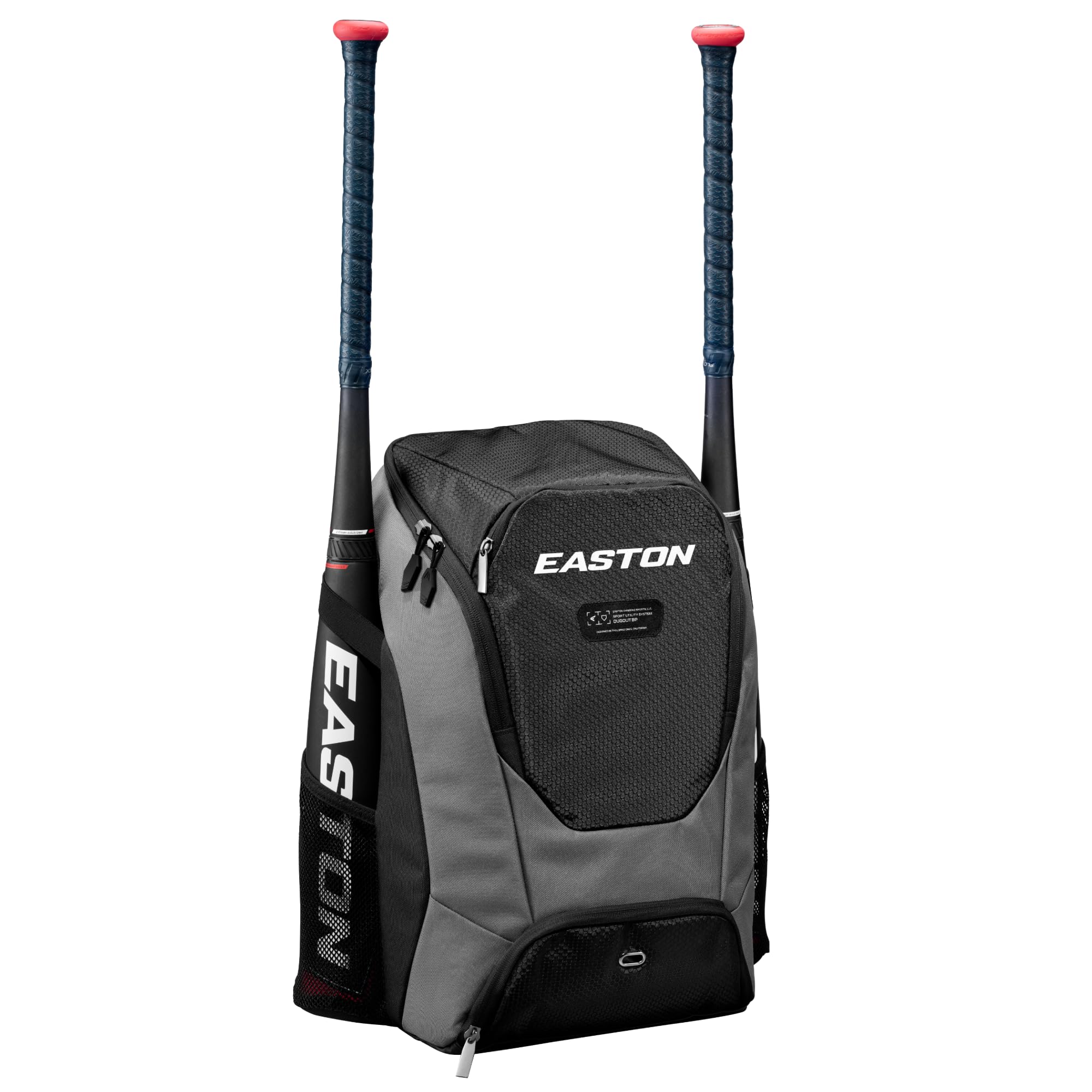
1. Easton | Dugout Backpack Equipment Bag
Our pick — over 4.5★ from 500+ verified ratings; the strongest balance of quality and price.
The one bag that swallows a full season of gear and still hangs clean on the dugout fence.
If your player carries two bats, a helmet, and a pair of cleats, you know the daily frustration of a bag that runs out of room by mid-season. This Easton solves that with three separate compartments across a 19″L x 13″W x 19″H frame — enough to hold a helmet, ball glove, and more in the main section, with a dedicated vented shoe compartment that lets air move through so damp cleats do not turn your car trunk into a science experiment. Two mesh side pockets hold bats or water bottles on the outside, and a large front personal pocket keeps keys, snacks, and a phone separate from the gear.
Over a season, the details that matter are the fence hook — a clip that hangs the bag on the dugout fence instead of dropping it in the dirt — and custom metal zipper pulls that do not jam after a few hundred openings. The quality is the standout: what wins people over most is how well it holds up, and the size fits a wide range of players. An 8-year-old carries it easily with room for two bats, a glove, and a helmet; a 9-year-old has space to grow into it. Buyers report the fabric and zippers still look new after a full season of practices.
- Vented shoe compartment keeps cleats separate and aired out
- Fence hook and metal zipper pulls hold up to daily use
- Three compartments fit a helmet, glove, cleats, and two bats
- Sized for players aged roughly 6 to 16 with room to grow
The one honest limitation: for the youngest tee-ball players, this bag is oversized. A parent of a 9-year-old noted it is probably too big for a t-ball player, and a few buyers mention the brand-name price runs higher than generic alternatives. Neither is a dealbreaker — it is simply a bag built for the player who is sticking with the sport past the tee-ball stage.
Team gear hauler: Families with a youth or rec player aged 6 and up who carries real gear to every practice and wants a bag that outlasts the season.
Locker space tight: If your player is still in tee-ball and travels with just a bat and helmet, this bag will feel oversized for the gear you have.
2. BAGAIL 7×7 ft Baseball & Softball Training Net
A full backyard batting cage that sets up in two minutes and catches everything your player throws at it.
The BAGAIL net ships as a complete practice kit, not just a net. Included in the box: a 7×7 ft net, an adjustable batting tee, iron frame tubes, one baseball, two strike zone targets, four ground stakes, and a carry bag. That is the whole setup for tee work, front toss, and pitching drills without buying anything else. The adjustable tee lets you change height for different swing planes, and the two strike zone targets help a pitcher focus on specific areas of the zone.
Build quality holds up to real use. The 7-ply knotless thickened polyester mesh (a net woven without knots at the intersections, so there are no weak points where strands rub) takes hard hits without wearing through quickly. The reinforced fiberglass tubes flex under impact and spring back into shape. Ground stakes anchor the base so it does not tip in wind. Kids from beginners through high school players use it for hitting, pitching, and fielding work — one family used it daily for two months through thunderstorms and high winds with the mesh intact.
Compact training net
- Complete kit: net, tee, 2 strike zones, stakes, and carry bag
- 7-ply knotless mesh takes hard hits without wearing out fast
- Two-minute tool-free setup with flexible fiberglass bow frame
Needs sturdy stakes
- Target attachment straps are thin and several seams came apart immediately
- Included baseball fell apart after the first hard hit
- Moving it takes two people once assembled
At 4.5 pounds the whole frame moves around the yard without effort, though fully assembled it needs two people to reposition. The recurring gripe is the black straps that hold the strike zone targets — they are weakly sewn and several came apart right from the start. That is a small fix with a needle and thread and does not affect the net itself, which is what carries the value here.
Backyard reps: You want a full home practice station — net, tee, and targets — in one box without hunting for accessories.
Soft ground only: You need a net that stays assembled permanently outdoors, since this one is designed to break down into the carry bag between sessions.
3. Franklin Sports MLB CFX Pro Batting Gloves
The batting glove that prioritizes feel over durability, and makes no apology for it.
Franklin builds the CFX Pro around the hand, not the bat. The palm uses digital cabretta leather with etched groove patterns — the grooves increase surface area and reduce bunching, which translates to a cleaner grip on the handle. Tri-curve technology pre-shapes the glove to follow the natural curve of a human hand, so it does not fight your grip. Quad-flex technology lets the palm flex with the bat handle, and tectonic fit inserts add that flex without bulking up the back of the hand. At 0.11 kg, this is a lightweight glove that disappears on your hands at the plate.
The upside is immediate grip and comfort. The leather is more supple than stiffer alternatives, and a 13-year-old who had worn a pricier brand preferred the fit and feel of these. Blisters are not an issue — the palm padding and pre-shaped fit keep the glove from rubbing. The glove runs slightly large: a size Small fits like a Medium in other brands, so check the size chart before ordering if your player is between sizes.
Pro-level grip: This is a soft leather glove, and soft leather wears. Batting gloves at every price point break down when you practice several days a week, and this pair is no exception — a small handful of owners mention holes forming within a few weeks of heavy use. For the grip and feel it delivers at the plate, most players consider that a fair trade.
One colorway caveat worth knowing before you buy: the pink color can bleed onto your batting grip and hands with sweat. It does not affect performance, but if you want the gloves to stay looking clean, a different colorway avoids the issue entirely.
Frequent hitters: Your player wants real leather feel and a grip that stays consistent through the swing, and you accept replacing batting gloves as routine.
Budget beginners: You need a glove that survives an entire season of daily practice, because the soft cabretta leather is built for feel, not longevity.
4. GoSports 7 ft x 7 ft Baseball & Softball Net

The net that has been sitting in a Southern backyard for two years and still has not weathered.
Where the BAGAIL net above prioritizes a complete kit, this GoSports is built for one job done very well: giving a player a reliable target they can hit into every single day. The bow type frame (a curved frame that flexes on impact) sets up in 90 seconds to a full 7 ft x 7 ft square, and metal stakes anchor it into grass or dirt so it stays standing. The included strike zone attachment clips on for pitching drills, letting a player work on command without a catcher behind the plate.
What makes this net worth the size is how the frame and mesh hold up over years, not months. Customers note leaving it staked outdoors through multiple seasons with no visible mesh wear, and the customer service backing it is a real part of the value — a part that fell off after two years and a net torn by a rabbit were both replaced quickly. On top of that, the setup takes a minute and a half, so it goes up and down without a project.
- Sets up in 90 seconds with a flexible bow type frame
- Holds up outdoors through years of weather without eroding
- Strike zone target plus metal stakes for pitching drills
- At 13 pounds, it stays stable in wind once staked
The honest caveat: 13 pounds of net and frame is a lot to move alone once it is assembled, so if you plan to relocate it between the yard and the field frequently, plan on two people or leave it in place. Wind can also tip it, so the stakes matter on open ground.
Quick setup: You want a heavy-duty net that stays staked in the yard all season and never needs a second look.
Rough terrain use: You need something that breaks down and travels easily, because the weight and frame make this a stay-put option.
5. Rawlings Sandlot Baseball Glove, 11.75″

A vintage-looking leather glove that arrives stiff and rewards the player who breaks it in right.
Rawlings builds the Sandlot around full-grain oiled shell leather with a modified Trap-Eze web at 11.75 inches — a pocket depth and shape that suits infielders, outfielders, and utility players who want the same glove across positions. The leather arrives roughly 80% broken in from the factory, which means it has some give from the start but still needs real work before it feels like yours. Zero Shock palm pads sit behind the pocket to reduce the sting of hard-hit balls, and padded finger back linings add comfort on the back of the hand.
The value proposition here is unusual. Buyers compare it directly to the Rawlings Player Preferred line and describe the Sandlot’s leather as stiffer and higher quality, with the Player Preferred softer but carrying its own break-in pain points. In practice, that means it takes time to soften — a mallet and some leather conditioner speed it up — but once it breaks in, it holds a deep pocket and forms a custom fit. What makes it stand out is how good it looks for what it costs; the vintage Sandlot styling reads as a much more expensive glove to anyone watching.
Game-ready leather: The single most common note from owners is that the “80% broken in” label oversells the starting point — several say it arrived stiff and needed real break-in work. If you are buying this for a young player who needs a glove that works immediately, budget a week or two of conditioning before game use. It is not a defect; it is the nature of full-grain leather.
For a player who wants a glove they will keep for multiple seasons, that stiffness is actually the point — it is what gives the leather its long life and deep pocket. Break it in properly and it plays like a keeper.
Youth infielders: A player who wants a real leather infield or utility glove with the depth and durability to last seasons, and does not mind a break-in period.
Instant comfort seekers: A parent who needs a glove that is game-ready on day one for a young or new player.
6. Furlihong 898BH Baseball Soft Toss Machine

A battery-free toss machine that lets a kid practice alone — when the timing works in your favor.
The pitch on this machine is simple: no power supply needed. Step on the paddle, release it, and the machine launches the ball after roughly six seconds. That timer is the whole design — it gives the hitter time to set up before the ball feeds. Three adjustable toss angles let you dial the pitch for different ages, changed with a rear switch, so the same machine works for a young player learning contact and an older player working on timing. It works with regulation baseballs and takes an extendable stacker (sold separately) to hold more balls if you want fewer reload pauses between swings.
The mechanical design — no circuit system at all — is what makes it more durable than motorized alternatives and easier to transport. It runs on your foot, not a battery, so there is nothing to charge and nothing to plug in. An 8-year-old can press the pedal without trouble, and one parent notes it solves a real problem: no more fear of hitting a sibling or parent while pitching batting practice in the driveway.
- No batteries or power cord — step the paddle and it launches
- Three adjustable angles fit different ages and skill levels
- Mechanical design with no circuitry to fail
- Roughly 6-second timer gives the hitter time to set up
Here is the honest part: this machine is timing-sensitive. It only feeds properly if you press the pedal firmly and slowly, and if you step too hard or not firmly enough, the ball may not launch at all. Younger kids can find the consistent foot pressure hard to manage on their own, which means a parent often needs to be nearby. The ball holder is also flimsy if you lift the machine by it, so grab the body, not the stacker.
Solo practice: You want a no-battery toss machine for driveway batting practice and accept that a parent needs to help a younger player keep the timing consistent.
No power outlet: You need a machine that feeds reliably on every single step without any foot-pressure finesse, because this one demands a specific pedal technique.
7. Rawlings Official League ROLB1X Baseballs, 24 Count

Twenty-four game-grade baseballs and a bucket that doubles as a seat — coaches will want this.
If your team burns through practice balls every season, this bucket stops the cycle. It ships with 24 ROLB1X Official League baseballs built for youth and 14U play, with full-grain leather covers and a composite cork and rubber center — construction that keeps the ball firm and round rather than going soft after a few dozen swings. The raised seams help the ball hold its shape through everyday practices, which is why a coaching family reports the balls still firm and round after six months of team practices.
The bucket itself is half the value here. It is a 6-gallon durable plastic bucket with a cushioned snap-on lid that converts to a seat — genuinely useful during pitching practice when a coach needs somewhere to sit between throws, or for a catcher resting between turns in the batting cage. The whole unit transports as one piece, so it lives in the trunk of a car without spilling baseballs across the floor.
League-approved balls: The balls hold shape and perform like game balls, and they arrive individually wrapped in the bucket — no loose, scratched balls rattling around. The bucket’s seat lid is a real convenience that gets mentioned more than expected. The honest catch is the bucket is not overflowing as some product photos suggest; 24 balls fill it partially, which is exactly what the listing says, but worth knowing if you were expecting a packed bucket.
Value is where opinions split, since baseball prices run high wherever you buy them, and some feel these do not outperform cheaper practice options enough to justify the difference. For a coach who wants consistent, durable balls for team drills, the quality justifies the choice.
Team practices: Coaches and parents running regular team or small-group batting practice who want balls that stay round and firm through months of swings.
Single-ball buyers: Casual backyard players who only need a handful of balls for occasional catch, not a 24-ball team supply.
8. Wilson EZ Gear 2.0 Catcher’s Gear Kit

A complete catcher’s kit that gets a young player behind the plate without breaking the family budget.
This Wilson kit is a full set in one box: catcher’s helmet, chest protector, and two leg guards, sized S/M for ages 5-7 or L/XL for ages 7-17. The helmet uses a premium grade ABS shell with vents that keep the head cool while maintaining a stated NOCSAE SEI protection standard, the chest protector attaches with an adjustable QuickChange hook-and-loop system that lets you dial in the fit and leave it, and the leg guards use the same QuickChange system for easy on and off. Padded — but not bulky — cushioning sits across the chest and legs.
The reason this kit works for young catchers depends on fit. Families with 50-pound five-year-olds report the straps cinch tight enough to stay in place, and a 10-year-old fastpitch player found it easier to put on than comparable sets. The velcro adjustments matter here: with kids growing fast, being able to resize the chest protector and leg guards between seasons keeps the gear useful longer than a one-size piece.
- Full kit in one box: helmet, chest protector, and two leg guards
- Adjustable QuickChange velcro straps fit small players down to 50 pounds
- Vented helmet keeps a young catcher cooler behind the plate
- Chest protector cap and fit adjust across multiple points
The honest limitation involves the leg guards on aggressive dirt use — a few reviewers point out the straps stretching and losing their grip on the leg after a stretch of games. With a sizing chart that runs borderline, Wilson recommends sizing up rather than down to get the right coverage. For the recreational and travel-level young catcher, this kit delivers real protection at the price tier.
New catchers: Parents of a young catcher aged 5 to 10 in rec or travel ball who need a complete, correctly sized gear set without assembling it piece by piece.
Adult players: Your player is playing serious travel or high school ball at older ages, where the leg guard straps may wear faster under heavy use.
9. TOY Life Tball Set for Kids 3-5 & 5-8

A full first-tee-ball setup for toddlers, with one honest caveat about how hard it gets hit.
For a three-year-old who has never swung a bat, the goal is not durability over seasons — it is getting a bat in their hands and a ball on a tee. This TOY Life set delivers exactly that: a bat, a tee, a glove, and six baseballs, plus a ball bag for storage. The set is built for ages 3 to 5 primarily, and the included six balls mean you can keep the whole game going without chasing a single ball around the yard. It weighs 0.93 kg, light enough for a toddler to carry or drag the setup outside without help.
What parents consistently enjoy is how it taps into a toddler’s enthusiasm. The set keeps young kids occupied and turns a birthday gift into an afternoon of outdoor play. It is the kind of toy a grandparent can buy for a two-to-six-year-old and get an immediate, delighted reaction — which is exactly what you want in a first baseball set.
Kid-friendly tball: The tee base is the weak point for hard-swinging toddlers. The bottom of the tee can crack and separate from the base after weeks of use, and the tee itself tilts if a very young player swings through it rather than at it. This is not a flaw in the balls or the bat; it is a physical limit of a lightweight plastic tee designed for toddlers, not for a five-year-old taking full swings.
For the family with a two- or three-year-old who is just learning to hold a bat, the trade is worth it. If your player is closer to six and swinging hard, a more durable tee setup is a better fit — this one is best treated as a first introduction, not a multi-season workhorse.
Ages three to five: Toddlers aged 3 to 5 getting their first taste of hitting off a tee, where the goal is fun and basic hand-eye coordination.
Older kids: Your player is over five and swinging hard, because the included tee is built for gentle toddler swings and not full-force hits.
Understanding the Specs
Mesh Ply Count And Net Construction
Ply count tells you how many layers of mesh are woven into a training net. More plies means a denser, more durable surface that resists wear where the ball hits hardest. The BAGAIL net uses 7-ply knotless mesh, which holds up to repeated hard hits without fraying. GoSports uses polyester mesh across a 7 ft x 7 ft span with metal stakes to anchor it. For a home practice net that stays outside, the combination of ply count and a flexible bow frame matters more than the raw dimensions.
Leather Type And Glove Break-In
Batting gloves and fielding gloves both use leather, but the type changes the feel. Cabretta leather — a thin, soft goatskin — gives the best grip and feel at the plate, but wears faster on batting gloves that see daily practice. Full-grain oiled leather on a fielding glove like the Rawlings Sandlot is stiffer from the start and requires break-in work to soften, but the resulting pocket is deeper and lasts multiple seasons. The Sandlot arrives roughly 80% broken in, which means the leather still needs a few weeks of conditioning and use before it fits your hand.
Batting Tee And Toss Machine Timing
A batting tee for youth players needs a base heavy enough to stay upright when hit and a stem that adjusts for different swing heights. A toss machine like the Furlihong 898BH works differently: it uses a mechanical paddle and spring, with a rear switch to adjust between three toss angles. The roughly six-second launch delay after you release the paddle gives the hitter time to set their feet and load their swing. Younger kids can find the required pedal force harder to manage consistently.
Catcher’s Gear Sizing And Standards
Catcher’s gear is sized in ranges rather than individual measurements. The Wilson EZ Gear 2.0 kit uses S/M for ages 5-7 with a helmet rated 6-7 in hat size, and L/XL for ages 7-17. The helmet meets a stated NOCSAE SEI protection standard. Chest protectors run 11″ on the S/M size and 13″ on the L/XL size, and leg guards run 10 1/2″ and 12″ respectively. When sizing is borderline, size up — a loose fit can be adjusted tighter, but a too-small kit cannot be stretched.
FAQ
What size baseball glove should I buy for a 9-year-old infielder?
How long do batting gloves last if my kid practices several days a week?
Do I need a training net if my player already has a batting tee?
Is the Wilson EZ Gear 2.0 catcher’s kit safe for a 6-year-old?
How many baseballs does a youth team need for a practice session?
Does a batting tee need to be adjustable for different ages?
How firm should a practice baseball feel?
What is the difference between a knotless net and a knotted net?
Should I buy a toss machine instead of a batting tee?
Final Thoughts: The Verdict
For most families, the baseball gear winner is the Easton Dugout Backpack because it is the bag that solves the daily problem — three compartments, a vented shoe section, and a fence hook that keeps it off the dugout dirt. It holds a 4.8-star average across 500+ owner ratings. If you want a leather glove that plays like an heirloom, reach for the Rawlings Sandlot. And for the household that wants a complete backyard practice station in one box, the BAGAIL 7×7 ft Training Net is the one to grab.
How We Picked
We do not accept paid placement. Every pick is matched to a real buyer and a real use-case; we do not hands-on test units.
Sources & Methodology
Specifications: manufacturer listings and product documentation. Review insights: verified customer reviews, as of September 2026. Pricing: not shown on this page (it changes often); check the current price via the retailer link.
As an Amazon Associate, Gadgets Feed earns from qualifying purchases. This does not affect which products we feature.