
Our readers keep the lights on and my morning glass full of iced black tea. As an Amazon Associate, I earn from qualifying purchases.
Specs are compiled from manufacturer listings and verified buyer reviews and can change over time — please confirm the key details on the product page before buying.
If you need a 1 1/2 backflow preventer, the short answer is this: buy the one that matches your hazard level first, your pipe threads second, and your climate third. Get those three right and the unit will pass inspection and quietly do its job for years. Get them wrong and you will be pulling a brand-new assembly back off the line in the middle of irrigation season.
I’m Min — the founder and writer behind Gadgets Feed. This guide is built by comparing the manufacturers’ published specifications and the patterns across verified customer reviews, so you get each pick’s real strengths and trade-offs instead of marketing spin.
Below you will find three 1 1/2 inch assemblies that all fit the same pipe size but solve very different problems, plus plain-English notes on picking the right one for 1 1/2 backflow preventer jobs.
Our Picks at a Glance

How To Choose The Best 1 1/2 Backflow Preventer
Backflow prevention is one of the few plumbing purchases where picking wrong is not just annoying — it can fail your water district inspection outright. The good news is that three questions narrow the field fast.
Match the assembly type to your hazard level
A reduced pressure principle assembly is the heavy hitter: it protects against both back-siphonage and backpressure and is what most jurisdictions require where a health hazard exists. A double check valve assembly is the lighter, cheaper sibling built for non-health-hazard cross-connections — think irrigation lines and service entrances rather than chemical injection. A pressure vacuum breaker is a third path, common on irrigation systems, that uses a spring-loaded check valve plus an air relief valve to break a vacuum. Your local code officer has already decided which one you need; your job is to buy the matching type at 1 1/2 inches.
Confirm the thread style before you unbox
NPT stands for National Pipe Tapered, a thread that gets tighter as you turn it and seals on the threads themselves. Full-port and other threaded connections show up too. Neither is “better” — the wrong one simply will not thread onto your existing riser without adapters. Measure your pipe and check whether your line is copper, brass, or PVC before ordering.
Think about winter before you think about summer
Bronze bodies hold up, but trapped water inside them is what cracks brass when temperatures crash. A freeze sensor tied to SentryPlus Alert technology is the difference between a warning and a repair bill, and it only matters if you actually pay attention to it.
Quick Comparison
| Model | Best For | Connection Size | Assembly Type | Freeze Sensor | Amazon |
|---|---|---|---|---|---|
| Zurn Wilkins 112-975XL2★ Best Overall | Health-hazard lines that need an RPZ | 1.5 inches | Reduced pressure principle | — | Amazon |
| Watts LF007 1-1/2″ NPT | Irrigation and service-line cross-connections | 1.5 inches | Double check valve | Included | Amazon |
| Febco 765 1-1/2″ Inlet | Sprinkler systems in cold-winter regions | 1.5 inches | Pressure vacuum breaker | Included | Amazon |
In‑Depth Reviews
1. Zurn Wilkins 112-975XL2 1-1/2″ 975XL2 Reduced Pressure Principle Backflow Preventer
Our pick — over 4.5★ from 300+ verified ratings; the strongest balance of quality and price.
The one that clears a health-hazard inspection and lets you fix it without cutting pipe.
For any line where contamination is a real health hazard, a reduced pressure principle assembly is the correct tool, and this is the one most buyers should start with. The bronze body takes the weather and the 1.5 inch full-port inlet is a straight match to standard service lines. What wins people over is how it behaves after the inspector leaves: the first check is easy to reach, so debris removal is a quick job instead of a disassembly project.
The service story is the real selling point. Every part of this unit can be serviced in line, and the repair kit fixes a fault without a full replacement. That matters when your assembly sits inside a vault or a tight riser where cutting it out is a half-day of labor. Buyers who received it as a turn-key unit — test ports and valves already fitted — report it needs only a riser and a connection before water district certification. Buyers report: “Works great, functions perfectly. Brought my irrigation system the the prior home owners installed up to code.”
Here is the honest catch. This is an RPZ, which means it handles the most hazardous cross-connections and costs accordingly — if your jurisdiction only requires a double check valve, you are paying for capability you will not use. Packaging is the other recurring gripe: the occasional unit arrives with a bleeder valve knocked loose, so open the box before you schedule the install. And because brass holds trapped water, a hard freeze can crack the body — owners mention: “Trapped water froze at 20°F, cracking brass.” That is not the device failing; that is winter winning, and it is the reason you drain or protect the assembly before the first hard freeze.
What it earns its keep on
- Covers the highest hazard level, so it passes where a double check valve would not
- Entire unit serviceable in line, with a repair kit available instead of full replacement
- Easy-access first check makes debris removal a fast routine job
- Low-lead law compliant and listed to ASSE 1013
Where it asks for patience
- Reduced pressure assemblies leak by design at the relief port when they fail — some units show leakage from the start
- Trapped water can crack the body in a hard freeze if you do not winterize
- Arrives with a repairable but annoying packaging risk on the bleeder valve
Buy this when: your code officer flagged a health-hazard cross-connection and you want one assembly that clears inspection and stays serviceable for its whole life.
Look at the Watts instead if: your line is irrigation-only with no health hazard, because an RPZ is the more capable and more expensive tool than that job needs.
2. Watts LF007 Lead-Free Double Check Backflow Preventer Assembly 1-1/2″ NPT

A compact double check that fits tighter spaces — and tells you when it is about to freeze.
Start with the number that decides whether this fits your vault: 17.88 x 9.5 x 7.25 inches. That is 52% more compact than the Zurn above, which measures 11.8 x 19.75 x 10.25 inches. In a tight irrigation pit or a crowded mechanical room, that gap is the difference between a clean install and reworking the piping around it. Threads are NPT with 1.5 inch inlets, and the body is lead-free copper silicon alloy rather than straight brass.
Two details separate this from a generic double check. First, the freeze sensor works with SentryPlus Alert technology, so facility staff get a signal when temperatures approach and reach freezing — the exact scenario that cracks unprotected brass. Second, the modular design has top-entry access and a single access cover, with replaceable check discs and seats, so in-line repairs do not require pulling the whole assembly. Owners call it a genuine upgrade over pricier double checks they had before, noting it threads straight onto existing irrigation lines to bring older setups up to code.
Now the trade-off. This is a double check valve assembly, not an RPZ. It is built for non-health-hazard applications in continuous-pressure systems, so if your situation involves a genuine health hazard, it is the wrong class of device no matter how good the price looks. The other thing to know is the size of its track record: this is a newer listing with a much thinner body of owner feedback than the Zurn or the Febco, so you are leaning a little more on the spec sheet than on a long history of field reports.
Editor’s read: The freeze sensor plus top-entry service access is an unusually practical combination at this tier. You are getting two things that normally cost more: a warning before winter damage, and the ability to fix the internals without cutting anything.
One thing to check first: Confirm your local code accepts a double check assembly for your application. It is the right tool for irrigation and service-line cross-connections, and the wrong one wherever a health hazard is present.
Reach for this if: you are protecting an irrigation system or a service line, space is tight, and you want freeze alerts before the temperature drops below freezing.
Skip it for: health-hazard cross-connections, where the Zurn’s reduced pressure design is the assembly your inspector is actually asking for.
3. Febco 765 Bronze Pressure Vacuum Breaker Backflow Preventer 1-1/2″ Inlet
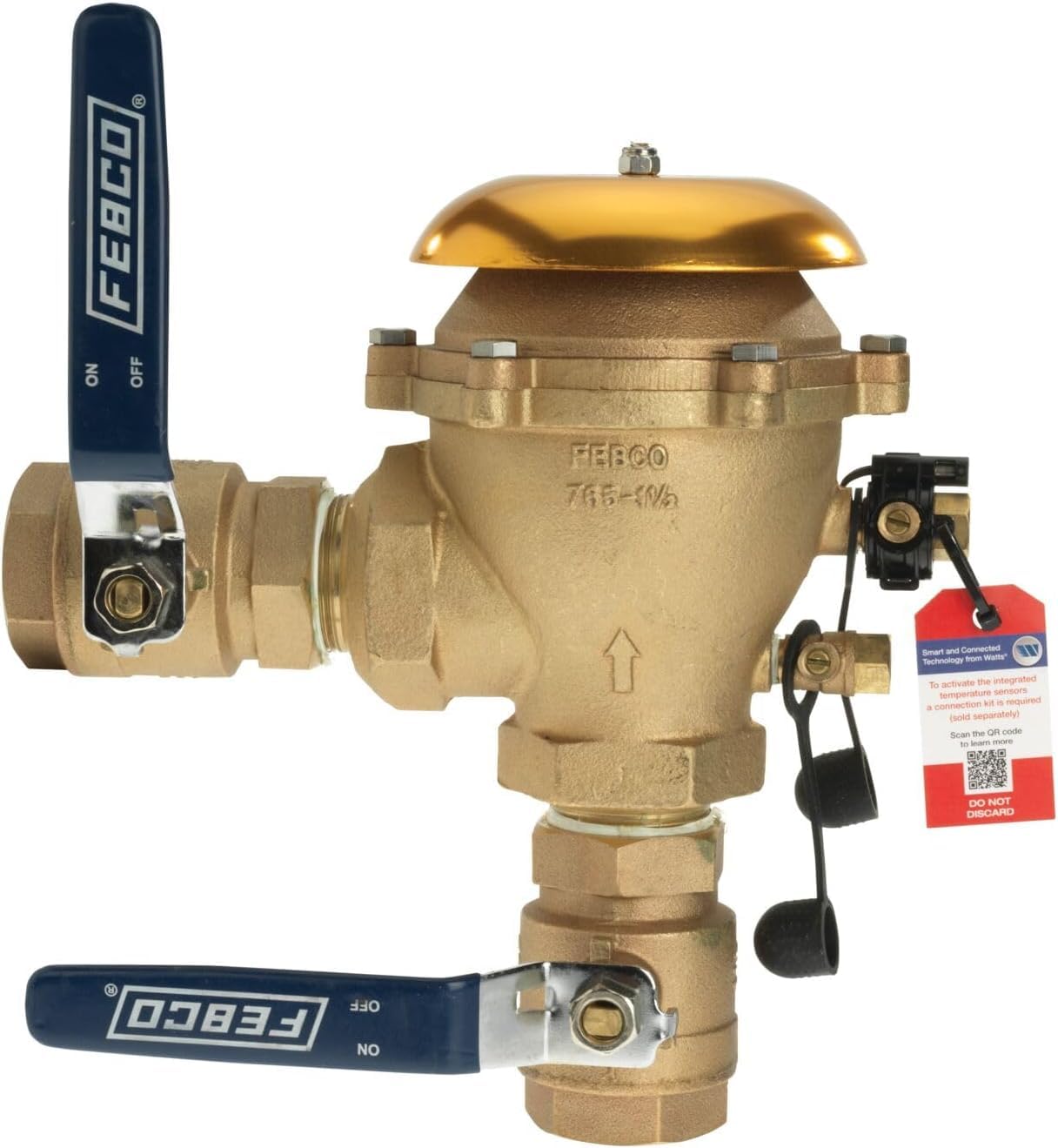
A 6.8-pound bronze workhorse for sprinkler lines that see real winters.
Sprinkler systems are where pressure vacuum breakers live, and this one is built for the job at 6.8 pounds of bronze with a plastic bonnet over the top. That bonnet is not decoration — it is there to shield the assembly from freeze damage, which is the failure mode that ends the life of an unprotected vacuum breaker. The internals are equally purposeful: a spring-loaded check valve, an air relief valve with an opening port, two resilient seated shutoffs, and test cocks. NPT end connections and 1.5 inch inlets match standard irrigation risers.
The spec sheet answers the two questions irrigators actually ask. Working pressure tops out at 150 psi and the temperature range runs from 32 degrees F to 140 degrees F, so you know exactly where this unit’s comfort zone ends. It is also engineered for minimum head loss, which means it does not steal pressure from your sprinkler zones on the way through. Reviewers repeatedly describe it as an exact replacement for a very old Febco unit, installed, tested, and running well.
The honest detail worth knowing: a pressure vacuum breaker is not an RPZ. It protects against back-siphonage, which is the irrigation scenario, but it is not the assembly you choose for a health-hazard backpressure situation. The other thing to plan for is that the shutoff handles occasionally need a snug after installation — if you see a drip from either handle nut, tightening the interior nut sorts it out. Customers note: “Looks like original that lasted ~20 years; hope it lasts 20+ years too.”
Why irrigators keep rebuying it
- Plastic bonnet shields the assembly from freeze damage on exposed sprinkler risers
- 150 psi maximum working pressure and a 32 to 140 degrees F range are published and clear
- Designed for minimum head loss, so sprinkler zones keep their pressure
- Freeze sensor works with SentryPlus Alert technology for an early cold warning
- Exact-replacement fit for aging Febco units already in the ground
What to keep in mind
- Back-siphonage protection only — not the right assembly for health-hazard backpressure
- Shutoff handles can drip after install until the interior nut is snugged down
- Bronze is heavy, and at 6.8 pounds it is a two-hand job on a ladder
This is the one for: irrigation systems in cold-winter regions where freeze protection and minimum head loss matter more than anything else.
Not the right assembly for: a health-hazard cross-connection — the Zurn’s reduced pressure design covers that ground, not a vacuum breaker.
Understanding the Specs
Assembly Type: RPZ vs Double Check vs Vacuum Breaker
These three names describe three levels of protection, and your local code decides which one you need. A reduced pressure principle assembly handles both back-siphonage and backpressure and is the standard where a health hazard exists. A double check valve assembly covers non-health-hazard cross-connections in continuous-pressure piping, which is why it shows up on irrigation and service lines. A pressure vacuum breaker protects against back-siphonage and is common on sprinkler systems. Buying a higher tier than your code requires is not wrong — it just costs more and adds a relief port that can drip.
Connection Size and Thread Type
All three assemblies here are 1.5 inches at the inlet, so the pipe diameter is not the variable — the thread and port style is. NPT is National Pipe Tapered, meaning the threads taper and seal as you tighten them, which is the most common match on both irrigation risers and service entrances. Full port describes a valve opening that does not narrow the flow path. If your existing line uses one and you buy the other, you are back at the hardware store for adapters, so check before ordering.
Maximum Pressure and Temperature Range
Pressure ratings tell you the ceiling the body can take, and the Febco publishes 150 psi as its maximum working pressure. Temperature range tells you the window before physics takes over — again on the Febco, that window runs from 32 degrees F up to 140 degrees F. Anything outside that range, especially trapped water below freezing, is where bronze bodies crack. A freeze sensor tied to SentryPlus Alert technology is the warning system for that exact risk.
Serviceability and Part Availability
The real cost of a backflow preventer is the labor every time it needs attention, not the assembly. Look for in-line serviceability and replaceable components so you are not cutting pipe. The Watts uses a top-entry modular design with one access cover and replaceable check discs and seats. The Zurn lets you service the entire unit in line and sells a repair kit, and it puts the first check where you can reach it for quick debris removal. Both designs save hours of labor over the life of the install.
FAQ
Do I need an RPZ or a double check valve for my 1 1/2 inch line?
Will these fit onto my existing 1 1/2 inch pipe threads?
How do I stop a backflow preventer from cracking in a freeze?
How long does a 1 1/2 backflow preventer typically last?
Is a pressure vacuum breaker the same as an RPZ?
Can I repair one of these instead of replacing the whole assembly?
What is the maximum pressure and temperature a 1 1/2 inch assembly can handle?
Does a backflow preventer reduce water pressure in my irrigation system?
Do these assemblies require annual testing and certification?
Which of these three is the best fit for a residential sprinkler system?
Final Thoughts: The Verdict
For most buyers, the 1 1/2 backflow preventer to beat is the Zurn Wilkins 112-975XL2, because it covers the highest hazard level and can be serviced entirely in line with a repair kit instead of a full replacement. If you are protecting an irrigation or service-line cross-connection, save the capability and grab the Watts LF007, which fits tighter spaces and warns you before a freeze. And for a cold-climate sprinkler system, the Febco 765 is the one to reach for, with published 150 psi and 32 to 140 degrees F limits and a bonnet built to shrug off winter. Whichever you pick, match the assembly class to your hazard level first — that single decision is the one your inspector checks.
How We Picked
We do not accept paid placement. Every pick is matched to a real buyer and a real use-case; we do not hands-on test units.
Sources & Methodology
Specifications: manufacturer listings and product documentation. Review insights: verified customer reviews, as of September 2026. Pricing: not shown on this page (it changes often); check the current price via the retailer link.
As an Amazon Associate, Gadgets Feed earns from qualifying purchases. This does not affect which products we feature.