
Our readers keep the lights on and my morning glass full of iced black tea. As an Amazon Associate, I earn from qualifying purchases.
Specs are compiled from manufacturer listings and verified buyer reviews and can change over time — please confirm the key details on the product page before buying.
You want one blade that opens a package, shaves tinder, and still holds an edge after a wet weekend — and the knife that does that for you rarely matches what the marketing says. The real deciders are simpler than the boxes suggest: how the grip feels soaked, whether the steel keeps an edge, and whether the sheath actually holds the knife. This guide walks through nine genuinely different camp knives, from a pocket-sized multi-tool to a full fixed-blade workhorse, so you can pick the one that fits your hands and your trips.
I’m Min — the founder and writer behind Gadgets Feed. This guide is built by comparing the manufacturers’ published specifications and the patterns across verified customer reviews, so you get each pick’s real strengths and trade-offs instead of marketing spin.
Camp knives split into two jobs — the folding blade you carry daily and the fixed blade that handles fire and food — so the right buy depends on which one you actually reach for. Below is a plain-spoken walkthrough of the camping knife options worth your money.
Our Picks at a Glance


How To Choose The Best Camping Knife
A camp knife has two jobs at the fire: making tinder and making dinner. The blade that carves feather sticks and whittles kindling is not always the blade that skins a trout or slices an apple, and knowing which of those you actually do most is the first decision. Everything after that — steel, handle, sheath — flows from it.
Fixed blade or folding
A fixed blade locks into a sheath and never folds, so there is no joint to loosen or fail when you are bearing down on a stubborn branch. A folding knife disappears into a pocket and walks the trail with you unnoticed, but its pivot is the part you will eventually have to oil and tighten. If your camping involves firewood, go fixed. If it is mostly box opening, food prep, and the occasional splinter, a folding knife earns its place.
The steel behind the edge
Steel grade decides how long you cut before you have to sharpen again. High-carbon stainless blends are the common workhorse — they resist rust in wet grass and still take a keen edge. Harder steels hold that edge longer but take more effort to bring back. If you hate sharpening in the field, lean toward stainless; if you enjoy a strop at the tent, you can go harder.
Handle and sheath: the parts nobody brags about
Your grip is where the knife meets your hand, and it matters most when both are wet. Rubberized and textured handles lock in when a smooth one would turn. The sheath is the second half of the knife — a loose one loses your blade in the brush, and a snug one lets you draw one-handed. Watch for retention (how hard the sheath holds the knife) before you commit.
Quick Comparison
| Model | Best For | Blade Length | Weight | Blade Type | Amazon |
|---|---|---|---|---|---|
| Victorinox Huntsman Swiss Army Knife★ Best Overall | Everyday carry and camp chores | Large blade | 97 g / 3.4 oz | Folding, 15 functions | Amazon |
| Gerber Gear Pledge Pocket KnifeLightest Carry | Lightweight everyday carry | 3.7 inches | 2.9 ounces | Folding, reverse tanto | Amazon |
| Old Timer 15OT DeerslayerBest Fixed Blade | Hunting and field dressing | 5.6 inches | 7.7 ounces | Fixed, clip point | Amazon |
| Buck Knives 684 Small BuckLite Max II | Field dressing and camp food prep | 3.25 inches | 2.8 ounces | Fixed, drop point | Amazon |
| Kizer Beaver Fixed Blade | Concealed fixed-blade carry | 2.75 inches | — | Fixed, D2 drop point | Amazon |
| Ruike 14C28N Bushcraft | Bushcraft and batoning | 4.33 inches | 6.72 oz | Fixed, drop point | Amazon |
| Buck Knives 110 Folding Hunter | Classic lockback everyday carry | 3.75 inches | 7.2 oz | Folding, clip point | Amazon |
| Gerber Gear StrongArm | Tactical survival and fire prep | 4.8 inches | — | Fixed, straight edge | Amazon |
| Benchmade Mini Griptilian 556 | Premium everyday carry | 2.91 inches | — | Folding, drop point | Amazon |
In‑Depth Reviews
1. Victorinox Huntsman Swiss Army Knife
Our pick — over 4.5★ from 19,500+ verified ratings; the strongest balance of quality and price.
The pocket-size fifteen-tool kit that handles camp, car, and kitchen without ever needing a sheath.
If your camping is car-camping, day hikes, and the occasional splash of wine, this is the one that earns its pocket space. The Huntsman folds to 91 mm / 3.6 in long by 26 mm / 1 in wide by 21 mm /.8 in tall and weighs 97 g / 3.4 oz, so it disappears into a pocket or a glovebox until you need it. Buyers report measurements of “91 mm / 3.6 in long × 26 mm / 1 in wide × 21 mm /.8 in height. Weight: 97 g / 3.4 oz.” — exactly what you feel in hand, light enough to forget until the moment it matters.
What wins people over is the sheer breadth of tiny jobs it covers — the scissors trim a hangnail, the can opener saves dinner when the pull-tab fails, the corkscrew rescues the bottle, and the wood saw rips through a branch in the fire pit. That toolset is why the Huntsman earns its place: it is the pocket knife most people reach for when they say they want one knife to do everything. The scissors and wood saw are the two additions that separate it from a basic pocket model, and both get used more than you would guess.
The honest catch is that none of the fifteen functions is as strong as a dedicated single-purpose knife — the large blade is fine for food and rope but not for batoning firewood, and the tools are small enough that the wood saw takes patience on anything over wrist-thickness. For that kind of work you want a fixed blade with a longer edge, not the Victorinox. Think of the Huntsman as the backup folder that lives in your pocket while the fixed blade stays in the pack.
Why hunters and campers pick it
- Fifteen functions including wood saw, scissors, can opener, corkscrew, and two screwdrivers
- Compact 97 g / 3.4 oz carry that slips into a pocket or glovebox without weighing you down
- Sharp, precise tools with no wobble from the start
Where it taps out
- Small tools take patience on thick branches; not a batoning knife
- Blades do not lock, so careless pressure can fold one back — cut with steady intent
- Pickpockets of the trail will find it in the pocket of whatever you wore last
Best match if: you want one compact tool for camp, car, and garden and value a blade that never rusts and never needs oiling.
Look elsewhere if: your camping means splitting firewood, where you need a longer fixed blade and a lockback joint that takes real pressure.
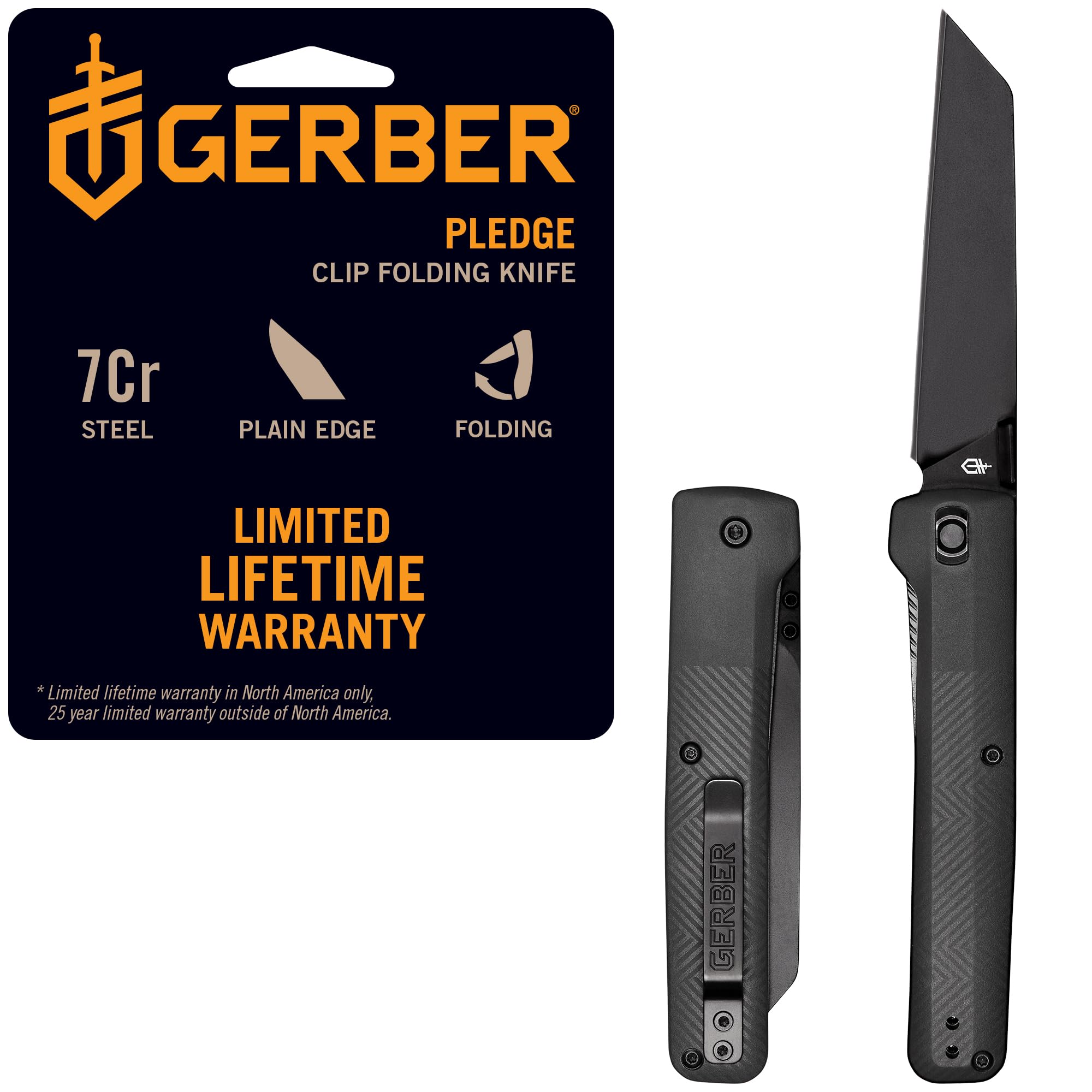
2. Gerber Gear Pledge Pocket Knife
An ounce-pinching folder that rides your pocket like a business card and pops open one-handed.
At 2.9 ounces, the Pledge is the lightest full-size folder on this list. Carry it against the Old Timer 15OT Deerslayer’s 7.7 ounces and the difference is a 2.7x gap in favor of the Gerber — which means on a long backpacking trip you notice the Pledge is in your pocket only when you reach for it. The 3.7-inch reverse tanto blade and the folding body keep the whole thing slim enough that it slides past a pocket seam without printing.
The steel is stainless and plain-edged, so it cleans up easily and takes an edge without a steep re-profile. Owners describe it as sharp right from the start, and the reverse tanto lets you get a fine point into packing tape and cardboard without dragging the belly of the blade across the box. The reversible pocket clip and thumb stud let lefties and righties both deploy it one-handed. Build quality and lockup hold up to daily pocket abuse — the liner lock clicks firmly and the handle has a textured grip that beats a smooth plastic handle in cold or damp conditions.
What keeps people talking is how much knife you get at the weight: it feels like a substantially bigger blade in hand. The honest caveat is that at 2.9 ounces there is not much meat to the handle, so slicing through a stiff double-walled box needs a firm grip rather than a lazy one. Treat it as a 2.9-ounce everyday carry slicer, not a firewood splitter.
Field verdict: the Pledge is a sub-three-ounce folder with a liner lock, stainless blade, and reversible clip that carries completely flat in a pocket. It is the knife that rides unnoticed in a pocket until the trail mix bag needs opening.
Reach for this if: you want an ultralight everyday carry with a fine-tip blade that opens one-handed, and you care more about pocket weight than batoning.
Think twice if: you need a knife for splitting wood or heavy camp chores — this is a slicer and a food-prep pocket companion, not a firewood tool.
3. Old Timer 15OT Deerslayer
A traditional fixed hunter with a five-and-a-half-inch clip point and a leather sheath worth the price alone.
If your camping involves any chance of cleaning a fish or dressing game, the Deerslayer is the one that does the job without apology. The 10.5-inch overall length and 5.6-inch clip point blade give you a working edge that reaches through a salmon or a whitetail without running out of blade mid-cut. At 7.7 ounces it is far heavier than the Gerber Pledge’s 2.9 ounces — the difference is a real 2.7x — but that mass is the whole point: this is a knife built to push.
The full tang (the steel running the full length of the handle, so there is no joint to break under pressure) plus the finger choil and thumb jimping behind the edge give you a locked-in grip whether you are skinning or making tent stakes. Buyers consistently note it arrives razor-sharp and stays that way through a hunting season. The brown leather belt sheath is riveted and real leather rather than nylon; the sheath gets mentioned on its own in reviews as one of the standout details of the package.
The trade-off to know upfront is weight and size — 7.7 ounces and a five-point-six-inch blade is not an everyday carry knife, and the fine clip point is not a cleaver. It is built for slicing meat, fish, and rope, not for chopping through knotted oak. If you want one fixed blade for camp and the field, this is the straightforward answer.
Why it wins outdoors: a full-tang high-carbon stainless blade with a five-and-a-half-inch reach, wrapped in a real leather sheath — the combination does hunting, fishing, and camp duty without a single feature pretending to be something it is not.
What you give up: it will not disappear in a pocket daypack side pouch the way a folder will, and the leather sheath needs a break-in before the knife slides in smoothly.
Suits you if: you hunt, fish, or process anything at camp and want a full-tang fixed blade with a sheath that also covers a hunting knife’s extra-long blade.
skip it if: you want a lightweight carry knife — this is a belt knife for the field, and the weight is part of the package.
4. Buck Knives 684 Small BuckLite Max II
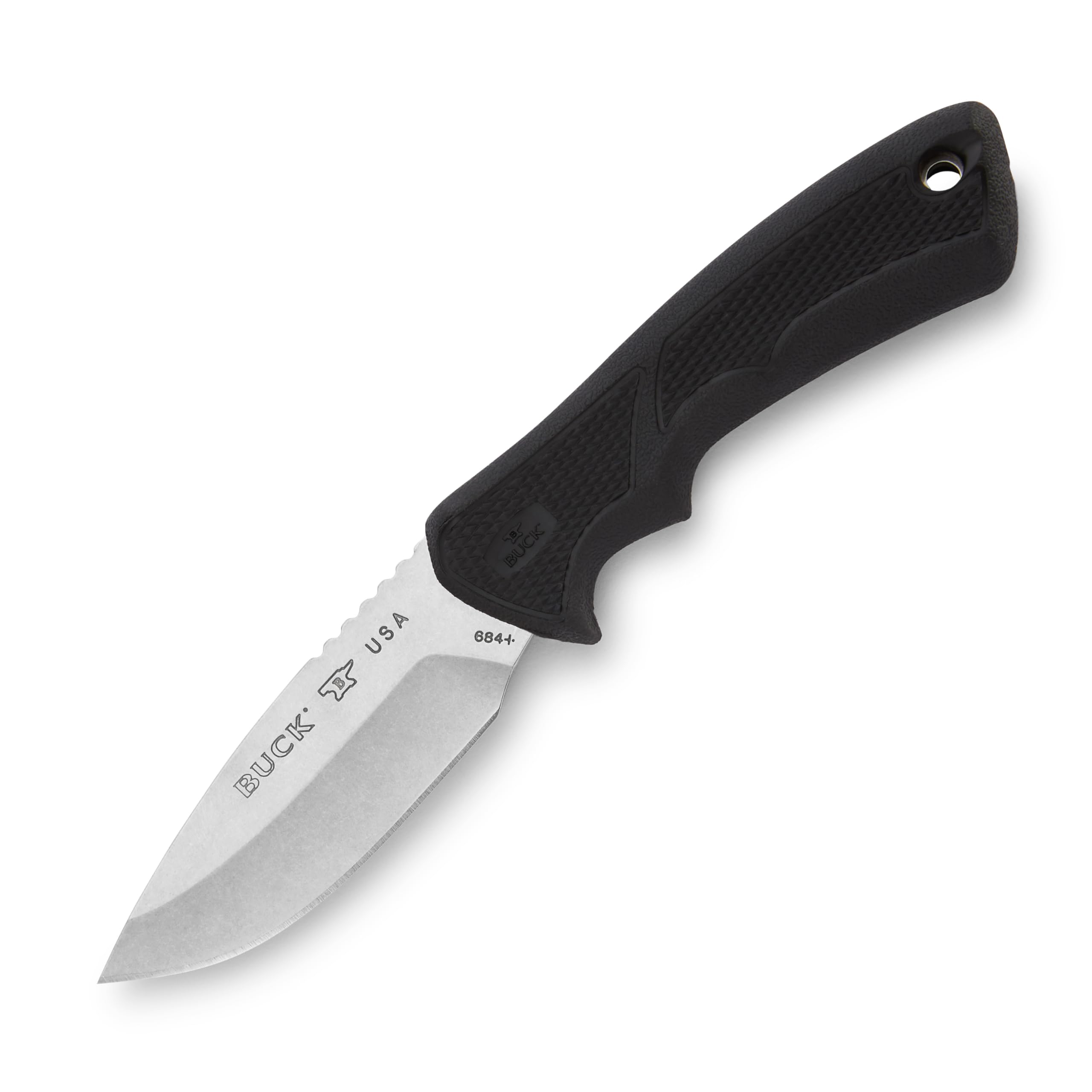
A three-and-a-quarter-inch fixed blade light enough to forget, built around a rubber grip that stays put when your hands are wet.
For the camper who wants a fixed blade without carrying a belt knife all day, the BuckLite Max II is the answer. The 3.25-inch 420HC stainless drop point is heat-treated for edge retention, and the whole knife weighs just 2.8 ounces — light enough that a belt sheath feels like nothing on your hip through a full day of hiking. This is the knife you grab for field dressing, slicing the sausage at lunch, or whittling a stick for the fire, and it handles all three without ever cluttering your gear.
The Dynaflex rubber handle with integrated finger grooves and top jimping is the standout: it grips even when wet, which is the actual difference-maker once you are knee-deep in a stream or holding a slippery fish. Owners mention the blade arrives extremely sharp and the rubberized grip feels secure under load. The full-tang construction underneath gives it more backbone than you would expect at this weight, and the drop point is a forgiving shape for anyone still learning to field dress.
The honest catch is the sheath: reports mention it can be loose enough that a knife has been known to slip out if you are moving through heavy brush. An easy fix (add a small clip or cinch) solves it in seconds, but it is worth doing before your first trip. The 420HC steel also asks for a touch-up after a few heavy use sessions — it sharpens quickly, which is the trade for soft, easy-to-work steel.
What makes it easy to carry
- 2.8 ounces for a full-tang fixed blade — disappears on the belt
- Dynaflex rubber handle with finger grooves locks in wet hands
- Made in the USA and backed by Buck’s lifetime warranty
Where it needs attention
- The included sheath can be loose; secure it before rough trail use
- 420HC steel holds an edge but needs regular sharpening under heavy field use
- The three-and-a-quarter-inch blade is on the small side for larger game
Who should grab one: hikers and first-time hunters who want USA-made fixed-blade capability at a feather weight and do not mind a quick sheath tweak.
Who should look past it: if your camp knife doubles as a firewood splitter, you want more blade length and a thicker spine.
5. Kizer Beaver Fixed Blade Knife

A two-and-three-quarter-inch D2 blade with a Kydex sheath that snaps in like a holster.
Small fixed blades live or die on the sheath, and the Kizer Beaver is the one that gets it right. The D2 tool steel drop point is 2.75 inches — the actual sharpened edge runs a touch shorter — but the blade is thick and beefy enough that everyone who handles it comments on how substantial it feels for its size. The D2 holds an edge and resists corrosion in wet conditions, which is exactly what you want on a belt knife that will see rain, mud, and the occasional river crossing.
The curved brown Micarta and black G10 handle is where the knife separates itself from the field: Micarta is the outer layer that stays comfortable in heat and moisture, and the G10 underlayer adds rigidity and durability. The textured surface and rounded profile make it a comfortable three-finger grip (some prefer a three-and-a-half). The included Kydex sheath retains with a positive click — hunters report it is the best factory Kydex sheath they have used, and it snaps in securely enough to carry inverted on a pack strap.
What keeps people buying this one is how easily it hides: a compact handle on a sheath that mounts vertically, horizontally, or on a shoulder strap means you can carry it however the day demands. The honest limit is the handle length — three fingers and a half is not a four-finger grip, and if you have larger hands you will want something longer for heavy work. For a lightweight fixed blade, though, the trade is a fair one.
Why it wins at this size: a 2.75-inch D2 drop point with a Kydex sheath and a three-finger Micarta-and-G10 grip — a compact fixed blade you can hide on your belt or strap.
Fits you if: you want a small fixed blade that disappears under a jacket and snaps into a secure sheath — the pick for compact everyday carry and lightweight backpacking.
Not for you if: you need a four-finger grip or a longer blade for splitting wood; this is a detail and defense blade, not a bushcraft chopper.
6. Ruike 14C28N Bushcraft Fixed Blade

A full-tang bushcraft blade with a rotating sheath that locks where you want it.
If your camp knife is going to chop through wrist-thick branches and shave kindling for the fire, the Ruike is the one built for it. The 4.33-inch drop-point blade is Sandvik 14C28N hardened to 57-59 HRC — the hardness scale that rhymes with how long an edge lasts, and 57-59 puts this well into the tough, edge-holding range. The single-piece steel tang is 0.18 inches thick, and the knife weighs 6.72 ounces, which gives you the mass to let the blade do the work instead of your wrist.
What separates the Ruike is the sheath. It rotates 360 degrees and locks firmly at any angle, so you can set the draw for right or left hand, vertical belt carry, or scout carry on the back. Retention is friction-lock, meaning the blade stays rattle-free without a strap you have to unsnap every time, and reviewers describe it as a rotating sheath that feels almost like a locking holster. The G10 fiberglass handle and deep finger choil keep your hand locked in even when the blade is wet from chopping sap-heavy wood.
The recurring gripe is the belt attachment: it sticks out about three-quarters of an inch and is riveted rather than modular, so an aftermarket clip fixes a real annoyance rather than a defect. The other honest note is that 14C28N is a stainless steel, which trades some of the sheer toughness of a carbon blade for its rust resistance — a reasonable trade on a camping knife that will get rained on. If you want a knife that can baton, carve, and eat its way through camp tasks, this is the one.
The case for it
- 4.33-inch Sandvik 14C28N blade hardened to 57-59 HRC for edge retention
- 360° rotating ABS sheath locks firmly at any angle for horizontal, vertical, or scout carry
- Full-tang construction with a 0.18-inch single-piece steel tang
The wart to know
- Belt attachment sticks out and is riveted to the sheath; an aftermarket clip fixes it
- The 6.72-ounce weight is substantial for pocket carry
- Rotating mechanism adds bulk to the sheath profile
Choose it if: you bushcraft, baton, or hunt and want a full-tang stainless blade with a sheath that locks into whatever carry angle fits your trip.
Move on if: you want a knife that disappears in a pocket — this is a belt knife built for real camp work.
7. Buck Knives 110 Folding Hunter
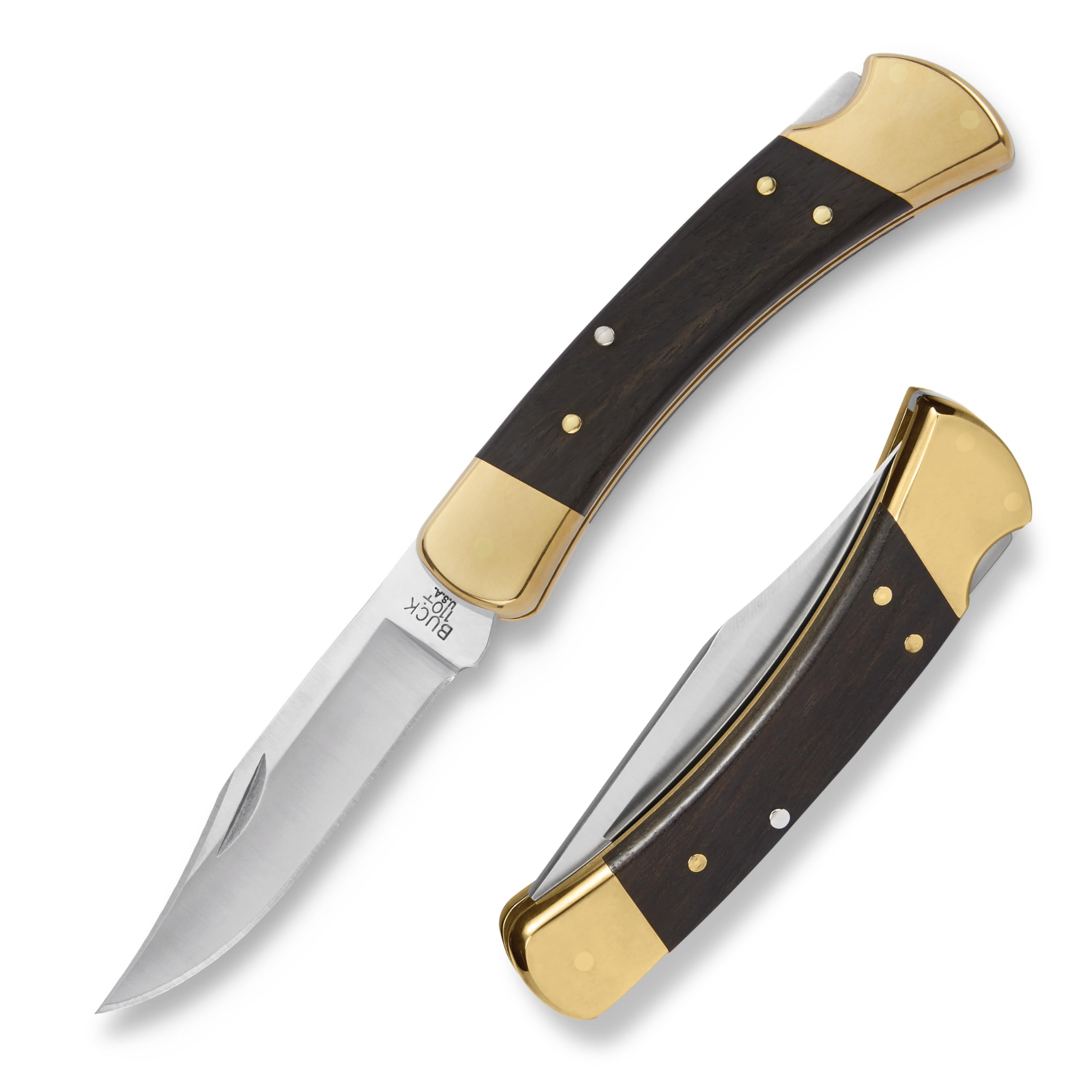
The brass-and-ebony lockback that has been on American belts since the middle of the last century.
A folding knife that behaves like a fixed blade is rare, and the Buck 110 is the original. The 3.75-inch 420HC stainless clip blade locks firmly in place with the iconic lockback design — the joint snaps over center and stays there under load, so you can cut with the confidence of a fixed blade but fold it closed for the pocket. The knife is 8.63 inches open, folds to 4-7/8 inches closed, and weighs 7.2 ounces. That weight is the point: it feels like a real tool in hand, not something that flexes when you push it.
Owners describe it as razor-sharp from the start and built to last a lifetime — the kind of knife that gets handed down rather than replaced. The brass bolsters and ebony handles are the aesthetic that made this model famous; it looks like what a hunting knife is supposed to look like, and it sits in a slim leather sheath with a snap fastener and belt loop for secure carry. It is the knife you carry because a brass-and-ebony lockback has worked this well for this long.
The honest trade-off is weight and width. The 7.2-ounce weight and 4-7/8-inch folded length are substantial for a folder — this is a belt-carry knife in the sheath, not a clipped pocket knife. It is also heavy enough that a dedicated pocket carrier will feel it, so the leather sheath is the better carry. For long walks and light use, a smaller folder does the work without the heft. For real hunting and camp work, the weight is the reason it feels like a serious tool.
Why it endures: 420HC stainless, a locking blade, brass bolsters, ebony handles, a lifetime warranty, and a USA-made build — this is what the classic American folding hunter looks like when it is done right.
What to expect: substantial weight and a wide folded profile, which means belt carry rather than pocket carry for most owners.
Right for you if: you want a folder that handles like a fixed blade on the belt, appreciate brass-and-ebony looks, and value a knife you can hand down.
Wrong for you if: you need a featherweight pocket clip daily carry — the 110 is a substantial belt knife, not a slim folder.
8. Gerber Gear StrongArm Fixed Blade Knife
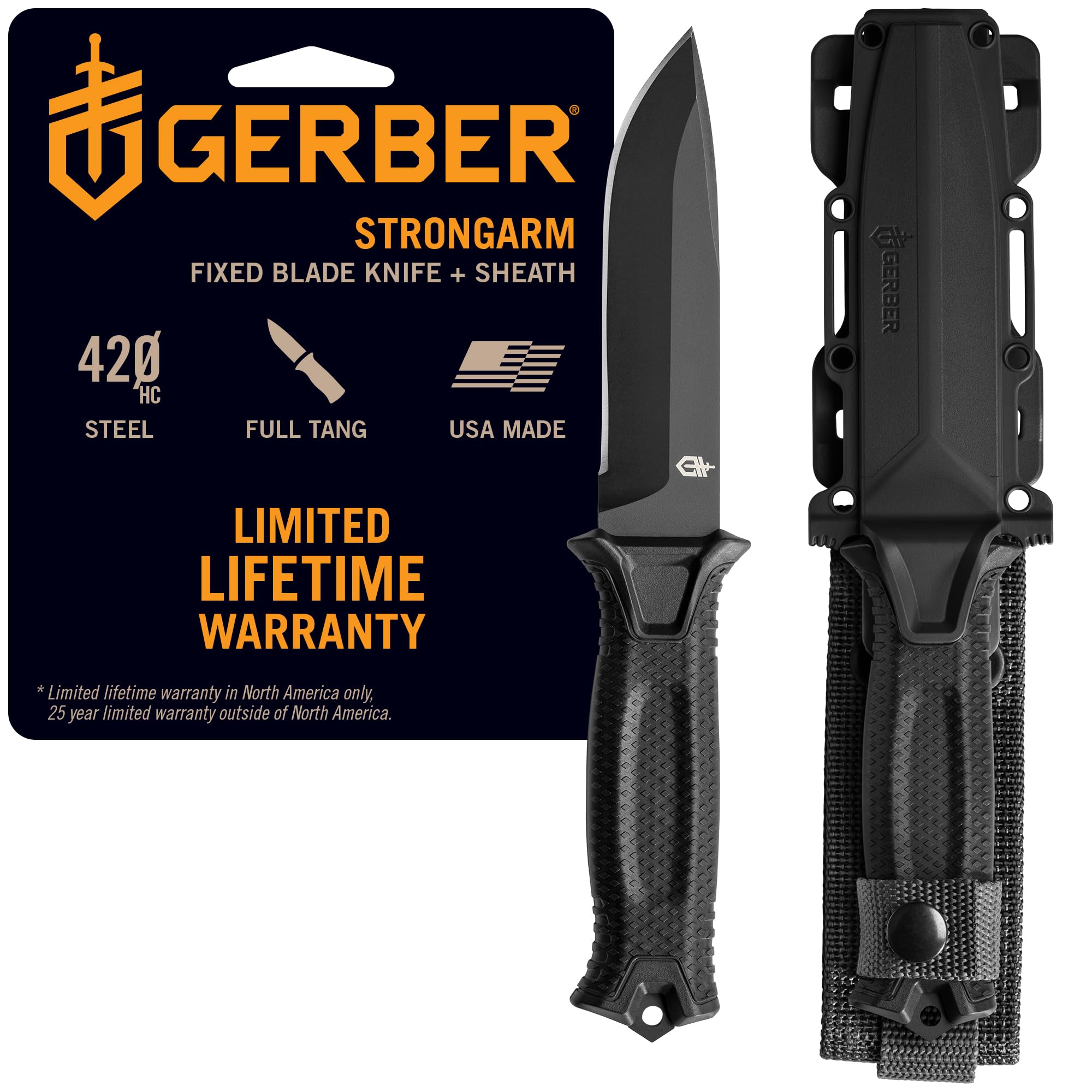
A full-tang survival blade with a striking pommel and a sheath that mounts almost anywhere.
When the trip is less “weekend at the lake” and more “everything has to earn its place in the pack,” the StrongArm is the knife that makes the cut. The 4.8-inch plain-edge blade in 420HC stainless is full-tang, which means the steel runs the whole length of the handle for maximum strength — no joint to break under pressure and no mystery about whether the blade will stay in the handle. The knife is 9.8 inches overall and offers a striking pommel (a hardened butt end that drives stakes, breaks glass, or crushes nuts) as a secondary tool.
The diamond-textured rubber grip is the feature owners bring up again and again — it locks into wet, greasy, or muddy hands and stays there. The knife runs to a plain edge rather than combo serrations, which means every inch of sharpened blade slices food, rope, and kindling instead of one quarter of it working like a saw. The MOLLE-compatible sheath supports belt, drop-leg, scout, and inverted carry, and reviewers consistently note that the sheath is as well-designed as the blade — retention is solid without needing a strap, and the carry options adapt to whatever strap, belt, or pack you wear.
The honest limit is at the two ends of the temperature range: reports mention the polymer sheath getting brittle in extreme cold, and the 420HC steel will need sharpening more often than a pricier high-carbide steel under sustained use. Neither is a deal-breaker — 420HC is easy to bring back to sharp and will not chip or roll on reasonable use — but if you are planning alpine trips and long expeditions, know what you are asking of the steel. For most camping, hunting, and preparedness work, the StrongArm is a do-everything fixed blade.
Why the field keeps one
- Full-tang 420HC stainless blade with a striking pommel for secondary tasks
- Diamond-textured rubber grip stays secure when wet, greasy, or muddy
- MOLLE-compatible sheath with belt, drop-leg, scout, and inverted carry options
- Made in the USA
What to expect under hard use
- Polymer sheath can get brittle in extreme cold
- 420HC steel holds an edge but does need periodic sharpening under sustained heavy use
- Fixed blade carry means a belt or pack mount rather than a pocket
Buy this one if: you want one fixed blade for camping, hunting, and emergency prep with a grip that works in any condition and a sheath that mounts however you carry.
Keep looking if: you want a pocket folder — the StrongArm is a belt knife and does not fold.
9. Benchmade Mini Griptilian 556

The premium folder that opens and closes one-handed and holds an edge far longer than the price of admission suggests.
This is the folder for the camper who wants S30V steel and an AXIS lock and will pay premium for both. The 2.91-inch S30V stainless drop-point blade is the headline: S30V is a high-alloy stainless prized for edge retention, so you spend less time sharpening and more time cutting. The knife measures 6.78 inches open and folds into a Grivory glass-filled nylon handle with a textured grip — light, slim, and molded for a solid hand feel.
The AXIS lock is what most owners name first when they describe why this knife stays in their pocket. It is a bar that slides sideways across the tang to lock the blade open, and it can be operated one-handed with a thumb and forefinger, so the blade flicks open and closes with a single hand. That matters when you are holding a rope with one hand or wearing gloves. The reversible clip, ambidextrous handle, and lanyard hole round out a design that works equally well for left and right-handed owners. Benchmade’s LifeSharp service also re-sharpens the blade to a factory edge for the life of the knife — a genuine long-term benefit and a rare one.
The honest catch is that this is a premium purchase, and reports mention the knife may arrive stiff from the start and want a small pivot adjustment before it flicks freely. That is a two-minute tune, not a flaw. The other consideration is the two-and-nine-tenths-inch blade — it is ideal for everyday carry tasks, but not the knife you reach for when you need to baton firewood. For daily carry and light camp work, the steel and lock make it the most refined folder here.
What sets it above the field: S30V stainless steel, an AXIS lock that opens and closes one-handed, a glass-filled nylon handle, and free lifetime re-sharpening from Benchmade — a serious everyday carry built by people who know knives.
For you if: you want the best everyday carry folder with steel and a locking mechanism that outperform the field, and you value the free lifetime sharpening.
Not for you if: you want a budget knife or a fixed blade for woodcraft — this is a premium pocket knife, not a chopper.
Understanding the Specs
Blade Steel
Blade steel is the recipe of metals in the blade, and it decides whether the edge stays sharp through camp chores or needs a touch-up after dinner. Stainless blends like 420HC hold up to wet grass and rain without rusting, and they sharpen easily in the field. High-alloy steels like S30V and Sandvik 14C28N hold an edge longer and resist cracking under stress, but the trade is a higher price and a little more effort at the sharpener. Match the steel to how often you actually sharpen — the answer is almost always “less than you plan to.”
Tang, Lock, and Handle
The tang is how far the steel runs into the handle. A full tang (steel running the entire handle length) gives the knife strength in a baton, and you feel it immediately when you press down. A partial tang is lighter and well-suited to folding knives like the Victorinox Huntsman and Benchmade Mini Griptilian. Handle material matters for grip: Dynaflex rubber on the BuckLite and diamond-textured rubber on the Gerber StrongArm grip in wet conditions, while Micarta and G10 on the Kizer Beaver resist heat and moisture with a firm, textured surface.
FAQ
Is a fixed blade or a folding knife better for camping?
What blade steel is best for a camping knife?
How long should a camp knife blade be?
Can I take a camping knife in my carry-on luggage?
Does a full tang really matter on a camping knife?
How do I keep my camping knife from rusting?
Is a lockback folder strong enough for camp work?
Why do so many camp knives include a leather sheath instead of plastic?
What should I check first on a new camping knife?
Can a camping knife handle both firewood and food prep?
Final Thoughts: The Verdict
For most campers, the camping knife winner is the Victorinox Huntsman Swiss Army Knife because its fifteen functions cover the widest range of camp, car, and kitchen jobs in one compact, rust-resistant package that lives in your pocket. If firewood and game processing are your priority, grab the Gerber Gear StrongArm for its full-tang build and MOLLE-ready sheath. And for hunters who want a traditional full-tang field knife, the Old Timer 15OT Deerslayer is the one to reach for.
The Benchmade Mini Griptilian 556 is the pick if you want the finest everyday-carry folder with premium S30V steel and a one-handed AXIS lock; the Kizer Beaver is the one to grab if you want a small fixed blade that hides easily; and the Gerber Pledge is the lightest carry on the list for anyone counting ounces. Whichever you choose, match the blade to the trip — a knife left at home cuts nothing.
How We Picked
We do not accept paid placement. Every pick is matched to a real buyer and a real use-case; we do not hands-on test units.
Sources & Methodology
Specifications: manufacturer listings and product documentation. Review insights: verified customer reviews, as of September 2026. Pricing: not shown on this page (it changes often); check the current price via the retailer link.
As an Amazon Associate, Gadgets Feed earns from qualifying purchases. This does not affect which products we feature.