
Our readers keep the lights on and my morning glass full of iced black tea. As an Amazon Associate, I earn from qualifying purchases.
Specs are compiled from manufacturer listings and verified buyer reviews and can change over time — please confirm the key details on the product page before buying.
If your newborn gulps, spits up, or screams through a bottle, the nipple is almost always the problem — not your baby. The right newborn bottle has a slow-flow nipple (a teat with a tiny hole that lets milk trickle instead of pour), a small 2 to 5 oz capacity that matches a newborn’s stomach, and a shape that stays close to the breast so switching back and forth feels familiar. Get those three things right and feeds get quieter, shorter, and far less messy.
I’m Min — the founder and writer behind Gadgets Feed. This guide is built by comparing the manufacturers’ published specifications and the patterns across verified customer reviews, so you get each pick’s real strengths and trade-offs instead of marketing spin.
Below you’ll find the vent systems, nipple stages, and materials that separate a bottle your baby accepts from one that ends up in a drawer — plus which warning signs to check before you buy. Every pick here is matched to the newborn stage, so this is the shortlist for bottles for newborns worth your money.
Our Picks at a Glance

How To Choose The Best Bottles For Newborns
A newborn drinks 2 to 4 oz per feed in the early weeks, so a bottle built for that stage — not an 8 oz toddler bottle — is the single biggest thing to get right. Three details decide whether a bottle works in your kitchen: the nipple flow, the vent, and the material of the body.
Match the nipple flow to the age, not the marketing
Flow stage is the number that matters. A Level 1 or SS nipple (the slowest in a brand’s lineup) lets milk come out slowly enough for a newborn to swallow and breathe between sucks. Too fast a flow and the milk pools in the mouth, which is what causes gulping, coughing, and half the gas you are trying to avoid. Most brands sell interchangeable nipples in staged sizes, so the body you buy today can grow with your baby by swapping just the teat.
Understand what the vent system actually does
A vent is a small channel inside the bottle that lets air escape as your baby drinks, instead of going into the nipple and then into the milk. A vacuum-free feed — where milk flows steadily without your baby having to pull hard — is what keeps the drinking pace even and cuts the amount of swallowed air. Vent systems add parts to wash, which is the honest trade-off: fewer bubbles versus a longer sink session.
Pick the body material by how you warm and clean
Glass warms and cools fast, holds up to boiling and sterilizers, and never stains — the catch is weight and breakage risk if it is dropped on a hard tile. Silicone is squeezable and quiet, grips easily in small hands, and does not shatter, but it stays warm longer and needs a firm lid to avoid leaks. Plastic is the lightest for a diaper bag. All three are fine for a newborn; choose based on whether the night feed happens at your sink or on the couch.
Quick Comparison
| Model | Best For | Capacity | Count | Material | Amazon |
|---|---|---|---|---|---|
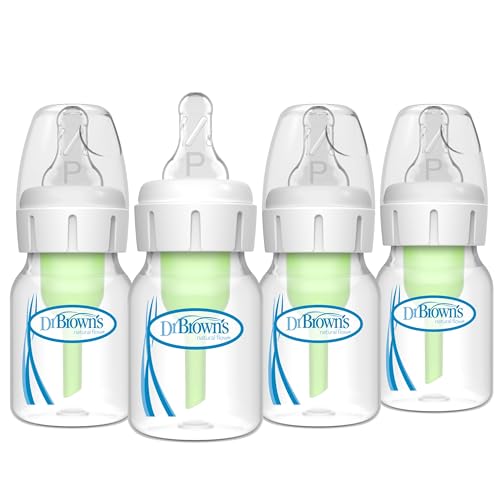
| Dr. Brown’s Anti-Colic Options+ Narrow 2 oz, 4-Pack★ Best Overall | Gassy, colicky newborns | 2 oz | 4-Pack | Plastic | Amazon |
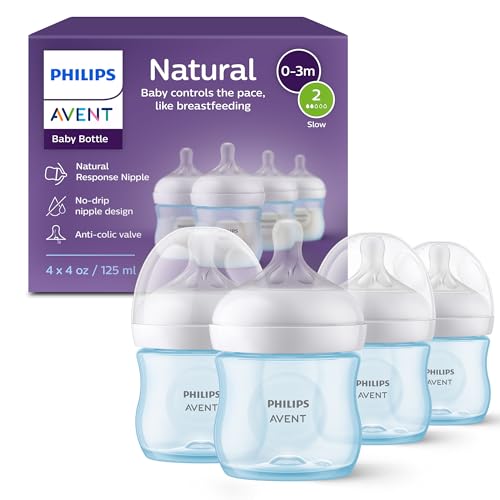
| Philips Avent Natural, 4 oz, 4-PackPremium Pick | Breastfed babies and paced feeds | 4 oz | 4-Pack | BPA-free plastic | Amazon |
| Comotomo Silicone Gen 2, 5 oz, 2 PackMost Gentle Latch | Babies who reject hard bottles | 5 oz | 2 Pack | Silicone | Amazon |
| Avima Anti-Colic, 4 oz, Set of 8 | Stocking a full day of feeds | 4 oz | Set of 8 | BPA-free plastic | Amazon |
| Gulicola Small Glass, 3 oz, 2 Pack | Newborns right out of the hospital | 3 oz | 2 Pack | Borosilicate glass | Amazon |
| Lansinoh Anti-Colic, 5 Ounces, 4 Count | Pickiness and short wash time | 5 oz | 4 Count | BPA-free plastic | Amazon |
| Pigeon PPSU Wide Neck, 5 oz, 2-Pack | Long-term durability and combo feeding | 5 oz | 2-Pack | PPSU | Amazon |
| Dr. Brown’s Anti-Colic Options+ Narrow Glass, 4 oz, 3-Pack | Families who prefer glass at home | 4 oz | 3-Pack | Borosilicate glass | Amazon |
| Thyseed Anti-Colic Glass, 5 oz, 2 Pack | Reflux and heavy gassers | 5 oz | 2 Pack | Borosilicate glass | Amazon |
In‑Depth Reviews
1. Dr. Brown’s Anti-Colic Options+ Narrow Baby Bottle, 2 oz, 4-Pack
Our pick — over 4.5★ from 40,000+ verified ratings; the strongest balance of quality and price.
The hospital-grade vent setup that turns a screaming feed into a quiet one.
The flip side is parts. This bottle has more pieces than almost anything else on this list, and the honest trade-off shows up in the reviews: parents consistently say the anti-colic system works, then immediately mention the extra cleaning time. A dishwasher basket handles it, and several note the nipple is best washed by hand. What wins people over is the effect on a gassy, fussy baby — enough that this is the crowd favorite in the category, holding a 4.8-star average from more than 40,000 owners. If you want the widest margin of “it just works,” this is where to start.
Why it earns the top spot
- Internal vent system is the most proven air-control design in the category
- 4-Pack means you are never mid-wash with a hungry baby waiting
- 2 oz size suits early feeds without wasting formula
- Nipple shape geared to ease the breast-to-bottle switch
What to weigh before buying
- More parts than any other pick, so cleaning takes longer
- Small capacity outgrown within a few months
- Filling past the marked line can cause leaking
Best suited to: any household fighting gas, colic, or a frantic fast-bottle feed — this is the lowest-risk first bottle to try.
Think twice if: your priority is a two-piece bottle you can rinse in seconds, because this one rewards patience at the sink.
2. Philips Avent Natural Baby Bottles, Slow Flow, 4 oz, BPA-Free, 4-Pack
A nipple that only releases milk when your baby actively sucks — pauses built in.
This is the bottle for the breastfed baby who loves the breast and resents everything else. The design works on an active-drinking principle: the unique opening and tip release milk only when your baby is actively sucking, and no milk flows when they pause to swallow or breathe. That built-in break is what mimics a real feeding rhythm and keeps a fast feeder from gulping. The 4 oz capacity is the most useful size for a newborn who has moved past the first days, and the wide breast-shaped nipple is soft to the touch, which is the detail parents keeping coming back to. Each bottle in the four-pack ships with a slow flow nipple (the brand calls it Flow 2).
Durability is a quiet strength here. The bottles hold up in the dishwasher and the nipple design is widely described as leak-proof even when tipped. It is worth knowing that flow is the one genuinely split subject: some babies finish easily while others seem to work hard for the milk, and that depends on how hard your individual baby sucks rather than a flaw in the bottle. If your newborn is a strong, impatient feeder, watch the first few feeds closely.
Unlike the Comotomo below, this one is a rigid plastic body rather than a squeezable silicone bulb, so it stands on the counter without tipping and grips like a standard bottle. It also holds 4.8 stars across tens of thousands of owners, so the design has held up over years of real kitchens.
Where it shines: paced feeding that lets your baby stop and breathe, a soft wide nipple built to feel familiar, and a four-pack that covers a full day.
The honest catch: flow rate is the one thing buyers split on — test the first feed or two before committing to a full shelf.
Reach for this if: you are combination feeding and need a bottle your breastfed newborn will accept without a fight.
Look elsewhere if: your baby is an unusually strong sucker who drains bottles fast and needs the very slowest flow available.
3. Comotomo Silicone Baby Bottle Gen 2, 5 oz Newborn Slow Flow, Green, 2 Pack
A soft silicone bottle that feels like skin and quietly survives the drop test.
If your baby has already rejected a drawer full of rigid bottles, this is the one to hand them next. The body is soft, squeezable silicone, and the nipple is laser-punctured (a tiny precision hole rather than a cut slit) to deliver a true slow flow for 0 to 3 months — a consistent trickle that supports a calmer, more natural pace. The Gen 2 version widened the base 40% over version 1 specifically to cut tip-overs, which matters when a wriggling baby knocks the bottle on the counter. The extra capacity is the practical difference from the smaller picks here: at 5 oz versus the 2 oz Dr. Brown’s, it holds 2.5 times as much, so it survives your baby’s growth spurt without a mid-feed refill.
What parents notice first is how little there is to clean. The truly wide neck means no special brush is needed, and the whole thing is dishwasher safe. The wide, tapered nipple with dual vents supports a comfortable latch, and reviewers who moved over from glass say the silicone never gets scalding hot the way glass can, and it does not clatter on the table. One recurring note: the ring needs tightening just enough — too loose and it can leak, too tight and the flow can pinch. It takes a feed or two to find the balance.
The one number to hold onto is the count. This is a 2-pack, so a newborn feeding every couple of hours will have you washing between feeds unless you buy two sets. Pair that with a genuine leak sensitivity and it is a bottle that rewards a little attention to assembly rather than a grab-and-go approach.
What parents keep mentioning
- Soft silicone bulb mimics the breast and eases the breast-to-bottle switch
- Wide neck makes cleaning fast with no special brush
- 40% wider Gen 2 base cuts tip-overs
- 5 oz capacity outlasts the newborn stage
Keep in mind
- Only 2 bottles in the pack, so washing is frequent early on
- Lid must be tightened precisely or it can leak or slow the flow
- Silicone stays warm longer than glass
The standout-spec pick: buy this for the breast-like feel and the easy cleanup, and know the 5 oz size buys you months of extra use.
One caveat: budget for a second set if your baby feeds around the clock, or you will live at the sink.
4. Gulicola Small Glass Baby Bottle for Newborn Breastfeeding Babies, Preemie & Extra Slow Flow Nipples (SS), Anti-Colic, Breast-Like, 0 Months+, 3 oz, 2 Pack – White
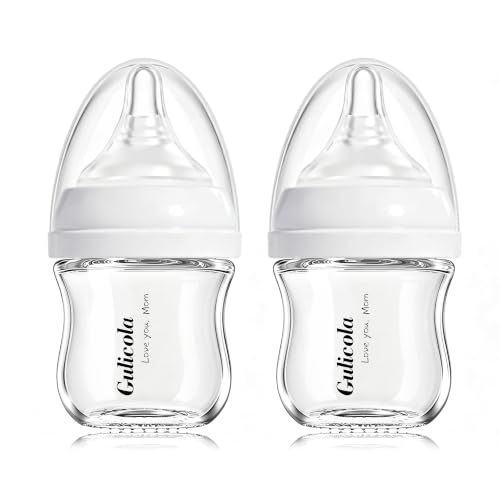
A tiny glass 3 oz bottle built for the very first weeks, with an extra-slow nipple.
For a preemie or a baby just home from the hospital, the smallest bottle with the slowest nipple wins, and this one is both. The set is a 2-pack of 3 oz bottles with an SS (extra slow flow) nipple rated for 0 months and up. That ultra-slow flow is the whole reason to pick it — your newborn gets a gentle trickle they can manage without coughing. The glass is borosilicate, a heat-resistant type that handles boiling, sterilizers, and bottle warmers without clouding, and it is free of BPA, BPS, and phthalates. A new nipple design uses guiding points to train a correct latch, which is the feature nursing moms notice most.
What wins people over is how tough the glass turns out to be. Buyers report it is “surprisingly really durable” and easy to clean, with one describing the bottle surviving a drop on slate tile without a scratch or chip. That is unusual feedback for glass, since the category’s normal risk is breakage, so the durability here is a genuine standout rather than a guess. The bottle doubles as a storage container, so you can pump, store, and feed from the same glass and cut down on dishes.
Two things to plan around. First, the second pack matters — with only two bottles, a heavy feeder keeps you washing. Second, the durability picture is genuinely mixed, not flawless: while many buyers find it sturdy, a section of reviews say it can crack, so treat it as a glass bottle with all the care glass asks for. Also worth flagging — unlike the wider-necked picks on this list, the SS nipple ships with the pack, so you do not need to hunt down a slow-flow teat separately.
Who it is built for: the 0-month stage — preemies, hospital-to-home babies, and any feed that needs the gentlest possible flow.
The honest note: it is glass, so durability is mixed rather than bulletproof — some owners find it sturdier than expected, others report cracks, so handle it accordingly.
Choose this if: you want a genuinely slow-flow newborn bottle and prefer glass for pumping, storing, and feeding in one container.
Skip if: your baby already drinks 4 oz and up, because the 3 oz capacity will be outgrown within weeks.
5. Avima 4 oz Anti Colic Baby Bottles w Slow Flow Nipples. 0-3M (Set of 8)

Eight bottles in one box — the wash-once-a-day answer for the newborn grind.
A newborn eats every two to three hours, which is roughly eight feeds a day, and this set hands you exactly that many bottles. If you are tired of washing through the night, eight beats the four-pack picks here on volume alone. The nipples use a patented Duo-Flo design with two valves that flex and adjust the flow to your baby’s pace, meant to cut colic, gas, and spit-up while preventing the nipple from collapsing or the feed from stalling. It ships with slow flow nipples for 0 to 3-plus months, and the brand sells medium and fast nipples separately so the same bottles grow with your baby. The narrow neck is also built to fit many breast pumps for direct pumping.
Two practical details stand out. First, the design earns the most praise of anything about this bottle — the shape and grip are what parents single out. Second, cleaning is quick: just four pieces per bottle, dishwasher safe on the top rack. The bottles are BPA-free and made by a company whose origin story is a parent who needed a colic fix, which shows in the emphasis on simplicity.
Here is the caveat to weigh honestly. Flow and anti-colic performance are split subjects — some babies do well, others get nothing slow about the flow and the anti-colic promise does not land. A handful also report leaking where others say they are tight. None of that makes it a bad bottle; it means this is the set to buy when convenience and price-per-bottle lead your decision, and you are happy to test how your baby takes to it.
Strongest points
- Set of 8 covers a full day of newborn feeds without mid-night washing
- Duo-Flo two-valve nipple flexes with your baby’s pace
- Four-piece design cleans fast and is top-rack dishwasher safe
- Nipples sold in later stages so the bottle grows with baby
Before you commit
- Flow and anti-colic results are genuinely mixed across babies
- Some report leaking, others none — quality varies slightly
- Narrow neck rather than a wide, easy-fill opening
The value play: if you want the most bottles per box and a neck that fits your pump, this set does the job on a newborn’s schedule.
Test it first if: your baby is sensitive to flow speed, since the anti-colic and slow-flow results are the split points here.
6. Lansinoh Anti-Colic Baby Bottles, 5 Ounces, 4 Count
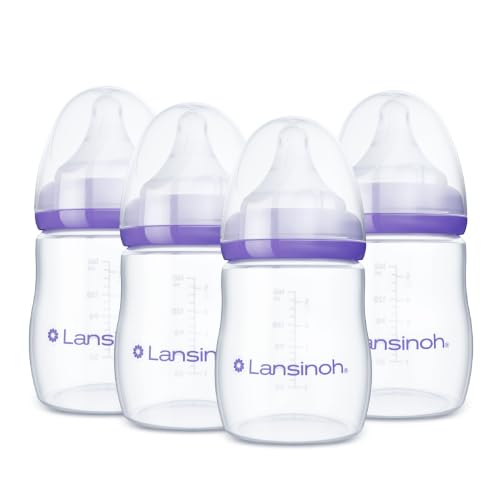
The three-piece bottle that only asks for a quick rinse — and a latch most babies take to.
The spec that defines this pick is the simplest one: three pieces, cap excluded. Where the leading anti-colic bottle needs a full parts tray, this one strips down to a bottle, a nipple, and a base, so cleaning takes minutes rather than a sink session. The 4-count set gives you four 5 oz bottles, each with a slow flow nipple (Size S, labeled 1 to 3 months). The nipple is ultra-soft and wide, with a gentle slope that molds to your baby’s mouth for a secure latch, and the NaturalWave ventilation system inside is designed to cut air intake and reduce gas, fussiness, and spit-up. For a baby switching between breast and bottle, that flexible, stretchy nipple tip is what helps them keep their normal rhythm.
Where this bottle wins people over is a smooth transition. Parents who have tried a long list of brands report it is the one their breastfed baby consistently accepts, with no nipple confusion, and the anti-colic function doing its part to keep bubbles down. The flow rate is also frequently described as better judged than the Dr. Brown’s bottles, which is the first head-to-head worth flagging here: this pick trades the extra vent parts for a simpler wash while keeping the feed gentle.
The trade-offs are minor and specific. On a 4-count at 5 oz each, washing comes around often, and one honest note from the review pages: the flow rate is a split subject, with some babies happier than others, so expect a short adjustment. It is a modern design that trades new features for a wider price than the value sets, but the easy-clean three-piece build is the reason to accept that.
Why it stands out: three-piece cleaning plus a flexible wide nipple make the transition between breast and bottle feel smooth — and the 5 oz size gives your newborn room to grow.
The trade-off: only four bottles in the box, so a frequent feeder quickly hits the wash pile.
Built for: the parent who wants fastest cleanup without sacrificing a gentle, breast-like feed.
Not ideal if: you need enough bottles to skip a second round of washing, since four covers less than a full day.
7. Dr. Brown’s Anti-Colic Options+ Narrow Glass Baby Bottle, 4 oz, 3-Pack
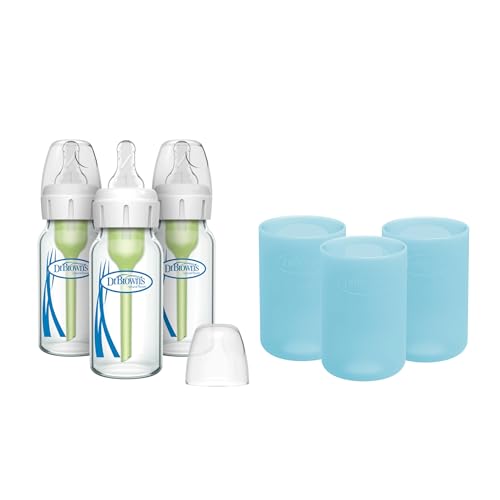
The same trusted vent system, now in heat-shock-resistant glass with a silicone grip.
The vent system also does something the plastic competitors here cannot claim in the same way: the maker says the vent preserves nutrients in bottle milk, which matters if you feed expressed breast milk. For a family already committed to glass, this is the version that keeps the anti-colic performance without giving up the material you prefer.
Two caveats stay in view. It is still glass, so it can break — buyers generally find it sturdy, but it is not immune to a hard drop. And a section of owners note that the measurement markings are hard to read once the silicone sleeve is on, which is a small annoyance when you are doing a 3 a.m. pour. If you can live with those, the glass body is the upgrade worth making.
Why glass fans pick it
- Borosilicate glass handles hot, cold, and gradual temperature changes
- Silicone sleeve adds grip and protects against knocks
- Same proven anti-colic vent system as the plastic version
- 3-pack covers a day of newborn feeds
Honest limits
- Glass can still break on a hard drop
- Measurement marks are hard to read through the sleeve
- More parts to clean, like all Dr. Brown’s bottles
Pick this for: a family that wants the category’s most trusted vent system in a glass body that warms, cools, and sterilizes without odor.
Consider the plastic version if: breakability is your main worry — that same vent system comes without the glass-weight risk.
8. Pigeon PPSU Wide Neck Anti-Colic Nursing Baby Bottle, 5 oz, 2-Pack
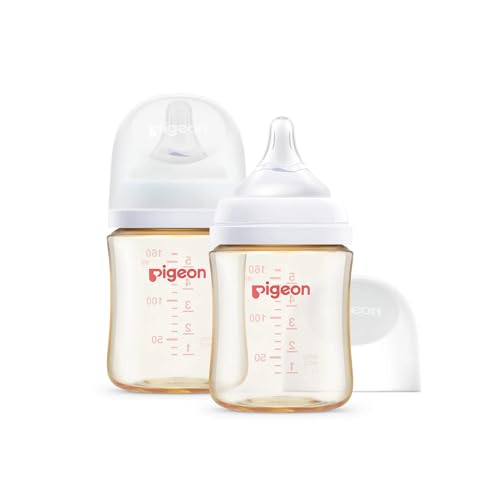
The high-tech latch design that lets a breastfed newborn switch sides without a fuss.
This bottle is built around one idea: that a baby’s feeding motion should be studied and matched. The nipple is shaped from research into the three natural movements a baby makes while feeding, and it carries a Latch-on Line — a curve on the nipple that guides your baby toward an appropriate latch and a deeper seal. The nipple is super soft and flexible, designed to allow smooth tongue movement, which is the key to the breast-to-bottle switch without nipple confusion. The body is PPSU, a tough, lightweight plastic that survives frequent sterilizing and drops while staying easy to hold, and the wide neck makes both filling and cleaning fast. The 5 oz bottle ships with an SS nipple rated 0 months+, with sizes running from SS up to 3L as your baby grows.
What earns this the top-performer nod is how often owners describe a baby taking it with zero fuss. Parents who say they tried every bottle on the shelf report this is the one that worked, with easy latching, less gas from the slow nipple flow, and no bottle refusal when combining breast and bottle. The PPSU body also outlasts cheaper plastics — it resists odor and discoloration through repeated washing and sanitizing, like the glass picks here but lighter.
The honest trade-off is price and size at the top end: buyers flag it as pricier than the value sets, and one owner notes the larger version can be small when mixing a full formula scoop count at once. Neither changes the core verdict — it is among the most thoughtfully designed newborn bottles on this list, and it lasts from birth through the move to a cup.
What the design buys you: a nipple shaped to guide a deep latch, soft enough to mimic the breast, so a breastfed newborn takes it without confusion.
Where it costs more: the premium build shows in the tag and the fact that the 2-pack is smaller than the four- and eight-count value sets here.
Worth it for: a parent who wants a bottle that lasts from the newborn stage until the switch to a cup, with a latch design that supports combination feeding.
skip it if: you just need a crowd of cheap bottles for a wash-by-volume routine.
9. Thyseed Anti-Colic Glass Baby Bottle for Breastfed Infants, Natural Feeding, Breast-Like Newborn Extra Slow Flow Nipple (0m+), 5 oz, 2 Pack
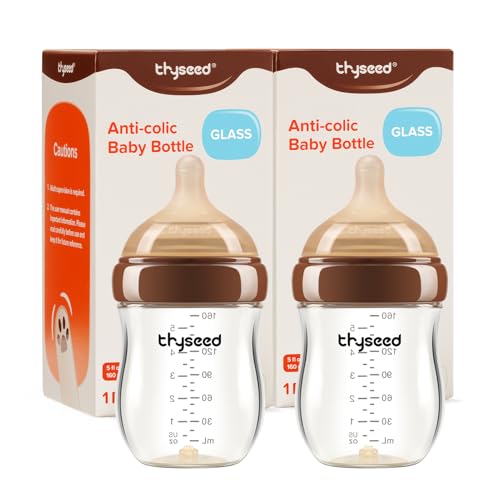
A vent at the base of the bottle, engineered to separate air from milk before it reaches your baby.
Most anti-colic bottles put the vent in the nipple. This one puts it in the base, and the maker says the base-vent design is clinically studied and published in JAMA. The base vent is meant to separate air from milk so fewer bubbles and less swallowed air reach your baby, which is the difference that shows up as calmer feeds and less tummy discomfort. The nipple uses multiple micro-openings to give a smooth, even flow that reduces gulping and frustration, and the silicone is ultra-soft so it moves the way a breast does — which is the feature that matters most for a baby transitioning off the breast. The body is food-grade borosilicate glass with a wide neck and fewer parts, so cleaning and reassembling are quicker, and the whole thing is top-rack dishwasher safe.
Where this bottle separates itself is flexibility and safety. It comes with 6 flow rates designed to grow with your baby, so you match the flow to each feeding stage instead of buying a new bottle. The materials are notable too: liquid silicone from WACKER (Germany), PP from TotalEnergies (France), and food-grade borosilicate glass — a level of sourcing detail few bottles here disclose. As a newborn pick, the 5 oz capacity and 0m+ extra-slow nipple fit the earliest feeds, and the anti-colic effect is what buyers describe as a genuine help for reflux and colicky babies.
The honest catch is price and consistency. This is the most premium pick on the list, and the reviews are split on value — some call it worth it, others feel it is overpriced. There is also a split on leaking: some owners mention no leaks, others say they do occur. Neither is damning, but for a bottle at this level, go in expecting to test it on your first few feeds rather than assume a flawless first try.
what separates it
- Base vent separates air from milk to cut swallowed air
- 6 flow rates grow with your baby across stages
- Ultra-soft silicone nipple supports natural tongue movement
- Food-grade borosilicate glass with few parts for easy cleaning
Caveats to consider
- Premium build shows in the price, and value is a split topic
- Leak reports split between owners — test the seal early
- Only a 2-pack at 5 oz, smaller than the value sets
Choose it for: a refluxy or very gassy newborn where the base-vent airflow and the soft, breast-like nipple are worth the premium.
Weigh the trade-off if: you want a budget-conscious set — the value picks here cover the same newborn job for less.
Understanding the Specs
Nipple flow stage (SS vs Level 1 vs Flow 2)
The flow stage is the size of the opening in the nipple, and it decides how fast milk comes out. A newborn 0 to 3 month baby needs the slowest stage a brand makes — an SS (extra slow) or Level 1 nipple — so they can swallow and breathe between sucks. A faster nipple, meant for older babies, sends milk too quickly and causes the gulping, coughing, and gas you are trying to prevent. Because every brand names its stages differently, check the age printed on the teat rather than the number alone, and plan to buy the next stage up as your baby grows.
Vent system and the anti-colic effect
A vent is a small air channel or valve that lets air escape as your baby drinks instead of traveling back through the milk. The plain benefit is a steadier, vacuum-free feed, which means your baby swallows less air and tends to be less gassy and fussy after eating. Vents add parts to wash, so the trade-off is real: more airflow control versus a longer cleaning routine. Most newborns do fine either way, but a colicky or reflux-prone baby often gets the most noticeable help from a vented bottle.
Bottle body material
Glass is the best choice if you sterilize often and value a material that does not stain, cloud, or take on odor — it warms and cools quickly, but it is heavier and can break on a hard floor. Silicone is soft and squeezable, easy for small hands to grip, and will not shatter, but it holds warmth longer and needs a firmly sealed lid. PPSU is a tough, lightweight plastic that resists discoloration through repeated washes, which makes it a strong middle ground for a diaper bag. None of these materials is wrong for a newborn — the choice is about your routine.
Capacity for the newborn stage
Newborns drink small amounts — often a couple of ounces per feed — so a 2 to 5 oz bottle matches the stage, and a huge bottle just means wasted formula and more to wash. Buying a 3 or 4 oz bottle gets most families comfortably through the first months, while a 5 oz size stretches further before you need to size up. If you plan to feed for a year, look for a body whose nipples come in later stages so you can keep the bottle and swap only the teat.
FAQ
What size bottle does a newborn actually need?
What nipple flow is right for a 0 to 3 month baby?
Are glass bottles safe for newborns, or should I stick with plastic?
Do anti-colic bottles really reduce gas and spit-up?
Howmany parts does an anti-colic bottle have to clean?
Can I use these bottles if I am breastfeeding and pumping?
Do I need to buy extra slow-flow nipples separately?
How do I stop a newborn bottle from leaking?
Will a wide-neck bottle fit my breast pump?
How often should I replace newborn bottle nipples?
Final Thoughts: The Verdict
For most newborns, the bottles for newborns winner is the Dr. Brown’s Anti-Colic Options+ Narrow 2 oz, 4-Pack because its internal vent system is the most proven way to cut gas and colic, and the 2 oz size matches a brand-new feeder’s stomach. If you want a paced, breast-like feed that lets your baby pause and breathe, the Philips Avent Natural is the close second and the easier one to wash. For a soft, squeezable bottle that survives tumbles and grows past the newborn stage, the Comotomo Silicone Gen 2 is the one to reach for, and if you want the extra gentleness of glass with a base vent for a refluxy baby, the Thyseed Anti-Colic Glass is worth the premium. One honest nudge: if you are unsure where to start and want the widest margin of a bottle that simply works, go with the Dr. Brown’s 2 oz 4-pack, which holds a 4.8-star average across more than 40,000 owners.
How We Picked
We do not accept paid placement. Every pick is matched to a real buyer and a real use-case; we do not hands-on test units.
Sources & Methodology
Specifications: manufacturer listings and product documentation. Review insights: verified customer reviews, as of September 2026. Pricing: not shown on this page (it changes often); check the current price via the retailer link.
As an Amazon Associate, Gadgets Feed earns from qualifying purchases. This does not affect which products we feature.