
Pairing an air compressor with a sandblaster is the fastest way to strip rust, paint, and grime from metal surfaces, but the wrong combination leaves you waiting for pressure recovery or fighting with an undersized tank that drains in seconds. The core tension is simple: sandblasting demands sustained CFM output, while most compressors are specced for quick bursts of nailing or inflation. Nail the balance between tank volume and delivery rate, and you unlock a shop capability that transforms restoration work.
I’m Min — the co-founder and writer behind Gadgets Feed. I’ve spent hundreds of hours analyzing pneumatic system specifications, comparing CFM curves at 90 PSI against real-world sandblasting dwell times, cross-referencing customer durability reports, and stress-testing the technical claims made by every major brand in the stationary and portable compressor market.
This guide cuts through the noise to deliver the best match for your workshop reality, whether you are restoring an old truck frame or refreshing garden tools. If you are serious about buying the best air compressor and sandblaster, the difference between a frustrating dust cloud and a smooth stripping session comes down to three specs you will learn to decode below.
How To Choose The Best Air Compressor And Sandblaster
Selecting the right compressor for sandblasting is not about brand loyalty — it is about matching CFM output and tank capacity to the nozzle size you intend to use. A standard siphon-feed sandblaster requires around 6–10 CFM at 90 PSI to sustain a clean abrasive stream. Compressors that cannot maintain that flow force you to stop every 30 seconds and wait for the tank to refill, turning a 20-minute job into a frustrating hour.
Matched CFM and Tank Volume
Look for a compressor that delivers at least 5 CFM at 90 PSI as a baseline for light blasting; serious restoration work benefits from 8 CFM or higher. A larger tank, such as 20 gallons versus 5 gallons, gives you a longer effective blast window before the motor kicks in, which means less pulsation in the abrasive stream and a smoother finish.
Pump Type and Duty Cycle
Oil-free pumps are quieter and require less maintenance, but they tend to run hotter and may have shorter life spans under continuous load. Oil-lubricated cast-iron pumps, like the one on the Makita MAC5200, run cooler and sustain higher duty cycles, making them a better fit for sandblasting sessions that last longer than 15 minutes of continuous trigger time.
Quick Comparison
On smaller screens, swipe sideways to see the full table.
| Model | Category | Best For | Key Spec | Amazon |
|---|---|---|---|---|
| VEVOR 20 Gal Oil-Free | Ultra Quiet | Sustained sandblasting | 10.6 CFM @ 90 PSI | Amazon |
| Klutch 20-Gallon | Oil-Lubricated | High-volume shop use | 5.2 CFM, 175 PSI | Amazon |
| Makita MAC5200 | Pro Grade | Continuous framing & blasting | 6.5 CFM @ 90 PSI | Amazon |
| California Air Tools 4620AC | Ultra Quiet | Noise-sensitive workshops | 5.3 CFM @ 90 PSI | Amazon |
| Craftsman 3 Gal Hot Dog | Portable | Light nailing & inflation | 2.6 CFM @ 90 PSI | Amazon |
| Parts-Diyer 40 Gal Cabinet | Blast Cabinet | Bench-top sandblasting | 60-125 PSI, 6-25 CFM | Amazon |
| Limodot Quiet 5 Gal | Silent Runner | Indoor woodwork & nailing | 2.8 CFM @ 90 PSI | Amazon |
| VEVOR 6.3 Gal | Mid-Range | Garage spray painting | 3.35 CFM @ 90 PSI | Amazon |
| Craftsman 2 Gal | Entry Level | Occasional tire inflation | 5 CFM peak, 125 PSI | Amazon |
In‑Depth Reviews
1. VEVOR 20 Gal Oil-Free Air Compressor

The VEVOR 20-gallon oil-free compressor delivers a massive 10.6 CFM at 90 PSI — enough airflow to run a medium-sized sandblaster continuously without frequent recovery pauses. The 20-gallon steel tank stores enough reserve volume to blast for extended periods, and the 78 dB noise rating is genuinely quiet for a unit of this output, thanks to the thickened muffler cover and rubber muffler pipe.
Built with a 3KW motor running at a low 1680 RPM, the pump generates less heat and wear than high-RPM alternatives, and the oil-free design eliminates the need for periodic oil changes. The three-layer anti-rust coating on the Q235B steel tank adds real longevity in damp garage environments where many compressors develop pin-hole leaks after a few seasons.
The automatic overheating protection and auto shutoff at excessive pressure provide safety margins during long sandblasting sessions. Keep in mind that this unit runs on 220V, so verify your shop wiring before purchase — the 40-inch power cord is short, and extension cord use is not recommended by the manufacturer due to startup current draw.
Why it’s great
- Highest CFM in class — 10.6 at 90 PSI
- Truly quiet operation at 78 dB
- Large 20-gallon tank for extended blast sessions
Good to know
- Requires 220V outlet — not standard 110V
- 134-pound weight is not easily portable
- Very short power cord limits placement
2. Klutch 20-Gallon Air Compressor

The Klutch 20-gallon compressor combines an oil-lubricated cast-iron twin-cylinder pump with a 2.0 HP motor to produce 5.2 CFM at 90 PSI and a max pressure of 175 PSI. The higher tank pressure effectively stores more usable air volume — at 175 PSI versus the standard 125–150 PSI, you get roughly 15% more effective runtime before the compressor kicks back in, which matters when blasting a large panel.
The splash-lubricated pump runs cooler than oil-free alternatives, supporting longer duty cycles without thermal shutdown. The belt-driven design contributes to quieter operation and smoother power delivery, and the ball-bearing-supported crankshaft is a durability feature normally found on industrial-grade units. The front-facing manual drain valve and oil sight gauge make routine maintenance straightforward.
Some units ship with a slightly bent foot from packaging, and the plastic control panel cover feels less robust than the cast-iron pump below it. For a home garage or small shop doing mixed work — sandblasting small parts, running impact wrenches, and inflating tires — the Klutch delivers premium reliability at a mid-range investment.
Why it’s great
- Oil-lubricated pump for cooler, longer runs
- 175 PSI max pressure for extra usable air
- Quieter than most oil-free units of this size
Good to know
- 5.2 CFM is adequate, not abundant, for large blast nozzles
- Unit weighs 90 pounds, wheels help but still heavy
- Minor cosmetic issues reported on some units
3. Makita MAC5200 Big Bore
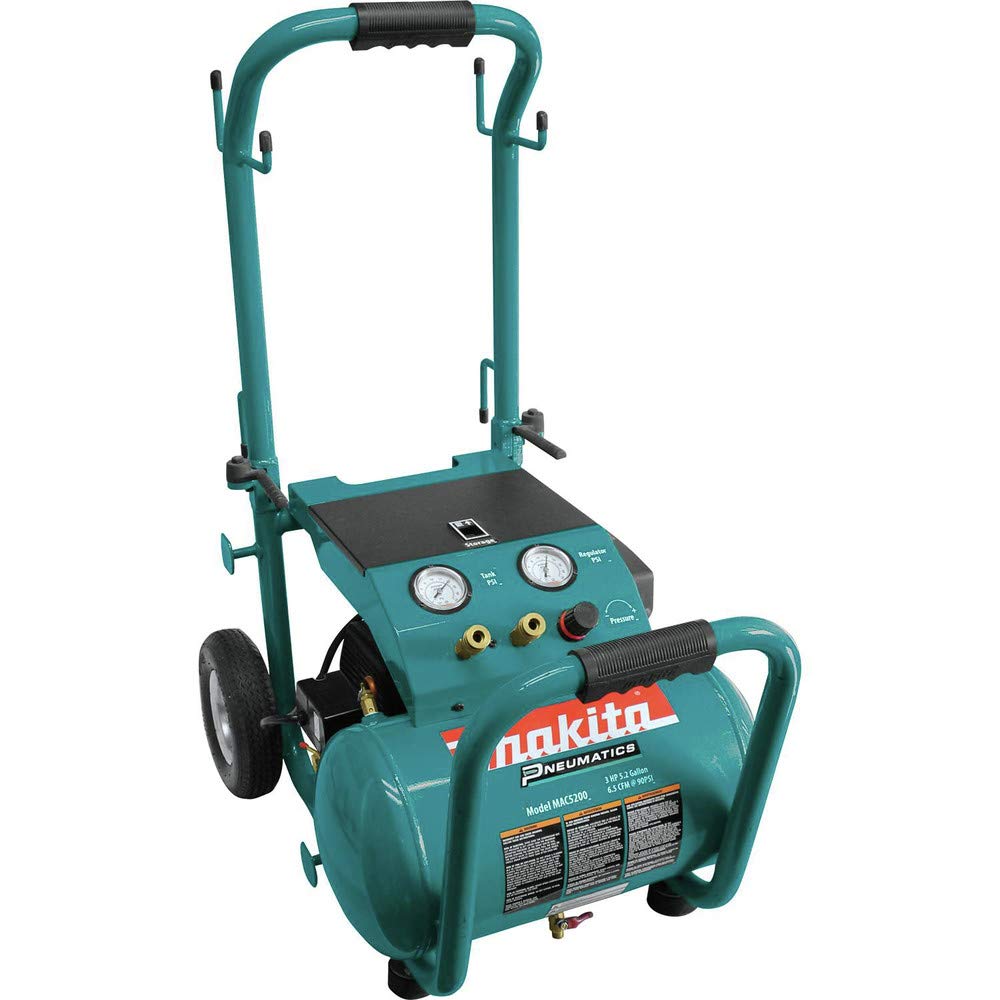
The Makita MAC5200 is the gold standard for serious sandblasting at the pro-sumer level, featuring a 3.0 HP motor paired with a cast-iron Big Bore cylinder that delivers 6.5 CFM at 90 PSI. The 5.2-gallon tank is smaller than the competition, but the oil-lubricated pump recovers so fast — reaching 120 PSI from empty in about 75 seconds — that you get a steady blast rhythm even with a modest tank volume.
The cast-iron pump runs cooler and quieter than any oil-free unit in its class, and the removable cylinder design allows for easy overhaul when the pump eventually wears after years of service. The folding handle and pneumatic wheels make it one of the most portable units at 75 pounds, and the two 1/4-inch quick couplers let you run a blast gun and a blow gun simultaneously.
The lower-pitched engine noise is less fatiguing than the high-pitched whine of oil-free compressors, though hearing protection is still recommended within the same room.
Why it’s great
- Cast-iron pump with proven long-term reliability
- Fast recovery — ideal for continuous tool use
- Lower noise pitch than oil-free models
Good to know
- 5.2-gallon tank is small; recovery is fast, but blasting runs are brief
- Requires regular oil maintenance
- Heavier than portable units at 75 pounds
4. California Air Tools 4620AC

The California Air Tools 4620AC is engineered for noise-sensitive environments — its 2.0 HP motor spins at just 1,680 RPM, producing only 70 dB while still delivering 5.3 CFM at 90 PSI. The 4.6-gallon aluminum twin tank is corrosion-resistant and weighs 68 pounds, making it easier to maneuver than steel-tank units of similar capacity.
The oil-free dual-piston pump has a rated life cycle of over 3,000 hours, which is exceptional for an oil-free design, and the low amp draw of 14 amps means it runs on a standard 110V circuit without tripping breakers. The thermal overload protection adds safety during extended blasting sessions, and the built-in regulator gives precise pressure control for delicate media like walnut shells or glass beads.
The control panel feels a bit flimsy compared to the aluminum tank, and the pressure gauge increments are large, making fine adjustments less precise than a geared regulator. The on/off switch is located at the back of the unit, which is inconvenient if the compressor is tucked under a workbench. Over years of ownership, the drain valve may seize, but replacement is inexpensive and straightforward.
Why it’s great
- Remarkably quiet at 70 dB — shop-friendly
- Aluminum tank resists rust better than steel
- 3,000+ hour pump life expectancy
Good to know
- 5.3 CFM is adequate for small blast cabinets, not large-scale stripping
- Control panel plastic is not as durable as the pump
- Rear-mounted switch is awkward in tight spaces
5. Craftsman 3 Gal Hot Dog Compressor

The Craftsman 3-gallon hot dog compressor is the most portable option on this list, weighing just 16 pounds and producing a maximum 155 PSI. The 1.5 HP oil-free pump delivers 2.6 CFM at 90 PSI — not enough for sustained sandblasting, but perfectly capable of powering a small spot-blaster for localized rust removal or a gravity-feed spray gun for touch-up painting.
The compact 18.5 x 18.1 x 11.2-inch footprint slides onto any shelf or truck bed, and the built-in handle makes one-handed carry realistic. The oil-free pump eliminates maintenance, and the 155 PSI maximum pressure partially compensates for the small tank by storing more energy per gallon than standard 125 PSI units.
Noise output is noticeably higher than the quiet compressors on this list — the high RPM motor produces a sharp whine that is audible through walls. The plastic gauge panel feels cheap and may need replacement over time, but for the price, this unit serves as an excellent secondary compressor for inflation, nailing, and light-duty tasks while you save for a larger sandblasting rig.
Why it’s great
- Extremely portable at 16 pounds
- High 155 PSI for extra stored energy
- Oil-free, maintenance-free operation
Good to know
- 2.6 CFM is too low for continuous sandblasting
- Noisy operation compared to premium models
- Plastic gauge panel is not durable
6. Parts-Diyer 40 Gallon Sandblasting Cabinet

This 40-gallon benchtop cabinet is the dedicated blast station for your compressor ecosystem. The heavy-duty steel body with powder-coated finish resists rust, and the working space of 23.6 x 20.9 x 18.1 inches accommodates engine blocks, wheels, and structural parts. It accepts a wide range of abrasive media, from silicon carbide to crushed walnut shells, through four included nozzles (4mm to 7mm).
The built-in ventilation system and pre-installed sealing strips minimize dust leakage, while the LED lighting and large plexiglass viewing window give you clear visibility during the blasting process. The air filter and dust collector port help keep the workspace cleaner than open-blast methods, and the compact design fits on a standard workbench without taking up floor space.
Assembly requires careful attention to the sealing strips — some units arrive with instructions that skip the step about installing the gasket between upper and lower cabinet sections, leading to media leaks if not caught early. The included sealant material is adequate, but applying an extra bead along the seams significantly improves dust containment. A compressor delivering at least 6 CFM at 90 PSI is recommended for effective blasting.
Why it’s great
- Dedicated cabinet with sealed workspace for clean operation
- LED interior lighting for excellent visibility
- Four nozzle sizes included for media versatility
Good to know
- Requires a 6+ CFM compressor to function well
- Assembly instructions need supplementing with sealant
- 55-pound cabinet is heavy for a benchtop unit
7. Limodot Quiet 5 Gal Air Compressor

The Limodot compressor is the quietest on the list at 68 dB — lower than normal conversation — making it the only option you could run inside a residential garage without disturbing the neighbors. The 1.2 HP induction motor spins at 3,400 RPM, producing 2.8 CFM at 90 PSI, which is sufficient for nailing, light spray painting, and occasional blasting of small parts with a fine media nozzle.
The 5-gallon steel tank refills from empty in about 80 seconds, and the 25-second recovery time between tool cycles keeps pace with staplers and brad nailers without noticeable lag. The package includes a 25-foot PVC air hose and a 13-piece accessory kit, which adds immediate value for buyers who do not already own air fittings. The oil-free pump means zero maintenance beyond draining the tank after each use.
The pressure regulator on some units arrived missing the adjustment plug, requiring a quick replacement with a standard part. For dedicated sandblasting that demands more than 3 CFM, this unit will struggle with larger nozzles — you would need to pair it with a smaller spot-blaster and work in short bursts. For noise-sensitive indoor work, this is the clear winner.
Why it’s great
- Exceptionally quiet at 68 dB
- Includes 25-ft hose and 13-piece accessory kit
- Fast 25-second recovery for nailing cycles
Good to know
- 2.8 CFM limits sandblasting to fine media and small parts
- Missing regulator plug reported on some units
- 1.2 HP motor is less powerful for continuous tools
8. VEVOR 6.3 Gal Air Compressor

The VEVOR 6.3-gallon compressor packs a 2 HP motor and double-cylinder intake design that delivers 3.35 CFM at 90 PSI — a solid step up from the smallest portable units without jumping to a 20-gallon footprint. The oil-free pump runs at 3,500 RPM, and the dual silencers reduce noise to a manageable level for a mid-range unit, making it suitable for garage spray painting and light sandblasting of small brackets or hand tools.
The Q235B structural steel tank features a three-layer anti-corrosion process, and the seamless welding construction is rated to 3.5 MPa maximum bearing pressure, providing a safety margin above the 116 PSI operating max. The two large cooling fans and automatic overheating protection prevent thermal shutdown during extended tool runs, and the dual-wheel kit makes the 43-pound unit reasonably mobile.
The power cord is only 40 inches long, which is frustrating if your nearest outlet is more than three feet away — using an extension cord may cause startup issues or prevent the pressure switch from engaging correctly. The small wheels also make the unit prone to tipping when rolling across uneven flooring. Despite these ergonomic flaws, the CFM output per dollar is among the best in this size class.
Why it’s great
- Good CFM output for the size and investment
- Dual silencers reduce noise noticeably
- Rust-resistant Q235B steel tank construction
Good to know
- Very short power cord limits placement
- Small wheels make the unit tippy
- Oil-free pump has shorter duty cycle than lubricated options
9. Craftsman 2 Gal Air Compressor

The Craftsman 2-gallon hot dog compressor is the entry point for homeowners who need a lightweight unit for tire inflation, brad nailing, and stapling. At 18 pounds with a carry handle, it is genuinely portable — you can grab it with one hand and move it from the garage to the driveway without strain. The 1/3 HP oil-free pump delivers 125 PSI maximum and provides 5 CFM at peak, though the duty cycle is short given the small tank.
For sandblasting, this unit is not a primary solution — the 2-gallon tank empties quickly, and the pump struggles to keep up with any continuous-flow tool. However, it can serve as a supplemental compressor for a small spot-blaster used on isolated rust spots, or for powering a gravity-feed spray gun for small projects. The oil-free design means no maintenance besides draining the tank.
The noise level is noticeable — several owners describe it as loud for its size, which is typical for high-RPM oil-free compressors. The included user manual is minimal, but the setup is straightforward. For the modest investment, this unit is a reliable companion for light-duty tasks, but it should not be the centerpiece of a sandblasting setup.
Why it’s great
- Very light at 18 pounds with comfortable handle
- Oil-free, maintenance-free pump system
- Ideal for inflation, nailing, and hobby painting
Good to know
- 2-gallon tank is too small for sustained blasting
- Loud operation — not suitable for noise-sensitive areas
- Limited duty cycle for continuous tool use
FAQ
What size air compressor do I need for a sandblaster?
Can I use a pancake compressor for sandblasting?
Final Thoughts: The Verdict
For most users, the best air compressor and sandblaster winner is the VEVOR 20 Gal Oil-Free because it delivers the highest CFM in the class at 10.6, runs whisper-quiet at 78 dB, and packs a 20-gallon tank that sustains real sandblasting sessions without constant recovery pauses. If you want oil-lubricated long-term durability for daily shop use, grab the Makita MAC5200. And for a noise-sensitive home garage where you need a balanced performer for other tools, nothing beats the California Air Tools 4620AC.