
Our readers keep the lights on and my morning glass full of iced black tea. As an Amazon Associate, I earn from qualifying purchases.
Specs are compiled from manufacturer listings and verified buyer reviews and can change over time — please confirm the key details on the product page before buying.
For a 20-gallon tank, two things decide whether your water stays clear and your fish stay healthy: turnover and noise. Turnover means how many times per hour the filter pushes your whole tank’s water through its media — aim for roughly ten times the tank’s volume every hour. You also want a motor quiet enough that you forget it is running. One note before the picks: this list uses flexible matching for rated-for-20-gallon capacity, so filters rated for roughly 20 to 30 gallons are included — not every pick is the exact number you searched, but each one serves the same purpose in a 20-gallon setup.
I’m Min — the founder and writer behind Gadgets Feed. This guide is built by comparing the manufacturers’ published specifications and the patterns across verified customer reviews, so you get each pick’s real strengths and trade-offs instead of marketing spin.
Every filter here has been weighed on the two things that decide whether you actually enjoy your tank long-term: how much water it moves, and how much noise it makes. That balance is exactly what separates a great 20 Gallon Fish Tank Filter from one you end up unplugging at midnight.
Our Picks at a Glance


How To Choose The Best 20 Gallon Fish Tank Filter
The single biggest mistake first-time buyers make is picking a filter by its price tag instead of its flow rate. A 20-gallon tank needs a filter that moves about 200 gallons per hour to hit ten-times turnover — the gold standard for clear water and a stable biological cycle. Too little flow and waste builds up; too much and smaller fish get pushed around. Here is what actually matters when you compare options.
Turnover rate and why GPH matters more than tank size claims
GPH stands for gallons per hour — the volume of water the pump moves through the filter media every 60 minutes. Manufacturers often rate a filter for a range (10-20 gallons, for example) because the same pump works in different tank sizes. But the real test is whether the flow gives you roughly ten cycles per hour at your tank’s actual water volume. A filter rated 100 GPH in a 10-gallon tank gives you that ten-times turnover; the same filter in a 20-gallon tank gives you five cycles, which may be enough for light stocking but not for a crowded community tank. Checking the GPH figure before buying saves you from a filter that looks right on the shelf but underperforms in your tank.
Filter type: hang-on-back, internal, or bio-wheel
Hang-on-back (HOB) filters sit on the rim of the tank and pull water up through media stages before returning it as a waterfall. They are the most popular style for 20-gallon setups because they hold more media and are easier to service — you lift the lid without reaching into the tank. Internal filters clip directly to the tank wall and sit underwater; they save space and hide well behind decor, but they take up room inside the tank and a strong internal pump can trap small fish. Bio-wheel designs use a rotating wheel that grows beneficial bacteria in a wet/dry environment, which can keep your cycle stable, though the wheel adds a moving part and a trickle sound. Your choice depends on how much maintenance you want and whether you value quiet over internal space.
Noise level and what decibels actually mean for your tank
Decibels (dB) measure sound — a normal conversation is around 60 dB, and a quiet room is about 30 dB. Some filters here are rated below 40 dB, which is roughly the sound of a whisper. If your tank sits in a bedroom or office, that number matters a lot. But noise also comes from the waterfall itself, not just the motor. A filter with a quiet pump can still splash loudly if the water level drops. Many owners fix this by raising the waterline or adding a sponge to the outflow. When you read a spec like “below 40 dB,” treat it as the motor’s best case — the total sound depends on your setup.
Quick Comparison
| Model | Best For | Flow Rate | Type | Rated Capacity | Amazon |
|---|---|---|---|---|---|
| AquaClear 20 Power Filter★ Best Overall | Best overall for most 20-gallon tanks | 100 GPH | Hang-on-back | 5-20 gallons | Amazon |
| Aqua-Tech Ultra Quiet Power FilterBudget Champion | Budget-friendly quiet option | 5x per hour | Hang-on-back | 10-20 gallons | Amazon |
| Marineland Bio-Wheel Penguin 100 GPHTop Performer | Bio-wheel biological filtration | 100 GPH | Hang-on-back | Up to 20 gallons | Amazon |
| Aqueon SmartClean Power Filter | Easy water changes without removing filter | Adjustable | Hang-on-back | 10-20 gallons | Amazon |
| FKSC Hang On Back Filter with Surface Skimmer | Surface skimming for freshwater tanks | Adjustable | Hang-on-back | Up to 20 gallons | Amazon |
| Tetra Whisper 135 GPH Internal Filter | Space-saving internal design | 135 GPH | Internal | 10-30 gallons | Amazon |
| hygger Aquarium HOB Filter 105 GPH | Filter-change indicator light | 105 GPH | Hang-on-back | 10-20 gallons | Amazon |
| Penn-Plax Cascade 100 Power Filter | Quad filtration with Bio-Sponge | 100 GPH | Hang-on-back | Up to 20 gallons | Amazon |
In‑Depth Reviews
1. AquaClear 20 Power Filter, Fish Tank Filter for 5- to 20-Gallon Aquariums
Our pick — over 4★ from 7,000+ verified ratings; the strongest balance of quality and price.
The 100 GPH hang-on-back with three separated media stages that clears a 20-gallon tank in under two days.
If you want a 20-gallon community tank that looks crisp without fiddling with it every weekend, this is the one to beat. It runs a three-stage media basket — a sponge for mechanical filtration (it traps floating debris), ceramic rings for biological filtration (they host the bacteria that break down fish waste), and carbon for chemical filtration (it pulls out odors and discoloration) — and each stage sits in its own compartment. That means you can replace the sponge or the carbon without throwing away the bacteria colony that keeps your water stable. At 1.4 pounds it hangs on the back rim without sagging, and it is genuinely compact on the tank edge.
A big part of why owners stick with this filter is the media flexibility. Because the three stages are separated, you never get the mini-cycle spike that comes from swapping a single all-in-one cartridge. The media volume here is up to 7 times larger than comparable filters, so biological filtration has more room to work. One buyer put it plainly: “Impressive HOB for 10G: rated 100GPH (10x turnover), fits well, smaller than expected.” That 100 GPH delivers the ten-times turnover a 20-gallon tank needs for clear water in a heavily stocked setup.
The recurring gripe is durability. Some units report cracking after about five months of use, so treat the housing gently and avoid over-tightening when you reseat it. The flow control also has a habit of drifting back toward high on its own, and a couple of owners note the lids can rattle. None of that changes the filtration quality — it just means this is a filter for someone who will handle it with a little care rather than yank it off the rim during water changes. The adjustable flow still lets you dial things down at feeding time, which is a real advantage over fixed-flow designs.
What wins people over
- Separated 3-stage media means you never crash your cycle by swapping a cartridge
- 100 GPH gives roughly ten-times turnover in a 20-gallon tank
- Quiet enough for a bedroom, and adjustable flow at feeding time
- Up to 7x larger media volume than comparable filters
Where it asks for care
- Housing can crack after months of handling — be gentle on the rim
- Flow control can drift back up on its own
- Lids sometimes rattle against the tank rim
Reach for this if: you want one filter that clears water fast, stays quiet, and gives you media control without a cartridge dependency.
Look elsewhere if: you want a filter you can yank off the rim every week without worrying about the housing — this one rewards a gentle touch.
2. Aqua-Tech Ultra Quiet Power Filter For Aquariums, 10-20 Gallon
The budget hang-on-back rated under 40 dB that turns over a 10- to 20-gallon tank five times per hour.
If you are setting up a 20-gallon tank on a budget and want the motor to disappear into the background, this is the value play. It has a decoupled motor with dampeners that holds noise below 40 dB — quieter than a normal conversation, close to a library. It filters a 10- to 20-gallon tank five times per hour, which is enough for light-to-moderate stocking. The molded ribbed back is designed to boost contact between the water and the activated carbon cartridge, so chemical filtration happens across the full surface of the media.
The water-cleaning results are the other strong suit. Owners consistently say it keeps tanks crisp, and it uses an integrated bio-foam layer that removes ammonia and nitrites on contact. Note that at 1.6 pounds it is slightly heavier than the AquaClear 20 above at 1.4 pounds — a small difference, but it means a touch more weight on the tank rim. What the reviews caution about is durability. The recurring theme is a unit that works fine for a few months and then suddenly stops, and the flow can run a bit strong for a 10-gallon betta setup. As one owner summed up: “Worked fine for three months, just stopped working suddenly; a little strong for a 10 gallon with Betta.”
Keeping it clean is the secret to getting your money’s worth. The intake slits above the impeller housing can clog with polyester fibers, and the instructions do not always mention it. If you clear both the impeller and those slits, flow comes back to full strength. For a 20-gallon tank with a reasonable fish load, this is a solid, quiet, wallet-friendly filter — just check the housing every couple of months and expect that you may be replacing it down the line.
Why the low price works here: the quiet motor and contact-based bio-foam give you real filtration without a premium markup, which is exactly what a starter 20-gallon setup needs.
The longer-term trade-off: durability is the honest weak spot, so this is best seen as an affordable first filter rather than a decade-long purchase.
Suits you if: you want a near-silent filter for a lightly stocked 20-gallon and you are not fussed about replacing it in a year or two.
Better to skip if: you run a heavy bioload or want one filter to last many years without attention.
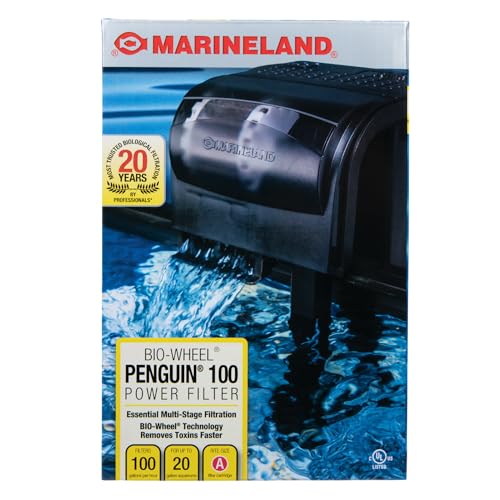
3. Marineland Bio-Wheel Penguin 100 GPH Power Aquarium Filter
The 100 GPH hang-on-back whose rotating bio-wheel keeps bacteria oxygenated through cartridge changes.
If you have ever had a tank crash after a filter change, this filter’s rotating bio-wheel is the feature to know about. It holds the beneficial bacteria in a wet/dry environment where they get constant oxygen, which keeps your biological cycle stable even when you swap the cartridges. It pushes 100 GPH through mechanical, chemical, and biological stages — the same ten-times turnover you want in a 20-gallon tank. At 1.65 pounds, it is the heavier of the two small hang-on-backs here (the AquaClear 20 comes in at 1.4 pounds), so it sits a little more firmly on the rim.
The value proposition is strong. It is one of the cheaper filters on this list, yet it covers all three filtration types and uses widely available Marineland Rite-Size cartridges. The cartridge system is straightforward: lift the cover, pull the old one, drop the new one in. Owners say the initial trickle noise from the bio-wheel fades over time, and the flow is adjustable for feeding. What earns it the most praise is how clean it keeps the water — tanks stay sparkling, and the multi-stage setup catches debris and chemical impurities before they circulate back.
A confident yes for: keepers who want bio-wheel biological stability and cheap, easy-to-find cartridges without spending much.
Think twice if: you want a filter that runs perfectly from the start with zero setup fiddling — this one sometimes needs its intake seated properly first.
4. Aqueon SmartClean Power Filter with EcoRenew Filter Cartridge
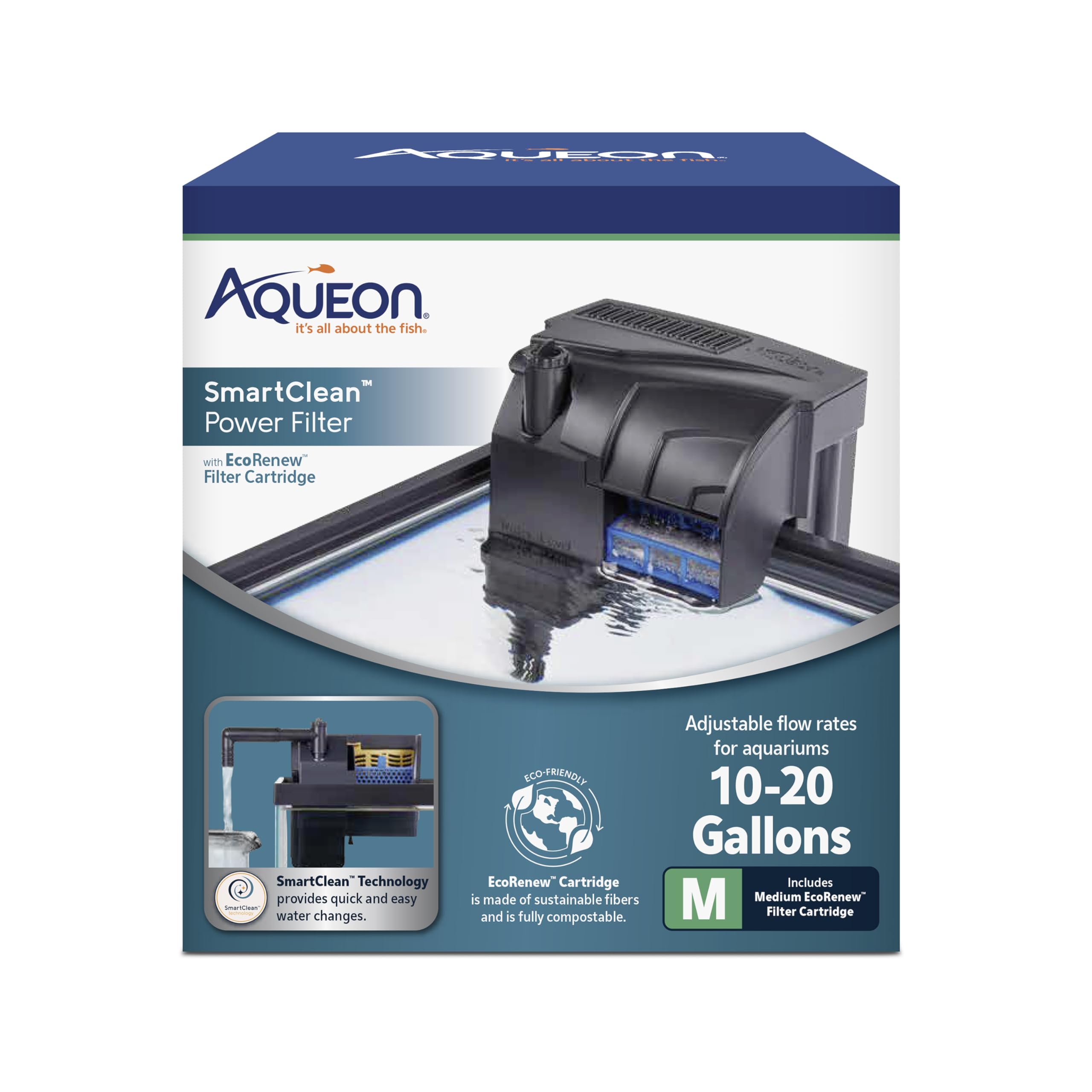
The auto-start hang-on-back whose rotating nozzle drains water for a partial change without removing the unit.
For the keeper who hates the mess of water-change day, this is the pick to reach for. SmartClean Technology lets you perform a partial water change without removing the filter at all — you just lift and rotate the nozzle to drain water without splashing. The pump auto-starts on plug-in with no priming, and it restarts by itself if your power cuts out and comes back. That matters in a 20-gallon tank because a filter that stays off for hours can starve the bacteria colony and cause a cycle spike. At 1.03 pounds it is the lightest filter here, so it barely presses on the rim.
The cartridge system is where it shines. A Bio-Holster holds the bacteria, separate from the EcoRenew cartridge, which is made from fibers infused with carbon — so you swap the cartridge without losing the biology. A NoDrip design on both the cartridge and its holster cuts down mess when you change media. For an overstocked 20-gallon guppy tank, buyers report it keeps water crisp despite constant breeding. The adjustable flow lets it work across freshwater and saltwater setups, so if you ever change your stocking plans, the filter adapts.
The honest caveat is cartridge sourcing in some areas. Replacement cartridges are not always available locally, which means planning ahead so you are not stuck mid-change. A few owners also note the flow sits strong even on the lowest setting for something like angelfish. Reliability is mixed — most units run well, but some report the pump quitting sooner than expected. That said, with the auto-restart, near-silent operation, and the water-change convenience, it earns its place for anyone who values low-effort maintenance over a cartridge-availability guarantee.
The everyday win: water changes go from a chore to a two-step twist, and the pump never needs priming or a manual restart after an outage.
The real caveat: keep a spare cartridge on hand — sourcing them locally can be tricky depending on where you live.
Pick this if: you want the least-fuss water changes and a filter that quietly restarts itself after every outage.
Move on if: you need a design you can buy a fresh cartridge for down the street, or you run slow swimmers that a strong pump would bother.
5. FKSC Hang On Back Aquarium Filter Up 20 Gallons with Surface Skimmer

The under-25 dB hang-on-back whose floating-ball skimmer pulls oil films and floating debris off the surface.
If your tank gets that greasy film on the surface, this filter targets exactly that problem. An integrated floating ball skimmer draws water off the top of the tank, pulling oil films and floating debris down into the media instead of letting them sit there. It runs a three-stage filtration system and self-primes the moment you plug it in — no manual pumping to get it going. At under 25 dB it is the quietest motor on this list, quieter than a whisper. It fits glass up to 0.8 inches thick, and it is rated for tanks up to 20 gallons.
The removable filter box is a nice touch for tinkerers — you can pull it out for a quick rinse or pack in your own media, so you are not locked to one brand of cartridge. The waterfall outflow also agitates the surface, which boosts dissolved oxygen for your fish and plants. It weighs 1.65 pounds, so it mounts securely on the rim. Setup is genuinely tool-free, and if quiet-and-clean is your priority over sheer filtering muscle, the skimmer alone is often a feature people pay separately to add.
Here is the honest part: this is a smaller, newer model with a mixed track record, and the flow is genuinely strong. Several owners found it too powerful even for a small tank and reported it stopping after a couple of weeks, so buy where returns are easy and test it thoroughly in the first month. The skimmer can also pull in floating food, so keep a floating ring over it if you feed pellets. Keep a prefilter sponge on the intake if you have small fish or snails — a few keepers had tiny livestock get pulled in. Treat it as a specialty filter for someone chasing a spotless surface, not a heavy-livestock workhorse.
Best for you if: surface film is your pet peeve and you run a lightly stocked 20-gallon where the strong flow is welcome.
A caution for: anyone with tiny fish, snails, or shrimp — the intake needs a sponge, and it runs hard for small tanks.
6. Tetra Whisper 135 GPH Internal Power Filter For Aquariums

The 135 GPH internal filter that clips to the inner wall so the tank can sit 1 inch from the wall.
This is the pick for a tank positioned where a hang-on-back will not fit — against a wall, under a shelf, or on a stand without room behind it. Because the Whisper clips directly to the inner wall and hides behind decor, your aquarium can sit just 1 inch from the wall. It pushes 135 GPH through large BioBag cartridges that trap debris and fish waste, with ultra-activated carbon cutting odor and discoloration. At 1.5 pounds it is light enough to stay put without stressing the glass.
The adjustable clip is what separates it from most internals — you can set it to run at high or low water levels, which means it keeps working through evaporation instead of grinding dry. Owners single out its low noise; the motor runs quietly and replacements are easy to find, which keeps long-term running simple. The single-cartridge design makes filter changes a two-minute job with no disassembly, and the whole unit pulls out and clips back in without tools, so cleaning is genuinely painless.
The size is the thing to weigh. It suits a 20-gallon turtle setup perfectly, but it can look bulky in a small tank, and the internal body eats into swimming space. It also sits low in the tank, which means if your water level drops, you will hear it. The most important warning: it can pull in small fish, with one owner losing nearly a full tank of guppies when they got trapped. Use a prefilter sponge if you keep tiny swimmers. For a 20-gallon tank with medium fish or a turtle, though, it is a quiet, low-maintenance, space-saving filter that works well anywhere a hang-on-back cannot reach.
Where it earns its keep: the wall-hugging internal mount and adjustable clip make it the best option when there is no room behind the tank, and it stays quiet through it all.
What to watch: the internal body takes up tank space and sits low, so it needs a prefilter sponge around small fish.
Choose it when: your tank sits flat against a wall and you cannot fit a hang-on-back, or you keep a turtle in a 20-gallon setup.
Choose something else when: you keep very small fish like guppies without a prefilter, or you want to keep every inch of tank space for decor.
7. hygger Aquarium HOB Filter 105 GPH for 10-20 Gallon Fish Tank

The 105 GPH hang-on-back with an LED that lights when a clogged pad backs up the water.
For the keeper who forgets to check the filter, this feature is worth the price of entry on its own. A built-in LED indicator light turns on when a clogged cartridge causes water to back up — so instead of guessing, you get a clear signal to swap the pad. It mounts on the outside of the wall with the hanging design, keeping your tank interior untouched, and you never have to disturb your fish to pull it off for cleaning. The top knob adjusts flow up to a max of 105 GPH, and the intake tube extends to match your tank depth. The intake is wrapped in sponge to keep small fish and shrimp from getting pulled in.
The media is genuinely flexible. You get a dual-sided sponge cotton cartridge with ultra-activated carbon for trapping waste and killing odors, plus a bio-filter plate that gives bacteria more surface area to colonize. Because you can add or replace media as needed, it works for beginners and tinkerers alike. It weighs 1.41 pounds and comes with a one-year manufacturer warranty. For a 10- to 20-gallon tank where you want a clear, low-odor look without a lot of fuss, this delivers.
The honest trade-offs come from the smaller model. There is no self-priming here — you fill the chamber with water before the first start — and the media compartment is small, so you will not pack in much. Cartridge availability for the small size is inconsistent, and the brand’s own indicator light has been reported to stay on even with a clean pad. On some units, water overflows at the back and needs tilting forward. It works best when you keep spare cartridges on hand and accept that you may have to source them online.
The right call for: keepers who want a visual cue for filter changes and like the freedom to pack their own media.
Pass on it if: you insist on self-priming or you want to buy replacement cartridges off a nearby shelf.
8. Penn-Plax Cascade 100 Power Filter – Hang-On Filter with Quad Filtration

The 100 GPH hang-on-back with four stages, a separate Bio-Sponge cartridge, and an adjustable lift tube.
This filter is built for the keeper who wants maximum filtration stages in one compact unit. It runs water through four separate filtration stages — mechanical, chemical, and biological plus a dedicated Bio-Sponge cartridge — so the bacteria that process ammonia and nitrate get their own independent media surface. It moves 100 GPH (or 360 liters per hour) for tanks up to 20 gallons, and it handles both freshwater and saltwater. The adjustable flow knob and adjustable lift tube are the practical touches: you can slow the current at feeding time, then dial it back up.
The Bio-Sponge cartridge is the standout feature. It tune colonization of anaerobic bacteria independently from the first-stage media, so you get two separate biological zones instead of one. The Bio-Falls outflow agitates the water as it returns, which adds oxygenation and helps remove ammonia. Owners mention it clears water fast — some within the hour — and stays quiet. At 20 gallons it delivers about five cycles per hour, which is fine for a moderately stocked community tank and plenty for a lightly stocked one. The double-sided cartridges with activated carbon and poly fiber floss trap particulates and clear discolorations as water passes through.
The honest limit is that this is a 100 GPH pump, so it will feel weak in a heavily stocked tank. Some customers note that their unit was too weak for a 20-gallon community in practice, and a few units arrived with a broken motor clip or a leak between the intake and the case. Inspect it carefully on arrival, and consider a prefilter sponge on the intake if you keep shrimp. For a freshwater or saltwater 20-gallon that wants thorough multi-stage filtration in one unit, though, the Cascade 100 does a lot of filtering for a fair price.
Strengths that stand out
- Four separate filtration stages, including an independent Bio-Sponge for bacteria
- Adjustable flow knob and adjustable lift tube for feeding control
- Clears water quickly and runs quietly in freshwater or saltwater
- Bio-Falls outflow adds oxygenation and aids ammonia removal
Points worth knowing
- 100 GPH is modest — weak for a heavily stocked 20-gallon
- An occasional unit arrives with a broken clip or a leak — inspect on arrival
Settle on this if: you want four-stage filtration in one compact hang-on-back and keep a moderately stocked tank.
Settle elsewhere if: your 20-gallon is densely stocked or you need a pump with more flow headroom than 100 GPH.
Understanding the Specs
Flow Rate (GPH) and Turnover
GPH is the volume of water a pump moves per hour, and turnover is how many times it cycles your whole tank in that hour. The common benchmark is ten times per hour — so a 20-gallon tank wants roughly 200 GPH of actual flow. When a filter lists a range like “10-20 gallons,” it is rated for the low end; pair it with your tank size to see whether you hit ten-times turnover. In a heavily stocked tank, higher turnover is what keeps the water from developing that murky tint.
Filtration Stages Explained
Most filters combine three types of filtration. Mechanical filtration traps debris in a sponge or floss — that is your first line against cloudy water. Chemical filtration uses activated carbon to pull out odors and discolorations. Biological filtration gives helpful bacteria a place to live so they can process ammonia and nitrite. Filters that separate these stages let you replace one without losing the others — the key to avoiding a cycle spike when you change media.
FAQ
How many gallons per hour do I need for a 20-gallon fish tank?
Is a hang-on-back or an internal filter better for a 20-gallon tank?
What does a surface skimmer do on an aquarium filter?
How long should media cartridges last before changing?
Do I need a prefilter sponge for shrimp or fry?
Can I use a saltwater filter on a freshwater tank?
Why does my filter need to be primed before it runs?
What is a bio-wheel and does it matter in a 20-gallon tank?
How much noise should I expect from a 20-gallon filter?
Will a strong filter disturb my betta or small fish?
Final Thoughts: The Verdict
For most 20-gallon setups, the strongest all-around pick is the AquaClear 20 Power Filter — because it pairs the ten-times turnover you need with separated three-stage media, so you can change a sponge without crashing your bacteria colony. If quiet is your top priority on a budget, the Aqua-Tech Ultra Quiet runs below 40 dB for a starter price, though you should expect to replace it sooner than the AquaClear. If you want extra biological stability from a rotating bio-wheel, grab the Marineland Bio-Wheel Penguin 100 GPH. And for tanks crammed against a wall where no hang-on-back fits, the Tetra Whisper 135 GPH clips inside and hides behind your decor. Match the flow to your stocking level, keep spare media on hand, and clean the housing every couple of weeks — that is what keeps a 20-gallon tank clear for the long haul.
How We Picked
We do not accept paid placement. Every pick is matched to a real buyer and a real use-case; we do not hands-on test units.
Sources & Methodology
Specifications: manufacturer listings and product documentation. Review insights: verified customer reviews, as of September 2026. Pricing: not shown on this page (it changes often); check the current price via the retailer link.
As an Amazon Associate, Gadgets Feed earns from qualifying purchases. This does not affect which products we feature.