
Buying a bulb for indoor growing that actually pushes seedlings, leafy greens, and flowering plants to their full potential means understanding more than just the wattage number on the box. The narrow beam angle of a standard PAR38 floodlight or the cool-white daylight of a 5000K tube determines whether your basil stays leggy or your succulents develop those deep red stress pigments you see on Instagram.
I’m Min — the co-founder and writer behind Gadgets Feed. I’ve spent countless hours cross-referencing PPFD maps, spectral distribution charts, and real-world customer grow journals from seed-starting enthusiasts to fine-tune exactly which bulb for indoor growing delivers measurable results for compact home setups.
Whether you are nursing a single Monstera in a dark corner or running a 2×2 germination tent, the right full-spectrum LED bulb transforms a sad, stretching plant into a compact, vibrant specimen in a matter of weeks.
How To Choose The Best Bulb For Indoor Growing
Selecting a bulb for indoor growing blind — just picking the biggest wattage or the cheapest price — leads to burned leaf tips, leggy seedlings, or zero flowering. Three physical specs define whether a bulb is a real grow tool or just a decorative light.
PPFD, Not Lumens
Lumens measure brightness perceived by the human eye, which peaks in the green spectrum. Plants use red (660nm) and blue (450nm) light for photosynthesis. A bulb’s PPFD number (μmol/m²/s) tells you how many usable photons hit a one-square-meter area per second. A high-lumen “daylight” bulb without a strong red peak will keep your plant alive but never push it to bloom.
Beam Angle and Coverage
A PAR38 bulb with a 50-degree beam angle concentrates light into a tight circle — perfect for a single large pot at 12 to 18 inches away. An A21 bulb with a 120-degree beam spreads the same power over a wider tray, which suits seedling flats but penetrates less deeply into a bushy plant’s canopy. Match the bulb’s beam to your container shape and the distance you can practically mount it.
Heat Management and Fixture Safety
LED bulbs for indoor growing can run surprisingly heavy — some ceramic-base PAR38 bulbs weigh close to two pounds. Clamp lamps and cheap gooseneck fixtures often have a weight rating printed on the socket. Exceeding that rating bends the neck or cracks the fixture. Also measure the bulb’s length; a long PAR38 may protrude past a typical desk-lamp shade and become a burn hazard.
Quick Comparison
On smaller screens, swipe sideways to see the full table.
| Model | Category | Best For | Key Spec | Amazon |
|---|---|---|---|---|
| VIPARSPECTRA XS1500 Pro | Premium Panel | Seed starting to small-plant flowering in a tent | 150W actual draw, dimmable, daisy-chain | Amazon |
| AC Infinity IONBEAM S16 | Supplemental Bar | Canopy penetration in a grow tent | Samsung LM301H EVO diodes, magnetic mount | Amazon |
| GLOWRIUM Floor Lamp | Standing Lamp | Large potted plants in living-room corners | Adjustable 32/47/63 in height, 6-level dimming | Amazon |
| SANSI Clip Triple-Head | Clip-On System | Multi-angled coverage on a desk or shelf | 3 replaceable 10W PAR20 bulbs, 4/8/12h timer | Amazon |
| Philips LED PAR38 | Standard Flood | Single large pot in a standard lamp socket | 15.5W, 1325 lumens, 50° beam, 25,000h life | Amazon |
| SANSI 32W A21 | High-PPFD Bulb | Dense seedling trays and compact greens | 350W equiv, 423 μmol/s/m² at 1ft, ceramic base | Amazon |
| Lonwon PAR38 30W | Wide-Coverage Bulb | Medium plant clusters needing broad light | 320W equiv, 4.7 in oversized head, 4000K | Amazon |
In‑Depth Reviews
1. VIPARSPECTRA XS1500 Pro

The XS1500 Pro is technically a panel, not a screw-in bulb, but it belongs in this list because it solves the number-one problem of single-bulb setups: uneven PPFD at the edges. VIPARSPECTRA’s optical-lens design concentrates photons across a 2×2 flowering footprint with minimal loss, and at 150W actual draw you get genuine penetration through a bushy canopy.
A built-in dimmer lets you ramp from 50% power for tender seedlings up to full blast for heavy-fruiting peppers or tomatoes. The daisy-chain connector means you can scale to a 4×2 tent using two units without extra controllers. Users report 747 μmol/m²/s at 50% dimming and 13 inches — enough to push super-hot chilies to full ripeness.
One trade-off: the four-position dimmer switch is coarse. Pairing it with an AC Infinity controller unlocks ten finer levels, but out of the box you get only preset steps. The exposed LED board also lacks a water-resistant cover, so keep it clear of overhead watering splashes.
Why it’s great
- Optical-lens array produces uniform PPFD across a 2×2 grow area
- Dimmable down to 50% for seedling safety
- Daisy-chain connection enables multi-panel setups without extra wiring
Good to know
- Coarse 4-position dimmer limits granular control
- LEDS are exposed and not water-resistant
- No integrated off switch — must unplug or use a timer
2. AC Infinity IONBEAM S16

The IONBEAM S16 is a supplementary light bar, not a primary bulb, and it earns its place here because canopy penetration is the silent killer of yield in deep pots. Each 16-inch bar uses Samsung LM301H EVO diodes rated at 3.14 μmol/J PPE — among the highest efficiency diodes you can buy — to push light into the lower branches that your overhead fixture misses.
AC Infinity bundles steel mounting bars that magnetically snap to tent poles, so you can position the S16 vertically or horizontally within seconds. The included Controller 77 offers ten intensity levels and a daily timer with a sunrise/sunset ramp that mimics natural photoperiods — a feature no screw-in bulb can match.
On the downside, the connecting cables between bars are short: anything beyond 16 inches apart requires a separately purchased extension. The unit is also optimized for tent owners who already have a primary lamp; as a standalone light it lacks the raw PPFD to flower a full canopy from scratch.
Why it’s great
- Samsung LM301H EVO diodes deliver industry-leading 3.14 μmol/J efficiency
- Magnetic mounting system works with standard tent frames
- Digital controller includes sunrise/sunset timer and ten brightness levels
Good to know
- Short connecting cables may require extra extension cords
- Designed as a supplemental bar, not a primary light source
- Higher price per watt than screw-in bulb alternatives
3. GLOWRIUM Floor Lamp 20W
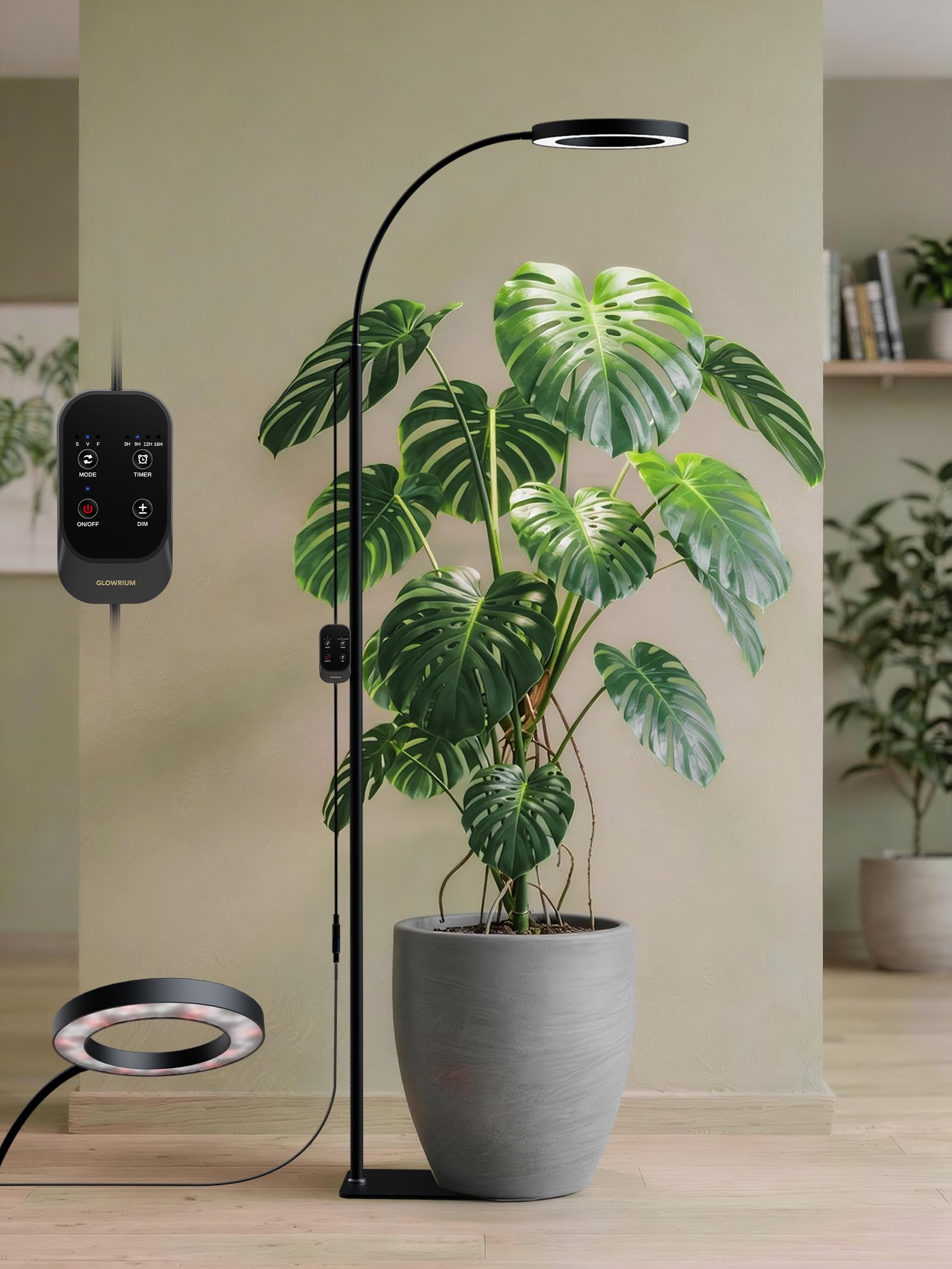
The GLOWRIUM floor lamp solves one ugly problem that standard bulb setups create: a bare bulb pointing sideways into your eyes. This standing lamp uses a 360-degree adjustable head and a full aluminum-alloy pole that telescopes from 32 to 63 inches, meaning you can aim the light down into a large fiddle-leaf fig or a floor-level monstera without any clamp or stand.
Its 66-LED array switches between three spectral modes: a warm-white plus cool-white for root growth, a cool-white plus red for flowering, and a full combo mode for the entire cycle. The 13-foot power cord gives you genuine placement freedom across a living room, and the remote control makes dimming from 10% to 100% feel natural rather than industrial.
The downside: 20W total draw is low for dense flowering. It will keep a rubber plant green and happy, but don’t expect it to drive heavy buds on a cherry tomato. The remote also requires line-of-sight, so you cannot hide the lamp behind furniture.
Why it’s great
- Three spectral modes cover germination, veg, and flowering phases
- Telescoping pole fits under standard ceiling height
- 13-foot cord lets you position it far from an outlet
Good to know
- 20W total output limits heavy flowering potential
- Remote control needs direct line-of-sight to the receiver
- Bulb is non-replaceable in the current assembly
4. SANSI Clip Triple-Head 30W

The SANSI triple-head clip light turns a desk or a shelf into a three-zone grow station without drilling holes. Each of the three goosenecks holds a 10W PAR20 bulb that SANSI backs with a lifetime free replacement policy — if a diode fails, you get a new bulb shipped at no cost. The clip itself is substantial enough to grip a 2-inch-thick shelf edge or a vertical tent pole.
A built-in timer offers 4, 8, or 12-hour cycles based on a 24-hour clock, so your plants get consistent photoperiods even if you forget to switch the light on. Users report that the cool-white 4000K output promotes tight internode spacing on succulents and reverses leaf yellowing on overwintered houseplants. The ability to aim each head independently means one lamp can cover a tall snake plant, a spreading pothos, and a tray of seedlings simultaneously.
The bulbs run hot — hot enough to burn skin on contact and scorch foliage if placed closer than 6 inches. The goosenecks are stiff but not infinitely strong; if you angle a head too far sideways the weight of the bulb can cause it to sag over time. Also, the timer resets to the beginning after any power interruption, which matters if your outlet is on a light switch.
Why it’s great
- Lifetime free bulb replacement from SANSI
- Independent goosenecks cover three separate plant zones
- Built-in timer handles daily photoperiod automatically
Good to know
- Bulbs get very hot — keep 6+ inches from foliage
- Gooseneck stiffness may not hold heavy bulbs at extreme angles
- Timer resets after any power outage
5. Philips LED PAR38 15.5W

The Philips PAR38 is the mature, no-nonsense entry for someone who just wants to screw a bulb into an existing floor lamp and see tangible improvement. Its 50-degree beam angle is wider than the typical PAR30 narrow spot, which means a single bulb can soak a medium-sized rubber plant or a cluster of succulents on a side table. At 15.5W actual draw, it is one of the most energy-efficient options here, and the 25,000-hour rated lifespan — roughly 23 years at three hours per day — removes the need to ever replace it.
The 92 CRI and 5000K daylight color temperature produce a crisp white light that does not distort the natural green of your leaves, making it visually pleasant in a living space. Real users confirm that it revived a dying echeveria and pushed red tips on succulents within weeks when positioned 8 to 12 inches away.
The catch: the bulb weighs just over a pound, so a cheap clamp lamp with a plastic socket will sag or fail. It also outputs only 1325 lumens, which is strong for a single plant but insufficient for a full tray of seedlings. And it lacks any red-spectrum boost, meaning it is a vegetative-maintenance bulb, not a flowering finisher.
Why it’s great
- Ultra-long 25,000-hour lifespan saves frequent replacement
- 92 CRI provides natural-looking illumination for living spaces
- Energy efficient at 15.5W for a PAR38 flood
Good to know
- No enhanced red wavelength for flowering stages
- Heavy construction (over 1 lb) strains lightweight fixtures
- Lower total lumens than dedicated grow bulbs
6. SANSI 32W A21

SANSI’s 32W A21 bulb packs a 423 μmol/m²/s PPFD at 12 inches — a measurement that beats most standard screw-in bulbs by a significant margin. The secret is the ceramic heat sink (Chip on Ceramic technology) that wicks heat away from the LEDs faster than aluminum, allowing the diodes to run at higher current without degrading. The result is 350W incandescent equivalent light from a bulb that fits any standard E26 lamp.
Users consistently note that plants physically lean toward this bulb within days. The 4000K natural-white output (Ra near 95) avoids the purple glow that makes grow bulbs an eyesore in open shelving. In a Fluker’s heavy-duty clamp lamp, the bulb stays cool enough to touch the housing, though the ceramic base itself gets warm. It is ETL listed and backed by a 5-year protection plan.
Two practical drawbacks: at 60 degrees, the beam angle is narrower than a standard A19 bulb, so you need to keep the distance under 18 inches for even coverage. The bulb is also noticeably heavier than a typical household LED, so a lightweight desk-lamp arm may droop under the weight.
Why it’s great
- Very high PPFD density for a screw-in bulb
- Ceramic substrate improves heat dissipation and diode lifespan
- Natural 4000K light blends into home decor without purple tint
Good to know
- 60-degree beam angle requires close placement for full coverage
- Heavier construction may not suit lightweight lamps
- Limited to vegetative growth without dedicated red boost
7. Lonwon PAR38 30W
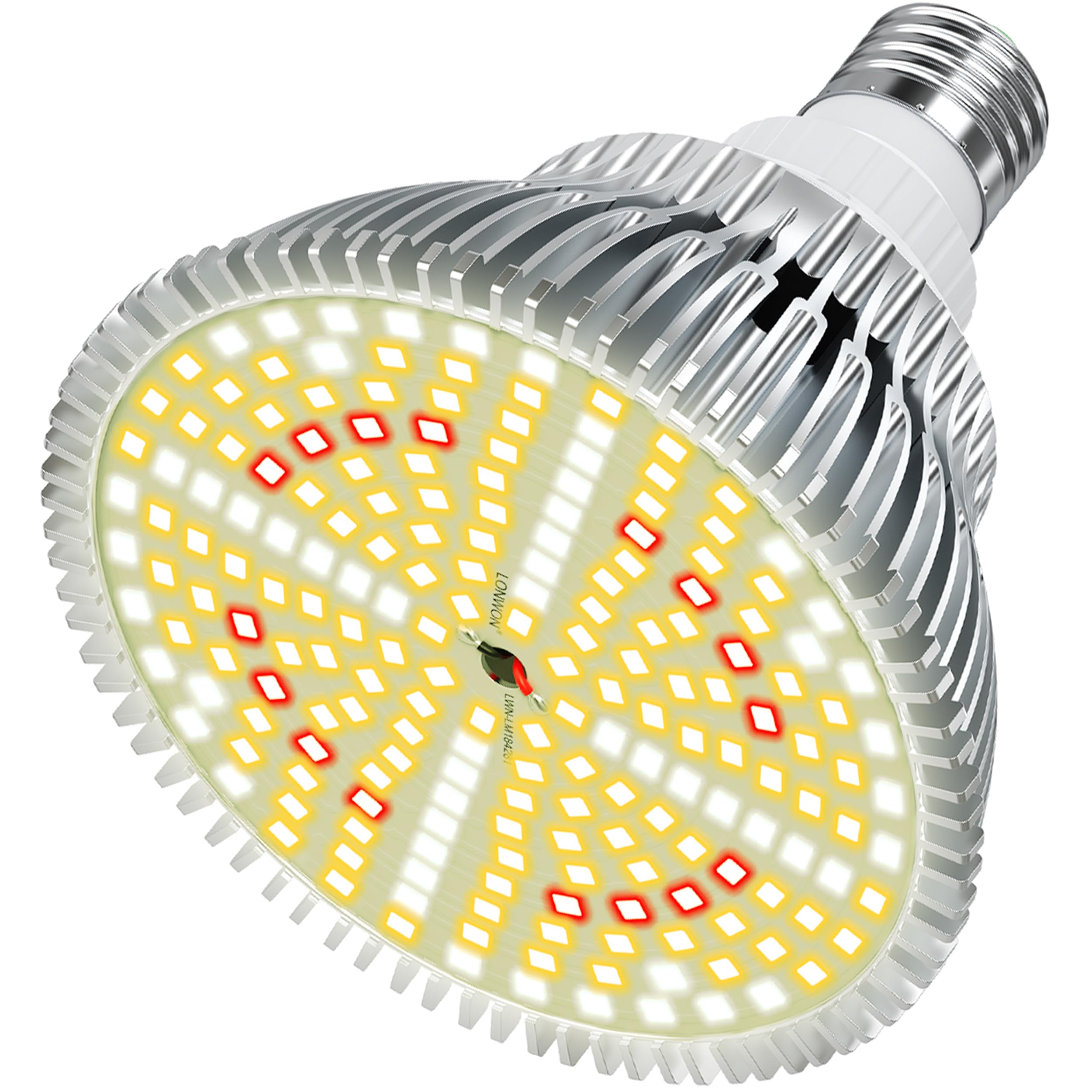
The Lonwon PAR38 takes the oversized-head approach: 4.7 inches across and packed with 184 LEDs to deliver a claimed 1300 μmol/m²/s at close range. The 30W draw translates to a 320W incandescent equivalent, and the enhanced 660nm and 730nm red wavelengths target the blooming and fruiting cycle more aggressively than a generic daylight bulb. Users report that jalapeño and basil seedlings reversed yellowing within two weeks under this light.
The 4000K natural-white glow keeps the grow area visually comfortable — no garish pink or violet wash. Customer support gets consistent praise: one user reported four LEDs burning out after six weeks, and the seller shipped a replacement in two days without a return request. At its price point, the bang-for-buck ratio is hard to beat.
Durability is the open question. While most units run reliably, the LED burn-out reports (even if quickly replaced) suggest quality control is not as tight as Philips or SANSI. The bulb also runs warm enough that the housing gets hot to the touch after a few hours, so ventilation around the socket matters.
Why it’s great
- Enhanced 660nm/730nm red wavelengths support flowering stages
- Oversized 4.7-inch head distributes light over a wide area
- Aggressive pricing with responsive warranty support
Good to know
- Occasional reports of LED burn-out within weeks
- Housing gets hot during extended operation
- Not as tightly focused as narrow-beam PAR38 alternatives
FAQ
Can a regular daylight LED bulb grow plants without a special grow bulb?
How high should I hang a grow bulb above my plants?
What does PAR38 mean and does the number matter for growing?
Do grow bulbs for indoor plants consume a lot of electricity?
Final Thoughts: The Verdict
For most users, the best bulb for indoor growing that delivers real vegetative and flowering power without a tent is the bulb for indoor growing winner is the SANSI 32W A21 because its high PPFD and ceramic heat sink outperform nearly every other screw-in bulb in the same price bracket. If you want a simple, bulletproof bulb for a single houseplant in a living-room lamp, grab the Philips PAR38. And for dedicated tent growers who need canopy-filling power with dimmable control, nothing beats the VIPARSPECTRA XS1500 Pro.