
Our readers keep the lights on and my morning glass full of iced black tea. As an Amazon Associate, I earn from qualifying purchases.
Specs are compiled from manufacturer listings and verified buyer reviews and can change over time — please confirm the key details on the product page before buying.
If your drawer is full of dead disposables and your remotes keep dying mid-week, one good set of AA rechargeable batteries plus a smart charger ends that for good. The catch: not every rechargeable AA is worth your money. Some hold their charge for years, others quietly drain on the shelf. Below, the genuinely dependable cells are sorted from the ones that disappoint, so you can see exactly which pack fits your devices.
I’m Min — the founder and writer behind Gadgets Feed. This guide is built by comparing the manufacturers’ published specifications and the patterns across verified customer reviews, so you get each pick’s real strengths and trade-offs instead of marketing spin.
Battery life claims are easy to print and hard to prove, so each pick below weighs measured capacity against what buyers report after months of use. The clear winner for most households is the Eneloop 8-pack: 2100 cycles, pre-charged, and still holding most of its charge after years in a drawer.
Our Picks at a Glance


How To Choose The Best AA Rechargeable Batteries
Two rechargeable AAs can look identical on the shelf and behave completely differently after six months. Three things decide that: how much charge the cell keeps while just sitting there, how many times you can refill it, and whether your device can live with the 1.2 volts a nickel-metal hydride (NiMH) cell delivers instead of the 1.5 volts a disposable gives. A 1.2-volt cell runs most remotes and controllers fine, but a few picky devices want the full 1.5 volts.
Low self-discharge is the feature that actually saves you money
Self-discharge is the rate at which a battery loses its charge while doing nothing in a drawer. A standard NiMH cell can bleed most of its power in weeks, which is why people give up on rechargeables — the batteries are always flat right when you need them. A low self-discharge cell holds a large share of its power for months or years, so the set you charged last spring still fires up a flashlight in autumn. Look for a stated retention figure, like holding most of its charge for a year or more, because that number is what decides whether rechargeables feel convenient or feel like a chore.
Capacity versus cycle life: you rarely get both
Capacity, measured in milliamp-hours (mAh), is how much energy the cell stores per charge — a 2800mAh battery runs longer between refills than a 2000mAh one. Cycle life is how many times you can recharge it before it starts losing capacity. High-capacity cells often trade some cycle life for that extra runtime, while moderate-capacity cells frequently survive far more recharges. A digital camera flash or a gaming controller drinks power fast and rewards higher capacity. A wall clock or a TV remote sips power and is better served by a cell that survives thousands of cycles. Match the cell to the job — high capacity for cameras and controllers, high cycle life for clocks and remotes — and a pack lasts years.
Quick Comparison
| Model | Best For | Capacity | Recharge Cycles | Cell Type | Amazon |
|---|---|---|---|---|---|
| Eneloop Panasonic BK-3MCCA8BA (8-Pack)★ Best Overall | Everyday all-rounder | 2000 mAh | 2100 | NiMH | Amazon |
| EBL 8-Pack 2800mAhBest Value | Budget runtime per charge | 2800 mAh | 1200 | NiMH | Amazon |
| Amazon Basics 16-Pack 2000mAhBulk Pick | Bulk stocking on a budget | 2000 mAh | 1000 | NiMH | Amazon |
| Eneloop Panasonic BK-3MCCA6BA (6-Pack) | Small households and first-timers | 2000 mAh | 2100 | NiMH | Amazon |
| Duracell AA NiMH 4-Pack | Camera and flash users | — | 400 | NiMH | Amazon |
| BEVIGOR 16-Pack 2800mAh | High-drain gadgets in volume | 2800 mAh | 1500 | NiMH | Amazon |
| NICEBATT 16-Count 2800mAh | Solar lights and outdoor gear | 2800 mAh | 1200 | NiMH | Amazon |
| Amazon Basics 24-Pack 2400mAh | Controllers and continuous-drain devices | 2400 mAh | 400 | NiMH | Amazon |
| Energizer Recharge Universal 16-Pack | Big households rotating many devices | 2000 mAh | — | NiMH | Amazon |
In‑Depth Reviews
1. Eneloop Panasonic BK-3MCCA8BA AA 2100 Cycle Ni-MH Pre-Charged Rechargeable Batteries, 8-Battery Pack
Our pick — over 4.5★ from 17,000+ verified ratings; the strongest balance of quality and price.
The cell that turned a skeptical camera crowd into believers — and still holds its charge two winters later.
Charge this pack once and forget it for months. Panasonic rates these at up to 2100 recharges, and the factory says they keep up to 70% of their charge after 10 years of sitting unused — a retention figure no rival on this list matches. No other cell on this list matches that retention figure. A cabinet of charged spares means a dead flashlight never sends you to the store at nine at night.
What wins people over is how long they keep going between charges. Across thousands of reviews, the pattern is the same: these do not fade the way cheaper cells do. Comparing cycle life head-to-head, the Eneloop’s 2100 recharges is more than double the 1000 cycles of the Amazon Basics 16-pack, though the Basics pack does give you twice the cell count — 16 versus 8.
The honest trade-off? Two things. At 2000mAh minimum, a 2800mAh cell like the EBL pack stores roughly 40% more energy per charge, so for a high-drain gaming controller you may swap batteries slightly more often. And like every NiMH cell here, it delivers 1.2V, not the 1.5V of a disposable, which some picky devices notice. For remotes, toys, wireless keyboards, and camera flashes, neither matters.
Where it earns its keep
- 2100 recharge cycles — the longest-running cell in this lineup
- Holds up to 70% charge after 10 years of storage
- Arrives pre-charged and ready, so you can use them straight from the pack
- Works down to -4°F, useful for outdoor gear and cold garages
What to weigh
- 2000mAh minimum trails 2800mAh rivals on raw per-charge runtime
- 1.2V output trips up the occasional voltage-sensitive device
Buy this if: you want one pack that quietly handles every AA device in the house for years without fuss — cameras, remotes, controllers, toys.
Think twice if: your main job is a heavy-drain gaming controller where maximum per-charge runtime beats sheer longevity.
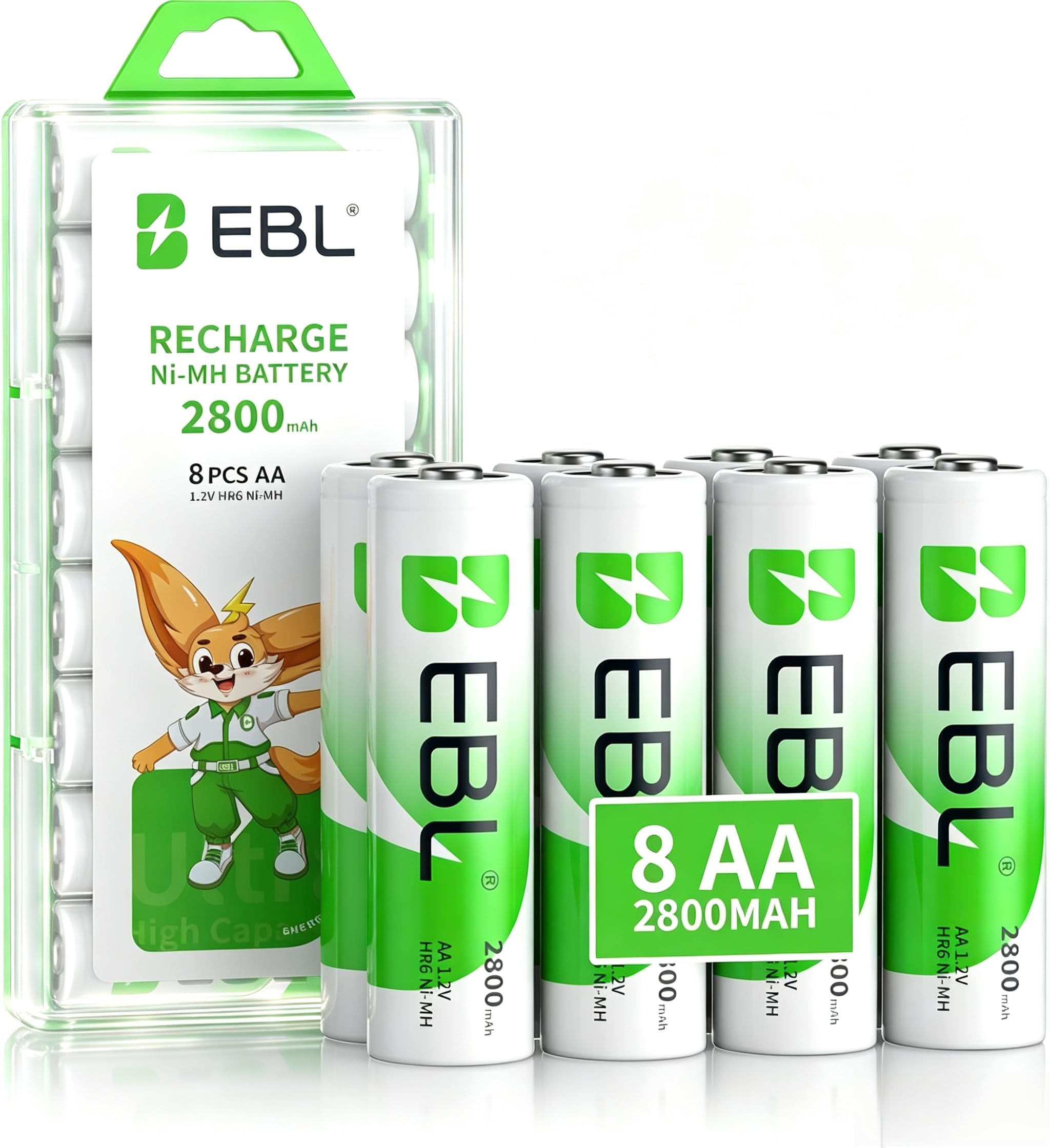
2. EBL Pack of 8 AA Batteries 2800mAh High Capacity Precharged Ni-MH AA Rechargeable Batteries
The capacity leader of the budget tier — 2800mAh per cell and storage cases thrown in.
When you are buying eight rechargeable AAs at an entry-level price, the number that matters is milliamp-hours. These EBL cells are rated at 2800mAh, and when you set that against the 2000mAh of the Eneloop pack above, that is roughly 40% more stored energy per charge. For a handheld camera or a toy that chews through power, that extra runtime is obvious. The pack also ships with its own storage cases, which is a neat way to keep charged and flat sets apart.
Battery quality is the thing owners single out most here, and it shows in the small details: the cells arrive partially pre-charged, so they can be used right out of the pack. EBL’s ProCyco technology and low self-discharge claim keeps 80% of capacity after three years of non-use. If you charge a set and forget it in a drawer, that figure matters more than peak capacity. Reviewers running multimeters report the cells still hold a good charge after heavy use, with jackets that hold up.
The catch is consistency. The advertised 2800mAh number is a ceiling, and plenty of longer-term users find real-world capacity lands closer to 2000mAh, with a full recharge taking a long time. A handful of buyers also report a cell or two needing a wiggle and a re-seat before the charger recognizes it. Both issues are the trade-off of chasing maximum capacity at this price, and neither ruins a solid budget pick.
Best for high-drain devices: Anywhere runtime per charge beats cycle life — cameras, toys, flash units — the 2800mAh rating earns its keep.
Do not expect 2100 cycles: EBL’s own specs point to a shorter service life than a premium low-self-discharge cell, so treat this as the runtime pick, not the decade pick.
Reach for this if: you want maximum stored energy for your dollar and do not mind charging a bit slower.
Look elsewhere if: you need the longest possible service life or every cell to charge without a nudge every single time.
3. Amazon Basics 16-Pack Rechargeable AA NiMH Batteries, 2000 mAh, 1.2V, Low Self Discharge, Pre-Charged, Recharge up to 1000x Times
The pack you grab when you want to stock the whole house at once and stop rationing cells.
Sixteen cells in one box changes how you use batteries. Instead of one set rotating between the TV remote and the kids’ toys, you load every device in the house and still have spares. At 2000mAh, each cell is rated the same capacity as the Eneloop pick, and these come pre-charged and ready to go. Low self-discharge keeps 80% of capacity for two years, with a shelf life up to five years — long enough to cover a power cut you forgot was coming.
Where this pack genuinely competes is cycle count against your budget. It is rated for 1000 recharges, and buyers testing a dozen cells from the start measured 1730 to 1820mAh fresh, rising to 2050 to 2130mAh after a couple of refresh cycles — above its own 2000mAh rating. Some report capacity down to 88 to 91% after 28 days of storage, which is real low-self-discharge performance, not a marketing claim. For a household running a dozen devices, that reliability at a per-cell price is the pitch.
Watch the physical fit, though. NiMH cells are slightly wider than alkaline disposables to meet IEC standards (the international safety and sizing rules for batteries), and this pack is no exception. Some buyers find it a tight squeeze in recessed battery compartments, and the positive button can sit short enough to miss the contact in a deeply recessed slot. That is a fit issue, not a defect, but it is the one thing to check before you buy sixteen of them.
Why the value is hard to argue with: Sixteen pre-charged 2000mAh cells, each rated to survive 1000 cycles, is enough to replace disposables across a whole house.
The compartment caveat: Slightly wider than standard, so measure a tight device bay before committing the whole pack to it.
Choose this if: you are arming multiple rooms with rechargeables and want the lowest cost per working cell.
Skip the bulk buy if: your devices have snug or deeply recessed battery slots that punish a slightly fatter cell.
4. Eneloop Panasonic BK-3MCCA6BA AA 2100 Cycle Ni-MH Pre-Charged Rechargeable Batteries, 6-Battery Pack

Same legendary cell, smaller box — the sensible first set if you are just testing the rechargeable waters.
Six cells is the balance for a small flat. That covers a pair of controllers, the TV remote, and a spare on the charger, and it lets you try low-self-discharge batteries (cells that barely lose charge while sitting) without committing to a sixteen-pack. You get the same DNA as the top pick here: 2100 recharge cycles, 2000mAh minimum capacity, and the factory claim of holding up to 70% charge after 10 years in storage. Pre-charged at the factory, they work the moment they land.
On battery quality and longevity, owners treat these as a long-haul buy rather than a short-term fix. Reports of original cells still charging fine after well over a decade are common, and the cells hold their charge in a TV remote or a wireless mouse for months. In high-drain gear like an Xbox controller, they deliver strong runtime before they need a top-up. The 2100-cycle rating here is more than five times the 400-cycle lifespan of the Duracell 4-pack lower down, which matters if you plan to keep them for the long haul.
What is the honest downside? The sticker. Buyers consistently flag these as pricier per cell than the multi-packs and suggest catching them on sale — the value math shifts depending on how many AAs your home actually burns through. If six cells cover your devices, the longevity offsets the outlay. If you want to supply a whole house, the 8-pack or 16-pack makes more sense.
Why the small pack wins
- 2100 recharge cycles and 2000mAh minimum — identical specs to the top pick
- Holds charge for months, so spares are always ready
- Low upfront quantity to test whether rechargeables fit your routine
The one thing to plan for
- Higher cost per cell than larger packs — best caught on a discount
- Six cells runs out fast if you also power cameras, flash gear, or multiple controllers
Best entry into low self-discharge: A small, premium, long-lived set for a couple of devices and a household that does not want a battery drawer.
Not the bulk answer: If you are replacing disposables across every room, step up to the larger packs for a better per-cell deal.
5. DURACELL AA NiMH Battery, Rechargeable, 4/Pack (DX1500B4N001)

A four-pack built for one job in particular — feeding a camera or a flash unit reliably.
If your gear lives in a camera bag, a compact four-pack makes sense: you fill the flash, keep a charged pair as backup, and rotate through a NiMH charger. Duracell rates these for up to 400 recharges, with Duralock Power Preserve holding charge up to a year in storage and a guaranteed service life of 10 years or 400 recharges, whichever comes first. They come pre-charged, and the Long-Life Ion Core is claimed to run 50% longer per charge than a 1350mAh AA within the first 200 cycles.
In practice, these fit the device they are bought for. Photographers running them in Kodak and professional camera bodies report they charge fast, last a while, and power the camera without complaint. The size is standard, so no fighting the compartment. For a flash-heavy weekend shooter, four reliable cells that keep firing are the whole job done.
The one recurring frustration is cosmetic, and worth knowing before you open the box. The cells arrive looking identical to standard Duracell disposables rather than the green rechargeable color some buyers expect, which makes it easy to misfile a rechargeable among the throwaways. It is a small gripe, not a performance problem, but a bright marker on the cell would help.
Suited to camera gear
- Pre-charged and ready, holds up to a year in storage
- Rated up to 400 recharges with a 10-year guarantee
- Works in any NiMH charger
Worth noting
- Only four cells per pack, so it suits a single device, not a household
- Color matches disposables, so keep it in a dedicated case to avoid mixing
A tidy fit for camera owners: Four cells, a NiMH charger, and one camera body — nothing extra to manage.
Step up if you need volume: For a household of remotes and toys, the larger 16- and 24-packs give you far more working cells.
6. BEVIGOR AA Rechargeable Batteries 16 Pack, 2800 mAh High Capacity and Low Self Discharge, 1.2V Ni-MH Double AA Rechargeable Batteries
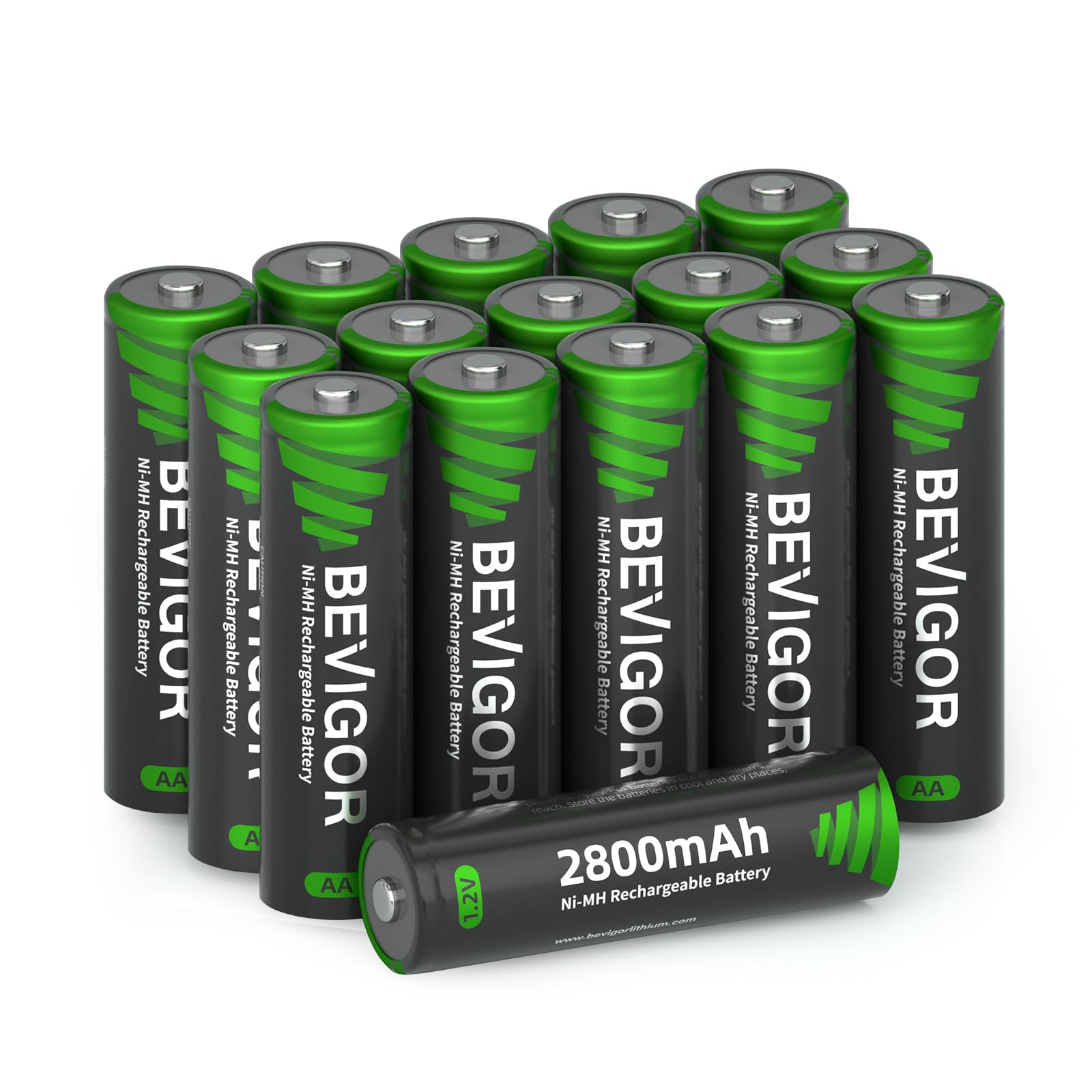
Sixteen high-capacity cells for the price of a mid-tier eight-pack — the volume runtime play.
The case for this pack is simple arithmetic: sixteen cells at 2800mAh each, rated for up to 1500 recharges, and low self-discharge that keeps 80% of charge after three years of sitting. Fill a camera bag, two game controllers, and the kids’ toys, and you still have spares on the charger. At that capacity per cell, battery compartments stay full longer between top-ups, which is exactly what a busy house wants.
Quality is the strongest note in the feedback, and the practical details back it up. The cells arrive pre-charged and ready to use, and each one passes six safety tests before it ships. Longer-term users running sets in cameras and Christmas lights report the first run of charge lasted well, and BEVIGOR backs the pack with a lifetime free replacement guarantee — useful confidence when you are buying sixteen cells at once.
Be realistic about battery life, though. The feedback here is genuinely mixed rather than glowing: some sets last for a very long time, but others start losing capacity on the second or third recharge. A few buyers reporting failures got replacements from the seller. That inconsistency is the real trade-off — you are buying volume and capacity, not the steady cycle-after-cycle consistency of a premium low-self-discharge cell.
What the capacity buys you: Sixteen cells at 2800mAh with 80% charge retention over three years of storage is a lot of ready-to-go power.
The consistency gamble: Mixed reports of some cells fading early mean this is a value-and-volume pick, not a guarantee-every-cell-forever pick.
Ideal for gadget-heavy homes: You want a big pile of high-capacity AAs for cameras, controllers, and toys without spending premium money.
Not for the perfectionist: If you insist on every cell in the pack behaving identically for years, a premium cell earns the extra.
7. NICEBATT Rechargeable aa Batteries 16 Count, 2800mAh Premium NiMH Double A Battery Low Self Discharge
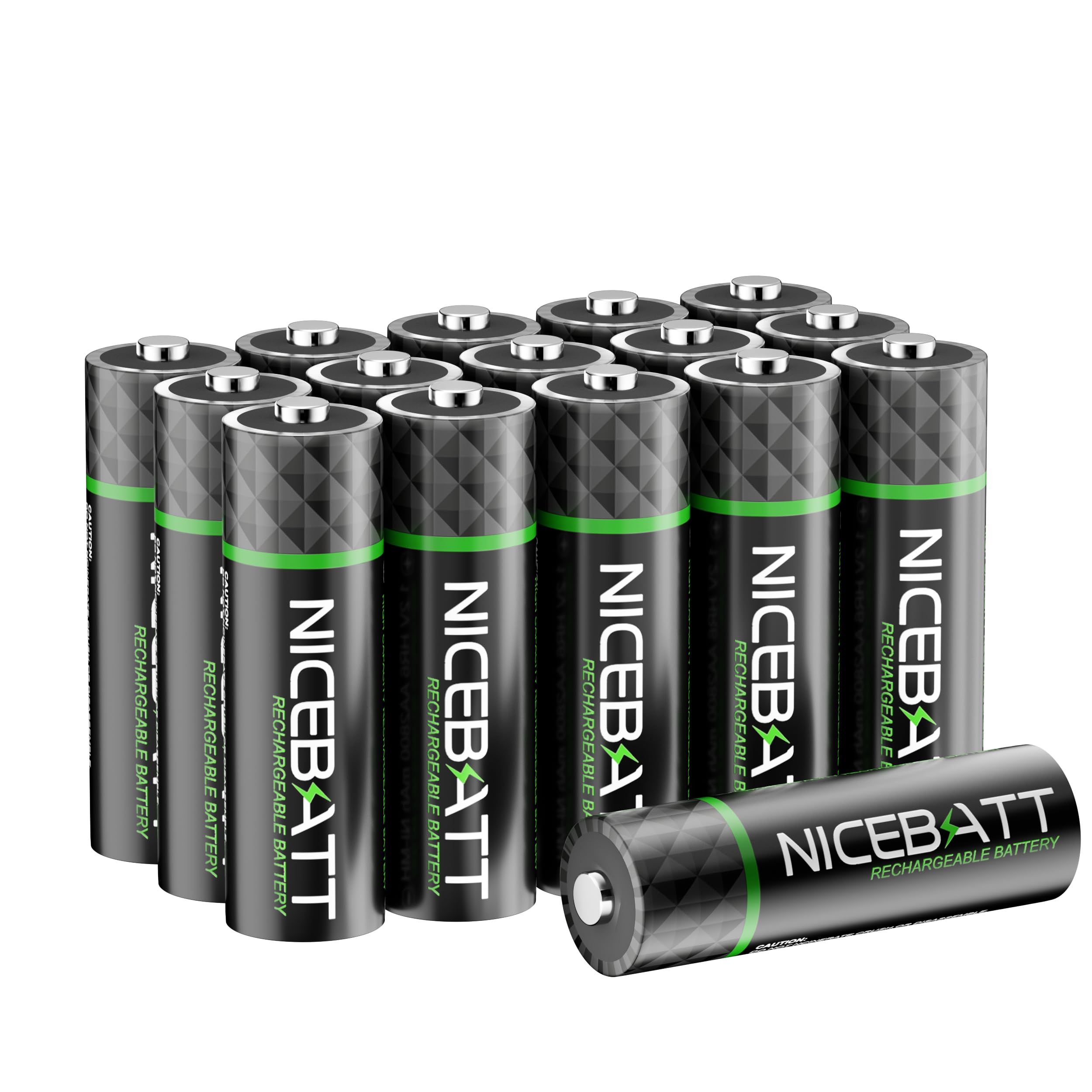
The sixteen-pack for garden lights and outdoor gear — high capacity with a two-year warranty behind it.
When you are replacing the cells inside a set of solar pathway lights, you want capacity and weather tolerance, not cycle counts into the thousands. This pack delivers both. Each cell is rated 2800mAh and built to perform from -4°F to 140°F, so it survives a cold snap on the porch or a baking afternoon in a garden fixture. Recharge life is rated over 1200 cycles, and NICEBATT stands behind the pack with a two-year warranty.
Outdoor owners see the difference immediately. Running these in twelve solar pathway lights, the lamps come on brighter and stay lit longer than they ever managed on their original cells — exactly the upgrade path a fading garden set needs. Value for money is the strongest thread in the feedback, with quick charging a close second, and buyers who tested these on a capacity meter found them holding to their claimed rating. That is a meaningful vote of confidence for a newer brand.
Be aware of two quirks before buying. The seller notes that the cells ship in a transport-safety mode at roughly 70% charge and recommends two or three full charge-and-drain cycles to reach full capacity — worth doing before you judge performance. And the battery life feedback runs mixed: some owners say they hold through an entire night, others find they do not keep a full charge in storage. For solar lights used daily, that second point is a non-issue; for a drawer full of spares, it is worth remembering.
Built for the outdoors
- Rated from -4°F to 140°F for garden and porch duty
- 1200-plus recharge cycles backed by a two-year warranty
- 2800mAh capacity — noticeably brighter, longer-lasting solar lamps
Handle with a routine
- Ships at about 70% charge — run two or three cycles before full performance
- Storage-holding feedback is mixed; better suited to devices in constant use
For the garden and the garage: Solar lights, outdoor sensors, and any device that is constantly working and constantly outdoors.
Less ideal for a spare drawer: If your extras sit unused for months, choose a low-self-discharge cell that holds charge quietly in storage.
8. Amazon Basics 24-Pack Rechargeable AA NiMH High-Capacity Batteries, 2400 mAh, 1.2V, Low Self Discharge, Pre-Charged, Recharge up to 400x Times

Twenty-four cells at 2400mAh, aimed straight at the devices that drink power all day long.
Game controllers, wireless gadgets, and toys with continuous drain are where these belong. Low self-discharge keeps 50% of capacity for a year, with a shelf life of up to five years. With 24 cells, two controllers can be loaded and still leave twenty spares for the rest of the house.
Independent testing on these cells paints a flattering picture. Buyers testing eight cells at 0.5A (a slow, steady drain) measured an average of 2700mAh against a 2400mAh rating, with every cell meeting or beating spec. In a head-to-head against EBL cells tested on the same rig, these delivered roughly 2574mAh to EBL’s 2100mAh — a clear capacity edge on the high-capacity tier, though the EBL pack was cheaper and faster to charge at 1.5A. Reliability over time is solid too — some owners mention cells still performing the same at 1.5 years old as they did when new.
The catch is the recharge ceiling and the physical size. They are also slightly wider than a standard AA, which some buyers find tight in recessed compartments and problematic in certain flashlights. That is the compromise you accept for the higher capacity — plan for it and the pack serves you well.
Big pack, big capacity: 24 cells at 2400mAh tested to 2700mAh means controllers and wireless gear run long between top-ups.
Two caveats to accept: A 400-cycle recharge limit and a slightly fatter body than standard AAs.
Best all-purpose in high-drain homes: If you run controllers and wireless devices continuously and want a big stockpile, this is the pack.
Diminishing returns if: You mostly power low-drain clocks and remotes, where the extra capacity is wasted and the cycle count works against you.
9. Energizer Recharge Universal Rechargeable AA Batteries (16 Pack), Double A Rechargeable Batteries

A big-name sixteen-pack for the whole house — long shelf life, garden-light friendly, no fuss.
This is the pack for the household that wants one box to solve everything. Sixteen Energizer NiMH cells at 2000mAh, made with 22% recycled materials and designed to prevent leaks, cover your remotes, controllers, toys, and solar garden lights. The standout figure is shelf life: Energizer rates these for up to 12 years of battery life when not in use, which is the kind of long-storage confidence you want in a set of spares kept for emergencies.
Where these shine in daily use is general household duty. Swapping them into solar lights, remotes, and small electronics, the cells hold a good charge and recharge without drama on a compatible charger. Running longer-term sets, some customers note the pack surviving six years of regular rotation through controllers and lights, still functional if aging — that kind of endurance is exactly what you buy a name-brand pack for.
Be honest about the trade-offs. This is a standard-capacity 2000mAh cell — it will not match the 2800mAh EBL pack for raw runtime per charge. And like all NiMH, it delivers 1.2V, so a handful of voltage-sensitive devices will reject it. For the typical home filling remotes and toys, neither point matters much. If you power flash photography or heavy cameras, look higher up this list.
Why it suits a full house: Sixteen leak-resistant cells rated for a 12-year shelf life means one box covers every everyday device plus future emergencies.
The limitation: Standard 2000mAh capacity and 1.2V output — perfect for remotes and toys, less so for the highest-drain gear.
For the everyday house: You want a big, reputable pack for remotes, toys, and solar lights and value knowing it will still charge after years in storage.
Consider the capacity pick instead: If your only real hunger is maximum runtime in a controller or camera, a higher-mAh cell serves you better.
Understanding the Specs
Capacity in mAh
Milliamp-hours (mAh) is how much energy a cell holds on one charge, and it is the single most quoted spec on the label. A 2000mAh cell runs for roughly the same time as a 2000mAh disposable in the same device, while a 2800mAh cell gives you noticeably more runtime between top-ups. Higher capacity typically means less cycle life, so if your device eats batteries fast — a game controller or a camera flash — go for the higher number. For a wall clock or a remote that sips power, moderate capacity with a longer cycle count is the smarter pick.
Low self-discharge and shelf life
Self-discharge is how fast a battery bleeds its charge while sitting unused, and it is the reason so many people give up on rechargeables. A low-self-discharge cell keeps most of its power in storage — some hold a large share of charge for a year or more, and one premium line claims up to 70% retention after ten years. Shelf life is the related figure, usually stated in years, that tells you how long the cell stays usable in the drawer. If your extras sit for months between uses, low self-discharge is the spec to prioritise over peak capacity.
FAQ
Will rechargeable AA batteries work in all of my devices?
How many times can a rechargeable AA battery actually be recharged?
Do rechargeable AA batteries lose charge when they sit unused?
What is the difference between NiMH and alkaline batteries?
Is a higher mAh number always better?
Can I mix rechargeable and disposable batteries in the same device?
What kind of charger should I use with NiMH batteries?
How long do rechargeable AA batteries last in storage?
Are rechargeable AA batteries worth it for solar garden lights?
Do I need a different charger for high-capacity batteries?
How much money do rechargeable AA batteries actually save?
Final Thoughts: The Verdict
For most households, the aa rechargeable batteries winner is the Eneloop Panasonic BK-3MCCA8BA 8-Pack — it is the cell that stays charged the longest, survives the most recharges, and works in nearly every AA device you own, backed by a huge body of happy owners and a 4.8-star reputation. If you want maximum runtime per charge for cameras and controllers, grab the EBL 8-Pack with its 2800mAh capacity. And for stocking a whole house on a budget, the Amazon Basics 16-Pack covers every room with pre-charged cells at a per-unit price that is hard to match.
How We Picked
We do not accept paid placement. Every pick is matched to a real buyer and a real use-case; we do not hands-on test units.
Sources & Methodology
Specifications: manufacturer listings and product documentation. Review insights: verified customer reviews, as of September 2026. Pricing: not shown on this page (it changes often); check the current price via the retailer link.
As an Amazon Associate, Gadgets Feed earns from qualifying purchases. This does not affect which products we feature.