
Our readers keep the lights on and my morning glass full of iced black tea. As an Amazon Associate, I earn from qualifying purchases.
Specs are compiled from manufacturer listings and verified buyer reviews and can change over time — please confirm the key details on the product page before buying.
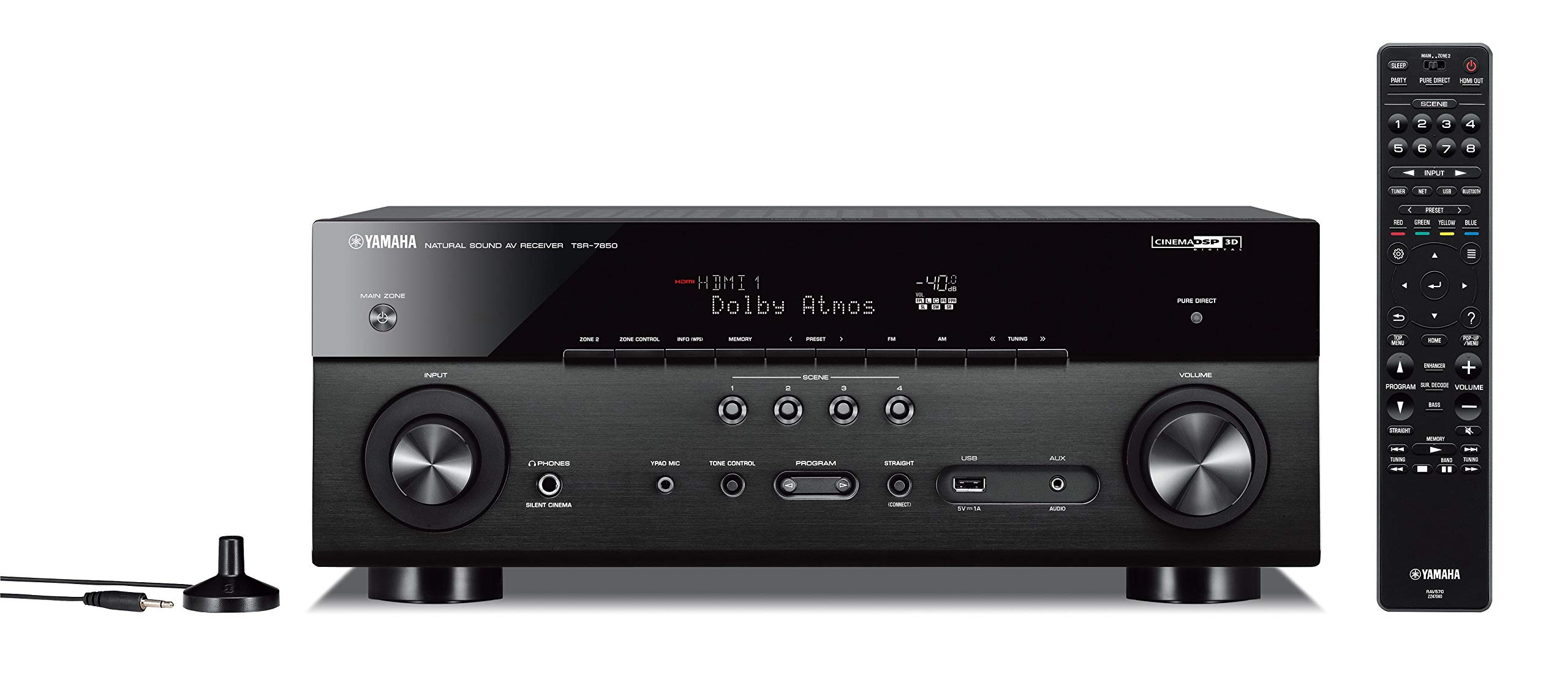
If you want true surround sound without paying flagship money, the Yamaha TSR-7850R is the smartest buy on this list. It packs 7.2 channels (seven speakers plus two subwoofers) and 5 HDMI inputs (ports for five video sources), and it is the crowd favorite here with 4.6 stars across 400+ owners. Everything below is a genuine multi-channel home-theater receiver, not a soundbar or a two-channel stereo amp, so you can trust that each pick actually drives real speakers.
I’m Min — the founder and writer behind Gadgets Feed. This guide is built by comparing the manufacturers’ published specifications and the patterns across verified customer reviews, so you get each pick’s real strengths and trade-offs instead of marketing spin.
You do not need flagship money to fill a room with sound. The right affordable av receiver depends on matching channels (how many speakers it can power), HDMI inputs (ports for your video sources), and power to your speakers and your room.
Our Picks at a Glance

How To Choose The Best Affordable AV Receiver
Choosing a receiver is less about chasing big wattage numbers and more about making sure the box physically fits your gear, your speakers, and your room. Here is what actually separates a good buy from a frustrating one.
Start With Your Speaker Count And Room Size
A 5.2-channel receiver powers five speakers and two subwoofers, which is plenty for a typical living room. A 7.2-channel unit adds two more surround or height speakers for a wider, taller soundstage. If you already own a 5.1 set, buying a 7.2 receiver gives you headroom to expand later without replacing the whole box.
Check The HDMI Inputs Before Anything Else
Count how many devices you need to plug in — a game console, a streaming stick, a cable box, a Blu-ray player. Each one eats an HDMI input. Modern receivers also pass 4K/120Hz and 8K signals, which matters if you play on a newer console or TV with a high refresh rate.
Match Power To Your Speakers, Not To A Spec Sheet
Weight is a fair proxy for the amplifier inside. A heavier chassis usually means a beefier transformer and cleaner output at high volume. If your speakers are efficient, even a modest per-channel rating will fill a medium room comfortably.
Decide If Room Correction Matters To You
Most of these receivers include a setup microphone that measures your room and auto-adjusts speaker levels and distances. It dials in speaker levels and distances in minutes, but a quick manual tweak afterward usually sharpens the result.
Quick Comparison
| Model | Best For | Channels | HDMI In / Out | Video Support | Amazon |
|---|---|---|---|---|---|
| Yamaha TSR-7850R★ Best Overall | Whole-home multi-zone setups | 7.2 | 5 in / 2 out | 4K, HDR10, Dolby Vision | Amazon |
| Denon AVR-X1700HPremium Pick | Future-proof 8K and gaming | 7.2 | 6 in / 1 out | 8K/60, 4K/120, HDR10+ | Amazon |
| Denon AVR-S960HTop Performer | Serious home theater depth | 7.2 | 6 in / 2 out | 8K/60, 4K/120, Dynamic HDR | Amazon |
| Pioneer VSX-935 | Built-in streaming and Wi-Fi | 7.2 | — | 8K, HDMI 2.1 | Amazon |
| Onkyo TX-SR494 | Budget Atmos with real power | 5.2.2 | — | 4K/60, HDR, Dolby Vision | Amazon |
| Onkyo TX-NR5100 | Gamers wanting 8K passthrough | 7.2 | — | 8K, 4K/120, VRR | Amazon |
| Yamaha RX300A | Compact rooms and easy setup | 5.2 | — | 4K/120, 8K/60, Dolby Vision | Amazon |
| Sony STRDH590 | Small cabinets and tight budgets | 5.2 | 4 in / 1 out | 4K HDR, Dolby Vision | Amazon |
| JBL MA310 | Simple two-speaker-plus setups | 5.2 | 4 in / 1 out | 4K | Amazon |
In‑Depth Reviews
1. YAMAHA TSR-7850R 7.2CH Dolby Atmos DTS Wi-Fi BT 4K Receiver, Black (Renewed)
Our pick — over 4.5★ from 450+ verified ratings; the strongest balance of quality and price.
Seven channels, two HDMI outputs, and Zone 2 — the small-budget box that runs the whole house.
If you want to power a main room and a pair of patio or kitchen speakers from one box, the TSR-7850R is built for exactly that. It runs 7.2 channels — seven speakers plus two subwoofers — with Zone 2 for a second listening area. The 5 HDMI inputs and 2 HDMI outputs let you feed a TV and a projector at the same time. That is 25 percent more HDMI inputs than the JBL MA310’s 4, and a 2.0x gap in output count versus the JBL’s single output.
The sound is the headline. What wins people over is the raw quality of the amplification and the many features packed in at this tier — dual HDMI outs (two HDMI outputs), a phono input for a turntable, Wi-Fi, Bluetooth, AirPlay, and MusicCast multi-room streaming all live inside one chassis. Setup is genuinely quick: buyers report a rough “10-min setup” with the YPAO mic (a microphone that auto-calibrates your speakers) handling speaker calibration. One memorable owner summed up the renewed-unit experience by noting it arrived “factory-sealed, appeared new; original remote/accessories sealed.”
Here is the honest catch. This is a renewed unit, so cosmetic and accessory condition varies, and a handful of buyers hit small hardware quirks on arrival — a loose Bluetooth antenna or minor menu friction. It is also not an 8K box, so if you plan to feed a 4K/120Hz console through it long term, look at the Denon picks instead. For 4K, HDR10, and Dolby Vision, it is fully equipped.
What earns it the top slot
- 7.2 channels with Zone 2 for a second room
- 5 HDMI in / 2 HDMI out — the most flexible video routing here
- Dolby Atmos and DTS:X with YPAO R.S.C. room correction
- Phono input, Wi-Fi, Bluetooth, AirPlay, and MusicCast built in
Where it asks you to compromise
- Renewed stock — box and accessories may be generic
- No 8K or 4K/120Hz passthrough
- A few units arrive with small assembly quirks
Reach for this if: you want the most channels, inputs, and zones for the money and you are staying at 4K.
Look elsewhere if: you need 8K/4K120 passthrough for a next-gen console.
2. Denon AVR-X1700H 7.2 Channel AV Receiver – 80W/Channel, Built-in HEOS
The most future-proofed pick here — three dedicated 8K inputs and the smoothest setup of the bunch.
The AVR-X1700H gives you 7.2 channels rated at 80 watts each, which is enough to drive most mid-sized speaker sets in a medium room. What separates it from everything else on this list is the video section: three dedicated 8K inputs and one output, with 8K/60Hz and 4K/120Hz pass-through and 8K upscaling across all six inputs. If you own a newer console or a high-refresh 4K TV, this is the box that will not become the bottleneck in two years.
Setup is where it quietly wins. The on-screen guide walks you through speaker connections with color-coded back-panel ports, and the auto-calibration gets you close fast. Buyers describe it as a genuine home-theater upgrade — one owner who built a 7.1.2 setup in a medium room said the result “creates theater experience.” The seven-channel plus Dolby Atmos support covers height speakers for overhead effects.
The catch is the menu depth. The manual runs hundreds of pages and the auto-calibration can miss the mark in odd-shaped rooms, so plan on a manual pass if your space is not a rectangle. There is also a phono input for a turntable and HEOS streaming built in, so multi-room music comes free.
The future-proof angle: 8K/60 and 4K/120 pass-through plus three 8K inputs means this receiver stays current with your next TV and console upgrade.
Know going in: the setup depth is real — budget an evening, not ten minutes, and expect to fine-tune the calibration by hand.
Suits you if: you want the latest HDMI 2.1 standards and multi-room HEOS streaming in one box.
Think twice if: you want a plug-and-play experience and hate on-screen wizards.
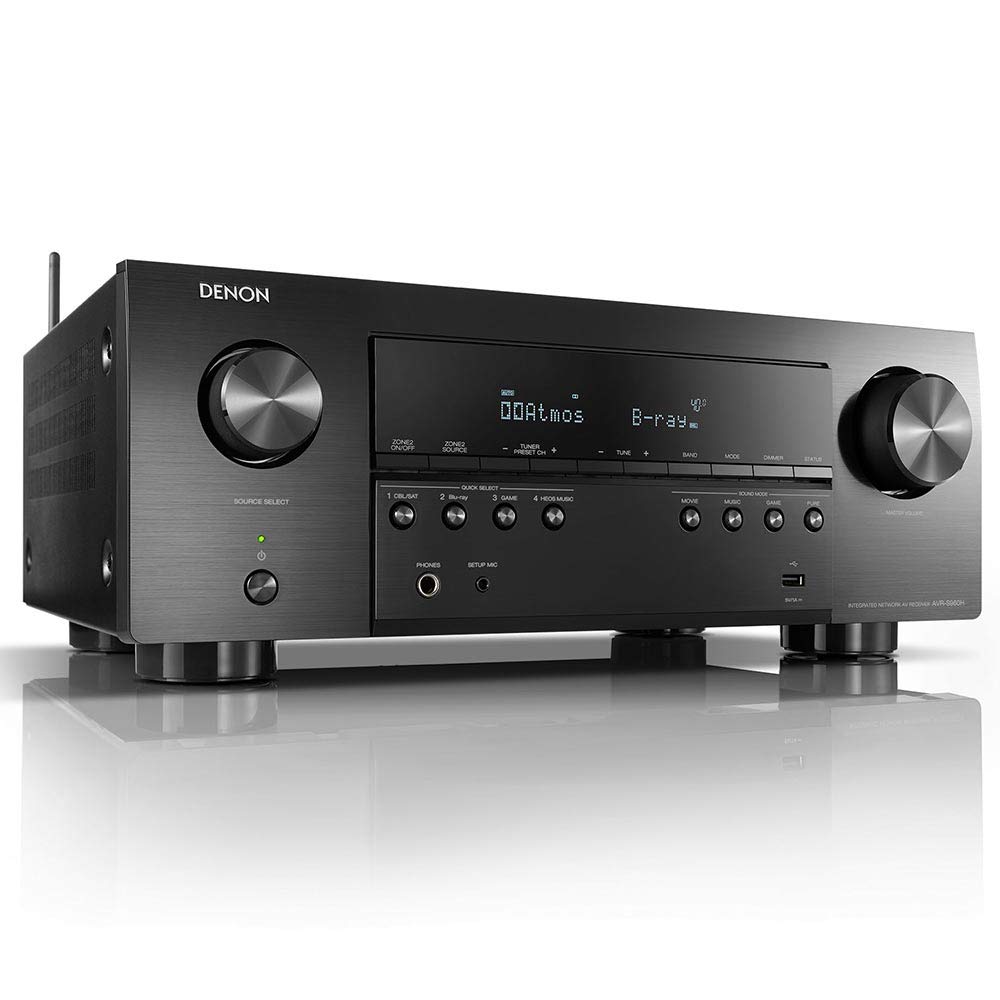
3. Denon AVR-S960H 8K Ultra HD 7.2 Channel (90Watt X 7) AV Receiver, Black
A 90-watt-per-channel muscle box with both a projector out and a TV out running at once.
This is the pick for someone building a proper theater room. It pushes 90 watts across seven channels (enough power for seven speakers) and includes Audyssey MultEQ XT room correction (auto-adjusts sound to your room), which goes a step beyond basic auto-setup by calibrating your speakers in two presets — handy if you want one profile for movies and another for music. The 8 HDMI ports (6 in, 2 out) let you run a projector and a TV simultaneously, and 8K/60Hz plus 4K/120Hz pass-through (video passthrough for high-res and high-frame-rate sources) keeps gaming smooth with VRR (variable refresh rate), QFT (quick frame transport), and ALLM (auto low latency mode) support.
What wins people over here is the sound quality, followed closely by how straightforward the setup is; the guided assistant and Audyssey mic do the heavy lifting. Streaming is covered too with HEOS multi-room, Wi-Fi, AirPlay 2, and Bluetooth built in, plus a phono input for a turntable.
Two real things to know. First, it runs hot — reviewers consistently flag that it needs breathing room, so do not bury it in a closed cabinet. Second, this is one of the pricier picks here, so it makes sense only if you will actually use the 8K and dual-output capabilities.
Where it leads
- 90W x 7 channels — the strongest per-channel rating on this list
- Audyssey MultEQ XT with two calibration presets
- 6 HDMI in / 2 out for TV plus projector at the same time
Trade-offs to weigh
- Runs noticeably hot — needs open ventilation
- Premium price point
- HEOS app feels clunky to some users
The verdict: buy this if you are splitting video between a TV and a projector, or want Audyssey guidance with 90 watts per channel.
skip it if: your cabinet is sealed and you do not need dual HDMI outputs.
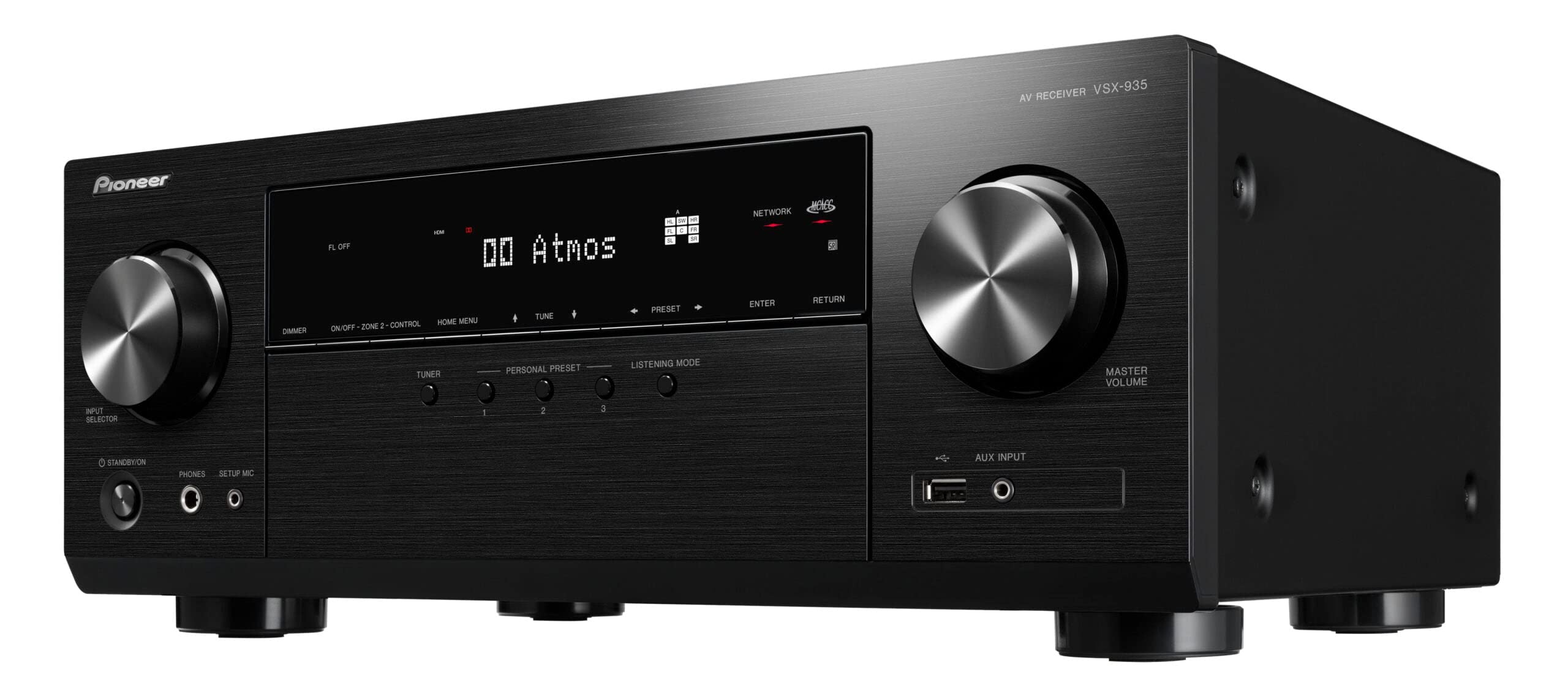
4. Pioneer VSX-935 7.2 Channel Surround Sound Network Receiver Dolby Atmos (2021)
Equal parts network streamer and theater amp — richer Wi-Fi music support than most rivals here.
Pioneer built the VSX-935 as a networking-first 7.2 receiver. It brings HDMI 2.1 with 8K support, dual-zone output, and streaming music services baked in. If your household plays music from Spotify and internet radio as much as it watches movies, this box earns its keep — the controls are the strongest-rated part of the whole product in buyer feedback.
Dolby Atmos Height Virtualization is a nice touch: it simulates overhead effects from a standard speaker layout without adding extra speakers, which is a real saving if you cannot ceiling-mount. It also powers a full 7-speaker setup well; one owner ran seven ceiling speakers plus a subwoofer and reported a proper theater experience.
Be ready to tinker. Buyers frequently note the auto-setup falls short and manual speaker tweaking is what open up good sound. Bluetooth and Wi-Fi streaming work, but the streaming side is hungrier on your network than you might expect, and some users found the on-screen interface dated.
Who it is for: the household that wants one central hub for movies and multi-service music streaming across two zones.
The adjustment period: manual calibration is essentially required, and the network streaming works best on a strong, stable connection.
A solid match if: streaming music services and 8K-era video support are both high priorities for you.
Look past it if: you want the least fussy setup possible from the start.
5. Onkyo TX–SR494 4K Ultra HD Dolby Atmos AV Receiver

Real Dolby Atmos, real height channels, and 80 watts a channel — the value pick that overdelivers.
For a first Atmos setup on a modest budget, the TX-SR494 is hard to argue with. It delivers 80 watts per channel, supports 5.2.2-channel Dolby Atmos and DTS:X, and adds both Dolby Atmos Height Virtualizer and DTS Virtual:X for simulated overhead sound without extra speakers. It also passes 4K/60p with HDR10, HLG, Dolby Vision, and BT.2020 color, so the picture quality will match a modern 4K TV.
What wins people over is how much clean, cost-efficient sound it produces — most owners describe crisp dialogue and full-throated movie audio that punches well above its tier. The AccuEQ mic with subwoofer EQ and AccuReflex gets you started quickly, and owners mention straightforward setup. It handles 5.1, 5.1.2, and 7.1 configurations, so it grows with your speaker collection.
The honest downside: quality consistency is genuinely a mixed bag across owners, with some units going strong for months and an unlucky few failing early. There is no phono input, so a turntable needs a separate preamp, and the Bluetoorg signal can be underwhelming on some units. For most rooms and everyday viewing, though, it delivers the Atmos experience without the premium tag.
What it nails
- 80W x 5.2.2 channels with true Dolby Atmos and DTS:X
- Height Virtualizer and DTS Virtual:X for overhead effects without extra speakers
- AccuEQ room calibration with subwoofer EQ and AccuReflex
- 4K/60p with Dolby Vision, HDR10, and HLG
Honest gaps
- No phono input — a turntable needs an external preamp
- Reliability varies unit to unit
- Bluetooth signal is weak on some units
Best value match: first-time Atmos buyers who want maximum sound-per-dollar in a standard 4K setup.
Not your pick if: you spin vinyl directly through the receiver or want long-term reliability guarantees.
6. Onkyo TX–NR5100 7.2-Channel 8K Smart AV Receiver – Black

Built for console players — 4K/120Hz, VRR, and ALLM all wired in for lag-free frames.
The TX-NR5100 is the gamer’s receiver on this list. HDMI 2.1 handles 4K/120Hz HDR pass-through, Variable Refresh Rate removes lag and frame-tearing, Auto Low Latency Mode cuts input delay from console to screen, and Quick Frame Transport smooths motion further. That combination matters more for competitive play than any wattage number on a spec sheet.
It is a 7.2-channel box with eARC for high-bitrate audio formats including Dolby Atmos, DTS-HD Master Audio, DTS:X, and Dolby TrueHD pulled straight from your TV’s apps. Streaming is easy too, with Chromecast built in for wireless audio. Owners find setup simple overall.
Be aware of the trade-offs. Bluetooth on this unit is the most common complaint — some users hit sync issues or dropped connections and needed an external Bluetooth transmitter for headphone use. The speaker wire terminals are small twist-and-clamp style that will not take thicker 12-gauge cable. And a subset of customers note long-term reliability issues after a year or two, so treat it as a value buy with a warranty in mind.
Gaming-first design: VRR, ALLM, and QFT together mean less input lag and smoother motion — the features console players feel immediately.
Worth knowing: Bluetooth is the weak link here, and thin speaker wire is a physical requirement thanks to the small terminals.
Your pick if: you play on a PS5 or Xbox Series X and want the receiver to keep pace with 4K/120Hz gaming.
Look elsewhere if: wireless Bluetooth audio is central to how you use the receiver.
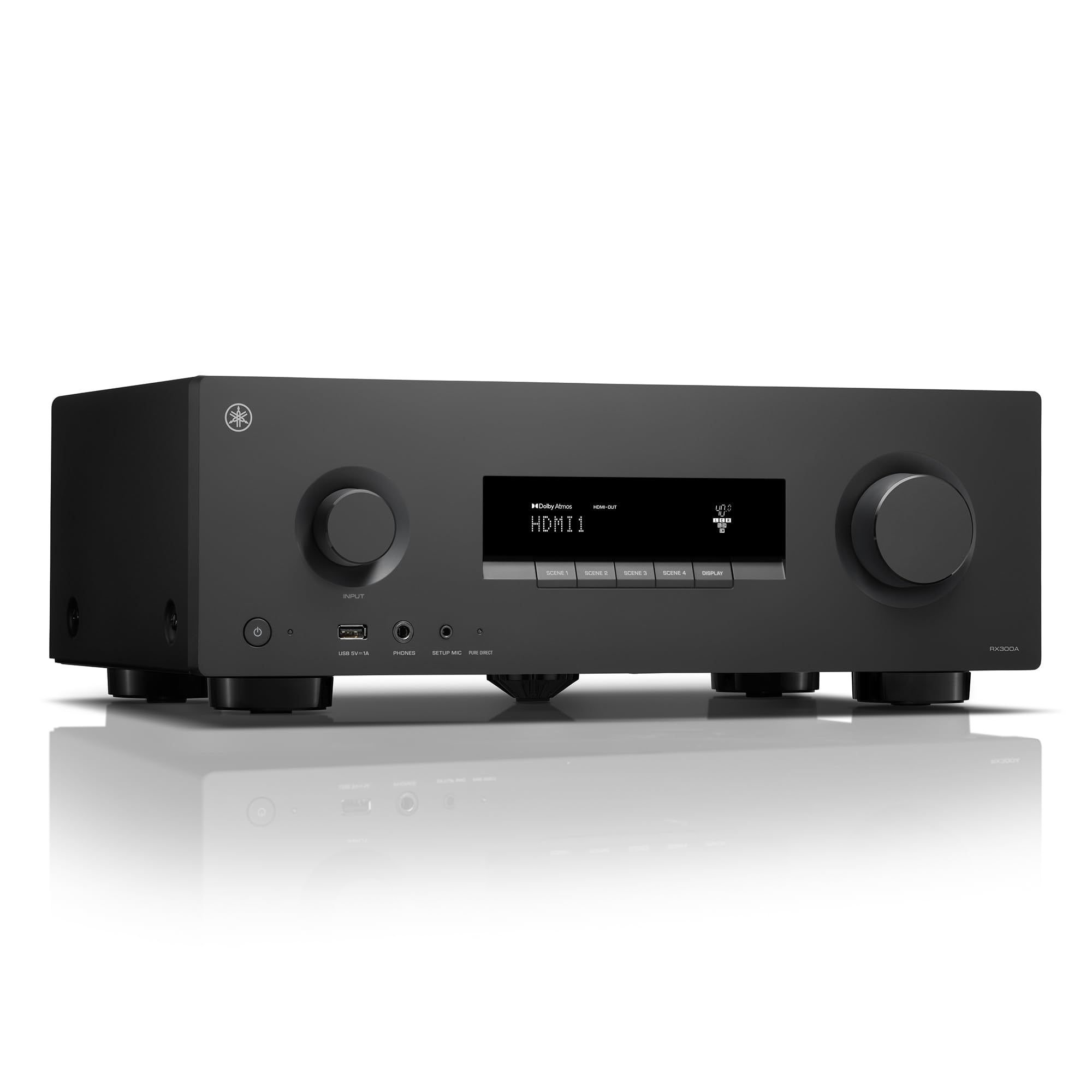
7. Yamaha RX300A 5.2-Channel Home Theater AV Receiver with Dolby Atmos, 4K120/8K HDMI and Bluetooth Multipoint (Black)
Streamlined and adaptable — a 5.2-channel Atmos box that fits where bigger units cannot.
The RX300A is for the buyer who wants clean sound without an intimidating setup. It is a 5.2-channel receiver at 70 watts per channel with flexible speaker layouts, including a 3.1.2 arrangement using up-firing or in-ceiling height speakers for Atmos. It handles 4K/120 and 8K/60 video with Dolby Vision and HDR10+, plus HDMI eARC and gaming features like ALLM and VRR — so even at a lower channel count, the video section is current.
Setup is the standout. A Quick Guide walks through every connection step, and the included setup mic measures your room’s acoustics and auto-tune speaker performance. Bluetooth Multipoint lets you pair two devices and switch between them instantly, which is a genuinely useful convenience for phones and tablets in a shared household.
The caveats are real but manageable. Some owners find the YPAO auto-tune tilts the sound bright in their rooms, and the setup menu can feel sparse compared with pricier Yamaha models. It is built for 5.1-style setups rather than a full 7-channel theater, so if you want more speakers later, this box caps you.
Why owners like it
- 70W x 5.2 channels with Dolby Atmos and DTS Virtual:X
- Quick Guide setup with included room-measuring mic
- Bluetooth Multipoint for two devices at once
- 4K/120 and 8K/60 with Dolby Vision and HDR10+
Where it tops out
- Only 5.2 channels — no 7-channel upgrade room
- YPAO auto-tune can sound bright in some rooms
- Setup menu is basic compared with Yamaha’s higher tiers
Right for you if: you run a 5.1 setup, want quick guided calibration, and value the ability to switch between two streaming phones instantly.
Pass if: you’re already planning a 7-channel theater and need room to expand.
8. Sony STRDH590 5.2 Multi-Channel 4K HDR AV Receiver with Bluetooth (Renewed)
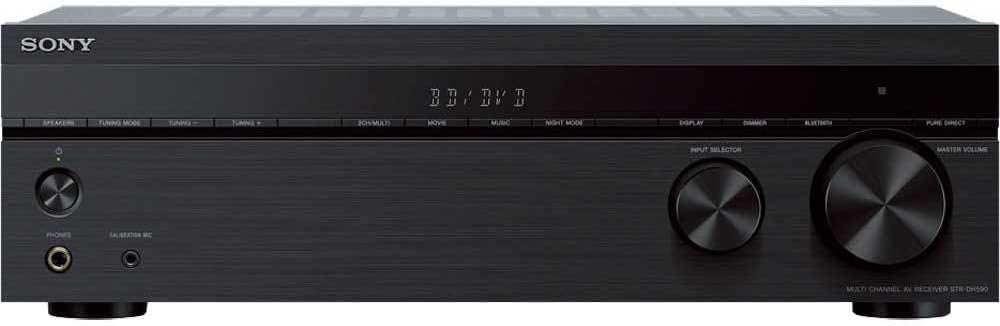
The shallow-cabinet solution — powerful on paper, compact in the rack, and easy on the wallet.
If you are short on vertical space, the STRDH590 slips into tight AV cabinets and flees the deep-chassis problem. It is a 5.2-channel receiver rated at 145W per channel, with 4K HDR and Dolby Vision for modern TVs and HDCP 2.2 for protected content. HDMI runs 4-in/1-out with Audio Return Channel, and Bluetooth lets you stream wirelessly from a phone or tablet.
The wiring options are generous for the class: four stereo RCA audio inputs, two digital audio outputs (one optical, one coaxial), S-FORCE PRO front surround, Dolby TrueHD and DTS-HD codecs, and an FM radio with 30 station presets. A full-size standard headphone jack is a nice touch for night listening. The front is the standout — owners consistently report that setup is easy and the sound quality is solid for the money.
Understand two things before you commit. This unit needs a powered subwoofer to anchor the low end — a detail some listings bury, so double-check your sub is self-powered. And reliability is the honest weak spot: a portion of renewed units fail within a year or two, with a “protect mode” fault showing up in a handful of reports. Buy it understanding that risk is part of the renewed bargain, and it is a fine entry point.
The case for it
- Built-in Bluetooth for wireless phone streaming
- Easy setup and solid sound — the repeated buyer feedback
- HDMI 4-in/1-out with ARC and full 4K HDR / Dolby Vision support
The honest catch
- Requires a powered subwoofer — it is not a self-contained bass solution
- Reliability issues show up in renewed units more than you’d like
- No phono input
Fits your setup if: you have a tight cabinet, modest budget, and a powered sub ready to go.
Not for you if: you want long-term confidence or a receiver that handles a turntable without extra gear.
9. JBL MA310 5.2 Channel (60 Watt x 5) 4K AV Receiver (Black)

The straightforward starter box — warm sound, a small footprint, and no overcomplicated menus.
The MA310 is the entry point for anyone stepping into surround sound for the first time. It runs 5.2 channels (five speakers plus two subwoofers) at 60 watts each, decodes Dolby and DTS natively in 5-channel, and passes 4K video. It has 4 HDMI inputs and 1 output with ARC (audio return channel, which sends TV sound back to the receiver) — which is 4 fewer HDMI inputs and 1 fewer output than the Yamaha TSR-7850R up top, and it tops out at 5.2 channels versus that model’s 7.2, so it is a fit for simpler setups rather than whole-home builds.
What buyers like most is how it sounds for the money. Owners describe a warm, round tone like an old-school amplifier, crisp dialogue, and audible digital upscaling. It is also compact and runs cool — a genuine plus if you are stuffing it into a tight space. Bluetooth 5.1 with Low Energy handles wireless music from your phone, and the app offers basic EQ tweaks.
The honest limits: menu changes are done on your TV screen rather than the receiver display, which unfamiliar users find fiddly at first, and it only handles 4K/60Hz rather than the higher refresh rates of the pricier picks. Depth is another consideration — owners with shallow consoles have had to return units that simply would not fit once cables were connected. Confirm your cabinet depth before ordering.
Best for beginners: a first surround system where warm, easy sound matters more than channel count or refresh rate.
Check first: confirm your cabinet depth and accept 4K/60Hz as the video ceiling before you buy.
Good match if: you want a compact, budget-friendly receiver that sounds warm and keeps setup simple.
Skip if: you need 7 channels, high-refresh gaming, or a shallow unit for a small console.
Understanding the Specs
Channels and Speakers
A channel is a single amplified output, so a 5.2 receiver drives five speakers and two subwoofers. The “.2” always means subwoofer outputs, not speakers. A 7.2 box adds two more surround or height channels. More channels means more speakers can play at once, which creates a wider, taller soundstage — but only if you actually own those speakers.
HDMI Inputs and Passthrough
Each HDMI input is one device slot, so more inputs means fewer cable swaps. Passthrough refers to the video signal moving from your console or streamer through the receiver to the TV untouched. Higher versions of the HDMI standard support higher refresh rates and resolutions like 4K/120Hz and 8K/60, which matter for modern gaming.
Room Correction
Room correction uses a bundled microphone to measure how your speakers sound in your actual space, then adjusts levels, distance, and tone to compensate. It is the fastest route to balanced sound without a professional calibration, though oddly shaped rooms often need a manual tweak afterward.
Watts Per Channel
Wattage indicates how much power each channel can deliver, but it is not the whole story. A heavier amplifier usually means a stronger power supply and cleaner output at high volume. For most medium rooms, even a modest per-channel rating pairs well with efficient speakers, so do not over-index on the biggest number.
FAQ
Will a renewed AV receiver last as long as a new one?
Do I need a powered subwoofer for these receivers?
Is 5.2 or 7.2 channels better for my living room?
What is the difference between 4K/60Hz and 4K/120Hz passthrough?
Can I use a turntable with these receivers?
What is room correction and is it worth using?
How deep are these receivers and will one fit my cabinet?
Does Bluetooth on these receivers work for TV audio?
Will these receivers pass through video when powered off?
How much does wattage per channel really matter?
Final Thoughts: The Verdict
For most buyers, the affordable av receiver winner is the Yamaha TSR-7850R because it delivers the most channels, the most HDMI flexibility, and Zone 2 multi-room output for the money. If you want permanent future-proofing with 8K and 4K/120Hz, grab the Denon AVR-X1700H. And for a first Dolby Atmos setup on the tightest budget, the Onkyo TX-SR494 is the one to reach for.
How We Picked
We do not accept paid placement. Every pick is matched to a real buyer and a real use-case; we do not hands-on test units.
Sources & Methodology
Specifications: manufacturer listings and product documentation. Review insights: verified customer reviews, as of September 2026. Pricing: not shown on this page (it changes often); check the current price via the retailer link.
As an Amazon Associate, Gadgets Feed earns from qualifying purchases. This does not affect which products we feature.