
Our readers keep the lights on and my morning glass full of iced black tea. As an Amazon Associate, I earn from qualifying purchases.
Specs are compiled from manufacturer listings and verified buyer reviews and can change over time — please confirm the key details on the product page before buying.
Buying a crankset depends on three things: the bolt pattern that has to match your frame, the arm length that decides how your knees and pedals feel, and the gear teeth that set how hard you push. Get any of those wrong and the part sits in a box while you ride the old one. So the short answer for most riders is the Shimano M361 — it pairs a 170mm arm with 42/32/22 tooth chainrings, ships with a chainguard, and drops onto a square-taper bottom bracket (the older two-piece spindle style) without drama. The rest of this page sorts out the bolt-circle traps, the 1x swap question, and why a shorter arm sometimes beats a longer one.
I’m Min — the founder and writer behind Gadgets Feed. This guide is built by comparing the manufacturers’ published specifications and the patterns across verified customer reviews, so you get each pick’s real strengths and trade-offs instead of marketing spin.
Some cranks bolt straight on and some fight you for an afternoon, and the gap usually depends on bolt pattern, arm length and bottom bracket type. Here is how to read a bike crankset listing before you click buy.
Our Picks at a Glance
How To Choose The Best Bike Crankset
A crankset is the arm-and-chainring assembly your pedals screw into, and it is the one part of the drivetrain you cannot guess at. It has to match your frame’s bottom bracket shell, the width of your chain, and the way you actually ride. Three numbers do almost all of the deciding: BCD, crank arm length, and chainring tooth count.
Bolt Circle Diameter sets your chainring options
BCD stands for bolt circle diameter — imagine a circle drawn through the middle of the chainring bolts, and BCD is how wide that circle is. A 104 BCD crank takes 104 BCD chainrings and nothing else, so swapping a worn ring later is a two-minute job with a hex key. Get this wrong and no amount of fiddling will make a chainring fit. Square-taper cranks also need a matching bottom bracket spindle length, so measure your old spindle before you order.
Arm length changes pedal strikes and knee angle
Shorter arms give you more ground clearance in corners and a faster spin, while longer arms give more leverage on a slow climb. Riders who keep catching pedals on rocks tend to drop to a 170mm arm, and riders chasing leverage on a commuter often stay at 175mm. If you are unsure, measure your current arm center-to-center — it is the number you already know works.
Tooth count and gearing decide how it rides
Tooth count is simply how many teeth sit on each chainring. A 42/32/22 triple gives you a wide range with a low climbing gear, while a single 30 or 32 tooth ring is the simple 1x setup that sheds the front derailleur entirely. Neither is better — a triple suits a hilly commute, and a single ring suits flatter trails where you rarely touch the front shifter.
Quick Comparison
| Model | Best For | Arm Length | Chainrings | Mount Type | Amazon |
|---|---|---|---|---|---|
| Shimano M361 Hybrid Crankset★ Best Overall | Everyday hybrid and MTB riders | 170mm | 42/32/22T | Square taper | Amazon |
| SRAM S600 CranksetBest Value | Older 8-speed rebuilds | 175mm | 42-32-22T | Square taper | Amazon |
| Shimano Altus FC-M311-LGreat for E-Bikes | Cheap hybrid and e-bike upgrades | 170mm | 48/38/28T | Square taper | Amazon |
| GANOPPER MTB Crank Arm Set | 1x conversions and kids’ bikes | 152mm | 38T narrow wide | Square taper, 104 BCD | Amazon |
| CYSKY Mountain Bike Crank Arm Set | Budget 1x swaps with BB included | 175mm | Sold with BB kit | Square taper, 104 BCD | Amazon |
| BUCKLOS 104 BCD Crankset | Hollowtech 1x trail builds | 170mm | 30-42T options | Hollow integrated | Amazon |
| CYSKY Single Speed Crankset | Folding bikes and e-bike speed | 170mm | 48T-60T | Square taper, 130 BCD | Amazon |
| SRAM NX Eagle Boost Crankset | Modern 12-speed trail bikes | 175mm | 32T X-Sync 2 | DUB direct mount | Amazon |
| GEOID PM500 Power Meter Crankset | Riders training with power data | 165mm | 110 BCD 4-bolt | Hollow integrated | Amazon |
In‑Depth Reviews
1. Shimano M361 Hybrid Crankset (Black)
Our pick — over 4.5★ from 850+ verified ratings; the strongest balance of quality and price.
The hybrid crank that quietly fixes both your gearing and your cornering clearance
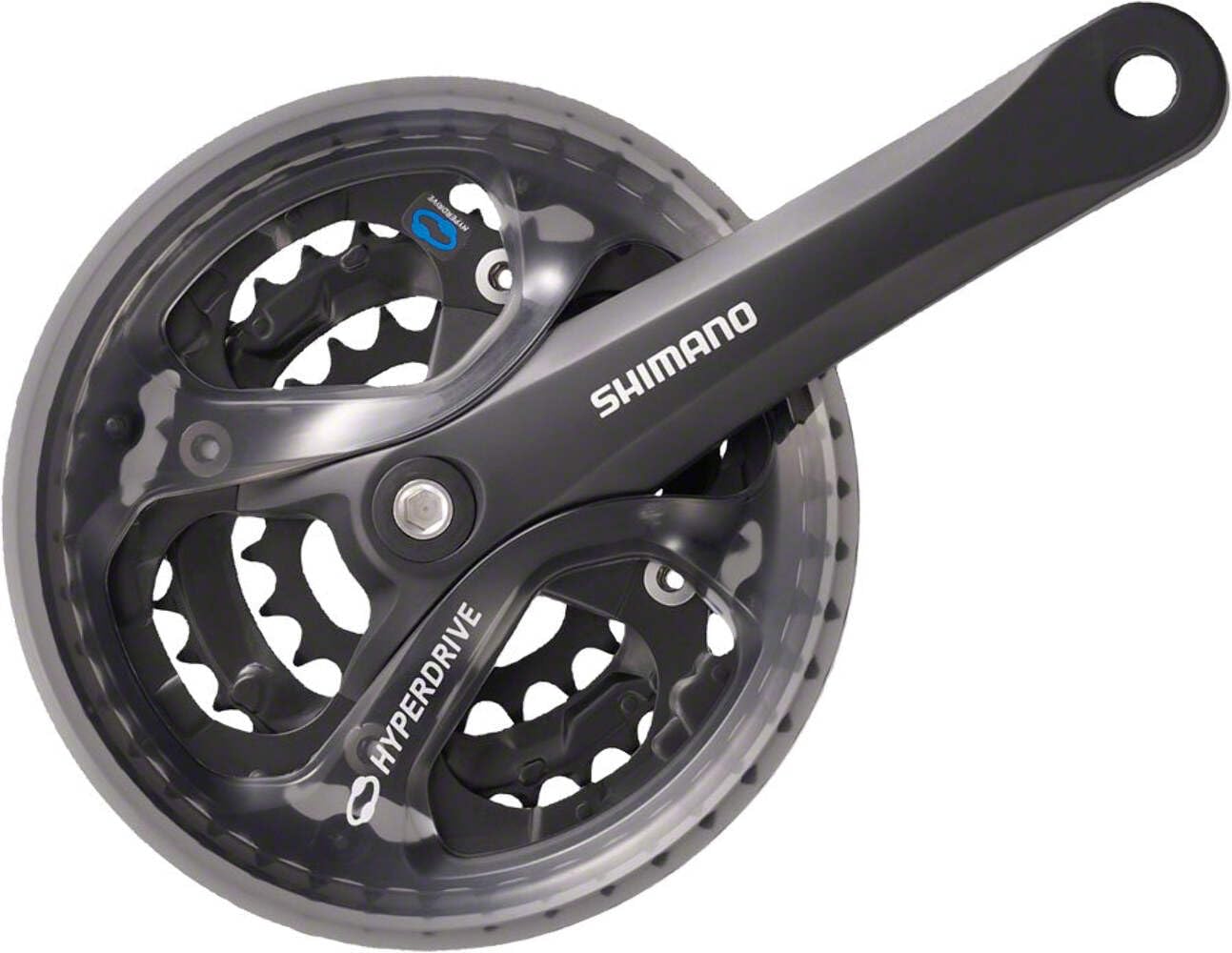
If your bike came with a long-arm crank that scrapes the ground every time you lean into a turn, this is the swap that ends it. The 170mm arm length is 5mm shorter than the common 175mm, and that small drop lifts your pedal off the deck exactly where it used to catch. Buyers report the “170mm cranks (vs 175mm) solved pedal strikes in turns.” The 42/32/22 tooth chainring set also gives you a genuinely low climbing gear, which matters far more on a hill than a bigger top gear does.
The build is square taper, so it mates with the older-style square bottom bracket spindle most hybrids and entry mountain bikes already run. Three chainrings come included, and so does a chainguard — a plastic outer plate that keeps your trouser leg out of the teeth. The removable rings are the quiet win here: replacing a worn chainring is far cheaper than replacing a whole crank, and on a 16 ounce unit that adds up over the years. Owners swapping back and forth with the SRAM S600 tend to land here for the narrower 42-32-22 spread, which sits noticeably lower than the Altus FC-M311’s 48/38/28 gearing.
What wins people over is simply how well it works — the quality of the shifting is the thing that gets called out most, and the value for what you pay runs a close second. The one honest caveat: chainring wear sits in mixed territory, so a handful of riders have had rings wear thin within a year. On a crankset this widely used that is a small slice, and swapping rings is exactly the cheap maintenance this design was built for.
Where it earns its place
- 170mm arms cut pedal strikes in fast corners
- 42/32/22T triple gives a real climbing gear
- Removable chainrings keep future repairs cheap
- Chainguard included, no extra purchase
- Square taper fits the bottom bracket most hybrids already have
What to keep in mind
- Chainring longevity is the recurring gripe — rings can wear thin inside a year
- Front derailleur setup can take a little patience after the swap
- Chain length usually needs adjusting if you change the ring sizes
The one to default to: most hybrid, touring and entry-MTB riders get the right gearing, the right clearance and a chainguard in a single purchase.
Different bike in mind: if your frame runs a modern hollow bottom bracket or a 1x drivetrain, this square-taper triple is the wrong architecture — look at the BUCKLOS or the SRAM NX instead.
2. SRAM S600 Crankset – 3 x 8-speed, 175mm x 42-32-22T, Square Taper, Black
The forged-alloy rescue kit for an aging 8-speed that still has life left in the frame
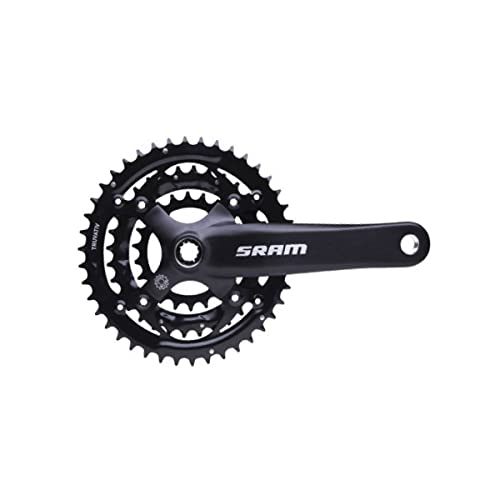
Twenty-year-old mountain bikes are where this crankset lives, and it is very good at that job. The 175mm arms run longer than the Shimano M361’s 170mm, so you get more turning leverage on steep, slow climbs in exchange for a little less clearance in the rocks. The forged alloy construction means the arms are shaped under pressure rather than cast, which is how it stays stiff under a hard standing pedal stroke for 0.3 kg of arm weight.
The chainring spread is where it separates itself from the budget pack. It runs 42-32-22 teeth, and that gives it a 11% more climbing range versus the GANOPPER’s single 38T ring — on a hilly route that is the difference between grinding and spinning. It bolts to a square taper bottom bracket, so no new tools beyond a crank puller. Owners run it on everything from a 1997 Trek to a fat-tire Mongoose, and the front shifting settles in quickly without the re-dialing some cranks demand.
Where buyers keep coming back is raw function — it simply works, and the price-for-value read is the second thing everyone agrees on. The two things to know before you commit: it carries a little more weight than a hollow-arm crank, and it is not a featherweight. A few riders also prefer upgrading the stock rings to a better aftermarket set for a quieter, cleaner shift, and every so often a unit starts clicking after a long season, so torque the chainring bolts evenly.
Straight read: a forged-alloy triple at a very light asking price, aimed squarely at rebuilding a bike you already love rather than upgrading a modern one.
The honest catch: a heavier overall package than the hollow cranks further down this page, and the stock chainrings are the weak link most owners eventually swap out.
Best if you’re reviving an old frame: this is the pick for a 3×8 drivetrain that just needs a fresh crank to ride another season.
Skip for a modern build: if you want a lighter, stiffer hollow crank or a 1x setup, this forged square-taper triple isn’t the move.
3. Shimano Altus FC-M311-L Black 170 x 28/38/28T
A tall-geared Altus built for commuters and e-bikes that need to cruise, not climb walls
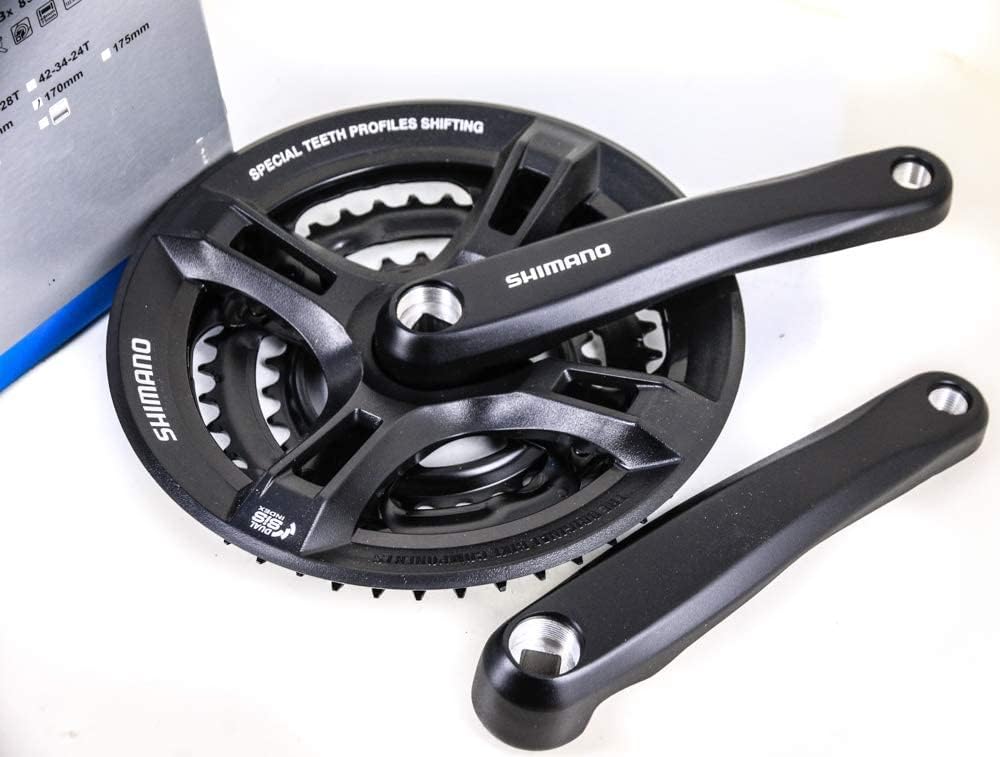
This is the opposite gearing philosophy to the M361 above: the Altus FC-M311-L runs 48/38/28 teeth, a taller spread that keeps you in a comfortable gear at speed rather than a low one on a wall. The 170mm aluminum arm spins quickly and gives better lean clearance — one rider put it plainly, that the “170mm arms spin faster, better lean clearance.” The Hyperdrive SG-X chainrings (Shimano’s shaped-tooth design) are shaped so the chain slides onto the next ring more cleanly under load, which is why the front shifting gets praised.
The integrated chainguard is the detail commuters notice — it is built into the crank rather than clipped on, so it stays put over rough pavement. Riders have bolted this onto everything from a 1990s Miyata rebuild to a Trek 820, and the alignment with a matching front derailleur is the part that surprises people with how easy it goes. One caveat on ordering: the silver variant is a different, lower-tier Tourney product, so choose the black Altus finish if you want the parts described here.
The performance and the shifting are the two things this crank is known for, and both land well. The trade-off is real but narrow: a few buyers have had a pedal thread strip out of the alloy arm, and that is a torque-and-fit issue more than anything, so thread your pedals in by hand before you tighten. Lightweight riders also shouldn’t expect a featherweight here — the arm checks in at 2.7 pounds.
Why riders pick it
- 48/38/28T gearing suits commuting and e-bike cruising
- 170mm arms give faster spin and lean clearance
- Integrated chainguard stays put over rough roads
- Common choice for reviving 1990s frames
Fit notes worth knowing
- The silver version is a different Tourney product — pick black for the Altus spec
- Pedal threads have stripped on a few units, so hand-thread before torque
- Heavier arm weight than hollow cranks
A commuter’s crank: if your ride is flat, fast and frequent, the tall 48/38/28 spread keeps you moving without fuss.
Look elsewhere if: you climb steep off-road and want a low granny gear — the M361’s 42/32/22 is the better fit for that.
4. GANOPPER MTB Crank Arm Set 104 BCD Square Taper 152mm

A rare short-arm crank that fixes heel rub and pedal bites on small frames
Short arms are hard to find, and that is exactly why this one exists. At 152mm the arm is a full 23mm shorter than the SRAM S600’s 175mm, which means your foot sits closer to the frame and your heels stop catching the rear triangle at the top of the stroke. Riders around five foot one report exactly that relief. The arm is 6061 alloy with a 7075 aluminum 38T narrow-wide chainring pre-fitted, and the whole set weighs in at 0.78 kg.
The 104 BCD bolt pattern is the real flexibility here: swap the included 38T ring for a 30T, 32T, 34T, 36T, 40T or 42T single-speed ring and the crank stays. That makes it a natural 1x conversion base — shed the front derailleur, run one ring, and adjust the chainline by mounting the ring on the frame side. The package includes the crank, the chainring and four chainring bolts, and it is a square-taper design that does not need a hollow through-axle bottom bracket.
How it feels in practice depends on your bottom bracket width. On some frames the stock spindle gave a bad chainline and a wide Q-factor — the distance between your two pedals — and owners fixed it by dropping to a 103mm spindle. That is a normal part of a 1x conversion rather than a fault, and once dialed in the shifting is clean and the chain retention on the narrow-wide ring holds up. The crank quality and the value are the two things riders are happiest with.
Who it suits: small riders, kids’ bikes, and anyone converting a 24-inch frame to a single ring who needs a genuinely short arm first.
Budget the tuning time: plan on checking chainline with a 103mm bottom bracket spindle, and know that a steel spindle will wear into the softer alloy over time.
Reach for this if: your current arm leaves your heels hitting the frame or the pedals clipping rocks on a small-wheel bike.
Not the pick for: long-legged riders who want leverage on climbs — the S600 or the Altus give you the longer arm.
5. CYSKY Mountain Bike Crank Arm Set 175mm 104 BCD with Bottom Bracket
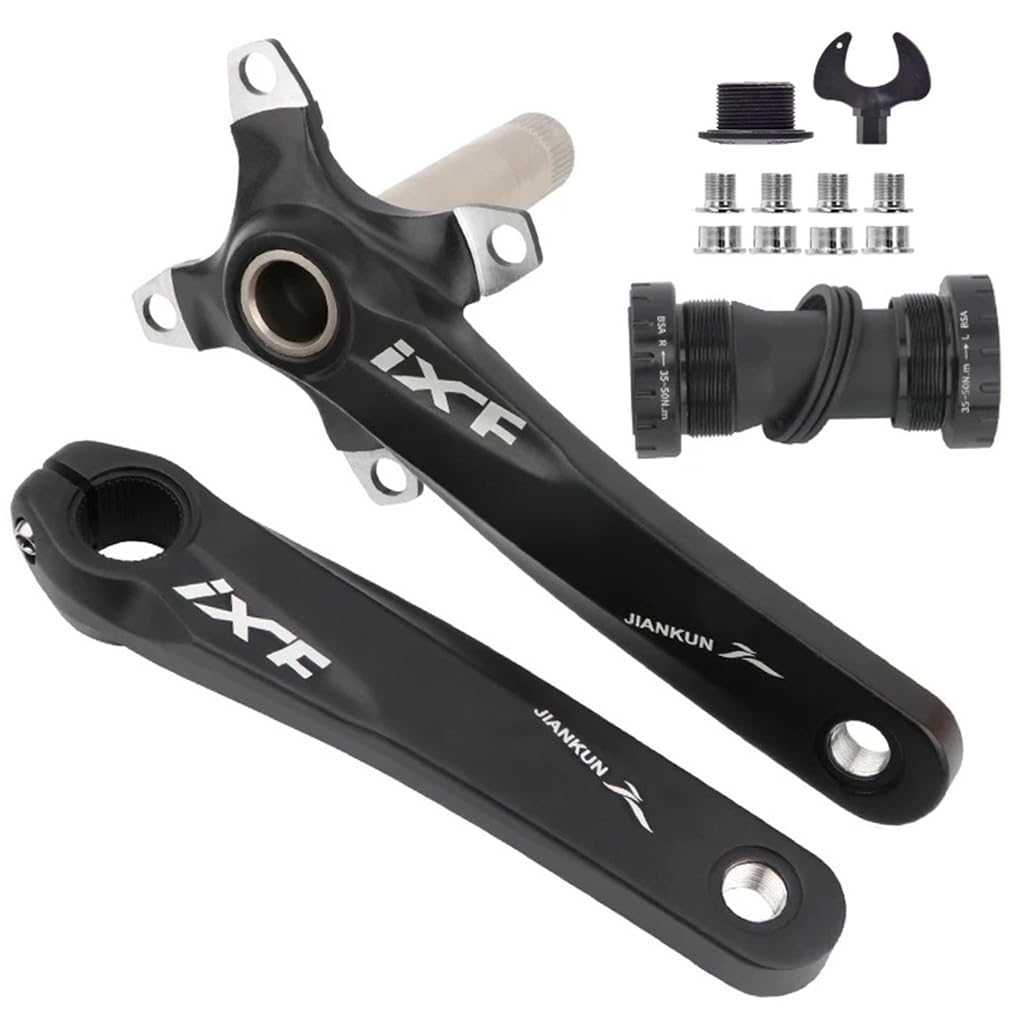
Everything in one box: forged crank, bottom bracket, chainring bolts and the Allen wrench
Buying a crank usually means a second trip for the bottom bracket and a third for the bolts. This CYSKY set skips all of that — the box holds a forged crank set, a bottom bracket sized for a 68-73mm shell, four chainring bolts, the crank screw and the Allen wrench. The arm runs 175mm with a 104 BCD bolt pattern (the circle the chainring bolts sit on) and a 74mm hole distance, so it takes standard 104 BCD chainrings. It is the highest-rated mid-priced pick of the group at 4.5 stars, and the 957 ratings behind that make it among the most widely ridden cranks on this page.
Installation is the reason people keep recommending it. Swapping from an old square-taper crank still takes a bottom bracket tool and a crank puller, but the new hardware threads in cleanly and the whole job is an afternoon. Riders have used it for everything from a 3×9 to 1×9 rebuild to a Trek Marlin 7 conversion, and one owner ran it through jumps at 230 pounds without a complaint.
The one number to double-check is the bottom bracket width. It is listed as fitting 68-73mm, but a few buyers found the splines and tension nut need at least 70.5mm, so a 68mm shell will need a non-drive spacer that shifts the pedals slightly off-center. That caveat barely matters on a mountain bike shell, but if you ride a 68mm single-speed or BMX frame, budget for the spacer. Quality is the thing riders praise most widely, with value a close second.
Why it’s a smart buy
- Bottom bracket, bolts and tool come in the box
- 175mm arm gives strong climbing leverage
- 104 BCD accepts a wide range of replacement rings
- Holds up to jumps and trail abuse
Check before ordering
- Fits 69mm-plus shells cleanly; a 68mm frame needs a spacer that offsets the pedals
- Removing the old crank still requires a dedicated puller and BB tool
- The included bottom bracket bearings have worn out on some units
Best for a first-time crank swap: the included bracket, bolts and wrench turn a two-store job into one purchase.
Think twice if you ride a 68mm shell: the spacer workaround is fine on a trail bike but fiddly on a tight single-speed frame.
6. BUCKLOS 104 BCD 30-42T Mountain Bike Crankset Hollow Integrated 170mm
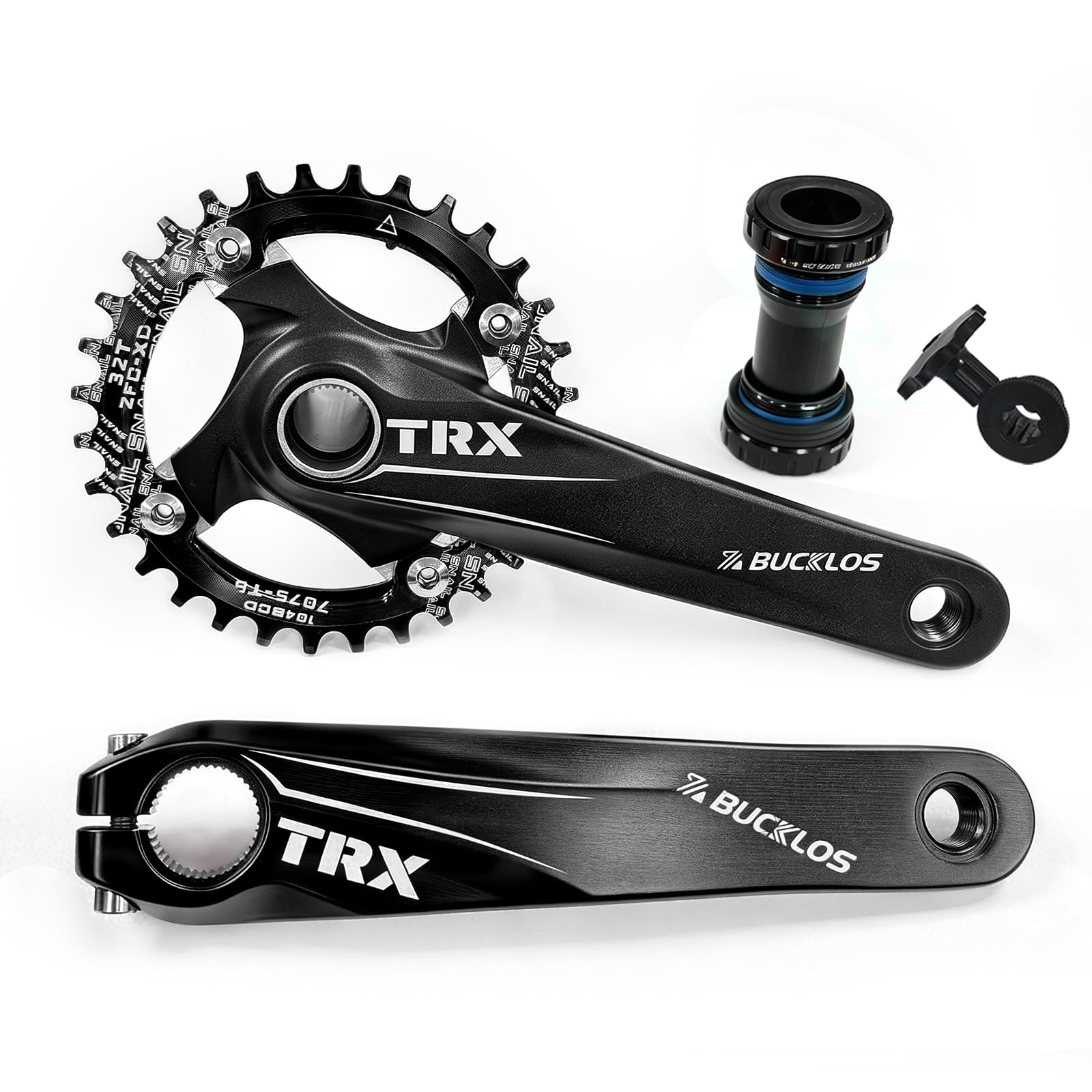
The lightweight hollowtech crank that carries a 1x trail build without weighing it down
At 550g for the crank, this is the pick for riders who count grams on a 1x trail build. The 170mm arm runs on a hollow integrated bottom bracket — the modern design where the spindle is built into the crank and the bearings sit outside the frame — and the threaded bracket fits a 68-73mm shell. It comes with a Snail narrow-wide chainring in a range from 30T up to 42T in round or oval, so you can pick the ring for your terrain. The arm and ring are aluminum alloy, which is how it stays light without going flexy. Note that the rings are for single-speed use only, which is fine — this is a 1x crank by design.
The install is friendly for a hollowtech setup. One rider converted a 2003 Trek from the older ISIS standard and needed just a single spacer to get the chainline perfect. Another picked it specifically because other cranks did not sit close enough to the frame and threw the chain out of line. There is one setup trick worth knowing: the chainring can mount inside or outside the spider, and mounting it outside can bump the front derailleur out of adjustment, so mount it inside. On most 1x builds there is no front derailleur to worry about anyway.
What buyers like most is the fit — it lands on the bike exactly as intended — with appearance running a close second. The caveat is on the bearings, which have been reported to last around a year on some units. That is the recurring gripe, not the rule, and the sealed-bearing bracket is cheap to replace when it finally goes.
What stands out
- 550g crank keeps a 1x build light
- Choice of 30T-42T narrow-wide rings, round or oval
- Hollow integrated bracket fits 68-73mm shells
- Easy chainline setup with a single spacer
Fair warnings
- Bottom bracket bearings have worn out within a year on some units
- Single-speed chainrings only, no multi-gear triple option
- Chainring mounting side affects derailleur adjustment if you keep a front mech
The grams-conscious choice: a hollowtech 1x crank that swaps in for a light, stiff trail build.
The catch to factor in: if you keep a front derailleur, mount the chainring inside the spider; and expect to replace the bracket bearings eventually.
7. CYSKY Single Speed Crankset E-Bike Crank 170mm 130 BCD 48T/53T/56T/58T/60T

A big-ring crank that turns an e-bike or folder into a genuinely fast machine
If your e-bike runs out of gear at cruising speed, the fix is more teeth up front — and this crank sells up to a 60T ring. The 170mm arms are forged from 7075-T6 aluminum alloy, a high-strength grade, and the 130 BCD pattern runs single-speed only. Fit it to a folder, a fixed-gear, or an e-bike with a square-taper bottom bracket and you get real top-end. One rider swapped a 56T onto a 20-inch e-cargo bike and finally killed the “ghost pedaling” that comes from spinning out a small ring.
The speed gain is the headline. Riders on the 60T ring report cruising at 25mph and holding 30mph downhill, and one long-term owner put 12,000-plus miles on a 7075-T6 60T crank through 850-watt efforts without a failure. The bigger ring means fewer pedal strokes to cover the same distance, which is why the speed aspect is the one buyers talk about most. The arm is still light and it is comfortable to install with a wheel puller and standard tools.
The honest trade-off is durability of the outer details. The ring guard has been called flimsy, and a few owners have thrown the chain, which is why the durability side of the picture reads mixed rather than settled. On the upside, the build quality and the appearance are the parts riders are genuinely happy with. Bottom bracket is not included, so confirm your spindle length before you order. If you want to go fast cheaply, this is where the extra teeth live.
The pitch: a forged 7075-T6 crank with a big single ring for riders who want speed on flat ground and e-bikes.
The real caveat: the chain guard feels thin and chains have come off for some riders, so add a tensioner or guide if you ride loose surfaces hard.
Pick this for: folding bikes, fixed-gear builds and e-bikes that need a taller top gear to cruise comfortably.
Not for a triple: if you want a wide climbing range or a front derailleur, this single-speed-only crank is the wrong shape.
8. SRAM NX Eagle Boost 148 DUB 12S Direct Mount 32T X-Sync 2 Steel Chainring
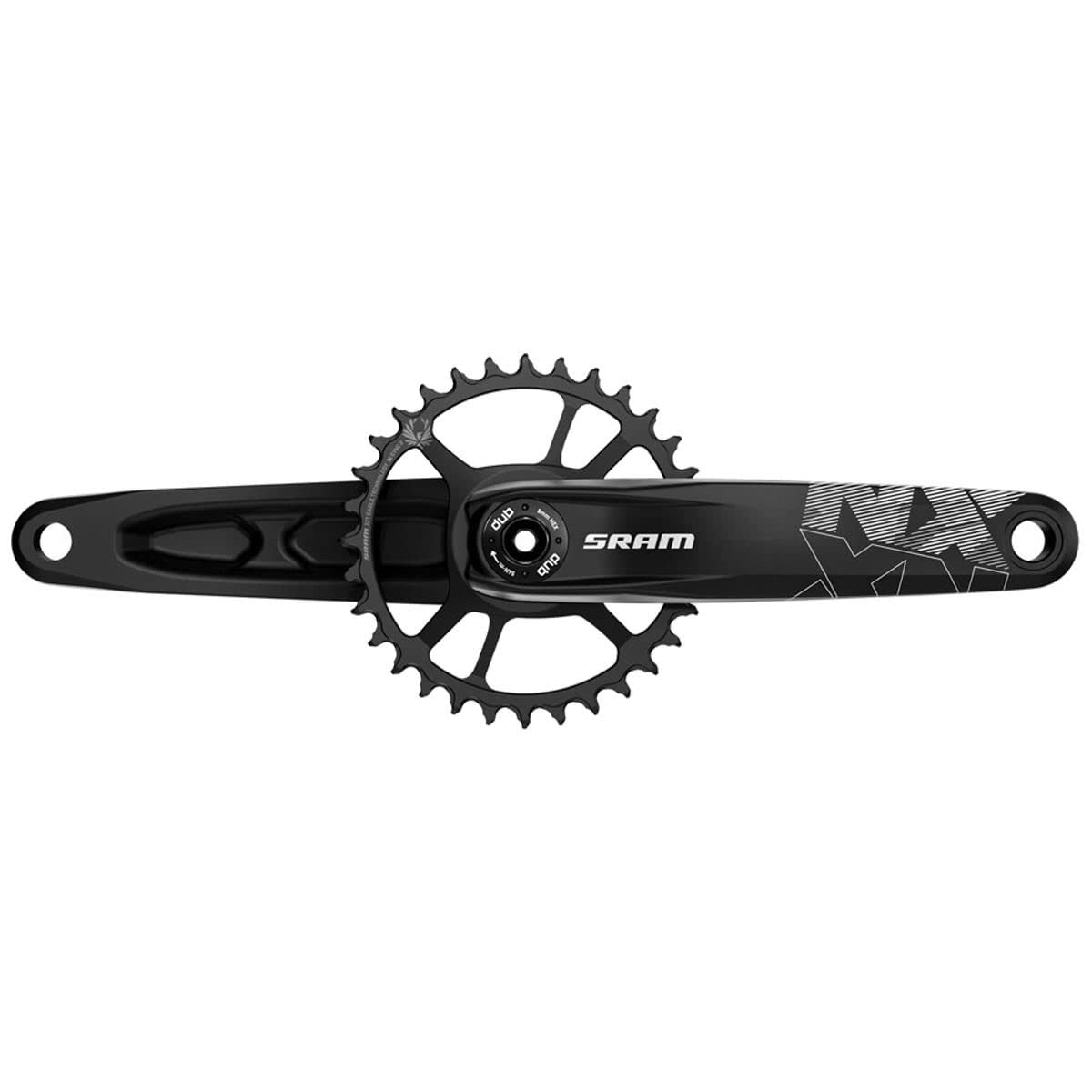
A precise 12-speed factory replacement, right down to the 52mm chainline
This crank is engineered around a specific frame standard, not a universal one. It is built for BOOST 148 spacing with a 52mm chainline, which is the hub width modern trail and enduro bikes use, and it runs 175mm arms. The DUB spindle — SRAM’s bottom bracket system with a standardized spindle diameter across the range — is designed to improve bearing sealing and cut noise and contamination. The direct-mount 32T X-Sync 2 chainring is steel, which is the durable choice for a 12-speed drivetrain where precise chain retention matters more than shaving grams.
Swapping in this crank is a bolt-on job when your bike already runs the ecosystem. Riders move to it for the shorter-option effect — going from a 170mm arm to a shorter one changes how the bike feels over rough terrain and jumps, matching what downhill and dirt-jump bikes use. The direct-mount interface means the ring comes off with a single tool if you ever change tooth counts.
The one thing to know before buying is fit. It is designed for a specific modern standard rather than older frames, and a rider trying to mount it on a Cannondale Scalpel found it would not work. That is a compatibility fact, not a defect — a BOOST frame with a DUB bracket is exactly what it is built for. Fit and function are exactly what owners expect on a compatible bike.
Where it shines
- Built for BOOST 148 spacing with a 52mm chainline
- DUB spindle designed for better sealing and less noise
- Steel X-Sync 2 ring holds the chain on a 12-speed setup
- Direct-mount ring swaps in seconds
Compatibility checks
- Will not fit frames outside the BOOST 148 and DUB standard
- Steel ring is heavier than an aluminum alternative
- Designed as a replacement, not an upgrade for older setups
Built for the modern trail bike: if your frame runs BOOST 148 spacing and a DUB bracket, this slots in like it came from the factory.
Wrong standard, wrong crank: on an older or non-BOOST frame it simply will not mount, so verify your spacing first.
9. GEOID PM500 Bike Power Meter Crankset, 165mm, 110 BCD

A power meter crank that puts real training data on your bars without the pro-tier price
Every other crank on this page moves your pedals; this one also measures how hard you push. The PM500 pairs a 165mm Senicx PR3 crank with a spider-based power meter that reads power to within plus-or-minus 1.5% using a strain gauge and an accelerometer, and it corrects for temperature as you ride so the numbers stay steady. It also logs cadence from 20 to 240RPM (revolutions per minute), left-right balance, and pedaling smoothness, so you can compare rides week to week.
The battery story is the standout. It charges with a magnetic snap-on puck, so there is no cable to line up. The full unit weighs 680g including the spider, with a forged 6061 aluminum crank and a CNC-machined 7075 spider for stiffness under load.
Setup is easier than most first-timers expect. It pairs over Bluetooth and ANT+ with bike computers from GEOID, Garmin, Wahoo and Magene, and syncs to Strava, Zwift and TrainingPeaks. It is 110 BCD 4-bolt, so it takes standard 110 BCD chainrings and works with SHIMANO’s 12-speed system. The 165mm arm is shorter than most cranks here, which spins faster and adds a little ground clearance. It carries an IPX7 water rating, so heavy rain and mud are covered. The one honest note: a few riders have hit connectivity snags with certain bikes, so check your computer’s protocol before you buy.
The training edge: real power, cadence and balance data from a single crank, with a 300-hour battery that barely sips charge.
The one thing to verify: connectivity is the mixed part of the picture, so confirm your bike computer speaks Bluetooth or ANT+ before ordering.
For the data-driven rider: if you train to numbers and want power on your bars without a pro-tier outlay, this is the one crank here that measures your effort.
Overkill if you just ride: for commuting or casual trail riding, a plain crank like the M361 does the job for far less.
Understanding the Specs
BCD Tells You What Chainring Will Fit
BCD, or bolt circle diameter, is the width of the imaginary circle through your chainring bolts. A 104 BCD crank takes 104 BCD rings; a 130 BCD crank takes 130 BCD rings. They do not cross over. This one number decides whether you can swap chainrings later, so if you plan to change gearing, buy a crank whose BCD matches the rings you want. Cranks with a standard BCD also let you replace a single worn ring instead of the whole assembly.
Arm Length and Bottom Bracket Type
Crank arm length runs from about 152mm up to 175mm and changes how the bike feels. Shorter arms give more ground clearance and a faster spin; longer arms give more leverage on a climb. Bottom bracket type matters just as much: square taper uses a tapered spindle that fits older bikes, while hollow integrated brackets build the spindle into the crank for a stiffer, lighter setup. Confirm which one your frame runs before you buy, because the two do not interchange.
FAQ
How do I know which BCD my bike needs?
Will a shorter crank arm stop my pedals hitting the ground?
Can I convert my bike to a single chainring with these cranks?
Square taper or hollow integrated, which should I pick?
What tools do I need to fit a new crankset?
Do bigger chainrings really make a bike faster?
Is a power meter crankset worth it for a recreational rider?
Why does my chainline matter after a crank swap?
What causes a pedal thread to strip out of a crank arm?
Final Thoughts: The Verdict
For most riders, the bike crankset winner is the Shimano M361 Hybrid Crankset because its 170mm arms cut pedal strikes, its 42/32/22T triple keeps a real climbing gear in reserve, and the included chainguard means one purchase covers the whole swap. If you want to go fast on a flat commute or an e-bike, reach for the CYSKY Single Speed Crankset with its big 60T ring. And for training with real power data on the bars, the GEOID PM500 is the one that measures your effort to within plus-or-minus 1.5%.
Three more worth a look depending on your frame. The CYSKY 175mm set is the pick if you want the bottom bracket, bolts and tool bundled into one box, and it sits at the top of the mid-priced group by score. The BUCKLOS 170mm hollow crank suits a lightweight 1x trail build. And the GANOPPER 152mm crank is the rare short-arm fit for small frames where heels keep catching the rear triangle. Whatever you choose, match the BCD and the bottom bracket type to your frame first — those two numbers decide whether the part ever leaves the box.
How We Picked
We do not accept paid placement. Every pick is matched to a real buyer and a real use-case; we do not hands-on test units.
Sources & Methodology
Specifications: manufacturer listings and product documentation. Review insights: verified customer reviews, as of September 2026. Pricing: not shown on this page (it changes often); check the current price via the retailer link.
As an Amazon Associate, Gadgets Feed earns from qualifying purchases. This does not affect which products we feature.