
Our readers keep the lights on and my morning glass full of iced black tea. As an Amazon Associate, I earn from qualifying purchases.
Specs are compiled from manufacturer listings and verified buyer reviews and can change over time — please confirm the key details on the product page before buying.
You already know the feeling: you pull into the driveway after dark and the porch light is on, or worse, it’s been burning since morning and nobody noticed. An automatic light switch timer replaces your ordinary wall switch and takes over that decision entirely, so your lights follow a schedule you set once instead of a habit you have to remember. Every pick below is a real in-wall timer with published specs, and each one suits a different job — daily porch lighting, a bathroom fan, or a whole-house fan.
I’m Min — the founder and writer behind Gadgets Feed. This guide is built by comparing the manufacturers’ published specifications and the patterns across verified customer reviews, so you get each pick’s real strengths and trade-offs instead of marketing spin.
The biggest split in this category is simple: 7-day programmable switches that follow a calendar every week, and countdown timers that just run for a set number of minutes and shut off on their own. That single difference decides which of these automatic light switch timers actually fits your wall box.
Our Picks at a Glance

How To Choose The Best Automatic Light Switch Timer
Before you pick a model, answer two questions about your own wall. First, what do you want the light or fan to do — follow a weekly schedule, or run for a few minutes and shut itself off? Second, what wiring is already inside the box? Get those two right and the rest of the listed specs become easy to compare.
Programmable schedule or simple countdown
A 7-day programmable switch follows a weekly calendar, so it can turn a porch light on at dusk and off at bedtime every night without you touching it. A countdown timer skips all of that: you press a button, pick a time length, and the load shuts off by itself when the time runs out. Choose scheduling for outdoor lighting you want to follow the seasons; choose a countdown for a bathroom fan, a heater, or anything you only want on for a short stretch.
Check for a neutral wire first
Most programmable timers need a neutral wire in the wall box to power their clock and screen, while many countdown models can run off the ground wire instead. Before buying, shut off the breaker and look at the wiring: a bundle of white wires spliced together usually means you have a neutral available. If your box only holds the two black switched wires and a ground, a no-neutral countdown timer is the safer pick.
Match the wattage and load rating to what you are switching
Timers list separate limits for LED and CFL bulbs, incandescent and halogen, and fan or motor loads, because each type of load draws current differently. Check the rating against your fixture before you commit. A timer rated for a half-horsepower fan and motor load will handle a bathroom exhaust fan with no trouble, while one built mainly for LED and CFL lighting is the better match for a porch light.
Quick Comparison
| Model | Best For | Type | Preset Times / Settings | Neutral Wire | Amazon |
|---|---|---|---|---|---|
| Honeywell PLS750C1000★ Best Overall | 3-way switches and automatic dusk-to-dawn outdoor lighting | 7-day programmable | 21 programs; 3-way | Required | Amazon |
| Leviton DT130-1LWBest for Bathrooms | Bathroom exhaust fans with separate light control | Countdown | 5-10-15-30 min | Not required | Amazon |
| Intermatic EI220W-1Best for Whole-House Fans | Whole-house and attic fans | Countdown | 1 to 8 hours; HOLD | Required | Amazon |
| Honeywell Home EconoSWITCH | Front porch and seasonal lighting on a weekly schedule | 7-day programmable | 7 programs per week | Required | Amazon |
| UltraPro 40954 | Porch lights that follow sunset automatically | 7-day programmable | 8 settings; sunrise/sunset | Required | Amazon |
| Intermatic EC200WK | Bathroom and exhaust fan auto-off | Countdown | 5/10/15/30 min | Not required | Amazon |
| Leviton DT115-1LW | Small spaces and one-touch fan control | Countdown | 2-5-10-15 min | Not required | Amazon |
| Eaton PT18M-LA | A fixed preset time with no wiring fuss | Countdown | 5/10/15/30/60 min | Not required | Amazon |
| Southwire Woods 59028WD | Budget 7-day scheduling in a slim profile | 7-day programmable | 7 settings | Not required | Amazon |
In‑Depth Reviews
1. Honeywell PLS750C1000 Timer Switch with Sunrise Sunset Single or 3 Way
Our pick — over 4.5★ from 800+ verified ratings; the strongest balance of quality and price.
The switch that learns your porch light’s bedtime and stops asking you about it.
The Honeywell PLS750C1000 is the strongest all-rounder here because it handles the hard case — a 3-way circuit — while still following your region’s sunrise and sunset. That means it can run a hallway or outdoor circuit where two switches control the same fixture, and shift its on-time automatically as the days shorten or stretch. Set it once and the seasonal drift takes care of itself, which is what people actually want when they stop chasing the light.
What owners talk about most is how reliably it does its job, with the manual override coming up again and again because it lets you flip the lights without wrecking tomorrow’s schedule. The programming is a standard weekday/weekend split with latitude and longitude doing the dusk and dawn work, and there is a 21-program ceiling if you like to build out a full week. Installation is a wall-switch swap as long as you have a neutral already run to the box.
What surprises buyers is how much it does for a low-load LED circuit — one route a lot of people never think to check is whether the fixture is above the minimum draw. Buyers report it “works with LEDs >10.5W load,” so if you are switching a single tiny LED bulb that sits under that draw, it may not behave. On the 3-way side, the supplied red jumper method can be confusing; the fix that works is to leave the existing switch wired to the load side and remove the second half of the traveler.
Where It Pulls Ahead
- Works on single-pole or 3-way circuits, which many timers do not
- Auto-adjusts to your region’s sunrise and sunset, then keeps pace with the seasons
- 21 programmable events per week, so you can schedule more than just dusk and dawn
- Manual override button so a press does not break the program
Where It Will Trip You Up
- Requires a neutral wire in the box; no neutral, no go
- The 3-way wiring diagram is the weakest part of the package
- Very small LED loads under the 10.5W threshold may not trigger it
Own It If: you have a 3-way porch or hallway switch and want dusk-to-dawn coverage that shifts with the calendar, plus a neutral already run to the box.
skip it if: your wall box has no neutral or you are only trying to switch a tiny low-wattage LED — the 10.5W floor and neutral requirement matter far more than the color of the faceplate.
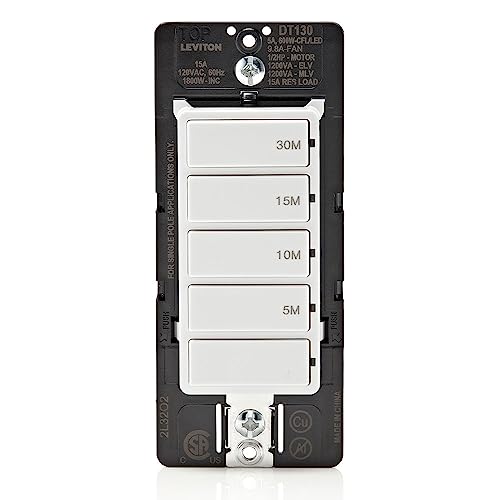
2. Leviton Countdown Timer Switch for bathroom fan and household lights, 5-10-15-30 min, No Neutral Required, Single Pole, 15A, 1/2 HP/9.8A Fan/Motor, DT130-1LW, White
Install it, press a button, and the bathroom fan stops being your kids’ problem.
If your actual frustration is a fan that runs for hours after every shower, this is the one to install. The DT130-1LW is a straightforward push-button countdown: four presets at 5, 10, 15, and 30 minutes plus an OFF button, and it is rated 15A with a ½ HP / 9.8A fan/motor limit, so bathroom exhaust fans, heat lamps, and towel warmers are all inside its envelope. It also handles 600W LED/CFL and 1800W incandescent/halogen loads, which means you can use the same switch on a light circuit if the fan is controlled separately.
What owners call out constantly is the build quality — the buttons feel solid, the faceplate sits flush with a Decora plate, and the LED indicator counts the remaining time down so you can see at a glance how long is left. The green flex sleeve wiring trick is the standout detail: it grounds the switch when no neutral wire exists in the box, or you strip the sleeve and connect to neutral when it is there. Two black wires can be swapped between line and load, which de-stresses the install for anyone doing this for the first time.
The honest catch is box size. If you are replacing an existing fan switch, you may need to upgrade to a larger wall box because the timer is deeper than a standard toggle — that is the recurring note in the reviews. And it is a 15A device, so a 20A circuit is not covered. Match it to your fan/motor load and existing wiring, and it installs flush and runs the countdown unattended.
What Actually Wins: the fan/motor rating is the number that matters here — ½ HP / 9.8A is what lets it drive a real exhaust fan, not just a lamp. On top of that, the 600W LED and 1800W incandescent limits mean you can quietly use it on a halogen heat lamp or a towel warmer too.
Wiring You Should Know: no neutral required, courtesy of the green flex sleeve; the two black wires swap between line and load if you misjudge which wire is which. You still need a ground wire for installation, so a fully ungrounded box still fails the requirements.
Reach For This If: a shower fan or heat lamp is your target and you want touch-and-forget control with no neutral hassle — this is the cleanest bathroom answer in this group.
Look Elsewhere If: your wall box is a shallow single-gang slot stacked with wires, or you are running a 20A circuit; size and current both matter here.
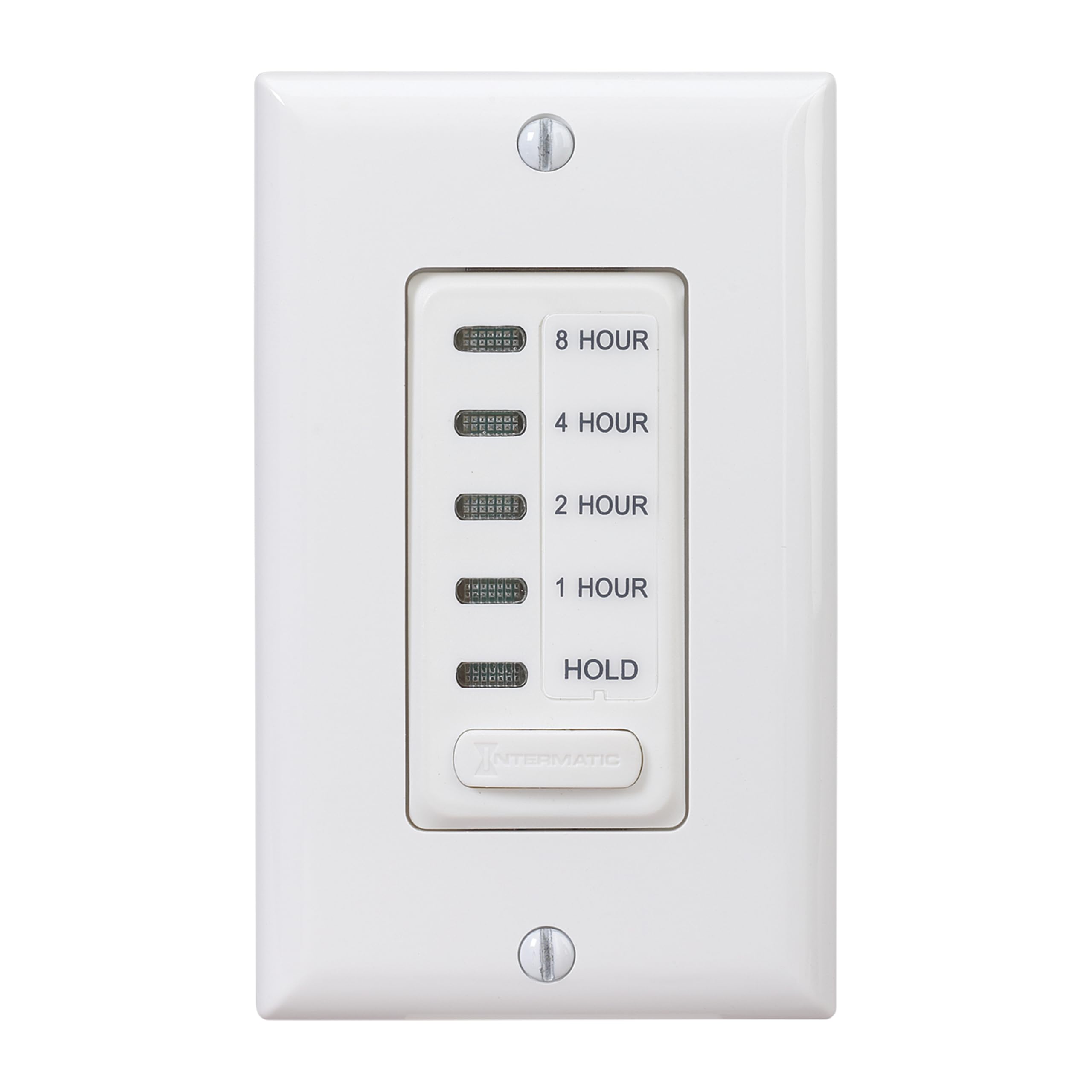
3. Intermatic EI220W-1 in-Wall Countdown Timer Switch, Whole House Fan, 1 HP
Press one button, pick one to eight hours, and the whole-house fan shuts itself off.
The EI220W-1 is built around a single job: run a big fan for a long stretch and shut it down without any programming. Presets run from 1 hour up to 8 hours plus a HOLD mode for continuous operation, so it matches how people actually use an attic or whole-house fan — set it, go to bed, wake up to a fan that already stopped. There is no separate clock to set and no schedule to maintain.
Owners describe it as an exact factory replacement for QuietCool units, which is the use case it is mostly selling into. The install is a straight single-pole switch swap and requires a neutral connection, and the decorator-style wall plate is not included, so keep that in mind if you are matching existing plates. Performance and fit are the two things buyers mention most, and the recurring story is a 10-minute install that just works.
Where it is most compelling is durability versus the mechanical timer it usually replaces — the electronic design eliminates the old ticking mechanism entirely, which is why it also works well in bedrooms where that click is intolerable. The honest trade-off is the length of its countdown window: if you only need a five-minute fan for a shower, this is overbuilt. And the packaging note that it is not for use with sunlamps, saunas, or loads that could cause injury if timed incorrectly applies here, so read that before you place it.
What Owners Praise Most: it drops straight into whole-house fan systems as a factory-replacement part, and the 1-to-8-hour range plus silent electronic operation means you never hear a mechanical tick again. Durability gets the mixed word — some units are simply built to outlast others.
Made For This: an attic or whole-house fan that runs for hours on end and needs to stop without anyone remembering it.
Overkill For That: a single bathroom fan — a shorter-range countdown like the Leviton DT115-1LW serves that far better than this 1-to-8-hour window.
4. Honeywell Home EconoSWITCH 7-Day Programmable Timer for Lights, Almond

A weekly porch-light schedule with a random mode that keeps the house looking lived-in.
For a front-entry or porch fixture you want on a weekday pattern and off early on weekends, the EconoSWITCH is the most flexible of the value-priced options. It supports up to seven programs a week — with each one able to repeat every day or attach to a single day — and it holds 2400W maximum on a 1 HP at 120V fan/motor circuit. The random mode shifts timing by +/-15 minutes, which is the detail that matters if the whole point is not sitting empty-looking all evening.
Two operating modes are the day-to-day reality: Manual gives you a regular on/off switch, and Automatic hands the light over to your schedule. The schedule and the clock survive a power outage on the internal battery, and it automatically resumes after a temporary manual override. Mounting is flush with a standard decorative wallplate — which is not included, so pair it with one that matches your room.
The one thing to plan around is the display. It is small and not backlit, which owners say makes programming in a dim hallway awkward, and setting the clock has some quirks — one buyer route was to program it during the day with the lights on. If you can program a small screen once and never touch it again, this switch holds its 7-day schedule silently. The remaining open question is whether the display stays readable over the years; that is where the “just installed, can’t say yet” reviews sit.
The Real Reason to Pick It: seven programs a week plus the +/-15 minute random mode is what turns a porch light from an obvious timer into a lived-in pattern. Setup happens once; after that it quietly runs the week without you.
What You Will Live With: the non-backlit screen and the fiddly clock set — those are the recurring complaints, not a defect. If you want a backlit screen and a sun-position slide, the UltraPro above is the friendlier option.
Best Match: a front porch or entry light that benefits from a random pattern, on a budget where seven weekly events and a 2400W ceiling are more than enough.
Think Twice If: you hate programming small screens — the display is not backlit, and that is your whole experience with this switch every time you use it.
5. UltraPro in-Wall Digital Timer Switch, Auto Adjust Sunrise/Sunset Times

The porch switch that quietly follows the actual sunset in your region, all year.
UltraPro’s DaySmart system does one thing better than almost anything else on the list: it tracks local sunrise and sunset so the light comes on when dusk actually lands, not at a fixed clock time. That is the biggest comfort upgrade over a straight 7-day schedule, because it self-corrects through the seasons. The switch offers 8 settings with a 7-day cycle, replaces a single-pole or 3-way switch, and works with LED, CFL, incandescent, and halogen fixtures.
What has made this such a solid pick is the button layout — owners describe two-button operation that turns outdoor lights on or off in seconds, plus a door that conceals the programming controls so it looks like an ordinary rocker switch from across the room. The screen is large enough to read easily, and there is a “Sunset ON, Midnight OFF” preset that lets you skip almost the entire setup. The overall design language is why people stick with it: it does not look like a gadget bolted onto the wall.
The two things to know before you install: it requires a neutral wire in the box, and it is deeper than a standard switch, so a crowded wall box with multiple circuits can be tight to close. Programming is fast — owners mention under five minutes once they learn the button sequence. If your outdoor lights are the mission and you want them responding to real sunset rather than a guess, this holds the field.
Where It Shines
- Sunrise and sunset tracking does the schedule for you, season to season
- 8 settings with a 7-day cycle and three geographic locations to choose from
- Swappable white and light almond faceplates, plus a rocker door that hides the controls
- Works on both single-pole and 3-way circuits
Before You Buy
- Neutral wire is required — no exceptions
- The body is deeper than a standard switch, so check your box depth
- Sunset time can be off by a few minutes; there is a +/-1hr adjustment to correct it
Go With This If: your lights are outdoors and you want them following the actual sun without any daily attention — the sunset tracking is the whole reason to pick it.
Pass If: you do not have a neutral in the wall box, or your wall cavity is shallow; either one makes the wiring the harder conversation than the programming.
6. Intermatic EC200WK Electronic Countdown Timer, 5/10/15/30 Min, Silent

A bathroom fan timer that shuts the fan down without ever announcing its own presence.
If what drove you to look at timers was a mechanical click you can hear through the wall at night, the EC200WK is the answer — it is a fully electronic silent countdown, popular for bathroom and exhaust fans and rated for resistive, tungsten, inductive ballast, and electronic ballast loads. Users have driven it from pedestal-style whole-house fans in garages through a low/high/off switch, so it is not confined to a single fixture type.
Where the EC200WK separates itself from the rest of the countdown group is the button behavior and preset lineup — a pronounced ON button that is impossible to miss in a dark bathroom, and the four countdown selections of 5, 10, 15, and 30 minutes that match most real fan cycles.
The honest note here is timekeeping drift and durability. A small number of buyers have found the timing window reading shorter than its label, and some report the unit aging out after a few years — the durability signal is genuinely mixed, though plenty of fans run for a decade without issue. Treat it like a solid mid-life component and you will be happy; expect ten years of a bathroom fan and you may be replacing it early.
Praise Worth Repeating: the silent operation and pronounced ON button are what owners like most about it — no clicking, no guessing whether the fan is running. UL listing and multi-load compatibility mean it is fine on the whole spread of bathroom lighting and exhaust loads.
Real Trade-Off: the durability record is not uniform — some units run for a decade, others give up sooner. If long service life is your top priority, a heavier-duty switch or a longer-window countdown is worth a look.
Right Fit: a bathroom or utility fan where silence matters and you want a short, clean countdown at a fair price point. It is also a competent garage-fan timer on a low/high/off circuit.
Not Your Fit If: you want one switch to run for an hour or more at a stretch, or you want the last word in durability over a decade.
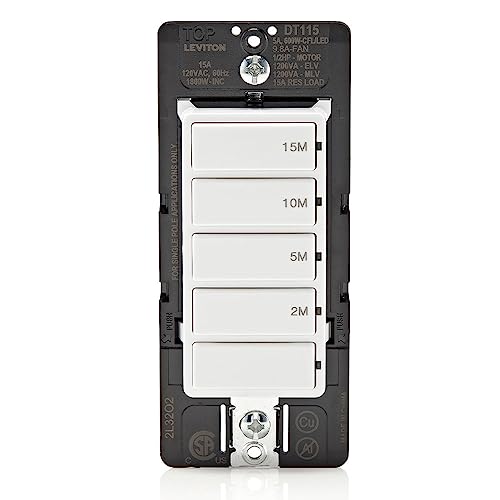
7. Leviton Countdown Timer Switch for bathroom fan and household lights, 2-5-10-15 min, No Neutral Required, Single Pole, 15A, 1/2 HP/9.8A Fan/Motor, DT115-1LW, White
Built for the small stuff — closet lights, bathroom fans, and the curling iron you forget about.
The DT115-1LW is the shorter-window sibling of the DT130-1LW above: four presets at 2, 5, 10, and 15 minutes, no neutral required, and the same 15A current rating with a ½ HP / 9.8A fan/motor ceiling. That makes it the pick for small spaces where a fan or lamp only needs to run for a handful of minutes — pantries, closets, powder-room fans, and the curling iron outlet people keep meaning to switch off.
The wiring approach is the same as the larger Leviton — a green flex sleeve that grounds the device when no neutral is available, and two black wires you can swap between line and load if you get the wiring turned around. Owners consistently describe it as easy to wire in with basic handyman skills and sturdy in the hand, and the DIY angle is genuine: the wire leads make a clean connection without needing to loop screw terminals in a cramped box. It also plays well with an existing line of Decora faceplates if you want to color-match.
What limits it is the top of its range — 15 minutes is short if your goal is a fan that runs an hour after a shower. It is also the same 15A envelope as the larger Leviton, so a 20A circuit is out. Match its 2/5/10/15-minute presets to your fixture and it handles the countdown without fuss.
what separates it: the shorter 2/5/10/15 minute preset group is the reason to pick this over its larger stablemate — the tiny first window is perfect for quick-hit closet lights and small pantry fans.
Best For: closets, pantries, powder rooms, or a curling iron outlet where you want a two-to-fifteen-minute auto-off — the short group of presets is the right tool for those jobs.
Skip For: showers with long fan run-times — 15 minutes tops out before most bathroom venting needs are done; step up to the 30-minute version for that case.
8. Eaton PT18M-LA 1800W 15 Amp 5-Button Minute Timer with Off Single-Pole, Light Almond

One press, one preset, one walk away — the countdown switch with the shortest learning curve.
The Eaton PT18M-LA keeps things almost absurdly simple: five tactile buttons for 5, 10, 15, 30, and 60 minutes, plus an OFF button, and it works on a single-pole circuit without needing a neutral wire. Green LEDs sit vertically and the OFF button stays lit so you can find the switch in a dark room. Three short leads (hot, switched, ground) with wire nuts handle the connection, and the device fits a standard box without any special alteration.
What stands out versus most of the countdown group is the single-button turn-on. Where some competitors require multiple presses, this one turns on with one button — the run time matches the duration printed on the button, and owners describe it as accurate to the stated window. It is a natural fit for a sauna or a 115V motorized HVAC duct damper, which the reviews confirm people use it for, and the light almond color matches Leviton products so it does not clash at the wall plate.
The catch is a mounting tolerance. Any side pressure on the switch can jam the buttons — mostly the 30 and 60 minute ones — if it is not perfectly flush with the faceplate, so be ready to shim or leave the plate screws slightly loose. And the button labels reportedly wear off over time, which is a real cosmetic aging issue, not a functional failure. Mount it flush with the faceplate and the buttons stay unjammed.
Where It Beats the Multi-Click Timers
- Single-button turn-on for the 5/10/15/30/60 minute groups
- Green LEDs with an always-lit OFF button that is easy to find in the dark
- No neutral wire required, so it works in older boxes
- Three short leads and wire nuts make a clean swap from a standard switch
Things to Mount Carefully
- Buttons can jam if the switch is not perfectly flush with the faceplate
- Button numbers wear off over time
- Fixed preset sizes — no custom or programmable times
Reach For This If: you have an older box with no neutral, want the simplest one-touch countdown, and can live with fixed 5-to-60-minute presets — it is genuinely the easiest of the group to just install and forget.
Look Elsewhere If: you need a custom or programmable time, or your faceplate is fiddly — the button jamming under side pressure is the one thing to watch for.
9. Southwire Woods In-Wall 7-Day Digital Timer – Programmable Light Switch – Automatic Light Switch Timer – Convenient Digital Timer – Smart Energy Control – Light Almond

The slim seven-day timer that gets the schedule job done without asking much of your wallet.
If all you need is a weekly schedule on a standard single-pole switch, the Woods in-wall digital timer covers it with up to seven on/off cycles that can be set for a single day, weekdays, the Saturday and Sunday pair, or the full seven-day week. It is rated 1800W and has a rechargeable battery that keeps the clock and your programs alive through a power cut. There is a manual on/off mode, automatic mode, and a randomize mode that varies the switch times by up to 15 minutes.
The visible detail that a lot of owners appreciate is the red glowing button on the front — you can find the switch in a dark hallway without fumbling, and it doubles as a quick visual check that the timer has power. The faceplate is included, so you can pull your old switch and put this in without a trip to the hardware store, and the programming happens from the front push-buttons. It has earned a reputation as an affordable and dependable alternative to the in-wall timers it replaces.
The honest caveats are size and long-term durability. Owners find it fits neatly in a single-gang box but note that it can be tight in boxes with multiple switches, and a small number have seen a unit fail after several months of use — treat that as the exception, not the pattern. If you have a simple single circuit and want to spend the least while still getting a real weekly schedule, this is the budget path.
What Buyers Mention Most: reliability is the aspect owners praise most — the switch just holds its schedule day after day. Ease of use is a close second, because front-panel programming and a short instruction sheet keep setup quick.
Worth Knowing: it needs a four-wire connection (ground, white neutral, and two black wires) and is single-pole only, so it will not replace a 3-way or dual-switch circuit. The faceplate is included, which is a nice touch that not every timer in this group offers.
Right For You If: you have a straightforward single-pole fixture, want a weekly schedule, and want to spend the minimum without losing the 7-day calendar.
Not For You If: your box is already crowded with three or four switches, or your circuit is 3-way — fit and wiring are the two things this model does not flex on.
Understanding the Specs
7-Day Programmable vs Countdown
A 7-day programmable timer stores a weekly schedule in its memory and follows it like a calendar. A countdown timer has no schedule at all — you press a button, it runs for the set number of minutes, then it shuts off. Pick the programmable kind for outdoor lighting, hall lights, and anything you want on a repeating pattern. Pick the countdown kind for bathroom fans, heaters, and cabinets where the only requirement is a solid auto-off.
Neutral Required vs No Neutral
A switch either has a neutral wire running into its wall box or it does not, and that decides which timers you can even install. Programmable models typically need a neutral to power their clock and screen. Many countdown timers can run off the ground wire instead. Before choosing, kill the breaker and look at the wiring: a bundle of white wires spliced together is a neutral. Two black wires plus a bare ground means no neutral, and you need a no-neutral model.
Wattage and Load Ratings
Timers list separate ratings for each kind of load because LEDs, CFLs, incandescent bulbs, and motors draw current differently. A switch rated for a half-horsepower fan and motor load is fine for a bathroom exhaust fan; one rated down at a small LED bulb may not trigger correctly. Check the printed load rating against what you are switching, and never exceed it — the rating is the ceiling for continuous operation.
3-Way Wiring
A 3-way circuit is one where two different wall switches control the same fixture. Timers that support this are less common and the wiring is more particular: the timer ends up on the load side, and the existing second switch must be wired correctly or the timer will not work. If you have a 3-way circuit, confirm the timer explicitly supports it before buying, and expect to spend a little longer on installation than a normal one-switch swap.
FAQ
Will an automatic light switch timer work with my LED bulbs?
Do I need a neutral wire in my wall box?
Can a timer switch replace a 3-way light switch?
How many on/off programs can I set on a 7-day timer?
What is the difference between a countdown timer and a fixed-minute timer?
Will a timer switch work with a bathroom exhaust fan?
Do these timers need Wi-Fi or an app?
Do these timers survive a power outage?
How long does a wall timer switch typically last?
Can I use one timer for two different lights on the same circuit?
Final Thoughts: The Verdict
For most people the best automatic light switch timer is the Honeywell PLS750C1000, because it is the one pick that handles a 3-way circuit and still tracks your region’s sunrise and sunset automatically. If your frustration is really a bathroom fan that runs too long after every shower, the Leviton DT130-1LW is the cleaner answer with its 5-10-15-30 preset group and no neutral requirement. And if you are trying to run an attic or whole-house fan through a long cooling cycle, the Intermatic EI220W-1 with its 1-to-8-hour presets is the one to reach for.
How We Picked
We do not accept paid placement. Every pick is matched to a real buyer and a real use-case; we do not hands-on test units.
Sources & Methodology
Specifications: manufacturer listings and product documentation. Review insights: verified customer reviews, as of September 2026. Pricing: not shown on this page (it changes often); check the current price via the retailer link.
As an Amazon Associate, Gadgets Feed earns from qualifying purchases. This does not affect which products we feature.