
Our readers keep the lights on and my morning glass full of iced black tea. As an Amazon Associate, I earn from qualifying purchases.
Specs are compiled from manufacturer listings and verified buyer reviews and can change over time — please confirm the key details on the product page before buying.
A watch that dies mid-run or loses GPS in the trees can wreck your training week. So this list ranks ten athletic smartwatches by the things that matter on the move: GPS accuracy you can trust, battery that outlasts a long training block, and water resistance that holds up in a pool. One honesty note before the picks: this list uses flexible matching for water resistance, so every watch here meets at least 5 ATM (a rating that means it survives splashes and shower-level water) or IPX7 (a rating for surviving short immersion). Not every pick is the exact model you typed into the search bar — the nearest same-type watch does the same job. You will not be misled.
I’m Min — the founder and writer behind Gadgets Feed. This guide is built by comparing the manufacturers’ published specifications and the patterns across verified customer reviews, so you get each pick’s real strengths and trade-offs instead of marketing spin.
You are about to compare battery life, GPS technology, and ruggedness side by side, so you can pick a training partner that keeps up instead of a gadget that quits. The crowd favorite here is a rugged Garmin — 4.6 stars across 800+ ratings — and the picks below are sorted to make that smartwatch for athletes decision simple.
Our Picks at a Glance


How To Choose The Best Smartwatch For Athletes
An athletic watch is really four tools sharing one wrist: a GPS receiver, a battery, a heart-rate sensor, and a rugged case. Get those four right and everything else is a bonus. Here is what to weigh before you buy.
Battery life in GPS mode, not on the shelf
A manufacturer’s headline number is daily-use battery, and it collapses the moment you switch GPS on. What matters is the GPS-mode figure — for example, the COROS PACE 4 runs 41 hours of continuous GPS while the mibro GS Pro2 lists up to 20 hours in GPS mode. If you run marathons or hike all day, that difference decides whether you finish with a live watch.
GPS technology and lock speed
Multi-band or dual-band GPS (two frequencies used together) holds a position better between tall buildings and under tree cover than a single-band receiver. Some watches here use multi-band or dual-band positioning from several satellite systems, and buyers confirm that even when a lock takes about 30 seconds, the tracked route afterward is very accurate.
Water resistance ratings, translated
5 ATM means the watch is rated for splashes and swimming, while IP69K is a rating for protection against high-pressure water and steam. The KOSPET Tank M4C carries both 5 ATM and IP69K, so it handles a swim and a rinse without a second thought. For pool training, treat 5 ATM as the floor.
The build: glass, titanium, and buttons
Sapphire glass (a scratch-resistant crystal used on premium watches) and titanium bezels survive contact with rock and gym equipment. Buttons matter too: several owners who moved from touchscreen watches say they stopped getting accidental inputs in the water once they switched to a button-first layout.
Quick Comparison
| Model | Best For | Battery Life | Water Rating | GPS Type | Amazon |
|---|---|---|---|---|---|
| Garmin Instinct 3 AMOLED★ Best Overall | Outdoor all-rounder | 18 days | 5 ATM-class | Multi-band GPS with SatIQ | Amazon |
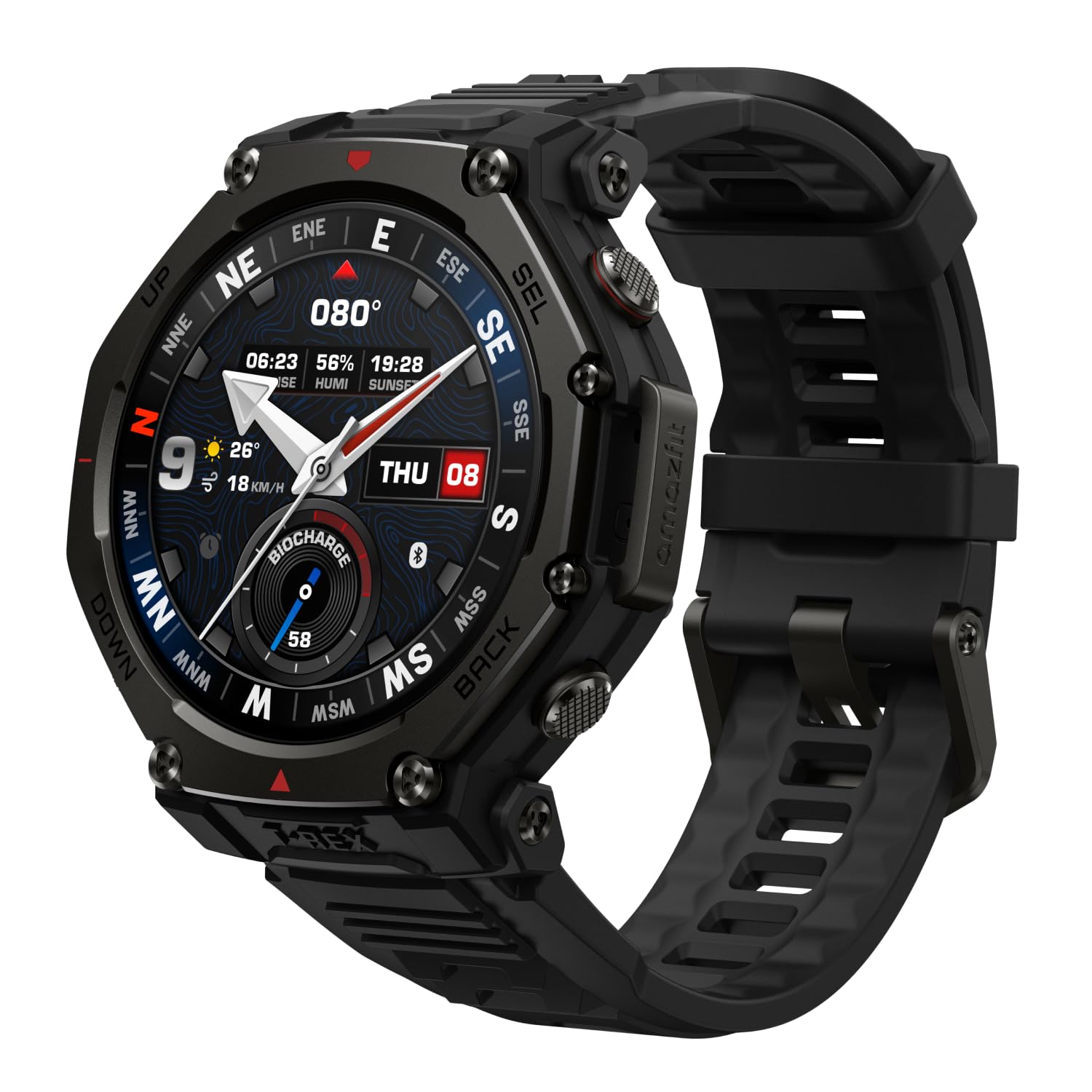
| Amazfit T-Rex 3 ProRugged Adventure Standard | Rugged adventure standard | 27 days | 10 ATM | Dual-band, six satellites | Amazon |
| Garmin Forerunner 970Premium Pick | Triathletes and runners | 15 days | 5 ATM-class | Multi-band GPS | Amazon |
| COROS PACE 4 | Runners on a budget | 19 days | 5 ATM-class | Standard GPS | Amazon |
| COROS APEX 4 (42mm) | Alpine and trail athletes | 41 hours (all-systems GPS mode) | 5 ATM-class | All-systems plus dual-frequency | Amazon |
| SUUNTO 9 Peak Pro | Endurance events | 40 to 300 hours GPS (by mode) | 100m waterproof | Four satellite systems | Amazon |
| Amazfit Active Max | Gym and weekend training | 24 days | 5 ATM-class | Five satellite systems | Amazon |
| POLAR Grit X Pro | Trail hikers | 40 hours training GPS | 100m water-resistance | Built-in GPS | Amazon |
| KOSPET Tank M4C | Water sports and field work | 15 days | 5 ATM and IP69K | Dual-band GNSS (L1+L5) | Amazon |
| mibro GS Pro2 | Budget runners | 20 days | 5ATM | Dual-band GPS | Amazon |
In‑Depth Reviews
1. Garmin Instinct® 3 AMOLED, Rugged GPS Smartwatch, 45mm, Black
Our pick — over 4.5★ from 800+ verified ratings; the strongest balance of quality and price.
A rugged GPS watch that finished a thirteen-hour trek with 34% battery left.
This is the one for the athlete who goes off-grid and hates charging. Garmin rates it at up to 18 days of battery, and a verified buyer reports a 13-hr trek used only ~34% of the charge. That gap versus the daily-charging crowd is the whole pitch: charge it on Sunday and it refuses to die before the next weekend. The 1.2-inch AMOLED screen (a bright, color-rich panel that stays readable in direct sun) holds up on open ridgelines.
Where it beats the SUUNTO, which leans on satellites alone, Garmin pairs multi-band GPS with SatIQ technology, a system that switches signal paths automatically to keep you on route without gulping battery. The 18-day capacity versus the Amazfit Active Max’s 25 days is a real gap — if raw standby life is your only metric, the Amazfit goes longer. But the Garmin gives you a 350 mAh cell, a three-axis compass, and a barometric altimeter (a sensor that reads your elevation changes) in a 45mm fiber-reinforced polymer case with a metal-reinforced bezel. Buyers report it handles weight-loss tracking, sleep, and mountain treks equally well.
What wins people over is how it looks and feels on the wrist — owners describe it as rugged without being bulky. And you will stop fumbling for buttons once you adjust to the five-button layout: there is no touchscreen, which cuts accidental inputs when your hands are wet.
Built for the backcountry
- 18 days of battery per charge, with one verified buyer logging ~34% drain on a 13-hr trek
- Multi-band GPS with SatIQ keeps you on route without draining the cell
- 3-axis compass and barometric altimeter for real trail navigation
- Built-in LED flashlight with strobe modes for night runs and campsites
Where it pushes back
- No touchscreen — expect about 48 hours to retrain your hands onto the five buttons
- 18-day battery, 350 mAh, and 20.4 cm band all give the edge to the Amazfit or the mibro on paper
- Button-first design is a genuine adjustment for anyone coming off a touchscreen watch
Best if: you want one rugged watch that survives a long outdoor season on a single weekend charge, complete with flashlight and trail sensors.
Think twice if: you depend on a touchscreen — this one runs entirely on buttons.
2. Amazfit T-Rex 3 Pro Smart Watch, 1.5″ AMOLED Sapphire Glass, iOS/Android
A 700 mAh cell, sapphire glass, and a titanium bezel built to survive job sites and trail rock.
You get sapphire glass (a scratch-resistant crystal) and a titanium alloy bezel and buttons on the T-Rex 3 Pro without paying boutique prices. It is rated to 10 ATM (a rating that lets you wear it in the pool and open water) with diving certification to 45m, so you can swim laps or dive without worrying about water getting in. Owners who wear watches into garages and job sites report it holds up.
You charge this watch far less often than most: Garmin lists up to 18 days for the Instinct 3, but Amazfit rates the T-Rex 3 Pro at up to 27 days, and the two verified owners who logged their longest stretches reported 15 and 17 days of real use with workout tracking running. The 3000-nit AMOLED screen (a brightness measure — higher nits stay readable in brighter sun) pairs with auto-ambient adjustment, so it dims indoors and brightens on a ridge without you fiddling.
What owners notice first is the look — it reads as a durable watch, not a gym accessory. Offline maps with auto rerouting and round-trip route creation mean you can wander a trail you have never seen and still find your way back, even with no signal. An occasional owner finds music downloads to the device clunky and wishes it used the same simple drag-and-drop storage a Garmin does; that is a real workflow quirk, not a fault in the hardware itself.
The build story: titanium and sapphire at this tier is the point of the watch — it takes dings, scratches, and pool sessions without looking worn. Add the built-in two-color flashlight with Turbo Mode and an SOS signal, and it covers dusk trail runs and overnight hikes alike.
The honest catch: the app-based music transfer is the weakest link, and the watch is not the slimmest on the list. If you want an ultra-light racing watch, the COROS PACE 4 below at 32g beats this on weight.
Reach for this if: you want tough materials and near-month-long battery in one device.
Look elsewhere if: you plan to sideload a big music playlist — the transfer process will test your patience.
3. Garmin Forerunner® 970, 47mm, Soft Gold Titanium, French Gray/Indigo
A triathlon watch that auto-detects swim, bike, and run transitions without a lap button.
Train for a race and you want data, not guesswork. The Forerunner 970 is the training-focused pick, with a titanium bezel, sapphire lens, and Garmin’s brightest AMOLED display paired with button controls. It runs up to 15 days in smartwatch mode and up to 26 hours in GPS mode, so a long ride or a full race day fits comfortably inside a single charge.
Where this separates from the rest is multisport auto-transition: it detects the swap between swim, bike, and run on its own, so triathletes record clean splits without touching the watch. Owners running triathlon seasons rate the swim, bike, and run metrics as excellent and the multi-week battery as the thing they brag about most. Wrist-based running dynamics — cadence, stride length, and ground contact time — plus running economy and running tolerance round out the training picture for anyone chasing a personal best.
The caveat is depth, not durability. This watch is stacked with metrics, and first-time owners describe a genuine learning curve coming from simpler watches — it takes a week or two before the menus feel natural. Full-color maps and dynamic round-trip routing handle the navigation side, and an in-watch speaker and mic let you take calls from the wrist when paired to your phone.
Why runners keep it: the combination of full-color maps, multi-band GPS, and automatic multisport transitions is the rare setup that works for a first 5K and a full Ironman with no settings change.
One real limitation: if you mostly walk and lift, you will pay for training tools you never touch, and the menu depth can feel heavier than a pure outdoor watch like the Garmin Instinct 3.
Best matched to: runners and triathletes chasing a personal best who want every metric on one wrist.
Overkill for: casual step-counters who will never open the training dashboard.
4. COROS PACE 4 Ultralight Sport GPS Watch (Black Silicone, Standard)
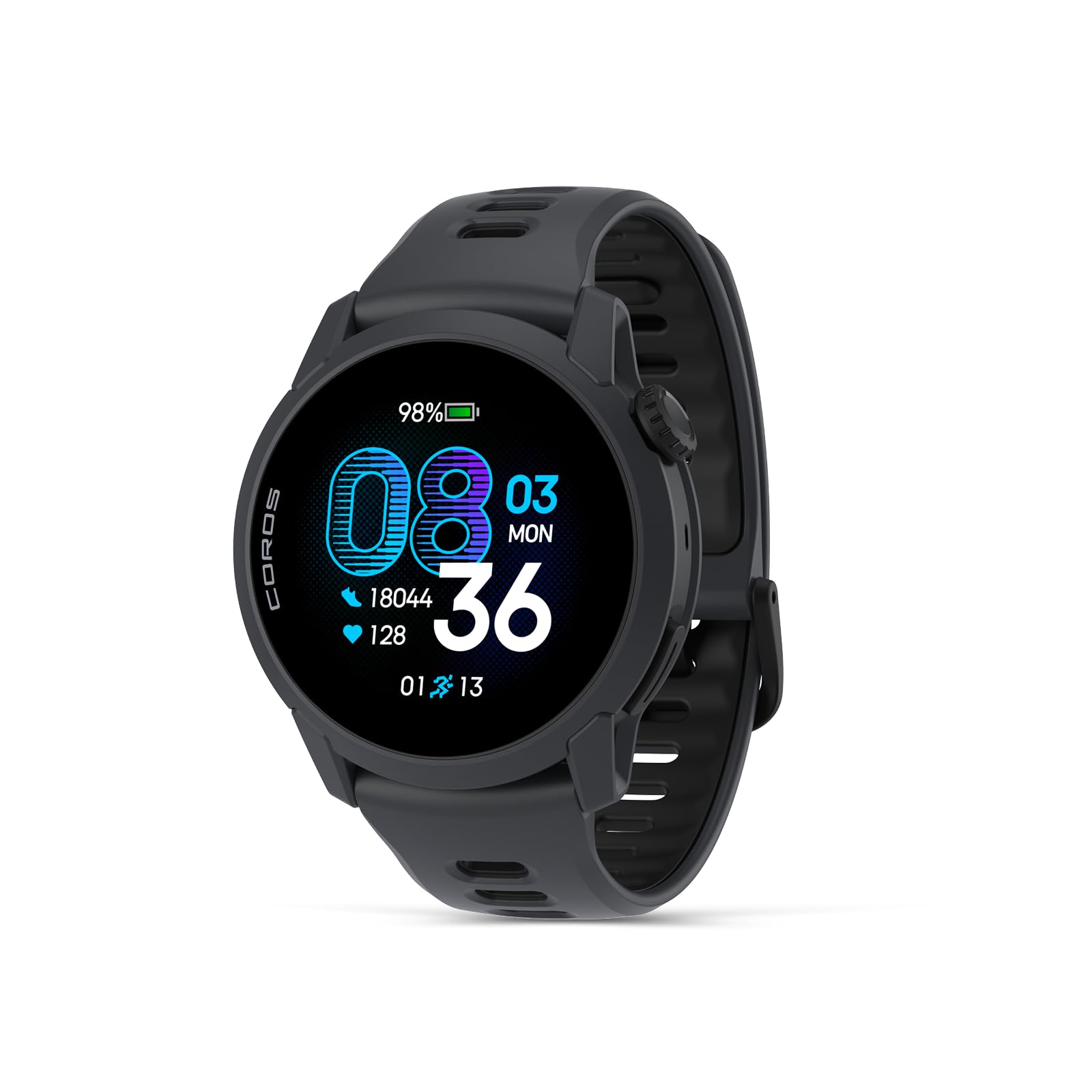
At 32g it is lighter than an energy gel, with 41 hours of continuous GPS.
At 32g with the nylon band and just 11.8mm thin, the PACE 4 disappears on a long run — you barely feel it on your wrist. Battery is rated at 19 days of daily use and 41 hours of continuous GPS, so you can go weeks between charges. A verified owner logged a 12-mile run with Bluetooth music and max-brightness GPS and still had 75% left, which is why the crowd that cares about battery keeps coming back.
The training tools go beyond pace. Voice Control lets you set an alarm or build a target workout hands-free, and a voice recording tool captures notes about where you were and how you felt, logged at the end of the activity. The COROS app tracks recovery time, sleep stages, HRV (heart-rate variability, a daily readiness signal), and training load, so the data picture is broad for the size. A tactile digital crown, two buttons, and a touchscreen share control, with a customizable Action Button for one-tap media or breadcrumb navigation.
The trade-off is smart features: you get notifications, but there is no message reply or voice-assistant tie-in like a phone-first watch, and the 4GB storage holds about 10 hours of music. If you need to answer texts from your wrist, this is not the pick — but if you need a featherweight training partner that lasts, it earns its place.
What runners get
- 32g, lighter than an energy gel, and 11.8mm thin for 24/7 wear
- 41 hours of GPS and 19 days of daily battery on one charge
- Voice Control and voice workout logs on the wrist
- 4GB storage plus running plans and guided routines
What you trade away
- No message reply or voice-assistant support like a phone-first smartwatch
- 4GB storage holds only about 10 hours of music
- Touchscreen plus button layout may feel fussy if you prefer a single physical crown
Pick this for: the runner who wants GPS accuracy and battery and does not need to reply to texts on the wrist.
Pass if: wrist-based messaging and a full app store are must-haves.
5. COROS APEX 4 (42mm) GPS Watch, 1.2″ MIP, 34 Days Battery Life – Black
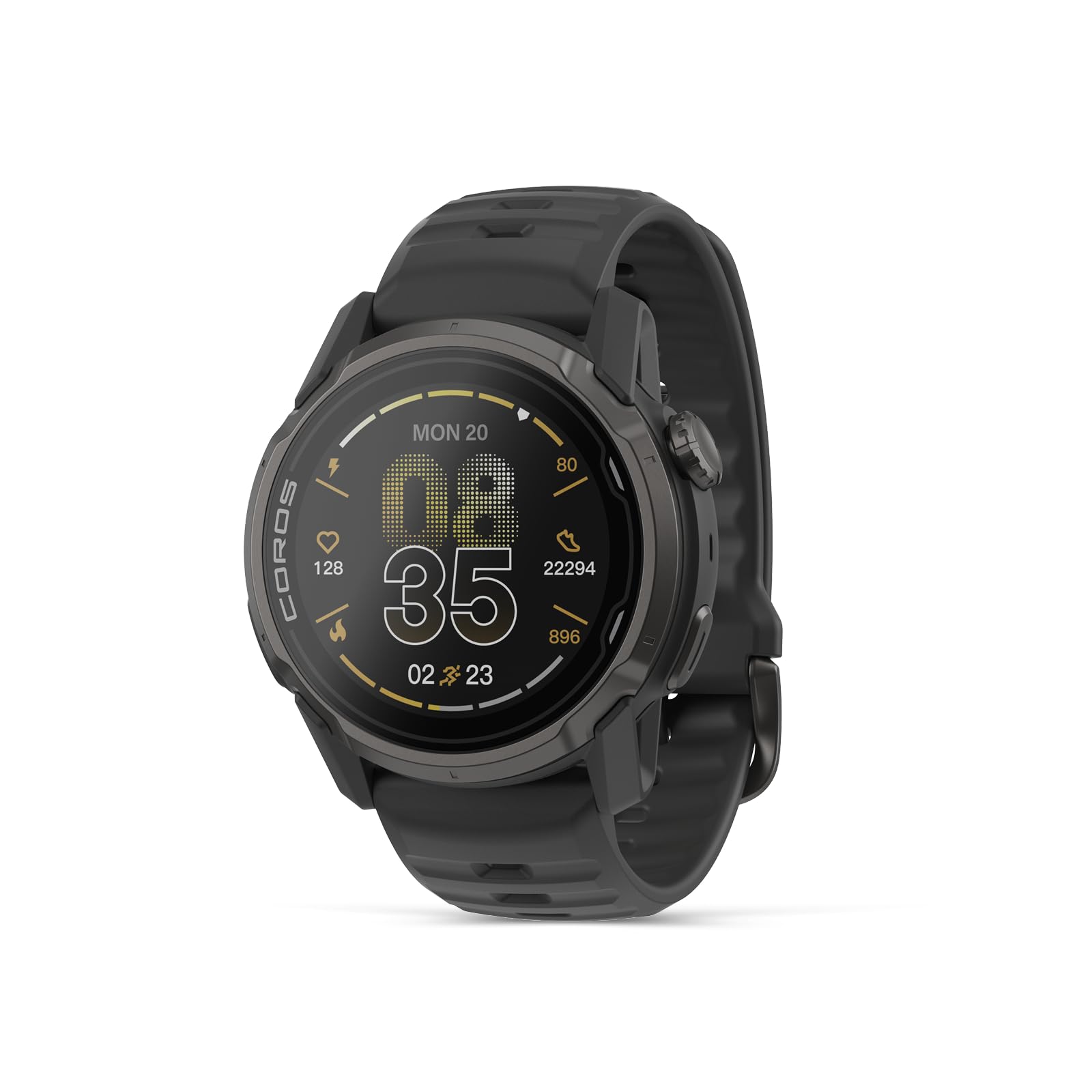
A titanium trail watch with offline topographic maps that work without cell signal.
This one is built for the mountains. The APEX 4 pairs a 1.2-inch always-on MIP display (a low-power screen that stays visible in bright sun and sips battery) with sapphire glass and reinforced titanium lugs. All-systems GPS plus dual-frequency positioning is tuned for dense forests and steep walls, and buyers running trails and alpine routes report the GPS stays locked and the battery runs three to four weeks with daily runs.
Navigation is where it pulls ahead of a basic tracker. You get topographic and landscape maps with trail and street names, turn-by-turn directions, and hydro maps — all readable without cell service, backed by 30x faster map rendering than its predecessor. Two map layers with 15m zoom keep you oriented on trail, street, or slope. A microphone and speaker let you record Voice Pins or take hands-free calls, and the 4GB storage holds music for the long descent.
The most consistent criticism is the display style. Owners coming from a bright OLED watch note the dimmer always-on screen takes adjustment — many call it a conscious trade for the pixel-level battery savings. The stock band also digs in for some wearers, and the button design can catch. Both are real, both are fixable, and neither touches the core battery-and-GPS strength.
Endurance first: 41 hours of all-systems GPS and up to 34 days of battery in normal use means a month can pass between charges for an active trail runner.
What to expect on the wrist: the always-on MIP screen is less vivid than an AMOLED competitor like the Amazfit Active Max, and the band choice can rub. Order a spare nylon strap if you are between band sizes.
For alpine and trail pursuits: ski touring, climbing, and long days where the map matters more than the screen shine.
Not for you if: you want a bright, colorful OLED every time you raise your wrist.
6. SUUNTO 9 Peak and Peak Pro Sports GPS Watch for Demanding, Performance Driven Athletes and Adventurers

A one-hour full charge delivers 40 hours of GPS — endurance over screen flair.
For the athlete who measures a watch in finish lines rather than apps, the SUUNTO 9 Peak Pro delivers. It fully charges in one hour and offers 40 hours of battery in best GPS mode, 70 hours in endurance mode, and 300 hours in tour mode, with a quick 10-minute top-up giving two hours of GPS training. Under the hood sits a 600 mAh cell — the largest on this list, ahead of the Garmin Forerunner 970’s 560 mAh and the Amazfit T-Rex 3 Pro’s 700 mAh cell that pairs with a 27-day rating.
The build is the other anchor. This watch is handcrafted in Finland and rated to 100m water resistance, with titanium, stainless steel, and sapphire glass, and it uses four satellite systems to hold a fix among tall buildings and canyons. What owners praise most is the overall watch quality and the raw battery endurance. Turn-by-turn navigation through komoot keeps you on track, and the SUUNTO app syncs your workouts, sleep, and recovery to Strava or Training Peaks.
The honest split here is software polish versus hardware muscle. Some owners mention inconsistent swim metrics and occasional lag on basic functions, so this favors the athlete who trains hard and cares about battery life over the one who wants the smoothest interface. The screen is accurate but not the brightest — a point several owners raise versus OLED rivals.
The endurance case
- 40 hours of GPS, 70 in endurance mode, 300 in tour mode on a 600 mAh cell
- One-hour full charge, with a 10-minute top-up giving two hours of GPS
- 100m water resistance with titanium, stainless steel, and sapphire glass
- Four satellite systems for a fast fix in canyons and tight city streets
Where it can wobble
- Software reliability divides owners — some report laggy basic functions
- Swim metrics can run inconsistent for a small number of wearers
- The MIP screen is not as bright as an OLED rival like the Forerunner 970
Settle on this if: battery hours and a 100m-waterproof build matter more to you than software polish.
Keep looking if: you need a bright OLED display or one of the smoothest interfaces in the group.
7. Amazfit Active Max Smart Watch, 1.5″ AMOLED Display, GPS, iOS/Android
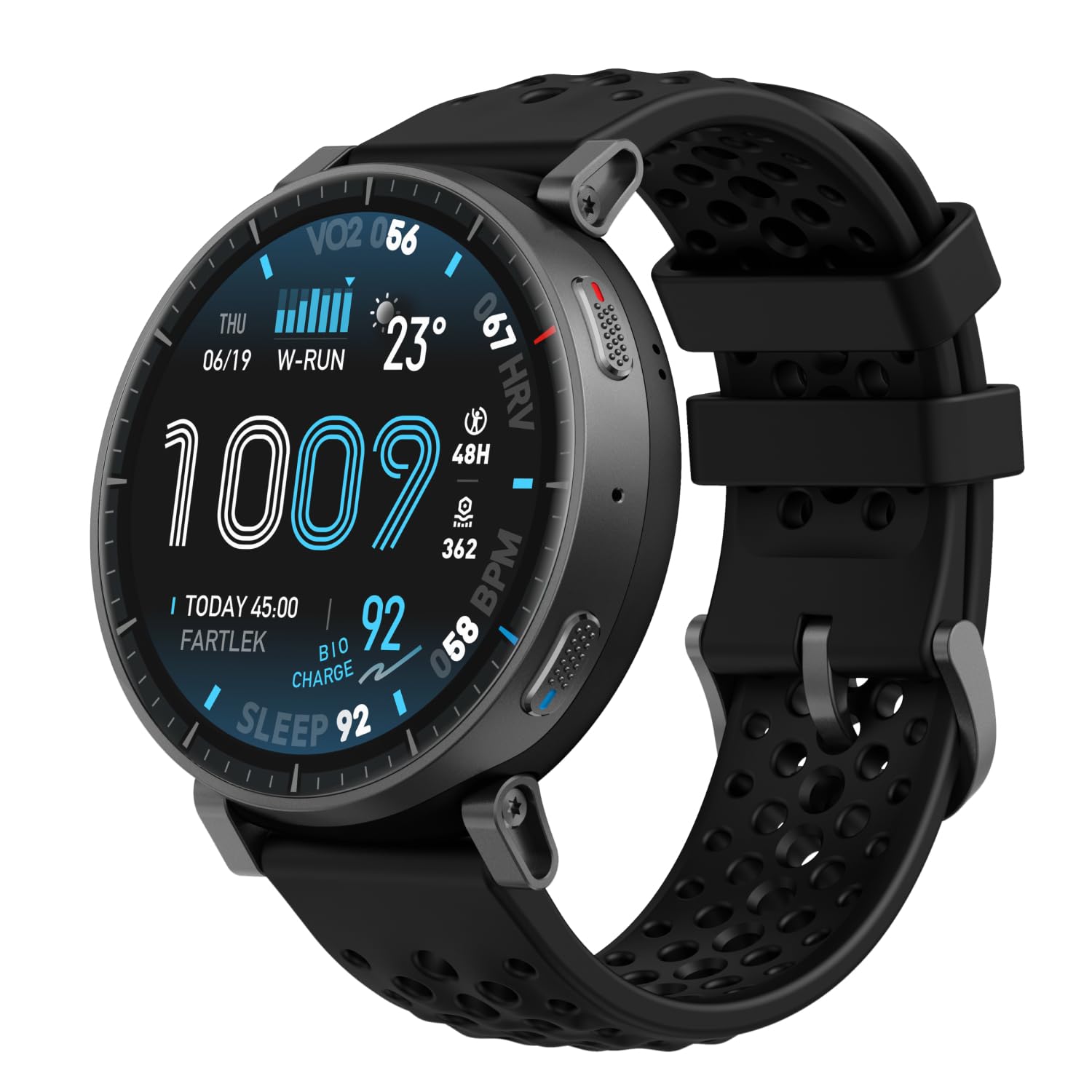
A 3000-nit AMOLED screen readable in full sun, backed by a 25-day battery.
You get up to 25 days of battery on the Active Max, more reserve than the Garmin Instinct 3’s 18 days and the Garmin Forerunner 970’s 15 days — so it keeps going through strength sessions, weekend runs, and long days on your feet. The large 1.5-inch ultra-bright AMOLED display hits a 3000-nit peak (a brightness measure — higher nits stay legible under harsh sunlight), so you can read it in direct sun. That endurance is the headliner.
The training layer is deeper than the price implies. You get 170+ workout modes, Zepp Coach personalized running plans for 3K up to a full marathon, and free downloadable maps — terrain and ski — for offline navigation, with built-in positioning across five satellite systems. A BioCharge energy score shifts with your workouts and stress, and 4GB of onboard storage holds your own music and downloaded maps with turn-by-turn directions right on the wrist.
The crowd drawn to it is broad — first-time smartwatch buyers and seasoned athletes both like the look, and the vast majority hails the appearance and battery. But accuracy is honestly mixed: some wearers report step-count and intense-workout metrics that drift. If you need lab-grade data under max effort, a dedicated training watch wins that category.
The value angle: a 3000-nit screen plus 25 days of battery plus offline maps is a hard combination to find in one watch at any tier, which is why it tops its cost class on features.
The one thing to weigh: step counting and high-intensity metrics are the least consistent part of the package — great for daily movement tracking, less so for pushing peak-performance numbers.
Right for you if: you want a bright, long-lasting watch that handles gym work and weekend routes with maps built in.
skip it if: you demand precise metrics during maximal-effort intervals.
8. POLAR Grit X Pro – GPS Multisport Smartwatch – Military Durability, Sapphire Glass, Wrist-Based Heart Rate, Long Battery Life, Navigation – Ideal for Outdoor Sports, Trail Running, Hiking, Black

MIL-STD-810G sapphire glass and komoot turn-by-turn guidance for trail hiking.
Built for trail and mountain use, this Grit X Pro leans on durability and navigation over screen flash. Scratch-resistant sapphire glass and FKM wristbands (a tough, sweat-friendly rubber) sit on an MIL-STD-810G premium design, with up to 100m water resistance. Battery is rated at up to 40 hours of training with full GPS and heart-rate tracking, extending to 100 hours with power-save options, and up to 7 days in watch mode with round-the-clock heart-rate monitoring.
Navigation is the standout. Turn-by-turn guidance runs through komoot, with assisted-GPS for faster fix times and automatic overnight recovery measurement that reads your sleep and tells you how well you recovered. The 346 mAh cell sits under it all, and the FKM band handles sweat and rain without sliding. For hikers and trail runners who want a real on-watch route instead of a breadcrumb line, this is a genuine step up.
Be measured about the interface, though. Screen lag and reliability are the mixed parts of the story — some owners find performance less snappy than the Garmin watches they came from. If your training is steadier walks, hikes, and trail miles rather than rapid interval work, this sits comfortably in the balance.
Durability that earns its keep: MIL-STD-810G testing and sapphire glass mean the Grit X Pro can take knocks a standard watch would not.
The honest downside: interface smoothness is the recurring gripe — this is not the fastest-feeling watch in the group.
Choose this if: you hike and trail-run with a route loaded and want sapphire-tough glass with komoot guidance.
Skip if: you expect the snappiest interface on the list.
9. KOSPET Tank M4C Smart Watch Rugged, Dual-Band GPS, 5ATM & IP69K Waterproof
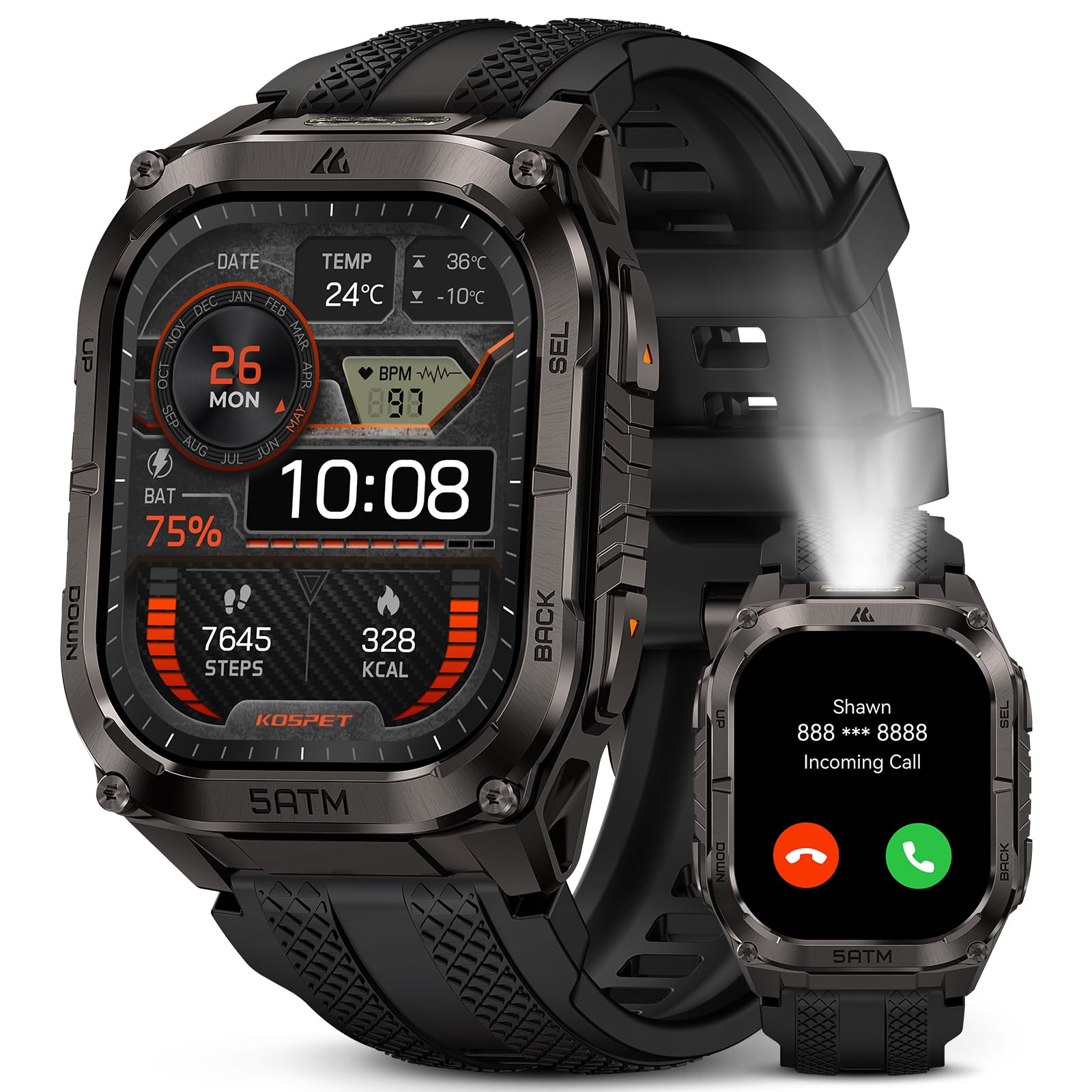
The field watch with a walkie-talkie, a 1.96-inch screen, and a stainless-steel shell that passed military shock tests.
For water-sports athletes and anyone working outdoors, this is a rugged build for a modest outlay. The Tank M4C pairs a 1.96-inch AMOLED display behind Gorilla Glass 3 with a reinforced stainless-steel structure rated to 15 U.S. MIL-STD-810H standards (a military test set for shock, temperature, and vibration). It is rated both 5 ATM and IP69K (protection against high-pressure water and steam), so pool swims, surf, and heavy rain are all in range.
Battery is rated up to 15 days typical use, 21 hours in GPS mode, and 5 hours of continuous flashlight, on a 500 mAh cell. A built-in LED flashlight with five adjustable levels handles night hiking and dark commutes, and there is a compass and barometric altimeter for orientation. The dual-band GNSS (L1+L5, two satellite frequencies for better accuracy) tracks across six major systems, and a 4PD sensor continuously monitors heart rate, blood oxygen, stress, mood, and sleep — including REM stages.
The feature that stands alone here is the walkie-talkie: push-to-talk connects up to four people across roughly 40 metres with no cellular signal, which changes how a group hike or fieldwork crew coordinates. As for the honest reviews, this watch’s battery, durability, and connectivity all draw divided feedback, and an occasional unit arrives with a band that fails early. Charge expectations accordingly and it justifies its place.
What it does that others do not: push-to-talk across four people over about 40 metres without a network is unique in this group and genuinely useful for group trails and field work.
The trade-offs to note: long-term battery and band durability are the most inconsistent parts of the story, so this suits buyers who want maximum features per dollar and are comfortable with minor variability.
Great match if: you swim, work outdoors, and want walkie-talkie plus military-tough build on a tighter budget.
Reconsider if: you prioritize top-tier long-term battery consistency above all else.
10. mibro GS Pro2 GPS Running Smartwatch with Dual Band GPS, 48mm, Dark Gray
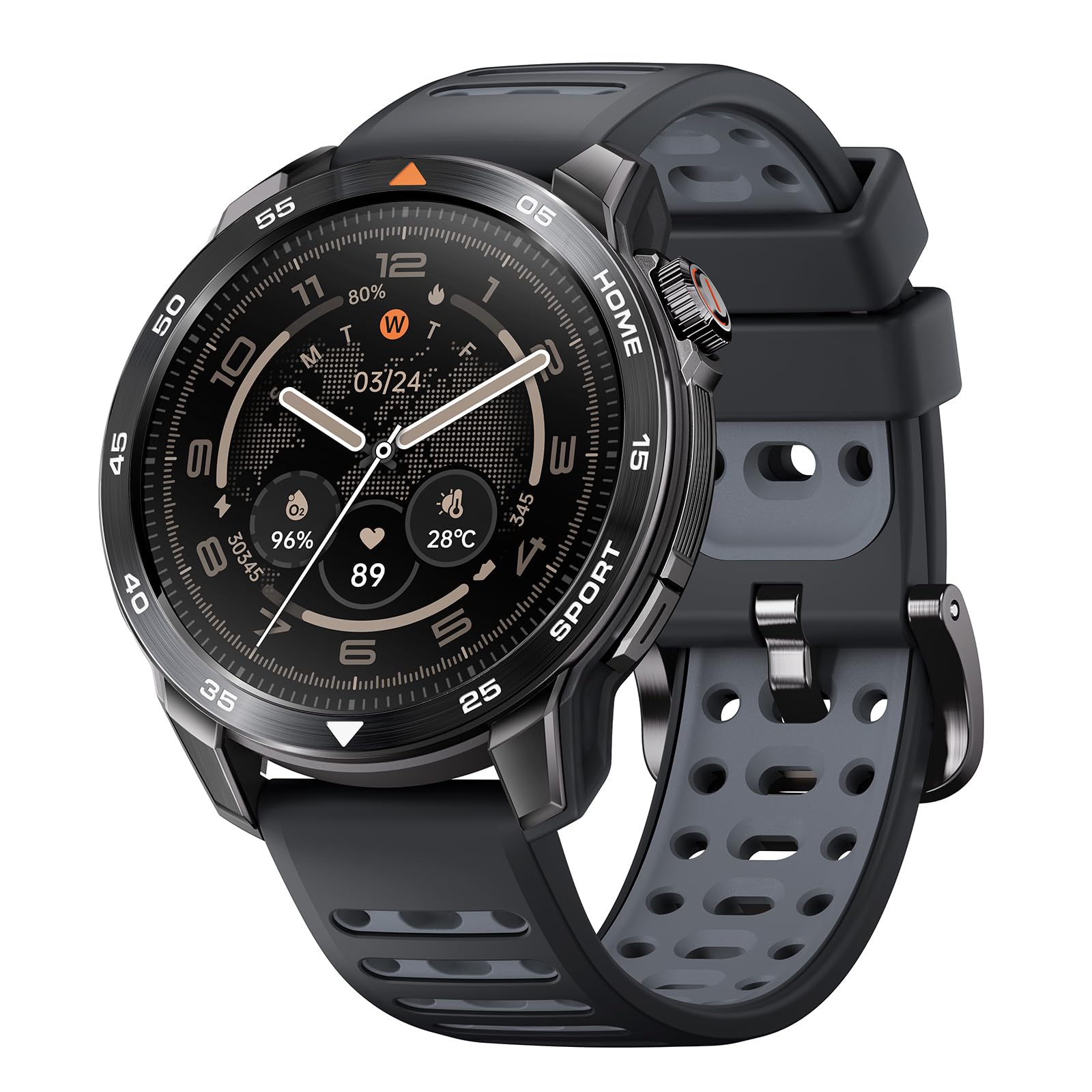
A dual-band GPS runner’s watch with a 460 mAh cell and two straps in the box, for the price of a gym membership.
If you are starting out or training on a tight budget, the GS Pro2 is the value play. It carries a 460 mAh battery — larger than the 350 mAh cell in the Garmin Instinct 3 — with up to 20 days of daily battery and 20 hours in GPS mode, plus a 2.5-hour charge time. Dual-band GPS, two straps (silicone and nylon), and 150+ workout modes cover running, cycling, and swimming.
The training layer punches above the price. mibro Coach builds personalized plans from your running habits, and the watch tracks pace, cadence, and stride length in real time, alongside heart rate, SpO2 (blood-oxygen saturation), training load, and recovery time. It syncs with Strava, which matters if you log every run, and a high-school cross-country runner’s owner reports the uploads go through cleanly and the bright screen is easy to read. Rain and pool swims are covered by 5ATM water resistance.
The watch does ask for patience in two places. GPS can take about 30 seconds to lock before it tracks very accurately, and the 26.5cm band still runs short for larger wrists. But for a runner who wants dual-band GPS and a big battery without spending much, the fundamentals land.
Built for the budget runner: dual-band GPS, 20 hours of GPS battery, and Strava sync in a single affordable package is the clearest value proposition on this list.
What to expect: a roughly 30-second GPS lock before it tracks accurately, and a band that is generous for most but tight for very large wrists. Neither undermines the core running experience.
Ideal for: new runners and students who want dual-band GPS and long battery without the premium outlay.
Not the one for: very large wrists or anyone wanting instant GPS locks every time.
Understanding the Specs
Battery life and GPS mode
Two numbers describe a watch’s power: daily-use battery and GPS-mode battery, and they are wildly different. The Amazfit Active Max rates 25 days of daily battery but the mibro GS Pro2 drops from 20 days to 20 hours once GPS turns on. Read the GPS-mode figure before you buy — that is the number that gets you through a long run or hike. Look for the capacity too: the SUUNTO 9 Peak Pro packs a 600 mAh cell while the Garmin Instinct 3 uses a 350 mAh one, which shapes how long each holds up.
GPS technology and accuracy
Multi-band and dual-band GPS (two frequencies used together) fixes your position more reliably than a single-band receiver, especially between buildings or under tree cover. The Amazfit T-Rex 3 Pro draws on six satellite systems, and the SUUNTO 9 Peak Pro uses four. Speed to lock matters as well: a dual-band watch can take about 30 seconds on the first fix, then track very accurately. If you run forests, canyons, or city streets, prioritize multi-band positioning.
FAQ
How much battery does GPS mode use compared to daily mode?
Is 5 ATM waterproof rating enough for swimming?
Does a smartwatch for athletes need multi-band GPS?
Which is more accurate for heart rate, wrist or chest strap?
Can these watches map a route without a phone?
Doyou need a touchscreen on an athletic watch?
How long does it take to charge an athletic smartwatch?
Is a titanium or polymer case better for trail running?
Can I run a marathon and ride a century on one charge?
Will a 48mm watch case fit a smaller wrist?
Do these watches sync with Strava and other training apps?
Final Thoughts: The Verdict
For most athletes, the smartwatch for athletes winner is the Garmin Instinct 3 AMOLED because it packs 18 days of battery, multi-band GPS with SatIQ, a compass, a barometric altimeter, and a built-in flashlight into one rugged 45mm case that owners wear from the trail to the job site. If you want premium materials and near-month-long battery, grab the Amazfit T-Rex 3 Pro with its 700 mAh cell and sapphire-titanium build. And for triathletes and runners chasing a personal best, the Garmin Forerunner 970 is the one to reach for, with automatic multisport transitions and full-color maps. If your budget is tight but your goals are not, the mibro GS Pro2 brings dual-band GPS and a 460 mAh battery to the starting line.
How We Picked
We do not accept paid placement. Every pick is matched to a real buyer and a real use-case; we do not hands-on test units.
Sources & Methodology
Specifications: manufacturer listings and product documentation. Review insights: verified customer reviews, as of September 2026. Pricing: not shown on this page (it changes often); check the current price via the retailer link.
As an Amazon Associate, Gadgets Feed earns from qualifying purchases. This does not affect which products we feature.