
Our readers keep the lights on and my morning glass full of iced black tea. As an Amazon Associate, I earn from qualifying purchases.
Specs are compiled from manufacturer listings and verified buyer reviews and can change over time — please confirm the key details on the product page before buying.
Most animal carrier backpacks fail the same way: your pet ends up squashed, hot, and clawing to get out by mile two. The fix is picking a pack that matches your animal’s real sitting height and weight — not the one with the prettiest photos. This guide walks you through nine carriers that owners actually keep, from budget mesh bags to premium framed packs, so you can match the right bag to the animal you carry.
I’m Min — the founder and writer behind Gadgets Feed. This guide is built by comparing the manufacturers’ published specifications and the patterns across verified customer reviews, so you get each pick’s real strengths and trade-offs instead of marketing spin.
If you hike, commute, or just need both hands free at the vet, the right best animal carrier backpack depends on weight limit, ventilation, and how easily your pet slides in.
Our Picks at a Glance

How To Choose The Best Animal Carrier Backpack
Two numbers decide whether your pet rides happily or fights the bag the whole way: their sitting height and their lying length. Get those wrong and no amount of padding saves the trip. Everything else — mesh placement, frame stiffness, strap padding — is tuning. Here is what actually separates a pack you keep from one you resell.
Measure your pet before you measure the bag
Put your pet in a sit and measure floor to the top of their head — that is the interior height you need. Then measure nose to tail-base for lying length. If your pet can sit upright inside with clearance to spare, the carrier works. If they have to crouch, they will spend the trip trying to stand up, which is the single most common reason owners return these packs. Pay attention to a listed weight limit too — it tells you what the frame and stitching were built to hold, not just what fits through the door.
Mesh everywhere beats mesh somewhere
Airflow is the whole point of a backpack carrier. A stock mesh panel on one side is not the same as mesh on all four sides, where air moves through and your pet watches the world go by instead of staring at fabric. A top panel that folds or rolls open adds headroom and turns the pack into a mobile lookout spot. Ventilation also does more than comfort — a hot pet panics, and a panicked pet tests every zipper.
Frame, tether, and locking zippers
A structured frame keeps the bag from sagging against your pet’s back. Steel wire or fiber rods hold the shape so the interior stays a pocket of space, not a collapsed sack. An internal safety tether — the strap that clips to your pet’s collar or harness — is the last line of defense if a zipper works loose. Locking or clip-together zippers stop a determined pet from pawing the top open. Treat these three as the safety core, and everything else as preference.
Quick Comparison
| Model | Best For | Weight Limit | Interior Size (L x W x H) | Entry Points | Amazon |
|---|---|---|---|---|---|
| PetAmi Dog Backpack Carrier, 4-Way Entry Ventilated★ Best Overall | Small dogs and large cats up to 18 lbs | 18 lbs | 14.5″L x 11.5″W x 18″H | 4-way (both sides, front, top) | Amazon |
| Pecute Cat Backpack Carrier, Large Space BubbleBest Value | Cats under 13.2 lbs and small dogs | 13.2 lbs (cats) / 11 lbs (dogs) | 12.6″L x 10.2″W x 16.5″H | Side door and bubble window | Amazon |
| Pecute Cat Backpack, Widened Interior SpaceBest for Space | Cats needing room to lie down on trips | 17 lbs | 16.5″L x 10.8″W x 15.7″H | 4 entrances | Amazon |
| Petsfit Dog Backpack Carrier, Expandable | Hiking with cats and small dogs up to 22 lbs | 22 lbs (listing) / 15 lbs (spec sheet) | 13″L x 10.5″W x 17.5″H; expands to 13″L x 27.5″W x 13.5″H | Top and expansion-side zippers | Amazon |
| Ruffwear Hitch Hiker Dog Backpack Carrier | Senior or injury-recovering small dogs | 40 lbs (listing) / 30 kg (spec sheet) | 18″L x 12″W x 4.75″H | Dual locking zippers open wide | Amazon |
| Little Chonk Maxine One Dog Backpack Carrier | Medium dogs like Cocker Spaniels and Beagles | 50 lbs | 14.5″L x 5″W x 22.5″H | Front-facing top opening | Amazon |
| Kurgo G-Train Pet Carrier Backpack | Long hikes and city commuting with a small dog | 25 lbs | 19.69″L x 17.32″W x 4.33″H | Roll-up mesh windows | Amazon |
| Travel Cat Backpack Carrier, The Navigator | Adventure cats who hike and camp | 4.4 lbs | 16.15″L x 17.48″W x 17.7″H | Side door and top window | Amazon |
| K9 Sport Sack Knavigate | Biking and strenuous hikes with medium dogs | Listed for 17″-19″ back length | 14″L x 2″W x 12″H | Top loading with arm holes | Amazon |
In‑Depth Reviews
1. PetAmi Dog Backpack Carrier, 4-Way Entry Ventilated, 18 lbs, Purple
Our pick — over 4.5★ from 350+ verified ratings; the strongest balance of quality and price.
Room to sit tall, four doors to load through, and a frame that will not sag under an 18-pound dog.
If you carry a small dog or a big cat and you’re tired of wrestling them through a single narrow opening, this is the carrier that solves the problem. The bag measures 14.5″L x 11.5″W x 18″H (length, width and height), and 18 inches of interior height is genuinely tall for this category — taller than most, so your pet can sit, stand and turn around instead of crouching. Four-way entry from both sides, the front, and the foldable top means you can load whichever way your pet cooperates, and the foldable top doubles as a head-out window on a hike.
The frame is the real story. The structured build keeps the bag rigid rather than collapsing onto your pet’s spine, and the bottom is a solid non-sagging panel rather than soft fabric. Ventilated mesh panels run along every side so air moves through constantly. A removable sherpa mat lifts out for cleaning, and the whole thing weighs just 2 pounds empty. It ships in purple, and the ASIN tag “compatible with airplane” tells you it was designed with travel in mind. A padded back panel with adjustable shoulder straps and chest and waist buckles keeps the load stable on longer outings, and a side mesh pocket plus zip pocket hold treats and keys without a stuffed pack.
One honest note: buyers report the top zipper takes some effort — with a determined dog, clawing at the flap from the other side, high quality hardware is not the whole battle. If your dog has never ridden in a backpack, budget a week of treat-training before you try a full afternoon. That aside, the pack’s balance of roominess and light weight is hard to match at this tier.
What earns its keep
- Tall 18″H interior — enough headroom for a sitting pet to stand and turn
- Foldable top turns a sealed bag into a head-out lookout
- Structured frame and solid base hold shape instead of sagging
- 2 lb empty weight; padded back with chest and waist buckles
Worth knowing
- Top zipper needs care against a pet that pushes from inside
- Carrying by the top handle rather than shoulder straps is lopsided
- Not built for pets above the 18 lb limit
Best for: Small dogs up to 18 lbs and large cats who need room to actually stand.
Skip if: Your pet is above the weight limit or you need a full frame-plus-hipbelt for long gear-heavy hikes.
2. Pecute Cat Backpack Carrier, Large Space Cat Bubble Backpack, Ergonomic, Gray
A bubble window, a sunshade, and a backplate built so your shoulders do less arguing.
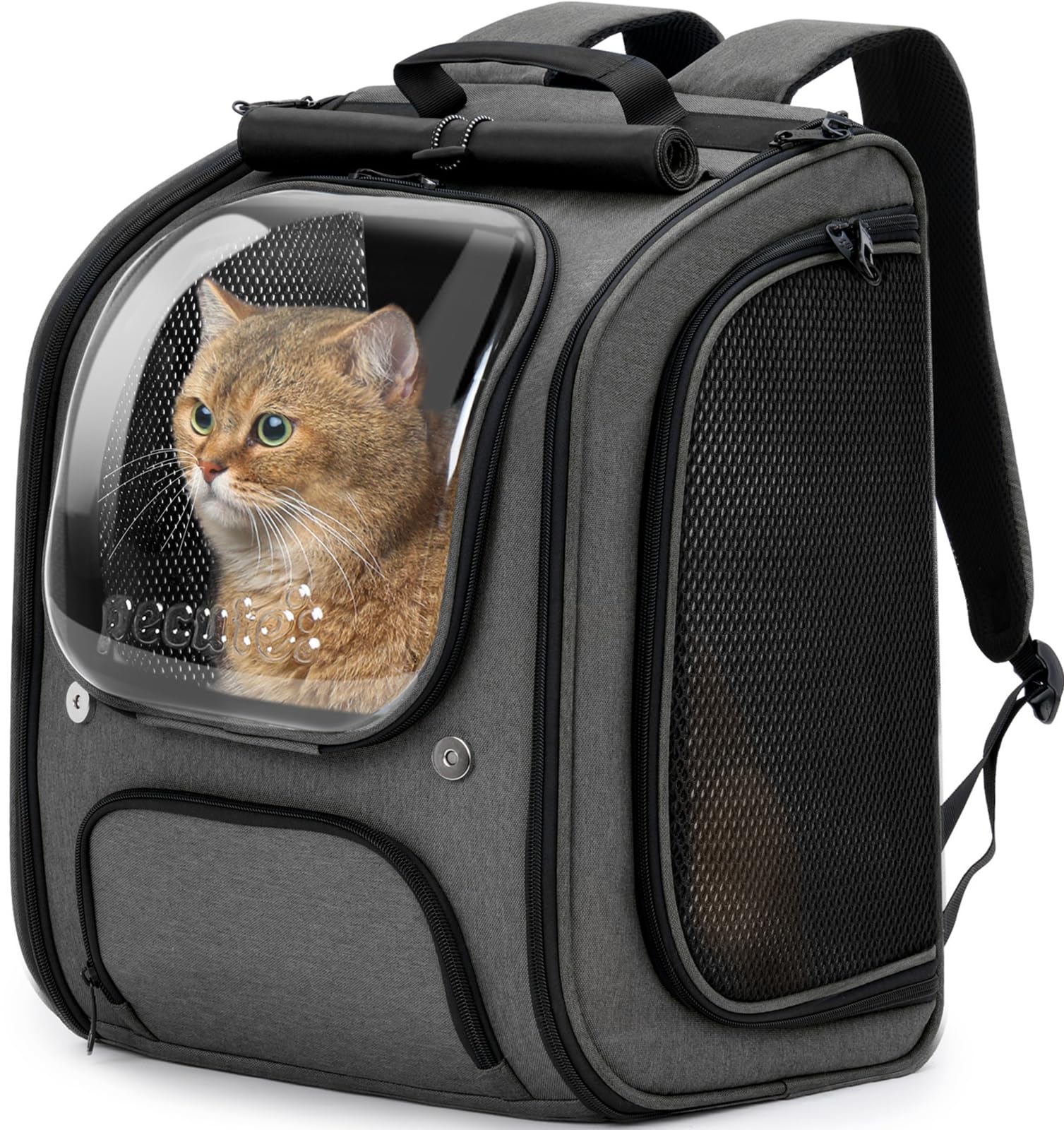
Pecute’s bubble pack targets the cat owner who wants the view without the sweat. The one-piece EVA 3D ergonomic backplate (a molded foam panel shaped to your spine) fits against your back and keeps airflow moving behind you, so you’re not wearing a damp slab after a mile. The transparent shell and mesh windows let your cat see the world, and the magnetic sunshade curtain drops over the window to block UV rays from hitting your pet directly. Built-in safety leash and locking zippers handle the escape concern without special effort.
Sizing is the spot that catches people. The bag measures 12.6″L x 10.2″W x 16.5″H (length, width, height), and Pecute recommends it for cats under 13.2 lbs and dogs under 11 lbs with a body length no more than 16.4 inches. The interior runs about 15% narrower in footprint terms than the PetAmi above, so a long cat will have less turning room. The listing even reminds you to check with your airline before planning travel — a good sign the manufacturer knows the bag straddles the carry-on line. On assembly, the floor piece and Velcro tabs take a little careful alignment, but the secure fit is the payoff once seated. Cleaning is straightforward: the soft padding comes out for machine washing.
Where the money goes: The value here is the bubble shell and sunshade pairing. Owners praise the roominess most, with size drawing the second-highest mentions — cats in the 14 lb range fit with space to spare, and multiple readers note the pack takes to a hike without complaint once the cat gets used to the shape.
The honest weigh-in: One reader who bought the smaller size had to upgrade after their cat outgrew it, and the pattern shows the bubble design runs on the compact side for the biggest cats. If your cat is over 13.2 lbs, measure the length before committing — you may be better served by the wider Pecute further down this list.
Reach for this if: You carry a cat under 13 lbs and want a view-forward, spine-friendly pack with a built-in sunshade.
Look elsewhere if: You have a large-framed cat or a dog over 11 lbs — the interior is tight for either.
3. Pecute Cat Backpack with Widened Interior Space, Upgraded Dog Backpack Carrier, Gray
A widened interior built for cats that want to spread out and lie flat, not stand stiff.
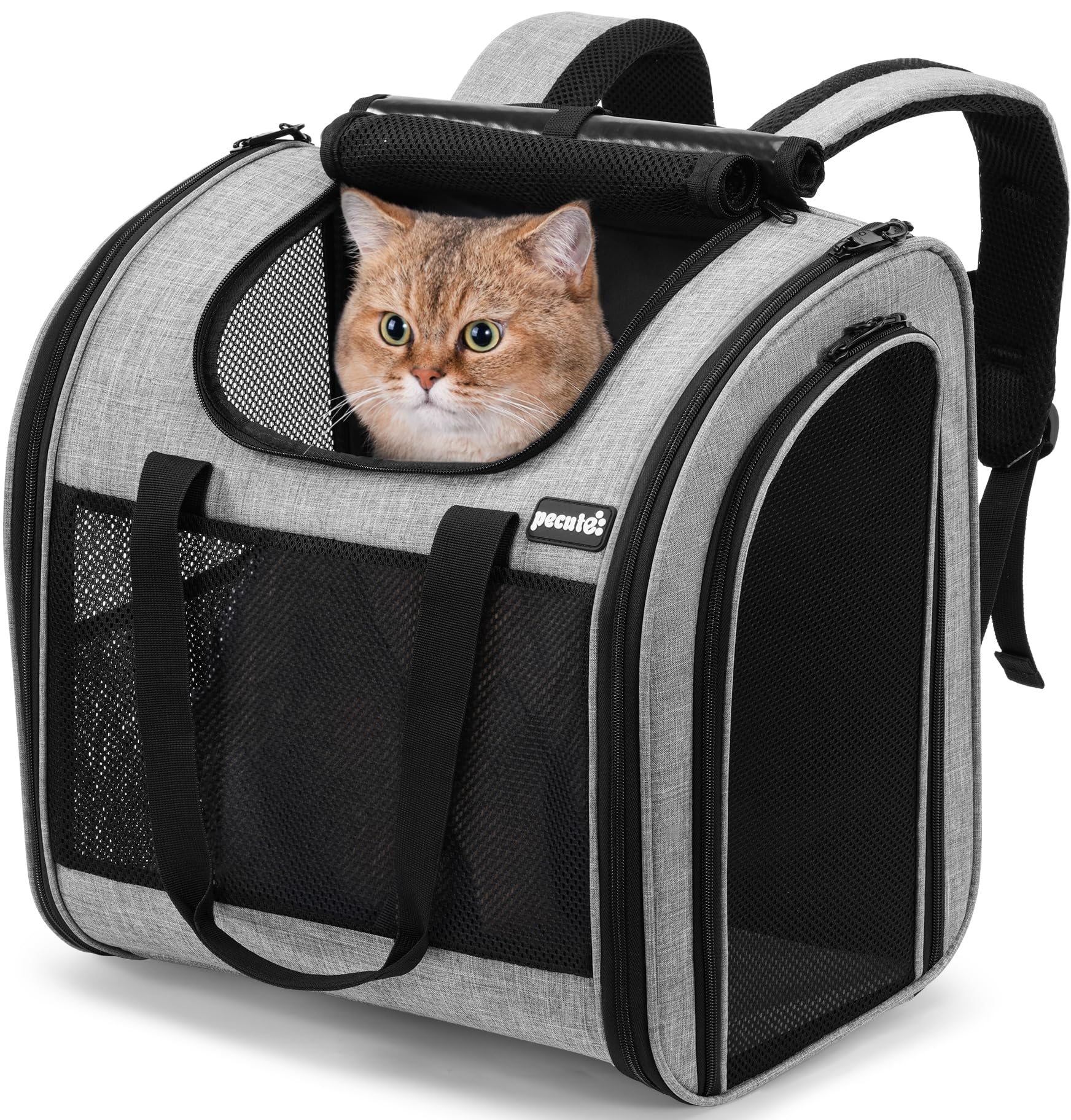
This is Pecute’s answer to the cat owner whose pet wants to lie down inside, not just sit. The listed interior is 16.5″L x 10.8″W x 15.7″H (length, width, height) and carries up to 17 lbs, giving room for a pet to stretch out and change positions. Pecute asks you to verify two measurements before ordering: your pet’s sitting height should not exceed 14.9 inches and their lying length should not exceed 15.7 inches. Get those numbers right and the pack earns its keep for hours at a stretch.
The structure is what holds it together. Steel wire frames sit on both left and right sides, and fiber rods run along the top and bottom, preventing the bag from collapsing and pressing on your pet’s back. The double-sided pad has a removable cover, with pearl cotton and honeycomb boards through the middle for stability. The all-around mesh uses nylon, which is more resistant to scratching than rubber mesh — useful when a bored cat decides to test the walls. Adjustable wide shoulder straps, a padded back, a handle, and chest and waist buckles round out the carrying system, which matters if you are also carrying a laptop or groceries.
Owners mention 18 lb cats and paraplegic cats riding 5-hour car trips in it, and it wears three ways — backpack, one-shoulder sling, or front-facing with the side door cracked open for petting. The recurring gripe is scale: the interior runs large enough that on a crowded subway the width becomes awkward, and when the top door is unzipped, the sides can cave inward without a sturdier support. That’s the trade of a bag this spacious — the interior is generous at the expense of a trim exterior.
Why owners stay loyal
- Lying-down room: 16.5″L interior for cats that refuse to sit
- Steel wire and fiber rod frame holds the interior open
- Four entrances plus a front-carry position for feeding and petting
- Removable, machine-washable double-sided pad
The trade-offs
- Side panels can cave when the top is open and one side is unzipped
- Bag is bulky in tight spaces like subway cars
- Single-pet sizing at the higher weight ranges
Best for: Cat owners whose pet has outgrown a bubble-style pack and wants to lie flat inside during long drives.
Skip if: You carry on foot through crowded city streets — the widened footprint is the whole point and also the whole hassle.
4. Petsfit Dog Backpack Carrier, Expandable with Great Ventilation, Fleece Mat

The pack that unrolls into a lounge — expanding from a carrier to a pop-out resting compartment.
Petsfit solves the “carrier or bed?” dilemma by building both into one bag. The carry size is 13″L x 10.5″W x 17.5″H, and the back panel unzips and expands to 13″L x 27.5″W x 13.5″H — a patented expandable design (US patent 10743515B2) that roughly doubles the floor area so your pet can stretch out, turn, or just rest. That expanded footprint accommodates pets up to 22 lbs according to the listing, though the spec sheet lists a 15 lb maximum weight recommendation — check your pet against the more conservative figure to be safe. The frame is metal, which is what keeps the bag from collapsing on your pet’s back when it is zipped shut.
Four-sided mesh windows keep air moving and give you eyes on your pet, with zippered openings on the top and on the expansion side for easier loading. The bottom cushion is a double-sided pad — one face plush fleece for warmth, the other Oxford cloth for breathability — and it is removable and washable. The dust-proof cloth pulls out from the underside and prevents stains from reaching your body, which is a small but appreciated detail when you’re on a muddy hike. Padded mesh shoulder straps adjust wide and the waist and chest straps reduce pressure and keep the load from sliding.
What draws owners in is adaptability. The extend-out room is a real advantage for pets that need periodic breaks during long hikes, and the rubberized or reinforced mesh resists clawing better than the softer mesh many budget bags use. The recurring patience point is price and bulk: this bag carries a heavier sticker than the simplest budget carriers, and one buyer checked out four rivals before settling on this one because they liked the padding. If you want a single bag that transitions from carry-mode at the trailhead to lounge-mode at the halfway break, this is the only one on this list that does both natively.
Why it stands out: That expansion patent is the entire pitch — no other pick here grows its interior mid-hike. Owners repeatedly note this carries small dogs and long cats, packs to a compact folded size, and gets daily-vet-run buy-in even from pets that resisted earlier backpack attempts.
The size math to know: The 22 lb listing figure and the 15 lb spec sheet figure are not the same thing, and that gap has real implications. Match your pet’s weight against the lower number if you want margin, and note that this bag will not fit two adult cats at once.
Pick this one if: You hike with a cat or small dog and want the carrier to double as a resting space mid-trail.
Think twice if: You want to travel by air — most of the expansion gets left behind once the bag is folded flat for a cabin bag.
5. Ruffwear, Hitch Hiker Dog Backpack Carrier, River Rock Green, X-Small
Built for the dog who walks the first mile and rides the second — with foam padding on both sides of the equation.
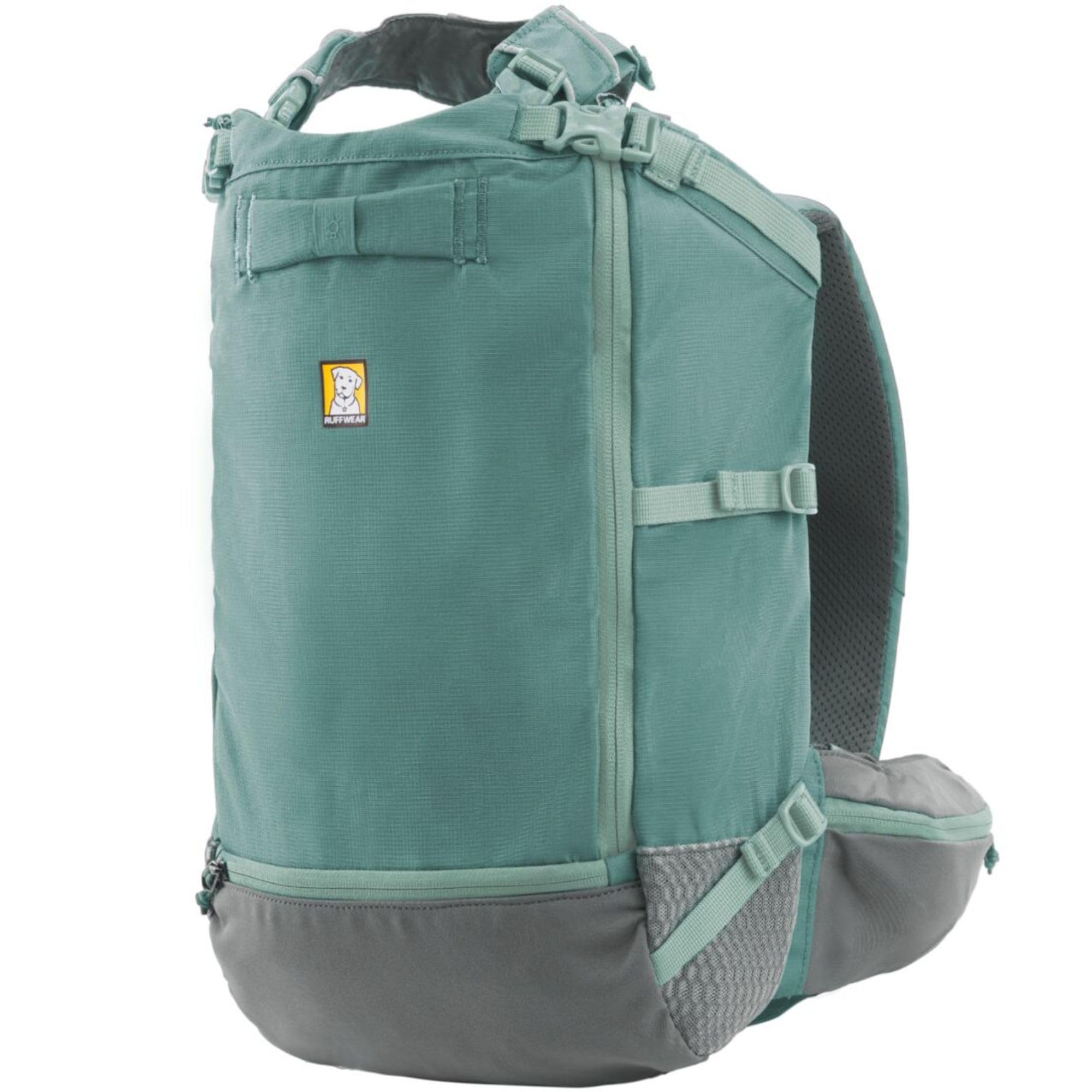
Ruffwear’s Hitch Hiker is aimed squarely at the aging or recovering dog that still wants to come along. Dual locking zippers open the pack wide so you can settle a stiff-jointed dog in without contorting them, and the listed weight capacity goes up to 40 lbs according to the listing while the spec sheet shows a 30 kg maximum — matching your dog against the smaller accepted figure keeps you within safe margins. Integrated adjustable harness and cinch straps keep the dog steady inside, and the interior is padded with plush EVA foam (a firm, cushioning material) rather than bare fabric.
Comfort for the wearer gets equal billing. An external grab handle lets you lift and shoulder the pack when it isn’t on your back. Padded shoulder straps, a breathable back panel, adjustable torso length, and a supportive hipbelt distribute the load for all-day wear. Pockets on the hipbelt hold pick-up bags, treats, and most phones within reach, and an external stretch pocket stashes a soft flask or a packable bowl. Air mesh side panels at the base boost airflow around the dog’s underside, which matters when they spend a full afternoon in the bag. The physical build is trim — 18″L x 12″W x 4.75″H rolled, weighing about 0.37 kg — so it collapses into a car trunk without fuss.
The one theme owners flag is heat. Ruffwear chose durable polyester construction, and the trade-off is that the material doesn’t breathe freely for long — the bag runs warm on hot days, which one reviewer noted bluntly with the words “hardly any ventilation way to hot for myself and my dog”. The honest read is that this pack is built for cooler hikes and air-conditioned transport, not a July trail in direct sun. Fit is the other variable: users report the X-Small suits dogs in the 22 lb corgi range comfortably while the smaller version gets snug on the very biggest sizes in the tier — check the size chart and fit video before you order.
Where it shines
- Wide-opening dual locking zippers settle a stiff or senior dog gently
- EVA foam interior padding plus air mesh panels at the base
- Hipbelt, padded straps, and adjustable torso length shift the load well
- Hipbelt pockets and stretch side pocket keep gear within reach
What to plan for
- Polyester build runs warm in hot weather — save it for cooler days
- Getting the pack on solo is awkward; a second set of hands helps
- Smaller sizes run snug on the top end of the weight range
The pick for you if: Your dog is slowing down but still wants the walk, and you want a true hipbelt to carry them the rest of the way.
The trade-off to know: Cooler climates only — this pack is not built for direct summer sun.
6. Little Chonk Maxine One Dog Backpack Carrier for Medium Dogs, Black
A rigid, front-facing pack for medium dogs up to 50 lbs that keeps both your posture and your pet’s spine straight.
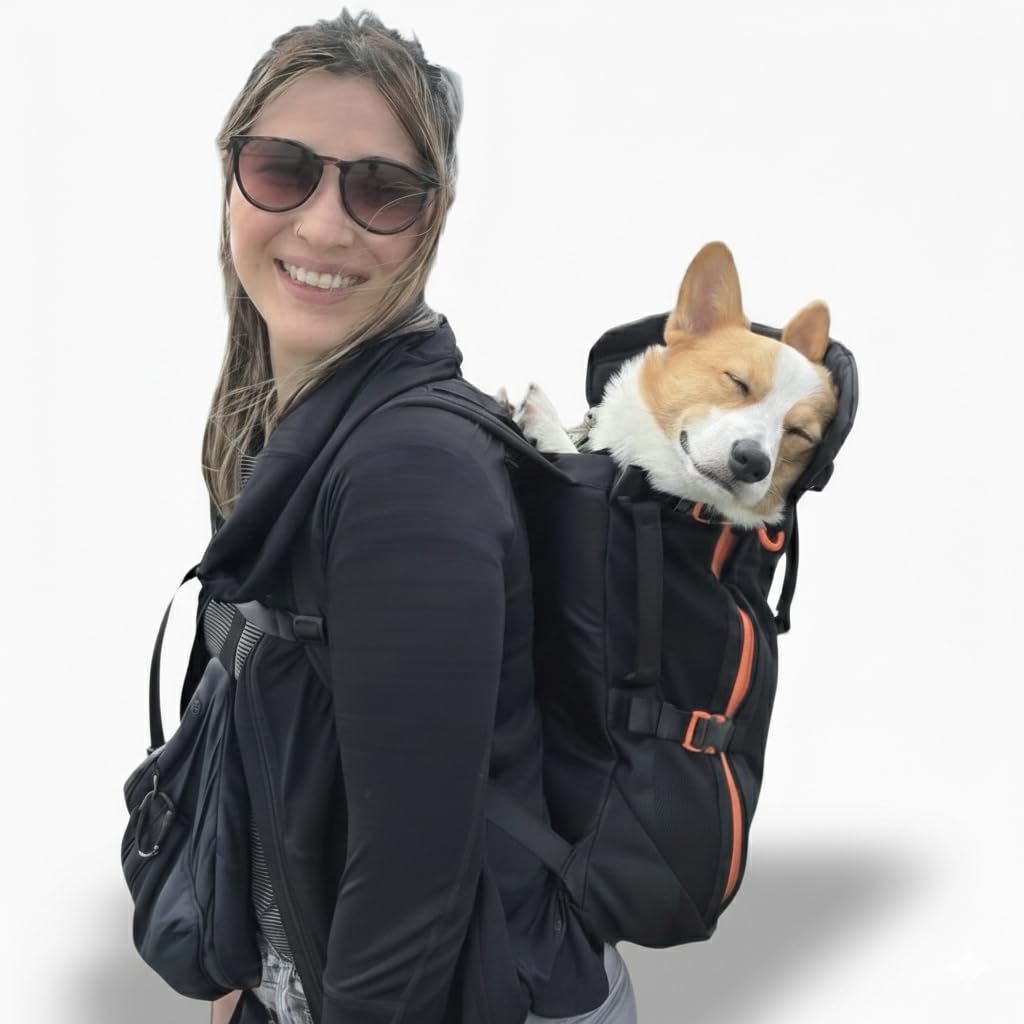
Little Chonk took a different design route: instead of a soft bag with straps, the Maxine One is rigid, with tubular grab handles on all four sides so you can load and unload a medium dog from any angle. The pack suits dogs with a max back length of 14″-19″ and a chest girth of 19″-30″, matching breeds around the size of Cocker Spaniels, Beagles, Shiba Inus, Mini Schnauzers, and Small Terriers. The listed maximum weight recommendation is 50 lbs, so an adult medium dog fits inside the design envelope. The carrier is front-facing, so most of the dog’s weight rides against your chest, which is different from a backpack — worth flagging if you have lower-back issues or plan long straights.
The build uses a rigid structure to hold you and your dog straighter, a soft reinforced neck collar with reflective detail that attaches to your dog’s collar (elastane construction keeps the collar moving with their neck), and a Tail Port at the rear so the dog can wag freely. Exterior material is 95% polyester with 5% neoprene, interior is 100% polyester, and the whole pack weighs just 1.01 kg empty — a plus for a rigid-bodied carrier. The manufacturer markets it as featured in Wired Magazine and suited to hands-free travel, hiking, and front-facing walking.
Owners love the experience side: pet enjoyment leads the positive mentions, and portability is a close second. Dogs that were nervous around crowds reportedly settle once inside and stay calm, and the Tail Port gets a recurring shout-out. The design holds a 46-count fit aspect in owners’ feedback, which is the highest-volume topic on this listing and its honest weak spot. Measure carefully before ordering — Little Chonk’s own sizing guide is the reference to trust.
Head-and-tail check: The Tail Port and reinforced neck collar aren’t gimmicks — they exist because the front-facing design means your dog’s body position is more exposed than in a closed backpack. That is the trade of a rigid, front-facing pack: more visible, more rigid, less anonymous.
The size reality: Even a 29 lb French Bulldog and a 25 lb chihuahua-terrier mix ride comfortably in this design, according to owner feedback, but the fit chart sits at the top of the recurring gripes. Get your dog’s chest girth right or plan to return.
Choose this if: You own a small-to-medium breed listed in the size guide and want a rigid, front-facing carry that supports your posture.
Pass on it if: Your dog’s girth sits near the edge of the 19″-30″ range, or you plan on back-to-back miles with no hip strap.
7. Kurgo G-Train Pet Carrier Backpack, Red

Hiking-grade fabric, a waterproof base, and dual water bottle sleeves — because this pack wants to be on the trail.
Kurgo built the G-Train for owners who plan long miles. It carries pets up to 25 lbs across a listed 19.69″L x 17.32″W x 4.33″H surface, with a waterproof armorsole base and rugged fabric that survive trail dust and camp spills. The designer spec includes roll-up mesh windows, two water bottle sleeves, stow-away straps, and a padded laptop compartment — a feature that tells you this bag wants to double as a work-commute carrier on days your dog isn’t riding. Supportive hip belts, ventilated back panels, and breathable mesh sides distribute weight over long treks, and Kurgo backs the bag with a lifetime warranty on its construction.
Owners across hundreds of trips report very different results at the top and bottom of the size range. Fit the 14 lb shih tzu realm and you get a durable, discreet hiking partner — one reviewer with a 14 lb shih tzu rode this bag through an 8-hour hike, though they flagged that shoulders ached and weight pooled at the bottom over the long stretch. Fit a puppy or a very small dog and the same pack fights you: the top opening runs large, the safety tether is long, and mesh blocks the pet’s view when closed. Return policy and treatment differ; customers note this bag is best for the mid-to-heavy small-dog crowd, not the tiniest riders.
The other honest calling card: heat retention. Owners measured complaints up to “hot in 98°F/80% humidity — needs cooling breaks,” and one buyer mentioned that a dog could escape even with the safety clip attached (they advise clipping to a harness, not a collar). The base also holds a subtle instability when a blanket is added under a short-legged dog. None of these are deal-breakers for a mid-size small-dog hiking partner, but they are the details that separate this from the sealed-frame carriers higher on this list.
What riders like: The bag feels purpose-built — hard bottom, support rods, adjustable back, chest, and hip straps, and removable washable inner pad. Owners flag it as discreet and comfortable for shops, hotels, and city walks when the dog needs to ride out public time.
The honest sum: This is a hiking bag for a mid-to-large small dog. Owners of puppies and tiny dogs should look at the smaller 4-way entry pack above instead — that bag’s foldable top and tighter opening are built for that crowd.
The G-Train stands out because Kurgo didn’t trim the comfort features — the hip belt and ventilated back panel are the ones hikers actually keep asking for — but the weight pooling and warm polymer shell are the honest compromises. If your adventures are long and cooler, this is a strong companion. If you are chasing eight-pound dogs through 95-degree afternoons, temper your expectations.
Made for: Hikers with a 12-18 lb small dog who want a load-bearing pack with a hipbelt and waterproof base.
Not for: Puppies or dogs under 10 lbs — the wide top opening and long tether are hard to contain at that size.
8. Travel Cat Backpack Carrier, The Navigator Convertible Pet Carrier Backpack, Earth

Full-mesh walls, two entrances, and a hydration pocket that treats the cat like a hiking partner, not luggage.
Travel Cat’s Navigator is the bag for cats that go places. The listed footprint is 16.15″L x 17.48″W x 17.7″H, with the “convertible” in the name referring to its ability to serve as either a backpack or a hand-carried tote. Two entrances — a spacious side door and a top window — mean your cat walks in through the door like a rational creature rather than being folded in. The mesh is scratch-resistant and designed to breathe across the entire body of the bag, and two adjustable internal clips secure one or two cats inside without needing a separate harness.
The catalog makes a specific offer on hydration and storage: a dedicated water reservoir pocket (a slot for a hydration bladder) plus two flexible side pouches for water bottles, treats, or a bag of dry food. Side pouches also fit human essentials. Roll-up windows open fresh air and line-of-sight, and there is an additional bottom pocket for notes or treats. The manufacturer shows use cases around hiking, city strolls, and short trips where the cat wants to see the world rather than hide from it. The listing also suggests this bag is airplane-oriented, though owners should confirm it fits their specific airline’s cabin dimensions before booking.
The most enthusiastic owner voice here comes from cat-people whose cats treat the bag as furniture. “Its as good as it gets! Stable but lightweight.” reads one full-marks owner summary. A 14.4 lb senior cat rode this 1.5 miles on trail behind a petite owner, and multiple cats have adopted the bag as a preferred sleeping spot — even at home with the door open. The recurring reality is durability at the frame edge: after about six months of light use, at least one owner’s support wire popped out and could not be pushed back in. It is a design point to watch, and note the heavier the cat is inside, the more the wire carries. Value perception on this bag sits split, with roughly as many buyers calling it worth the price as those who feel it could be sturdier for the cost.
Why cats and owners agree
- Full-mesh walls plus roll-up windows keep airflow constant
- Two adjustable internal clips secure one or two cats
- Hydration reservoir pocket and two side pouches for long trails
- Convertible backpack-to-tote carry; top window doubles as a perch
The details to weigh
- Support wire can pop at the frame edge with heavy use
- Direct sun exposure warms the mesh interior
- Bag is on the larger side for airline cabin fit
Best for: Adventure cats who hike, camp, or ride along on long road trips — and who like the view.
skip it if: Your cat is timid in open mesh or you plan a lot of direct-sun walking without a shade alternative.
9. K9 Sport Sack Knavigate — Medium, Dune
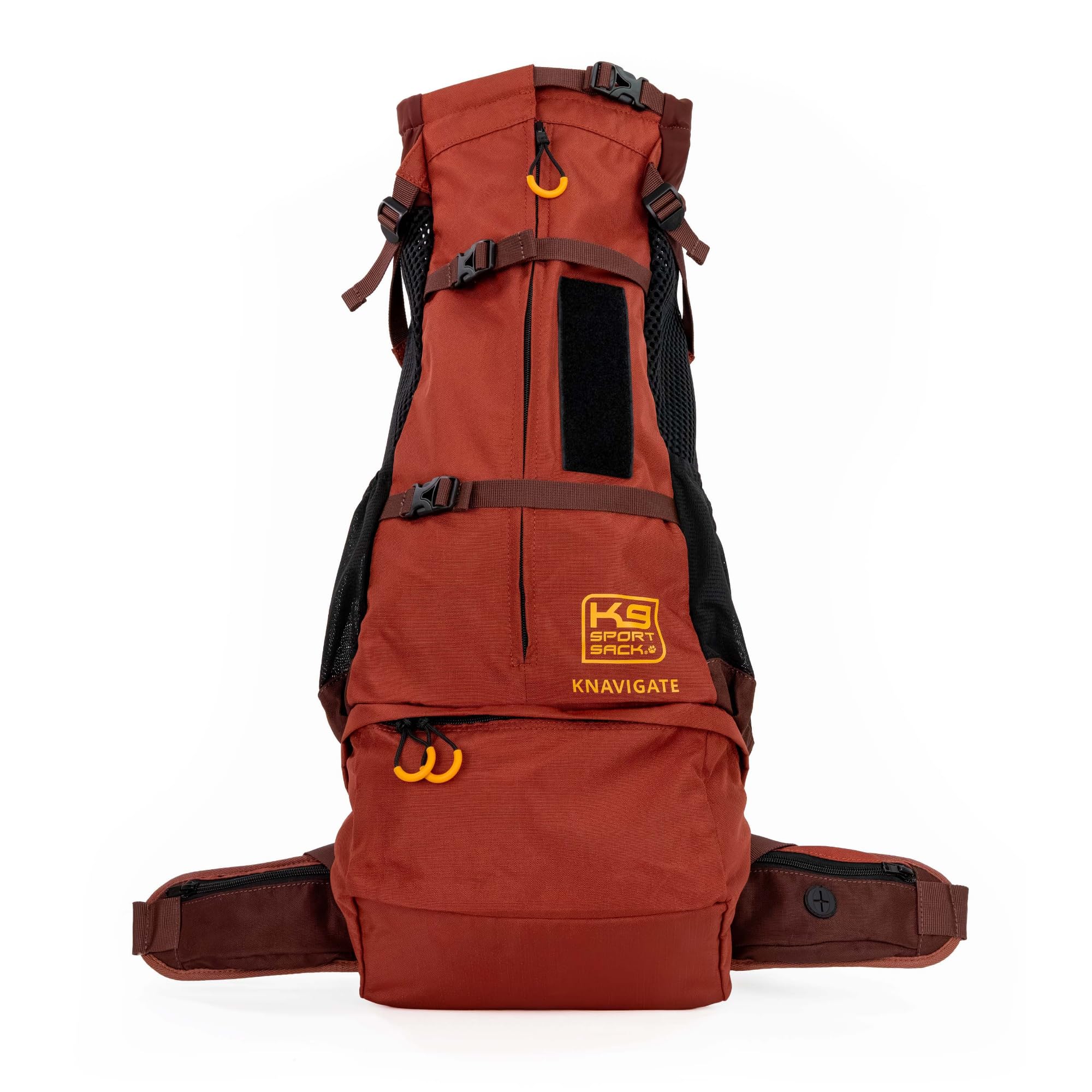
A metal-frame, hipbelt-equipped pack that carries medium dogs on bikes and long hikes — with arm holes that let the dog stay itself.
K9 Sport Sack’s most advanced carrier is designed for anyone who brings a medium dog on strenuous adventures. The Medium size serves dogs with a 17″-19″ back length from collar to the base of the tail, with a recommended breed list including Beagle, Cocker Spaniel, Corgi, French Bulldog, Sheltie, Shiba Inu, and Terrier. The bag pairs a metal back plate frame with a padded hip belt and fully adjustable straps so the load distributes across your body, not just your shoulders. A carabiner safety clip keeps your dog attached to the carrier while the patended upper arm holes let their front legs stay free during the ride, and patended mesh panels deliver cooling airflow.
Storage is generous: a zippered pocket, two pockets on the waist belt, and two full-size water bottle holders on the sides of the carrier keep hands free on trail. The listed build is 14″L x 2″W x 12″H when packed, and the carrier weighs 1.05 kg empty. K9 Sport Sack markets the Knavigate as veterinary approved, positioning it for longer, more strenuous adventures than their other models. The companion material is polyester throughout.
Reviewers point out the Knavigate delivers on build quality specifically — a rigid metal back plate that keeps the pack from collapsing, comfortable straps for the wearer, and a compact rolled profile. What nobody denies is the entry learning curve: dogs must lie down and slide in rather than step in vertically, and matching size to a specific dog is the single biggest risk. A buyer who ordered the 80 lb-limit version for a 63 lb dog found it “too tight”, a strong signal to size up if you are on the fence. A 16.5 lb dog also drew shoulder-pressure complaints on long hikes, another reason the hipbelt matters. The bottom of the bag is unpadded, so plan a cushion layer or extra padding under your pet on long rides. On the storage front, owners note the bag itself keeps room for water bottles and treats, but does not have much left over for human gear on multi-mile treks.
What justifies the premium tier
- Metal back plate frame plus hipbelt distributes weight properly
- Patented arm holes keep front legs free while riding
- Two full-size water bottle holders and waist belt pockets
- Compact pack-down: 14″L x 2″W x 12″H at 1.05 kg empty
Where the fit asks work of you
- Unpadded base — bring a cushion for long rides
- Entry requires the dog to lie down and slide in
- Size-to-dog accuracy is critical; err up, not down
Choose this if: You bike or take long, strenuous hikes with a medium dog and want a metal-frame pack with a real hipbelt.
Size up if: Your dog’s weight sits near the top of its listed range — the tighter fit is the most common regret on this bag.
Understanding the Specs
Maximum weight recommendation
This is the manufacturer’s ceiling for what the frame and stitching were engineered to hold. Match your pet’s real weight against the lowest figure the manufacturer uses (the listing figure and the spec sheet figure do not always agree — when they don’t, trust the smaller one). A pet over the limit shifts the pack’s center of gravity, strains the straps, and turns a comfortable carry into a shoulder ache. Note that the interior height often matters more than the weight limit for a tall, lightweight cat — a small cat standing up can still need 18 inches of headroom.
Ventilation and mesh placement
Airflow keeps your pet calm, and the design detail that matters most is where the mesh sits. A single side panel is not the same as mesh on all four sides. The best bags here use mesh on every side, and some add a top panel that folds or rolls open for extra headroom and air. Nylon mesh resists claws better than rubber mesh, which is worth checking if your cat or dog likes to scratch. A sunshade or roll-up window adds UV protection and shade on hot days. If your pet gets quiet and warm inside the pack, airflow — not padding — is the fix.
Carrying system and frame support
Shoulder straps, chest buckles, a waist strap, a hipbelt, and back padding are what let you carry a pet for hours instead of minutes. A structured frame — steel wire, fiber rods, or a metal back plate — keeps the bag from collapsing onto your pet’s spine. An external grab handle makes loading and unloading easier. Look for a hipbelt on any bag you plan to wear for more than an hour; it moves weight from your shoulders to your hips, which is the difference between a pleasant hike and a sore one.
Entry points and escape-proofing
The more ways your pet can be loaded, the easier the trip. Four-way entry (both sides, front, and top) lets you open the door your pet cooperates with instead of forcing one approach. Internal safety tethers clip to a collar or harness and stop a pet from bolting if a zipper works loose. Locking or clip-together zippers resist a determined paw. If your pet has ever unzipped a bag, choose a carrier with locking zippers — self-locking designs and paired zipper pulls both work, though no closure is truly immune to a clever pet.
FAQ
How do I measure my pet for an animal carrier backpack?
Can I use a cat backpack carrier for a small dog?
Is a backpack carrier safe for a cat that hates carriers?
What does the safety tether inside a pet backpack do?
How much weight can an animal carrier backpack hold?
Are pet backpack carriers airline approved?
How do I keep a pet cool inside a backpack carrier?
Can a carrier backpack replace a stroller or carrier crate?
What should I check on a carrier backpack before a long hike?
How do I stop my pet escaping from a backpack carrier?
Final Thoughts: The Verdict
If you are picking one animal carrier backpack and calling it done, the PetAmi Dog Backpack Carrier is the safest call for most owners — it gives your pet the tallest listed interior in its class at 18″H, four entry points, a structured frame that does not sag, and only 2 lbs on your back empty. That is a rare combination, and a 4.7-star average across hundreds of ratings says the field testing has already happened. If your cat is the passenger, the Travel Cat Navigator delivers the mesh-forward design a hiking cat wants, with roll-up windows and clips for two. For a senior or recovering dog who still wants to come along, the Ruffwear Hitch Hiker opens wide and carries them on a real hipbelt.
Two quick purchases worth flagging before you close the tab. If you are working with a heavier small dog — say 12-18 lbs — and plan actual trail miles, the Kurgo G-Train carries the load with a hipbelt and waterproof base that the lighter packs do not, and its long-run reputation is the reason so many hiking owners keep it. And if you want a bag that grows with your trip, the Petsfit expandable unrolls from a standard carrier into an on-trail lounge with patented expansion — a design you will not find in the budget tier. Either way, measure your pet before you click buy. Every pick here is worth owning — the difference is which one fits the animal you actually have.
How We Picked
We do not accept paid placement. Every pick is matched to a real buyer and a real use-case; we do not hands-on test units.
Sources & Methodology
Specifications: manufacturer listings and product documentation. Review insights: verified customer reviews, as of September 2026. Pricing: not shown on this page (it changes often); check the current price via the retailer link.
As an Amazon Associate, Gadgets Feed earns from qualifying purchases. This does not affect which products we feature.