
Our readers keep the lights on and my morning glass full of iced black tea. As an Amazon Associate, I earn from qualifying purchases.
Specs are compiled from manufacturer listings and verified buyer reviews and can change over time — please confirm the key details on the product page before buying.
If your fridge, stove, or washer still runs perfectly but looks tired and scratched, you do not need a new appliance — you need the right can of epoxy spray. This guide covers the two appliance epoxy paints worth your money, what each one is genuinely good at, and where each one will test your patience.
I’m Min — the founder and writer behind Gadgets Feed. This guide is built by comparing the manufacturers’ published specifications and the patterns across verified customer reviews, so you get each pick’s real strengths and trade-offs instead of marketing spin.
Refinishing metal is mostly about matching the formula to the surface, so the real question is coverage and cure time rather than brand loyalty. That is exactly what separates the two contenders in this comparison of the best appliance epoxy paint.
Our Picks at a Glance

How To Choose The Best Appliance Epoxy Paint
Appliance epoxy is not the same animal as a can of general-purpose spray paint. Its epoxy resin cures into a hard, washable shell that resists stove-side heat and laundry-room damp. Pick the right can and a fifteen-minute respray makes a twenty-year-old fridge look current again.
Match the finish to the appliance, not the photo
Gloss and brushed finishes read completely differently under kitchen light. A high-gloss finish bounces light and hides small dents, while a brushed look softens shine and suits darker colors. Neither is better — but the finish you pick is the one thing you cannot change without stripping everything back down.
Do the coverage math before you buy
Coverage per can is quoted in square feet, and it is the number that decides whether you finish the job or stall halfway with a half-painted door. Measure the face you plan to cover, then compare it against the can’s stated coverage. Buying one can short is the most common mistake in this category.
Prep decides the outcome
No epoxy sticks to grease, and every appliance surface is greasy. Degrease, scuff, and tape off anything you do not want painted. Painters who take that step report a smooth, hard finish; painters who skip it report peeling. Ventilation matters too — this is strong solvent-based paint, so open a window and wear a mask.
Quick Comparison
| Model | Best For | Coverage | Dry Time | Full Cure | Amazon |
|---|---|---|---|---|---|
| Rust-Oleum Appliance Epoxy Stainless Steel Spray Paint | Refinishing stainless-look fridges, dishwashers, and washers | 7 sq. ft. per can | 2 hours | 4 hours | Amazon |
| Krylon Appliance Epoxy, Black, 12 oz | Recoloring working appliances to a dark tone | 20-25 square feet/can | 0.5 hours | 1 hours | Amazon |
In‑Depth Reviews
1. Rust-Oleum Appliance Epoxy Stainless Steel Spray Paint
The stainless-look finish that makes a tired fridge read as a brand new one
If your goal is the brushed-metal look of a modern kitchen, this is the benchmark. It is a glossy stainless steel epoxy that cures into an ultra-hard, washable shell aimed at the outside of refrigerators, dishwashers, and laundry machines. What wins people over is the quality of the finish itself — it is the single thing owners rave about most, followed closely by how the appliance looks afterward. A 4.6-star product with thousands of owners behind it, and the crowd is not wrong about the shine.
Plan your can count carefully, though. This formula covers about 7 sq. ft. per can, which is squarely a doors-and-panels amount rather than a whole-appliance amount — so a side-by-side fridge usually takes two cans. The payoff is the surface it leaves: a hard, waterproof coat that stands up to everyday wear and wiping. Two thermometers read the same here — dry to the touch in 2 hours, fully cured in 4. Heat tolerance is where the line sits: Rust-Oleum states plainly that this is for the outside of appliances only, not immersed surfaces, and nothing exposed above 200°F.
Two things decide whether you love the result: color match and technique. The first is color: the stainless tone is lighter in person than some people expect next to a true stainless appliance, which is the most common note in the reviews and worth checking against your own fridge. The second is technique — this paint rewards patience, with proper surface prep and a willingness to wait out the recoat window. Get those right and, as buyers report, “One 12 oz can covered the whole door with enough left for touch-ups.”
What Earns The Top Spot
- Glossy stainless finish that leaves appliances looking brand new — the quality is the most-praised thing about it, with appearance a close second
- Hard, waterproof, washable surface that resists everyday wear, moisture, and temperature swings once cured
- Comfortable learning curve — no beginner troubles with clogging or uneven coverage reported
Where It Asks For Patience
- At around 7 sq. ft. per can, a full-size fridge generally needs more than one can
- The stainless tone often reads lighter than a true stainless appliance — check it against your own finish first
- Strictly for appliance exteriors — no immersed surfaces, and nothing above 200°F
Reach for this if: you want the brushed-metal look on a fridge, dishwasher, or washer and can give it proper prep and a patient recoat.
Look elsewhere if: you need to cover a large surface in a single can, or you are repainting something that gets hot near a burner.
2. Krylon Appliance Epoxy, Black, 12 oz
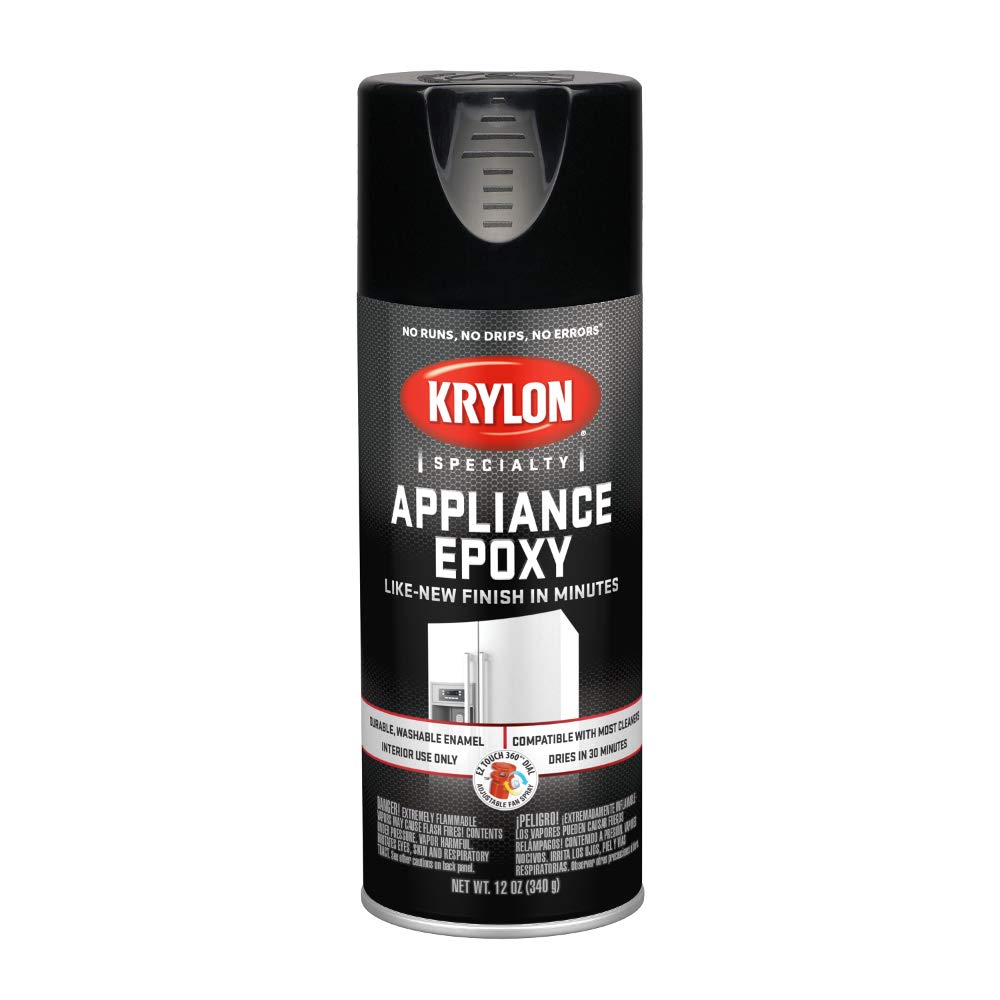
The fast-drying recolor can that saves a working appliance from the curb
Grab this can when the appliance runs fine but the color is wrong. Krylon’s black epoxy is built for recoloring — the reviews are full of dishwashers and stoves rescued from replacement simply because a new coat was cheaper than a new machine. It spreads farther than the Rust-Oleum above, at 20-25 square feet per can versus that formula’s 7 sq. ft., and it is rated for both indoor and outdoor use, which the Rust-Oleum is not.
The half-hour dry time is the headline. Dry to the touch in half an hour, fully cured in one hour — against 2 hours and 4 hours for the Rust-Oleum, that is a much shorter window before you can handle the surface again. Coverage and appearance are what buyers talk about most, and the color is a strong point when you want a deep black appliance that matches a dark kitchen. One reviewer’s math sells itself: “A can costs a fraction of a replacement appliance.”
The catch is the matte finish and the nozzle. The result reads more matte than glossy, so it is a different look from the Rust-Oleum’s high shine, and a few buyers have found the nozzle refuses to spray at all — worth a test spray before you commit to the job. Durability is the open question some raise, with concerns about yellowing over time on white surfaces. It is a 4.3-star product with a few hundred owners behind it, and most of them are happy with the recolor.
The value case: at 20-25 square feet of coverage per can and a half-hour dry time, this is the can to reach for when you want to change an appliance’s color quickly and cheaply rather than chase a premium finish.
The honest limit: the finish lands closer to matte than the glossy look some buyers expect, and a few cans have arrived with a nozzle that wouldn’t spray — test before you start.
The short version: this is the pick for anyone recoloring a working stove, dishwasher, or fridge on a tight budget and short timeline.
The one caution: if you want a high-gloss reflection or need a color that will stay bright white without yellowing over time, look at the Rust-Oleum instead.
Understanding the Specs
Coverage Per Can
Coverage is quoted in square feet and tells you how much surface one can will actually coat. A can rated around 7 sq. ft. suits a door or a panel; a can rated 20-25 sq. ft. handles a much larger face. Do the math on your appliance before you buy, because running out mid-panel is the fastest way to a blotchy finish. Always buy one can more than you think you need for touch-ups.
Dry Time vs Full Cure
Dry time is when the surface is safe to touch; full cure is when the epoxy has fully hardened into its final shell. These are two different moments. A can that dries in half an hour may still need time before it is ready for real wear, and recoating too early — or too late — is what causes lifting or a pebbled texture. Follow the can’s recoat window rather than guessing.
FAQ
Can I use appliance epoxy paint on a refrigerator that still runs?
Is appliance epoxy paint heat resistant enough for a stove?
What is the difference between appliance epoxy paint and regular spray paint?
How long does appliance epoxy paint take to dry and to cure?
Do I need to sand or prime before applying appliance epoxy paint?
How much surface area will one can of appliance epoxy paint cover?
Is the finish glossy or matte after the paint cures?
Can appliance epoxy paint be used outdoors on a grill or outdoor fridge?
Why is my appliance epoxy paint not spraying out of the can?
Will appliance epoxy paint cover scratches and rust on an old appliance?
Final Thoughts: The Verdict
For most people refinishing a stainless-look kitchen, the appliance epoxy paint winner is the Rust-Oleum Appliance Epoxy Stainless Steel Spray Paint because it delivers the glossy, hard, washable shell that makes a tired fridge or dishwasher read as new — and it is the higher-scoring of the two. If you want to recolor a working appliance to a deep black on a short timeline and a small budget, grab the Krylon Appliance Epoxy, Black, 12 oz for its 20-25 square feet of coverage and one-hour cure. And if you are painting a stove panel near a burner, check the temperature limit on either can first.
How We Picked
We do not accept paid placement. Every pick is matched to a real buyer and a real use-case; we do not hands-on test units.
Sources & Methodology
Specifications: manufacturer listings and product documentation. Review insights: verified customer reviews, as of September 2026. Pricing: not shown on this page (it changes often); check the current price via the retailer link.
As an Amazon Associate, Gadgets Feed earns from qualifying purchases. This does not affect which products we feature.