
Our readers keep the lights on and my morning glass full of iced black tea. As an Amazon Associate, I earn from qualifying purchases.
Specs are compiled from manufacturer listings and verified buyer reviews and can change over time — please confirm the key details on the product page before buying.
Feeding bluebirds is easy; keeping starlings, grackles, and squirrels off the mealworms is not. Dried mealworms pull in exactly the birds you want — and, just as fast, starlings, grackles, and squirrels that empty the dish before a bluebird gets a turn. The fix is a cage with openings around 1.5 inches — wide enough for a bluebird, too narrow for a starling. This guide breaks down nine feeders that get that balance right, and tells you which ones actually hold up through winter weather and squirrel attempts.
I’m Min — the founder and writer behind Gadgets Feed. This guide is built by comparing the manufacturers’ published specifications and the patterns across verified customer reviews, so you get each pick’s real strengths and trade-offs instead of marketing spin.
Bluebirds are small, so the feeder you pick lives or dies on three things: the size of the opening, how high you hang it, and how fast you can dump out soggy food after a rainstorm. Get all three right and bluebirds will use the feeder.
Our Picks at a Glance
How To Choose The Best Bluebird Feeder
Bluebirds are cavity nesters and cautious eaters. They want a sheltered, dry dish of mealworms they can fly into quickly and leave just as fast — and they will not fight a crowd for it. Everything below is about meeting those two needs without inviting every starling in the neighborhood to the party.
Match the opening size to the bird you want
Bluebirds are small, so a fly-through opening (a hole birds hop through to reach the food) around 1.5 inches lets bluebirds, wrens, and chickadees in while keeping starlings and grackles out. If the maker lists openings much bigger than that, expect bigger birds to squeeze in — several caged feeders here run a 1.7 by 1.7 inch grid, which is a wider door than a strict bluebird-only setup. Measure the opening before you buy: a 1.5-inch hole admits bluebirds, a 1.7-inch grid admits starlings.
Think about where the food sits and whether water can drain
Mealworms spoil fast when they get wet, so drainage is not a nice-to-have. Look for a tray or cup with drain holes, or a mesh floor that lets rain pass straight through. A raised dish inside a cage keeps the food off the floor, which keeps it drier and lets you see at a glance when it needs a refill. If the food sits low and flat with no drainage, plan on dumping soggy worms after every storm.
Choose a body material that survives your winters
Powder-coated steel mesh and recycled poly lumber both shrug off freezing, thawing, and sun without cracking or rusting, and they clean up in seconds. Untreated wood looks lovely but can warp or come apart, so it rewards a little maintenance. If you hang a feeder where squirrels patrol, the thickness of the cage wire matters more than the color — thin mesh gets chewed, heavy-gauge mesh holds.
Quick Comparison
| Model | Best For | Capacity | Material | Mounting | Amazon |
|---|---|---|---|---|---|
| Mosaic Birds Hummble Hanging Glass★ Best Overall | Watching birds up close from a window | 3.4 ounces | Glass, Metal | Hanging Mount | Amazon |
| Kingsyard Upgraded Mealworm TubeCompact Pick | Compact hanging on a thin branch | — | Metal | Hanging Mount | Amazon |
| STARSWR Wooden Bluebird House FeederWood-Look Charm | Wood-Look Charm | — | Wood | Hanging Mount | Amazon |
| Birdream Metal Bluebird Feeder | Keeping noisy flocks off the seed | 1.2 pounds | Metal, Plastic | Hanging Mount | Amazon |
| Kingsyard 4 lbs Large Bird Feeder House | Set-and-walk-away feeding through the week | 4 pounds | Recycled Plastic | Hanging Mount | Amazon |
| Petite Bluebird Feeder with Plexiglass Roof | Refilling without opening the lid | 8 ounces | Wood | Hanging Mount | Amazon |
| Gbekery Bluebird Feeder with Glass Bowl | Blocking squirrels while feeding bluebirds | — | Metal | Hanging Mount | Amazon |
| AmishToyBox Poly Lumber Bluebird Feeder | A long-lasting feeder worth keeping for years | — | Engineered Wood | Hanging Mount | Amazon |
| Erva Starling-Proof Barrier Guard | Turning away starlings and grackles | — | Metal | Freestanding | Amazon |
In‑Depth Reviews
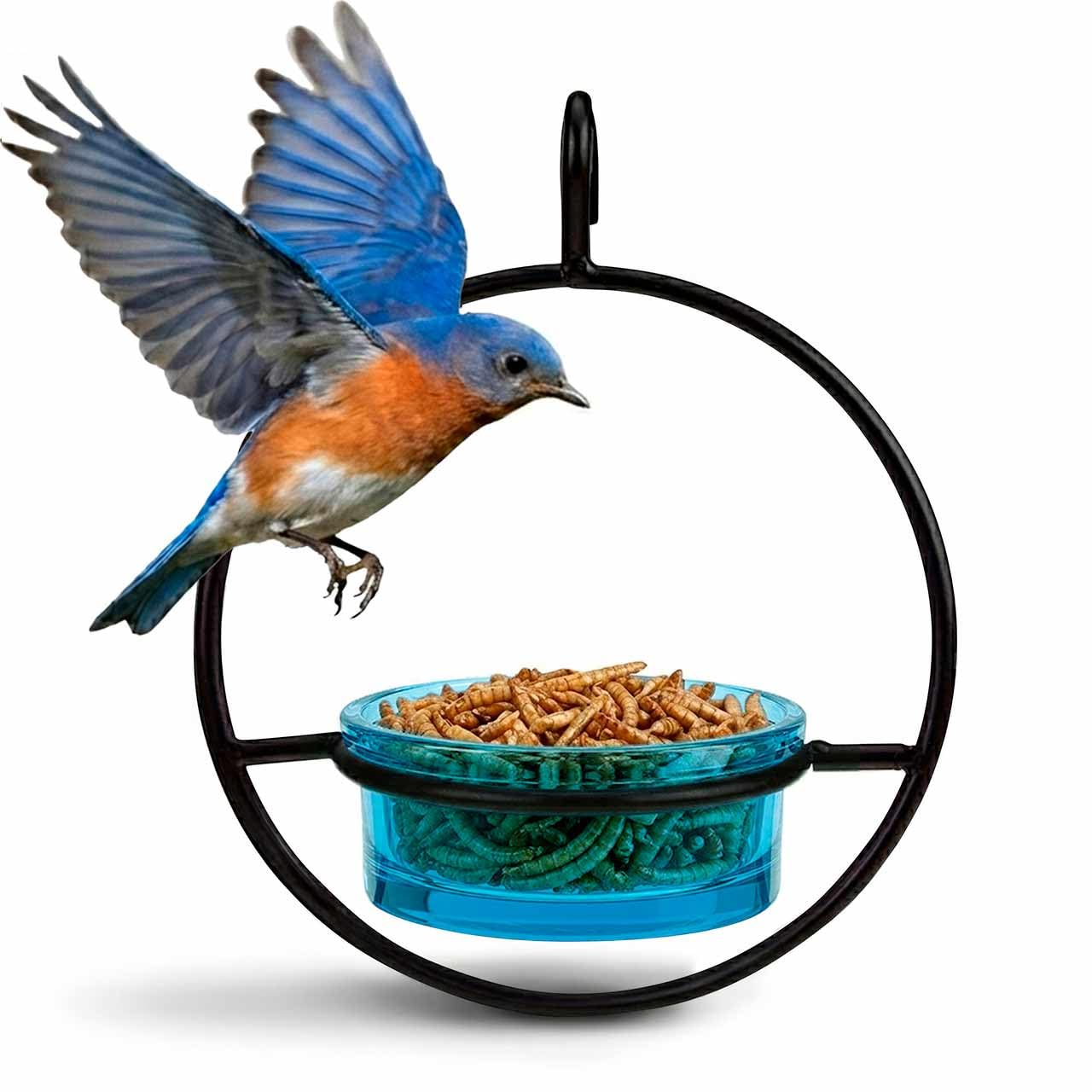
1. Mosaic Birds Hummble Hanging Glass Bluebird Mealworm Feeder, 3.4 oz, Aqua
Our pick — over 4.5★ from 400+ verified ratings; the strongest balance of quality and price.
A shallow 3.4-ounce glass dish that bluebirds find fast and you can watch for hours.
This feeder wins people over because birds actually show up — the bowl holds 3.4 ounces of mealworms, suet pellets, jelly, or flower seed, and its open, 3-inch-wide top gives several birds room to feed at once. The simplest proof is what the bowl does with a spoonful of grape jelly. As owners put it: the orioles love it with grape jelly in the bowl, and the wide, open design means you can fill it in seconds and see exactly how much is left without opening anything.
Build quality holds up in real weather. The bowl is recycled glass, the fittings are powder-coated metal, and the open top hook lets you hang one on its own or link several in a vertical stack. Bluebirds, orioles, and smaller seed-eaters all work the extended rim, which doubles as a narrow perch — so you get a longer window of activity than with a single-port tube. The whole unit weighs one pound and hangs from any hook or branch without a permanent mount.
The honest trade-off is size. The bowl is 3.4 ounces, and the cobalt blue has a reputation for fading fast outdoors — some owners say it washes to almost clear within a season, though the other colorways hold their shade longer. The upside is that refilling is painless, so a smaller bowl is not a real problem if you top it off every few days. If you want a feeder you can refill in seconds and that draws orioles, bluebirds, and tanagers, start here. Unlike the caged feeders further down, there is no barrier here — the appeal is simplicity, not squirrel defense.
What works
- Wide 3-inch opening gives multiple birds feeding room
- Attracts orioles, bluebirds, tanagers, and hummingbirds with simple contents like jelly
- Recycled glass and powder-coated metal build
- Weighs one pound and hangs from any hook with no permanent mounting
- Open top hook stacks multiple feeders vertically
Where it falls short
- The cobalt blue fades quickly outdoors; other colors hold up better
- 3.4-ounce bowl is small and needs frequent refilling in busy yards
- No starling or squirrel barrier
Go for it if: you want the simplest, lowest-effort feeder that draws a wide variety of birds, and you check the bowl every few days.
Look elsewhere if: starlings or squirrels are the main problem in your yard, or you want a feeder you fill once a week.
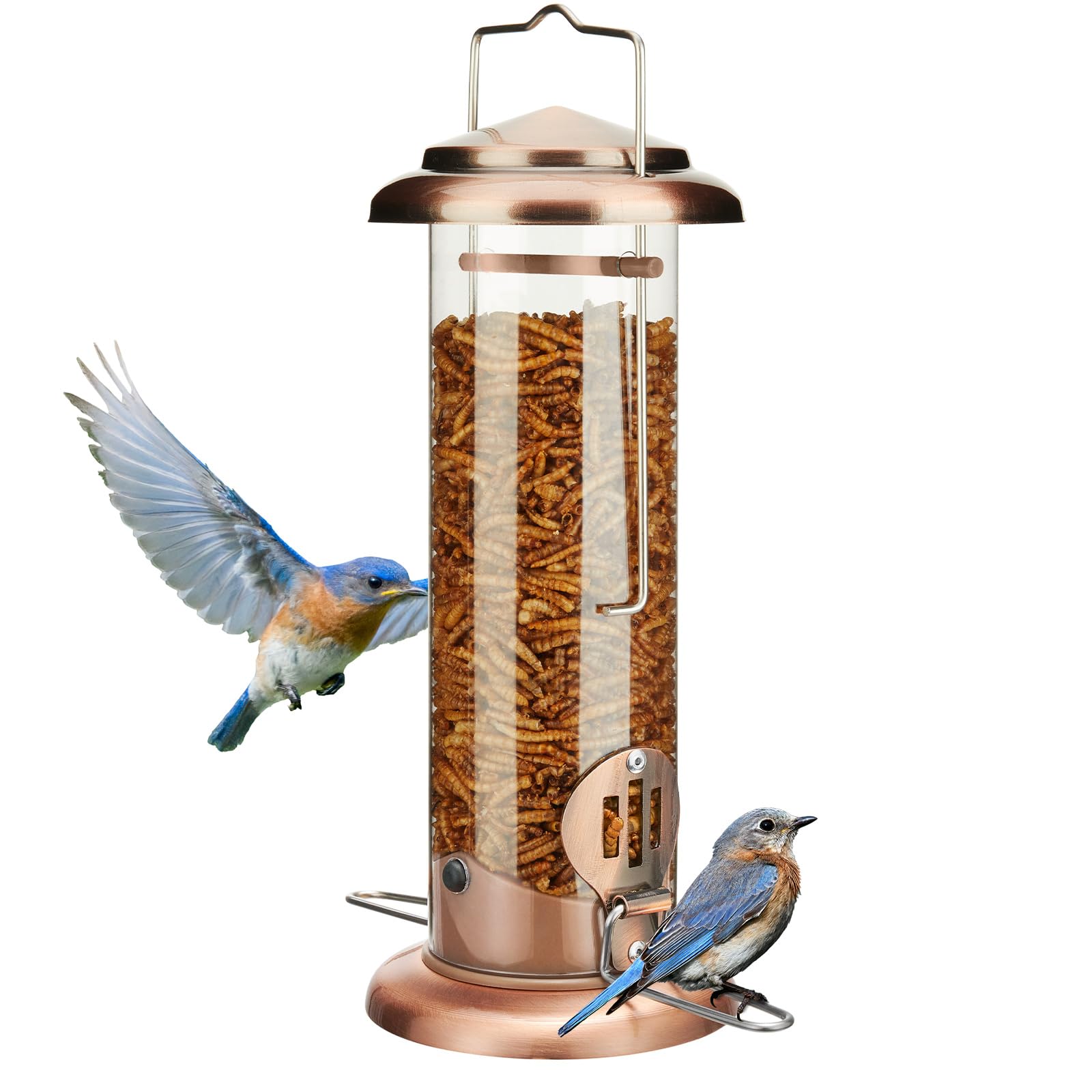
2. Kingsyard Upgraded Bluebird Feeder for Outdoors Hanging, Metal Mealworm Tube Bird Feeder with Widen Perch for Wild Birds, Squirrel Chew Proof, Easy to Refill & Clean (Copper)
A slim copper tube built specifically for dried mealworms, with a perch bluebirds can stand on.
At roughly 6 by 3.6 by 9 inches, this is the most compact feeder on the list — the kind that slips onto a thin branch and stays out of the way. It is designed around one food: dried mealworms. The clear compartment lets you watch the food level without lifting the lid, and the transparent tube means you can see at a glance when the mealworms are running low. A widened perch gives small birds a stable landing spot, and the top-fill lid makes refilling quick.
Rain and snow won’t ruin the food: the metal parts carry a full protective coating, and the lid plus four bottom drainage holes are meant to keep mealworms fresh and dry. The base sits flush with the feeding port and uses a sloped diversion design so feed stays reachable when the tube runs low — a smart detail for mealworms, which tend to clump at the bottom of a narrow tube. The removable base is what most owners point to as the best part of the design: it makes the feeder far easier to clean than a fixed tube.
Before you buy, know that the appeal is divisive. Some yards see near-instant action; others wait a long time. The recurring note from patient owners is a simple tip: fill the tube only part of the way. One recurring owner experience is worth repeating — a buyer who had this for months wrote that they had never seen a bird eat from it, despite having plenty of bluebirds nearby, so weigh how well this feeder fits your local bird population. It is a well-made tube, but it is not a guaranteed bluebird magnet.
Build and layout: Fully coated metal, a safety lid, and four drainage holes make this a sturdy, low-maintenance tube. The flush base and sloped diversion keep food reachable, which is exactly the problem a narrower tube usually has.
Who it suits: Best for yards that already have visiting bluebirds and want a small, sealed mealworm feeder that stays dry. If you are trying to attract bluebirds for the first time, start with the Mosaic dish above — its open bowl is easier for birds to discover.
Worth owning if: you have resident small birds and want a compact, weather-sealed tube for dried mealworms that cleans easily.
Consider an open dish instead if: your goal is to introduce bluebirds to a new yard, or if you have seen local birds ignore tube feeders before.
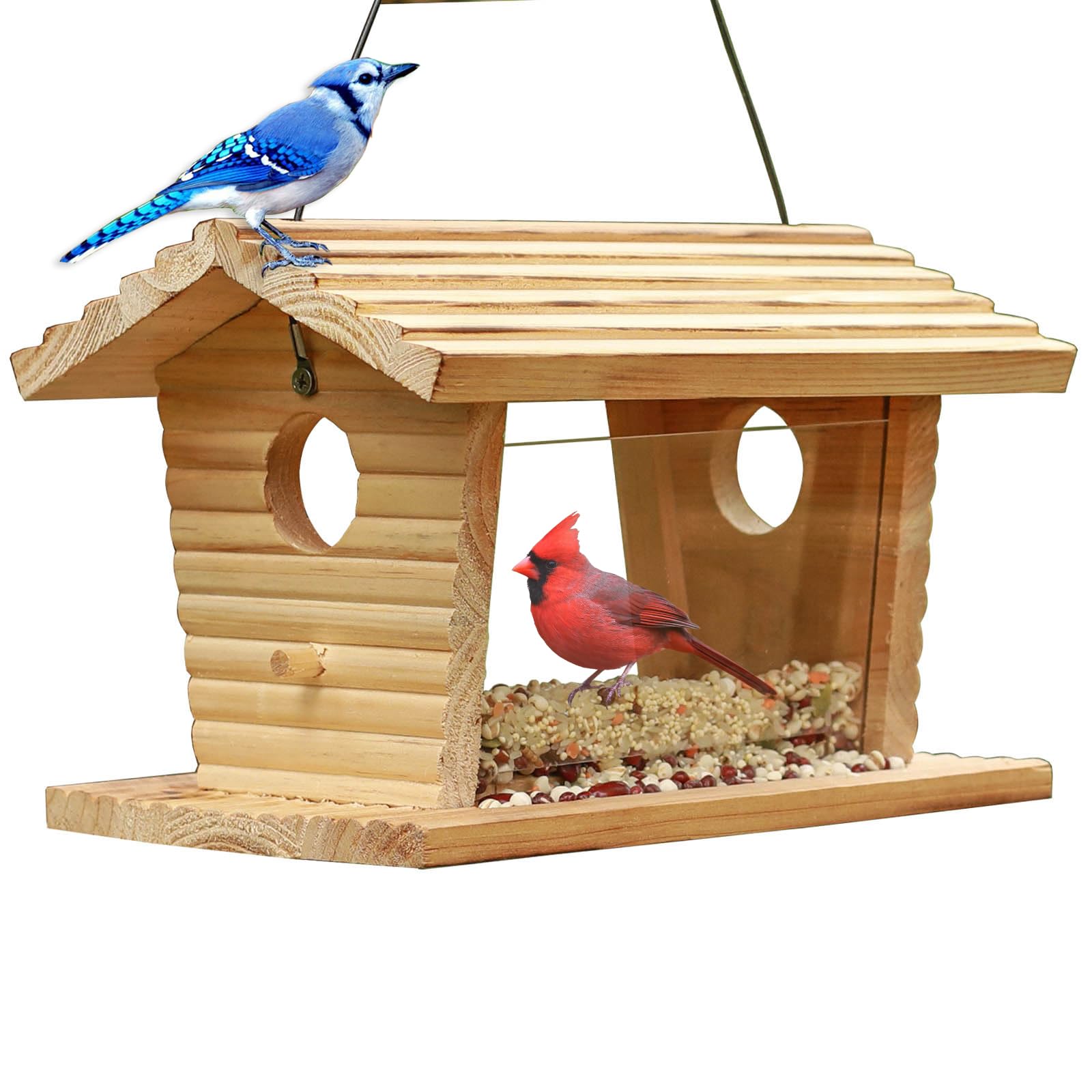
3. STARSWR Bluebird Feeder Outside, Mealworm Bird Feeder for Outdoors Squirrel Proof Hanging Birdhouse Feeder Wooden Bird House Feeder for Cardinal, Finch
A roomy wooden birdhouse feeder with a sloped roof and a moisture-draining tray.
The first thing you notice about this one is the size — at 10 by 7.3 by 7.3 inches, its platform is the widest on the list. That extra room matters for birds that want to stand and eat rather than dart in and out. It is built from wood with a sloped roof and a removable top, and it hangs from a stainless steel rope strong enough to run from a branch or out of reach on a pole.
The standout feature is the moisture-removal system. Drain holes in the tray are sized to let rain and snowmelt out while keeping seeds in — and they are deliberately sized so that tiny seed does not fall through. In practice, that means the tray is still dry and usable after a storm instead of being a soggy, spoiled mess. The wide platform also invites cardinals and finches, so you are not limited to mealworms.
The honest caveat is durability. The wooden build is not as weather-hardened as the metal and recycled-plastic options higher on this list, and the build quality has drawn mixed reactions — a few owners have had to re-staple the assembly or found it arriving damaged. It is a fine feeder for a sheltered, dry spot where it sees occasional rain but not a full winter exposure. Set against the Mosaic glass dish, it trades long-term toughness for a bigger feeding platform and classic garden looks. Its larger footprint is also easier for the smallest birds to navigate without getting cornered, though one owner noted a small bird once went fully inside and needed a hand getting out.
Choose it for the platform: a 10-inch-wide perch space, a removable roof for cleaning, and drain holes that actually keep the tray dry after rain set this apart from a narrow tube.
The durability question: wood bodies age faster than coated metal or poly lumber outdoors. This is the pick for a covered or protected hang spot, not a bare pole in a windy yard.
Best for: a sheltered porch or tree where you want maximum eating space and a wood-look appearance, and where you can check on the joints after a storm.
Skip if: you need a feeder that will shrug off a rough winter on its own, or if your smallest birds need guaranteed easy exits.
4. Birdream Metal Bluebird Feeder, Squirrel Proof, Blue
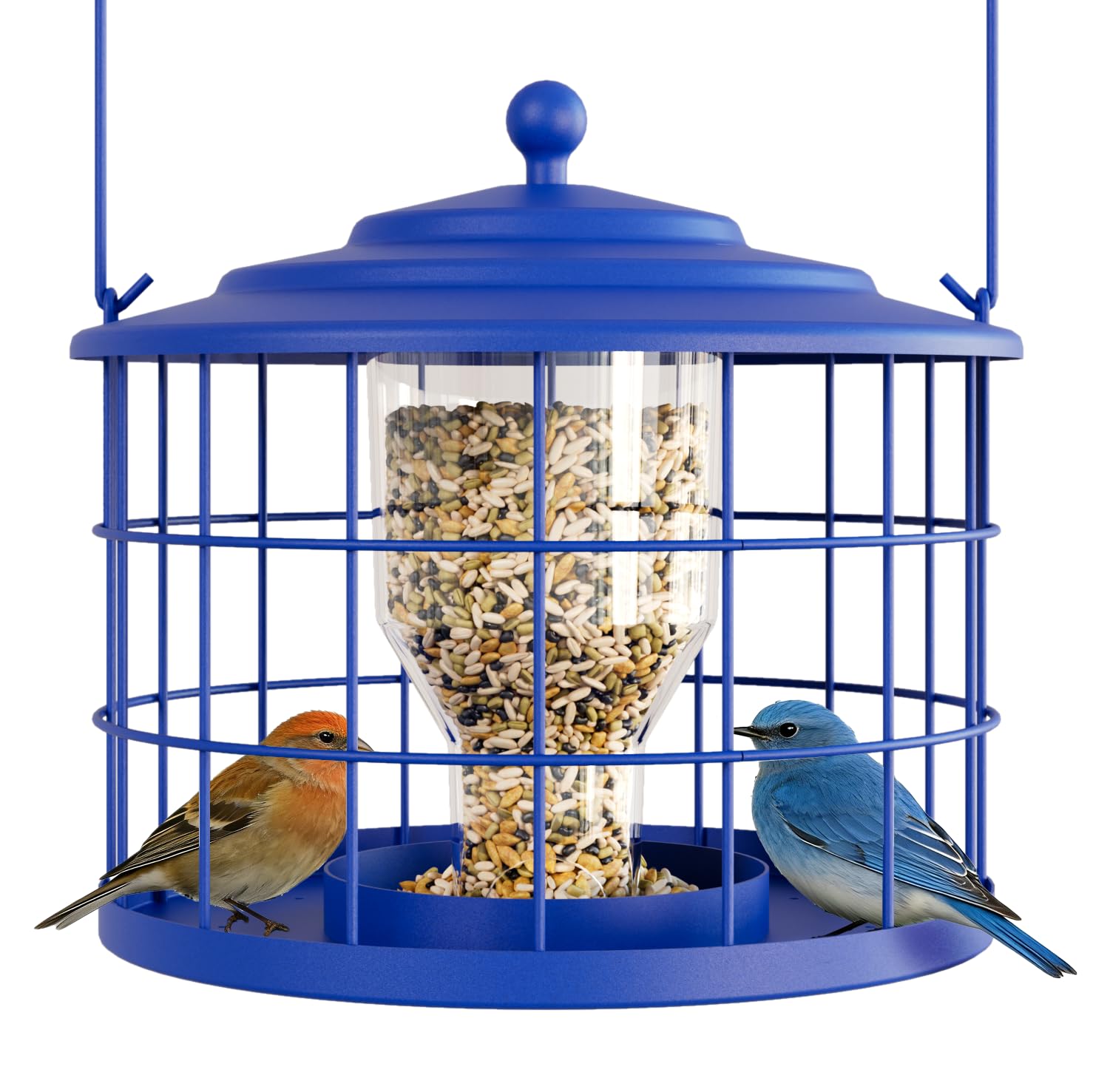
A teal metal cage feeder built to give finches and chickadees a quieter seat at the table.
This is the pick for anyone whose yard is overrun by big, hungry birds. A protective metal cage wraps the seed tube, and the design is specifically meant to keep starlings out while finches and chickadees feed with less competition. The wide opening makes it quick to refill, and it takes sunflower seed, safflower seed, and mixed seed — so you are not locked into mealworms. A covered lid and drain holes help keep seed drier after rain.
On paper, it holds 1.2 pounds and measures 9.2 by 9.2 by 6.7 inches, which gives it a solid footprint for a hanging cage feeder. The metal body is described as built for porch, patio, garden, and backyard use — and it is one of the few options here that pairs a cage with a weatherproof lid, so seed stays usable longer between refills.
The honest trade-off here is squirrel resistance — and it is worth reading carefully. The cage helps and clearly adds friction for squirrels, and one recurring report from owners is that squirrels eventually give up because the effort is not worth it. But the honest consensus is that it is not fully squirrel-proof. Some owners have had young squirrels squeeze through, and the internal seed tube has been reported to shift or fall loose, with the top latch also flagged as fiddly. It is a genuinely well-made, good-looking feeder that small birds like — just do not expect it to be a perfect fortress. If starlings and grackles are your main problem and squirrels are a secondary one, this feeder does what you need. Unlike the Erva barrier guard further down, which has 1.5-inch openings, this cage runs a wider gap that admits slightly larger birds. And there is one detail worth checking before you hang it: it is built for sunflower and mixed seed rather than mealworms, so if bluebird mealworms are the goal, look to the caged options with racked bowls.
Reasons to pick it
- Cage keeps larger birds like starlings off the seed
- Holds 1.2 pounds of sunflower, safflower, or mixed seed
- Wide refill opening and a covered, quick-draining lid
- 1.2-pound capacity means less frequent refilling
- Sturdy metal body built for porch, patio, and garden use
What to weigh first
- Not fully squirrel-proof; young squirrels can squeeze through the cage
- Inner seed tube has been reported to shift or fall and is tricky to refill
- Built for seed, not mealworms — not ideal for bluebird-only feeding
- Squirrel resistance is a mixed result, not a guaranteed barrier
Worth buying if: starlings or grackles are crowding out your smaller birds and you want a caged seed feeder that also holds up outdoors.
Pass on it if: you need a feeder for mealworms specifically, or if you have determined squirrels that have defeated every caged feeder you have tried.
5. Kingsyard 4 lbs Large Bird Feeder House for Outdoors Hanging
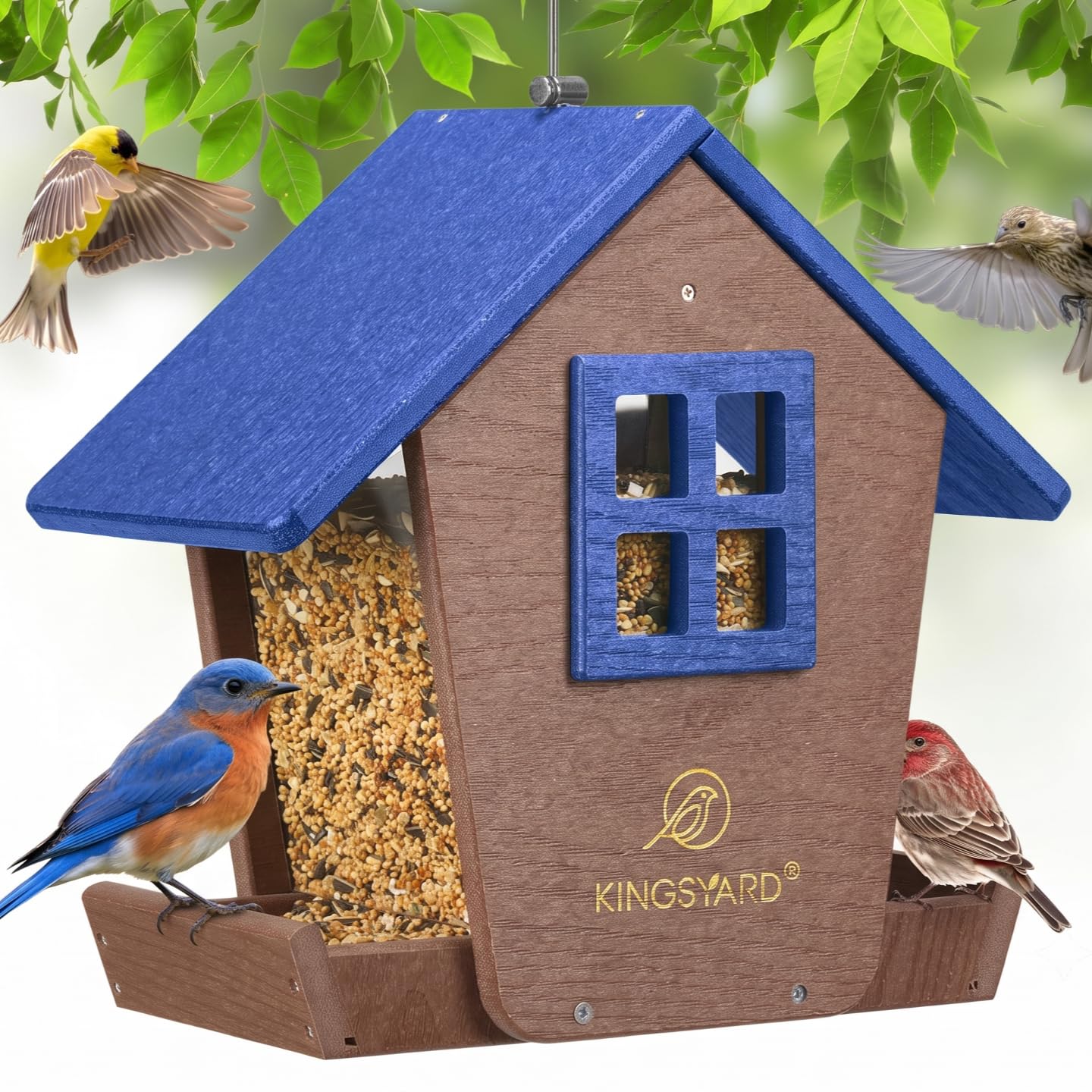
A poly-lumber hopper that holds four pounds of seed and shrugs off rain, snow, and sun.
If you want to fill a feeder and be done for the better part of a week, this is the one to look at. It holds up to 4 pounds of mixed seeds, with openings along the bottom of the hopper that automatically dispense seed into the trays — an action that means you do not have to keep coming back to top it off. Built-in drainage holes keep the seed dry, and the recycled-plastic body is engineered to withstand rain, snow, strong sunlight, and cold temperatures without denting, cracking, or breaking.
The design details make setup easy, too. The roof uses a drawcord lock, so the top slides off for refilling and cleaning without any tools. That matters because a big hopper is only convenient if it is easy to open and empty. At 8.46 by 5.12 by 9.25 inches and weighing about 0.85 kg, it is light enough to hang from a hook or branch without a heavy post.
The trade-off is a narrow menu. This feeder is built for finches, goldfinches, cardinals, woodpeckers, titmice, nuthatches, chickadees, and jays eating milo, peanuts, sunflower seeds, and thistle nyjer — but it is not a mealworm feeder. The mixed size feedback is mostly that the openings suit smaller birds, so if titmice and chickadees are your targets, that is a bonus, not a flaw. Squirrels can still access it, though many owners find that switching to safflower seed sends them looking elsewhere. One more detail worth knowing: a few owners find the perches narrow — only wide enough for about two goldfinches or a single cardinal — so if the goal is a crowd of cardinals, plan accordingly.
Set-and-forget feeding: a 4-pound hopper plus bottom-dispensing openings means you are refilling once every several days rather than daily. The recycled-plastic body is built to survive year-round weather without cracking.
The perch sizing: narrow perches fit one cardinal or a couple of smaller finches, so this is best for a steady trickle of small birds rather than a busy mixing station.
Reach for this if: you feed a mixed crowd of small seed-eaters and want to refill only every few days.
Think twice if: you are set on mealworms, or if your yard hosts a big crew of cardinals that need wider landing spots.
6. Petite Bluebird Feeder – Plexiglass Roof – Mesh Tray
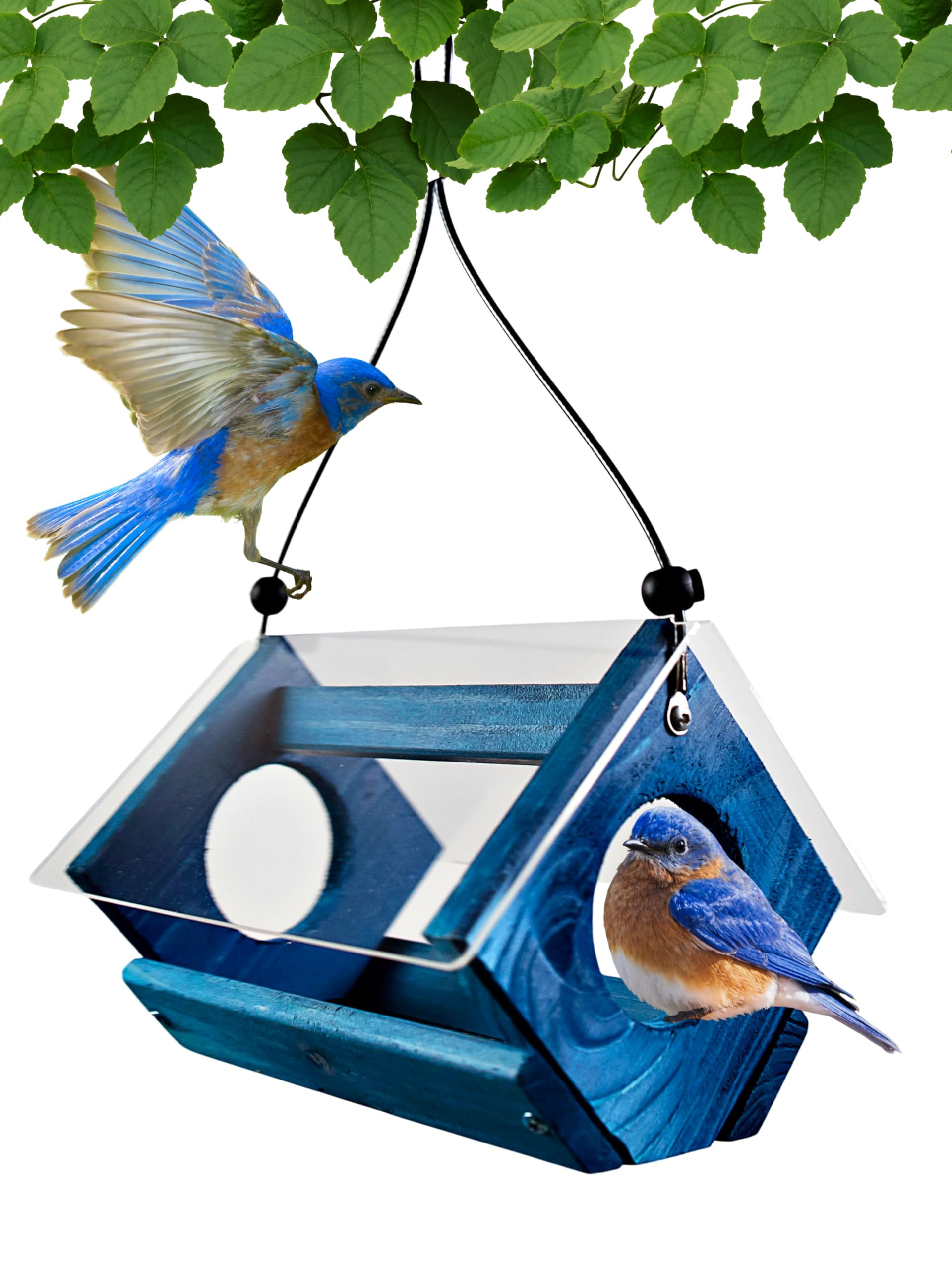
A slide-roof tray feeder that lets you see food levels and refill without unpacking anything.
The clever part of this feeder is the plexiglass roof. Because it is clear, you can gauge how much food is left at a glance — no lifting the lid, no guessing. When it runs low, you slide the roof up, tip out the old food, add fresh mealworms, nuts, dried fruit, suet balls or seeds, and slide it back down to lock with the two pull cord stops. It is a genuinely quick routine, and the powder-coated steel mesh tray drains quickly so food stays fresh longer.
The tray itself carries 8 ounces and sits inside a painted deep-blue wood base that hangs from a pole or branch — compact at 8 by 6.5 by 5.5 inches. Two openings sized for easy fly-through give birds a straightforward way in and out, and the whole thing is built for hanging anywhere without special hardware.
The catch is that the entry openings are wide open, which means the guest list is not limited to bluebirds. Starlings, red-winged blackbirds, and other larger birds can get in, and owners who want a strict bluebird-only setup end up shrinking the openings themselves. The other honest note is the plexiglass roof — it is the part most likely to crack if a squirrel knocks the feeder down. Treat it gently and mount it out of squirrel reach, and it does its job well; leave it hanging low and the roof is the weak link. Compared with the wooden STARSWR birdhouse above, this feeder is smaller and lighter but trades that solid construction for the convenient slide-up top.
The slide-roof convenience: a clear plexiglass top and a slide mechanism with pull-cord locks make cleaning and refilling quicker than the open-bowl designs, and you can always see how full the tray is.
The fragile point: the roof is the part that fails if the feeder gets knocked down. Mount it high and it is a non-issue; hang it low near squirrel traffic and it will cost you.
Ideal for: someone who wants low-effort, no-guesswork refills and a slim tray that fits a tight hanging space.
Not for: yards where starlings and blackbirds raid feeders, unless you are willing to modify the entry holes yourself.
7. Gbekery Bluebird Feeder for Mealworms with Glass Bowl for Outdoors, Blue
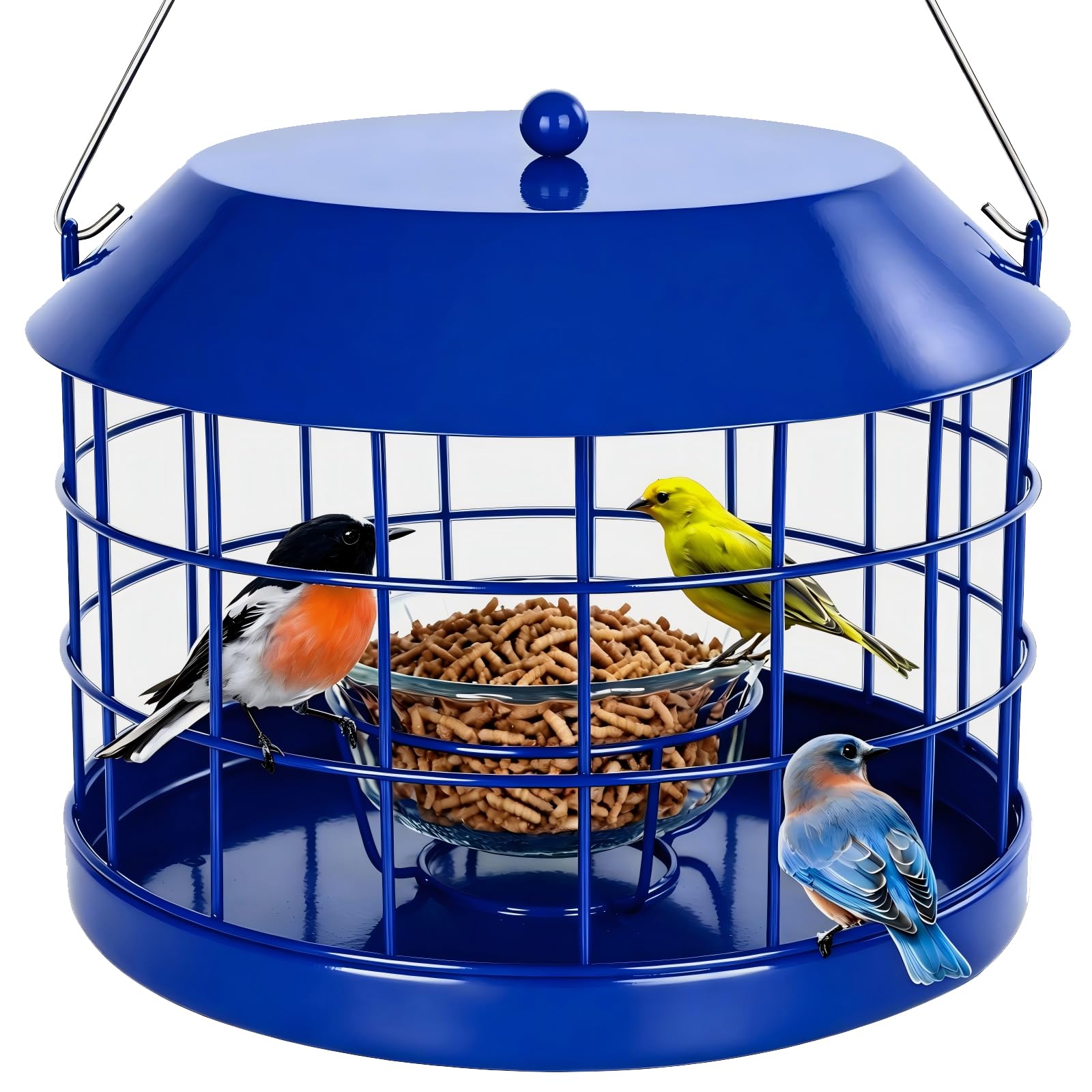
A tall metal cage with a glass mealworm bowl that keeps squirrels grabbing at nothing but air.
The defining number here is the cage mesh — a 1.7 by 1.7 inch grid built with thicker metal to keep adult squirrels and large birds out while small birds and bluebirds feed without being cornered. At 9 by 9 by 12 inches, it is one of the taller feeders on the list, with the bowl sitting up inside the cage rather than dangling below it. That lowness is deliberate: it puts the food out of reach of anything trying to grab from below.
The glass bowl detaches easily, so you can fill it with birdseed, fruit jam, water, or mealworms and change the food by season to attract a wider mix of visitors. The metal frame carries a weatherproof lid and a protective coating for rust resistance, and bottom drainage holes keep rainwater from pooling in the food. Refilling is a two-step operation: pull the roof off, empty and rinse the bowl, then slide it back in. The hook and roof combination also helps deter squirrels from prying the top open.
The honest trade-off is that squirrel resistance has limits. The cage does well against most small mammals and large birds, but the crows have proved smarter than the cage — they cling to the tray edge and poke their heads through to reach the bowl. It also takes bluebirds time to adjust to entering the cage; some buyers report waiting a few days before birds used it confidently. If squirrels are your main pest, this is one of the better caged options here. If crows are the problem, no cage at this size will fully stop them. One further note: only one bluebird fits inside the cage at a time despite the multi-bird look in the product photos, so if you are feeding a busy colony, a second feeder is worth having.
Smart build details
- 1.7 by 1.7 inch cage grid keeps out adult squirrels and large birds
- Detachable glass bowl goes in the dishwasher — genuinely easy to clean
- Weatherproof lid and rust-resistant coating for outdoor durability
- Bottom drainage holes keep food dry after rain
- Tall 9 by 9 by 12 inch cage keeps the bowl out of reach from below
Fine print to know
- Not crow-proof — crows reach through the cage and grab the food
- Bluebirds can take a few days to get comfortable entering the cage
- Only one bluebird fits inside at a time
Buy it for: a durable, squirrel-resistant mealworm feeder with a genuinely easy clean-up routine and a bowl you can wash in the dishwasher.
Know before you buy: crows in your area will still get a snack, and the cage is designed for one small bird at a time.
8. Bluebird Feeder – Poly Lumber – Hanging Blue Bird Feeder for Mealworms (Gray and Blue)
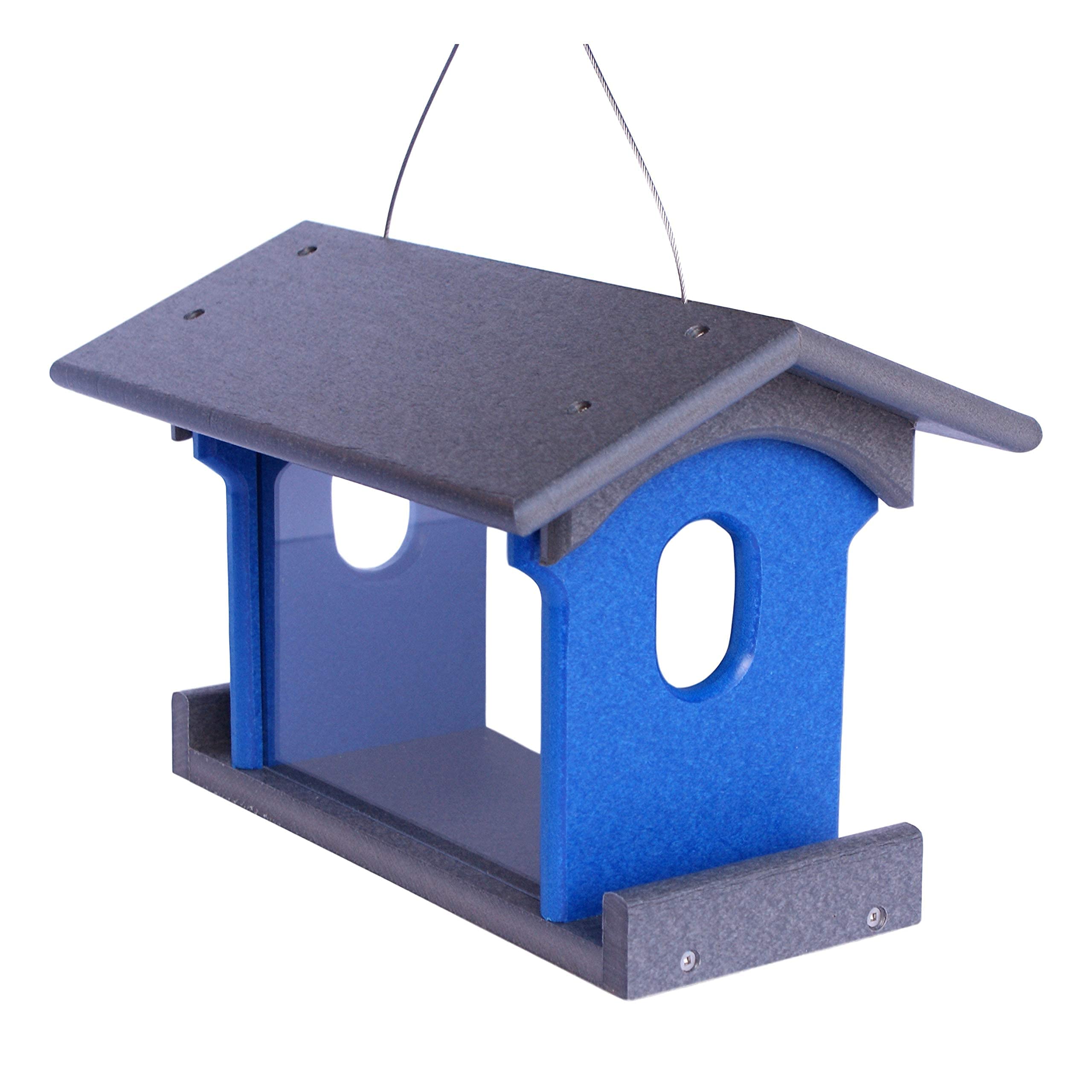
Hand-built poly-lumber feeder made from recycled milk jugs, with a top and sides that lift clean off.
Everything about this feeder is built to last and to be easy to keep. The body is poly lumber made from recycled milk jugs and assembled by Amish craftspeople in Shipshewana, Indiana. Both the top and sides come off, so filling and cleaning are about as simple as a feeder can be. It is sized at 12 by 8 by 8 inches and hangs from a wire, and it is designed for mealworms — just add a scoop and wait.
The recycled poly lumber is the reason to pick this over a wooden version: it does not warp, crack, or need repainting the way real timber does, and it shrugs off UV light and weather season after season. Sturdiness and clean-up are the strongest points of the design, and sturdiness is what owners praise most about it. The removable panels mean you never have to reach into a cramped tube to scrub out old mealworms.
The part to think about is the opening and the clear sides. The feeding openings are large enough that some owners find them too big for a strictly bluebird-only yard. More importantly, the clear plexiglass panels have been known to make bluebirds panic — one recurrence reported by owners is birds failing to find the exit and needing the panel removed or a sticker added to the glass to break up the reflection. Several owners have solved it by covering the clear sides, adding interior grip surfaces, or opening up a side. Cover the clear panels or add a grip strip under the exit hole, and it is a beautiful, well-made feeder. If you want something that works with zero fuss, the Gbekery cage above demands less tuning. And the smooth exit-hole wall is the specific thing to watch: birds need a grip surface under the opening, so a strip of tape or a scuffed edge helps them get out.
Made to outlive the weather: recycled poly lumber from milk jugs, all-removable panels, and a construction meant to sit outdoors for years without warping. Recycled poly lumber will not warp, crack, or need repainting, so it is a one-time purchase.
The one adjustment: clear plexiglass sides can spook bluebirds that cannot find the way out. Adding an interior grip surface or covering part of the panel solves it, but it is a step you may have to take.
Perfect if: you want a durable, hand-built feeder that will look good for years and clean up in seconds, and you are happy to fine-tune the entry for your birds.
Less suited if: your bluebirds are skittish around clear panels, or you want a feeder that works with no modifications from the start.
9. Erva Starling-Proof Barrier Guard Bluebird Feeder with Glass Mealworm Cup – Premium Copper Finish

A broad copper-toned barrier guard whose 1-1/2 inch openings let in small birds and nobody bigger.
This is the feeder that solves the starling problem most directly. It surrounds a clear glass mealworm cup with a sturdy 16 gauge vinyl-coated wire mesh, and the openings measure 1-1/2 inches — big enough for bluebirds, wrens, titmice, and pine warblers, too small for starlings and grackles. The top and bottom are powder coated, the finish is an attractive copper tint, and the overall guard measures 14 inches wide by 8 inches high. It is the widest barrier here by a good margin, and that extra width gives birds a full run-up approach rather than a tight squeeze.
Owners are clear about what it does well: it keeps the bigger, voracious birds away and leaves the mealworms for the ones that should get them. Bluebirds, wrens, and titmice use it regularly, and some owners have found that a simple DIY bottle extension turns the included cup into a multi-day supply. The 1-1/2 inch opening also halves the mess — birds eat from the cup rather than slinging mealworms over the side.
The catch is the setup detail that trips people up: the guard sits on a freestanding mount, so it wants a shepherd’s hook or a feeder pole rather than a bare branch. Bluebirds also need time to find and trust a new feeder — some owners mention that the first few days are slow, and many choose to add a small perch on the front. Without a perch, some bluebirds will hover rather than land. If you are willing to mount it on a proper pole and give the birds a landing spot, it is among the most effective bluebird-specific feeders you can hang. And there is one thing owners find reassuring about the design: no squirrel can reach the mealworms through the barrier.
Why it earns a premium slot
- 1-1/2 inch openings admit bluebirds, wrens, titmice, and pine warblers only
- 16 gauge vinyl-coated wire mesh resists chewing and bending
- Glass mealworm cup is easy to clean and sits inside the barrier
- 14-inch-wide guard gives birds a full run-up approach
- Small-bird-only design halves spilled mealworms
What to know first
- Freestanding mount means you need a pole or hook — not a bare branch
- Bluebirds can take days to find and trust a new feeder
- Many owners add a small perch to help bluebirds land
The serious bluebirder’s feeder: if you have already lost mealworms to starlings and grackles and want a barrier that keeps them out for good, this is the strongest option in this roundup.
Do not expect instant action: bluebirds need a few days to adjust, and you may want to add a small perch to help them land.
Understanding the Specs
Capacity (ounces and pounds)
Capacity tells you how long the food lasts between refills, so it maps directly to how often you want to walk outside. A 3.4-ounce glass bowl needs topping up every few days in a busy yard, while a 4-pound hopper can run a full week. There is no universally right size — it depends on whether you enjoy the daily refill ritual or want to fill and forget.
Entry Opening Size
Opening size is the number that decides which birds actually get to eat. Around 1.5 inches lets bluebirds and other small birds in while generally blocking starlings and grackles. Wider openings — the 1.7 by 1.7 inch cage style, for instance — admit slightly larger visitors, so use that spec to set your expectations before buying.
Material and Weatherproofing
Powder-coated steel, vinyl-coated wire mesh, and recycled poly lumber all tolerate freezing, thawing, and direct sun without rusting or cracking. Real wood looks warmer but ages faster and can warp, so choose it only for covered or sheltered spots. Whichever you pick, drainage holes and a weatherproof lid keep mealworms dry and usable.
Mounting Type
Hanging feeders work from any branch, hook, or pole and are the easiest to relocate if the birds are not finding them. A freestanding barrier guard needs a pole or shepherd’s hook, so plan your mount before you buy. Hang height matters too: keeping the feeder out of jumping range from the ground is the simplest way to limit squirrel access.
FAQ
What size opening will let bluebirds in but keep starlings out?
Should I feed mealworms or seed to attract bluebirds?
How do I stop squirrels from getting to the mealworms?
Will a clear plexiglass feeder scare bluebirds away?
How long does it take bluebirds to use a new feeder?
Can I leave dried mealworms out in the rain?
Is a glass bowl or a tube better for mealworms?
Do hanging feeders need a pole or will a branch work?
Will starlings still get into a caged bluebird feeder?
How often will I need to refill a bluebird mealworm feeder?
Which material holds up best through winter?
Final Thoughts: The Verdict
For most yards, the bluebird feeder winner is the Mosaic Birds Hummble Hanging Glass Bluebird Mealworm Feeder because its wide 3-inch opening, recycled glass bowl, and one-pound hanging build make it the easiest feeder to fill and the fastest to draw a crowd of orioles, bluebirds, and small seed-eaters. If starlings and grackles are the real problem in your yard, reach for the Erva Starling-Proof Barrier Guard, whose 1-1/2 inch openings block bigger birds while letting bluebirds and wrens feed. And if you want a squirrel-resistant cage with a glass bowl you can rinse in the dishwasher, the Gbekery Bluebird Feeder is the one to hang.
How We Picked
We do not accept paid placement. Every pick is matched to a real buyer and a real use-case; we do not hands-on test units.
Sources & Methodology
Specifications: manufacturer listings and product documentation. Review insights: verified customer reviews, as of September 2026. Pricing: not shown on this page (it changes often); check the current price via the retailer link.
As an Amazon Associate, Gadgets Feed earns from qualifying purchases. This does not affect which products we feature.