
Our readers keep the lights on and my morning glass full of iced black tea. As an Amazon Associate, I earn from qualifying purchases.
Specs are compiled from manufacturer listings and verified buyer reviews and can change over time — please confirm the key details on the product page before buying.
If one corner of your home — or your whole backyard — gets a weak, one-bar signal, a 300Mbps Wi-Fi range extender (also called a repeater or booster) grabs your router’s existing signal and re-broadcasts it further out, so devices that used to drop out stay connected.
I’m Min — the founder and writer behind Gadgets Feed. This guide is built by comparing the manufacturers’ published specifications and the patterns across verified customer reviews, so you get each pick’s real strengths and trade-offs instead of marketing spin.
Quick heads-up before you scroll: this list uses flexible, human-like matching for the 300Mbps speed class, so not every pick is the exact number you searched — the nearest same-type unit serves the same purpose, and every real spec is listed so you can compare directly. Each pick below is a genuine same-class option, helping you choose the best 300mbps wifi range extender for your particular dead zone.
Our Picks at a Glance
How To Choose The Best 300Mbps WiFi Range Extender
The label “300Mbps” tells you one thing above all: this unit runs the N300 standard (also written 802.11n) on the 2.4GHz radio band, the oldest and slowest Wi-Fi classification still sold new. That is not a flaw — it means the extender is built for range and compatibility rather than raw speed. Knowing that up front keeps you from expecting gigabit performance out of it.
Pick Your Band Before Your Brand
Every extender on this list operates on 2.4GHz, the band that travels farthest through walls but carries the least data. A single-band unit repeats that one signal; a dual-band model like the Speed Wave adds a 5GHz channel as well, letting devices that support it switch to a quicker, less crowded lane. If you want to extend the signal mainly to cameras, a sprinkler controller, or smart sensors, single-band 2.4GHz is exactly what those devices use anyway.
Placement Is Half The Battle
An extender cannot create signal that isn’t already reaching the spot where you mount it. The manufacturer’s own recommendation on the AQUZO outdoor unit is blunt about it: mount it where the router’s signal already shows about three bars, and it will boost that signal outward. Put it in a total dead zone and you’re just amplifying nothing. Keep it roughly midway between the router and the room or yard you’re trying to cover.
Indoor Wall-Plug Or Solar Outdoor?
Wall-plug extenders like the Cudy RE300 and the NETGEAR EX2700 solve indoor problems: a back bedroom, a basement, a detached garage with a socket. Solar outdoor extenders like the Tigerpai and AQUZO carry their own battery and connect where there is no outlet at all — a shed, a ranch gate, a robotic-mower charging corner. The choice comes down entirely to whether power and shelter exist at the coverage point.
Match The Job To The Spec
This class of extender handles web browsing, email, music, and standard-definition video comfortably; 1080p streaming works where the connection is solid. It is not designed for heavy 4K streaming on many devices at once or competitive gaming where latency matters. Buy it to close a coverage gap, not to raise your internet speed.
Quick Comparison
| Model | Best For | Speed | Band | Coverage Range | Amazon |
|---|---|---|---|---|---|
| Solar Powered Outdoor WiFi Extender (Tigerpai)★ Best Overall | Farms, ranches & wide yards with no power | 300 Mbps | 2.4 GHz | 150 meters | Amazon |
| Cudy N300 RE300Best Value | Indoor dead zones & wired device bridging | 300 Mbps | 2.4 GHz Single-Band | — | Amazon |
| ZMISDRI 300Mbps WiFi Extender | Large homes wanting coverage claims and device headroom | 300 Mbps | 2.4 GHz | 11999 sq ft (claimed) | Amazon |
| Speed Wave WiFi Extender (Extendtecc) | Small apartments and room-by-room signal boost | 300 Mbps | 2.4 GHz & 5 GHz | 360° full coverage (claimed) | Amazon |
| Net Boost (Aimery WD-R611U) | Coverage for smart TVs, cameras & streaming | 300 Mbps | 2.4 GHz | 2800 sq ft | Amazon |
| NETGEAR EX2700 | Indoor whole-floor coverage with a wall plug | 300 Mbps | 2.4 GHz | 800 sq ft | Amazon |
| AQUZO Solar Outdoor WiFi Extender (E6) | Backyards, RV parks & campsites off-grid | 300 Mbps | 2.4 GHz Single-Band | 200 feet | Amazon |
In-Depth Reviews
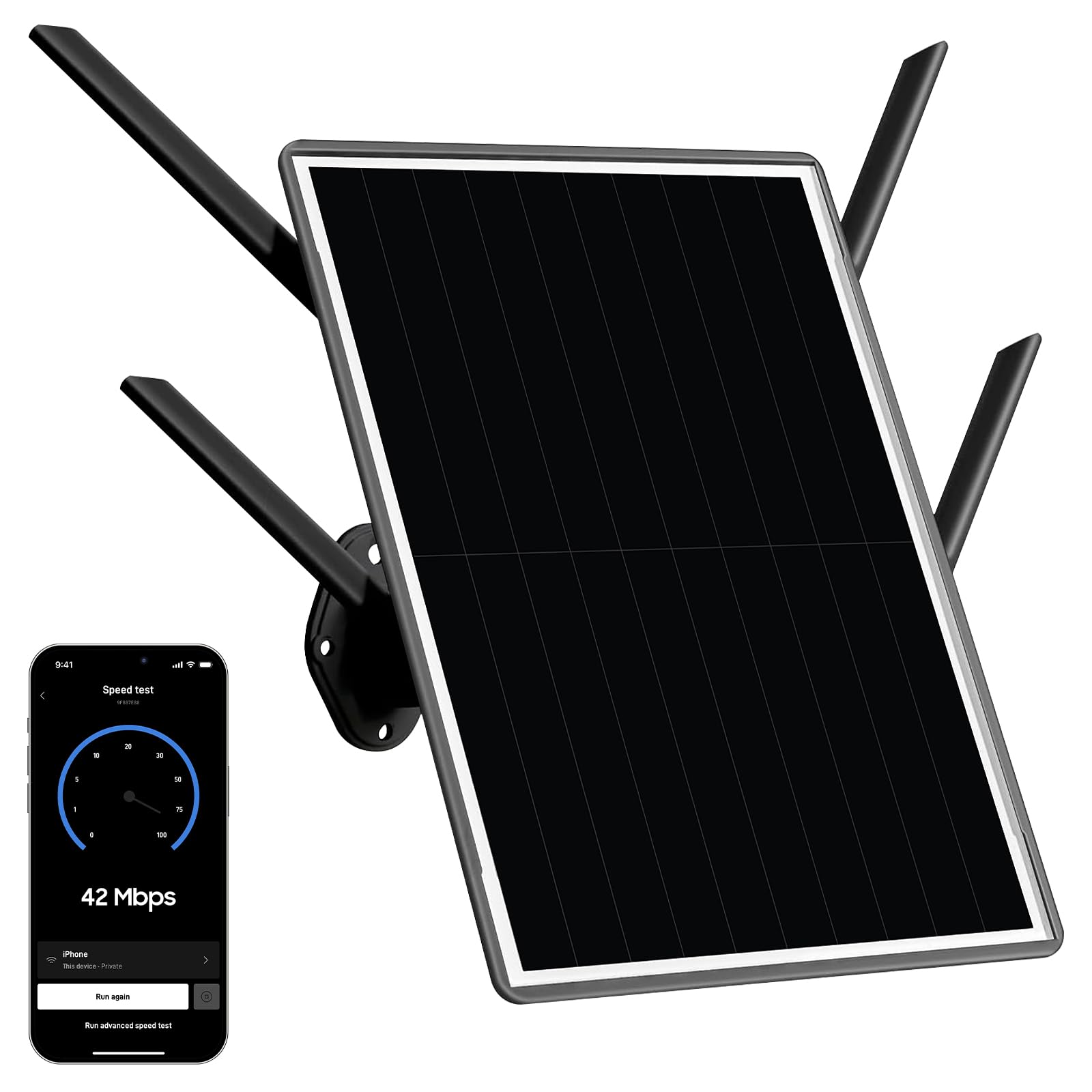
1. Solar Powered Outdoor WiFi Extender, 300Mbps 2.4GHz Wireless WiFi Repeater (Tigerpai)
Our pick — over 4★ from 20+ verified ratings; the strongest balance of quality and price.
Solar power plus a 26000mAh battery pack is the angle here — coverage that keeps running where plugs don’t exist.
Owners burying cable to a detached shop or a ranch outbuilding are the exact people this was built for. The unit pairs a 15W solar panel with a 26000mAh battery pack (a fairly large rechargeable reserve that keeps the extender alive overnight) so it keeps broadcasting across outdoor spaces without a power outlet. It repeats your existing router’s 2.4GHz signal at 300Mbps and reaches a range of 150 meters — roughly the distance across a wide property — making it a fit for gardens, farms, and remote structures.
This unit keeps working through rain, snow, and direct sun because it is rated IP65 (a protection level for dust and water resistance), so it survives weather a typical indoor unit would not. Buyers who mounted it for a detached shop report strong gains: “Extends WiFi ~100ft to shop; signal improved from -80dBm to -68dBm.” Setup ran under an hour for most, and a 360° rotatable bracket lets you aim the outdoor antennas for the cleanest link back to the router.
Its off-grid reach is the draw: it extends signal to a hunting shack or second building with no buried Ethernet. Sizing the catch: the 26000mAh battery needs a USB charge before its first solar cycle, and after several cloudy days the 15W panel can run down before sunrise. A 20W panel is the natural upgrade if your winters are gray, and the solar-in-shade behavior is undocumented in the manual.
Compared with the Cudy RE300 on this list, this is the pick for outdoor property with zero wiring: the Tigerpai’s dimensions run 2″D x 9″W x 12″H (a unit built around that panel and battery), while the Cudy is a compact wall-plug made for an indoor socket, not a fence post.
Where It Earns Its Keep
- 26000mAh battery plus 15W solar panel runs without grid power
- IP65 weatherproofing for rain, snow, and direct sun
- 150-meter range reaches barns, shops, and detached structures
- 360° rotatable bracket to aim antennas toward the router
Before You Mount It
- Battery needs an initial USB charge before solar takes over
- 15W panel can drain after a stretch of cloudy days — a 20W panel is the fix
- Only one unit in the box, so multi-building sites need a second extender
Reach for it if: your coverage target is outdoor, unpowered, and remote — a farm gate, a ranch outbuilding, a garden far from any outlet.
Look elsewhere if: you just need to fix one indoor room, where a wall-plug unit sets up faster and costs far less.
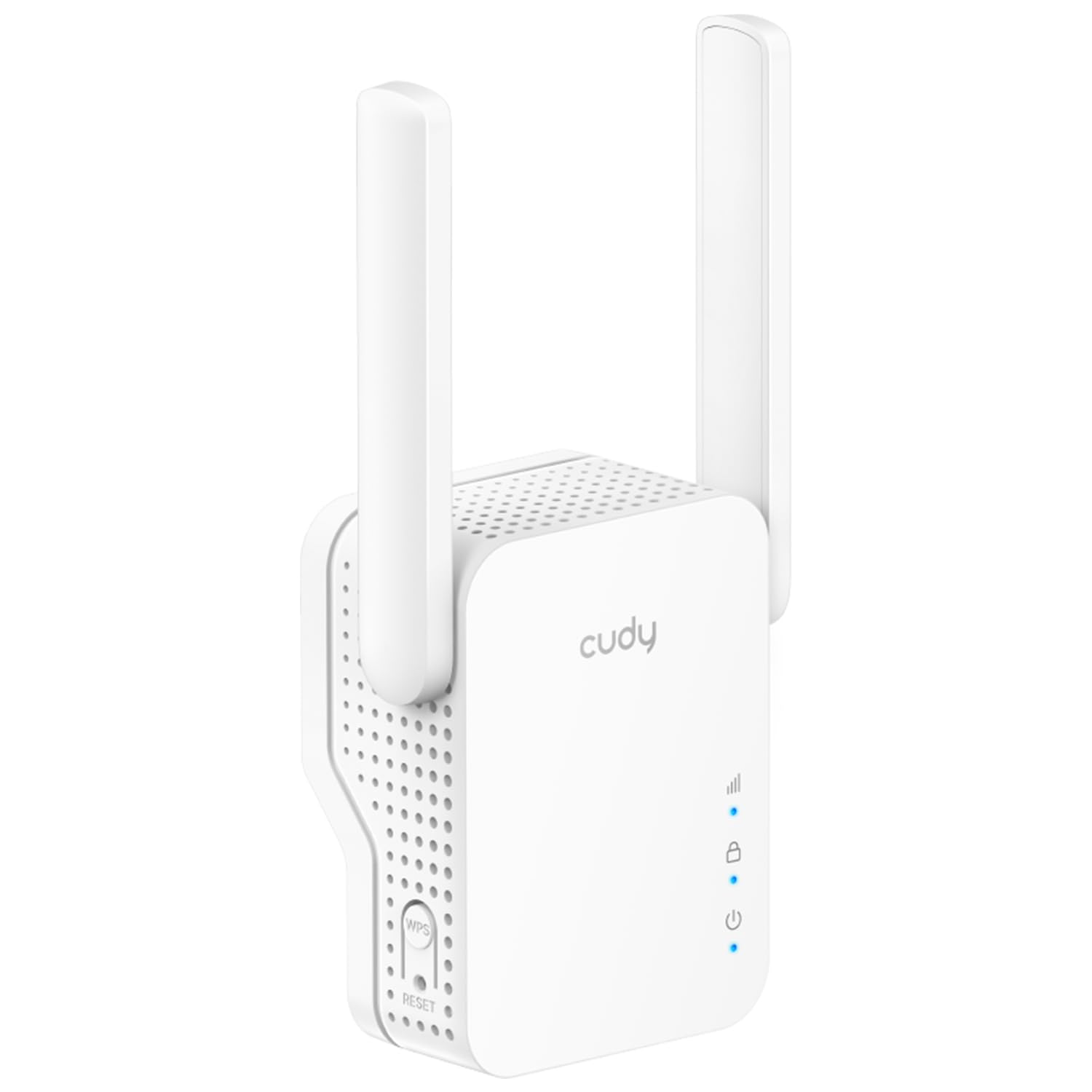
2. Cudy N300 Wi-Fi Range Extender, Wall Plug, WPS, Compact, RE300
Plug it in, press WPS, and a dead back bedroom comes back to life — no tools, no cables.
The Cudy RE300 is the value pick because it does the boring job well: it boosts a weak 2.4GHz signal, plugs directly into any outlet, and adds a wired port most cheap extenders skip. It runs the N300 standard at 300Mbps on the 2.4GHz band, singles-band (no 5GHz lane), and connects up to 30 devices — plenty for a room of tablets, phones, and smart plugs. Its wall-plug body measures just 1.5″D x 2.36″W x 3.15″H, making it one of the smallest picks here.
That extra Ethernet port is a genuine upgrade for the money. It lets the RE300 act as an access point (turning a wired connection into a Wi-Fi hotspot), as a client bridge (connecting a wired device like a smart TV or console to your wireless network), or as a plain extender — three modes in one box. WPS setup takes under 30 seconds and WPA3 security plus the Cudy app handle management and firmware updates remotely.
On raw throughput, this is where expectations need sizing. One buyer clocked the RE300 at “Speed capped at 24Mbps down/10Mbps up” when repeating a signal — fine for SD streaming and light browsing, but not a speed upgrade. The range also steps down as you move further from the router, so it fits small coverage gaps and legacy devices rather than whole-home coverage.
Set beside the NETGEAR EX2700, the Cudy trades broader 800-sq-ft coverage for a smaller footprint and a lower entry cost. Where the NETGEAR is rated for 800 sq ft and 10 devices, the Cudy stretches to 30 devices and keeps that single Fast Ethernet port for one wired device — handy when your smart TV needs to stay off Wi-Fi entirely.
The practical read: for an indoor dead zone and a couple of wired devices, this is the least fuss for the least outlay — a true plug-and-play fix.
The honest limit: it is 2.4GHz-only with no channel selection, so expect modest speeds rather than a performance lift.
The easy call for: anyone closing one indoor gap and wanting a wired port for a smart TV, console, or IP camera.
Pass on it if: you need to push fast Wi-Fi across a large multi-floor home, where a stronger-coverage extender earns its place.
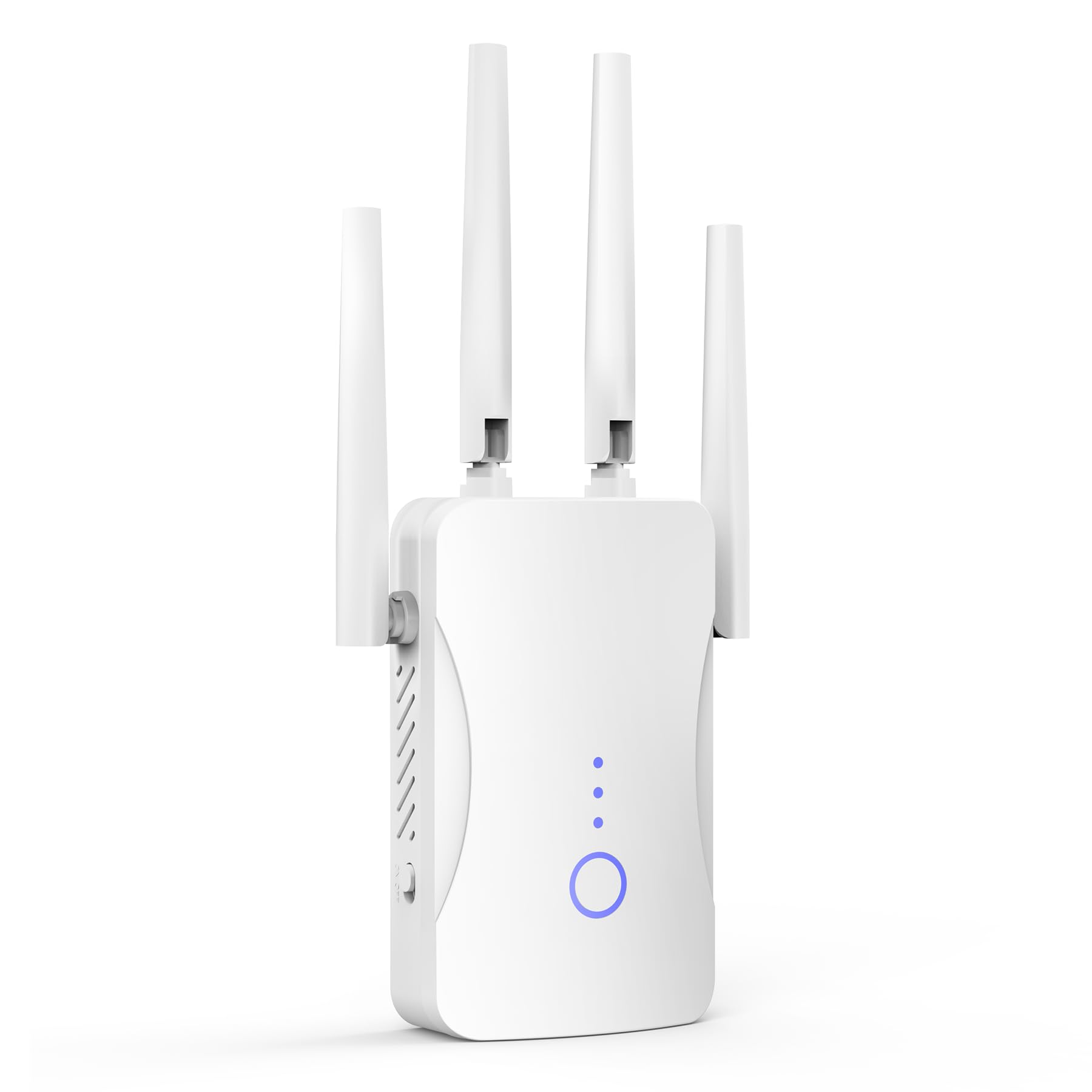
3. WiFi Extender, 2026 New 20X WiFi Extender Signal Booster (ZMISDRI)
A whole-home booster pitched at busy households — the claim is coverage and device headroom, and that is exactly its pitch.
The ZMISDRI runs an advanced chip architecture (the processing unit that handles the repeat traffic) to push a stable 300Mbps on the 2.4GHz band and cut down on data loss while it re-broadcasts. It is a plug-and-play unit: connect it to your router, and it re-broadcasts the signal in seconds. Support for WEP/WPA/WPA2 security protocols keeps the network locked down once connected.
The headline numbers are aimed at big households: a claimed coverage of up to 11999 Sq. Ft, and compatibility with 85+ devices — phones, laptops, tablets, speakers, IP cameras, smart TVs, and robot vacuums. For a family juggling multiple screens and connected gadgets, that device count is the number that matters most.
What buyers describe is consistency under load. Owners running everything from smart TVs to gaming consoles say the connection holds steady even with multiple devices going at once, and households spread across work, school, and entertainment report no interference. The setup reflex — plug in, connect, done — is the part most mention as painless.
Worth reading the coverage claim with a level head: like every extender in this class, real-world reach depends on walls and placement, and the 11999-sq-ft figure is a manufacturer’s best case. Compared with the Speed Wave below, the ZMISDRI leans single-band 2.4GHz rather than dual-band, so it is the pick for device-heavy homes over speed-hungry ones.
What Stands Out
- 300Mbps 2.4GHz with an advanced chip to keep data flowing
- Compatibility with 85+ devices for busy, screen-heavy homes
- Simple plug-and-play setup in seconds
- WEP/WPA/WPA2 security protocols built in
Keep In Mind
- Single-band 2.4GHz, so no 5GHz lane for faster devices
- The 11999-sq-ft coverage figure is a claimed maximum, not a guaranteed result
- Works best placed where the router signal still reaches
Built for: large, device-heavy households that want one booster to cover many rooms and many gadgets at once.
Second-guess it if: your priority is top speed on modern dual-band devices rather than coverage spread.
4. Speed Wave WiFi Extender Extendtecc WiFi Booster Signal Booster 300Mbps

The one that lists both 2.4GHz and 5GHz on the box — dual-band flexibility at a room-by-room scale.
This Speed Wave unit is the dual-band outlier in the group, advertising both 2.4 GHz and 5 GHz support and 300Mbps speeds, plus compatibility with 802.11a/b/g/n/ac routers (the mainstream Wi-Fi standards, so it plays with virtually any modern router). The pitch is 360° full coverage for indoor and outdoor use, including detached-garage spots and gaming setups.
The buyer pattern here is more mixed than some picks, so set expectations to match. Where it works, it works well: owners using it in small-to-medium apartments describe easy setup, a stronger stable signal, compact build, and no overheating — and it does fine for streaming and browsing. One buyer summed up the simple side: “Easy to set up and works great. Range is as advertised.”
The most-discussed themes in the reviews are functionality, quality, and setup, and the consensus there is genuinely split — it satisfies some users and leaves others wanting. The range itself lands as the reliable strength, helping where signal is weak across a few rooms. If your signal problems are specific to one room, a single well-placed unit of this type can clear them; if you are chasing whole-home speed, this is not built for that.
Against the Cudy RE300 up the page, the Speed Wave adds 5GHz to the band list and 802.11ac router compatibility, but the Cudy brings the wired Fast Ethernet port and lighter 150g wall-plug form. Which you pick depends on if you want the extra band or the wired socket.
What it gets right: dual-band 2.4GHz/5GHz plus broad router compatibility makes it the most flexible pick for a single weak room.
Where it wobbles: reviews split on whether it performs as expected, so treat it as a small-space fix rather than a guaranteed whole-home upgrade.
A sensible match for: a small apartment or a single stubborn room where you want dual-band options in one plug-in unit.
Think twice if: you need consistent, high-demand coverage across a large multi-device home.
5. Net Boost Netboost Pro WiFi Extender, WiFi Range Extender 300Mbps (Aimery WD-R611U)

Two high-gain antennas and a genuinely light 3.2-ounce body — small package, 2800-sq-ft coverage target.
The Net Boost (Aimery WD-R611U) leans on two high-gain external antennas to cover up to 360 degrees and a listed range of 2800 square feet, re-broadcasting up to 300Mbps on 2.4GHz. It weighs just 3.2 ounces, so it tucks onto a shelf or sits near the router without fuss. It supports repeater and access point modes and adds an RJ45 Ethernet port to turn a wired connection into wireless coverage.
Where it shines for owners is real-world camera coverage. Households behind block or cement walls have used it to get outdoor security cameras working, and it holds up in everyday streaming for smart TVs, Ring doorbells, and speaker setups. Universal compatibility with 802.11b/g/n/ac routers means it slots into most homes without brand fuss.
Be honest about the setup experience: it is smooth for someone comfortable in a router’s web page and far less friendly for a first-timer, with instructions some describe as hard to follow. The reviews here range from “works well” after a reset to gripe-level frustration, and the configuration page can be fussy. Buyers after coverage rather than speed are the happiest; one satisfied owner noted it did the job for outdoor cameras about 50 feet away.
Stacked against the NETGEAR EX2700, the Net Boost offers a wider 2800-sq-ft coverage target versus the NETGEAR’s 800 sq ft, but the NETGEAR carries the tried-and-tested WPS simplicity and a longer track record. If coverage reach is your goal and you don’t mind a fiddlier setup, this one stretches further per unit.
Reasons Buyers Keep It
- Two high-gain external antennas cover up to 360 degrees
- 2800-sq-ft listed range for a light 3.2-ounce unit
- Repeater and AP modes plus an RJ45 Ethernet port
- Works with any 802.11b/g/n/ac router
What To Expect
- Setup can be tricky for non-technical users and the manual is thin
- 2.4GHz-only, so no 5GHz speed lane
- Review sentiment is split — some find it works well, others don’t get the result they wanted
Worth choosing for: reaching cameras and smart devices across a couple of rooms, especially behind thick walls, on a compact footprint.
Look past it if: you want a one-touch setup with no tinkering, where an easier plug-in unit suits you better.
6. NETGEAR Wi-Fi Range Extender EX2700, N300, Up to 800 Sq Ft and 10 Devices

The well-known wall-plug name in the class — N300 speed, a wired port, and a WPS button most people already trust.
The NETGEAR EX2700 is the household-name option: an N300 extender delivering up to 300Mbps on 2.4GHz, sized to add coverage up to 800 sq ft and connect up to 10 devices. It works with any wireless router, gateway, or cable modem with Wi-Fi, and includes a single 10/100M Ethernet port for plugging in a game console or streaming player directly.
The setup is the selling point for many. Press WPS to pair with the router, and the NETGEAR WiFi Analyzer app helps you find the best spot to place it. It supports WEP and WPA/WPA2 security protocols, and its compact wall-plug design measures 1.34″D x 2.17″W x 2.64″H so it stays out of the way. The crowd of owners behind it is huge — a 4.0-star rating across roughly 63,000 ratings — and it’s the most-reviewed pick here by a wide margin.
Where it earns the trust: the long-running buyer picture is overwhelmingly positive on build quality and easy setup, with signal strength and range close behind. Owners in long, rambling homes praise how it carries a weak router signal into far rooms, and one 2,800-sq-ft two-story home plus a 1,500-sq-ft basement setup got full-strength coverage on every floor after a sub-five-minute WPS pairing.
The recurring gripe is the connection at the edges: speeds can sag when several devices pile on at once, and some units drop and recover on their own. It’s still the safest mainstream indoor pick. Next to the Net Boost above, the NETGEAR covers 800 sq ft and 10 devices versus the Net Boost’s 2800-sq-ft target, but the NETGEAR trades that reach for a smoother, better-documented setup.
Where It Wins Hearts
- Easy WPS pairing backed by the NETGEAR WiFi Analyzer app
- Single 10/100M Ethernet port for a console or streaming player
- Works with any router, gateway, or Wi-Fi cable modem
- WEP and WPA/WPA2 security support
Fair Warnings
- Speeds can drop when many devices connect at once
- Occasional self-recovering connection drops reported
- 2.4GHz-only, capped at 10 devices and 800-sq-ft coverage
The comfortable pick for: a standard indoor home wanting reliable, well-documented coverage that sets up in minutes.
Consider another if: you need to cover a large property or run more than ten devices at once.
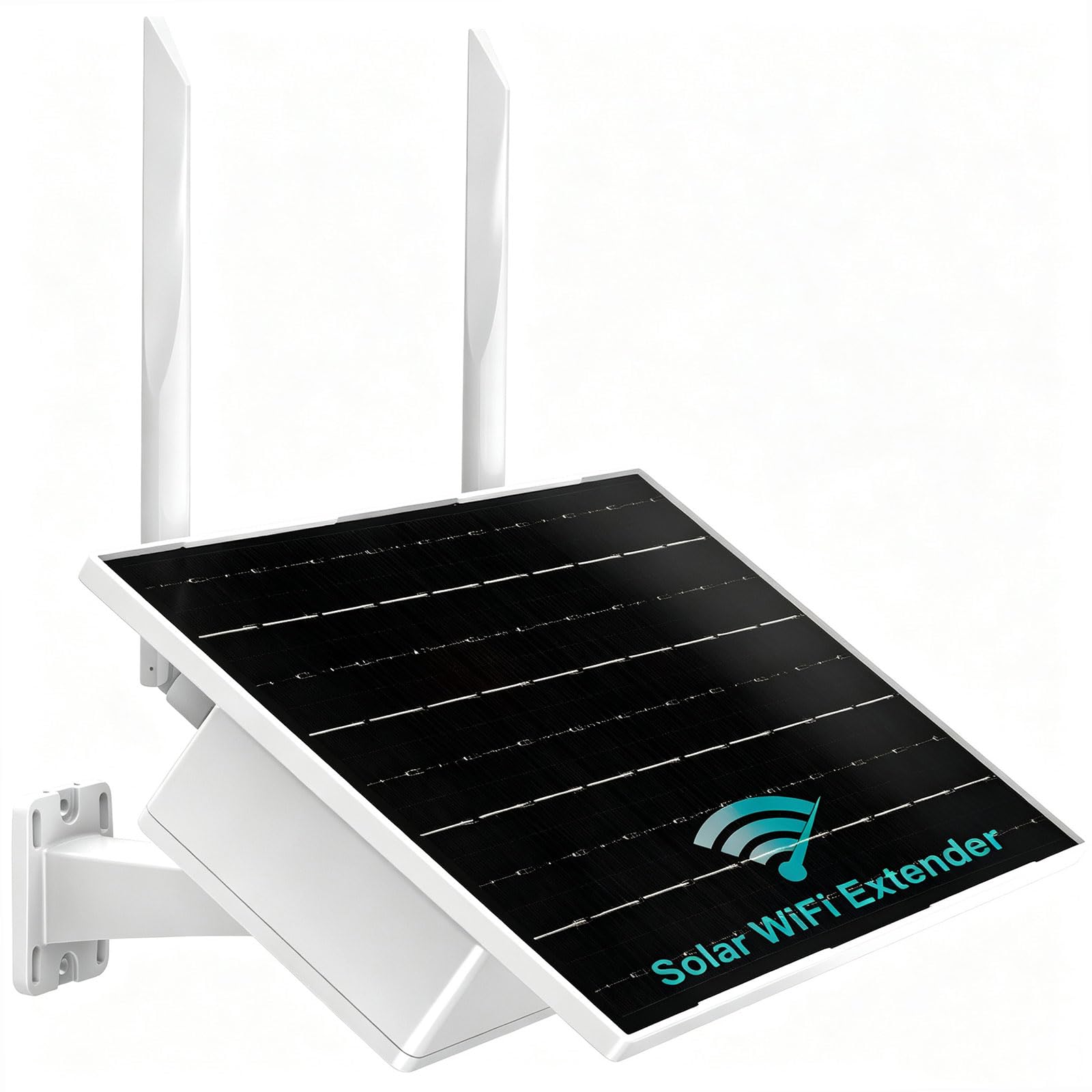
7. AQUZO Outdoor WiFi Extender Solar Powered, WiFi Booster and Signal Amplifier (E6)
A 27,000mAh battery and IP66 shell built for the fence line — designed to keep running through a week of clouds.
The AQUZO E6 is a wirelessly self-powered outdoor unit pairing a 12W high-efficiency solar panel with a 27,000mAh rechargeable battery. Its 27,000mAh battery keeps it broadcasting for up to 7 days through cloudy or rainy weather. Its dual high-gain external antennas with MIMO technology (multiple antennas working together for a cleaner link) rebroadcast a 2.4GHz signal over an open-air range of 200 feet.
Durability is the headline build spec: an IP66-rated dustproof and waterproof enclosure that the manufacturer says withstands rain, snow, dust, and heat across a -20°C to 60°C (-4°F to 140°F) range. It supports 802.11b/g/n routers including Starlink, delivers up to 300Mbps, and includes two USB-C solar inputs so you can add a second panel for more power down the line.
Owners mount it for yards, campsites, and RV parks — and the pattern that holds is simple coverage where there’s no outlet. One owner ran it to support an automated mower in a yard with no power, and backyard users report full coverage after an easy setup. A recurring “haven’t noticed a difference” frustration exists in the review set, usually when the mount point was too far from the router to catch a usable signal.
Owners praise the independence: no cables, no outlet, no buried Ethernet. It suits a backyard, a campsite, or a fence line with no outlet nearby. Sizing it fairly against the Tigerpai at the top of this list: both are solar and battery-powered for unpowered outdoor spots, though the AQUZO leans on a heavier 4-pound body and a 12W panel versus the Tigerpai’s larger 15W panel.
The standout spec: a 27,000mAh battery paired with a 12W panel means real off-grid runtime — up to 7 days of cloudy-weather coverage.
The fine print: it still needs the router’s signal to reach its mount point, and the 2.4GHz single-band format is aimed at cameras and IoT gear rather than fast downloads.
Made for: backyards, RV parks, and campsites where there’s sun but no wire — especially for security cameras and mowers.
Not the one if: your target spot is shaded or far from the router, where a mains-powered or higher-gain setup does better.
Understanding the Specs
300Mbps Speed Class
This is the N300 standard on the 2.4GHz band — the mainstream, broadly compatible class this whole guide is built around. It’s fast enough for browsing, email, music, and standard video, and slow enough that you shouldn’t expect it to replace a fast home router.
2.4GHz Band vs. Dual-Band
The 2.4GHz radio is what travels far and punches through walls, which is exactly why extenders live there. A dual-band unit adds a 5GHz lane for compatible devices to run quicker and less congested. If your devices are cameras, sensors, and IoT gear, 2.4GHz is all they use anyway.
Solar Panel & Battery
Outdoor extenders carry their own power: the Tigerpai’s 26000mAh battery and 15W panel, the AQUZO’s 27,000mAh battery and 12W panel. Battery capacity sets how long the unit runs after dark, and panel wattage sets how fast it refills — a bigger panel recovers quicker through long cloudy spells.
IP Rating & Coverage Range
The IP rating tells you how dust- and water-resistant a unit is — IP65 and IP66 mean an outdoor unit can take rain and snow rather than needing shelter. Coverage range is often listed as a best-case maximum (square feet or meters); real reach shrinks with walls and obstructions, so treat the number as a ceiling.
FAQ
Will a 300Mbps extender slow down my existing Wi-Fi speed?
Do I need a 5GHz extender or is 2.4GHz enough?
Where should I place my Wi-Fi extender?
Will the extender work with my existing router?
How many devices can a 300Mbps extender connect at once?
Can I use a wall-plug extender outdoors?
How long does a solar outdoor extender run without sun?
Do extenders cause or fix Wi-Fi dropouts?
Is a 300Mbps extender enough for streaming in SD or HD?
What does an Ethernet port on the extender do?
Final Thoughts: The Verdict
The best 300mbps wifi range extender for most outdoor, unpowered jobs is the Solar Powered Outdoor WiFi Extender (Tigerpai), because its 26000mAh battery and 15W solar panel keep coverage running across farms, yards, and remote buildings without any wiring. If you want a fuss-free indoor boost with a wired port, the Cudy N300 RE300 is the value pick. And for covering a large indoor home on a proven name, reach for the NETGEAR EX2700. One last nudge: match the extender to your actual coverage problem — an indoor wall-plug for a dead room, a solar outdoor unit for a property with no outlet — and this class delivers exactly what you need.
How We Picked
We do not accept paid placement. Every pick is matched to a real buyer and a real use-case; we do not hands-on test units.
Sources & Methodology
Specifications: manufacturer listings and product documentation. Review insights: verified customer reviews, as of September 2026. Pricing: not shown on this page (it changes often); check the current price via the retailer link.
As an Amazon Associate, Gadgets Feed earns from qualifying purchases. This does not affect which products we feature.