
Our readers keep the lights on and my morning glass full of iced black tea. As an Amazon Associate, I earn from qualifying purchases.
Specs are compiled from manufacturer listings and verified buyer reviews and can change over time — please confirm the key details on the product page before buying.
Cold-weather riding is only miserable when your hands go numb and your breath fogs the windshield from the inside. The fix is a 12-volt cab heater that runs off your UTV’s own battery, and the trick is choosing one with enough CFM to clear glass and warm a cab instead of just humming in the corner. Some of these units push serious airflow with a real fan and forced-air ducting, while others only warm the air around your feet. This guide breaks down eight 12-volt heaters by CFM, BTU, and install style, so you can match one to your machine and your coldest mornings.
I’m Min — the founder and writer behind Gadgets Feed. This guide is built by comparing the manufacturers’ published specifications and the patterns across verified customer reviews, so you get each pick’s real strengths and trade-offs instead of marketing spin.
Once you know how CFM and heat source change the way a cab feels, picking a heater stops being guesswork. The essential thing is matching output and install style to your machine, and this breakdown of the 12v heater for utv field shows you exactly how.
Our Picks at a Glance
![Auxiliary Heater with Dual Vents [260 CFM, 28,000 BTU]](https://m.media-amazon.com/images/I/614eMO8JnPL.jpg)
How To Choose The Best 12V Heater For UTV
The first thing to settle is if you want a heater that makes its own heat or one that borrows heat your engine already produces. That single choice decides whether you’re running wires or coolant hose, and how fast the cab warms up once you flip the switch.
Electric forced-air versus coolant-fed hydronic
An electric heater like the JEGS units runs straight off 12 volts and blows warmed air through its own fan — simple to wire, no hose routing. A hydronic heater taps your engine’s coolant, so it only gets hot once the engine does, and it needs a coolant line hooked up before it does anything. If you blast out on short rides, an electric heater warms up without waiting on the engine; if you run long, steady shifts, a coolant-fed hydronic unit can keep pouring heat.
Airflow clears glass, heat keeps you warm
Look at the CFM rating (airflow in cubic feet per minute) alongside the BTU figure (heat output). A high CFM number, like the 260 CFM on the top pick, throws enough air to push defrost across the windshield, while a low-CFM unit may only warm the space at your knees. For a quad with soft doors or an open cab, airflow is what keeps the glass clear.
Match the install to your machine
Check three things before ordering: the amperage draw against your machine’s accessory circuit, the hose or duct diameter if it is a coolant-fed unit, and whether mounting brackets and the connectors are actually in the box. Confirm all three before ordering and the install is an afternoon job rather than a parts scavenger hunt.
Quick Comparison
| Model | Best For | Airflow | Heat Output | Weight | Amazon |
|---|---|---|---|---|---|
| Auxiliary Heater with Dual Vents★ Best Overall | Fast, powerful cab heat | 260 CFM | 28,000 BTU | 9.8 lb | Amazon |
| Upgraded 12V Universal Auxiliary HeaterBest Value | Budget-friendly under-dash heat | — | — | 6.93 lb | Amazon |
| XuSha Hydronic Heater 12VCompact Pick | Compact multi-vehicle fitment | 80 CFM | 8,500 BTU | 8.03 lb | Amazon |
| Saihisday 12V Car Truck Auxiliary Heater | Defrost and demist duty | — | — | 7.04 lb | Amazon |
| 12V Compact Design Hydronic Heater | Coolant-fed RZR and skid loader heat | 80 CFM | 8,500 BTU | 8 lb | Amazon |
| 12V Volt Heater for Honda Yamaha Can Am | Universal fit, light and swivel-mounted | — | 300 W | 3.19 lb | Amazon |
| 12V Volt Electric Cab Heater & Base | Budget semi-truck and bus cabs | — | 300 W | 3.2 lb | Amazon |
| Auxiliary Heater Assembly 177 CFM | Compact premium cab heat | 177 CFM | 20,000 BTU | 6 lb | Amazon |
In‑Depth Reviews
1. Auxiliary Heater with Dual Vents [260 CFM, 28,000 BTU]
Our pick — over 4.5★ from 100+ verified ratings; the strongest balance of quality and price.
When you need the cab warm before your fingers stiffen, this is the blower that does it.
If your priority is raw warmth, this JEGS unit is the one to beat. It throws 28,000 BTU of heat — a measure of how much warmth the unit produces per hour — and moves 260 CFM of air, meaning it pushes a strong, steady stream through its dual vents rather than a weak puff. That airflow is the whole point for a UTV: it clears fogged glass and heats the space fast, not just the air at your ankles. Compared with the 80 CFM of the XuSha hydronic heater lower down this list, it moves far more air, and that gap is what you feel on a cold morning.
Owners call it reliable and gripe about exactly one thing: noise. As buyers report, “Very loud; low of 3 settings sufficient.” The three-speed blower means you rarely need the top setting, and the low of the three settings is enough to heat a truck cab — so the noise is real, but you rarely live at full blast. It recirculates cabin air, which can fog the windows when humidity builds, so cracking a vent helps on damp days.
Install is a bolt-in affair for most, with a little fabrication depending on where you choose to mount it. It is a forced-air electric heater, so it runs off your machine’s 12-volt power with a 9.6 A draw — worth checking against your accessory circuit before you start. At 9.8 pounds it is the heaviest pick here, heavier than the 6.93-pound Upgraded unit, so plan for a solid mounting surface. In a side-by-side, that build and 260 CFM together are what keep a cab livable.
What earns it the top spot
- Strongest airflow here at 260 CFM and 28,000 BTU of heat output
- Three-position motor means low is often all you need
- Reliability is what owners talk about most, and it holds up
The trade-offs to weigh
- Recirculated cabin air can fog windows, so you crack a vent
- Fans are loud on the top setting
- Heaviest pick in this lineup at 9.8 pounds
Go for it if: you want the most heat and airflow this lineup offers and can live with a little fan noise.
Think twice if: you run closed up in damp weather, since you’ll want to crack a vent to keep glass clear.
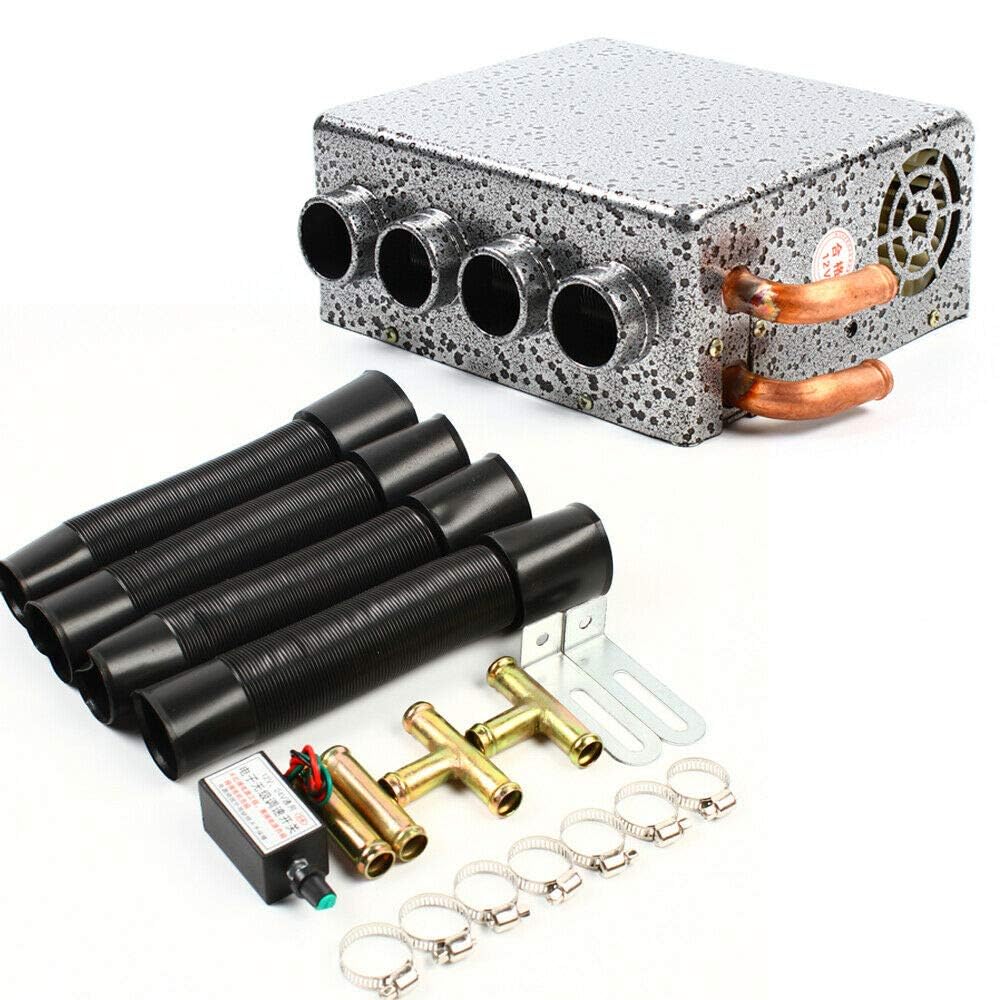
2. Upgraded of 12V Universal Auxiliary Heater Underdash Heat with Speed Switch for Car or Truck Minivans Excavators Harvesters 4 ports US Stock
A coolant-fed under-dash heater that turns a chilly footwell into the warmest spot in the cab.
This is the pick for the rider who wants warmth without leaning on the machine’s electrical system. It is a hydronic heater, which means it draws heat from your engine’s coolant — the hot coolant runs through the heater core, a fan forces air across it, and warm air comes out — so it sips electricity instead of drawing a heavy load. With four output ports and a stepless speed knob, you dial the airflow wherever you want it: feet, glass, or both. One rider summed up the install plainly: “installed it in my CFMOTO ZFORCE 950 sport took some modifying of the dash to get it to fit where I wanted it but it was worth it great heat.”
The heat output and the value both land well — owners consistently call the warmth good and the price fair for a heater with a blower. Installation gets steady praise too, since it mounts under the dash and needs only a power hookup and coolant lines. The honest wrinkle is build quality: some units feel cheaply made, and the included tubing and clamps draw the most grumbles, with one buyer noting the clamps “strip out.” Swap them for better hardware and the unit itself holds up.
Wiring is where you want to read the fine print. It needs a minimum 8 A connection and an owner recommends a 10 A fuse, so check that against your circuit before you cut anything. At 6.93 pounds it is noticeably lighter than the 9.8-pound JEGS top pick, which is a plus when you’re hanging it under a tight dash. The compact 11 x 9 x 3.93-inch body slips into limited space, though the tubing that comes in the box is worth replacing with the good stuff.
Reach for this if: you want coolant-fed heat with stepless fan control and don’t mind upgrading a few fittings.
Look elsewhere if: you want everything included and ready to bolt on, since the clamps and tubing are the weak link.
3. XuSha Hydronic Heater 12V 4 Front Vents, Compact Design, Portable Assembly Mountable Switch 3-Speed Fan 80 CFM Airflow 8500 BTU of Heat, fits for Car/Truck/Boat/RV
A compact four-vent heater built to squeeze into small machines and get the chill off.
XuSha’s hydronic unit is small, light on the wallet, and made to fit where a bigger heater won’t. It pulls heat from engine coolant, so it works best once the machine is warmed up, and its 80 CFM of airflow and 8,500 BTU of heat output are aimed at warming footwells and clearing glass rather than blasting a whole cab. Four front vents and a three-speed fan spread that warmth across the cabin space you actually sit in.
What wins people over is that it functions exactly as billed across a range of machines. The flip side shows up in the details: some units arrive with bracket screws missing from an opened bag, and the instructions are thin enough that you’ll lean on your own expertise. Heat output divides owners — some find it plenty, others want more on the coldest days.
Treat this as the warmer-upper, not the cab roaster. It is a great fit for a compact UTV or a small car where a big forced-air unit simply won’t go, and it pairs nicely with the machine’s own engine heat. At 8.03 pounds it sits in the middle of this lineup, between the 6.93-pound Upgraded unit and the 9.8-pound JEGS top pick. If you want strong defrost and a warm footwell in a tight machine, it delivers; if you expect furnace-level output on a sub-zero ride, temper that.
Where it shines: compact dimensions and a four-vent layout make it easy to tuck into machines with almost no dash space to spare.
What to plan for: count your parts on arrival and budget a little time to figure out the mounting, since the included instructions are minimal.
Ideal for: compact UTVs and cars where space is tight and you want gentle, steady cabin warmth.
Pass if: you ride in deep cold and expect a heater to overpower it, because the output here is modest.
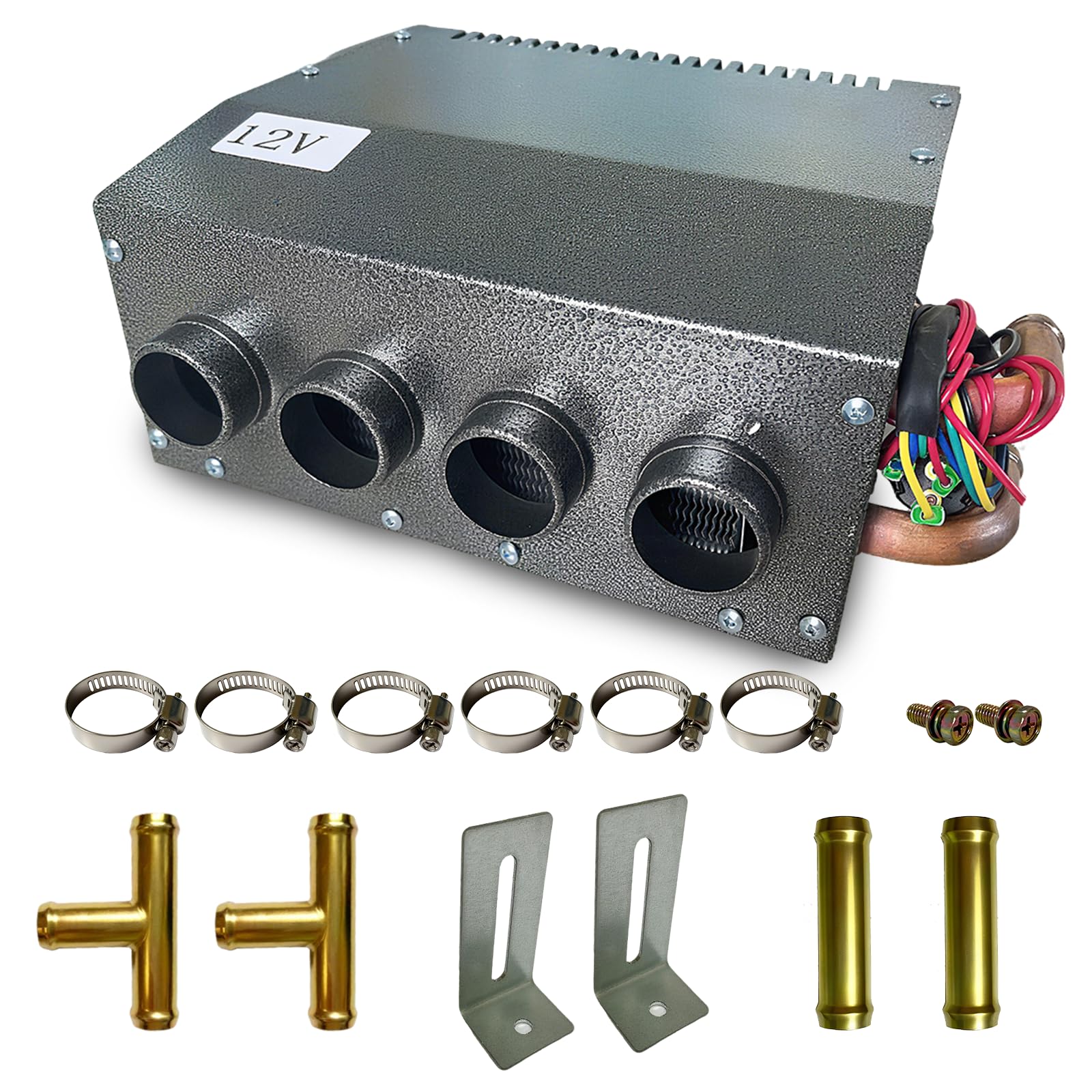
4. Saihisday 12V Car Truck Auxiliary Heater, 4 Ports Universal Underdash Compact Auxiliary Heater, Winter Automotive Air Conditioner for Heating&Defrosting

Built to spread warm air through four ducts — clear the glass, warm the footwell, repeat.
This Saihisday unit is a blower-first heater: it runs on 12 volts, uses a motor to push air, and its four vent ports are set up for defrosting and demisting as much as for warming you. If your winter problem is a fogged windshield as much as cold hands, the ducting approach here makes sense. It is the kind of small forced-air heater that fits under a dash in a truck, a minivan, an excavator, or a harvester, and the included switch wiring is spelled out clearly in the listing so you know which red, blue, and black wire goes where.
Value and ease of install are the recurring wins — people call it worth it for what it is, and one buyer in a 1998 Chevy S10 with no prior heat found it worked well and beat having nothing. The complaint that keeps surfacing is airflow: the blower doesn’t push hard enough through all four ducts at once, and a couple of owners found the ducts barely move air. Run it to one or two vents instead of spreading it four ways and the stream is stronger.
Weigh it as a defroster and foot-warmer rather than a whole-cab furnace. It is light at 7.04 pounds and compact enough to tuck under a dash, and the plastic hose in the box is the first thing you’ll want to upgrade if a duct keeps popping off. For clearing glass on a frosty morning and taking the bite off, it does the job — just match your expectations to a focused four-port unit, not a high-CFM blower.
The smart use: point one or two ports at the windshield for defrost and leave the others for your feet, and the airflow feels far stronger than spreading it across all four.
The weak spot: through all four ducts at once the fan can feel thin, so treat it as a focused defroster, not a cab-filling blower.
Pick it if: fogged glass and cold feet are your winter headache and you want an affordable under-dash fix.
skip it if: you need a heavy airflow to heat a big open cab, because four-way spread dilutes the stream.
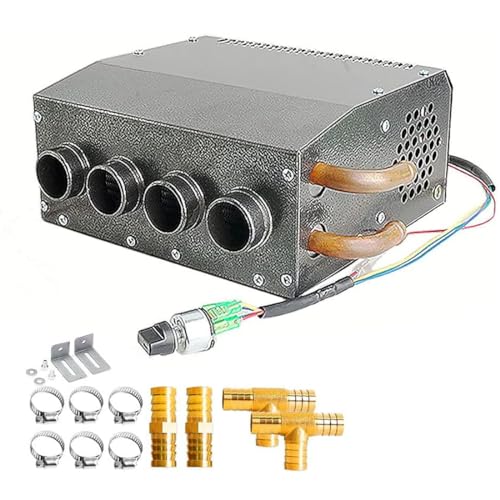
5. 12V Compact Design Hydronic Heater Assembly Mountable Switch 4 Front Vents 3-Speed Fan 80 CFM Airflow 8500 BTU of Heat for Car Truck Boat RV UTV
Hook it to coolant and power, and this little Evargc heater quietly earns its keep across four machines.
Evargc’s hydronic heater is the one to reach for when you want warmth that comes from the engine rather than the battery. It is a coolant-fed unit: connect it to a water line and a power lead and it goes to work, pulling heat from engine coolant and pushing it through four front vents with a three-speed fan. At 96 watts and 12 volts DC, its electrical draw is light — a real plus when your UTV battery is already feeding lights and a winch. Its 80 CFM of airflow and 8,500 BTU stack up the same as the XuSha unit’s figures, so the difference here is the polished fit and finish and the wide range of machines owners have made it work in.
The performance is what owners praise most, and this unit handles some unlikely jobs — an unheated skid loader with added plexiglass panels, and a 12-seater bus with lots of glass both came up in reviews, and it produced more heat than either needed. It is not plug-and-go: you route hoses and supply power yourself, and one RZR owner warns strongly that you must run the hoses to the front radiator, not the rear, or the unit will overheat. Give it a coolant line and a shut-off valve to govern output and it flattens fog and warms the cab nicely.
Two things to plan around. It wants 5/8-inch (16 mm) inner-diameter hose, sold separately, and the mounting brackets sit on the side panels, which can put the coolant lines on the left when some machines need them on the right. At 8 pounds it is a solid, mid-weight unit that mounts without drama once you’ve sorted the hose routing. Whether you run a UTV, a boat, or an RV, the payoff is steady warmth with a light electrical load.
Where it pulls ahead
- Light 96-watt draw at 12 volts keeps battery load low
- Engine-coolant heat suits long, cold shifts
- Proven across UTVs, skid loaders, buses, and more
Before you order
- Needs a 5/8-inch (16 mm) inner-diameter hose you supply yourself
- Side-mounted brackets can aim coolant lines left when you need right
- Not a plug-and-go install — you route hoses and wire it
Best suited to: riders who want engine-heat warmth with a minimal electrical draw and don’t mind running hose.
Not for you if: you want zero plumbing, since this one needs hose, fittings, and a little planning.
6. 12V Volt Heater for Honda Yamaha Can Am Arctic Cat Kawasaki John Deere Kubota UTV
A featherweight universal unit that aims warm air wherever you point it — just don’t expect a furnace.
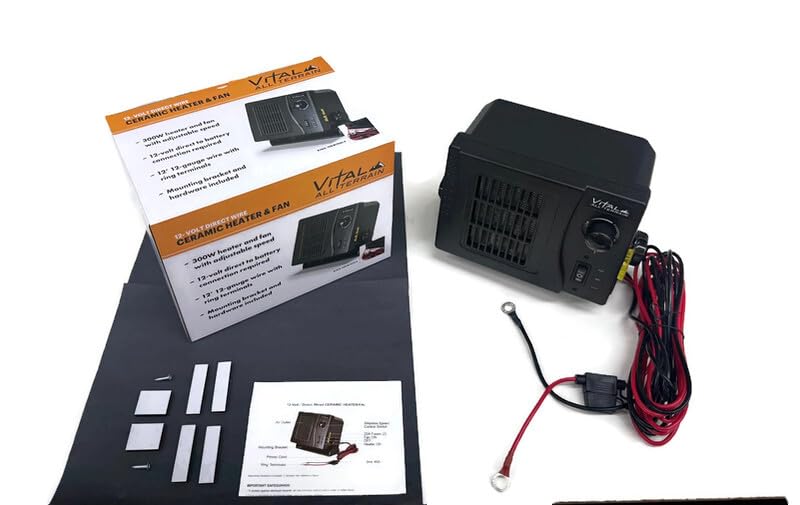
Vital All-Terrain built this one for flexibility, not brute force. It is a 12-volt, 300-watt electric heater with a three-position switch that toggles between heat and fan-only, and a swivel stand that lets you aim the airflow at your feet or your glass. It claims to work on nearly any model UTV, from Honda and Yamaha to Can Am, Arctic Cat, Kawasaki, John Deere, and Kubota, and it comes with installation instructions in the box. At 3.19 pounds it is by far the lightest heater here — less than half the heft of the 6.93-pound Upgraded unit — so mounting it is barely a chore.
Here is the honest part: this is a chill-off unit, not a cab roaster. Owners who found it satisfying describe it as “not a lot of heat but takes the chill out,” which is exactly the realistic expectation for a 300-watt electric heater. Others wanted far more warmth and were disappointed, and the recurring theme in those reviews is heat output falling short of what a cold cab needs. If your idea of winter warmth is a genuinely cold morning in an open machine, this won’t replace a high-CFM forced-air heater.
Where it earns a place is as a light, simple, aim-and-go backup for milder conditions or a small cab you just want the edge taken off. The swivel mount is genuinely handy, and the heat-or-fan switch means you can use it as a plain air mover in summer. Set your expectations to “takes the chill off” and the fitment and low weight make it an easy add — just don’t ask it to out-heat the 28,000-BTU JEGS pick up top.
Good match for: riders who want a light, aimable heater to take the edge off in milder cold or a small enclosed cab.
Not the one for: bitter mornings or open cabs, where its modest 300-watt output simply won’t keep up.
7. 12V Volt Electric Cab Heater & Base for Tractor Trailer Semi Semi-Truck Truck Bus
A universal 300-watt cab heater aimed at tractor trailers, semis, and buses on a budget.
This Vital All-Terrain unit shares the same 12-volt, 300-watt design and three-position heat-or-fan switch as its UTV-focused sibling, but it targets big-cab machines: tractor trailers, semis, buses, and the like. It ships universal-fit with a swivel stand so you can direct the airflow where you want it, and instructions come in the box. At 3.2 pounds it is about as light a heater as you’ll find and mounts anywhere there’s a flat spot and a power feed.
The honest read is that this is a chill-remover, not a space heater. Buyers who expected a big-cab furnace came away unimpressed — the common refrain is that the heat output is modest and the fan speed knob doesn’t show a clear difference between low and high. One vet truck owner hoped to keep a box warm and found the output fell short of the job. Read the listing as a cab-warmer for a small enclosed space and it behaves like a three-position electric heater should — steady warmth without a big air throw.
Its real value is as a low-cost back-up or supplemental heater for a semi sleeper or a bus cab where you just need the chill knocked off a small zone. The universal mounting and light weight make it easy to move from one spot to another. Match it to a small, enclosed space and a reasonable cold, and it fits that role; ask it to heat a whole trailer and it will disappoint. That is the honest scale of it.
What it is: a light, universal 300-watt electric heater that warms a small zone in a big-cab machine without much mounting fuss.
What it isn’t: a high-output number that will heat a full sleeper cab on a deep-freeze night, so size your hope to a small, enclosed area.
A fit for: drivers who want an inexpensive supplemental cab warmer for a small zone and value light weight and easy mounting.
Look past it if: you need to heat a full trailer or sleeper on the coldest nights, since its output is modest.
8. Auxiliary Heater Assembly 177 CFM
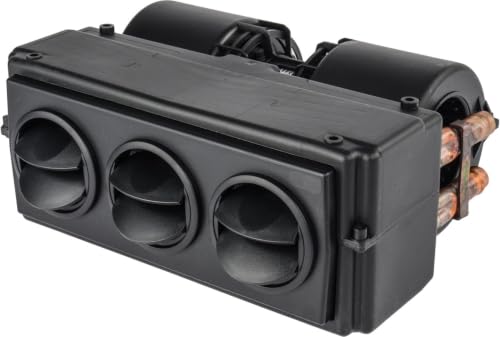
A compact JEGS blower with real punch — big airflow in a body that fits where others won’t.
This JEGS heater is the smaller sibling of the top pick, and it keeps most of that unit’s character in a trimmer frame. It puts out 20,000 BTU and moves 177 CFM of air, so it still pushes a strong stream even though it is lighter on raw output than the 260 CFM, 28,000 BTU top pick up top. Its heavy-duty injection-molded and glass-filled nylon housing is built to shrug off constant use — the kind of durability owners value in a bumper-to-bumper work machine. It is the pick to reach for when you need real airflow but your mounting space is tight.
Owners who fit it into tight spots love how it fits. One Ranger owner’s install took a few hours and no directions — they watched YouTube walkthroughs — but the payoff was a UTV that heats up in bitter cold, described as “so worth it.” Another praised how it “fits where others can’t” and blows strong. Points to know: the whining noise and the uncontrolled multi-point air intake are the recurring gripes, and the three-prong connector doesn’t include the pigtail you need to reach the switch — order that separately so you’re not stalled mid-install.
At 6 pounds it is the lightest of the higher-output units here, easier to hang than the 9.8-pound top pick while giving up some airflow in exchange. It runs on 12-volt electric power through its own three-speed blower, so wiring is straightforward once the pigtail is on hand. If your heart is set on maximum output, the dual-vent JEGS at the top of this list out-blows it; if you need real heat in a space the big one won’t fit, this is the one.
Why riders rate it
- 177 CFM and 20,000 BTU give a strong stream in a compact housing
- Glass-filled nylon build takes constant use
- Fits spots where a full-size blower won’t
Watch these points
- No pigtail included for the three-prong connector — buy it separately
- Whining noise and uncontrolled intake are the common gripes
- No printed directions in the box for some buyers
Choose this if: you need strong 177 CFM airflow in a compact body that squeezes into small machines.
Hold off if: you want maximum output or everything in the box, since the top pick out-blows it and you’ll need a pigtail.
Understanding the Specs
CFM — Your Airflow, Explained
CFM means cubic feet per minute — how much air the blower pushes out. It’s the number that decides whether warm air reaches your windshield or just your shins. A high value, like the 260 CFM on the top pick, throws enough air to defrost glass and fill a cab; the 80 CFM units in this list warm a smaller zone. If clearing fogged glass matters to you, airflow is the spec to compare first.
BTU and Watts — How Much Heat
BTU measures heat output per hour; watts measure electrical draw on electric heaters. The top pick’s 28,000 BTU and the 20,000 BTU of the smaller JEGS unit sit well above the 8,500 BTU hydronic units, which pull their warmth from engine coolant instead. Check the draw — like the top pick’s 9.6 A — against your accessory circuit so you don’t overload the machine.
Hydronic vs Electric — Where Heat Comes From
Hydronic heaters tap engine coolant through a core and blow air across it, so they need a hose hookup and only warm up with the engine. Electric heaters make their own heat from 12-volt power, so they work the moment you switch them on. Pick hydronic for long, steady shifts; pick electric for short rides and instant heat.
Fitment and Amperage
Measure your mounting space and check the hose or duct size before ordering. Hydronic units often want a 5/8-inch (16 mm) inner-diameter hose sold separately, and small four-port heaters need room for their ducting. Matching the heater’s electrical draw to your circuit and confirming hardware is in the box turns a frustrating install into an easy afternoon.
FAQ
Will a 12V UTV heater drain my battery?
What is the difference between a hydronic and an electric 12V heater?
How many CFM do I need to defrost a UTV windshield?
Do these heaters come with mounting brackets and screws?
What hose size does a hydronic UTV heater need?
Will a 12V heater fit my UTV, truck, or tractor cab?
Are these 12V heaters loud?
How do I wire a 12V UTV heater?
Can these heaters also defog and defrost the windshield?
Final Thoughts: The Verdict
For most riders, the 12v heater for utv winner is the Auxiliary Heater with Dual Vents because it delivers the most airflow and heat here — 260 CFM and 28,000 BTU — which is what actually warms a cab and clears glass fast. If you want engine-coolant warmth with a light electrical draw, grab the Evargc hydronic heater, and if you need real airflow in a compact body that fits where a full-size blower won’t, the JEGS 177 CFM unit is the one to reach for. Match the heater’s CFM and amperage draw to your machine’s space and accessory circuit, and crack a vent when you’re closed up to keep the glass clear.
How We Picked
We do not accept paid placement. Every pick is matched to a real buyer and a real use-case; we do not hands-on test units.
Sources & Methodology
Specifications: manufacturer listings and product documentation. Review insights: verified customer reviews, as of September 2026. Pricing: not shown on this page (it changes often); check the current price via the retailer link.
As an Amazon Associate, Gadgets Feed earns from qualifying purchases. This does not affect which products we feature.