
Our readers keep the lights on and my morning glass full of iced black tea. As an Amazon Associate, I earn from qualifying purchases.
Specs are compiled from manufacturer listings and verified buyer reviews and can change over time — please confirm the key details on the product page before buying.
If you are shopping for a 100Ah battery, the real question is not which one is “best” — it is whether a lighter lithium pack or a proven lead-acid unit fits the way you actually use power. A 100Ah battery stores 100 amp-hours of energy (amp-hours measure how much current it can deliver over time), enough to run a trolling motor all day, keep an RV fridge and lights alive, or back up a sump pump during an outage. Lithium versions weigh far less and last through many more charge cycles (a charge cycle is one full discharge and recharge), while sealed lead-acid versions cost less up front and swap straight into older gear. This guide breaks down eleven real 100Ah batteries so you can match the right one to your boat, camper, or solar setup.
I’m Min — the founder and writer behind Gadgets Feed. This guide is built by comparing the manufacturers’ published specifications and the patterns across verified customer reviews, so you get each pick’s real strengths and trade-offs instead of marketing spin.
Below you will find a quick comparison table, hands-on-style breakdowns of each battery, and a plain-English specs section. By the end you will know exactly which 100ah battery matches your boat, camper, or backup power needs.
Our Picks at a Glance


How To Choose The Best 100Ah Battery
The biggest decision you will make is chemistry: lithium iron phosphate (LiFePO4) or sealed lead-acid (SLA/AGM). Lithium packs weigh roughly a third of what an equivalent lead-acid battery weighs and last through thousands more charge cycles. Lead-acid units cost less and drop straight into older vehicles, golf carts, and UPS boxes that were designed for them. Neither is universally better — it depends on whether you prioritize weight savings and lifespan or up-front cost and drop-in compatibility.
Chemistry: LiFePO4 vs SLA/AGM
LiFePO4 batteries use lithium iron phosphate cells, which stay stable under heavy discharge and typically deliver 100% of their rated capacity. A lead-acid battery can only safely use about half its rated amp-hours before voltage drops too low. That means a 100Ah lithium pack gives you roughly twice the usable energy of a 100Ah lead-acid pack in the same application. The trade-off is price and cold-weather behaviour — lithium BMS boards cut off charging near freezing, while AGM handles cold better without electronics.
BMS and low-temperature protection
A BMS (battery management system) is a small circuit board inside a lithium battery that monitors voltage, current, and temperature. It shuts the battery down if it detects a short circuit, over-voltage, over-discharge, or abnormal heat. Many 100Ah lithium batteries also include low-temperature cutoff, which stops charging below freezing to protect the cells from damage. If you camp or fish in cold weather, look for this feature. AGM batteries do not use a BMS — they rely on their sealed construction and you manage charging manually.
Size groups and fit
Battery size groups like Group 24, Group 27, and Group 31 describe the physical dimensions of the battery tray. Group 24 is the smallest of the three and fits many RVs and smaller boats. Group 27 and Group 31 are progressively larger and hold more lead plates or cells. A lithium battery in Group 24 size often weighs about 21 pounds, while a lead-acid Group 31 can weigh over 60 pounds. If you are upgrading from lead-acid, check your existing tray dimensions before ordering — some lithium batteries list a Group 24 footprint but may be slightly taller.
Quick Comparison
| Model | Best For | Chemistry | Weight | BMS / Cycles | Amazon |
|---|---|---|---|---|---|
| MARSENERGY 12V 100Ah LiFePO4 Group 24★ Best Overall | Overall lithium value | LiFePO4 | 21 lb | 100A BMS / 15,000 cycles | Amazon |
| Mighty Max ML100-12 SLA AGMBudget Pick | Budget drop-in replacement | Lead Acid | 28 lb | No BMS / 300-500 cycles | Amazon |
| WEIZE 12V 100Ah Deep Cycle Group 31Heavy Duty | Heavy-duty off-grid backup | Lead Acid | 63 lb | No BMS / 300-500 cycles | Amazon |
| CYCLENBATT 12V 100Ah Mini Bluetooth | Compact bluetooth monitoring | LiFePO4 | 20.8 lb | 100A BMS / 5,000 cycles | Amazon |
| DC HOUSE 12V 100Ah Bluetooth Trolling Motor | Trolling motor with app | LiFePO4 | 23.8 lb | 100A BMS / 15,000 cycles | Amazon |
| WattCycle 12V 100Ah Mini Bluetooth | Lightweight mini form factor | LiFePO4 | 20.94 lb | 100A BMS / 15,000 cycles | Amazon |
| ECO-WORTHY 12V 100Ah LiFePO4 Bluetooth | Solar & off-grid systems | LiFePO4 | 23.2 lb | 100A BMS / 4,000+ cycles | Amazon |
| Power Queen 12V 100Ah Trolling Motor | Marine trolling motors | LiFePO4 | 22 lb | 100A BMS / 4,000+ cycles | Amazon |
| Redodo 12V 100Ah LiFePO4 Group 31 | High-capacity off-grid | LiFePO4 | 22 lb | 100A BMS / 15,000 cycles | Amazon |
| VMAX MR127 12V 100Ah AGM | Marine AGM reliability | Lead-Acid AGM | 68 lb | No BMS / 300-500 cycles | Amazon |
| LiTime 12V 100Ah Group 24 Bluetooth | Premium RV & trailer upgrade | LiFePO4 | 21.9 lb | 100A BMS / 4,000+ cycles | Amazon |
In‑Depth Reviews
1. MARSENERGY 12V 100Ah LiFePO4 Lithium Battery, BCI Group 24 Size, 100A BMS
Our pick — over 4.5★ from 250+ verified ratings; the strongest balance of quality and price.
The Group 24 lithium that trades lead-acid bulk for a 21-pound shell and 15,000-cycle promise
If you want a 100Ah lithium battery that drops into a standard Group 24 tray without rewiring, the MARSENERGY LFP12100 is the one to beat. It weighs just 21 pounds, which is roughly a third of a comparable lead-acid unit, and its footprint measures 10.16 x 6.54 x 8.64 inches. That means you can slide it into your existing Group 24 box or even step up to a Group 27 or 31 tray — it is compatible with all three sizes. The 100A BMS (battery management system) shuts the battery into sleep mode on short circuits, over-voltage, or abnormal temperatures.
This pack stands out for how long it lasts. MARSENERGY rates it at 4,500 cycles with 100% depth of discharge (DOD means how much of the battery’s capacity you use before recharging), 8,000 cycles at 80% DOD, and 15,000 cycles at 60% DOD. Lead-acid batteries typically manage 300 to 500 cycles, so the lifespan gap is enormous. What wins people over is the consistent power delivery — owners running mobility scooters report long runtime per charge, and RV owners note it cut significant weight off their tongue load. A dump-trailer user calls it “very lightweight and easy for me to move around for different job uses.” The battery also operates down to -4℉ for discharge and 32℉ for charging, with low-temperature additives in the cells to handle cold better than standard lithium.
As owners put it: “Excellent product, lasted all day only used half a charge.” One thing to know before you buy is that a single battery rated under 100Ah is not enough for every high-draw setup — some owners running multiple batteries in parallel (wired together to share the load) use terminal blocks and load-balance the bank to get even discharge. The terminals are raised rather than recessed, so if your current cables have tight right-angle lugs, double-check the fit. And while the battery arrives fully charged, MARSENERGY recommends a full charge cycle before first use to balance the cells.
The Numbers That Matter
- 21 lb — roughly a third the weight of lead-acid, per the manufacturer’s comparison
- 15,000 cycles at 60% DOD and a 10-year rated lifespan
- Fits Group 24, 27, and 31 trays without modification
- 100A BMS with sleep-mode protection and low-temp cutoff
Where It Asks For Patience
- Charging cuts off at 32℉ — cold-weather campers need a warmed charging setup
- Terminals are raised, not recessed, so check cable lug clearance
- Multiple-battery banks need terminal blocks and load balancing to discharge evenly
Reach for this if: you want a lithium upgrade that fits your current Group 24 tray, saves 40+ pounds, and comes with a 5-year after-sales service commitment.
Think twice if: your cables use tight right-angle lugs that need recessed terminals, or you regularly charge below freezing.
2. Mighty Max ML100-12 12V 100Ah SLA AGM Battery
A maintenance-free sealed AGM battery that asks for zero water checks and drops into older equipment
The Mighty Max ML100-12 is the budget-friendly pick for anyone who needs a sealed lead-acid (SLA) battery that works without a lithium charger. It is a 12-volt, 100Ah unit in Group 30H size, weighing 28 pounds and measuring 12.17 x 6.61 x 8.31 inches. The maintenance-free design means no distilled-water refills, and the spill-proof construction handles being mounted at odd angles. It carries UL certification for safety inside a vehicle or home.
What surprises people is how versatile it is. Sump pump systems, pellet stoves, modem and router backup, and small solar setups all show up in the real-use reports. A large-UPS owner packed it with fused wiring and noted it arrived just about fully charged. Another household runs it as a solar battery for a beginner setup, calling it “user friendly and great for beginners.” The 25mm terminal bolts fit 300A ring terminals (connectors that handle up to 300 amps) for heavier connections, though a few installations hit snags with wrong-size bolts in the box. Performance earns the highest single praise here — 38 owners specifically cite how well it does its job.
The honest trade-off is AGM’s shorter lifespan under deep cycling. Battery life is the most-discussed aspect overall, and it reads mixed — some report it holds charge very well, others say it stopped taking a charge after roughly two and a half years. Repeated deep discharges accelerate the wear on any AGM. If you need thousands of cycles and half the weight, lithium is the better path. But if you want a low-cost, maintenance-free battery that fits an existing charger and tray today, this AGM delivers.
Installation reality: owners replacing riding-mower batteries report the swap took minutes with no wiring changes, and the OEM charger still works because AGM voltage profiles match lead-acid expectations.
Lifespan caveat: AGM batteries live shorter under heavy discharge cycles. Keep it topped up between uses and avoid draining it flat, and you will get the most from it.
Best for: budget-focused buyers who need a sealed, maintenance-free battery that works with their existing lead-acid charger.
Look elsewhere if: you cycle deeply every day or need a battery that lasts through thousands of charge cycles.
3. WEIZE 12V 100Ah Deep Cycle Battery, Group Size 31
Sixty-three pounds of sealed lead-acid muscle built for stationary backup and trolling duty
At 63 pounds, the WEIZE Group 31 is the heavyweight in this lineup — literally. Its dimensions are 12.99 x 6.73 x 8.34 inches, and the group 31 form factor fits wheelchair, scrubber, generator, and trolling motor applications. It is a sealed lead-acid (SLA) battery with a maintenance-free, spill-proof design, so there is no water to add and no acid to worry about. The 3% self-discharge rate means it holds its charge for months between uses, which matters for emergency backup batteries that sit idle. The 1150A max discharge current gives it enough punch to handle a 2000W inverter for short bursts.
Where it shines is whole-home emergency backup. One owner runs four of these in parallel to a 2000W inverter for roughly 4.8kWh, which powers 120V outlets, fans, and garage openers during an outage. The battery quality earns the top praise here with 63 owners calling it out, followed by battery life at 51. A fifth-wheel camper owner installed two and ran a residential refrigerator through an 8-to-10-hour campground power cut, still going strong after six hours. Another reports using two 100Ah units off-grid with two 150W solar panels for two years without issues, powering a 700W pure sine inverter. The trickle-charge friendliness and spill-proof construction make it a solid fit for medical equipment, emergency lighting, and alarm systems too.
The weight is the recurring gripe, and it is real — this is a stationary battery, not something you carry back and forth. It is not the right pick if you need to swap batteries between a boat and a camper regularly, and it cannot be paralleled with lithium batteries. But for a permanent installation where the battery stays put, the WEIZE delivers reliable deep-cycle power at a mid-range price.
Choose it for: stationary backup power, off-grid solar storage, or any setup where the battery stays in one place.
Not the one if: you need to carry the battery between vehicles or want lithium’s cycle life and lighter footprint.
4. CYCLENBATT 12V 100Ah Mini Bluetooth LiFePO4 Battery
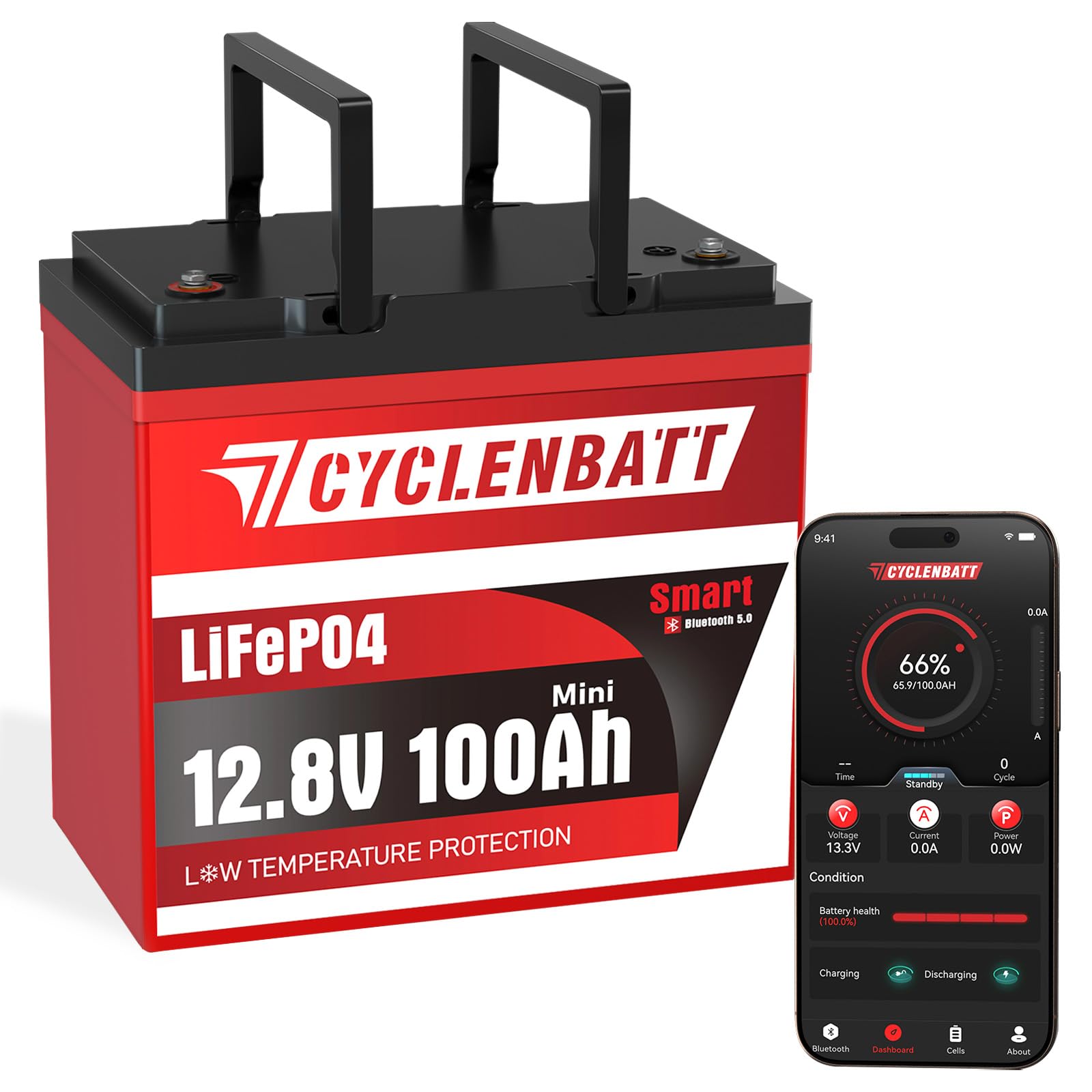
A 20.8-pound mini lithium with Bluetooth monitoring and 330A of instantaneous surge
The CYCLENBATT 12V 100Ah Mini is for anyone who needs lithium power in a tight space and wants to see exactly what the battery is doing at all times. It weighs 20.8 pounds and measures 9.02 x 5.44 x 8.19 inches, which makes it among the most compact 100Ah lithium batteries here. The built-in 100A smart BMS handles overcurrent, overvoltage, and undervoltage protection, and the Bluetooth app shows voltage, amps drawn, per-cell voltage, charge cycles, temperature, and charge/discharge status. You can also control the battery from the app and see automatic low-temp shutdown in action. It handles up to 330A instantaneous discharge current, which gives headroom for motors that spike on startup.
Overlanding and UPS users both find it useful. One replaced two SLA batteries (sealed lead-acid, the older type) in a Cyberpower 1500AVRLCD UPS and reported the BMS stays cool at 10A charge and the compact size fits where the old batteries sat. A boat owner ran two of them for four to five trips of seven hours each without recharging and never dropped below 90%. Another built a small DIY solar generator for power outages and paired it with an inverter easily. The full-color manual is well translated, and the five-year warranty adds confidence.
The app takes a little learning. Some find the dashboard switches hidden unless you scroll, and the “Discharging” toggle comes off by default, which can make the battery seem weak until you enable it. The state-of-charge reading can also drift except at the top end, so checking voltage alongside the percentage is smart. None of this is a defect — it is just the nature of Bluetooth battery apps that vary brand to brand.
Standout spec: 330A instantaneous discharge is substantial for a mini 100Ah battery, enough to handle motor startup surges without tripping the BMS.
App tip: enable the discharging switch on the dashboard first thing after connecting — the battery works best once you do.
The one for you if: you want a compact, Bluetooth-equipped lithium battery for overlanding, UPS replacement, or tight boat compartments.
skip it if: you would rather not fiddle with an app and prefer a plug-and-play battery with no digital interface.
5. DC HOUSE 12V 100Ah Bluetooth LiFePO4 Trolling Motor Battery
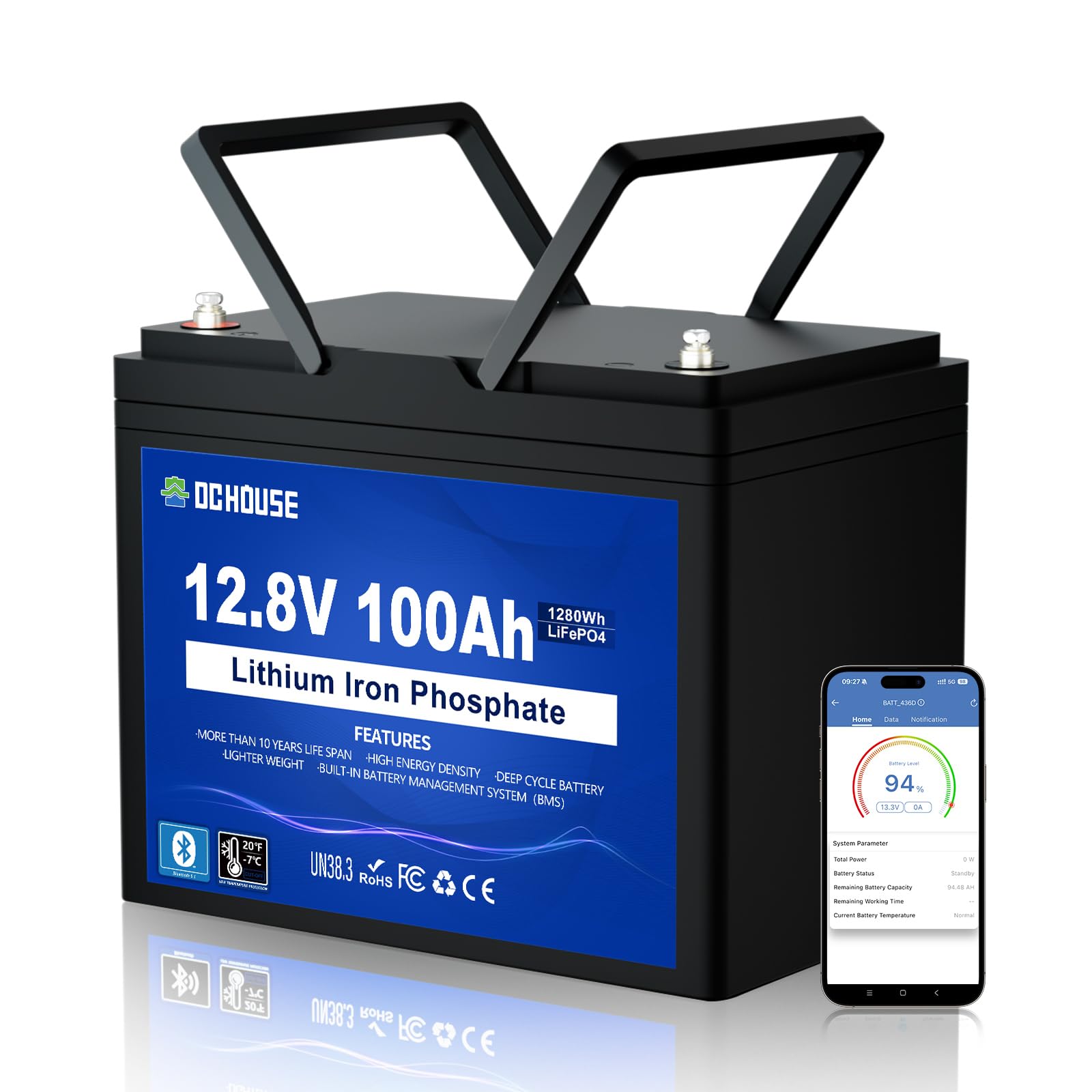
Built for trolling motors with Blue-tooth monitoring and low-temp protection that cuts charging below 19.4℉
The DC HOUSE 12V 100Ah battery is aimed squarely at anglers who want to monitor their remaining charge without crawling into the boat hatch. It uses Bluetooth 5.1 with a 5-to-10-meter range, and the app shows state of charge, voltage, current, and even per-cell data. There is a dedicated fault display page for troubleshooting, and you get instant push notifications if the battery detects an anomaly. The low-temperature protection is notable — the BMS cuts off charging below 19.4℉ and cuts discharge below -4℉, then auto-recovers once the temperature climbs back to 32℉. That protects the cells through cold nights on the water.
The 100Ah pack uses Class A LiFePO4 cells and is rated for up to 15,000 cycles with a 10-year service life. Its dimensions are close to BCI Group 24 size (about 0.32 inches taller than standard), so it fits most Group 24 trays. A Minn Kota 55lb motor pushed an Ascend DC14 with two people and gear at over 5 knots for roughly three hours at 75-100% throttle, using only 40% of the battery’s capacity. Owners camping in a 23-foot travel trailer with a solar panel report the battery never fell below 70% capacity across a full week. Battery quality earns the top praise with 36 owners calling it out, followed by battery life and Bluetooth connectivity at 19 each.
The main limitation is that this battery is not designed for starting or cranking engines, and you need a dedicated lithium charger — a lead-acid charger will not charge it properly. It supports up to four in series or four in parallel for a maximum of eight batteries total, but 4P4S configurations are not allowed, so plan your bank layout accordingly.
What the app adds: per-cell voltage readout and push notifications make troubleshooting straightforward when you are on the water and need to know if a cell is drifting.
Charger note: a lead-acid charger will not work here — budget for a dedicated LiFePO4 charger before you take delivery.
Made for: trolling motor users who want live battery monitoring and cold-weather cell protection without a separate meter install.
Not suited for: engine-starting duty or anyone planning a 4P4S bank configuration.
6. WattCycle 12V 100Ah Mini LiFePO4 Battery with Bluetooth
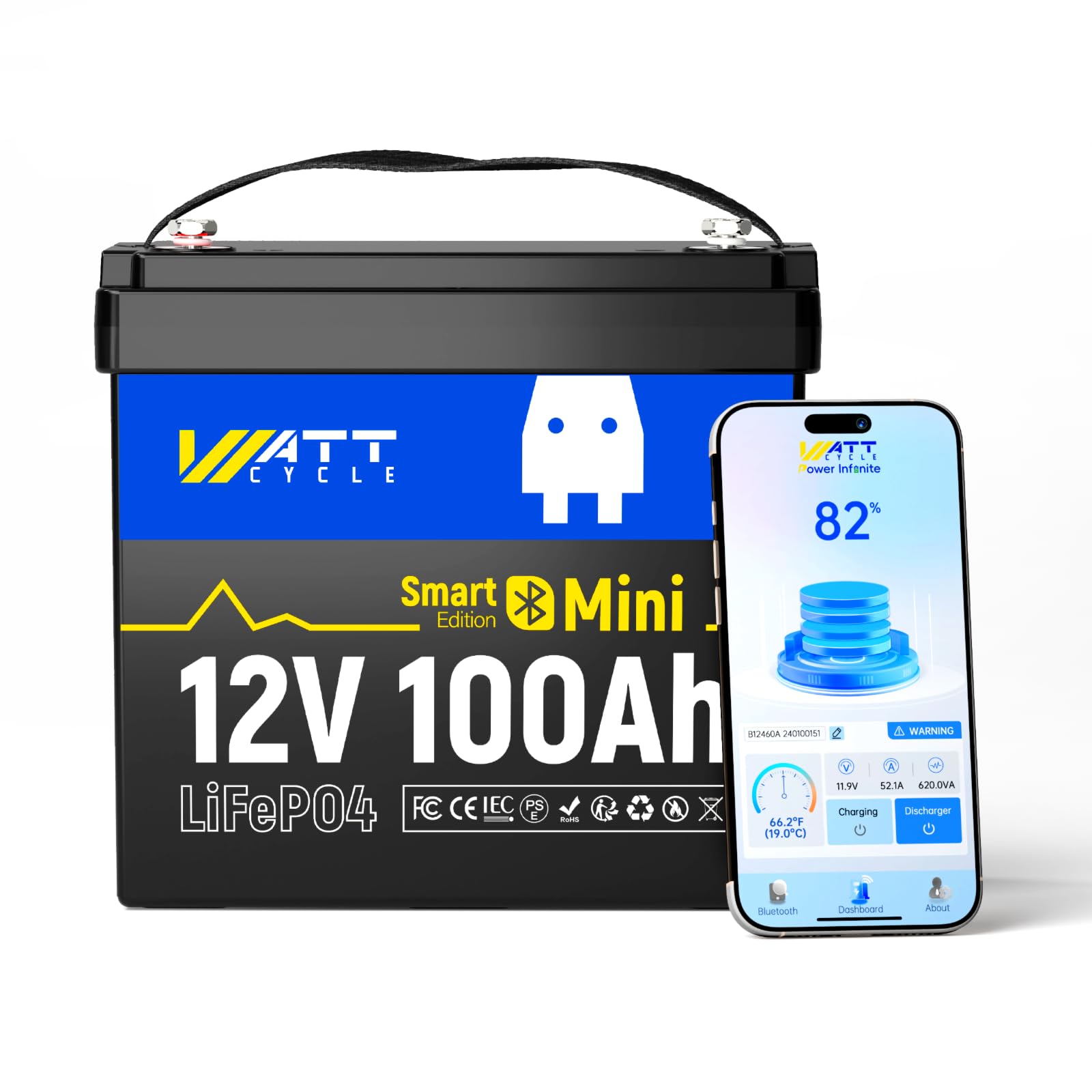
The mini lithium that squeezes 100Ah into 20.94 pounds and an IP67 waterproof shell
WattCycle’s mini 100Ah says a lot with its spec sheet: 20.94 pounds, 9 x 5.4 x 8.2 inches, and an 11% weight cut plus 39% volume reduction versus its own first-generation battery. The energy density figure of 63Wh/lb is high for the category. It uses EV Grade A+ cells rated for up to 15,000 cycles and a 10-year lifespan, and the built-in BMS guards against overcharge, deep discharge, overload, overheating, low temperatures, and short circuits. IP67 waterproofing means it can handle splashes and brief submersion, which matters on a boat. The Bluetooth app lets you set a custom name for the battery and read voltage, charge/discharge current, alarm prompts, and temperature in real time.
Cold-weather behavior is handled by automatic low-temperature shutdown — the operating range spans -4℉ to 158℉. It supports 4S4P expansion up to 20.48kWh, so you can grow your bank as your needs change. Battery quality dominates the feedback with 158 owners praising it, followed by reliability at 125 and weight at 32. One user replaced a tired lead-acid battery for car audio and lighting and reported consistent power with efficient charging. A golf cart owner runs three in series and says the cart performs better than it did on lead-acid, though one battery discharges about 0.15V faster than the other two.
The recurring story worth knowing is BMS reliability in cold conditions. Some batteries have shut down in cold weather and needed to be warmed back above roughly 58℉ to restart, and WattCycle has honored its five-year warranty by replacing affected units. The support team responds, though some communication has been a work in progress. For most buyers running moderate climates or keeping the battery sheltered, the WattCycle mini is a great balance of price, weight, and features.
Go with this one if: weight and compact size matter most and you want IP67 waterproofing plus Bluetooth monitoring at a mid-range price.
Consider another option if: you regularly camp or fish in sub-freezing temperatures and need a battery that restarts without warming up.
7. ECO-WORTHY 12V 100Ah LiFePO4 Lithium Battery with Bluetooth

A Group 24 lithium built for solar and off-grid work, with Bluetooth range that checks on the battery from anywhere
ECO-WORTHY’s 12V 100Ah is a strong fit if you are building a solar or off-grid power station and want to know the state of charge from inside the house. It measures 10.23 x 6.6 x 8.43 inches, weighs 23.15 pounds, and matches the BCI Group 24 standard, so it drops into Group 24 lead-acid or AGM trays and replaces them without wiring changes. The 100A BMS protects against overcharge, over-discharge, over-current, low temperature, and short circuit. Bluetooth 5.1 lets you read voltage, current, capacity, and estimated remaining working life from your phone, and it expands up to 4P2S for a maximum of 10.24kWh.
Charging performance is the second-most praised trait with 73 owners calling it out, and battery quality leads at 97. Owners run these as solar-charged power stations that operate an electric cooler and run diesel heaters for hours or days. One user paired two in series with a portable AC for over 10 hours at full draw. Bluetooth drain is negligible — batteries hold at 100% after weeks idle. A capacity test owner measured 1.05kWh through an 80-90% efficient inverter, which is roughly 96-105% of the rated capacity, confirming the 100Ah rating holds up. The three-year warranty and 24-hour response window are reasonable for the category.
The trade-off is that Bluetooth is built in if you want it or not — some buyers with existing simple setups would rather skip the app and the extra cost. Battery life and capacity reviews are mixed overall, with a minority reporting reduced performance over time. For the vast majority running solar or seasonal off-grid use, this battery does what it claims, and support has replaced defective units quickly when needed.
Why solar owners like it: the app shows estimated remaining working time alongside voltage and current, so you know before bed whether you have enough stored juice for the night.
The honest caveat: Bluetooth is baked in, so you pay for the feature even if you prefer a simpler battery without an app.
Fits your setup if: you are building solar storage or an off-grid power station and want real-time monitoring plus Group 24 drop-in fit.
Better to pass if: you prefer a no-frills battery without a Bluetooth app and its added cost.
8. Power Queen 12V 100Ah Trolling Motor LiFePO4 Battery
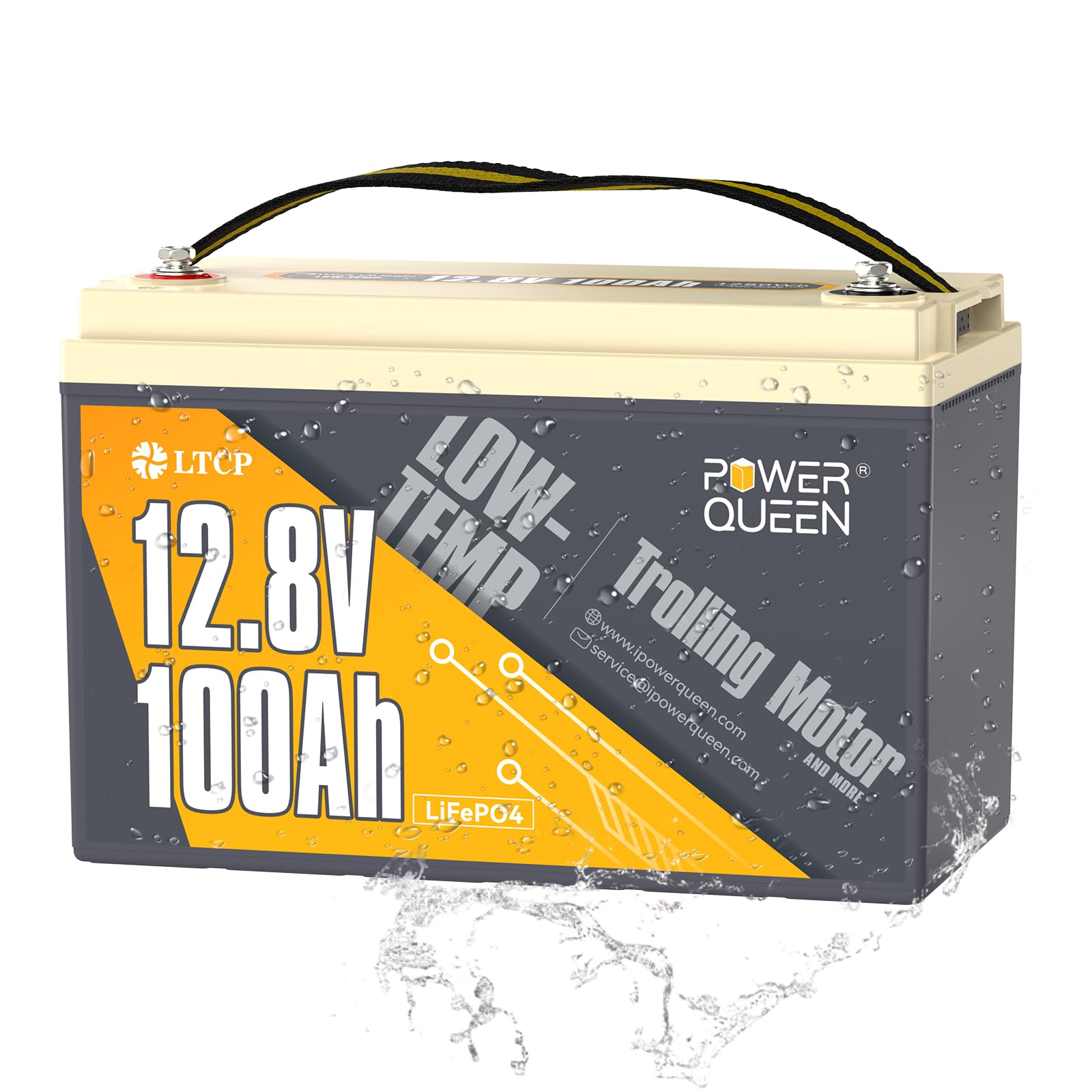
A marine-specific lithium with a TVS surge protector built for trolling motors up to 120lb thrust
The Power Queen 12V 100Ah is designed from the ground up for boats, not as a general-purpose battery. It has a built-in TVS surge protector that blocks voltage spikes for 12V-to-36V motors, keeping output steady in rough water. The triple-protected BMS is dust, water, and salt-spray guarded, and the battery meets ABYC E-13 compliance standards for marine installations. It supports 4P4S expansion up to 51.2V and 400Ah, and the smart low-temperature protection stops charging below 32℉ and discharging below -4℉.
What stands out in owner reports is reliability — 30 buyers cite it specifically, followed by performance at 21. A Pelican Bass Raider owner with a Minn Kota 50lb trolling motor reports 10-plus trips averaging four hours each and the battery meter still reading full, with three consecutive trips without draining. A kayak angler with a 33lb thrust motor ran two days of solid use on a single charge and still had power left. It is rated for 4,000-plus cycles at 100% depth of discharge, and Power Queen’s five-year warranty has shipped replacements promptly after troubleshooting.
One caveat from the field: a few units have developed BMS failures after roughly two years of heavy use, and Power Queen has replaced them under warranty. Power capacity feedback is mixed — some owners say it has power for days, others report shortened runtimes on higher-draw applications. The Group 31 size is also larger than Group 24, so verify your tray before ordering. For marine-specific use with a surge-protected BMS and a strong warranty behind it, this is a well-sorted package.
Built For The Water
- TVS surge protector handles voltage spikes from 12-36V trolling motors
- ABYC E-13 compliant with dust, water, and salt-spray protected BMS
- 22.16 lb weight and Group 31 fit with 4P4S expansion to 20.48kWh
What To Know First
- Group 31 size is larger than Group 24 — confirm tray dimensions
- A small number of units developed BMS failures after heavy use, replaced under warranty
- Power capacity feedback is mixed at higher draw rates
Ideal for: boat owners running trolling motors who want marine-specific surge protection and a warranty that responds quickly.
Check your tray first if: your boat uses a Group 24 battery box, because this Group 31 footprint needs more room.
9. Redodo 12V 100Ah LiFePO4 Battery, Group 31
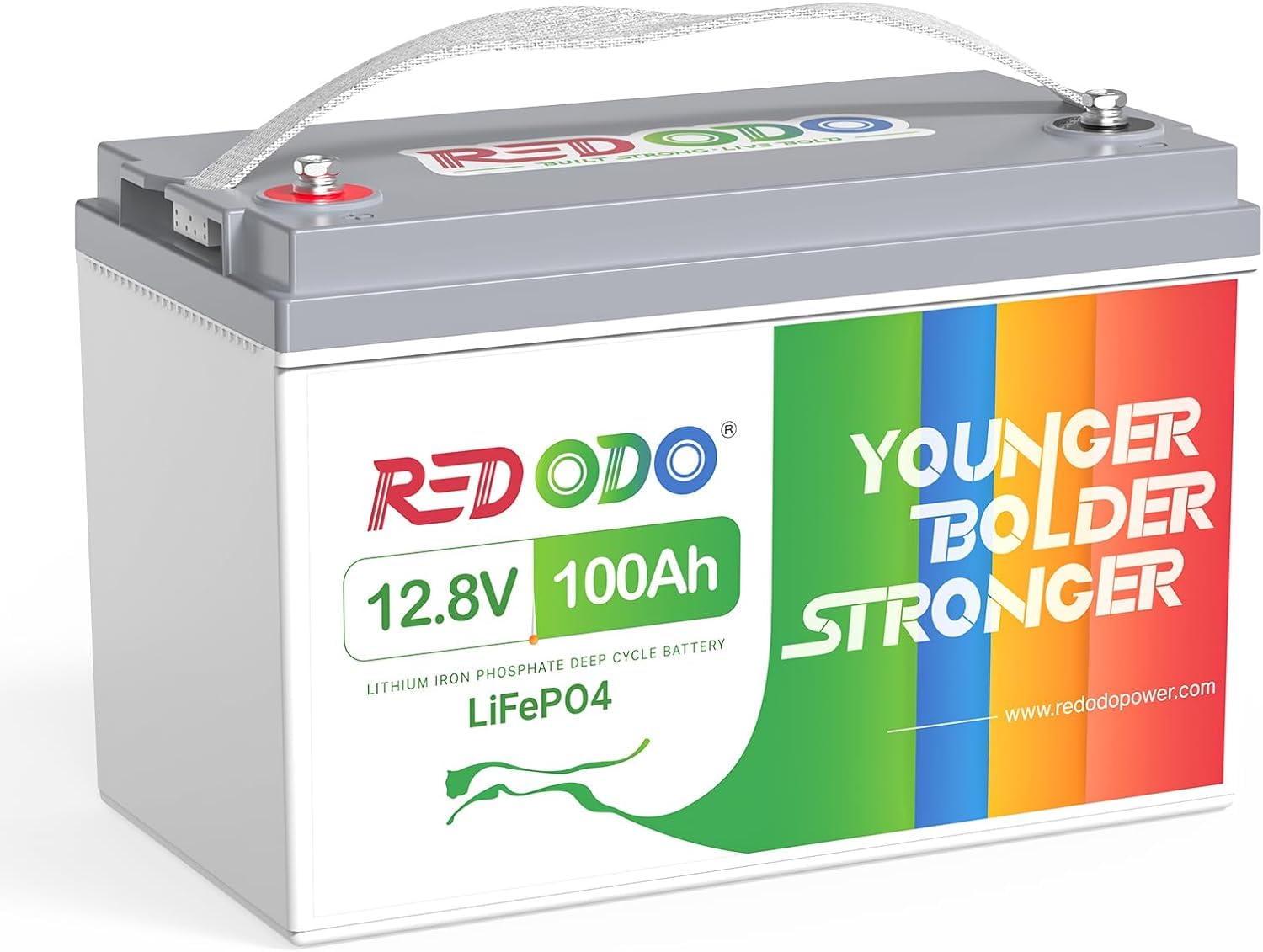
A high-density lithium that fits a Group 31 tray while weighing 22 pounds
Redodo’s 12V 100Ah is the pick for anyone running a Group 31 tray who wants maximum usable energy at minimum weight. It measures 13 x 6.77 x 8.43 inches and weighs 22.04 pounds, with an energy density of 58Wh/lb — well above the roughly 20Wh/lb of a lead-acid equivalent. The self-discharge rate is just 3%, compared to 15-30% for lead-acid, so it holds charge through long storage periods. The 100A BMS guards against overcharge, over-discharge, over-current, short circuit, and high temperature. Cycle life is rated at 4,000 cycles at 100% DOD, 6,000 at 80% DOD, and 15,000 at 60% DOD, with a 10-year lifetime estimate.
The standout in owner reports is battery quality with 164 owners praising it, followed by value for money at 81 and charging at 77. A van-lifer running a 200W solar panel and 1000W inverter reports the battery handles a fridge, TV, and laptop on 40-60Ah overnight and recharges in about five hours of sun. A pool service company switched from AGM batteries that failed every three to four months to Redodo lithium vacuums and reports they last all day with no voltage-sag slowdown. The battery is expandable up to 4S or 4P for a maximum of 400Ah capacity or 48V. It works best with a 30-70lb thrust trolling motor and needs a dedicated lithium charger for best results.
The battery life feedback is mixed overall, which is worth knowing before you commit. A handful of buyers report it stopped charging after three or four years of service, though Redodo replaced those batteries under warranty despite the age. It is not suitable for starter or golf cart use, so match it to the right application. For off-grid, trolling motor, and RV duty, this is a dependable, high-capacity lithium at a mid-range price.
Long-term durability: the low 3% self-discharge rate means you can store this battery for months and still find it near full — a real advantage for seasonal use.
Match the load: the manufacturer recommends pairing it with a 30-70lb thrust trolling motor and warns against using it as a starting battery.
Made for: off-grid solar storage, RV house banks, and trolling motor setups where a Group 31 tray is already in place.
The mismatch to avoid: engine starting and golf cart duty, neither of which this battery is rated for.
10. VMAX MR127 12V 100Ah AGM Deep Cycle Marine Battery

Sixty-eight pounds of marine-grade AGM built for all-day trolling runs and cold-cranking duty on the water
The VMAX MR127 is a sealed AGM (absorbed glass mat) deep cycle battery meant for boats and trolling motors in the 40-100lb thrust range. It weighs 68 pounds and comes with carrying handles to make moving it manageable. Inside, an electrolyte suspension system uses high-porosity glass mat to absorb and contain the electrolyte with no silica gels or contaminants. The heavy-duty lead-tin alloy grids add an extra margin of performance and service life in float or cyclic applications, even after repeated over-discharges. This is a Group 27 marine deep cycle battery, so it fits larger trays and sits securely in boats where a smaller battery might slide.
Battery quality leads the praise with 59 owners calling it out, followed by battery life at 48. One owner running a 55lb thrust Minn Kota on a 12-foot aluminum boat trolls six hours a day and recharges every other day with a 10A charger, only dropping below half charge once. Another powers a Minn Kota 40# and 55# EnduraMax simultaneously for five-plus hours and still reads 95% charge when he pulls in. A third runs two in series for an 86lb thrust motor and trolled four hours with only a small voltage drop. The battery holds charge during storage and handles continuous trolling duty without the voltage sag that plagues cheaper AGMs.
The weight is the most common complaint — at 68 pounds it is not easy to move, and some feel the value is not there for the price compared to lithium options. The 1-year warranty is also shorter than what lithium competitors offer. If you want a marine AGM that will run your trolling motor all day without cold-weather electronics to worry about, the VMAX is a strong pick. But if you plan to carry your battery back and forth, lithium is worth the extra up-front cost.
Best for: boat owners who want a sealed marine AGM with proven all-day trolling performance and no electronics to fail.
Not ideal if: you need portability or want the extended warranty and light weight that lithium batteries deliver.
11. LiTime 12V 100Ah LiFePO4 Battery, Group 24 Bluetooth
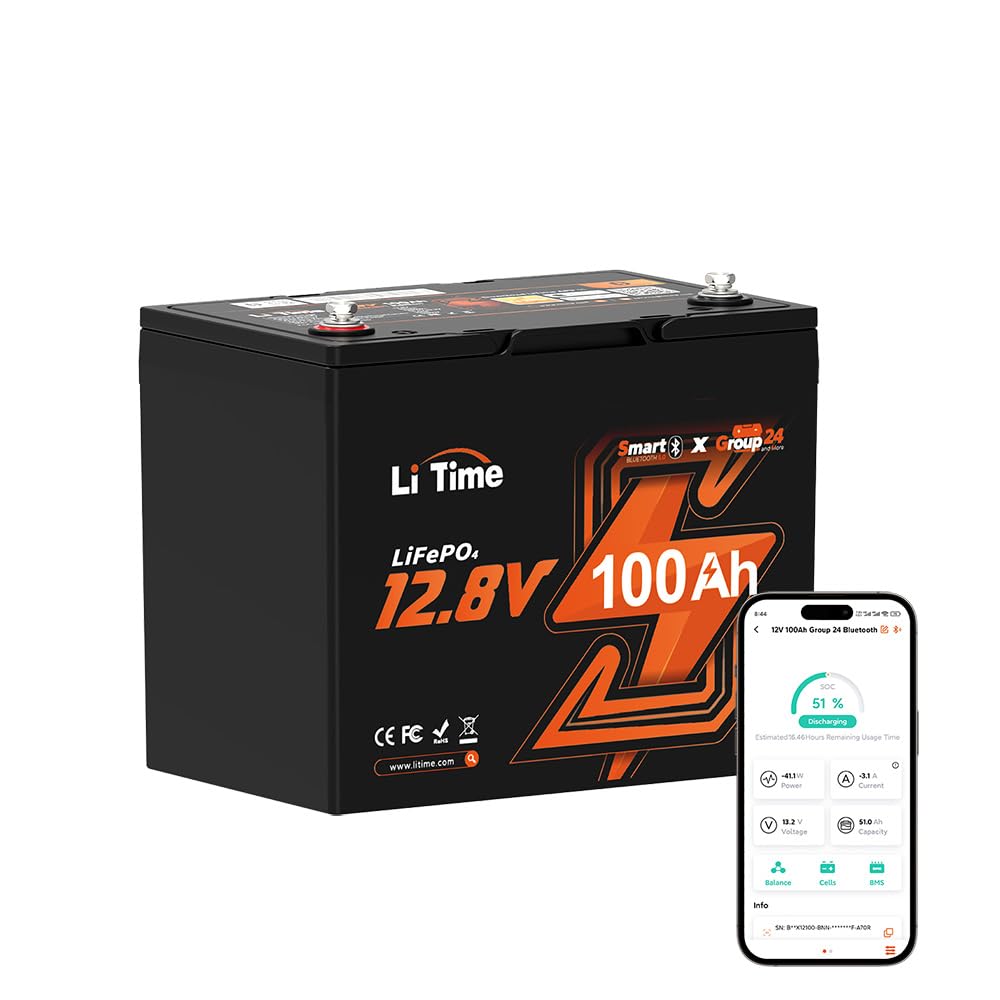
The premium Group 24 lithium with 20-plus BMS safeguards and the broadest warranty support here
The LiTime 12V 100Ah Group 24 Bluetooth is the premium pick for buyers who want lithium performance without compromise. It weighs 21.9 pounds, measures 10.24 x 6.61 x 8.3 inches, and drops into a Group 24 tray as a direct lead-acid replacement — no wiring changes needed. The manufacturer rates it 35% smaller and 63% lighter than ordinary lead-acid batteries. The built-in 100A BMS offers 20-plus safeguards, and low-temperature cutoff stops charging at freezing to protect the cells. Bluetooth 5.0 pairs instantly with the LiTime app via QR code, letting you monitor voltage, current, state of charge, and temperature remotely. It supports 4P4S expansion up to 20.48kWh and carries a 5-year warranty with 24/7 online assistance.
What wins people over is the power output and the fit. A 200-amp continuous capability (per buyer reports of the app’s power readout) handles the draw of a 12V fridge without complaint. Owners mention the battery runs an ARB fridge in a truck bed through six to seven months of heat and cold with no issues, and that the Bluetooth range reaches 50-plus feet. The app shows charge level and charge/discharge rates so you always know where you stand. A tent trailer owner reports full 100Ah usable capacity compared to roughly half the usable capacity of the 94Ah lead-acid battery it replaced, and the stock RV charger brought it to 99% without a lithium-specific charger.
The one honest quirk is that the app can have trouble updating status while the battery is actively charging — it may only refresh after you disconnect and reconnect, and out-of-range notifications arrive more often than some would like. That is a minor annoyance, not a functional failure, and the battery itself charges and discharges as it should. For buyers who want the most polished Group 24 lithium on this list with the longest warranty term and the broadest safeguard set, this is the one to choose.
Why It Earns The Top Shelf
- 20-plus BMS safeguards — the broadest protection set on this list
- 5-year warranty with 24/7 support and AIG product liability insurance coverage
- Bluetooth 5.0 app with 50-plus-foot range for remote monitoring
- Drop-in Group 24 fit and 4P4S expansion up to 20.48kWh
The Fine Print
- App struggles to refresh status during active charging until reconnected
- Charging cuts off at freezing temps, so cold-weather charging needs a warmed setup
- Premium price point places it above most lithium options here
Pick this one if: you want the most feature-complete Group 24 lithium with the longest warranty and broadest safeguard coverage.
Pocket the savings elsewhere if: the app’s charging-status quirk would bother you, or you do not need premium features.
Understanding the Specs
Ampere-Hours and Depth of Discharge
Amp-hours (Ah) measure how much energy a battery can deliver over a period of time. A 100Ah battery can theoretically put out 100 amps for one hour, or 5 amps for 20 hours. The critical distinction is depth of discharge (DOD), which is how much of that capacity you can safely use. Lithium iron phosphate (LiFePO4) batteries can use 100% of their capacity without damage, while lead-acid batteries should only use about 50% before voltage drops too low. That means a 100Ah lithium battery effectively delivers twice the usable runtime of a 100Ah lead-acid unit. When comparing batteries, the DOD rating tells you how much of the advertised capacity you can actually rely on.
BMS and Cycle Life
The battery management system (BMS) is a circuit board inside lithium batteries that monitors and protects the cells. It cuts power if it detects a short circuit, over-voltage, over-discharge, or high temperature, and it balances individual cells so they charge evenly. Low-temperature cutoff is a BMS feature that stops charging below freezing to prevent permanent cell damage. Cycle life is how many times you can charge and discharge the battery before capacity drops. A lithium battery rated for 4,000-15,000 cycles will outlast a lead-acid battery rated for 300-500 cycles by a wide margin, though the exact lifespan depends on how deeply you discharge it and how well you maintain it.
Size Groups and Weight
Battery size groups like Group 24, 27, and 31 describe the physical dimensions a battery tray accepts. Group 24 is the most common in RVs and smaller boats; Group 27 and Group 31 are progressively larger. A lithium Group 24 battery weighs around 21 pounds, while a lead-acid Group 31 can weigh over 60 pounds. When upgrading, always check your tray dimensions — some batteries claim a Group 24 footprint but measure slightly taller. Weight matters most when you are mounting the battery in a boat or tongue of a trailer, because every pound up front affects handling.
Voltage and Expandability
All the batteries here are nominal 12-volt, which is the standard for RV, marine, and solar systems. You can connect multiple 12V batteries in parallel to increase capacity (more amp-hours) or in series to increase voltage (24V, 36V, 48V). The expandability rating tells you how many batteries you can safely connect together. Some support 4P4S (four in parallel and four in series) for a maximum of 20.48kWh, while others are more limited. Always match the configuration to your inverter and charger — mixing lithium and lead-acid batteries in the same bank is dangerous and should never be done.
FAQ
Can I replace my lead-acid battery with a 100Ah lithium battery without changing my charger?
Is a 100Ah lithium battery really twice as powerful as a 100Ah lead-acid battery?
Will a 100Ah lithium battery work in cold weather?
Do I need a BMS if I buy a sealed lead-acid battery?
How many 100Ah batteries can I connect together?
Can I use a 100Ah battery to start my car or boat engine?
What is the difference between Group 24, Group 27, and Group 31 battery sizes?
How long does a 100Ah trolling motor battery last on the water?
Final Thoughts: The Verdict
For most people shopping for the best 100Ah battery, the MARSENERGY 12V 100Ah LiFePO4 is the pick — it fits Group 24, 27, and 31 trays, weighs 21 pounds, and carries a 15,000-cycle rating backed by a 5-year after-sales service commitment. If you want the most safeguard coverage and longest warranty, the LiTime 12V 100Ah Group 24 Bluetooth is the premium upgrade. For budget-focused buyers who need a sealed, maintenance-free battery that works with an existing lead-acid charger, the Mighty Max ML100-12 keeps costs down without giving up performance. And if you are running a boat and want a marine-specific lithium with surge protection for 12-36V trolling motors, the Power Queen 12V 100Ah was built for exactly that. Whichever chemistry you choose, match the battery to your charger and tray first — that one check saves more hassle than any spec on the box.
How We Picked
We do not accept paid placement. Every pick is matched to a real buyer and a real use-case; we do not hands-on test units.
Sources & Methodology
Specifications: manufacturer listings and product documentation. Review insights: verified customer reviews, as of September 2026. Pricing: not shown on this page (it changes often); check the current price via the retailer link.
As an Amazon Associate, Gadgets Feed earns from qualifying purchases. This does not affect which products we feature.