
Our readers keep the lights on and my morning glass full of iced black tea. As an Amazon Associate, I earn from qualifying purchases.
Specs are compiled from manufacturer listings and verified buyer reviews and can change over time — please confirm the key details on the product page before buying.
A dead battery after a week of sitting is almost never a bad battery — it is a slow drain from a clock, an alarm, or a computer that never sleeps. A battery disconnect switch cuts that drain at the source with one twist of a knob, and it doubles as theft protection and a safe way to kill power before you work on the wiring. The trick is matching the switch’s amp rating to what your vehicle actually pulls, because a 200-amp switch bolted to a 350-amp load will fail at the worst moment.
I’m Min — the founder and writer behind Gadgets Feed. This guide is built by comparing the manufacturers’ published specifications and the patterns across verified customer reviews, so you get each pick’s real strengths and trade-offs instead of marketing spin.
You want to cut power fast and safely, and the switch you pick decides how easy that job is. Ratings here run from 200A to 350A (amps, the current the switch can carry continuously), and the difference between a smooth install and a frustrating one usually depends on the hardware in the box and the stud size (the threaded post your cable bolts onto). Below you’ll find the specs that matter, the trade-offs owners actually hit, and a clear read on the best battery disconnect switch for your setup.
Our Picks at a Glance
How To Choose The Best Battery Disconnect Switch
Three numbers decide almost everything: the continuous amp rating, the intermittent surge rating, and the voltage range the switch is built for. Get those wrong and no amount of solid brass or nice packaging will save the install.
Continuous amps versus surge amps
The continuous rating is what the switch can carry all day without heating up. The surge rating is the brief spike a starter or winch throws at it for a few seconds. A 200A continuous switch handles a car, a winch circuit, or a trolling motor fine, but it is a mismatch for a big diesel starter that pulls harder on every crank. The 350A unit here exists for exactly that reason.
Voltage range and system type
A switch rated for 12-48V DC covers everything from a 12V truck to a 48V golf cart or solar bank. If you run a 48V lithium pack, check that the switch’s voltage range actually lists 48V — a 12V-only switch is not the right part, even if the amperage looks generous.
Mounting and access
Where the switch lives decides how often you will actually use it. A surface-mount unit with a flush face works when you want it on a panel or dash. A side-post bracket lets you bolt the switch straight to the battery post area, which shortens cable runs and speeds up the job. Rear-panel mounting is the choice when the switch needs to disappear behind a bulkhead.
Water, dust, and vibration
Boats, trailers, and off-road rigs see spray, dust, and constant bouncing. An IP65 or IP66 rating is a sealed-housing promise against water and debris getting into the contacts. Vibration matters too: a knob with a positive detent won’t drift from on to off when the road gets rough.
Quick Comparison
| Model | Best For | Continuous Amps | System Voltage | Mount Style | Amazon |
|---|---|---|---|---|---|
| Blue Sea Systems e-Series On/Off Battery Switch★ Best Overall | Big starters and 48V banks | 350 A | Listed for boats (48V owner-reported use) | Surface or rear panel | Amazon |
| SUNMORN Battery Disconnect Switch 12V-48V 6AWGPremium Pick | RV and boat owners wanting a kit | 275 A | 12V / 24V / 48V | Battery box or tongue box | Amazon |
| 300A Boat Battery Disconnect Switch Waterproof | Marine and inverter circuits | 300 A | 12-48V DC | Panel with mounting screws | Amazon |
| Spurtar Battery Disconnect Switch 12V 24V 48V | Golf carts and RV lithium upgrades | 200 A | 12-48V DC | Panel or surface | Amazon |
| Joinfworld 12V Battery Disconnect Switch with Side Post Bracket | Fast side-post installs | 200 A | 12-48V DC | Side post bracket | Amazon |
| 12-48V Master Battery Disconnect Switch 200A | Trailers and winch circuits | 200 A | 12-48V DC | Surface with face plate | Amazon |
| Remote Battery Disconnect Switch 12V 200A | Remote kill without opening the hood | 200 A | 12V DC | Battery clamp, inline | Amazon |
In‑Depth Reviews
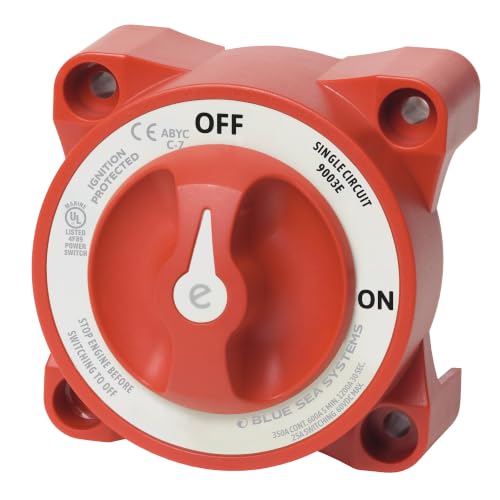
1. Blue Sea Systems e-Series On/Off Battery Switch, 350A
Our pick — over 4.5★ from 700+ verified ratings; the strongest balance of quality and price.
The 350A headroom that shrugs off golf carts, outboards, and camper banks without breaking a sweat.
This is the switch you buy when the load could be serious. Its 350A continuous rating covers a 48V electric golf cart or a 120hp Yamaha outboard, both of which show up in owner feedback. Tinned copper studs accept multiple cables and hold high-torque connections, so you are not fighting a stripped post halfway through the job. Amazon’s customer consensus is unusually specific: buyers report that the voltage rating matches and “far exceeds 200A max.”
The knob and face plate are textured so you can find and turn it by feel in a dark engine bay or a dim battery locker. What wins people over most is plain functionality — owners describe it as doing once more of what it should, with a solid build and a feel that justifies the step up. One owner used it on a modular battery box and noted it “sits super tight” going in with a 3 5/8-inch hole saw. Installation is a recurring theme: surface or rear-panel mounting gives you flexibility on where the switch lands, and the compact footprint opens up tight spaces.
Set your expectations on size before you buy. The housing is larger than some shoppers picture, which is the single most-discussed trade-off in the reviews — not a defect, just a fit note. One buyer mounted it on a generator and had to modify the opening to make it work, so measure your panel and hole size first. There is also no non-metallic back cover plate for the exposed studs, so if live studs concern you, plan a guard or mount it where nothing metal can bridge the gap.
Marine-grade 350A rating
- 350A continuous rating — the highest amp ceiling in this lineup, so starter and inverter loads have real margin
- Tinned copper studs take multiple cables and hold torque without fuss
- Textured knob and face let you work it by feel in low light
- Flush mount works well, and the footprint stays small enough for tight installs
Bulky terminal layout
- Physically bigger than some buyers expect — the top mention in owner feedback
- No non-metallic back cover for the exposed studs, so plan a guard if that matters
- Needs a 3 5/8-inch hole saw if you are face-mounting it, plus hardware of your own
Boats and RVs: The right switch if you run a 48V bank, a serious starter, or anything that draws hard on the crank — the amp ceiling is the reason.
Budget builds: Measure your mounting hole and available space. If the panel is tight, this housing may need repositioning.
2. SUNMORN Battery Disconnect Switch 12V-48V 6AWG Kill Switch for RV Boat
The one that arrives with the cables already crimped, so your install is a wrench job, not a parts run.
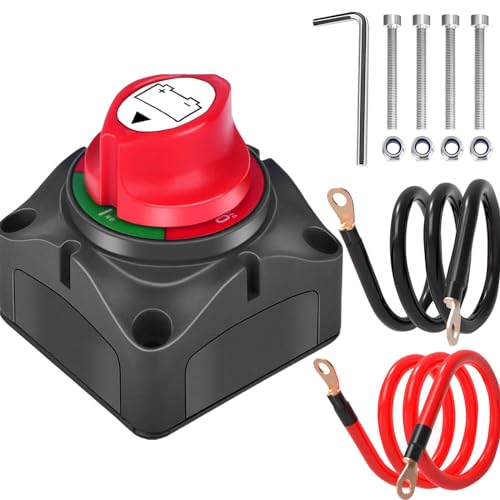
Open the box and you have almost everything: two 6AWG tinned copper cables at 1.64FT (about 20 inches) each, pre-crimped with tinned copper lugs and adhesive heat shrink, plus a 275A continuous rating. For a camper or trailer owner, that is the difference between a weekend project and an afternoon job. IT also carries an IP66 rating — a sealed housing that keeps dust and heavy water spray out of the internal contacts — and is rated from -40°F to 221°F with vibration testing for diesel and off-road use. That temperature range is why it suits a tractor in a cold barn or a boat in a hot slip.
The rotary knob has a positive detent, meaning it clicks between positions and will not drift from on to off from road bumps alone. A red/green indicator shows power state at a glance in dim light, and it draws no power when switched off. Buyers wiring it to the positive battery cable found it stops the overnight drain from a 12V fridge, outlets, and a CO detector — a common RV pain point. Setup on a battery box side is straightforward, and the compact housing mounts on a battery box or tongue box for easy reach.
Two honest caveats. The included cables run about a foot to 20 inches, which is short if your switch sits far from the battery; a buyer looking at a longer run flagged that. Also, this fits standard SAE top post batteries — if you have oversized marine terminals, confirm post size before you order, because it will not stretch to fit. And it is not UL or CE certified, so if you need a listed part for an inspection, look elsewhere.
Solar setups: You want a waterproof 12-48V switch and you would rather not source cables, lugs, and heat shrink separately.
Saltwater exposure: Your battery posts are oversized marine terminals, or you need a certified part — this one fits standard SAE top posts only.
3. 300A Boat Battery Disconnect Switch Waterproof 12V 48V Battery Shut Off Switch
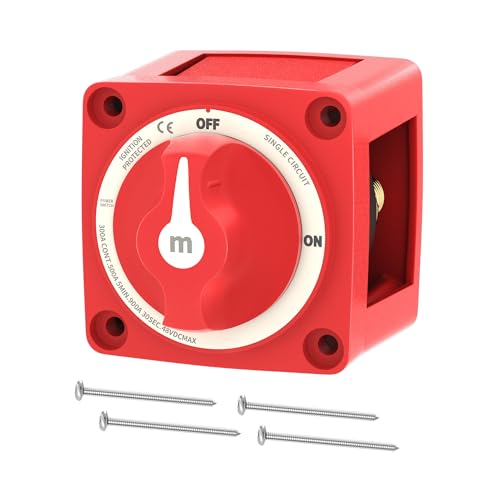
A marine-ready 300A cutoff with an ignition-protected crank rating and a roomy shell for clean wiring.
For a boat or an inverter circuit, the crank rating matters as much as the steady number. It is ignition protected to 900A for 30 seconds, 500A for 5 minutes, and 300A continuously — headroom that matters on a starting circuit. The 12-48V DC range covers trolling motors, inverter banks, and 48V lithium setups. A 24V trolling motor battery owner reported it “worked as expected” with straightforward instructions, and one boat owner used it as a cutoff for a 3000W inverter to stop power drain.
Anyone who has turned a wrench before can install this switch. The shell comes apart easily, there is real room inside for the wiring, and the base has a partition design that keeps wires from interfering with each other — a small detail that shows up when you are pushing three cables into a tight housing. The IP54 rating (protection against dust and splashing water) suits a protected marine compartment, not a fully exposed deck.
Worth being upfront about: build quality and durability are the mixed parts of the feedback here. Most owners describe it as solid and well made, but a few call it cheaply made, and one reported it lasting only 1.5 years. That is a fit note rather than a warning — if you are running a low-cycle cutoff on a trolling motor or seasonal boat, this is more than enough. If you are cycling a hard-drawn circuit daily, consider stepping to a higher amp-rated switch above.
Wet engine bays: Trolling motors, boat inverters, and 48V lithium banks where the ignition-protected crank rating is the deciding spec.
Indoor panels: You want decades of daily cycling from a switch — a few owners mention the plastic housing feeling lighter than expected.
4. Spurtar Battery Disconnect Switch 12V 24V 48V Heavy Duty Battery Shut Off

A metal-bodied 200A cutoff with the connectors already in the box, built to take heat and sun without cracking.
Two things sell this switch to trailer and golf cart owners. First, the housing is metal rather than plastic, which matters in a hot, sun-exposed install — a 2016 trailer owner upgrading from acid to lithium specifically picked the metal unit for Southern California heat. Second, it carries a 200A continuous and 1000A intermittent rating for 12-48V DC systems, enough for a 48V 100AH LiFePO4 golf cart battery. Customers note using it exactly there to solve a slight drain, and the ON/OFF click is firm and clear when you flip it.
The kit padding is real value: you get the switch, two 3/8-inch copper lugs, two heat shrinks, and two rubber terminal insulator sleeves to prevent incidental shorting and clean up the wiring presentation. The face plate reads on/off clearly, and the pointers sit 180 degrees apart so you can install the switch in either orientation. Durability is the thing owners point to most — it holds up better than the price suggests.
Two things to know before you buy. The knob on the on/off stem lacks flats to match the shaft, so a mini lock washer is what holds it — do not lose it. And the adjustability of the mounting and terminals gets some pushback; the size is also a mixed point, with some finding it perfect and others too big for their application. A trailer owner had to swap the trailer connection because it did not fit the bolt. Check your lug sizes first.
Heavy-duty brass contacts
- Metal housing handles engine-bay and sun-exposed installs where plastic fatigues
- 1000A intermittent rating gives real surge headroom for a 48V golf cart
- Ships with lugs, heat shrink, and terminal insulators — no extra parts run
- Firm ON/OFF click with clear face plate markings
Short mounting bolts
- The knob has no flats on the shaft — the mini lock washer is load-bearing, keep it
- Mounting footprint is a mixed point; some owners find it larger than their space allows
- Terminal bolt sizing can mismatch a trailer’s existing connector
Trucks and tractors: Golf cart and trailer owners who want a metal body and a full kit at an entry-level point.
Thin cables: Measure your mounting space and confirm your lug and bolt sizing before ordering.
5. Joinfworld 12V Battery Disconnect Switch with Side Post Mounting Bracket, 200A

The bracket-included 200A switch that clamps straight onto the post and skips the panel cutting.
Most switches here assume you will drill a panel and bolt them in. This one ships with a heavy-duty steel side post mounting bracket, so it mounts right at the battery and you skip the cut-out job entirely. It carries a 200A continuous rating, a 1000A intermittent crack rating, and 2 x 3/8-inch (M10) tinned copper studs with nuts. The IP65 rating means the housing is sealed against dust and water spray, which is the right level for engine bays and exteriors. It runs a simple on/off two-position design for 12-48V DC systems.
Owners describe the fit as quick. One buyer used it on an RV battery, another on a boat with a winch, and the recurring theme is that it is easy to set up. A car owner used it to kill a parasitic drain from a computer module that would not sleep, running it daily for about two months with no complaints. The package includes three stainless steel mounting screws, two 3/8-inch copper lugs, and two rubber terminal insulators to help fix the switch tightly.
Two honest notes. A few owners found the switch action lighter than expected — one specifically mentioned it turns without much resistance, which is a feel preference rather than a fault. And the quality and durability mentions are mixed rather than uniform praise, so if your circuit is high-draw, a higher continuous rating above is the safer call. For a typical RV, boat, or winch cutoff, though, it does the job.
Top-post batteries: You want a switch mounted at the post with zero panel fabrication, and the included bracket is the reason.
Side-post only: Your load runs near the top of a 200A circuit — the Blue Sea and the 300A unit above carry more.
6. 12-48V Master Battery Disconnect Switch, High Current 200A Battery Power Cutoff Isolator

An all-metal 200A switch with a rotary lever and a face plate, and the install takes minutes.
If you want a heavy chunk of metal without spending much, this is the one. It is a 200A continuous, 1000A intermittent switch for 12-48V DC systems, built with an aluminum alloy housing that is meant to stand up to weather and rough handling. The rotary lever turns with a definitive click, and the on/off indicator on the face plate makes the state obvious. Owners describe it as a large, all-metal switch that feels substantial — several compare it favorably to a cheap plastic on/off switch at a similar price point. Setup is a bolt-on job with no modifications required.
The listing spells out the install steps: disconnect the battery and pick the negative cable, choose your mounting position, connect the positive and negative cables (not at the same time), install the switch, then reconnect and test. A trailer owner runs one to power a winch and reports a positive click turning it on and off. A golf cart owner found it large but fitting nicely, and the “dead man switch” framing comes up more than once — this is the switch people reach for when they want to physically cut power.
The thing to note is the reliability mention, which comes up more than any other single point in the feedback and reads mixed rather than glowing. That is worth knowing if you are running a high-cycle circuit. It carries a 1-year warranty against failure. For a seasonal trailer, a winch, or a low-use cutoff, owners have had good results.
Inverter banks: You want heavy all-metal construction, a rotary lever, and a face plate without stretching the budget.
Small gauge wire: You will cycle the switch hard every day — the reliability column is the honest variable here.
7. Remote Battery Disconnect Switch 12V 200A Kill Switch with Remote Control

Kill your battery from the driver’s seat with a key fob — no hood, no wrench, no reaching.
This is a different animal from every manual switch above. It is a 200A DC12V remote-controlled switch built for a 360A starting load, so you disconnect and reconnect the battery from a fob button. The install is a two-step: connect the red wire to the positive post, then fix the battery clip to the negative post. The black negative wire is pre-installed at the bottom of the switch, and the product connects to your car’s original negative cable. Reviewers point out killing a parasitic drain that flattened a battery in about an hour, and one has run it since 2022 with no failures.
The fob runs on two stacked CR2016 lithium batteries that shoppers say lasting years. Two remotes come in the box, so you have a spare. The application list runs wide — cars, trucks, RVs, travel trailers, campers, SUVs, ATVs, UTVs, and boats with a 12V battery are all covered. For an overland camper, this gives you a fast way to cut power to exterior LED lights and accessories from inside the rig.
The catches are worth front-loading. This is a 12V-only product, so a 24V or 48V system is out of scope — the manual 12-48V switches above cover those. And on some vehicles you must wait about 6 seconds after reconnecting before pressing the start switch.
Dash-mounted cutoff: You want anti-theft and drain protection from a key fob, without popping the hood every time.
Simple manual setups: You run a 24V or 48V system, or you want a plug-and-play install with clear instructions — the manual switches above fit better.
Understanding the Specs
Continuous Amp Rating
The continuous rating is the current a switch can carry steadily without overheating — the number that decides whether it survives your starter, winch, or inverter. A 200A continuous switch suits a car, a trailer winch, or a trolling motor. A 350A continuous switch exists for heavier loads like a big diesel starter or a 48V golf cart bank. Always match the switch’s continuous rating to what your circuit actually pulls, not what looks impressive on the spec sheet.
Intermittent and Crank Ratings
The intermittent rating is the short burst a switch can take before it is designed to rest. You will see figures like 1000A intermittent, or an ignition-protected crank rating such as 900A for 30 seconds, 500A for 5 minutes, and 300A continuously. These matter when the switch sits on a starting circuit, where the surge happens every time you turn the key. For a plain kill switch on an accessory circuit, the continuous number is the one that governs day-to-day reliability.
IP Ratings and Water Resistance
An IP rating tells you how well the housing keeps out dust and water. IP65 covers dust and low-pressure water spray, suitable for engine bays and exterior mounts. IP66 handles heavier water spray, which is why boat and off-road owners look for it. A sealed rotary design with a reinforced O-ring keeps water and debris off the internal contacts — the failure mode that causes intermittent switching over time. Match the rating to where the switch will live, not to the worst case you can imagine.
Terminal and Stud Sizing
The stud size decides what cables fit and how tight you can torque them. Common sizes are 3/8-inch (M10) tinned copper studs, which accept multiple cables and hold a high-torque connection. Tinned copper resists corrosion better than bare copper, which matters on boats and in humid climates. Check your existing lug and bolt sizes before ordering — a switch whose studs do not match your cables means a return trip to the parts store.
FAQ
What amp rating do I need for a 12V car battery disconnect switch?
Will a 200A switch work on a 48V lithium golf cart battery?
Do a disconnect switch and a kill switch do the same thing?
Will a disconnect switch stop my battery from draining while parked?
Can I install a battery disconnect switch myself?
Do I connect the disconnect switch to the positive or negative cable?
Will disconnecting the battery reset my car’s settings?
Are these switches waterproof enough for a boat or a marine outboard?
How long does a battery disconnect switch last?
What hole saw size do I need to mount a battery disconnect switch?
Final Thoughts: The Verdict
For most people, the battery disconnect switch winner is the Blue Sea Systems e-Series On/Off Battery Switch because its 350A continuous rating is the highest ceiling in this lineup and it holds up to 48V golf cart and outboard use. If you want a waterproof kit with the cables in the box, grab the SUNMORN 12V-48V switch. And for a boat or inverter circuit, the 300A waterproof switch is the one to reach for, thanks to its ignition-protected crank rating.
Whichever you pick, buy the amp rating you actually need. A 200A switch covers almost every car, trailer, and trolling motor circuit here — you only step up to 300A or 350A when a starter or inverter demands it. If your rig sits for weeks between drives, any of these will end the dead-battery routine.
How We Picked
We do not accept paid placement. Every pick is matched to a real buyer and a real use-case; we do not hands-on test units.
Sources & Methodology
Specifications: manufacturer listings and product documentation. Review insights: verified customer reviews, as of September 2026. Pricing: not shown on this page (it changes often); check the current price via the retailer link.
As an Amazon Associate, Gadgets Feed earns from qualifying purchases. This does not affect which products we feature.