
Our readers keep the lights on and my morning glass full of iced black tea. As an Amazon Associate, I earn from qualifying purchases.
Specs are compiled from manufacturer listings and verified buyer reviews and can change over time — please confirm the key details on the product page before buying.
If your car’s air conditioning is blowing warm, the fastest way to know whether you are low on refrigerant or looking at a dead compressor is to read the high and low side pressures yourself. That is exactly what a manifold gauge set does. It hooks to the service ports, shows you what the system is doing, and lets you add refrigerant or pull a vacuum without paying a shop to guess. The catch is that these kits look almost identical online, yet the fittings, hose ratings, and refrigerant compatibility vary wildly — and the wrong one simply will not thread onto your ports.
I’m Min — the founder and writer behind Gadgets Feed. This guide is built by comparing the manufacturers’ published specifications and the patterns across verified customer reviews, so you get each pick’s real strengths and trade-offs instead of marketing spin.
What follows breaks down which refrigerants each kit handles, how the hoses are rated, and which accessories actually show up in the box. The goal is simple: help you pick the ac pressure gauge set that fits your system on the first try.
Our Picks at a Glance


How To Choose The Best AC Pressure Gauge Set
The single most expensive mistake with these kits is buying a set that does not cover your refrigerant. R134a, R1234yf, R410A, R32, R22, R12, and R502 all use different couplers and can taps, so the compatibility list on the box is the first thing to check — not the last. Get that right and everything else is a question of build quality and how much you plan to use the thing.
Match the refrigerant before anything else
Older cars and most home units run R134a or R410A. Newer vehicles switched to R1234yf, which uses left-hand-thread can taps and different quick couplers. A set that lists only R134a and R410A will not seal onto an R1234yf port no matter how hard you push it. Check the refrigerant list against your vehicle’s under-hood sticker or your home unit’s data plate.
Working pressure versus burst pressure
Working pressure is the highest pressure the hose is built to hold during normal operation. Burst pressure is the point at which it fails. Most sets here are rated for 600 psi working pressure and 3000 psi burst pressure, and the heavier units jump to 800 psi working and 4000 psi burst. That higher ceiling gives you more headroom on systems that run hot.
2-way, 3-way, or 4-way manifold
A 2-way manifold runs two hoses. A 3-way adds a third service port. A 4-way lets you keep the vacuum pump and the refrigerant supply hooked up at the same time, so you can evacuate and charge without swapping hoses mid-job. If you do this more than once a year, the 4-way saves real time.
What actually ships in the box
The gauge and hoses are only half the story. Self-sealing can taps, piercing taps, R410A adapters, and 1/4″ to 1/2″ ACME adapters are the pieces that decide whether the kit works on the refrigerant source you already own. A set missing the right can tap means another order and another wait.
Quick Comparison
| Model | Best For | Refrigerants | Working / Burst Pressure | Manifold Type | Amazon |
|---|---|---|---|---|---|
| OMT AC Manifold Gauge Set 4 Way★ Best Overall | Cars and A/C systems on R1234yf or R134a | R1234yf, R404a, R134a | 800 psi / 4000 psi | 4-way | Amazon |
| CALPOSE AC Manifold Gauge SetBest Value | Mixed home and auto systems on R410A | R134a, R410a, R32, R22 | 600 psi / 3000 psi | 3-way | Amazon |
| VEVOR 4 Way AC GaugeTop Performer | DIY car A/C and home units on R134A | R134A, R12, R22, R410A | 800 psi / 4000 psi | 4-way | Amazon |
| WISSCOOL HVAC Manifold Gauge Set | Light-duty DIY work on older refrigerants | R134a, R22, R12, R502 | 600 psi / 3000 psi | 3-way | Amazon |
| OMT 3-Way AC Manifold Gauge Set | Home garage AC diagnostics on R134a | R134a, R12, R22, R502 | 600 psi / 3000 psi | 3-way | Amazon |
| Lichamp R134a R502 Manifold Gauge Set | Budget-friendly R134a charging | R134a, R502 | 600 psi / 3000 psi | 3-way | Amazon |
| Lichamp HVAC R410A Manifold Gauge Set | R410A and R32 systems, home or auto | R134A, R32, R410 | 800 psi / 4000 psi | 3-way | Amazon |
| VIVOHOME 4 Way HVAC Gauges | R1234yf and R32 mini-split work | R134a, R1234yf, R410a, R404a, R32 | 800 psi / 4000 psi | 4-way | Amazon |
| Mastercool 89660-PRO5 | Frequent R134a service work | R134a | — | 2-way | Amazon |
In‑Depth Reviews
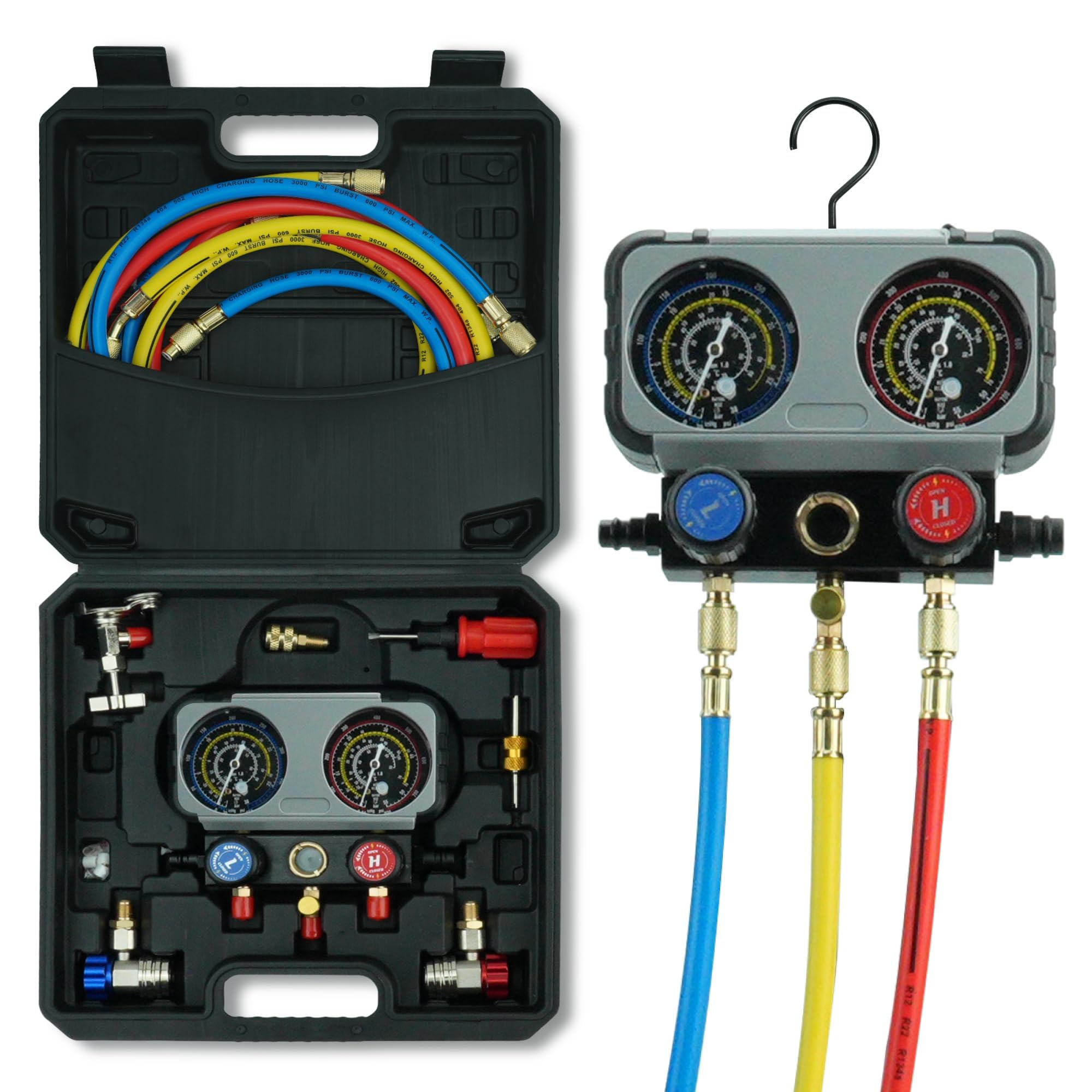
1. OMT AC Manifold Gauge Set with 5ft Hoses for R1234yf R404a R134a, 4 Way
Our pick — 4.5★ from 350+ verified ratings; the strongest balance of quality and price.
The only kit here with couplers and can taps for both R1234yf and R134a in one box.
If your driveway holds one vehicle on R1234yf and another on R134a, this is the set that stops you from buying two kits. Orion Motor Tech ships a 4-way gauge with four hoses, two quick couplers for R1234yf and two for R134a, a self-sealing can tap for each of those refrigerants, and two 1/4″ male to 1/2″ female adapters in left-hand and right-hand thread.
What wins people over is the guts of the thing. The oil-filled gauge core resists wear and shock from being tossed in a truck bed, and the dry dial is built to keep reading properly in cold weather when a liquid-filled needle gets sluggish. Calibration screws hold accuracy to within 1.6%. The hoses are color-coded PVC with four reinforced layers, rated to 800 psi working pressure and 4000 psi burst pressure — compare that to the CALPOSE set below at 600 psi working and 3000 psi burst, and the OMT carries meaningfully more headroom. It runs 8.4 pounds against the VEVOR’s 6.78 pounds, so it is the heavier kit of the two, and the aluminum body with pure copper fittings is built to shrug off rust and corrosion.
The honest trade-off is the case. It is small for stowing four 5-foot hoses neatly, so expect to coil them with a little patience. The taps for R1234yf also use left-hand thread, which trips up first-timers — they need an extra snug turn compared to what your hands expect. Buyers report the kit covered a full R1234yf refill using a vacuum pump and a can of refrigerant, with the whole job done at home instead of a shop.
What earns its keep
- Handles R1234yf, R404a, and R134a — the widest refrigerant spread in this lineup
- Oil-filled gauge core plus a dry dial that stays readable in winter
- 4000 psi burst-rated hoses with four reinforced layers
- Calibration screws hold accuracy to within 1.6%
- Includes LH and RH thread adapters for tank and vacuum pump hookups
Worth knowing before you buy
- 8.4 pounds — the heaviest set reviewed here
- Included case is tight for four 5-foot hoses
- R1234yf can taps are left-hand thread and need a harder seating turn
- An R134a can adapter is not part of the box, so check what your supply can needs
Buy this if: you want one kit that will not be obsolete when you trade up to an R1234yf vehicle, and you value the dual coupler set.
Look elsewhere if: you only ever touch R134a systems — the CALPOSE or VEVOR sets cover that for less.
2. CALPOSE AC Manifold Gauge Set for R134a R410a R32 R22 Refrigerant
A zinc-alloy manifold with a brass conversion head that covers R134a, R410A, R32, and R22.
Here is the kit for someone who owns a home air conditioner running R410A and a car running R134a and wants one tool for both. CALPOSE lists R134a, R410A, R32, and R22 — a wider refrigerant spread than most of the auto-only sets here — and pairs it with an impact-resistant dial designed to survive the inevitable drop off a ladder. The body is zinc alloy with a solid brass conversion head, threaded for standard connections, and a sight glass lets you watch liquid refrigerant flow while you charge.
A 4-layer thickened hose carries 600 psi working pressure and 3000 psi burst pressure, with a leak-proof rubber ring at the connection. That is the same hose ceiling as the WISSCOOL and OMT 3-way sets, and comfortably below the 800 psi working pressure you get from the VEVOR 4 Way above — fine for standard home and auto systems, less headroom for systems that run hot. Accuracy is held to 1.6% with a calibration screw, and the box count here is 1 Count against the OMT’s 16 Count, which is just how the two listings count their contents, not a measure of what is in the case.
The one thing to check carefully is the coupler set. The recurring complaint among owners is that the gauge does not fit R1234yf despite what the listing implies, so buyers with a newer vehicle should treat this as an R134a and R410A tool and verify their port type first. Owners mention it beating a 2-knob set because it keeps the vacuum pump and supply bottle connected through the whole service rather than forcing a hose swap.
Where the value sits: four refrigerants and a 3-way manifold for the kind of money that makes it a low-risk first kit for a homeowner or a home mechanic.
The thing to verify: confirm your system is R134a, R410A, R32, or R22 before ordering — R1234yf owners have been caught out by the compatibility wording.
Reach for this if: you split your wrench time between a home A/C unit and an older car, and want one manifold for both.
Pass if: your vehicle runs R1234yf — the OMT 4-way at the top of this list is built for that refrigerant.
3. VEVOR 4 Way AC Gauge – AC Manifold Gauge Set for R134A R22 R12 R410A Refrigerant
A true 4-valve manifold with four 5-foot hoses rated to 4000 psi burst, at a budget price.
VEVOR pulls off something the budget kits generally do not: a genuine 4-valve manifold without a premium tag. The 4-valve layout means you can leave the vacuum pump and the refrigerant bottle plumbed in while you work, so evacuating and charging become one continuous process instead of two hose-swapping sessions. It runs R134A, R12, R22, and R410A, which covers older vehicles, house units, and refrigerator work in one box.
Scan the pressure numbers and this is the standout: 800 psi working pressure and 4000 psi burst pressure across four reinforced 5-foot PVC hoses. Those are the top figures in this roundup alongside the OMT and VIVOHOME sets, and a clear step above the CALPOSE and WISSCOOL kits at 600 psi working and 3000 psi burst. Anti-slip sealing gaskets at each hose interface resist working loose mid-job, which is exactly where leaks start. The gauge mixes a dry and liquid-filled design, holds accuracy to ±1.6% with calibration screws, and shows Fahrenheit units for quick reading. A sight glass confirms refrigerant flow while filling. It weighs 6.78 pounds — lighter than the OMT’s 8.4 pounds — and the complete set runs to a 4-valve gauge, two quick couplers, three adapters, a valve core wrench, a screwdriver, a hook, gaskets, O-rings, and a manual.
The completeness is the soft spot. Some kits arrive short a connector, and the listing’s own photo of a “LOW”-labeled fitting has been the reference point for that dispute, so open the case and check every piece against the parts diagram before you start a job. A fitting working loose on the first run and spraying refrigerant is a known first-use hiccup that tightening solves. Customers note charging two cars from one kit and zeroing the gauges from the start.
Why buyers keep it
- True 4-valve manifold at a budget-friendly tier
- 800 psi working and 4000 psi burst-rated hoses
- Anti-slip sealing gaskets resist loosening under pressure
- Covers R134A, R12, R22, and R410A
- Accessory count is generous for the price tier
Where it needs a check
- Kits have arrived missing a connector — inventory the case first
- Loose fittings on the first charge spray refrigerant until tightened
- Modern reclosable R134a cans have been a compatibility snag for some
Built for: the DIY owner who wants a 4-way manifold and heavy hose ratings without paying premium money for it.
Second-guess it if: you would rather not inventory a parts diagram before every job.
4. WISSCOOL HVAC Manifold Gauge Set 3-Valve for R134a, R22, R12 R502

A built-in moisture indicator on the manifold, which no other kit at this price includes.
Most kits at this tier give you gauges and hoses and call it a day. WISSCOOL adds a built-in moisture indicator, which lets you eyeball refrigerant condition during a service instead of waiting for a symptom. It is the feature to lead with here, because nothing else in this price band offers it. The three-valve manifold ships with three 5-foot hoses, adjustable R134a couplers, both self-sealing and piercing can taps, a valve core key, an adapter, a pipe thimble, and replacement seals.
The gauges read in °F with calibration screws for fine adjustment, and the two dials are split by range: the low side measures 0–350 PSI and the high side measures 0–450 PSI. That split range is genuinely useful — it spreads the low-side scale out so small changes are easier to see. Hoses are three-layer PVC in red, blue, and yellow, rated 600 psi working and 3000 psi burst, the same ceiling as the CALPOSE set. The manifold body combines brass, aluminum, ABS, and rubber, and a rear hanging hook keeps it off the ground while you charge. Service covers R134a, R12, R22, and R502.
What gets mentioned most is simply the quality of the build relative to what it costs, and the easy-read gauges back that up. The catch is fitting quality: the recurring complaint is couplers and fittings that take real effort to seat, and valve seepage shows up on some units. It is a light-duty set, better suited to adding R134a in a driveway than to daily shop use. Reviewers point out holding 250 psi on the high side without leaks after tidying up the valve ends.
What you are really buying: a compact three-valve set with a moisture indicator and a rear hanging hook, sized for occasional driveway service.
The honest limit: seating the couplers takes patience, and this is a light-duty tool rather than a shop-grade daily driver.
Suits you if: you want an easy-read 3-valve set with a moisture indicator for occasional home and auto work.
Skip the upgrade path: if you service systems weekly, step up to the Mastercool’s piston-valve design instead.
5. OMT 3-Way AC Manifold Gauge Set for R134a R12 R22 R502, 5 ft Hoses

The only kit here that includes shatter-proof glasses and nitrile-coated work gloves.
Refrigerant is nasty stuff, and this is the one set that treats safety as part of the product instead of an upsell. Orion Motor Tech includes nitrile-coated work gloves and shatter-proof glasses with the kit, which matters if you have never purged a line before and are learning on your own car. Alongside the gloves you get the 3-way diagnostic manifold with XL gauge dials in Fahrenheit and large print, plus thickened rubber covers on the dial heads for grip and drop protection.
Hoses are rated 600 psi working pressure and 3000 psi burst pressure, wrapped in a rugged neoprene coating that stays flexible in the cold — a real advantage if you work in an unheated garage in winter. Standard 1/4 inch female flare fittings carry a valve core depressor, and one end has a 45° bend so you can reach ports that sit awkwardly against a firewall. The build mixes solid brass, aluminum, ABS, and rubber. Refrigerants covered are R134a, R12, R22, and R502, and the box includes R134a couplers, a 29° adapter, both self-sealing and piercing can taps, a wrench, and a screwdriver.
The friction is in the fittings and the can tap. Coupler quality and occasional leaking gauges are the recurring notes, and the R134a can tap is described as clunky and awkward with self-sealing cans — many owners simply use their own tap. Outside of that, DIYers report accurate readings, no leaks on a soapy-water test, and spare seals included for when the originals wear. It is a solid 3-way choice if you accept that the tap is the weak link.
The reasons to pick it
- Gloves and shatter-proof glasses included — unique among these nine sets
- XL Fahrenheit dials with large print and rubber head covers
- Neoprene-coated hoses stay flexible in cold weather
- 45° bend on one hose end reaches tight ports
The reasons to hesitate
- R134a can tap is clunky with self-sealing cans — plan to use your own
- Coupler quality varies, and leaking gauges come up in feedback
Worth it for: the first-timer who wants safety gear, big readable dials, and cold-weather hose flexibility in one purchase.
Think twice if: your job depends on the included can tap — budget for a replacement from the start.
6. Lichamp R134a R502 Diagnostic Manifold Gauge Set with 5FT Hose
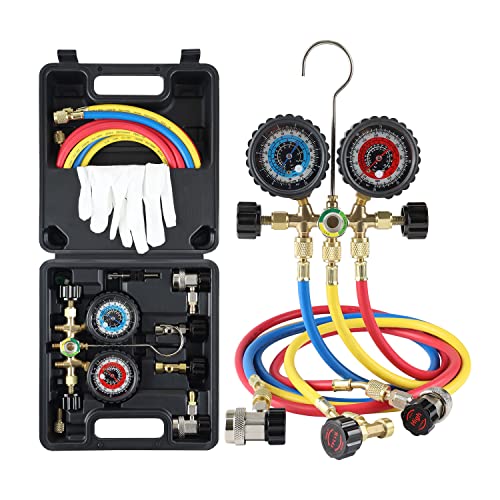
A 3-way R134a set with two can taps, two adjustable adapters, and an ACME adapter at an entry-tier price.
Shop around the entry tier and most kits give you one can tap. This one hands you two, plus two adjustable R134a adapters, an ACME adapter, a valve core remover, and gloves — the accessory count is where the value hides. The 3-way diagnostic manifold covers R134A and R502, aimed at freon charging, evacuation, diagnostics, and recovery. Dials are extra large and colored with Fahrenheit units, the red gauge rated to 500 psi max and the blue to 350 psi max, and a sight glass shows liquid refrigerant moving while you charge.
Hoses are the extra-long 5-foot high-impact type, thickened with a precise valve core depressor and a 45° bend on one end, rated 600 psi max working pressure and 3000 psi burst pressure — matching the WISSCOOL and CALPOSE hose ceilings rather than the 800 psi working pressure of the VEVOR 4 Way. The gauge shell is upgraded and built to take drops, with metal parts in brass and aluminum. At 5.6 pounds it sits mid-pack on weight, lighter than the OMT 4-way at 8.4 pounds.
What works in its favor is that it simply functions — the functionality of this set draws more positive comment than any other single trait, which is a good sign for a kit at this tier. Where it needs care is the seals and the fittings: the rubber hose O-rings and gaskets are the weak point, with owners swapping in better seals and tightening all fittings before first use. The low gauge has read a few PSI high for some, the high gauge stays spot on for others. Budget it as a capable DIY kit rather than a lifetime tool.
Where the money goes: two can taps, two adjustable adapters, an ACME adapter, and a valve core remover — the fullest small-parts bag of the entry-tier sets.
The maintenance note: plan to swap the rubber seals for name-brand ones and tighten every fitting, which shoppers say turns it into a leak-free kit.
Pick this if: you want a low-risk R134a starter set with the fullest accessory kit at its tier.
Budget in seals if: you plan heavy use — the stock rubber gaskets are the first thing to upgrade.
7. Lichamp HVAC R410A Manifold Gauge Set AC R134A, Freon R32 410A 134A Diagnostic Manifold Gauge with Hose Kit
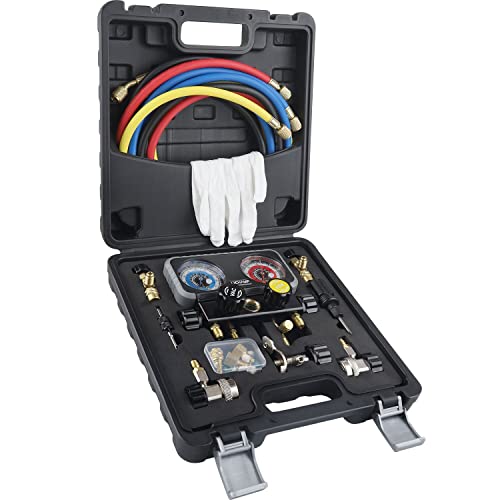
Rated for R410A: a 550 psi blue low-side dial, an 800 psi red dial, and 4000 psi burst hoses.
R410A systems run hotter and higher than R134a, and this kit is scaled for exactly that. The blue low-side dial reads up to 550 psi and the red high-side dial to 800 psi, both extra large and colored in Fahrenheit for quick glancing. Four 5-foot high-impact hoses carry 800 psi max working pressure and 4000 psi burst pressure, matching the top hose ceiling in this roundup and leaving plenty of margin over the CALPOSE and WISSCOOL sets at 600 psi working and 3000 psi burst. Refrigerant coverage is R134, R32, and R410.
What ships in the box is broad: a 4-valve gauge, four hoses, two adjustable R134A adapters, two R410A liquid safety valves, an adjustable can tap, two tank adapters, an R410a swivel adapter, a calibration screwdriver, a valve core remover, and gloves. The two R410A liquid safety valves are the piece you will not find in the auto-oriented kits, and they are what make this a legitimate home A/C tool. The build is alloy steel and copper alloy. Reliability is the trait that carries it — the set keeps working job after job, and the adapter spread means it can serve both a car and a home unit without buying extra couplers.
The recurring snag is hose connectivity. The hoses seal when you tighten them but tend to work loose again, so expect to re-check every connection mid-job. Fittings have leaked for some owners, and accuracy draws divided opinions, with even a pro-level reviewer calling the gauges workable rather than precise. The R32 tank adapter has been a sticking point for some. It is a great beginner-to-intermediate set that will not embarrass you, provided you tighten and re-tighten as you go.
Why it earns a slot: R410A-rated safety valves, 800 psi working hoses, and the widest adapter bag among the 3-way kits here.
Plan for it: re-tighten the hoses partway through every job — sealing is good, staying sealed is the watch point.
Best matched to: a homeowner or beginner tech servicing R410A equipment who wants maximum hose headroom and a full adapter set.
Not for you if: you need dials precise enough for critical charging — the gauges here are workable, not laboratory grade.
8. VIVOHOME 4 Way HVAC Gauges with R134a R1234yf Quick Couplers and Can Taps
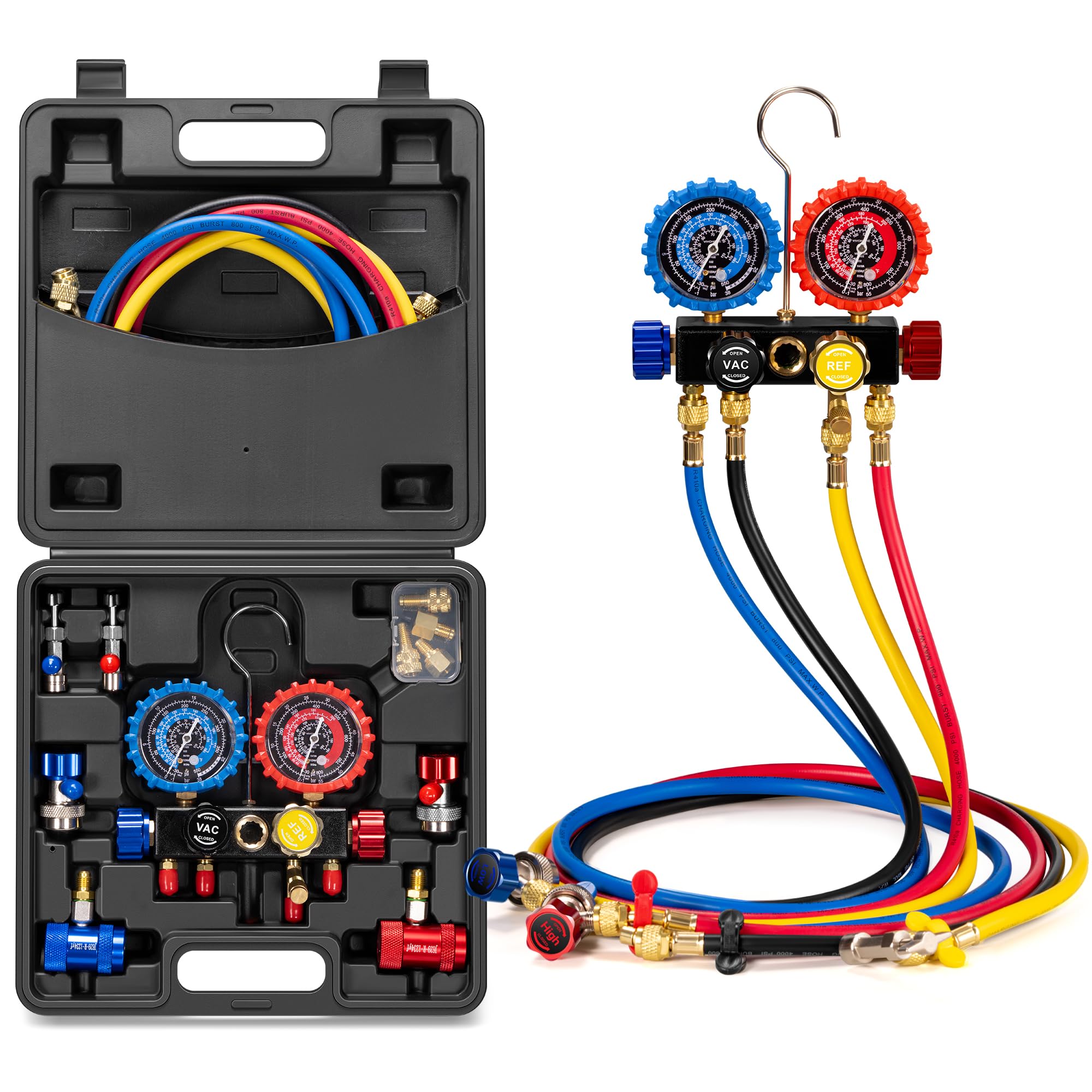
Covers five refrigerants with four color-coded hoses and an unloading valve most kits here omit.
This is the broadest refrigerant coverage on the list — R134a, R410a, R404a, R32, and R1234yf, spanning both the older A1 refrigerants and the newer A2L class. If you work across a mixed fleet or maintain a mini-split alongside a car, that coverage alone justifies a look. The 4-way manifold delivers pressure readings across the range, and the wear-resistant, impact-resistant gauge core pairs with a dry dial tuned for cold environments. Calibration screws hold precision to within ±1.6%.
The safety details punch above the price tier. An unloading valve releases excess pressure during maintenance, which is a feature most kits here omit, and it comes with a sturdy hanging hook for hands-free work plus a carrying case for storage. Four 5-foot PVC hoses are color-coded red, blue, yellow, and black to mark high-pressure, low-pressure, charging, and evacuation lines, each with four reinforcement layers and rated 800 psi working pressure and 4000 psi burst pressure — the same top-tier hose rating as the OMT and VEVOR sets, well clear of the 600 psi working pressure found on the CALPOSE and WISSCOOL kits. The box includes four quick couplers, self-sealing can taps for both R1234yf and R134a, two 1/4″ male to 5/16″ female adapters, and two 1/4″ male to 1/2″ female adapters in LH and RH thread.
What you should weigh is that this is the newest listing here and the lightest on feedback, so it has less of a track record than the Mastercool or the Lichamp kits. What feedback exists is positive on function — the set held a nitrogen pressure test above 400 psi and a vacuum reading for a full day without valve leaks on one R-32 mini-split job, which is meaningful confirmation for a mini-split buyer. The occasional unit arrives with a sight glass that needs sealing. Treat it as a strong, well-equipped set for the money rather than a proven long-runner.
Where it stands out
- Five refrigerants including R1234yf and R32
- Unloading valve for releasing excess pressure
- 800 psi working and 4000 psi burst-rated hoses
- Color-coded hoses for all four lines
- Hanging hook and carrying case included
What to weigh
- Newest listing here with the fewest reviews behind it
- The occasional unit arrives with a sight glass that needs resealing
Made for: a mini-split installer or mixed-fleet owner who needs R32 and R1234yf coverage plus an unloading valve.
Compare before choosing: if you want a longer track record, the OMT 4-way at the top has more history behind it.
9. Mastercool 89660-PRO5 R134a 2-Way Manifold Gauge Set
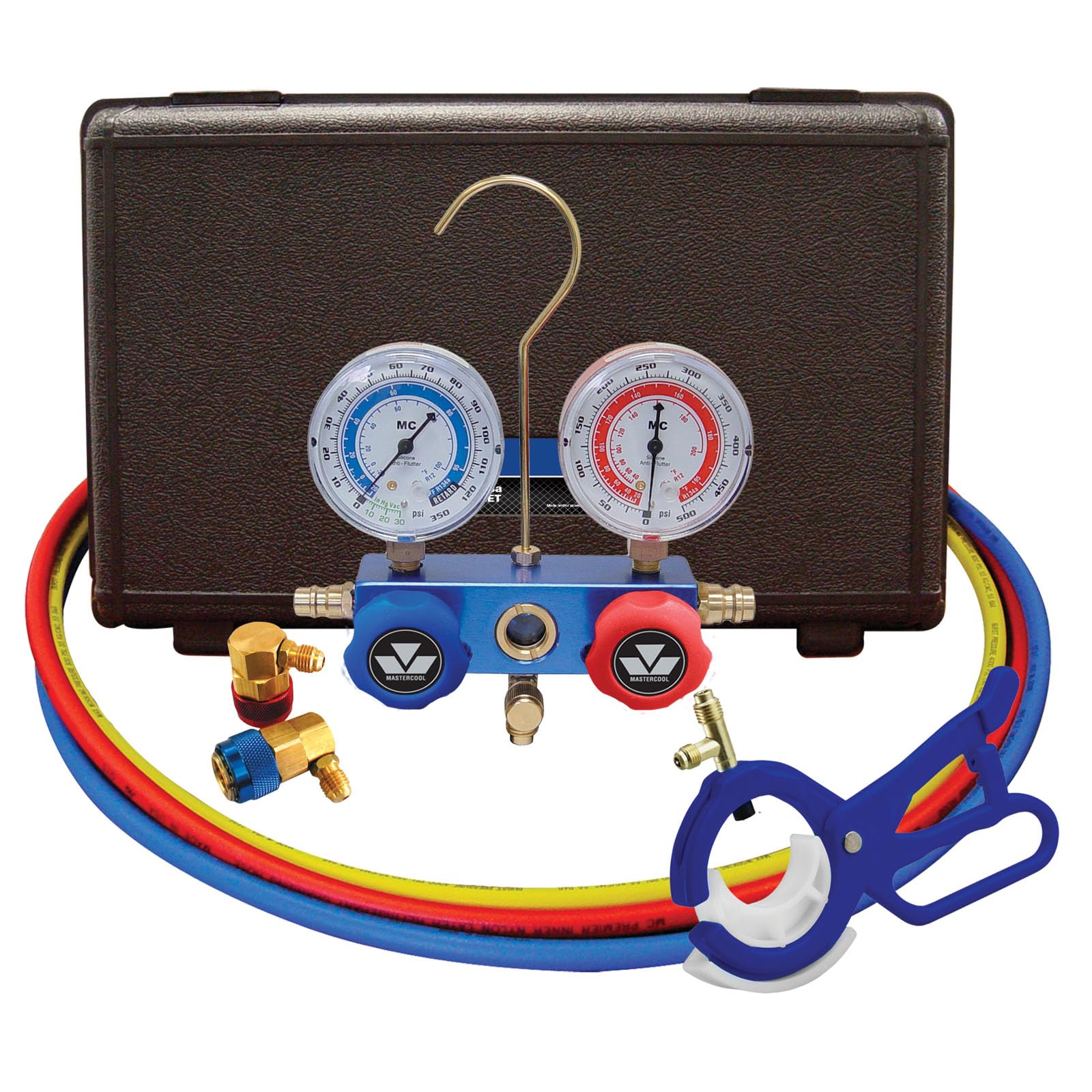
The R134a-only set built for people who reach for their gauges every week.
Strip the whole category down and this is the one for the technician. Mastercool designs the 89660-PRO5 specifically for R134a automotive A/C systems, which means no adapter guesswork — it does one refrigerant and does it with the kind of hardware that survives daily handling. The extruded aluminum body uses free-floating piston valves that cut down the O-ring wear that eventually kills cheaper manifolds, and the silicone-dampened 2.5″ gauges steady the needle so flutter does not hide the reading you are chasing.
The details that separate it from the budget kits are functional: an extra-large sight glass for quick refrigerant flow checks, 60-inch SAE-approved nylon barrier hoses, and a 3-in-1 side mount can tap valve for both refrigerant and oil charge cans. It ships and stores in a heavy-duty blow-molded carrying case, and it is a 2-way manifold, so it is not built to hold a vacuum pump and a supply tank at once the way the 4-way OMT and VEVOR sets are. That is the trade: fewer simultaneous connections, but thicker, more serviceable parts in the ones it does have.
The honest wrinkle is the connectors. Couplers and the sealing mechanism are the parts that draw complaints, with the high-side quick connect reportedly stopping sealing after repeated use. Set that against the overwhelmingly positive picture on function and the fact that owners regularly compare it to rebranded tool-truck sets at several times the money, and it lands as a set worth the premium if you use it as intended. It wants a vacuum pump for evacuation and quick-connect fittings to avoid cross-threading ports.
The upgrade it delivers: piston valves that reduce O-ring wear, silicone-dampened gauges that steady the needle, and 60-inch SAE-approved nylon barrier hoses — the durability story here is about the parts that fail first on cheap sets.
The one watch point: the high-side quick connect has reportedly given out after repeated use, so keep an eye on it and treat the connectors gently.
This is for: the R134a specialist who wants gauges that will still be accurate on their two-hundredth job.
Wrong pick if: you need R1234yf or R410A coverage — this one stays deliberately narrow to R134a.
Understanding the Specs
Working Pressure vs. Burst Pressure
Working pressure is the highest pressure a hose is designed to hold during normal operation — the number that matters every time you connect to a system. Burst pressure is the point where the hose gives out entirely. Across this roundup, the entry and mid kits are rated at 600 psi working pressure and 3000 psi burst, while the heavier sets move up to 800 psi working pressure and 4000 psi burst. Higher working pressure gives you more safety margin on systems that run hot, and higher burst pressure is your backstop if something goes wrong. Look at both numbers together, never one without the other.
Manifold Type: 2-Way, 3-Way, 4-Way
A 2-way manifold runs two hoses — one to the low side, one to the high side — which is enough for straightforward pressure checks and charging. A 3-way manifold adds a third service port, giving you a dedicated charging or evacuation line. A 4-way manifold adds a fourth, which lets you keep both the vacuum pump and the refrigerant source connected at the same time. The practical difference shows up in a full service: a 4-way set lets you evacuate and then charge without disconnecting and reconnecting hoses between steps. If you do this more than once or twice a year, that convenience is worth the step up in cost.
Refrigerant Compatibility and Couplers
Each refrigerant type needs its own couplers and can taps, and mixing them up means the fitting will not seal onto your port. R134a and R410A are the common pair for older autos and household units; R1234yf is the newer automotive refrigerant and uses left-hand thread can taps and distinct quick couplers; R32 and R502 show up on specific modern mini-splits and older systems. Check the refrigerant list on the box against the sticker under your hood or the data plate on your home unit before buying. The right accessory bag — the right can taps and adapters — is what turns a kit from a paperweight into a working tool.
Accuracy, Calibration, and Sight Glasses
Accuracy on these sets is usually stated as a percentage — 1.6% shows up across the OMT, VEVOR, CALPOSE, WISSCOOL, and VIVOHOME kits. That number tells you how close the gauge reading is to true pressure, and the calibration screw on each dial lets you zero it back in if it drifts after a knock. A sight glass is a small window on the manifold that shows liquid refrigerant moving when you charge, so you can confirm flow instead of guessing. Combined, a tight accuracy figure and a working sight glass are what let you trust the number on the dial when a vehicle’s cooling performance is on the line.
FAQ
Will a gauge set for R134a work on an R1234yf car?
What is the difference between working pressure and burst pressure on these hoses?
Do I need a 4-way manifold or is a 3-way enough?
What can tap do I need for R134a self-sealing cans?
Can I use these gauges on a home air conditioner as well as a car?
Why do the hoses on these kits eventually leak?
Do these gauge sets include the vacuum pump?
Are the gauges accurate enough for professional diagnostic work?
What is included besides the gauges and hoses?
How do I keep a new gauge set from leaking on the first job?
Final Thoughts: The Verdict
For most buyers, the ac pressure gauge set winner is the OMT AC Manifold Gauge Set 4 Way because it covers both R1234yf and R134a with the couplers and can taps for each, and its 4000 psi burst-rated hoses leave the most margin in this roundup. It is the one kit that will not need replacing when your next vehicle changes refrigerant. If you want a home A/C set with R410A liquid safety valves and maximum hose headroom, grab the Lichamp HVAC R410A Manifold Gauge Set. And for an R134a specialist who wants silicone-dampened gauges and piston valves built to outlast the cheap stuff, the Mastercool 89660-PRO5 is the quiet upgrade worth planning for.
One last thing worth knowing: the highest-rated set here is the OMT 4-Way at 4.5 stars, and it earns that amid the most buyer feedback in the group — so if you want the set with both the best coverage and the broadest owner experience behind it, that is the one to start with.
How We Picked
We do not accept paid placement. Every pick is matched to a real buyer and a real use-case; we do not hands-on test units.
Sources & Methodology
Specifications: manufacturer listings and product documentation. Review insights: verified customer reviews, as of September 2026. Pricing: not shown on this page (it changes often); check the current price via the retailer link.
As an Amazon Associate, Gadgets Feed earns from qualifying purchases. This does not affect which products we feature.