
Our readers keep the lights on and my morning glass full of iced black tea. As an Amazon Associate, I earn from qualifying purchases.
Specs are compiled from manufacturer listings and verified buyer reviews and can change over time — please confirm the key details on the product page before buying.
Buying 240V wire is really a question of three things: the right gauge for your amperage, a voltage rating that covers your circuit, and a jacket that survives the pull. Get the gauge wrong and the wire runs hot. Get the length wrong and you are splicing in a crawlspace at midnight. This guide breaks down eight copper wires that owners actually put into panels, sheds, EV chargers, and generator inlets, so you can match one to your job in about five minutes.
I’m Min — the founder and writer behind Gadgets Feed. This guide is built by comparing the manufacturers’ published specifications and the patterns across verified customer reviews, so you get each pick’s real strengths and trade-offs instead of marketing spin.
Most 240V jobs come down to how the wire handles bends and terminations, so the picks below lean on pull-ability. That is exactly what separates a smooth weekend install from a frustrating one with any 240v wire.
Our Picks at a Glance
How To Choose The Best 240V Wire
Every 240V circuit needs two hot conductors, and most need a neutral and a ground on top of that. The wire you pick has to carry the amperage your breaker is sized for, fit the space you are pulling through, and be rated for where it lives. Here is what actually drives the decision.
Match The Gauge To The Breaker, Not The Price
Gauge (written as AWG, where a smaller number means a thicker wire) decides how much current the copper can carry before it heats up. A 14 AWG conductor is commonly used on 15 amp residential branch circuits, and 12 AWG steps up to 20 amp work. Thicker 10 AWG and 6 AWG go where the loads get serious — electric ranges, subpanels, EV chargers and generator feeds. Oversize the gauge on a long run and you cut voltage drop; undersize it and the wire warms under load. Gauge matters more than brand.
Stranded Or Solid Copper
Stranded copper is made of many thin copper strands twisted together, which makes it bend easily around tight conduit bends. Solid copper is one firm conductor, which holds a shape and staples flat against a stud. If your run threads through conduit with several 90-degree bends, stranded saves your forearms. If you are running cable along joists in an open basement, solid is tidy and fast. Both are pure copper here — no aluminum or copper-clad aluminum impostors in this lineup.
Indoor Sheath, Single Conductor, Or Burial Rated
NM-B is a flat sheathed cable for dry indoor locations — inside wall cavities, attics, basements and garages. THHN is a single insulated conductor that lives inside conduit. UF cable is built for direct burial outdoors. Picking the wrong one is the most common mistake: NM-B is not a burial wire, and THHN needs a raceway to protect it. Pick the cable format for the location first, then the gauge.
The Ratings That Actually Matter
A 600V rating covers any residential 240V circuit with headroom to spare. A 90°C temperature rating means the insulation tolerates a hot conductor. UL listing means the wire has been tested to a published standard, and several picks here print a verifiable E-file number on the jacket. Those three marks are the baseline; everything else is convenience.
Quick Comparison
| Model | Best For | Gauge | Conductors | Length | Amazon |
|---|---|---|---|---|---|
| THHN Wire 10 Gauge 25 FT Stranded Copper, Red★ Best Overall | Pulling through tight conduit | 10 AWG | 7 strands | 25 Feet | Amazon |
| Arizona Electrical Solutions 25 Ft 14/2 NM-BBest Value | Short 15A indoor runs | 14 AWG | 2 conductors + ground | 25 Feet | Amazon |
| 50 Feet 14/2 Type NM-B CopperLong Run Pick | Rewiring a basement or attic | 14 AWG | 2 conductors + ground | 50 Feet | Amazon |
| Energeaster Solid Indoor 10/2 W/G NMB Cable | Subpanel and mini-split feeds | 10 AWG | 3 conductors | 25 Feet | Amazon |
| XMK 6/3 NM-B Wire with Ground | EV chargers and electric ranges | 6 AWG | 4 conductors | 10 Feet | Amazon |
| CIRENKO 12/2 NM-B Cable 100 FT | Whole-shed 20A wiring | 12 AWG | 3 conductors | 100 Feet | Amazon |
| Southwire Romex SIMpull 10 Gauge, 3 Conductors, 50 Ft | Conduit pulls that need to glide | 10 AWG | 3 conductors + ground | 50 Feet | Amazon |
| Southwire 250′ 10/3 W/G UF Cable | Direct burial to an outbuilding | 10 AWG | 4 conductors | 250 Feet | Amazon |
In‑Depth Reviews
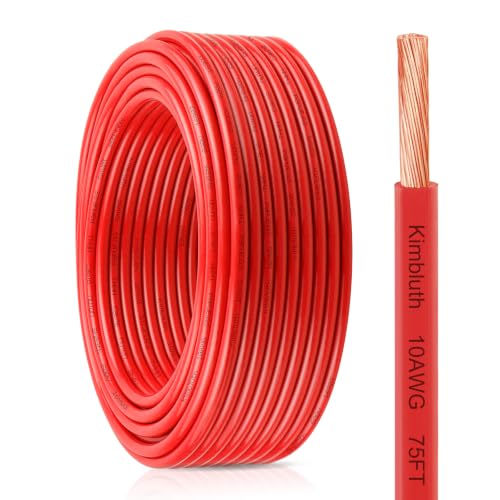
1. THHN Wire 10 Gauge 25 FT Stranded Copper Wire, Red
Our pick — over 4.5★ from 500+ verified ratings; the strongest balance of quality and price.
Seven copper strands in a nylon jacket that slide through bends where solid wire fights back
If your run threads through conduit with elbows and offsets, this is the one to start with. It is a 10 AWG single conductor made from 7 copper strands, and that strand count is exactly why it bends. Stranded copper flexes where one thick conductor kinks, which is the difference between a pull that takes ten minutes and one that takes an hour. The copper is 100% bare copper, not clad aluminum, so oxidation resistance is baked in.
The insulation is PA6 nylon over PVC, a two-layer jacket that resists oil and corrosion and keeps a low friction coefficient against the inside of a raceway. It is rated to 600V with a working temperature up to 90°C, which covers a residential 240V circuit comfortably. And because it is a single conductor, you buy several runs for your hots, neutral and ground rather than one sheath — 7 wires versus the 2 conductors in the 14/2 NM-B below, because these do completely different jobs.
Against the 50-foot 14/2 NM-B down the list, this is a 25-foot single conductor where that one is a 50-foot two-conductor cable — twice the length, different format entirely. Owners who pulled it solo describe multiple 90s and offsets through conduit, and reported the gauge measuring true to their ferrules with generous length. The conduit-friendly jacket is the thing everyone raves about here. The catch: it does not arrive on a spool, so coiling it yourself for a long pull takes a minute of patience.
Where it shines
- 7-strand copper construction bends around tight conduit elbows without kinking
- Two-layer PA6 nylon and PVC jacket resists oil, corrosion and abrasion
- 600V rating and 90°C working temperature cover residential 240V circuits
- Pure bare copper strands resist oxidation over the life of the run
Worth knowing
- Ships loose rather than on a spool, so a long solo pull needs hand-coiling
- It is a single conductor, so one purchase covers only one leg of the circuit
Made for: anyone feeding conduit where the wire has to snake around bends and offsets
Think twice if: you want one sheathed cable to staple along a stud bay instead of individual conductors
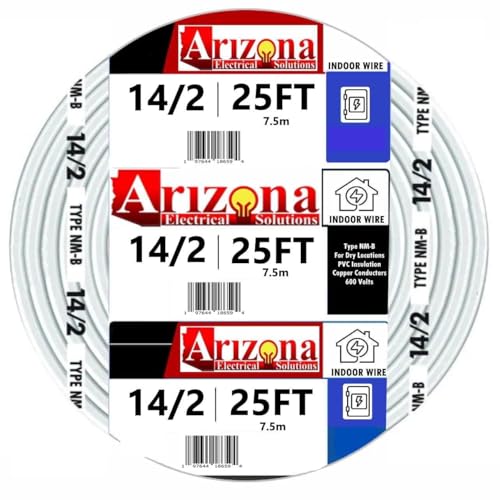
2. Arizona Electrical Solutions 25 Ft 14/2 NM-B Copper Wire, 14 AWG 2 Conductor with Ground
The small-repair reel — enough cable to add one outlet without buying a full spool
For a single outlet, a moved switch, or a short light run in a garage or shed, buying a 250-foot coil is waste. This is 25 feet of 14/2 NM-B: two insulated 14 AWG copper conductors plus a bare copper ground, sized for standard 15 amp residential branch circuits and rated 600 volts for indoor dry locations. The white jacket is the familiar color code for 14 gauge, so you can identify the gauge at a glance during inspection.
The flat sheath pulls through studs and joists and strips cleanly for fast terminations in boxes, panels and fixtures. Copper carries current efficiently, which is the whole point of paying for it over aluminum — and buyers report it worked as well as any romex they have used, whether wiring a light and an outlet in a shed or a set of high hats. What wins people over is the quality of the copper itself and the value, which is what the review pages keep coming back to.
Here is the honest trade-off. At 15 amps, this is a lighting-and-outlet gauge, not a feeder — thin 14 AWG copper simply cannot carry a 240V appliance load. If you are wiring anything with a heating element, step up to the 10 AWG Enengeaster below or the 6 AWG XMK. For branch circuits that stay under 15 amps, that limitation never comes up.
Pick this when: you need a short length for one or two 15 amp indoor branch circuits
Look elsewhere if: your circuit feeds a range, dryer, or EV charger, which needs thicker conductors
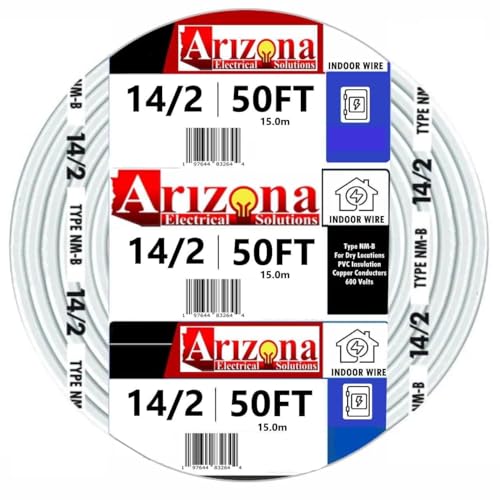
3. 50 Feet 14/2 Type NM-B Copper. #14 AWG, 2 Conductors with Ground. Insulated Jacket White
Twice the length of the short 14/2 reel, for a project that runs further than one wall
This is the same 14 AWG two-conductor-with-ground NM-B format as the pick above, but in a 50-foot length — exactly twice the 25 feet of the Arizona reel — which is the number that matters if your run crosses a room instead of a single bay. A homeowner rewiring an unfinished basement will not have to splice mid-run. It is listed per UL Standard 719 and UL 83 conductor construction, along with ASTM B-3 and B-8 and Federal Specification A-A-59544, and it complies with NEC and NFPA 70.
For a 14 gauge cable on 15 amp circuits, that UL listing carries weight at inspection time. The white PVC jacket is smooth enough to pull along joists, and copper conductors carry the current the way you would expect. What owners praise most is the quality — the report that keeps coming back is that it performed identically to name-brand cable on a basement rewire, with the same wire and insulation quality, and that it arrived without the over-packaging some reels ship in.
One buyer summed up the whole category neatly: “Cheaper than big box store and works just fine.” Nothing about this cable is exotic, and that is the point — it does the standard job at a friendlier price than the store shelf. If you need protection from direct burial or wet ground, though, NM-B is the wrong cable entirely; you want the UF wire further down this list.
Suits: a 15 amp indoor run long enough to need the extra 25 feet over the shorter reel
Skip if: you plan to bury the cable or run it through a damp location, where UF wire is required
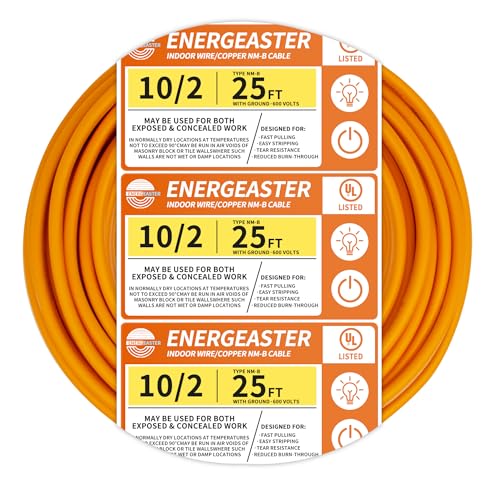
4. Energeaster Solid Indoor 10/2 W/G NMB Cable 25ft, Orange
Ten-gauge solid copper in a jacket meant to be stripped, bent, and terminated in a tight panel
Ten AWG is where residential wiring stops being light-duty and starts feeding real loads. This Energeaster cable is solid 10/2 NMB with three conductors — two insulated 10 gauge conductors in black and white plus a 10 gauge solid ground wrapped in fire-retardant paper and laid between them. The orange jacket is the color code for 10 gauge NM-B, so it reads as a heavier cable the moment you pick it up. Voltage rating is 600 volts, and it is intended for indoor branch circuits inside wall cavities and attics.
Solid copper construction holds its shape when you staple it flat and takes a clean bend without springing back, which matters when you are landing conductors on a breaker. This is coiled and coated for easier pulling, stripping and installation. Owners mention it arrives nicely spooled and works easily — one used it to feed a subpanel in a shed on a 30 amp line and had no problems, and the load range people keep bringing up is 30 amp work like a mini-split.
The honest note: solid 10 gauge is noticeably stiffer to bend than the 7-strand THHN at the top of this list, so if you are pulling through a long conduit with multiple elbows rather than running along open framing, the stranded pick is easier on your hands. For subpanels and short appliance runs where the cable sits in a wall, that stiffness is a non-issue.
Best fit: feeding a subpanel, mini-split, or other 30 amp indoor load with a short 25-foot run
Consider the alternative if: your run is a long conduit pull, where stranded copper bends far more easily
5. XMK 6/3 NM-B Wire with Ground, 10ft 6 Gauge Wire 3 Conductor Type NMB Cable
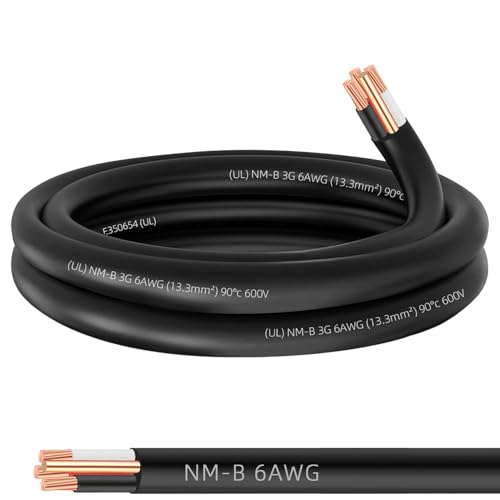
The beefiest conductor here — six-gauge copper for EV chargers, ranges and the loads that demand it
Nothing else on this list carries the ampacity of a 6 AWG conductor, and that is the whole reason it exists. This is UL Listed 6/3 NM-B cable: a 6 gauge 3-conductor cable with ground, carrying three insulated conductors in black, white and red plus a 10 AWG bare ground. The voltage rating is 600 volts and the jacket handles a temperature range of -10°C to +90°C (-14°F to 194°F). It is rated RoHS for environmental compliance and listed for residential indoor wiring.
Where a 10 gauge cable feeds a subpanel, this 6 gauge goes after the big stuff — a 240V circuit requiring two hots and a neutral, plus electric ranges, ovens, dryers, EV chargers and HVAC systems. Customers note it installing easily for an EV charger running from a subpanel to a NEMA 14-50 outlet, and a few measured the ground wire at the stated 10 AWG. The durability is what earns its keep: the 3 inner wires are coated in a double jacket of nylon and premium PVC, and the copper is 99.99% oxygen-free for low resistance and reliable conductivity.
The trade-off is real and it is physical. Six-gauge wire is stiff — the listing itself notes it is not a flexible cable and is not meant as a portable cord. Reviewers point out exactly that: it is a bit stiff, which is what you expect from 6 gauge. Add that it is a 10-foot length, so a long run from panel to outlet may need more than one piece. For a short, high-amperage feed where the cable gets stapled and terminated, that stiffness never gets in your way.
Why it earns its place
- 6 AWG copper handles high-amperage 240V loads like EV chargers, ranges and dryers
- 99.99% oxygen-free copper delivers low resistance and reliable conductivity
- Double nylon and PVC jacket on the inner wires resists corrosion and oxidation
- UL Listed with a 600V rating and a -10°C to +90°C working range
Hands-on reality
- Six-gauge cable is stiff and not intended to flex like a portable cord
- The 10-foot length is short, so longer panel-to-outlet runs may need more than one piece
Choose this for: any high-amperage indoor feed — EV charging, electric range, dryer, or HVAC branch circuit
Not your wire if: you are wiring a 15 or 20 amp lighting circuit, where this gauge is far more than the job requires
6. 12/2 NM-B Cable 100 FT, UL Listed 12 Gauge Indoor Wire with Ground
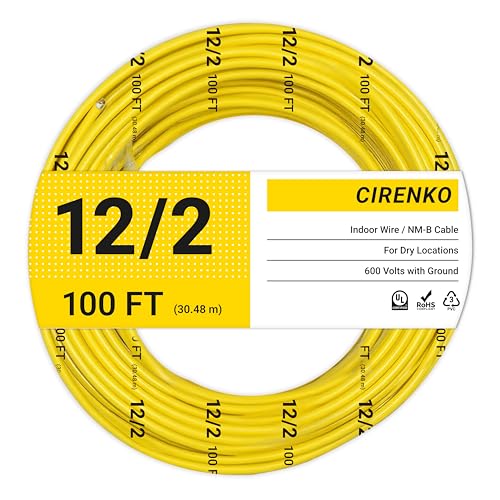
A hundred feet of twelve-gauge copper — enough to wire a whole shed without running out
The reason to reach for this one is the two numbers in its name: 100 feet and 12 AWG. That is four times the length of the 25-foot Energeaster coil and twice the 50-foot Southwire pull, and 12 gauge copper steps up to 20 amp circuits where 14 gauge tops out at 15 amps. Two insulated 12 AWG copper conductors plus a bare ground, sheathed in a durable yellow NM-B jacket rated 600V, and listed to both UL 83 and UL 719 with a verifiable UL E-file number printed on the insulation.
The build is solid bare copper with no CCA (copper-clad aluminum, a cheaper substitute that carries less current), which is exactly what you want on a circuit that feeds more than lights. The jacket resists abrasion, includes clear printed markings, and strips cleanly — shoppers say the insulation comes off easily and that it wired a shed from panel to outlets with no issues. As buyers put it on the review pages: “Quality is on.pqr with southwire at a much liwer cost.” One caution worth knowing — this is indoor wire, and one buyer returned it for a direct-burial job where it was not the right cable.
For indoor 20 amp branch circuits, the 100-foot length plus 12 gauge copper is the combination that lets you run outlets, switches and a small appliance circuit across an entire outbuilding without splicing. If your project is a short single-bay repair, a 25-foot reel does the job for fewer dollars — but for a full build-out, one roll saves you a second order mid-weekend.
Built for a full rough-in: 100 feet of 12 AWG copper covers a garage, shed or basement across multiple circuits, with the 20 amp rating to feed outlets and small appliances rather than lighting alone.
Read the location label first: this is indoor dry-location cable. Buyers who needed direct burial should step to the UF wire rather than force this one into the ground.
Worth it for: a whole-building indoor 20 amp rough-in where 100 feet of 12 gauge covers the job in one coil
Overkill if: you are moving one switch or adding a single outlet on a short run
7. Southwire Romex SIMpull Electrical Wire 10 Gauge, 3 Conductors, 50 Ft, NM-B, Pink

The name-brand ten-gauge with a patented jacket that glides through conduit
Southwire’s SIMpull jacket is the specific feature that earns this cable its spot — a patented coating designed to reduce friction as the cable slides into place, so pulls through conduit need less force and less coaxing. Under the pink sheath sits 10 gauge copper, 3 conductors with ground, 50 feet per coil, UL Listed type NM-B. It is made in America by the brand most electricians already recognize, and that name recognition is the reason a lot of buyers accept the premium.
The gap to close here is against the THHN at the top of the list. Both are 10 AWG, but this one is a sheathed 3-conductor cable for stapling along framing, while the THHN is a single stranded conductor for pulling inside a raceway — and this one ships 50 feet against that one’s 25 feet, a 2-to-1 length advantage for a longer run. Buyers report the real Southwire wire arriving, not a knock-off, and that it pulls nicely in conduit because of the coating. A 30 amp generator inlet is the job people mention most often putting it to work on.
The catch is the one the review pages flag honestly: installation experience splits. Some say it installs great, others find it difficult to handle — 10 gauge sheathed cable is simply firmer than thinner stock and takes more effort to bend around tight spots. It also weighs 8.2 pounds per coil, so if you are working overhead, plan for the heft. If you are comfortable with stiff 10 gauge and want the friction-reducing jacket, this is the one electricians tend to trust by name.
The defining feature: Southwire’s patented SIMpull jacket is built to lower pull friction, so a 50-foot 10 gauge run into conduit takes less wrestling than a plain-sheath cable of the same gauge.
Where hands-on feedback splits: some owners find the 10 gauge sheathed cable installs smoothly, while others find it harder to handle — the gauge itself is firm, and at 8.2 pounds per coil it is not light to work with overhead.
Reach for this if: you want a name-brand 10 gauge cable with a friction-reducing jacket for a longer conduit run
Pass if: you want maximum flexibility, in which case the stranded single-conductor THHN bends more easily
8. Southwire 250′ 10/3 W/G UF Cable

A quarter-mile of ten-gauge burial cable for running power to an outbuilding without a splice
Everything else here lives indoors; this one goes in the ground. It is 250 feet of 10 AWG UF cable — direct-burial rated, four conductors, multistrand copper for 220 and 240 wire applications, and rated up to 600V. That 250-foot length is the headline number: it lets you trench from a main house to a detached garage or outbuilding and land both ends without a single splice, which is the whole reason you pay for a reel this size.
Multi-strand copper construction is what makes a long underground run work, and the cable is built for residential, commercial and agricultural settings. Owners mention running it between a main house and an outbuilding 240 feet away, and that it performs the same as the big-box version at a better price. What buyers value most here is the value — one mention sums up the length situation: “Anyone need 10ft of cutoff?” A generator feed is the other job buyers call out. At 46 pounds, though, this reel is genuinely heavy, and the cable is stiff.
That stiffness is the honest cost. Several buyers describe UF cable as very stiff and hard to work, which is inherent to a jacket built to survive being buried — it has to be rigid to take the abuse. If your run is indoors in a dry wall cavity, there is no reason to wrestle with it; the indoor NM-B picks handle that. But for a trench to a garage or a generator hookup outdoors, this is the one cable on the list actually rated for the job.
what separates it
- 250 feet of 10 gauge UF cable covers a long outdoor run without a splice
- Direct-burial rated for outdoor and utility installations where NM-B cannot go
- Multistrand copper construction supports 220 and 240 wire applications
- 600V rated and suited to residential, commercial and agricultural settings
Plan around this
- The 46-pound reel is heavy to move, so a long trench run is best done with two people
- UF cable is stiff by design, which makes it harder to bend than indoor NM-B
This is your wire if: you are trenching power to an outbuilding, garage, or generator pad and need burial-rated cable in a long continuous length
Wrong pick if: your run is indoors in dry framing, where the lighter, more flexible NM-B cables below it in price do the same job more easily
Understanding the Specs
AWG Gauge And Ampacity
AWG stands for American Wire Gauge, the numbering that runs backward — a smaller number is a thicker copper conductor. Thickness sets how many amps the wire can carry before it heats up, which is why 14 AWG suits 15 amp circuits, 12 AWG suits 20 amp circuits, and 10 AWG and 6 AWG handle the heavy 240V loads like subpanels, ranges and EV chargers. Match the gauge to your breaker first: an undersized conductor warms under load, and an oversized one is extra cost you did not need. On a long run, thicker copper also cuts voltage drop so the far end of the circuit still sees full voltage.
Conductors, Ground And Sheathing
A 240V circuit needs two hot conductors, and many appliances also need a neutral, so a 6/3 cable carries three insulated conductors plus a separate ground. The “2” in 14/2 means two insulated conductors, and “with ground” adds a bare copper ground on top. Sheathing decides where the cable can live: NM-B is a flat indoor dry-location cable, THHN is a single conductor that belongs inside conduit, and UF is a direct-burial cable made to sit in the ground. Buy the wrong rated cable and the circuit fails inspection even with the correct gauge.
Voltage And Temperature Ratings
A 600V rating means the insulation is tested to 600 volts, which covers any residential 240V circuit with headroom. The 90°C temperature rating tells you how hot the insulation can get in service — relevant when a conductor runs near a hot appliance or through an attic. THHN wire is commonly used for its heat resistance and stable operation at high temperatures, while NM-B insulation is rated for dry indoor service. Staying within the temperature and voltage ratings keeps the insulation intact for the life of the run.
Stranded Versus Solid Copper
Stranded copper bundles many thin copper strands, which makes it bend easily and pull smoothly through conduit elbows — customers note stranded wire pulling through multiple bends solo. Solid copper is one firm conductor that holds its shape, staples flat, and terminates cleanly, but fights you on tight bends. Neither is better in the abstract: stranded wins on conduit-heavy runs, solid wins on open framing and straightforward terminations. Both carry current the same; it is handling that differs.
FAQ
Is 10 gauge wire big enough for a 240V circuit?
Can I use indoor NM-B wire for an underground run?
What is the difference between THHN and NM-B wire?
How many conductors do I need for a 240V circuit?
Do I need stranded or solid copper wire for conduit?
What does a 600V rating mean on household wire?
How long does copper electrical wire last?
Can I use 12 gauge wire on a 20 amp breaker?
Is copper-clad aluminum wire as good as pure copper?
How much wire should I buy for my project?
Final Thoughts: The Verdict
For most 240V jobs, the winner is the THHN Wire 10 Gauge 25 FT Stranded Copper — 7-strand copper that bends around tight conduit, a PA6 nylon and PVC jacket that resists oil and corrosion, and a 600V rating with a 90°C working temperature that covers residential circuits. If you are feeding a high-amperage appliance like an EV charger or range, step up to the XMK 6/3 NM-B for the heavier 6 gauge copper and UL listing. And for a trench to an outbuilding, the Southwire 250′ 10/3 W/G UF Cable is the one cable on the list rated to go in the ground. Match the gauge to your breaker and the format to your location, and any of these copper wires will do the job for years.
How We Picked
We do not accept paid placement. Every pick is matched to a real buyer and a real use-case; we do not hands-on test units.
Sources & Methodology
Specifications: manufacturer listings and product documentation. Review insights: verified customer reviews, as of September 2026. Pricing: not shown on this page (it changes often); check the current price via the retailer link.
As an Amazon Associate, Gadgets Feed earns from qualifying purchases. This does not affect which products we feature.