
Our readers keep the lights on and my morning glass full of iced black tea. As an Amazon Associate, I earn from qualifying purchases.
Specs are compiled from manufacturer listings and verified buyer reviews and can change over time — please confirm the key details on the product page before buying.
Your attic takes a beating: heat rises into it, humid air settles in it, and you might not open the door for months. That is why you need an attic dehumidifier that works differently from a basement unit. Look for honest pint ratings (how much water it pulls per day), a drain setup that works without you climbing a ladder, and a build that survives temperature swings.
I’m Min — the founder and writer behind Gadgets Feed. This guide is built by comparing the manufacturers’ published specifications and the patterns across verified customer reviews, so you get each pick’s real strengths and trade-offs instead of marketing spin.
A dehumidifier only earns its place in an attic if its real-world pint pull and drain options hold up in heat and tight space, which is exactly what this breakdown of the best attic dehumidifier covers.
Our Picks at a Glance


How To Choose The Best Attic Dehumidifier
Attics break the normal rules for dehumidifiers. Three things decide whether a unit works up there: how much water it pulls, how the water leaves, and how it copes when the attic turns cold.
Match pints per day to the space, not the marketing
“Pints per day” means how much water the machine can pull out of the air in 24 hours at a stated temperature and humidity. A 50-pint unit and a 115-pint unit are different tools, and the bigger number only matters if the rating is measured at realistic conditions. Many makers quote their peak figure at 95°F and 90% relative humidity, which is the hot, soupy end of the scale. Ask what the unit pulls at a milder setting before you trust a headline number.
Plan how the water leaves the attic
Manually emptying a tank means climbing into the attic every time it fills, which gets old fast in summer. A gravity drain hose needs a downhill path to a floor drain or outside. A built-in pump solves the uphill problem by pushing water upward, but pumps add a moving part that can clog. Decide your drainage route before you buy, not after.
Check how it handles a cold attic
Compressor dehumidifiers lose efficiency as temperatures drop, and coils can frost over in a cold attic. Auto defrost prevents frost buildup so the unit keeps working through cool spells. If your attic gets genuinely cold, look for a unit that states auto defrost as a feature, plus a humidity range that reaches low enough to actually dry the space.
Quick Comparison
| Model | Best For | Pints Per Day | Coverage | Drainage | Amazon |
|---|---|---|---|---|---|
| Gasbye 4500 Sq.Ft. DryPrime★ Best Overall | Whole-attic and large-room drying | 115 pints (100 pints/day rated) | 4,500 sq ft | 1.7 gal tank, 5 ft hose, garden hose | Amazon |
| Arecovas 52 PintsBest Value | Smaller attics and tight budgets | 52 pints | 3,500 sq ft | 0.66 gal tank, 6 ft hose | Amazon |
| hOmeLabs 1,800 Sq FtBest for Small Spaces | Wi-Fi control and small attics | 8 pints (24 pints max) | 1,800 sq ft | 3.3 ft drain hose | Amazon |
| Yaufey 80 Pint 5000 Sq. Ft. | Big attics on a mid-range budget | 80 pints | 5,000 sq ft | 1.06 gal tank, 3.28 ft hose | Amazon |
| Vellgoo 4000 Sq.Ft | Efficiency-focused large spaces | 64 pints | 4,000 sq ft | Tank, 6.56 ft hose, garden hose | Amazon |
| avylo with Pump and Hose | Attics with no floor drain | 90 pints | 4,500 sq ft | 2.11 gal tank, 15 ft pump lift, 15 ft hose | Amazon |
| AEOCKY LEO-001 | Uphill draining in awkward attics | 80 pints | 4,500 sq ft | Pump, 5m hose | Amazon |
| DECIUU 5000 Sq.Ft 100 Pint | Whole-home attic humidity control | 100 pints | 5,000 sq ft | 1.45 gal tank, 6.56 ft hose, garden hose | Amazon |
| Waykar 80 Pints 5000 Sq. Ft | Even airflow across a wide attic | 80 pints | 5,000 sq ft | 1.14 gal tank, 3.3 ft hose | Amazon |
| Frigidaire 50 Pint with WiFi | App control from downstairs | 50 pints | 4,500 sq ft | Tank, washable filter | Amazon |
| Yaufey 70 Pints Commercial | Crawl spaces and industrial attics | 70 pints (8.75 gal/day) | 5,000 sq ft | 6.56 ft gravity hose | Amazon |
In‑Depth Reviews
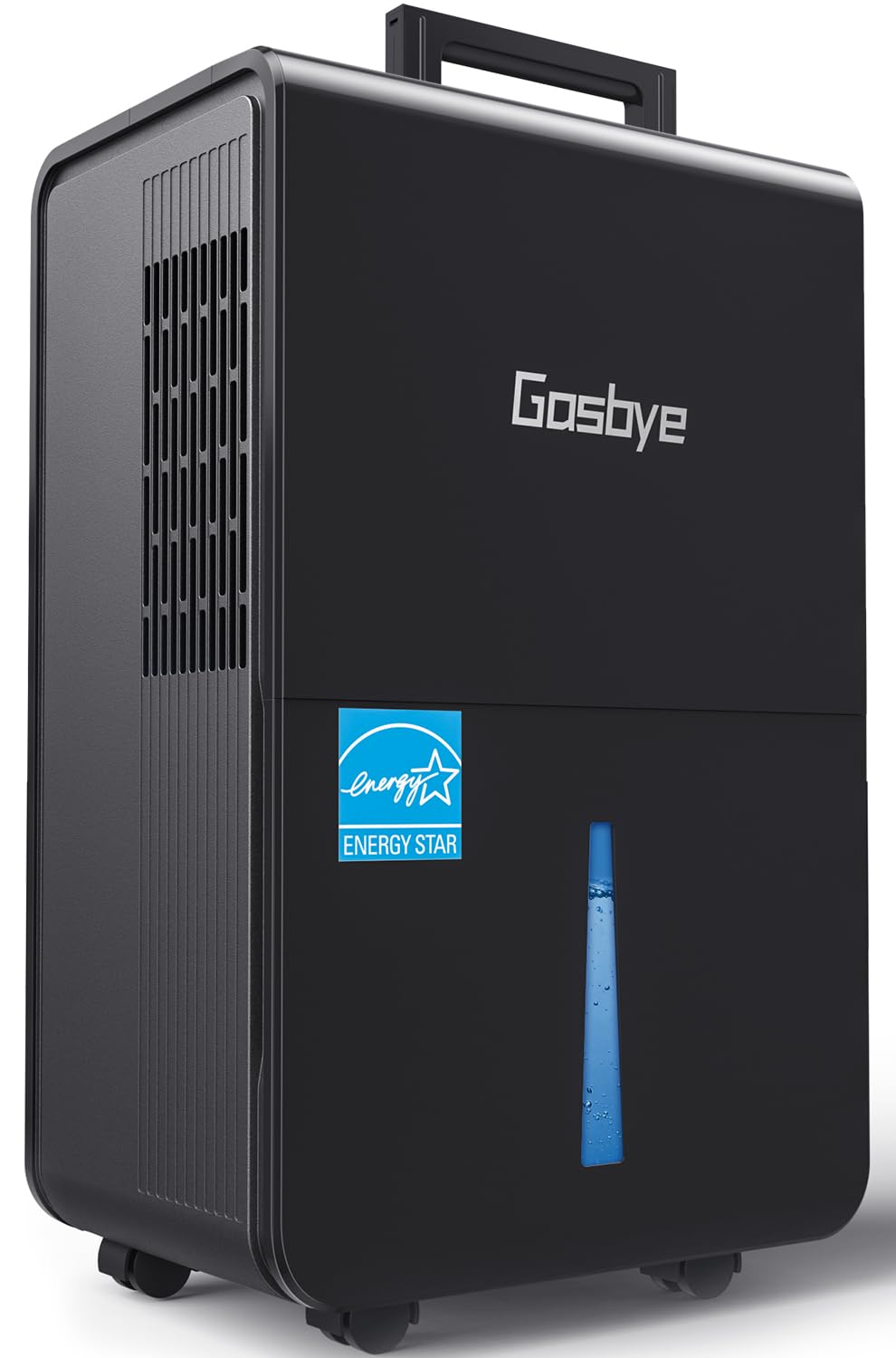
1. Gasbye 4500 Sq.Ft. DryPrime Dehumidifier
Our pick — over 4.5★ from 900+ verified ratings; the strongest balance of quality and price.
The heavy hitter that clears a soaked attic without you babysitting the tank
If your attic sits over a whole house and turns clammy every summer, this is the unit built for that job. It claims up to 115 pints per day at 86°F and 80% RH, with a rated 100 pints per day and coverage of 4,500 square feet. Those numbers mean one machine can dry the whole top floor instead of you buying a small unit and swapping buckets twice a day.
What wins people over is raw effectiveness — the single most-praised trait in its review pages, by a wide margin. Buyers report pulling a damp attic from 66% to 43% RH in an hour and collecting up to 3.5 gallons in 3–4 hours. The 1.7-gallon tank, included 5-foot drain hose, and a threaded outlet for a standard 3/4-inch garden hose give you three ways to get water out, so you can run it continuously and forget the tank entirely.
It is also refreshingly honest about its size. At 43 pounds and 11″D x 15″W x 24″H, it is bigger than the “mini” units that inflate their pint ratings — because it is not one. That is 35% heavier than the 31.9-pound Arecovas below, with 2.2x its 52-pint capacity. The 45dB compressor runs quiet enough for a living space, and the auto shut-off and restart cycle keeps it efficient without micromanaging. Solid 5-tier copper coil construction backs the durability pitch, and buyers consistently single it out as the thing that keeps running season after season.
Where it earns its keep
- 115-pint peak output genuinely handles a full-size attic at 4,500 sq ft
- Three drainage paths, including a 5-foot hose and garden-hose thread
- 45dB operation and a 5-tier copper coil built for multi-season use
- Auto restart after a power cut keeps your settings
What to know before you buy
- At 43 pounds it is a two-person lift into a tight attic hatch
- The 24-inch height needs real headroom above the joists
- A few owners note it draws meaningful power during long summer runs
Made for: anyone drying a large attic, basement, or garage who wants one machine to do it all without constant emptying.
Size it up first: if your attic hatch is narrow or your joists run low, measure the 24-inch height and 43-pound weight before committing.
2. Arecovas 52 Pints Dehumidifier
A compact, light-touch option for smaller attics and tight budgets
Not every attic needs a monster. This 52-pint unit covers up to 3,500 square feet and weighs 31.9 pounds, which means you can actually carry it up a ladder alone. It stands 8.86″D x 12.6″W x 19.29″H, so it slips into tighter spots the bigger Gasbye won’t reach.
Owners describe it as quiet, simple to set up, and effective — the dominant theme in the reviews. The 0.66-gallon tank keeps the unit compact, and a 6-foot drain hose is included for continuous drainage. It also brings three modes on a single touch: DEHU for holding your target humidity, DRY to speed up clothes drying, and CONT for nonstop pulling. The rear intake lets you push the front right against a wall, which matters in a narrow attic where space is tight. Five safety features — overload protection, outage memory, auto shutoff, auto-defrost, and a child lock — round out the package.
Here’s the trade-off: because it is so compact and light, this one is better suited to smaller attics than to a whole-house top floor. Expect to empty the tank more often if you run it without the hose.
Straight read: great fit for a bedroom-sized attic or a second space that doesn’t justify a large machine.
Think twice if: your attic runs large and humid all season, where the bigger Gasbye’s 115-pint ceiling is the safer bet.
Reach for this: if you have a small-to-medium attic and want a lighter unit you can move and set up solo.
Look elsewhere if: your space is genuinely huge and runs clammy year-round — you’ll want more headroom on output.
3. hOmeLabs Dehumidifier 1,800 Sq Ft
The app-controlled option for small, reachable attics you check from downstairs
For a compact attic that you’d rather not climb into constantly, the Wi-Fi control here is the real draw. It removes up to 8 pints per day at 80°F and 60% RH, with a 24-pint maximum at 95°F and 90% RH, covering up to 1,800 square feet. Set your humidity level, timer, and auto mode from an app or voice assistant instead of hauling yourself up the ladder.
At 38dB it is the quiet one of this bunch, and at 22.3 pounds it is the lightest pick in the list — easy to set on a shelf or floor joist. A 3.3-foot drain hose is included for continuous drainage, and the removable tank has a washable filter to keep airflow clean over time. Owners widely report the quality and moisture removal as its standout traits, with reliability and value drawing more of a mixed picture in the longer-term reviews. Some owners say theirs has run for years of constant use; others report a shorter life.
Don’t push this one beyond what it’s built for. Eight pints a day is a small-space figure, and its own product copy positions it for bedrooms, nurseries, and home offices rather than whole-house attics. If your attic is large and damp, you’ll want a higher-capacity unit.
what separates it
- Wi-Fi control via app or voice assistant, so you don’t climb up to adjust it
- 38dB operation — the quietest here by a clear margin
- Lightest pick at 22.3 pounds, easy for one person to place
- Washable filter and removable tank for simple upkeep
The honest caveats
- Just 8 pints/day rated, so it’s for small attics only
- Reliability is mixed in the long-term reviews — buy with warranty in mind
- 3.3-foot hose is short for reaching a far drain
Best match: a small attic or finished loft you want to control remotely without repeat trips up.
Not the one for: a large, persistently damp attic that needs far more daily pint pull than this can deliver.
4. Yaufey 80 Pint Dehumidifier for Basement 5000 Sq. Ft.
A quiet, wheeled workhorse that hands a big attic over to continuous drainage
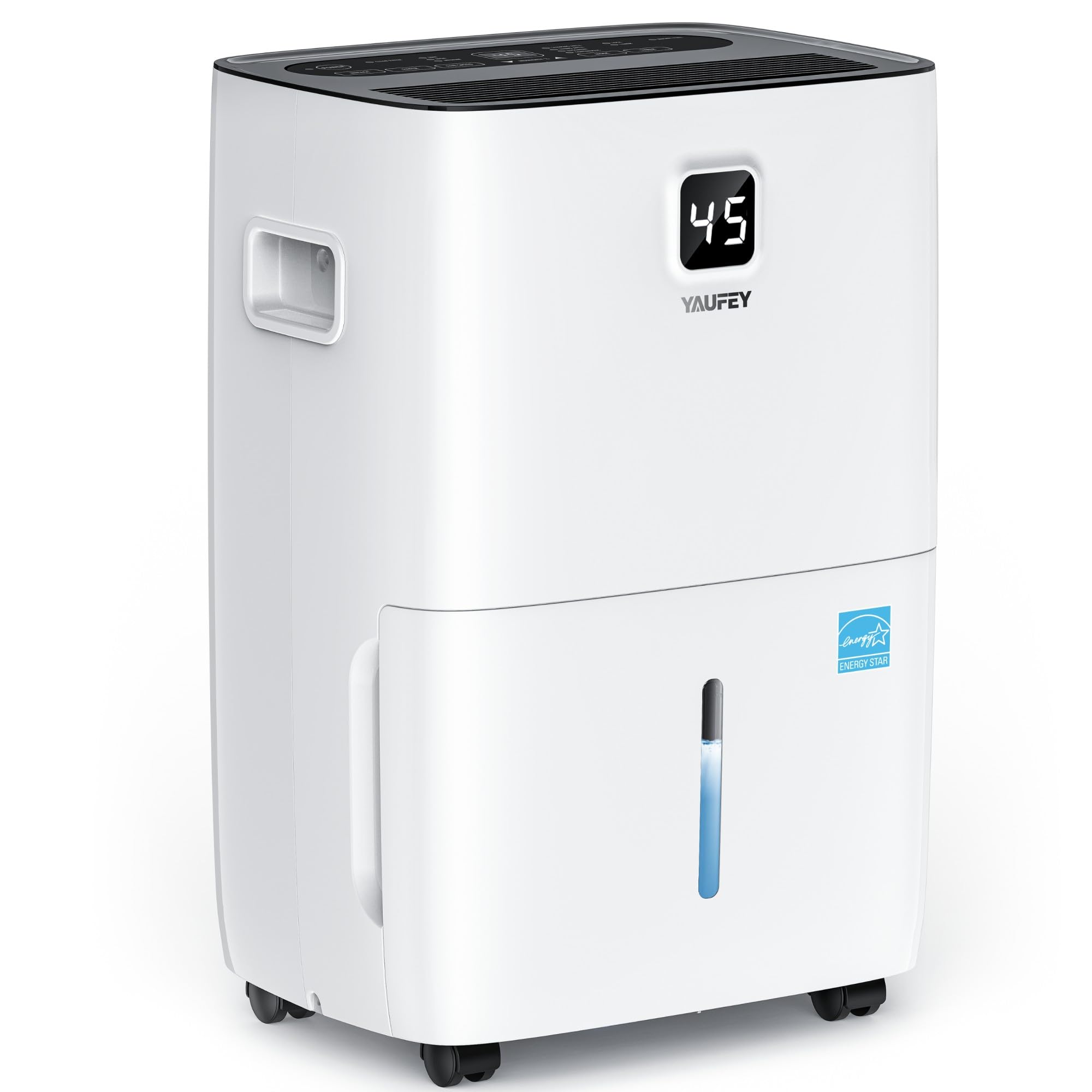
Big output, modest footprint. This one removes up to 80 pints per day and covers spaces up to 5,000 square feet, while standing just 13.86″D x 10.71″W x 19.49″H at 30.4 pounds. That combination of large capacity and narrow profile is what makes it a natural fit for a long, low attic where floor space is limited.
What owners praise most is how quietly it runs — the noisiest thing about this unit is that it barely registers. It keeps working while you’re watching TV or talking nearby. The wheeled base makes it easy to reposition as you dry different zones, and the 1.06-gallon tank pairs with a 3.28-foot drain hose for continuous gravity drainage, plus a standard garden-hose option for longer runs. Energy Star efficiency and a heat-exchange system with 7mm inner-grooved copper tubing and blue hydrophilic aluminum fins round out the build.
The honest wrinkle is the tank. It’s a small reservoir, so without a hose you’ll be emptying it often — one owner reported the 1.06-gallon tank filling in about 9.5 hours on a humid day. Set it up with continuous drainage from the start and that problem disappears.
Editor’s note: the reliability story is mixed across reviews — some units run for years — one owner reported a 6-year run — while others fail early. Buy from a seller with a solid return window.
Pick this if: you need broad coverage and genuinely quiet operation in a long, narrow attic.
Downside to plan around: the small tank means continuous drainage is close to essential for unattended attic use.
5. Vellgoo 4000 Sq.Ft Dehumidifier

Built to run for months of humid weather without spiking your power bill
An attic dehumidifier often runs nonstop through the sticky months, which makes efficiency a daily-usage concern, not a footnote. This one carries the ENERGY STAR Most Efficient 2024 designation and pulls up to 64 pints per day across up to 4,000 square feet, so you get large-space drying that keeps operating costs in check.
Its name matches it: buyers consistently report a big difference within the first week, dropping humidity fast and then holding a comfortable level. The core is a high-efficiency rotary compressor paired with a 3+2 evaporator-condenser setup, pure copper tubing, and hydrophilic aluminum fins. Drainage is flexible — the built-in tank, a 6.56-foot hose, or a standard garden hose — so you can run it unattended in an attic. Smooth-glide caster wheels and a hidden handle make it easy to move between zones, and a 40%–80% RH range with a Comfort Mode handles the day-to-day.
The catch is durability. Owners mention everything from a unit still running perfectly to one that stopped after 13 months, which is why the two-year limited warranty matters, so this is a pick where the two-year limited warranty honestly matters. It’s a solid performer with a real-world reliability caveat worth knowing up front. It’s also worth checking the drain hose adapter, which a few owners found fiddly to seat the first time.
Choose this: if you want strong, efficient large-space drying and you value the two-year coverage.
Weigh the risk: if long-term reliability is your top priority, prefer a unit with a more consistent multi-year track record.
6. avylo Dehumidifier for Basement with Pump and Hose
The pump-powered pick for attics that have no downhill drain in sight
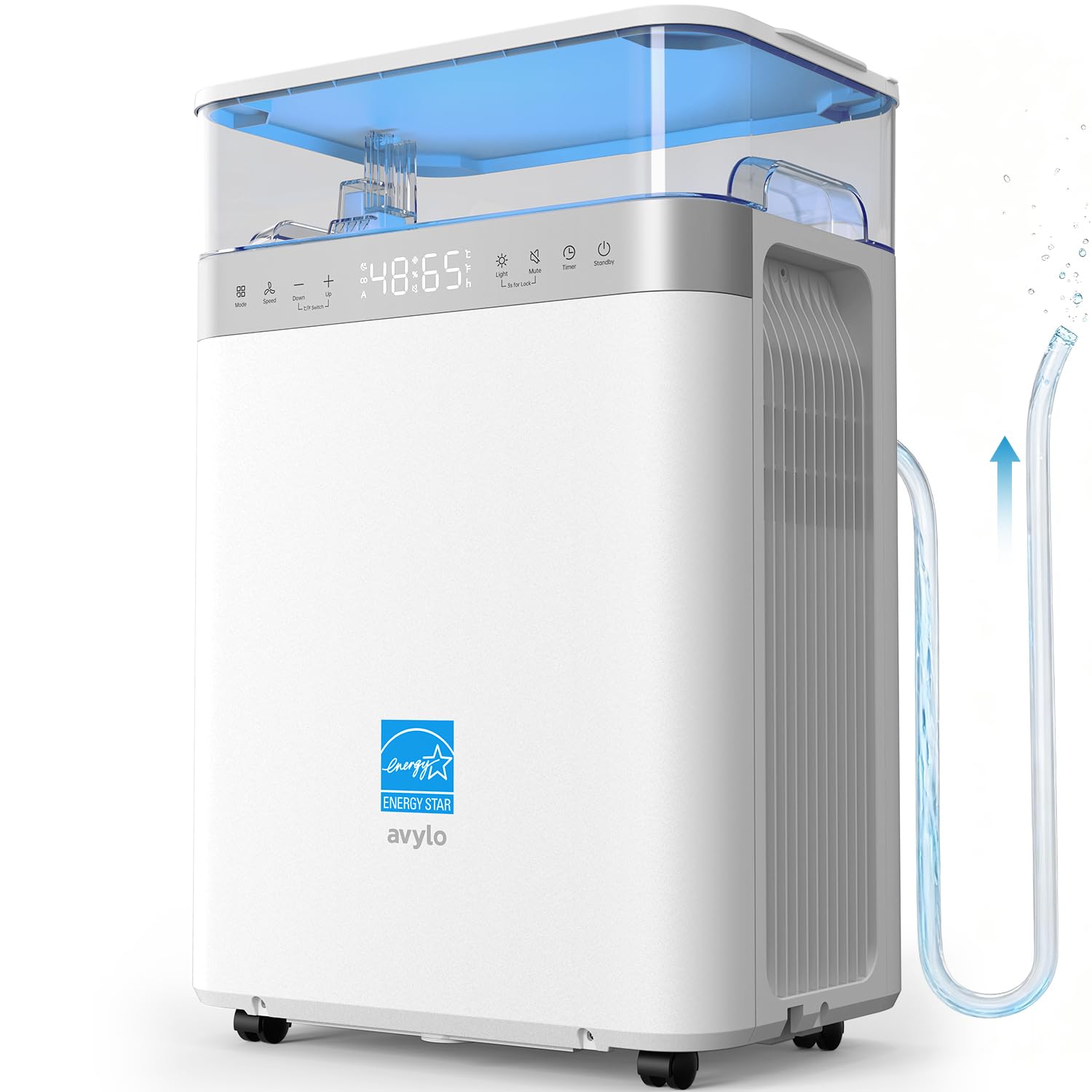
If your attic has nowhere for gravity to send water, this is the one that solves the physics problem. Its built-in pump pushes water up to 15 feet through an included 15-foot drain hose, so you can route it to a distant drain or window regardless of height. Capacity is serious too: up to 90 pints per day across 4,500 square feet, with a 2.11-gallon top-mounted tank as the manual backup.
The top-mounted tank is a genuinely thoughtful touch — you lift it off instead of bending to pull a bottom drawer, and a corner drain opens automatically when you pour. It’s rated as low as 41dB and carries ENERGY STAR Most Efficient 2025 certification, plus a deep pile of safety listings including DOE, CEC, FCC, TSCA, and UL standards with a child lock. Owners describe it pulling water out of the air fast, keeping basements comfortable, and being ready to run straight from the box with no installation. The auto shut-off, auto defrost, and top-tank design all come in for repeated praise.
The one thing to know: the tank capacity gets mixed feedback — some owners find it adequate, others wish it were larger, which is why the pump-and-hose route is the smarter long-term setup. Use it as the primary drain and the tank rarely matters.
The standout: that 15-foot pump lift is the feature that makes this viable in a no-drain attic where gravity units simply can’t work.
Set-up tip: empty the tank before first use and let the pump handle continuous drainage — the manual drain note in the instructions exists to prevent leaks during setup.
Right for you if: your attic has no floor drain and you need water pushed uphill to get out.
Consider a simpler unit if: you already have an easy downhill gravity path — you’d be paying for a pump you don’t need.
7. AEOCKY Dehumidifier with Pump Up to 16.5ft
A flagship pump unit that drains itself upward and stays compact doing it
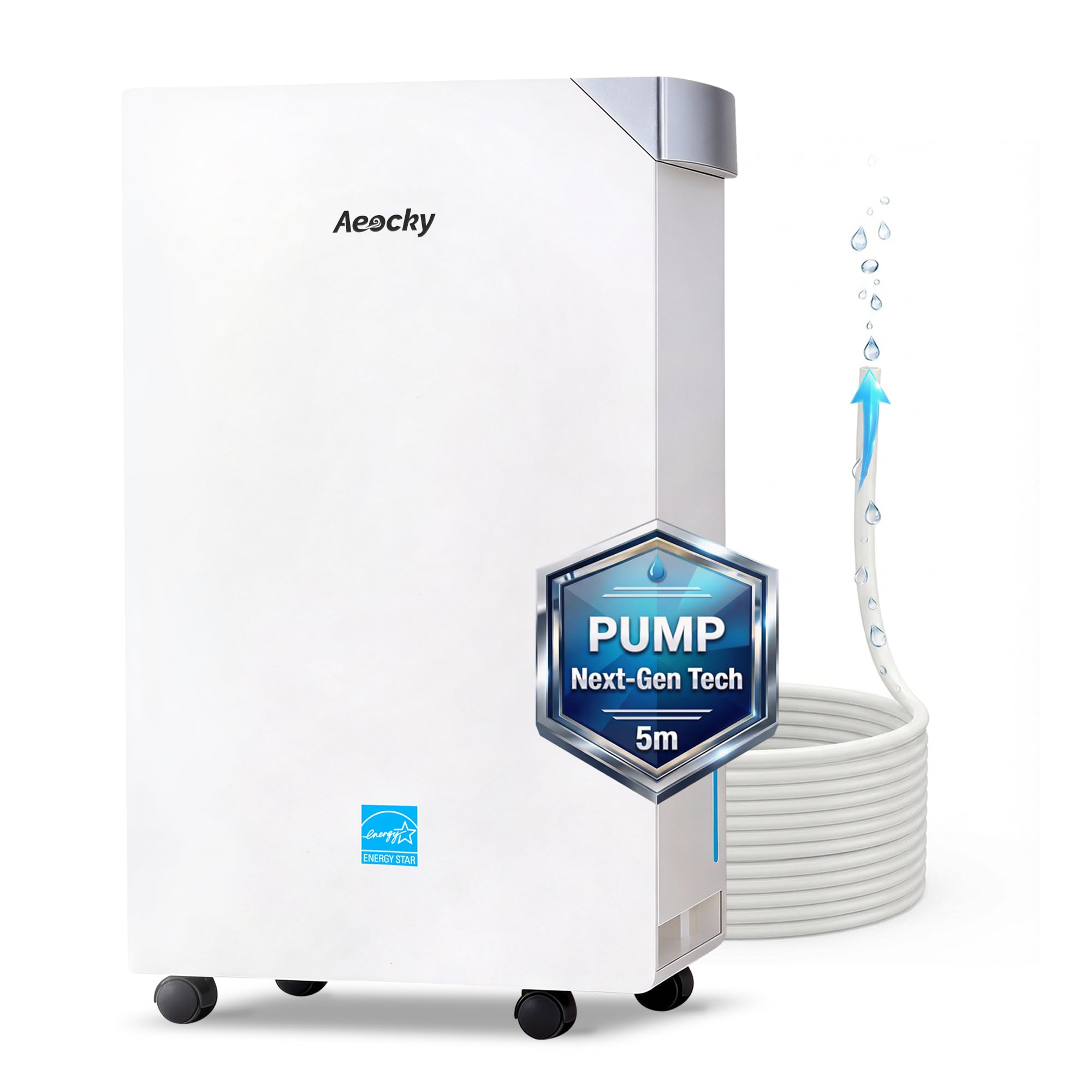
If your attic has no floor drain and the nearest drain is up and over, this pick solves that: an exclusive pump pushes water upward for true 360° auto-drainage, supplied with a 5m hose. That means no bucket runs, even in a tall attic. It pulls 80 pints per day in the humid peak (95°F, 95% RH) and 56 pints per day at 86°F and 80% RH across 4,500 square feet, and it holds ENERGY STAR Most Efficient 2025 certification.
Owners rate effectiveness highest and quiet operation right behind it, saying it pulls the air dry fast — one owner reported dropping a whole-house basement from 71% to 40% RH in a couple of days. The pump gets mentioned as a genuine convenience, doing the emptying automatically. It runs on a high-efficiency rotor compressor with a “3+3” coil structure and 7mm pure copper piping, and its off-grid-friendly power-off memory resumes your settings after an outage. The unit is compact at just 8.6 inches wide, which helps in a crowded attic corner.
The honest catch is the pump itself. It draws the most mixed and even negative feedback long-term — pumps can clog on thin hoses and call for a little maintenance — and there are scattered reports of units leaking. So this is not a set-it-and-leave-it-forever machine without checking on it. The manufacturer’s own reliability testing claims are its own, so treat them as such. Treat the pump kindly, and it earns its keep.
Why it earns the premium
- Upward pump drainage with a 5m hose frees you from floor-drain limits
- 80-pint peak output over 4,500 sq ft
- Quiet enough for bedrooms, easy power-off memory for smart outlets
- Compact 8.6-inch width fits tight attic corners
Don’t overlook
- The pump is the most failure-prone part — it needs periodic attention
- A handful of units have arrived leaking, so verify on setup
- Value-for-money is mixed in reviews versus simpler non-pump rivals
Go here if: your attic demands upward drainage and you want a flagship pump that handles it quietly.
Think about the alternative: if you have an easy downhill path, a gravity-drain unit skips the pump — and its maintenance — entirely.
8. DECIUU 5000 Sq.Ft 100 Pint Dehumidifier
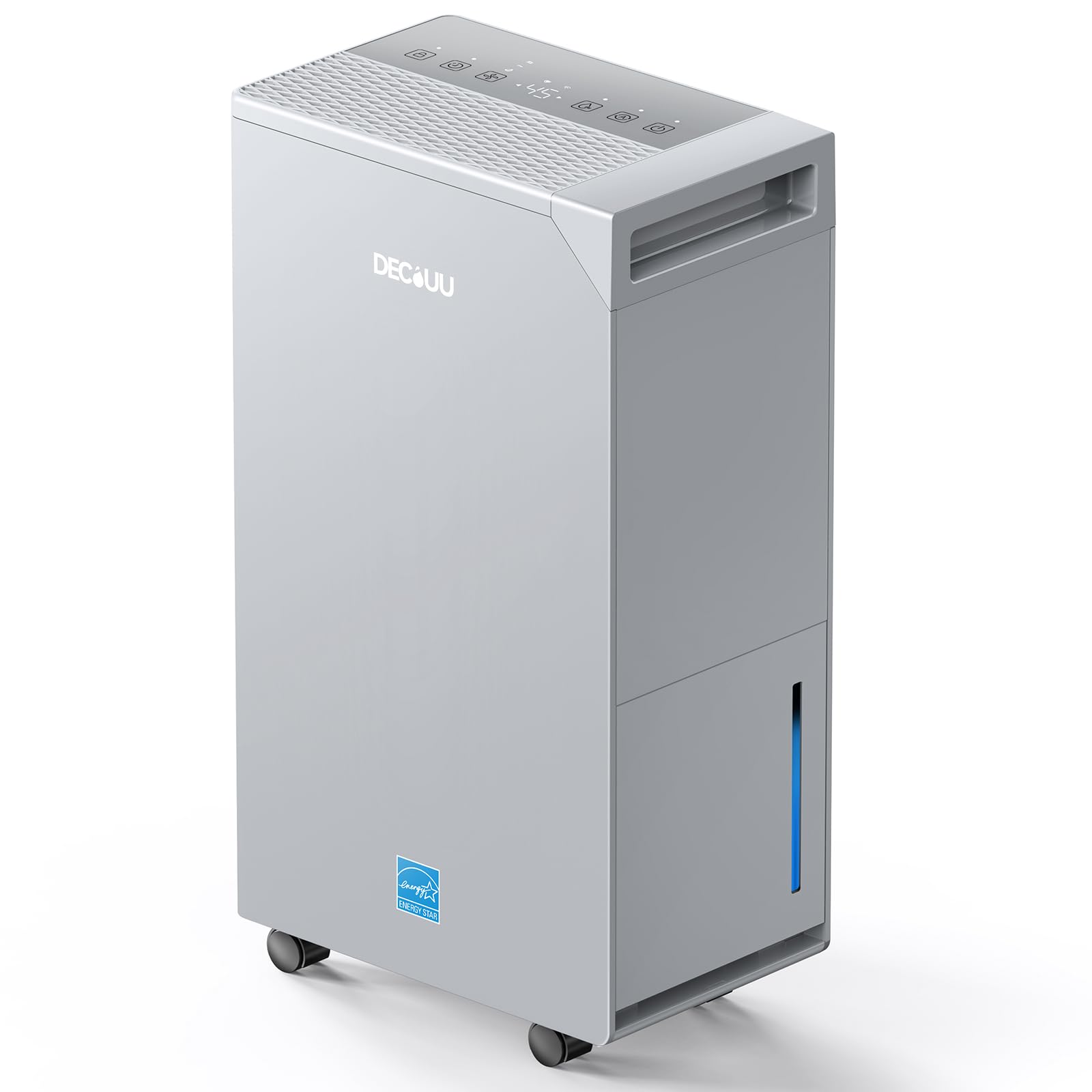
A hundred-pint whole-home unit that keeps a big attic steady without fuss
When the goal is to hold a large attic at a target humidity all season, output and set-and-hold control matter more than gimmicks. This one removes up to 100 pints per day under high humidity and 70 pints per day at 86°F and 80% RH, covering up to 5,000 square feet. Set it between 35% and 80% RH and the auto defrost and auto restart handle the rest, even through cooler spells.
Customers note it simply works: it takes the stickiness out of the air fast and then keeps it there. Their numbers show it: one owner dropped a basement from about 80% to 69% RH within an hour en route to a 55% target; another held 60% down to 45% RH in a day or two. Drainage is generous — a 1.45-gallon tank, a 6.56-foot hose, or a standard 3/4-inch garden hose — and the smooth 360° swivel casters plus hidden handle make repositioning easy. There’s a removable washable filter for airflow upkeep, backed by up to two years of protection.
Two things to size up. The tank capacity gets mixed feedback — some owners are fine with it, others want more, so hose drainage is the safer setup. And the packaging runs heavy; a few shipments have arrived over-boxed and jostling, so inspect the unit on arrival. At 32.8 pounds and 26.33 inches tall, it’s a substantial machine to lift into place.
Best for: whole-home attics that need a 100-pint ceiling and reliable humidity holding.
Plan for: the drain hose as your main setup, and check the box on delivery.
Fits you if: you want a high-capacity, efficiency-rated unit that quietly holds a big space at your target.
Skip if: your attic is small — you’d be running a big machine for a job a 50-pint unit handles easily.
9. Waykar 80 Pints 5000 Sq. Ft Dehumidifier

A wide-swing unit that spreads dry air evenly across a long attic floor
Attics are uneven by nature — dry at the vent, damp in the far corner. This one’s defining trick is a 90° auto swing airflow function that distributes dry air more evenly and reduces the humid pockets a fixed-vane unit leaves behind. It removes up to 80 pints per day across up to 5,000 square feet, and runs at about 42dB thanks to a vibration-reducing compressor mount.
The control range is unusually wide — 30% to 80% RH, which reaches lower than most household units that stop at 40% — useful if your attic needs to be pushed genuinely dry. Drainage covers both a 1.14-gallon removable tank and a 3.3-foot drain hose, plus a standard 3/4-inch garden-hose thread that needs no adapter. An AI-assisted protection system watches for frost and abnormal operation and triggers auto defrost. Owners describe it as effective, quiet, and pleasingly compact for its capacity — at 31 pounds and just 12.6 inches tall, it tucks into low-clearance spots.
The recurring gripe is the humidity readout — it can run a few points off from reality, so it’s worth pairing with a separate hygrometer and setting your target slightly higher to compensate. Reliability draws mixed long-term feedback too, though the customer service behind it consistently gets high marks for quick, painless warranty replacements.
What makes it stand out
- 90° auto swing spreads dry air instead of dumping it in one spot
- Wide 30%–80% RH range for genuinely dry targets
- 42dB operation and a low 12.6-inch height for tight attics
- Direct garden-hose thread with no adapter needed
Worth knowing
- Humidity readout can drift, so pair it with an external hygrometer
- Long-term reliability is mixed — the warranty support is the reassurance
- 3.3-foot hose is short for far-away drains
Match this to: a long or uneven attic where even airflow matters, and where you want a low, tuckable profile.
Budget for: a separate hygrometer to keep the humidity target honest.
10. Frigidaire 50 Pint Dehumidifier with WiFi
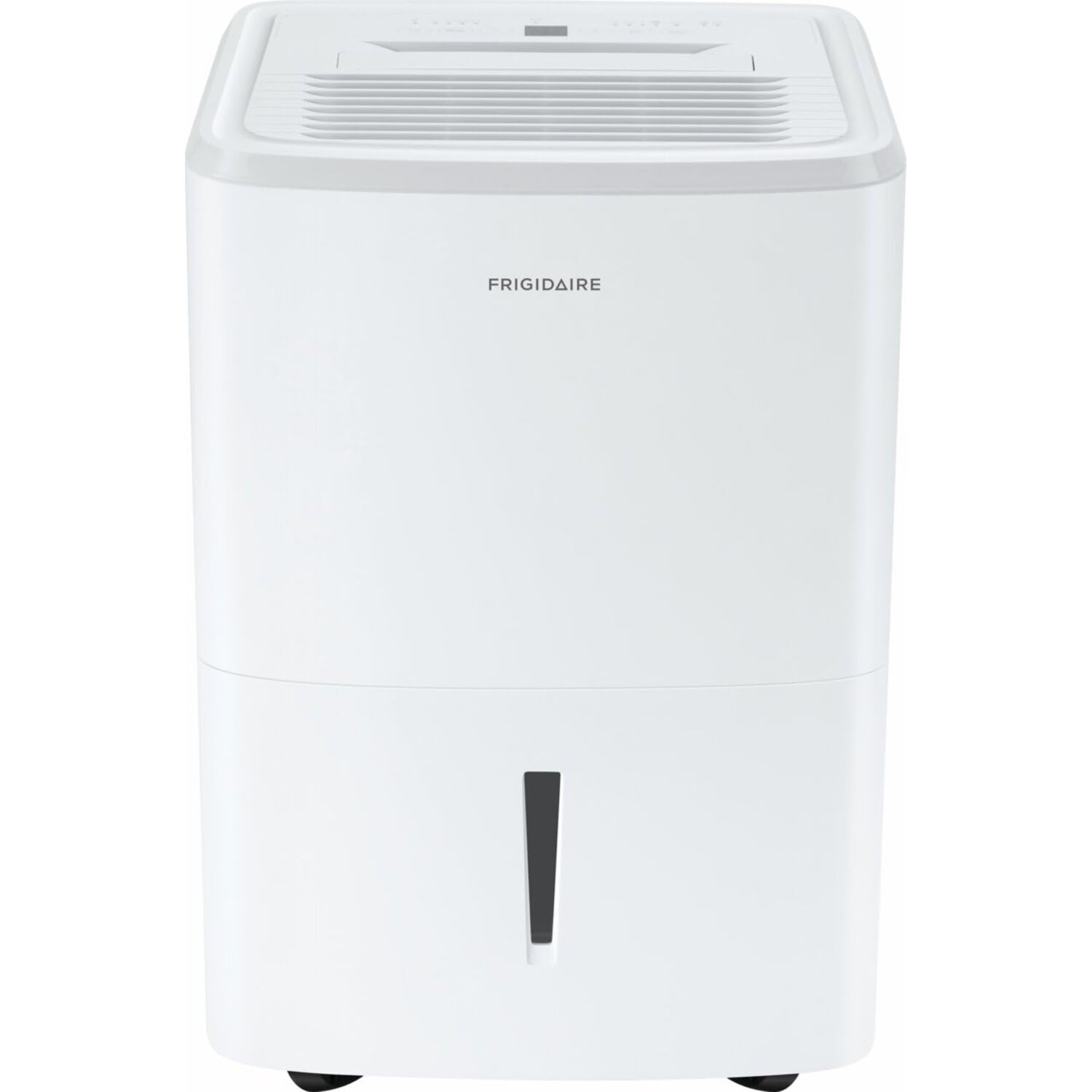
A brand-name option with app control for checking the attic from your couch
If brand recognition and remote control matter to you, this is the pick. It removes up to 50 pints per day across a 4,500 sq ft rating, and the added Wi-Fi lets you see and adjust the unit from anywhere once it’s paired with your phone. For an attic you rarely visit, that remote visibility is the strongest argument for choosing it. Custom humidity control with a washable filter rounds out the everyday use.
Reviewers point out it effectively and quietly, pulling a lot of water — reaching a set humidity and holding it while reducing the load on the home’s air conditioning. It’s a genuine replacement-grade machine in its category, and the washable filter makes maintenance simple. This is the one unit here that many buyers will recognize from a previous basement unit that ran for years.
Where I’d slow down: reliability opinions are mixed, with durability being the least-settled theme in its reviews, and its Wi-Fi setup has been known to need a call to support to get the app merged with the unit. There’s also no on-unit indicator for the current humidity level — you only see your target — so verify conditions another way. Weigh the brand name against those caveats.
Consider this if: you want Wi-Fi control and a familiar brand, and you value the ability to check in remotely.
Weigh the trade-off: the mixed reliability picture means checking the return policy before you buy.
Suits you if: remote app control from downstairs is worth it for an attic you don’t want to keep climbing into.
Look at the Waykar instead if: you need a lower humidity floor — its 30% RH range reaches drier than this unit’s control set.
11. Yaufey 70 Pints Commercial Dehumidifier with Drain Hose
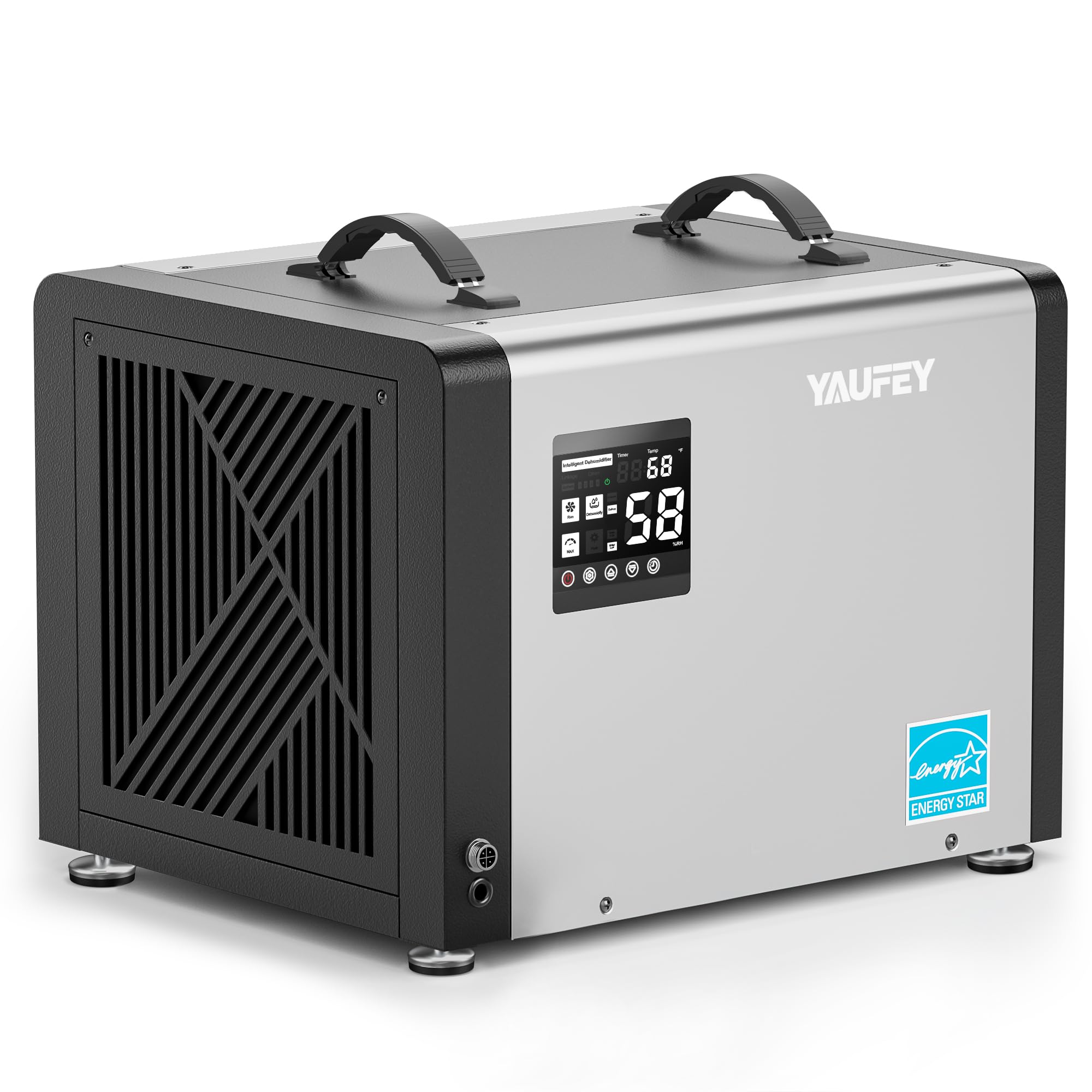
An all-metal, wide-range unit for tough, low-clearance attic and crawl spaces
Some attics are really crawl spaces — cramped, dusty, and permanently damp. This one is built for exactly that: an all-metal anti-corrosion housing, a compact 16.54″D x 12.99″W x 11.81″H body at 42 pounds, and support for freestanding, countertop, or joist-mounted placement. It removes up to 70 pints per day under saturated conditions (95°F, 90% RH) with 159 CFM airflow and covers up to 5,000 square feet.
The standout spec is its humidity range: a 10% to 90% RH span, far wider than ordinary household units, which lets you push for seriously dry targets. It runs on low-GWP R32 refrigerant and carries Energy Star certification, with a 6.56-foot gravity drain hose for 24/7 unattended use. Owners describe it as quiet, compact, easy to use, and capable in a large basement, with strong customer support backing the pump-and-warranty story. The metal frame, easy filter access, and simple digital panel (no Wi-Fi or app needed) come in for genuine praise.
The honesty note here: reliability is the most-discussed theme in its reviews, and it cuts both ways — some units run flawlessly for a year or more, while a few shoppers say weak water removal or a failed pump. One owner also found the humidity sensor needed relocating to read accurately. Given the wide range and metal build, this is a specialist tool best suited to a genuinely hostile, hard-to-reach attic, and it rewards buying with the warranty in mind.
Why a specialist would choose it
- 10%–90% RH range reaches far drier than typical home units
- All-metal corrosion-resistant frame for dusty, damp crawl spaces
- 6.56 ft gravity hose for nonstop, maintenance-light running
- Joist-mount option for low-clearance, tight attics
Be realistic about
- Reliability is the most mixed theme in its reviews
- A few buyers report a failed pump or weak water removal
- The humidity sensor can read off on some units
For the tough attic: a dusty, low-clearance space where you need a wide dry range and a rugged metal body.
Buy with eyes open: reliability varies, so lean on the extended compressor coverage and check the unit thoroughly on arrival.
Understanding the Specs
Pints Per Day: The Number That Actually Matters
This figure tells you how much water a unit can pull out of the air in 24 hours at a stated temperature and humidity. A higher number dries a bigger, damper attic faster and means you empty the tank less often. The catch is that most makers quote it at the hot, saturated end of the scale — often 95°F and 90% relative humidity — so a headline number is a ceiling, not a promise. Ask what the unit pulls at milder, real-world conditions before you decide a rating is enough for your space.
Coverage Area: Size The Unit To The Space
Coverage is quoted in square feet and reflects how large an area the maker expects the machine to dry. Match it to your attic’s footprint with a little headroom — an attic sitting under a hot roof is a harder job than an open room of the same size. Undersizing means the unit runs constantly and never quite catches up; oversizing just means it cycles on and off more efficiently. Coverage and pints per day usually track together, so one rarely outpaces the other.
Drainage Options: Gravity, Pump, Or Tank
How water leaves is what separates a set-and-forget attic unit from one you service daily. A gravity hose needs a downward path to a drain or outside. A built-in pump pushes water upward, so it works where gravity can’t — but it adds a moving part that can clog and calls for occasional care. A removable tank is the simplest but requires you to empty it, which is inconvenient in an attic you only visit occasionally. Pick your drainage route before choosing a model.
Auto Defrost And The Cold-Attic Problem
Compressor dehumidifiers lose effectiveness as temperatures drop, and the cold evaporator coils can frost over, which stalls drying. Auto defrost detects that frost and cycles the unit to clear it, so operation continues through cool weather. If your attic runs cold in winter, this is a feature you want named explicitly. Pair it with a humidity range that reaches low enough — some units stop at 40% RH, others reach 30% or lower — to actually dry the space rather than just take the edge off.
FAQ
How many pints per day do I need for an attic?
Can I run an attic dehumidifier without emptying a tank?
Do all dehumidifiers include a drain hose?
Will a compressor dehumidifier work in a cold attic?
Is a built-in pump better than gravity drainage?
How much noise will an attic dehumidifier make?
Can I use a regular garden hose with these units?
Does an ENERGY STAR rating matter for an attic unit?
What humidity level should I set for an attic?
Are the humidity readouts on these units accurate?
Final Thoughts: The Verdict
For most attics, the best attic dehumidifier pick is the Gasbye 4500 Sq.Ft. DryPrime because its 115-pint peak and three drainage options handle a full-size, damp attic without constant bucket duty, and owners consistently report real humidity drops — from 66% to 43% in an hour in one case. If your attic has no floor drain and you need water pushed uphill, grab the avylo with its 15-foot pump lift. And for a genuinely cold or cramped crawl-space-style attic that needs a wide dry range, the Yaufey 70 Pints Commercial is the one to reach for.
How We Picked
We do not accept paid placement. Every pick is matched to a real buyer and a real use-case; we do not hands-on test units.
Sources & Methodology
Specifications: manufacturer listings and product documentation. Review insights: verified customer reviews, as of September 2026. Pricing: not shown on this page (it changes often); check the current price via the retailer link.
As an Amazon Associate, Gadgets Feed earns from qualifying purchases. This does not affect which products we feature.