
Our readers keep the lights on and my morning glass full of iced black tea. As an Amazon Associate, I earn from qualifying purchases.
Specs are compiled from manufacturer listings and verified buyer reviews and can change over time — please confirm the key details on the product page before buying.
You want one box on the counter that microwaves leftovers, air-fries fries, and bakes a roast — without giving up half your kitchen. That is exactly what a 3-in-1 microwave oven promises. The catch is that “3-in-1” gets slapped on machines that only do two of those jobs well, and a few that stop heating after a year. This guide sorts the real combos from the pretenders and tells you which one fits your counter, your cooking, and your patience.
I’m Min — the founder and writer behind Gadgets Feed. This guide is built by comparing the manufacturers’ published specifications and the patterns across verified customer reviews, so you get each pick’s real strengths and trade-offs instead of marketing spin.
You will see how wattage, cavity size, and inverter heating change what you can actually cook. The picks below range from 0.9 cu. ft. budget combos to 1.2 cu. ft. inverter ovens, so there is a fit for a small kitchen or a busy family. Here is what separates a genuinely useful 3-in-1 microwave oven from a countertop that just collects crumbs.
Our Picks at a Glance

How To Choose The Best 3-in-1 Microwave Oven
A 3-in-1 microwave oven crams three cooking jobs — microwaving, air frying, and convection baking or grilling — into one countertop box. The trick is that these three jobs pull in opposite directions, so the machine you pick should match the job you do most. If you mostly reheat coffee and leftovers, a lower-wattage combo is fine. If you want crispy fries and browned chicken, you need the air-fry and convection side to be strong, not an afterthought.
Wattage sets your cooking speed
Wattage is the power the oven puts into your food, and it sets how long everything takes. A 900-watt microwave (like the BLACK+DECKER combo) heats more slowly than a 1,050-watt or 1,000-watt unit, so a frozen dinner that takes five minutes in a high-power oven may take noticeably longer. Higher wattage also means more even reheating, because there is more raw power pushing through the food. Match wattage to how much you cook: a solo cook can live with 900 watts, while a family cooking nightly will feel the difference at 1000 watts and up.
Inverter vs standard heating
Standard microwaves cycle the magnetron (the part that makes the microwaves) on and off at full blast, which can leave cold edges and overheated centers. Inverter technology runs the power continuously at a lower level, so delicate jobs like melting chocolate or defrosting meat happen gently and evenly. If you plan to use the microwave for more than reheating, inverter is worth having. That is the difference between cold-edged, patchy reheating and food heated evenly throughout.
Quick Comparison
| Model | Best For | Capacity | Microwave Power | Cooking Modes | Amazon |
|---|---|---|---|---|---|
| BLACK+DECKER 5-in-1 Microwave Oven Air Fryer Combo★ Best Overall | Small kitchens and RVs | 0.9 cubic feet | 900 watts | 5 functions | Amazon |
| Magic Chef 1.0 cu. ft. Countertop Microwave with Air FryerBest Value | First-time combo buyers | 1 cubic foot | 1000 watts | 4 modes | Amazon |
| TOSHIBA 6-in-1 Inverter Countertop Microwave Oven | Two-person households | 26.93 quarts | 1800 watts | 6-in-1 | Amazon |
| GE 4-in-1 Air Fry Countertop Microwave Oven | Apartments and dorm rooms | 1 cubic foot | 1,050 watts | 4-in-1 | Amazon |
| Panasonic HomeChef 4-in-1 Countertop Microwave | App-guided family cooking | 1.2 cubic feet | 1000 watts | 4-in-1 | Amazon |
| Breville Combi Wave 3-in-1 | Quiet, precise everyday cooking | 1.1 cubic feet | 1200 watts | 3-in-1 | Amazon |
| SAMSUNG 1.2 cu. ft. Countertop Convection Microwave with Air Fry | Built-in style and WiFi control | 1.2 cubic feet | 1.6kW microwave | 7 modes | Amazon |
In‑Depth Reviews
1. BLACK+DECKER 5-in-1 Microwave Oven Air Fryer Combo, 0.9 Cu.Ft, 900W
Our pick — over 4★ from 22,500+ verified ratings; the strongest balance of quality and price.
The five-function workhorse that replaces your air fryer and still fits a cramped counter.
Space is the first thing this oven solves. At 0.9 cubic feet and just 14.5″D x 19.5″W x 11.4″H (14% shallower and 11% smaller than the 1.0 cu. ft. Magic Chef above), it slides into kitchens where a full-size combo would not. Inside it cooks five different ways — microwave, air fry, combi (grill plus convection), bake, and roast — so a frozen pizza night and a roast chicken night can both come out of the same box.
The recipe brain is bigger than you would expect from a compact. There are 7 auto menus (Beverage, Fresh/Frozen Vegetables, Oatmeal, Potato, Popcorn, Frozen Pizza) and 11 air-fry presets covering frozen French fries, steak fries, squid rings, chicken nuggets, wings, legs, fish sticks, cheese sticks, vegetables, and spring rolls. Ten power levels let you dial down for delicate reheating instead of blasting leftovers. It runs on 900 watts, which is one of the lower outputs on this list — the TOSHIBA tops it at 1800 watts, so this one trades speed for a gentler footprint.
What wins people over is how little fuss it demands. The touch controls are friendly enough that someone who has never used a combo oven can start cooking in minutes, and a child-lock setting (hold stop for three seconds) keeps small hands off the panel. The recurring gripe is reliability — the design is proven when it works, but a few units have stopped heating after months of use, so buying an extended warranty is a smart move rather than an upsell. Cabinets and counter clearance matter here too, so measure before the box arrives.
What it does well
- Five cooking functions — microwave, air fry, combi, bake, roast — in a compact footprint.
- 11 air-fry presets cover fries, chicken, fish sticks, and vegetables.
- Touch panel is easy to operate; child lock keeps kids out.
- Quiet enough to run without drowning out conversation.
Where it falls short
- 900 watts means slower heating than higher-output combos.
- Interior is tight — a dinner plate and splatter cover barely fit.
- Reliability is mixed; a small number arrive with heating faults over time.
Pull the trigger if: you need one box to do microwave, air fry, bake, and roast in a kitchen that has no spare inches.
Hold off if: you want high-wattage speed or plan to cook for a crowd — the Magic Chef and TOSHIBA both give you more room and more power.
2. Magic Chef 1.0 cu. ft. Countertop Microwave with Air Fryer
A 1000-watt combo that hands a first-time buyer every tool the box needs.
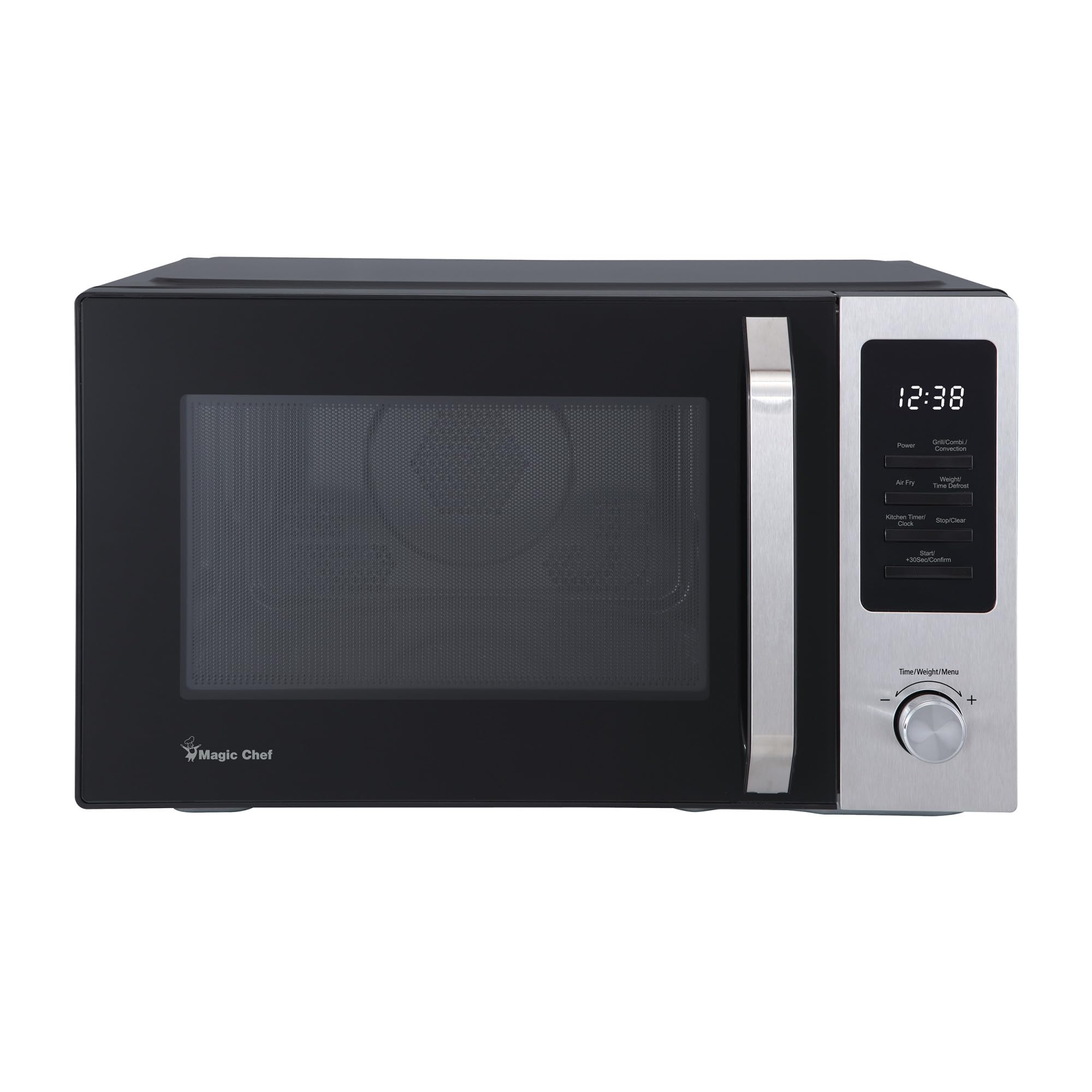
If you are moving up from a plain microwave, the Magic Chef makes that switch easy. It is a 1000-watt multi-use oven that plays four roles — air fryer, convection oven, grill, and microwave — and the accessories that other brands charge extra for are in the box: an air frying rack, a crisper tray, and a grill rack. That is the whole reason it earns a spot: you do not buy the mode, you buy the mode plus the hardware to actually use it.
The controls are touchscreen with a digital display, and you get 10 power levels plus auto defrost by weight or time. The combo cooking mode is the interesting bit — it activates microwave, grill, or convection heat together, so you get a browned outside and a thoroughly cooked inside without guessing. Auto touch options cover pizza, potatoes, popcorn, soup, and vegetables, and a child safety lock keeps unintended button presses from turning into a mess.
The honest trade-off is thermal. Owners note that ceramic plates and bowls come out too hot to handle in just about two minutes, so a hot pad is now a kitchen tool you cannot skip. On the plus side, buyers report it is well-made and quiet, and at 1.0 cubic feet — 11% more cavity room than the 0.9 cu. ft. BLACK+DECKER above — it handles a real family dinner plate without a fight.
Compact and controlled: 1000 watts with 10 power levels gives you a fine-grained range from gentle defrost to full-power reheat, and the included accessories remove the “which tray do I buy” guesswork.
Buy this one if: you want a mid-tier wattage combo with every rack included and a straightforward touchscreen.
Think twice if: you expect the interior to stay cool to the touch — this one heats plates fast, so keep a mitt nearby.
3. TOSHIBA 6-in-1 Inverter Countertop Microwave Oven

Six jobs, 1800 watts under convection, and an inverter that defrosts like it read your mind.
The number that does the talking is 1800 watts of convection power — roughly double the BLACK+DECKER’s 900 watts — and that gap is the reason to look here first if you cook real meals rather than reheat leftovers. Six modes cover microwave, air fry, convection oven, broiler, defroster, and Speedy-Combi (a blend of microwave, convection, and grill heat at once). Convection runs up to 425°F and the grill throws 1000 watts, so you can sear a chicken thigh and finish a bake in the same cavity.
Inverter technology is the clever part. Instead of pulsing full power on and off, it distributes heat uniformly, which is why defrosting comes out even without cooking the edges of a frozen roast. It also runs at a 50dB working noise level — about the volume of a normal conversation — so it does not rattle the house. You get 27 classic recipes in the included cookbook, plus 11 Auto Menus, 10 Air Fry Menus, and 6 Defrost Presets on the panel itself.
What owners praise most is the overall build — the quality side gets the strongest feedback — followed closely by how much it collapses into one machine. And on the honest side, some units have stopped heating after a few years of heavy use, so buying an extended warranty is a small cost against a real risk.
Why cooks keep it
- 1800 watts under convection and 1000 watts under grill for real searing.
- Inverter heat distributes evenly for gentler defrost and reheat.
- Six modes plus 27 recipes, 11 Auto Menus, and 10 Air Fry Menus built in.
- 50dB working noise level keeps the kitchen quiet.
Cutting through the hype
- Suits two people far better than a family of four.
- A minority of units have failed after a few years of heavy use.
- Not every setting is adjustable, so advanced cooking takes some workaround.
The smart pick if: you want restaurant-grade browning and even defrosting from a two-person countertop oven.
Choose differently if: your household is five plates deep or you want every setting fully tweakable — the GE gives you more control for a family.
4. GE 4-in-1 Air Fry Countertop Microwave Oven, 1050 Watt, 1.0 Cu. Ft., White
The quiet apartment companion with four cooking methods and one-touch shortcuts.
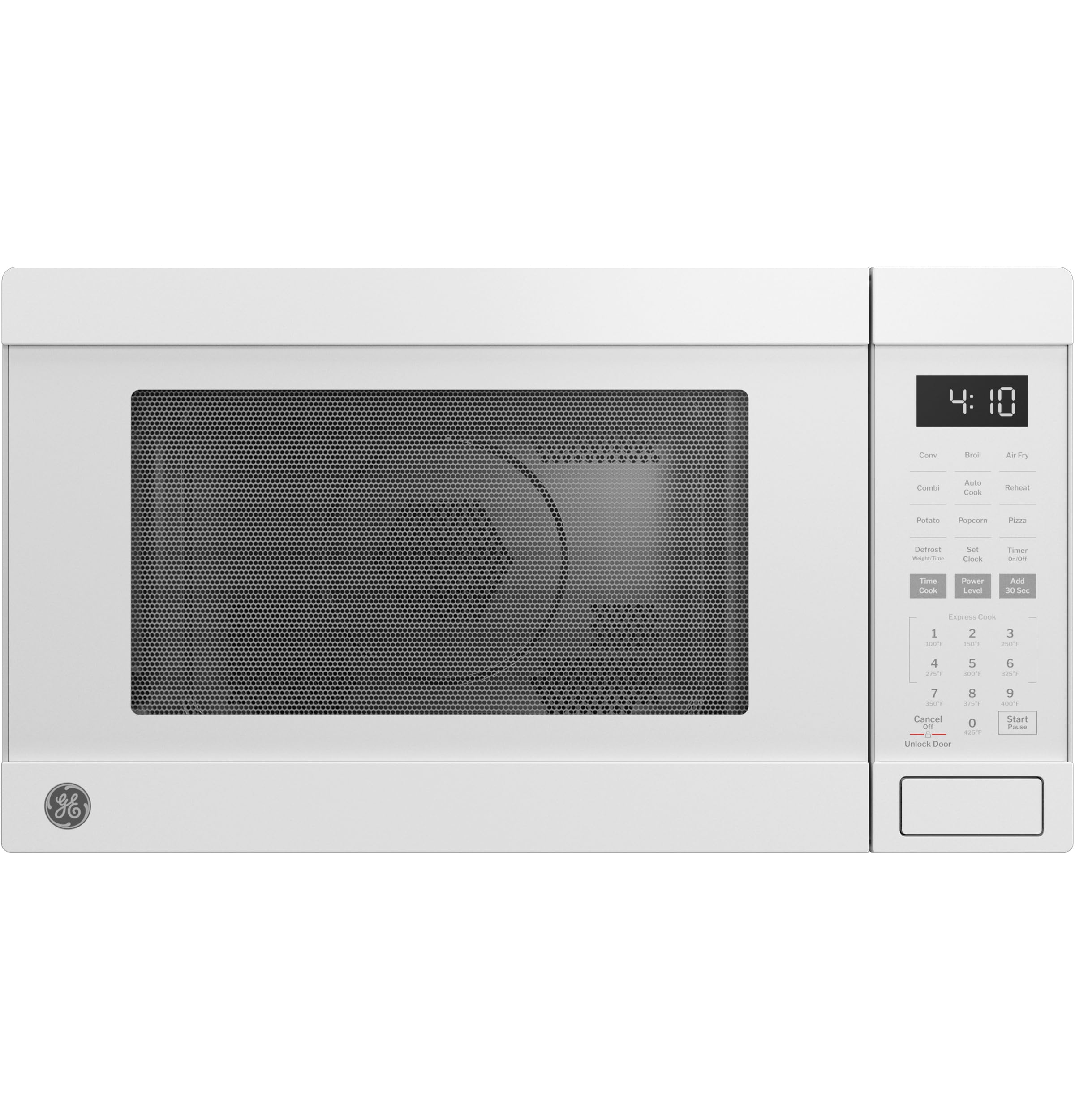
This one earns its spot on quiet and convenience. It uses 1,050 watts and a 1.0 cu. ft. cavity to cover four methods — microwave, air fry, convection, and broil — and the crisper pan, plus a tall wire rack for broiling and a short wire rack for convection, are all included. Convenience-cook controls like Pizza and Popcorn turn a snack into one button press, and the quiet operation makes it a good fit for dorm rooms, offices, or thin-walled apartments where noise carries.
The air fry side gets genuine praise from owners who test it — curly fries that come out crispy outside and soft inside, cinnamon rolls that bake soft and fluffy in convection mode. It beeps four times when cooking finishes, then once a minute until the door opens or cancel is pressed, which is more reminder than alarm. The three-inch clearance on each side, one inch at the rear, and a fully unobstructed bottom are note before you slide it into a tight cabinet.
The honest side of the ledger is durability. The recurring themes among owners are moisture building up inside and door-button wear, so wiping the cavity dry after air-fry sessions and treating the latch with some care are the small habits that keep it going. Reliability across the fleet is mixed, and while the overwhelming majority of this oven’s many owners are happy with the cooking itself, a minority report failures in the first year. The 1,050-watt power sits right between the 1000-watt Magic Chef and the 1800-watt TOSHIBA.
What it gets right: four cooking modes plus one-touch Pizza and Popcorn controls in a unit quiet enough for shared walls.
What to plan for: the door mechanism and interior moisture need a little attention over time, so it rewards a careful owner rather than a careless one.
Make it your pick if: you want confident air-fry results, quiet operation, and a full set of racks and pans in the box.
Look past it if: you want a unit you can ignore for years without maintenance — the moisture and door design ask for a little upkeep.
5. Panasonic HomeChef 4-in-1 Countertop Microwave Air Fryer Combo, NN-CV87QS
The largest cavity here, with an app that walks you through dinner step by step.
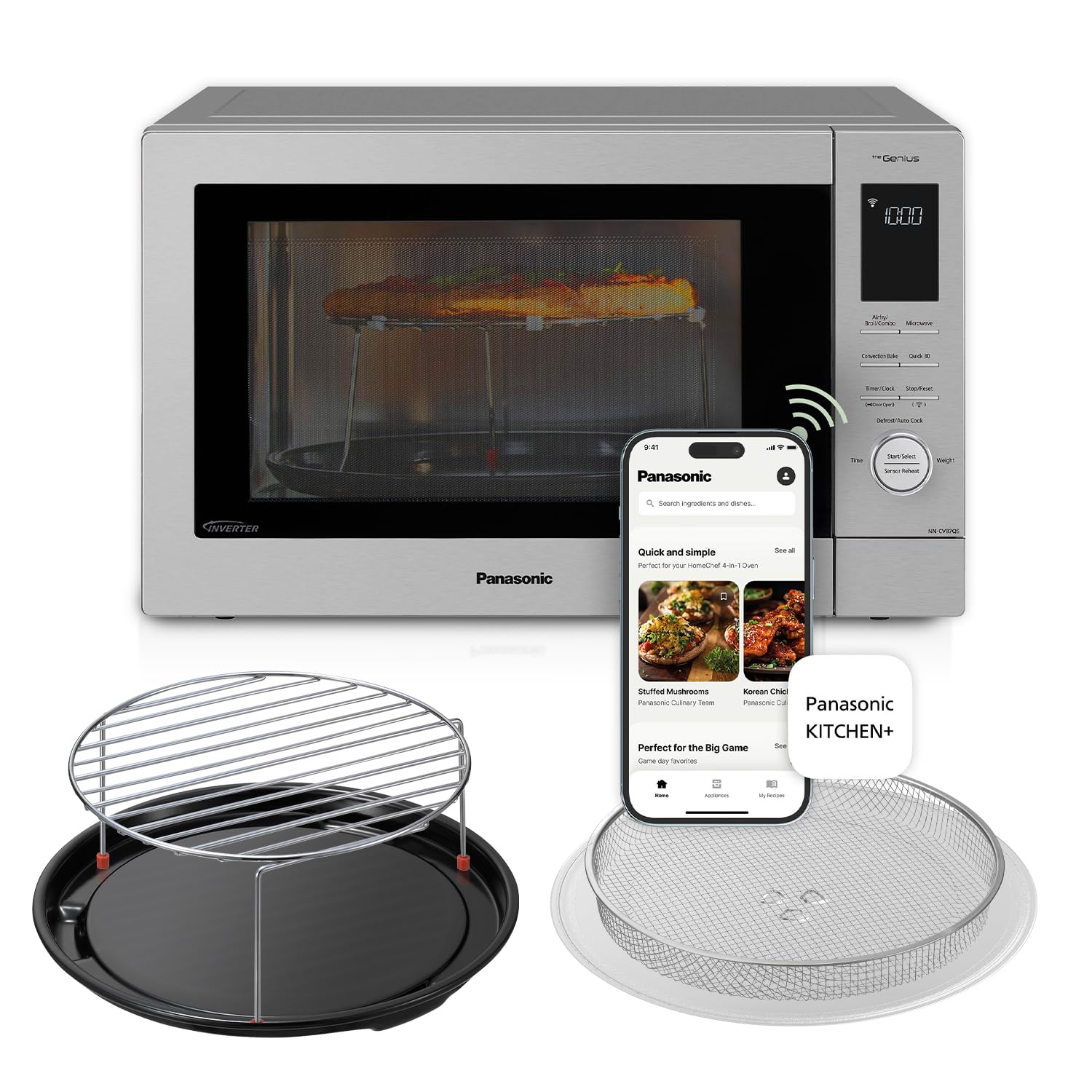
Capacity is the headline: 1.2 cubic feet and a 14.2″ turntable, the biggest cooking space on this list, in a footprint of 22″W x 13.4″H x 17.7″D that still slides under an upper cabinet. Four modes cover microwave, broiler, air fryer, and convection oven, and the Panasonic Kitchen+ app pairs to the oven to automate the built-in modes — pick a recipe, gather ingredients, and let the machine run the cycle. Twenty presets plus Turbo Defrost and a Genius Sensor (which reads the food and stops overcooking) round out the automation.
Inverter technology is where Panasonic has earned its reputation. Instead of cycling the magnetron on and off, it adjusts intensity continuously, so low-power jobs like melting chocolate and delicate reheating come out smooth rather than patchy. Multi-stage cooking is a real bonus — you can run a microwave phase and then a browning phase in one guided sequence. Power consumption is 1350 watts, and the unit ships with the mandatory child safety lock enabled, which the packaging explains how to disengage.
The catch is the interface. Owners find the air fryer and microwave modes excellent but the controls awkward — the dial-and-button layout is not intuitive, and the app has drawn complaints about discontinued US support and limited settings. The air fry temperatures are also capped at 400, 410, and 425°F, which is fine for most frozen foods but restricts fine-tuning. The door lock has also drawn negative notes for the extra press it takes to open.
The machine that cooks for you: the Genius Sensor and 20 presets handle the timing decisions, and the largest cavity on the list gives you room to fit a real roast or a full family dinner.
Worth owning if: you want the biggest interior, app-assisted recipes, and Panasonic’s inverter smoothness in a family kitchen.
Reconsider if: you prefer simple physical controls — the interface takes patience, and the app support has been a moving target.
6. Breville BMO870BSS Combi Wave 3-in-1, Brushed Stainless Steel

The stainless showpiece that quietly does air fry, convection, and microwave in one box.
Breville built this one to feel like a fitted appliance rather than a countertop box, and the brushed stainless finish plus a soft-close door that is 80% quieter than a standard microwave door carries that impression. Three functions live inside: air fryer, convection oven, and microwave. Internal power tops out at 1200 watts for convection and 1100 watts for the grill, and the 1.1 cu. ft. / 32-liter cavity handles a family-sized dish without crowding.
The Element IQ system is the smart part. It steers power where and when it is needed to build the cooking environment for the job at hand, and the Power Smoothing Inverter adjusts intensity on the fly so reheating pizza or defrosting meat does not dry the edges. Nineteen built-in smart presets cover Smart Cook, Smart Defrost, and Smart Reheat, and shortcut buttons inside the door handle the small stuff — melting chocolate, softening butter, reheating pizza, all with one touch. The Combi Crisp Pan and trivet are in the box, and the Fast Combi and Cook From Frozen modes cover the two situations where most combos fall down.
Where it asks for care is at the edges. Owners praise the preset coverage and the door feel, but a pattern of reports flags reliability long-term and the cost of ownership. The soft-close mechanism has drawn complaints about it failing to close fully, and some units have needed replacement. The oven side is powerful but not quick, and the temperature presets move in 50-degree steps starting at 400°F, which leaves gaps if you need a precise bake. Built-in fitment is excellent if you have the space, though.
Built for feel and finish
- Soft-close door is 80% quieter and the whole oven runs 50% quieter than a standard microwave.
- 19 smart presets plus Fast Combi and Cook From Frozen cover the tricky jobs.
- Stainless finish and jog-dial interface feel premium in a built-in space.
- Power Smoothing Inverter keeps reheated food even and moist.
Where the shine wears
- Long-term reliability is the recurring complaint, and repairs are pricey.
- Temperature presets step in 50-degree jumps starting at 400°F.
- The convection side is slower than a dedicated oven on a bake.
Best matched to you if: you want the quietest, best-feeling combo oven here and will use the presets more than the manual modes.
Not the one if: you demand precise temperatures or long warranty confidence — the presets and reliability record do not fully deliver either.
7. SAMSUNG 1.2 cu. ft. Countertop Convection Microwave with Air Fry, MC12DB8700CKAA

The drop-down-door showpiece that looks built-in even when it is not.
If you want your countertop oven to disappear into the cabinetry, this is the design-led pick. Power Convection merges traditional convection with a powerful hot-air system to distribute heat thoroughly, and Samsung rates Power Convection up to 30% faster than standard convection. A 1.2 cu. ft. cavity pairs with a 15″ turntable, and the drop-down door — which reads like a wall oven in operation — is the most-complimented feature among owners.
Air Fry handles the healthy-fried side without a countertop deep fryer, and PowerGrill Duo runs a wide grill element to brown and crisp the outside without drying the center. Wi-Fi and SmartThings Food add recipe recommendations and guided cooking steps, and you can check status or control the oven by voice through Samsung Bixby, Amazon Alexa, or Google Assistant. It runs on 1.6kW across microwave, grill, and convection.
What buyers appreciate most is the appearance — the black glass finish and the drop-down door read like a premium built-in. The catch shows up in the fine print: it lacks multi-stage cooking, does not offer a turntable-off option, and the broiler element is non-removable, which makes the interior harder to wipe down. Ambient Wi-Fi interference is low, and the oven boils a cup of water noticeably faster than a comparable 1000-watt GE, so the raw performance is there even if the programmability is not.
Design-first cooking: the black glass front, drop-down door, and 15″ turntable make this the one to pick when the oven is on display.
Choose it if: you are fitting the oven into a visible spot and want app and voice control alongside strong convection power.
Pick a rival if: you want multi-stage cooking, a removable broiler element, or a simpler interface — this one trades those for style.
Understanding the Specs
Cavity Capacity and Turntable Size
Capacity in cubic feet (or quarts) tells you how much a microwave can hold — think of it as the size of the box the food sits in. A 0.9 cu. ft. cavity fits a dinner plate and a splatter cover, while a 1.2 cu. ft. cavity can take a whole chicken or a larger casserole. Turntable diameter matters too; the 14.2″ and 15″ tables found on the larger models give you real room to spread food out so it heats evenly. Measure your countertop and cabinet clearance, then match capacity to how many people you cook for.
Wattage, Inverter, and Combi Modes
Wattage is the power the oven uses to heat food, and it decides how long cooking takes. A 900-watt unit is gentler and slower; a 1,050-watt or 1800-watt unit heats faster and holds temperature better. Inverter technology runs the power at a steady low level rather than pulsing on and off, which prevents the cold-edge, hot-center problem on defrosting and delicate jobs. Combi modes are worth understanding because they combine microwave, grill, and convection in one cycle — that is how you get crispy skin on a roast without overcooking the middle. Match wattage and combi modes to what you actually cook, not to the biggest number on the box.
FAQ
Can I put metal racks or foil trays inside a 3-in-1 microwave?
Will a 3-in-1 microwave fit under my kitchen cabinets?
What is the difference between air fry and convection mode?
Do I need an inverter microwave, or is a standard one enough?
How much wattage do I need for a family of four?
Can I disable the child lock on these ovens?
Are these safe for ceramic plates and bowls?
How long do these 3-in-1 ovens typically last?
Is it worth replacing a standalone microwave and air fryer with one combo?
Do I need Wi-Fi or an app to use these ovens?
Final Thoughts: The Verdict
For most kitchens, the winner is the BLACK+DECKER 5-in-1 Microwave Oven Air Fryer Combo because it collapses five cooking modes into a 0.9-cubic-foot footprint that fits where larger combos will not, and it runs quieter than you would expect from a budget-friendly countertop. If you want real searing power and even defrosting, the TOSHIBA 6-in-1 Inverter Countertop Microwave Oven delivers 1800 watts under convection and inverter heat distribution for a two-person kitchen. And if you are fitting the oven into a visible spot and want app and voice control, reach for the SAMSUNG 1.2 cu. ft. Countertop Convection Microwave. Whichever you choose, buying an extended warranty on a countertop combo is the smartest small spend you can make — the category’s reliability record is honest about that.
How We Picked
We do not accept paid placement. Every pick is matched to a real buyer and a real use-case; we do not hands-on test units.
Sources & Methodology
Specifications: manufacturer listings and product documentation. Review insights: verified customer reviews, as of September 2026. Pricing: not shown on this page (it changes often); check the current price via the retailer link.
As an Amazon Associate, Gadgets Feed earns from qualifying purchases. This does not affect which products we feature.