
That flicker of worry when you turn the key after two weeks of parking — the slow crank, the dashboard lights dimming, the click of a starter solenoid that knows it doesn’t have the juice. Parasitic drain from clocks, alarms, and ECUs silently siphons your 12V battery’s life, and a standard wall-powered trickle charger is useless if you don’t have a garage or an outlet nearby. A dedicated solar panel that feeds your battery directly changes that equation entirely.
I’m Min — the co-founder and writer behind Gadgets Feed. I’ve spent hundreds of hours combing through wattage curves, MPPT efficiency claims, connector compatibility matrices, and real-world user reports across dozens of 12V solar maintainers to separate the panels that actually hold a charge from the ones that just look the part on a dashboard.
Whether you’re keeping a weekend RV battery topped off in storage or fighting the cold-start dread on a seldom-driven truck, the right panel delivers silent, automatic maintenance you can trust. This guide breaks down the specs and real-world trade-offs behind the top options for the best battery solar charger on the market today.
How To Choose The Best Battery Solar Charger
A 12V solar battery charger is a deceptively simple device — a panel, a controller, and a wire — but the wrong combination can leave you with a dead battery and a false sense of security. The key variables are wattage, controller type, connector compatibility, and physical durability. Here’s what separates a reliable maintainer from a dashboard ornament.
Panel Wattage and Real-World Charging
Wattage determines how much current the panel can push into your battery under peak sun. A 5W panel works fine for maintaining a stored car battery against parasitic drain. A 20W panel recovers discharged batteries faster and handles deeper discharges. A 100W kit moves into true recharging territory for larger banks. But wattage ratings assume full, direct sunlight — partial shade, clouds, dirt, and angle all reduce output. Buy for the worst-case light conditions you actually park in, not the lab spec.
Charge Controller Type: PWM vs. MPPT
The charge controller regulates voltage and current going into the battery. Pulse-Width Modulation (PWM) controllers are simpler and cheaper, working fine for small trickle chargers under 15W where the panel voltage is close to the battery voltage. Maximum Power Point Tracking (MPPT) controllers extract up to 30% more power from the same panel, especially in low-light or cold conditions and when the panel’s voltage is significantly higher than the battery’s. For any charger above 15W or any lithium battery, an MPPT controller is the smarter investment.
Connector Type and Installation
Most 12V solar maintainers include multiple connector cables. A cigarette lighter adapter is the simplest — plug into your vehicle’s accessory socket and park in the sun. Alligator clips bypass the vehicle wiring and clamp directly to battery terminals, useful for batteries that are already disconnected or mounted in a trailer. SAE connectors are common for permanent mounts, and MC4 connectors are the standard for larger panels that feed a remote charge controller. Choose a kit whose included cables match your battery location and how often you plan to move the panel.
Quick Comparison
On smaller screens, swipe sideways to see the full table.
| Model | Category | Best For | Key Spec | Amazon |
|---|---|---|---|---|
| SUNER POWER 30W | Premium | Multi-battery type maintenance | 30W, MPPT, LiFePO4 mode | Amazon |
| SOLPERK 100W | Premium | Off-grid recharging | 100W, 10A MPPT controller | Amazon |
| POWOXI 15W MPPT | Mid-Range | MPPT efficiency at low wattage | 15W, MPPT, IP65 | Amazon |
| SUNAPEX 20W | Mid-Range | RV windshield mounting | 20W, ETFE, smart controller | Amazon |
| SOXONO 40000mAh | Mid-Range | Portable device charging | 40000mAh, PD 20W | Amazon |
| Sunway Solar 8W | Budget | Basic car battery maintenance | 8W, 8.5W max power | Amazon |
| Topsolar 100W Kit | Mid-Range | Fixed roof or ground mount | 100W, 30A PWM controller | Amazon |
In‑Depth Reviews
1. SUNER POWER 30W 12V Solar Battery Charger

The SUNER POWER 30W packs a genuine Ultra-Smart MPPT controller into a slim, ETFE-coated panel, delivering up to 99% tracking efficiency and roughly 30% more usable power than a conventional PWM charger of the same wattage. That matters when you’re parked under a partly cloudy sky or trying to recover a deeply discharged 12V battery. The three-stage charging algorithm (Bulk, Absorption, Float) handles flooded, AGM, gel, and LiFePO4 chemistries with a dedicated mode selector, so you aren’t locked into a single battery type.
Four suction cups and pre-drilled mounting holes make the panel easy to position on a windshield, cabin roof, or flat surface. The kit includes SAE-to-alligator clips, SAE-to-bare end, and SAE-to-cigarette lighter cables — giving you three connection options straight out of the box. At roughly 4 pounds, it’s light enough to move between vehicles. Multiple users report maintaining 20Ah batteries and reviving older 660CCA batteries, with the charge-level LEDs showing state of charge at 25%, 50%, 75%, and 100%.
Smart safety protections cover overcharge, over-discharge, over-voltage, reverse polarity, and temperature extremes. The spark-proof design and waterproof build mean it survives direct rain and windshield heat without concern. Some users note the included wiring could be a few feet longer for rear-mounted battery compartments, but for most dashboard or windshield placements, the cable length is sufficient.
Why it’s great
- Genuine MPPT controller with selectable battery modes (Flooded, AGM, Lithium)
- Three cable options included for multiple installation scenarios
- Clear 4-stage charge indicator for real-time status monitoring
Good to know
- Panel is just 0.15 inches thick — stiff but not rigid enough to mount completely flat without support
- Wiring length may be short if your battery is far from the mounting spot
2. SOLPERK 100W Solar Battery Charger

The SOLPERK 100W kit shifts from simple battery maintenance into genuine energy generation territory. Its monocrystalline A+ cells achieve a rated 30% efficiency, and the included 10A MPPT controller extracts over 30% more power than a standard PWM controller in identical light conditions. In four hours of full sun, the panel outputs roughly 400 watt-hours — enough to top off multiple 12V deep-cycle batteries or power a small off-grid camera setup and WiFi repeater.
Build quality is solid: a tempered glass front, anodized aluminum frame, and polymer backsheet wrap the 54 cells in weather-resistant layers. Z-mounting brackets with pre-drilled holes simplify roof or ground installation, and the MC4 connectors are securely attached. The controller’s three LEDs (blue for power, red for charging, green for full charge) give an at-a-glance status readout. Users consistently report keeping deep-cycle marine batteries charged through rainy days and maintaining 1000W inverter loads without issue.
The kit includes the panel, controller, a 19.7-inch alligator clip cable, O-ring connectors, and mounting hardware. One-year warranty and lifetime technical support back the purchase. A small number of users mention the controller doesn’t display wattage on a screen, preferring a more detailed readout. If that matters to you, pairing this panel with a third-party display controller is an easy swap.
Why it’s great
- High 100W output with premium monocrystalline cells for maximum daily yield
- True MPPT controller adds over 30% charging efficiency vs. PWM
- Weather-resistant build survives rain, snow, and prolonged outdoor exposure
Good to know
- Controller lacks a display screen for real-time wattage and voltage readout
- Panel is 15.84 pounds — fixed mount, not a portable dashboard unit
3. POWOXI 15W MPPT Solar Battery Charger
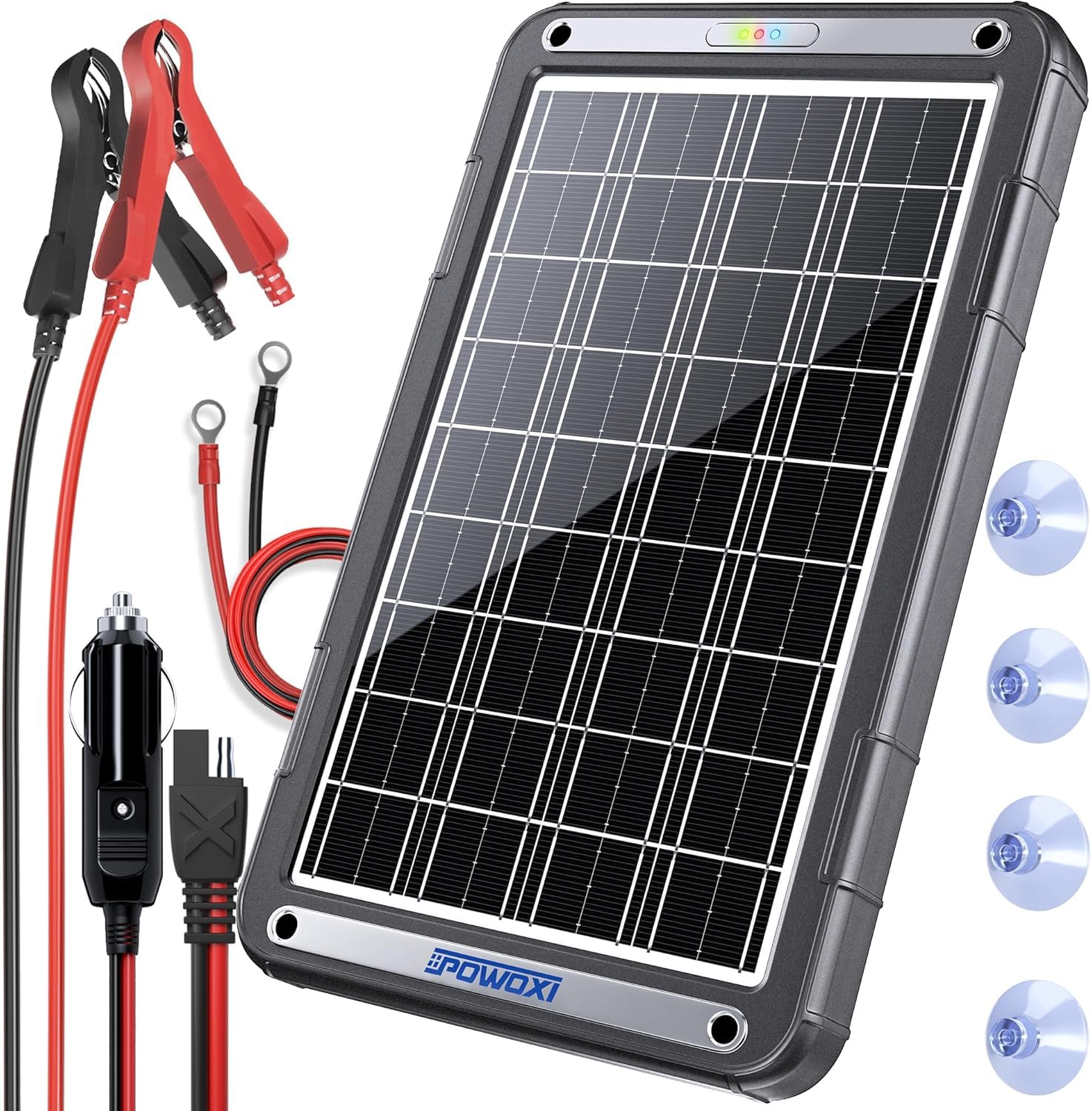
The POWOXI 15W is a rare find at this wattage tier — an integrated MPPT controller in a sub-20W panel. Most trickle chargers in the 12-15W range use a simple PWM controller or no controller at all, but POWOXI’s built-in Maximum Power Point Tracking pushes conversion efficiency up to 99%, pulling meaningful current even through cloud cover or morning shade. The panel’s 1.25A rating is enough to maintain a car, boat, or motorcycle battery against parasitic drain and recover small voltage drops overnight.
Build construction uses PC+ABS+toughened glass, rated IP65 waterproof, and the frame resists heat from -40°C to 137°C. The three-LED system (blue for sun, red for charging, green for full) updates every two seconds as the MPPT controller recalculates the maximum power point. The kit includes both alligator clamps and a cigarette lighter adapter, plus a fabric storage bag. Users consistently report that the POWOXI maintains 12.8V on batteries that would otherwise drop to 11.5V within a month of sitting.
The MPPT controller’s voltage detection means the open-circuit voltage may read below 14V when not connected to a battery — this is normal behavior, not a defect. The MC4 connectors are secure, and the tempered glass surface holds up well under direct sun exposure. The 15W output won’t recharge a fully depleted deep-cycle battery quickly, but for its intended job of steady low-current maintenance, the MPPT advantage makes it more effective than any PWM 15W charger on the market.
Why it’s great
- Genuine MPPT controller at a sub-20W price point — rare in this category
- Dual output cables (clamps and lighter plug) for flexible installation
- IP65 waterproof rating withstands rain and splash exposure
Good to know
- 15W output is limited to maintenance duty — not for fully draining deep-cycle batteries rapidly
- MPPT adds a 2-second calculation delay before LED status updates
4. SUNAPEX 20W Solar Trickle Charger Maintainer
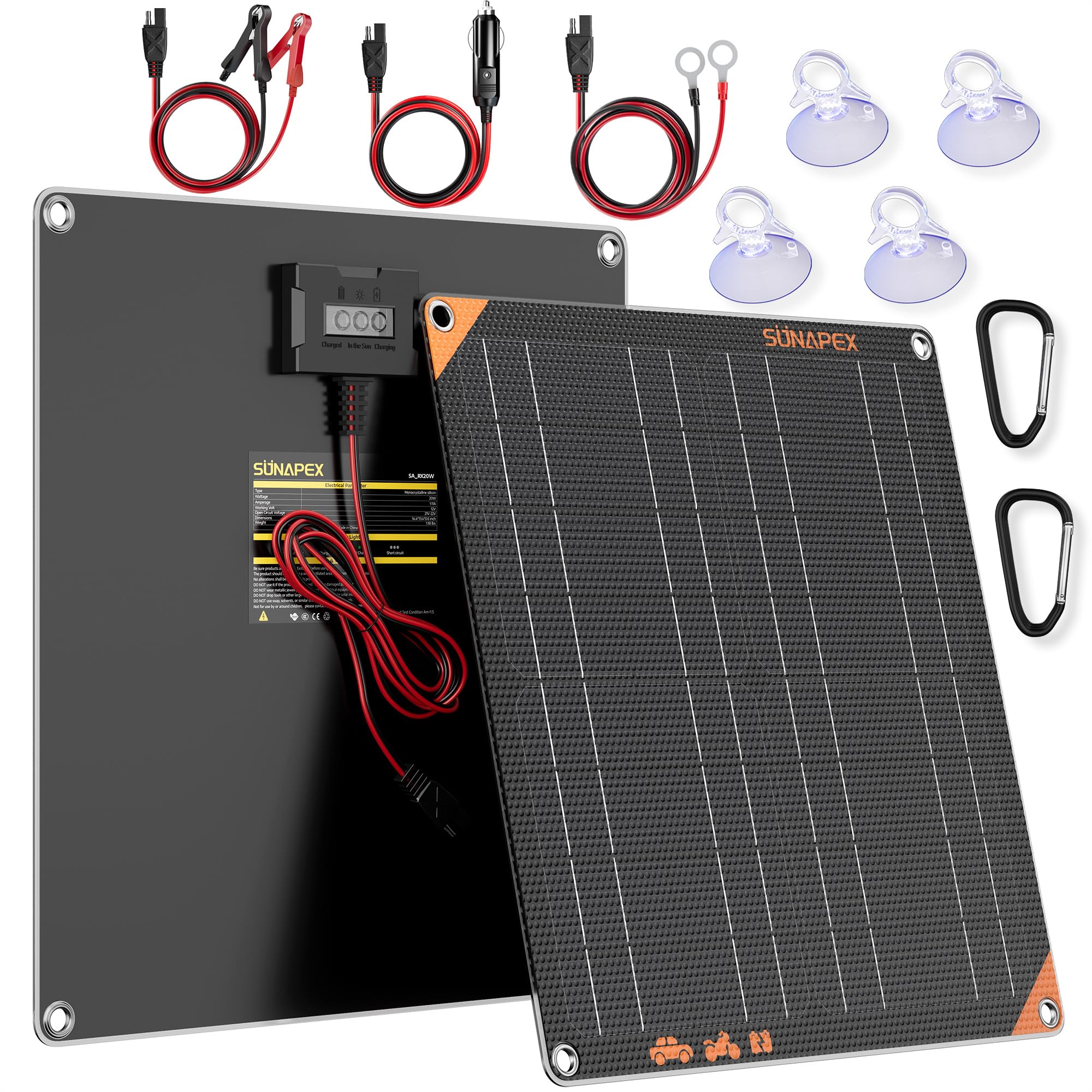
The SUNAPEX 20W distinguishes itself with a flexible ETFE panel design that conforms to curved surfaces — a genuine advantage when mounting on an RV windshield, boat dashboard, or car roof where rigid panels don’t sit flush. The built-in smart controller (not MPPT, but a capable PWM with optimized charging logic) handles up to 20W without requiring a separate controller box, and the three clear LEDs indicate sunlight detection, active charging, and full battery status.
The monocrystalline cells deliver stable output even in low-light and cloudy conditions, and the 1.11A output is sufficient to maintain a 3.5L truck battery over three weeks of inactivity. Users mounting this on RVs report it prevents the chassis battery from dying during boondocking sessions, and the suction cup mount holds securely on glass surfaces. The kit’s SAE connector supports easy swapping between alligator clips, O-ring wires, and the included cigarette lighter adapter.
IP67 waterproofing means the panel resists full immersion — not that you’d submerge it, but it handles heavy rain and snow melt without concern. A minor limitation: the smart controller won’t begin charging a battery that has dropped below a certain voltage threshold (roughly 3-5V), so it’s best suited for maintaining healthy batteries rather than resurrecting fully dead ones. For ongoing battery maintenance on vehicles stored for weeks at a time, the SUNAPEX 20W offers reliable, flexible performance.
Why it’s great
- Flexible ETFE panel conforms to curved windshields and dashboards
- IP67 waterproof rating — fully sealed against rain and snow
- Three color-coded LEDs remove guesswork from charge status monitoring
Good to know
- Smart controller won’t charge a battery that’s dropped below a safe threshold
- Panel output heats up significantly in direct sun — ensure ventilation
5. SOXONO 40000mAh Solar Charger Power Bank
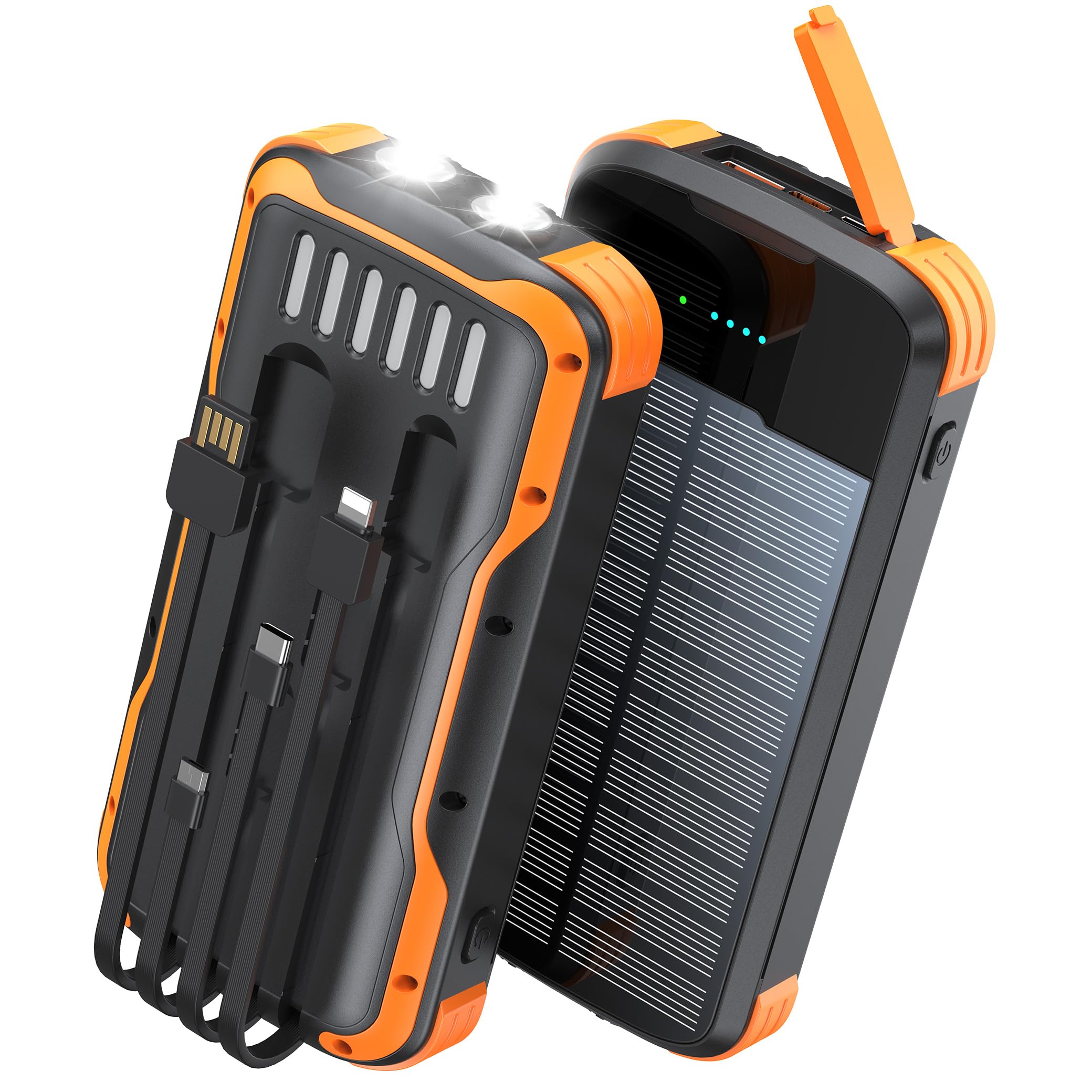
The SOXONO takes a completely different approach from the 12V direct-wire chargers above — it’s a self-contained 40000mAh power bank with a built-in solar panel. This isn’t for trickle-charging a car battery; it’s for keeping your smartphone, earbuds, and tablet charged during multi-day camping trips or emergencies. The solar panel replenishes the internal battery slowly, while the PD 20W USB-C output charges an iPhone 15 to 65% in roughly 30 minutes.
The unit packs four built-in cables (Type-C, iOS, Micro USB, and a USB-A input cable), plus three additional ports, allowing simultaneous charging of up to five devices. Two bright flashlights on the front edge provide up to 30 hours of continuous light — useful for tent setup or emergency signaling. The IP67 waterproof ABS housing withstands drops and rain, and the 450-gram weight is manageable for a pack, though it’s on the heavier side for backpacking.
Customer feedback consistently highlights the enormous capacity and fast wired charging speed. Some users note a persistent plasticky-electrical smell from the unit, and the solar charging rate is slow enough that you’ll primarily rely on wall or car charging to fill the 40000mAh capacity quickly. For its intended role — a high-capacity backup power source that can slowly recharge from the sun when mains power isn’t available — the SOXONO delivers excellent utility.
Why it’s great
- Massive 40000mAh capacity charges multiple devices for days
- PD 20W fast charging via USB-C for rapid device top-ups
- Built-in cables eliminate the need for separate charging cords
Good to know
- Solar charging is slow — think of the panel as an emergency top-up, not a primary charge source
- At 450 grams, it’s heavy for ultralight backpacking trips
6. Sunway Solar 8W Trickle Charger

The Sunway Solar 8W panel is the minimalist’s entry point into solar battery maintenance. Its 8.5W peak power output is just enough to counteract the parasitic drain from a car’s clock, alarm, and ECU — roughly 30-50mA that would otherwise flatten a battery over two to three weeks. The monocrystalline cells feed through a built-in blocking diode that prevents reverse current from draining the battery at night, a critical safety feature absent from the absolute cheapest panels.
Installation is genuinely plug-and-play: mount the panel on the dashboard or windshield with the four included suction cups, route the cable to the cigarette lighter socket, and leave it. The kit also includes alligator clips for direct battery connection. The LED indicator lights up when the panel is receiving sunlight and actively charging. At 2.67 pounds and a 14.9 x 8.3-inch footprint, it sits unobtrusively on most dashboards.
This panel is strictly for maintenance — it won’t recharge a deeply discharged battery. A few users note the absence of a visible charging status indicator beyond a single LED. The 12-month warranty covers defects, and the built-in diode protects your battery from overnight drain. For someone who simply wants to keep a seldom-driven car or motorcycle battery from dying, the Sunway 8W delivers reliable, unattended trickle charging at an accessible price point.
Why it’s great
- Built-in blocking diode prevents overnight battery drain — essential for any solar maintainer
- Ultra-simple cigarette lighter plug installation for dashboard use
- Lightweight and compact footprint for windshield mounting
Good to know
- 8W output is only sufficient for counteracting parasitic drain, not recharging dead batteries
- Single LED indicator doesn’t show the battery’s state of charge
7. Topsolar 100W 12V Solar Panel Kit

The Topsolar 100W kit takes a practical, system-building approach. It bundles a 100-watt monocrystalline panel, a 30A PWM charge controller, two 16-foot MC4 cables, two 5-foot O-ring cables, and a V-shaped adjustable mounting bracket — everything needed for a small off-grid installation on an RV roof, shed, cabin, or ground mount. The heavy-duty anodized aluminum frame and tempered glass surface are built for permanent outdoor exposure.
The included 30A PWM controller supports both 12V and 24V battery systems and provides basic protections against overcharge, over-discharge, and short circuits. Users report wiring two panels in parallel to charge a fleet of tractor and buggy batteries, and the 4.5A output is enough to maintain multiple 12V deep-cycle banks. The adjustable bracket allows angle optimization for better sunlight capture depending on latitude and season.
The PWM controller is the primary limitation here — it lacks the efficiency gains of an MPPT controller, and the 100W panel’s voltage output (around 23V open-circuit) is somewhat underutilized by a PWM controller that simply pulses it down to battery voltage. Some users note the mounting hole patterns don’t align perfectly with standard roof rails, though drilling through the aluminum frame is straightforward. For budget-conscious buyers seeking a complete 100W starter kit, the Topsolar delivers solid hardware for the price.
Why it’s great
- Complete kit includes panel, controller, cables, and adjustable mounting brackets
- Rugged anodized aluminum frame and tempered glass for long-term outdoor use
- 30A PWM controller supports 12V and 24V battery systems
Good to know
- PWM controller is less efficient than MPPT — you lose potential power from the 100W panel
- Mounting hole alignment may not match all roof rails out of the box
FAQ
Can a solar trickle charger overcharge my 12V battery?
How many watts do I need to prevent a car battery from dying?
What’s the difference between a solar maintainer and a solar battery charger?
Final Thoughts: The Verdict
For most users, the best battery solar charger winner is the SUNER POWER 30W because it combines genuine MPPT charging efficiency, selectable battery profiles for flooded, AGM, and lithium chemistries, and three cable options in a portable, waterproof panel that fits on any windshield or flat surface. If you need maximum daily energy throughput for off-grid recharging, grab the SOLPERK 100W for its high-efficiency monocrystalline cells and dedicated 10A MPPT controller. And for a simple, budget-friendly way to keep a seldom-driven car battery alive, nothing beats the Sunway Solar 8W — just plug it into the lighter socket and park in the sun.