
Our readers keep the lights on and my morning glass full of iced black tea. As an Amazon Associate, I earn from qualifying purchases.
Specs are compiled from manufacturer listings and verified buyer reviews and can change over time — please confirm the key details on the product page before buying.
If you need internet where there is no wall socket, the GL.iNet GL-XE300 Puli is the pick to beat. It pairs a 5000mAh battery (a battery that holds 5000 milliamp-hours of charge, enough for hours of use) with 300Mbps 4G-to-Wi-Fi conversion (it turns a 4G cell signal into Wi-Fi at up to 300 megabits per second — fast enough for video calls and 720p streaming). It is the only model here that runs OpenWrt (a free, open-source router operating system you can customise), so you can change how it works. The rest of this list covers faster 5G hotspots, a no-SIM travel unit with data bundled in, and a budget entry point that costs a fraction of the premium picks.
I’m Min — the founder and writer behind Gadgets Feed. This guide is built by comparing the manufacturers’ published specifications and the patterns across verified customer reviews, so you get each pick’s real strengths and trade-offs instead of marketing spin.
The biggest mistake buyers make is assuming any hotspot works with any SIM — carrier lock and band support decide everything. That is why a battery operated wifi router should be chosen by band list and battery capacity first, not by top speed claims.
Our Picks at a Glance


How To Choose The Best Battery Operated WiFi Router
A battery operated WiFi router — also called a mobile hotspot — takes a cellular signal and turns it into a Wi-Fi network your laptop, tablet, or smart TV can join. Unlike a home router that plugs into a wall and a phone line, this class of device runs entirely on its own internal battery. That means two things matter above all else: how long the battery lasts, and whether the device will actually connect to your carrier.
Check the bands and carrier lock before anything else
Every hotspot supports a specific list of cellular frequency bands (the radio channels a carrier uses to send data). If your carrier broadcasts on a band the hotspot does not list, you get no service. Look for a device that explicitly names your carrier or lists the LTE bands it supports. An open up hotspot lets you insert your own SIM, while a locked one only works with the carrier it was built for. This single factor explains most of the frustration in hotspot reviews.
Battery capacity tells you how long you can stay offline-capable
Battery capacity is measured in mAh (milliamp-hours — think of it as the size of the fuel tank). A 5000mAh battery holds roughly twice the charge of a 2400mAh one, so a device with a larger battery keeps broadcasting Wi-Fi for longer between charges. If you plan to work remotely for a full day, capacity matters more than a fancy speed number you will rarely hit.
Do not confuse 4G speeds with 5G speeds
4G LTE hotspots are the workhorses — they cover wide areas and are cheap to run. 5G hotspots, especially mmWave models, can deliver far higher throughput but consume more power and heat. For email, maps, and standard video calls, 4G LTE is plenty. Choose 5G only if you regularly need to move large files or stream at high resolution in a location with strong 5G coverage.
Quick Comparison
| Model | Best For | Battery | Max Data Rate | Frequency Band | Amazon |
|---|---|---|---|---|---|
| GL.iNet GL-XE300 (Puli)★ Best Overall | Best Overall | 5000mAh | 300 Mbps | 2.45 GHz | Amazon |
| NETGEAR Nighthawk M7 ProPremium 5G Pick | Premium 5G Picks | Spare Battery Included | 5800 Mbps | 6000 MHz | Amazon |
| GL.iNet GL-E750V2 (MUDI) | Customisation Fans | 7000mAh | 433 Mbps | 5 GHz | Amazon |
| NETGEAR Nighthawk M6 Pro | 5G With Ethernet Port | 5040mAh | 3600 Mbps | 2.4 GHz | Amazon |
| Portable WiFi Travel Router (iotesimglo) | No-SIM Travel | 3500mAh | 150 Mbps | Dual-Band | Amazon |
| SCHOK 4G LTE Portable WiFi | Everyday Budget | 4000mAh (Removable) | 600 Mbps | 2.4/5 GHz | Amazon |
| KuWFi 4G LTE Mobile Hotspot | Budget/Light Use | 2400mAh | 150 Mbps | 2 GHz | Amazon |
In‑Depth Reviews
1. GL.iNet GL-XE300 (Puli) 4G LTE Mobile Smart VPN Router
Our pick — over 4★ from 90+ verified ratings; the strongest balance of quality and price.
The one that runs open-source firmware and still tops the whole list
Its 5000mAh battery is more than double the 2400mAh in the KuWFi below — a 2.1x gap that shows up in how long you can stay offline-capable between charges. The 300Mbps data transfer rate also beats the KuWFi’s 150 Mbps by a full 2x, so downloads and video calls finish faster on the same connection.
What genuinely wins people over is how much you can customise. OpenWrt (a free, open-source router operating system) is already installed, so the router is open up and highly extendable. You get 128MB RAM (short-term memory for running apps), 16MB NOR plus 128MB NAND flash (storage for the system and your files), dual Ethernet ports (two wired network sockets), a USB 2.0 port, and antenna SMA mount holes (screw points for adding external antennas later) reserved for future upgrades. OpenVPN and WireGuard (two common VPN protocols that encrypt your traffic) are both pre-installed and compatible with 30+ VPN service providers. The built-in Web UI (a browser-based control panel) and GoodCloud platform let you manage the device remotely, check signal strength, and set up VPN servers without touching a command line. As buyers put it, this is a router that “saved my butt during a camping trip” — the 4G LTE link (a fast cellular connection) kept video conferencing and 720p streaming alive when nothing else worked.
The honest trade-off is speed ceiling. This is a single-band 2.45 GHz router limited to 4G LTE — there is no 5G option, and the VPN slows things down further when enabled. There is also no 5GHz band, unlike the GL-E750V2 MUDI below. For email, maps, video calls, and moderate streaming that is fine; if you need to push large files regularly, a 5G model is the better call.
What works brilliantly
- 5000mAh battery runs about 6 hours per charge
- OpenWrt firmware with 128MB RAM and dual Ethernet ports
- WireGuard, OpenVPN, and 30+ VPN providers supported from the start
- Antenna mount holes and USB 2.0 port for expandability
Where it holds back
- 4G LTE only — no 5G support
- 2.4GHz single band, lacking the 5GHz option on pricier picks
- VPN use noticeably slows connection speed
Reach for this if: you want the full package — big battery, OpenWrt flexibility, and strong 4G LTE coverage for camping, remote work, or backup internet.
Look elsewhere if: you need 5G speeds or dual-band Wi-Fi, which this single-band router does not offer.
2. NETGEAR Nighthawk M7 Pro Mobile Hotspot Bundle 5G mmWave
WiFi 7 and 5G mmWave in one pocket-sized shell, spare battery included
For anyone who genuinely needs the fastest possible connection on the road, the M7 Pro is the premium answer. It supports 5G mmWave and sub-6 GHz bands, with a data transfer rate of 5800 Mbps — far ahead of the 300 Mbps the GL-XE300 Puli manages. The quad-band 6000 MHz frequency setup and WiFi 7 technology mean lower latency and smoother performance when multiple devices are connected at once. Wi-Fi coverage reaches up to 2,000 square feet, enough for a small home, office, or RV without a repeater.
The bundle separates it from the competition at this level. Unlike the Nighthawk M6 Pro, which ships without a spare, this version includes a protective travel case and an extra rechargeable battery — so you can swap cells and keep working rather than hunting for an outlet. Setting up is straightforward, and the open up design (not tied to one carrier) works with compatible AT&T, Verizon, and international SIM cards. In practice that means you can arrive in a new country, slot in a local SIM, and be online in minutes.
There are two things worth knowing before you decide. First, this is a Renewed unit, so the firmware situation can vary — some owners found it still carried AT&T firmware rather than NETGEAR’s, which locks out certain NETGEAR-only features. Second, C-band and mmWave coverage varies enormously by location; if you are not in a strong 5G area, the speed advantage shrinks. The battery capacity and Wi-Fi range for the base unit are also less clearly specified than the bundle extras — the real value here is the spare battery and case.
The standout spec: 5800 Mbps data transfer across quad-band 5G mmWave and sub-6 GHz, paired with WiFi 7 — a combination no other pick on this list matches.
One caveat worth planning around: as a Renewed listing, the firmware may still be carrier-branded, so confirm what version you are getting before relying on NETGEAR-exclusive features.
Pick this when: maximum throughput and 5G coverage are non-negotiable, and you want the spare-battery bundle for uninterrupted travel days.
Consider an alternative if: you are outside reliable 5G range or prefer a device with clearly documented specs for every component.
3. GL.iNet GL-E750V2 MUDI 4G LTE Portable Travel Router

A 7000mAh battery and dual-band Wi-Fi for travellers who stay out all day
The MUDI’s headline number is its 7000mAh battery — the largest on this list and the reason it earns its place. That 7000mAh cell is rated for up to 8 hours per charge, and combined with a compact 285g frame measuring 5.7 in × 3.1 in × 0.9 in, it is genuinely pocketable without sacrificing runtime. It delivers 300Mbps on 2.4GHz plus 433Mbps on 5GHz, giving you a dual-band network the single-band GL-XE300 above simply cannot match. Portability is what owners consistently praise — it is designed to be part of your travel kit, not a device you leave behind.
Security and flexibility are where the MUDI earns its higher price. OpenVPN, WireGuard, and a custom DNS server are all built in, and it connects with 30+ VPN servers for secure remote file access. WireGuard speeds reach up to 50Mbps and OpenVPN up to 10Mbps, which is respectable for a mobile router. Storage and extensibility are generous too: DDR2 128MB RAM, 16MB NOR flash, 128MB NAND flash, up to 1TB MicroSD, and a USB 2.0 port. It also supports GL.iNet’s physical eSIM card for switching operators between countries — the card is sold separately.
Two honest caveats stand out. First, despite the large battery, real-world battery life is mixed in owner feedback — some find it excellent, some find it underdelivers, and there is also a recurring note about heat during extended use. Second, the battery is sealed and non-replaceable. Unlike the Nighthawk M6 Pro, which has a removable battery, the MUDI’s cell cannot be swapped, so when the battery eventually degrades, the device’s usefulness follows. Setup is also mixed — easy for some, fiddly for others.
The number that matters: 7000mAh — the largest cell here, giving up to 8 hours of rated runtime in a 285g frame you can drop in a jacket pocket.
Think twice if: you want a user-replaceable battery. The MUDI’s cell is sealed in, so long-term battery health depends entirely on how you charge it.
Best matched to: frequent travellers who need dual-band Wi-Fi, VPN support, and the longest possible single-charge runtime in a compact body.
Not the right fit if: you want to swap batteries yourself, or you need 5G — this is a 4G LTE device.
4. NETGEAR Nighthawk M6 Pro Mobile Hotspot 5G mmWave

5G speed, a 2.5G Ethernet port, and room for 32 devices at once
The M6 Pro is built for people who need to connect a lot of things. It supports up to 32 devices simultaneously, which is well beyond what most travel hotspots can handle — enough for a family, a small office on the move, or anyone running multiple laptops, tablets, and smart devices at once. The 5G mmWave and sub-6 band support (two types of 5G signal, one very fast over short distances, one wider-reaching) means it can hit serious speeds on compatible networks. The Qualcomm SD X65 chipset (the processor that handles the cellular connection) is the same generation found in flagship phones. A 2.5G Ethernet port (a wired network socket that runs at 2.5 gigabits per second) gives you a wired fallback for devices that need a stable cable connection.
Its 2.8-inch colour touch LCD panel is a genuine convenience — you check signal, battery, and connected devices without opening an app. Setup is fast and the device holds guest WiFi with privacy separation, so visitors can join without seeing your network traffic. A 5040mAh battery keeps it running, and the included AC adapter supports high-power mode. An honestly cautious note: high-power mode requires the battery to be removed because of heat generation, so power users on the go need to choose between max performance and internal battery use.
The M6 Pro does carry real-world caveats worth weighing. Five-G coverage is the biggest variable — some owners find it excellent on T-Mobile but problematic on Verizon, and the Wi-Fi range is modest at roughly 40 feet in real-world use. The battery also runs down faster than many expect. Because this is a Renewed unit, unit condition varies; most arrive like new, but occasional faulty ones are reported. For the price of a refurb, though, you get 5G mmWave speeds and a colour touchscreen that the cheaper 4G picks simply cannot offer.
Why it stands out: the 2.5G Ethernet lane paired with 5G mmWave and 32-device capacity puts it in a different class from the budget hotspots — you can wire in a laptop while still serving a room full of Wi-Fi devices.
The honest catch: carrier compatibility is variable. It works best on T-Mobile, and performance drops if you connect many devices or stray far from a cell tower.
Choose this if: you need 5G throughput, a wired Ethernet option, or the ability to connect a large number of devices at once.
Go in a different direction if: your carrier is Verizon, you need the lowest price point, or you want a simpler 4G setup that simply works everywhere.
5. Portable WiFi Travel Router 15GB US Data, No SIM, No Contract
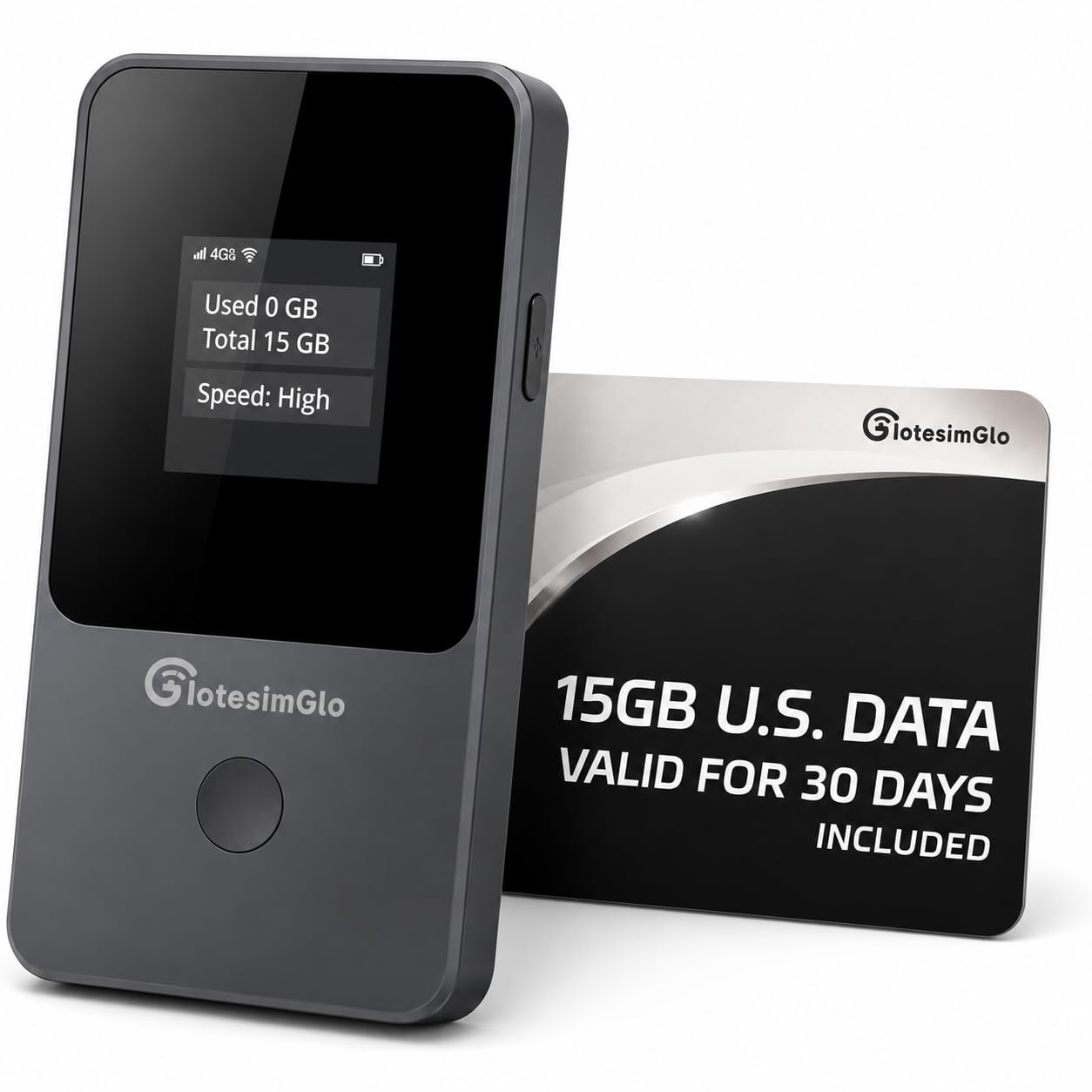
Switch it on and you are online — no SIM, no contract, no fuss
This is the hotspot to reach for if you want zero setup friction. It includes 15GB of high-speed US data, valid for 30 days after first activation, and the plan activates automatically the moment you power it on. There is no physical SIM to buy, no app to download, and no monthly subscription to sign. In practice that means you unbox it, turn it on, and connect — ideal for a last-minute trip or for someone who does not want to deal with carrier plans at all.
For its size it covers a lot of ground. Coverage extends to the United States plus 130+ countries and regions through supported local carrier networks, with automatic network selection handling the switching for you. Wi-Fi 6 supports up to 8 devices at once, which covers a family or small travel group. The 3500mAh battery plus power-saving mode is rated for up to 12 hours per charge — a longer rated runtime than the GL-XE300 Puli — and at just 106g the whole unit disappears in a pocket. Support is available 24/7, and the customer service is a recurring bright spot in owner feedback.
what separates it from a SIM-based hotspot is the built-in data. You can also insert your own compatible Nano-SIM (a small SIM card) if you prefer a local or regional plan. The limitations are weather and cell coverage: if there is no cell tower nearby, no hotspot works — a point some buyers discover the hard way. A small number of users also report the device heating up significantly during heavy use. Neither is unusual for this category, but worth knowing if you plan to use it in truly remote areas.
What makes it different: 15GB of US data is already in the box and live on first power-on — you never have to source or insert a SIM to get started.
Where it fits: best for city or town use where cell coverage is solid; in remote backcountry with no tower, even this device will lose signal.
Should be your pick if: you want the simplest possible setup with data already included, and you value a rated 12-hour runtime with Wi-Fi 6.
Skip the impulse buy if: your destination has no cell coverage, or you specifically need 5G throughput.
6. SCHOK 4G LTE Portable WiFi Mobile Hotspot
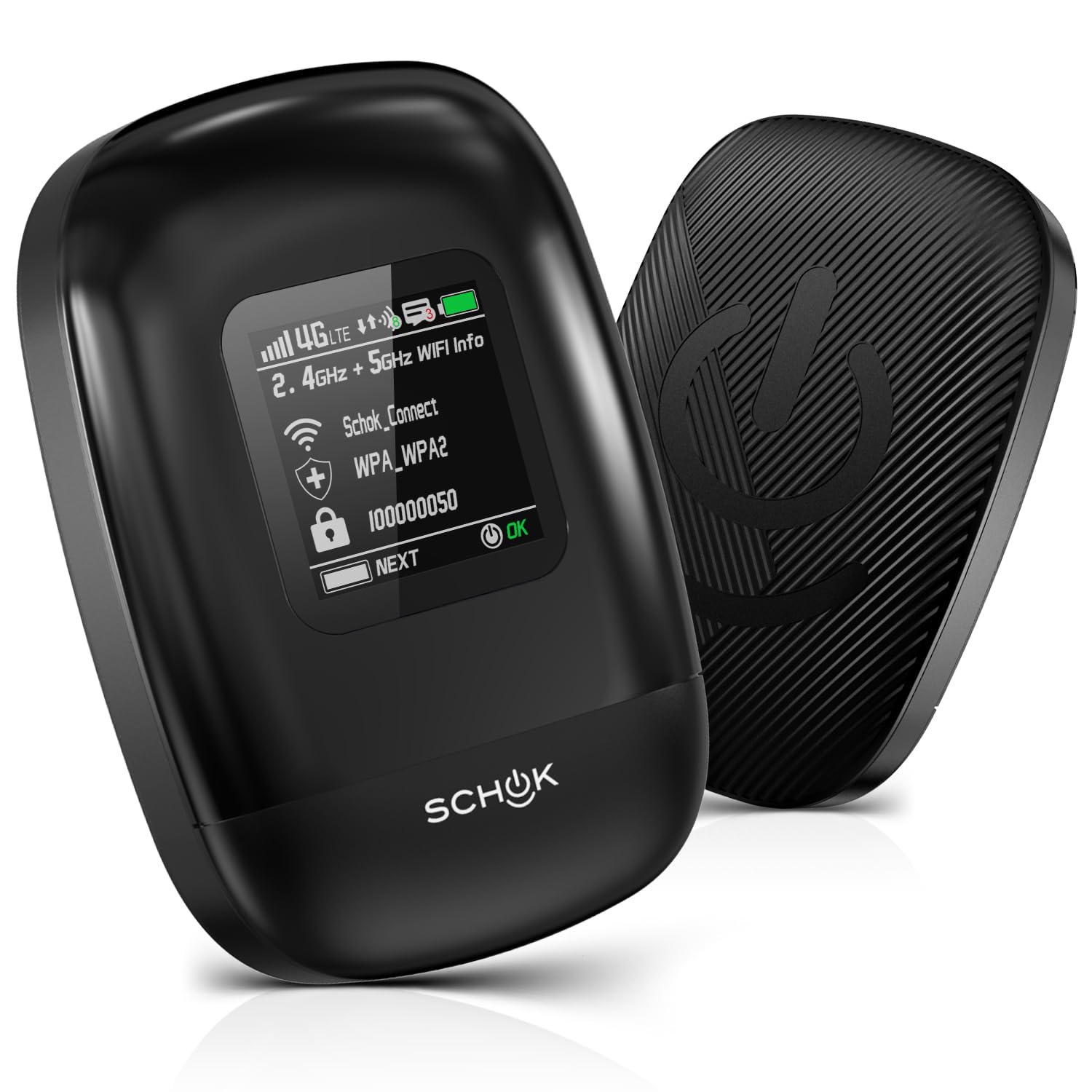
The budget option that punches up with Cat 12 speeds and a removable battery
For the price, the SCHOK is impressively specced. It runs 4G LTE Cat 12 with Quad Carrier Aggregation for 600Mbps theoretical download speed, supports dual-band 2.4GHz and 5GHz Wi-Fi with 2×2 MIMO, and connects up to 16 devices at once. The 4000mAh battery is removable, which means you can swap it out rather than throw the whole unit away when it eventually wears down. At just 5 ounces it is light enough to slip into a jacket pocket without noticing.
What wins people over is how easy it is to live with. Connecting to a carrier generally takes under a minute, the signal holds steady, and the value proposition for an everyday hotspot is solid. Setup and signal strength are consistently praised. In owner feedback it is described as a good little device for travelling — easy to set up, connecting to the carrier quickly, with a stable signal.
Where the SCHOK falls short is carrier flexibility and battery durability. It is designed primarily for Verizon but also works with T-Mobile, AT&T, Speedtalk, Rogers, Fido, and TELUS — however, Verizon compatibility specifically is a recurring pain point for some owners. It also requires a data-only or Jetpack plan; standard smartphone plans often will not work. On the battery side, a small number of users have reported battery expansion over time and difficulty sourcing replacement cells. Those are notable — but the removable design at least gives you an option with most competitors.
The good stuff
- 600Mbps Cat 12 download with Quad Carrier Aggregation
- 4000mAh removable battery — easier to replace than a sealed cell
- Dual-band 2.4/5GHz with 2×2 MIMO for up to 16 devices
- Very light at 5 oz for on-the-go use
Worth knowing
- Requires a data-only or Jetpack plan — standard phone plans often fail
- Verizon compatibility is inconsistent for some owners
- Replacement battery sourcing can be tricky
Suits you if: you want strong 4G speeds and a swappable battery without paying a premium price tag.
May frustrate you if: you are a Verizon customer or want zero friction around battery replacement.
7. KuWFi 4G LTE Mobile WiFi Hotspot open up
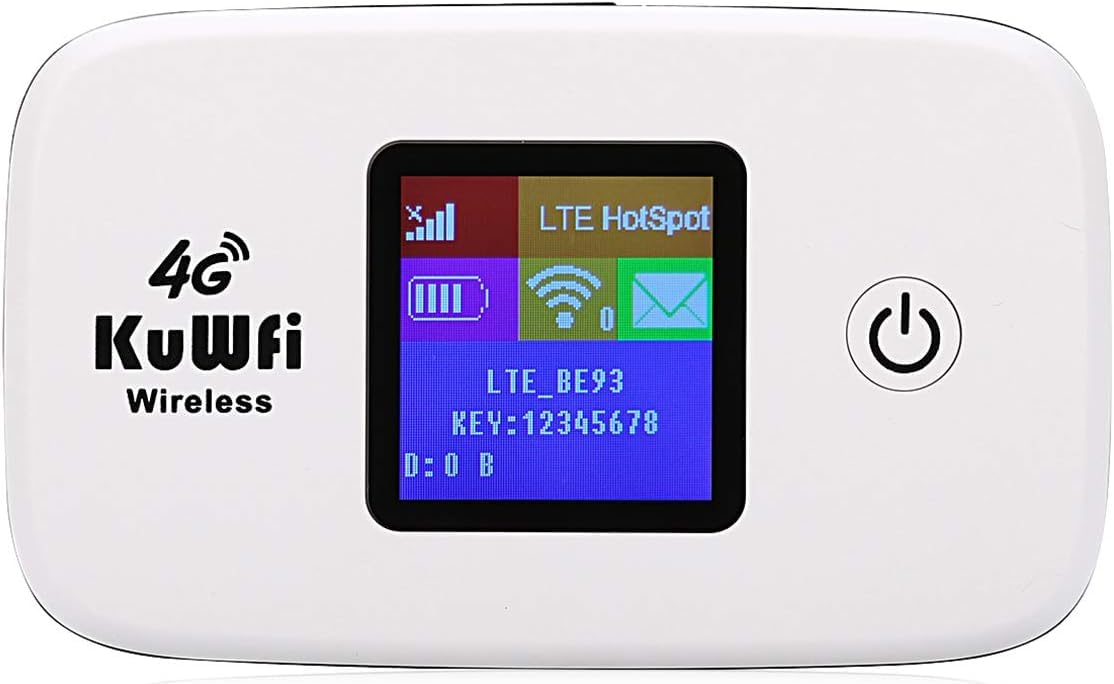
A cheap 4G hotspot for overseas travel with a 2400mAh battery
This is the most budget-friendly entry on the list, aimed squarely at short overseas trips where you just need basic Wi-Fi in your pocket. It supports 4G FDD B1/B3/B5/B7/B8/B20 and TDD-LTE B38/B39/B40/B41 bands, making it applicable to Europe, Asia, Southeast Asia, Australia, Africa, the Middle East, and parts of South America. It has a built-in screen display, a nano-SIM slot, and shares its connection with up to 10 users within 50 metres. The 2400mAh battery is the smallest here, and the 2 GHz single-band frequency and 150 Mbps data transfer rate make its performance modest compared to the 300 Mbps on the GL-XE300 Puli above.
Where it works, it works well — some owners use it happily in Europe with a local SIM and find the browser interface easy to manage. It is small, priced for occasional use, and does the basic job. For a quick trip where you need maps, messages, and email more than heavy streaming, it covers the requirement.
The honest picture is more mixed than the price tag suggests. Initial setup can be anything but plug-and-play: you may need to disable the SIM PIN and modify the APN through the router’s interface at 192.168.0.1 — a step that trips up less technical buyers. Roaming is not supported, virtual SIMs and IoT SIMs will not work, and battery life is short. As one buyer put it: “Battery lasts 5-6 hrs, gets hot in backpack.” The battery cover is also difficult to remove, and instructions are printed very small. Get past setup and it is a capable little travel companion — but budget extra patience for the first run.
Read this before buying: the 2400mAh battery and manual APN setup make this a device for patient, light users — plan to tinker on day one rather than plug and play.
The upside: it is the lightest commitment on the list and the band list covers a wide strip of Europe, Asia, and Africa for short trips.
Good match for: budget-conscious travellers taking a short international trip who are comfortable editing APN settings on day one.
Look past it if: you want plug-and-play simplicity, long battery life, or are travelling to the Americas where the band coverage is weaker.
Understanding the Specs
Battery capacity (mAh)
Battery capacity in mAh (milliamp-hours) measures how much charge the cell holds — the bigger the number, the longer you can leave the outlet behind. A 7000mAh cell like the one in the GL.iNet MUDI holds nearly three times the charge of the 2400mAh cell in the KuWFi. In daily use that means the difference between a device that runs all day and one that needs a mid-afternoon charge. Runtime also depends on how many devices are connected and how hard the router is working, so real hours are usually shorter than the mAh number suggests.
Data transfer rate (Mbps)
Data transfer rate is measured in Mbps (megabits per second) and tells you how fast data moves between the internet and your devices. A hotspot rated at 600 Mbps can theoretically download far more per second than one rated at 150 Mbps; a 5800 Mbps 5G hotspot is faster again. But theoretical peak speed rarely matches what you get in the real world, because it depends on signal strength, carrier network load, and proximity to a tower. Treat the Mbps figure as a ceiling — useful for comparing devices, not a promise of what you will experience.
FAQ
Will a battery operated WiFi router work with any SIM card?
How long does a hotspot battery actually last on a full charge?
Do I need a special data plan for a mobile hotspot?
What is the difference between 4G LTE and 5G hotspots?
Will a hotspot work in another country?
How many devices can connect to one mobile hotspot?
Can I use a hotspot as my main home internet?
What does OpenWrt mean on a travel router?
Do mobile hotspots get hot during use?
Is it worth buying a renewed or refurbished mobile hotspot?
Final Thoughts: The Verdict
For most people shopping in this category, the battery operated wifi router winner is the GL.iNet GL-XE300 (Puli) — it pairs a 5000mAh battery, 300Mbps 4G LTE, and OpenWrt flexibility at a mid-range price that is hard to argue with. If you need 5G throughput for serious remote work, the NETGEAR Nighthawk M7 Pro with its 5800 Mbps rate and spare-battery bundle is the premium call. And if you want to skip carrier plans entirely, the iotesimglo Portable WiFi Travel Router arrives with 15GB of US data ready to use — no SIM required. Whichever you choose, check your carrier’s bands and your data plan first; those two factors decide whether any of these routers will actually work where you need them.
How We Picked
We do not accept paid placement. Every pick is matched to a real buyer and a real use-case; we do not hands-on test units.
Sources & Methodology
Specifications: manufacturer listings and product documentation. Review insights: verified customer reviews, as of September 2026. Pricing: not shown on this page (it changes often); check the current price via the retailer link.
As an Amazon Associate, Gadgets Feed earns from qualifying purchases. This does not affect which products we feature.