
Our readers keep the lights on and my morning glass full of iced black tea. As an Amazon Associate, I earn from qualifying purchases.
Specs are compiled from manufacturer listings and verified buyer reviews and can change over time — please confirm the key details on the product page before buying.
Before you buy an 8-inch speaker, the number that decides whether it fits your car, boat, or pro box is not the wattage on the sticker — it is the mounting depth. A driver with a shallow frame slips into a door or a factory location with basic tools, while a deep, heavy magnet can force a spacer, a panel trim, or a whole new plan. This guide sorts that out for you, pick by pick, along with impedance (how hard a speaker is for an amp to drive), sensitivity (how loud it gets per watt of power), and the honest trade-offs owners run into.
I’m Min — the founder and writer behind Gadgets Feed. This guide is built by comparing the manufacturers’ published specifications and the patterns across verified customer reviews, so you get each pick’s real strengths and trade-offs instead of marketing spin.
Every pick here is a genuine 8-inch driver, so you can cross size confusion off your list. The real work is matching impedance, power handling, and depth to your setup — which is what this roundup of the best 8 Inch Speakers helps you do.
Our Picks at a Glance


How To Choose The Best 8 Inch Speakers
An 8-inch speaker is a mid-size driver that sits between a compact door speaker and a dedicated subwoofer. Buyers pick this size when they want more output and lower midrange weight than a smaller driver can give, without committing to a full subwoofer build. The catch is that not every 8-inch speaker does the same job, so the first thing to settle is what role you want it to play.
Know what job you want the driver to do
A midrange loudspeaker is built to cover vocals and instruments in the middle of the frequency range, which is why models like the PRV Audio and Deaf Bonce drivers top out around 6,000 Hz to 16 kHz. A shallow-mount subwoofer is built for low bass only and needs a sealed enclosure to work, like the Pioneer TS-A2000LD2. A marine coaxial combines a woofer and a tweeter in one frame and is sealed to survive spray. Buying a midrange when you need bass, or a sub when you need vocals, is the most common mistake in this category.
Match impedance to your amplifier
Impedance is measured in Ohms and tells you how much electrical resistance the speaker presents to your amp. The picks here run from 2 Ohm to 8 Ohm. An 8-Ohm driver pulls less current and pairs with amplifiers that are stable at that load, while a 2-Ohm subwoofer draws more power and needs an amp rated to handle it. Mismatch the load and you get weak output or a stressed amplifier.
Check sensitivity and mounting depth before you buy
Sensitivity is rated in dB and measures how loud the speaker gets for a given amount of power, so a higher figure squeezes more volume out of a modest amp. Mounting depth is the space the back of the magnet needs behind the mounting surface, and it is the figure that decides whether the driver drops into your existing location or fights you every step of the way.
Quick Comparison
| Model | Best For | Impedance | Power Handling | Sensitivity | Amazon |
|---|---|---|---|---|---|
| Pioneer P.R.O. Series TS-M801PRO★ Best Overall | Everyday car door upgrades | — | 700W max / 200W continuous | 96 dB | Amazon |
| PRV Audio 8MR450ABest Value | High-output midrange on a budget | 8 Ohm | 450W | 96 dB | Amazon |
| Pyle PLMR82 MarineBudget Champion | Budget boat and off-road sound | 4 Ohm | 300W max / 150W RMS | 91 dB | Amazon |
| DS18 PRO-X8BM | Loud car doors and pro installs | 8 Ohm | 550W max / 275W RMS | 97 dB | Amazon |
| BELVA BBMS8B Marine Coaxial | Boats, ATVs, and powersports | — | 500W peak / 250W RMS (per pair) | 90 dB | Amazon |
| DS18 PRO-HY8.4MSL | Tight spaces needing loud mid-bass | 4 Ohm | 400W max / 200W RMS | — | Amazon |
| Pioneer TS-A2000LD2 Subwoofer | Factory sub replacement in tight spots | 2 Ohm | 700W max / 250W nominal | 83 dB | Amazon |
| Deaf Bonce Apocalypse AP-M81AC | Maximum midrange output | 4 Ohm | 600W peak / 300W RMS | 97.50 dB | Amazon |
| KICKER KM8 Marine Coaxial | Premium marine installs with LED | 4 Ohm | 300W peak / 150W RMS | — | Amazon |
In‑Depth Reviews
1. Pioneer P.R.O. Series TS-M801PRO 8″ Component Car Speakers 700W Max
Our pick — over 4.5★ from 700+ verified ratings; the strongest balance of quality and price.
The 40 Hz-to-15 kHz spread that lets one driver carry vocals and low-end punch at the same time.
If you want a door speaker that plays warm notes and highs without adding a separate subwoofer stage to your build, this is the pick to start with. It pairs a light pulp cone with a rated 40 Hz to 15 kHz frequency response, so the same driver handles the low rumble of a bassline and the detail in a vocal line. The spec sheet lists 700 watts max and 200 watts continuous, which gives you room to grow if you later add a more powerful amp.
Sensitivity is the spec that surprises a lot of buyers here. At 96 dB, this speaker turns modest amp power into real volume, so you are not forced to buy the biggest amplifier in the store to get clean output. What wins people over is the sound quality — it is far and away the most-praised thing about this model, with value for money a clear second. Owners describe pulling the stock speakers out of a Silverado, bolting these in, and hearing a brutal difference between the factory driver and the Pioneer.
Here is where you need to think ahead. A 4-ohm speaker like this one plays nicely with most factory systems and aftermarket amps, but the fit is the real project — one Silverado owner had to trim the door panels and run a modified adapter and spacer to seat the driver, so measure your door depth before you order. There is also a quiet minority who report units that never produced sound at all, which is worth knowing but is clearly not the norm given how consistently these get praised for output.
Where it stands out
- 40 Hz to 15 kHz response covers both low-end and vocal detail in one driver
- 96 dB sensitivity means strong volume from a modest amplifier
- 700W max and 200W continuous power handling
- Comes as a full component kit with grilles and mounting screws
What to plan for
- Deep door locations may need trimming and an adapter to fit
- Not built for hard bass — pair it with an amp and sub if that is your goal
- A small number of units arrive with no output at all
Reach for this if: you want one driver that handles both mid-bass and warm detail in a car door, with enough headroom to grow into a bigger amp later.
Look elsewhere if: your door cavity is shallow or you are chasing deep sub-bass — you will want a dedicated subwoofer instead.
2. PRV Audio 8MR450A 8 Inch Midrange Speaker, 8 Ohms, 450 Watts, 96 dB
An efficiency specialist that turns a small amp into serious output, thanks to 96 dB sensitivity.
Buyers running portable car audio setups online — the kind where you have months of listening behind you — keep circling back to this midrange for the same reason. Its 96 dB sensitivity means you get high output from low power, so a modest amplifier drives it to clean, detailed vocals. That efficiency edge is real, not marketing talk: it beats the Pyle marine option’s 91 dB rating, and that 5 dB gap matters because every dB of sensitivity is volume you get without spending on more amp power.
The build supports the sound. A 38 mm (1.5 in) copper clad aluminum wire is wound in a double layer on a ventilated glass fiber former, with a copper sleeve on the pole piece to reduce inductance and keep the high frequencies clean. A triple roll cloth surround and an tune fiber pressed paper cone smooth out the response. It is rated to cover 100 Hz to 6,000 Hz in three-way systems, works as a door speaker in car audio, and can serve as the woofer in a two-way satellite setup.
Fitment is the trade-off to plan around. The mounting depth is only 3.21 inches, which makes it a friendly fit in cramped doors and custom boxes — but the frame has four mounting holes rather than eight, so a factory board drilled for an eight-bolt pattern will need some work to line up. The sound quality praise is loud and consistent here; owners describe crisp tones that hold up even at high volumes.
Why owners love it: the 96 dB sensitivity is the headline — it beats the Pyle unit’s 91 dB and delivers high output without a big amp, which is why this driver earns its place as the value pick for anyone running efficient, high-quality sound on a budget.
Locked in if: you are building a portable or door setup and want maximum volume per watt from a modest amplifier.
Measure first if: your mounting board uses an eight-hole pattern — this frame has four holes, so a drill or adapter will be needed.
3. Pyle Marine Speakers, Waterproof, Weather Resistant, 8 Inch Dual, 10 Inch Outer Frame, 300 Watt Power, PLMR82
The budget boat speaker with a big 20 oz magnet that owners say outclasses the lighter driver it replaces.
For a budget marine install, this Pyle unit punches harder than its tier suggests. It runs a poly mica cone with a butyl rubber surround, and the specs list a 20 oz circuit magnet driving a 1.5 inch aluminum voice coil. Sensitivity sits at 91 dB — which is the figure it loses to the PRV Audio’s 96 dB — but the real story for boat owners is the magnet upgrade they experience first-hand when they swap out an old 8 oz driver for this 20 oz one.
Waterside use is the whole point, so the 4-ohm impedance and 300W max power rating are tuned to work with common marine amplifiers rather than exotic ones. The full-range frequency response runs 60 Hz to 20 kHz, and it ships with the wiring and mounting hardware needed to get it wet and running. The frequency spread is wide enough that a single driver covers most of what you hear on the water without needing a separate tweeter.
Here is the honest caveat that experienced buyers flag repeatedly: real-world power handling is lower than the 300W max sticker suggests, and driving these near their limit with a high-wattage amplifier is a recipe for blown drivers. The speakers are happiest paired with a modest amplifier that keeps the pressure reasonable — the upgrade from the older 8 oz version is real, but so is the ceiling on how hard you can push them. The sound quality is solid for the money and the build holds up in salt and spray.
What the boat crowd notices: the move from an 8 oz magnet to this 20 oz unit makes a clear difference in bass depth and overall sound, and the waterproof build keeps everything working after a day on the water.
Best suited to: a budget-conscious boat or off-road build where you want a waterproof driver with a bigger magnet than the cheap 8 oz speakers it replaces.
Do not do this: pair them with a high-wattage amp and crank it — real-world power handling falls well short of the 300W max figure, so keep your amp reasonable.
4. DS18 PRO-X8BM Loudspeaker – 8″, Midrange, Red Aluminum Bullet, 550W Max, 275W RMS, 8 Ohms

A 97 dB efficiency rating that makes every watt of your amp count for maximum volume.
If pure output is the goal, this DS18 midrange gets closer to the front of the pack than almost anything else in this class. It carries a 97 dB sensitivity rating and a 30 oz magnet, and it covers 115 Hz to 16 kHz, so it produces strong midrange with clear high frequencies across a wide band. At 8-ohm impedance it presents an easy load for amps stable at that rating, and the high-temperature 1.5 inch (38.6 mm) voice coil is built to hold up through long, loud sessions.
The install story here is about the magnet. That 30 oz motor and a 3.2 inch mounting depth mean the driver needs real space behind the mounting surface, so this suits a door, a custom enclosure, or a professional build where the depth is already planned out. The red aluminum bullet design also stands out visually once it is mounted, which is why this one shows up in more show-style builds than most of the midrange options here.
Owners praise the sound and the build in equal measure; loud and clear is the recurring theme, and plenty of buyers land on it for the money. A couple of the loudest applications need tuning discipline — run a capable amplifier at a sane level and let the efficiency do the work. Pair it with the right amp and this is among the most volume-per-watt drivers in the 8-inch class.
The efficiency story: at 97 dB, this driver edges out nearly everything else here on raw loudness per watt, which is exactly what you want for a car or truck system where you are pushing the amp hard.
This is the one if: your build is about loud, clean midrange and you have the door depth and the amp to feed a hungry 8-ohm driver.
Pass on it if: you need a shallow, low-power fit — the deep magnet and high efficiency are overkill for a basic stock replacement.
5. BELVA BBMS8B 8” 2-Way 500W Peak (250W RMS) Marine Coaxial Speakers

Sealed to an IP66 rating and built as a 2-way coax, so one frame covers highs and mids on the water.
The BELVA is designed for boats, ATVs, UTVs, and side-by-sides, and it earns that role with a genuine IP66 waterproof rating. That is a real-world dry-and-running figure: 6 is dust-tight and the second 6 means the enclosure stands up to powerful water jets, so a splash off the bow or a wash-down does not end your day. It is built as a 2-way coaxial, meaning a 1 inch PEI balanced dome tweeter sits inside the same frame as the 8-inch woofer, so you get high frequencies and midrange from one cutout instead of two.
The power and coverage numbers are solid for a marine driver. It handles 500 watts peak per pair and 250 watts RMS per pair, which is 250 watts peak and 125 watts each driver, and an oversized 1.2 inch high-temperature aluminum voice coil helps it stay composed when you push the volume. The frequency response runs 55 Hz to 20,000 Hz with a 90 dB sensitivity. A polypropylene cone, rubber surround, and injection-molded rust-resistant polymer basket sit behind the front face, and it comes with stainless steel mounting hardware and grilles.
The installation dimensions are the part you want to check against your boat before ordering. The top-mount depth is 3.54 inches and the cutout is 6.89 inches, which is a snug fit you should measure for. The one recurring fit note is that these run oversized for the mounting holes owners are replacing, so plan for a bit of elbow room in the cutout.
Why it works on the water
- IP66 rating means dust-tight and protected against powerful water jets
- 2-way coax pairs a 1″ PEI dome tweeter with the 8″ woofer in one frame
- 55 Hz to 20,000 Hz coverage with 90 dB sensitivity
- Ships with stainless steel mounting hardware and grilles
What owners run into
- Oversized for standard 6.5″ replacement cutouts — measure before you order
- Deep bass is limited; owners add a dedicated sub for real low-end
- Distortion climbs if you push a cheap high-power amp too hard
Grab this for: a boat, ATV, or UTV build that gets wet and needs a waterproof 2-way coax with real marine sealing.
Think twice if: you are chasing deep bass — buyers report these need a separate subwoofer to fill in the low end.
6. DS18 PRO-HY8.4MSL 8 Inches Shallow Hybrid Mid-Range Car Audio Loudspeaker with Built-in Driver
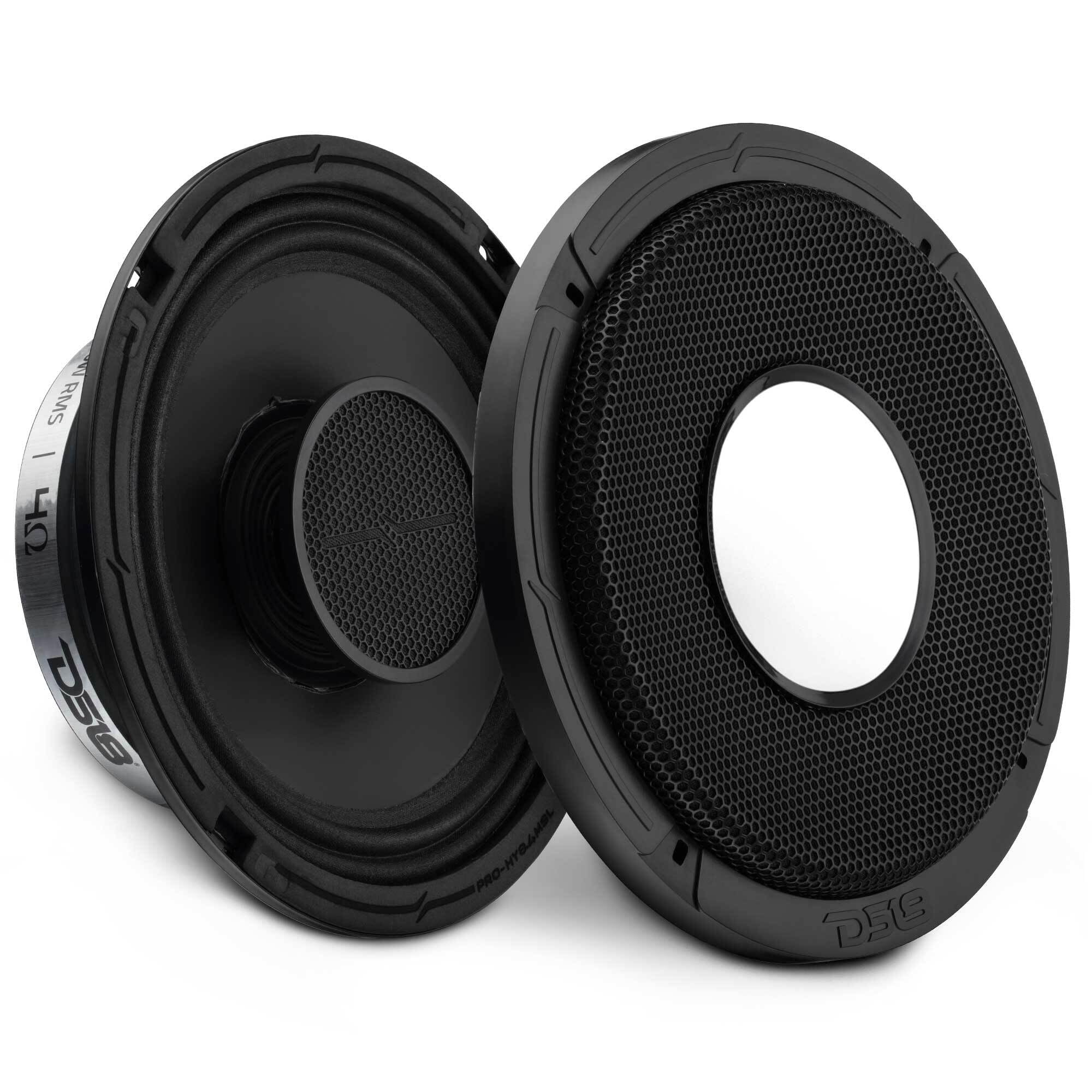
A hybrid that packs a pro-audio midrange and a driver into one slim frame for cramped installs.
The name of the game here is space-saving without giving up output. DS18 combined a pro-audio midrange and a high-intensity driver into a slim package, so you get a compact footprint that still pushes real volume. It handles 400 watts max and 200 watts RMS at 4-ohm impedance, and the spec sheet lists it at 8 inches. It ships with a built-in driver and a grille included, so you are not hunting for extra parts to finish the install.
Owners back the loudness claim. Plenty describe it as extremely loud yet well-built, and one built an entire motorcycle system around DS18 gear after starting with this driver and wishing he had gone to the brand sooner. Another replaced a subwoofer in a 2010 LS460 with this speaker and said it gets down with the right setup and a DSP to tune it. That pro-audio slant is the honest edge here — it is a loudspeaker and not a mid-bass woofer, so it plays loud and clear, but it is not going to deliver the deepest bass on its own.
The main caution is tuning. The sound is powerful but runs a touch less crisp than the very top end of the class, and a member of the crowd noted the low end gets cut off if you do not dial in the amp correctly. Feed it clean power through a decent DSP or amp and it rewards you. If your priority is raw loudness in a small space, this is the pick to shortlist.
The space-saver angle: pairing a pro-audio midrange with a built-in driver in a shallow frame is exactly what you want when depth is tight but you still need a genuinely loud driver.
Made for you if: you are working with tight mounting depth but still want serious loud-midrange output from a compact driver.
Skip the upgrade if: you already have full-size door room — a standard-depth mid-bass driver will give you more low-end than this hybrid.
7. PIONEER A-Series TS-A2000LD2 Shallow-Mount 8″ Subwoofer 700W Max

The shallow-mount sub built to slip behind a seat and revive a tired factory system.
If your factory subwoofer gave up the ghost and you want real bass back without building a giant box, this is the driver to look at. It is a 2-ohm single voice coil design rated for 700 watts max and 250 watts nominal, with a Glass-Fiber and Mica Reinforced IMPP cone for rigidity and 83 dB efficiency. The single voice coil keeps the wiring simple, and the 2-ohm impedance pairs with amplifiers stable at that load.
Space is where it earns its keep. The mounting depth is only 2.625 inches, so it tucks behind or under a seat far more easily than a full-size woofer, and Pioneer recommends a 0.5 cu. ft. sealed enclosure for it. Because it is a passive subwoofer, you connect it to your own external amplifier and set the bass to taste. For anyone replacing a worn factory sub, that shallow frame is the difference between a clean drop-in and a cabinet rebuild.
Fit is the recurring headache rather than sound. What wins people over is the bass quality and the fit that mostly drops into 4-ohm-friendly factory locations — a 4th-gen 4Runner owner called it a perfect stock replacement and a 2010 Highlander owner said it fit with an adapter. But the frame holes often do not line up with the receiver box, so a jig and a little patience help. One heavy user who tried it as a Grand Caravan upgrade was underwhelmed and planned a smaller enclosure with a matched mono amp instead — a useful reminder that this sub is at its best in a proper sealed box, not stuffed into a factory cavity.
Where it delivers
- 2-ohm single voice coil keeps wiring simple and efficient
- 2.625″ mounting depth fits behind or under seats
- 700W max / 250W nominal with a rigid glass-fiber cone
- Works as a direct replacement for many factory subwoofers
What to expect
- Frame holes often do not match the receiver box holes
- Needs a sealed enclosure — it is not a free-air drop-in
- Bass stays moderate rather than booming
Buy it for: a factory sub replacement where depth is tight and you want clean, honest bass back in a vehicle that lost its low end.
Not the one if: you want chest-thumping output — this delivers measured, sealed-box bass, not a boom.
8. Deaf Bonce Pair Apocalypse 8″ 600W Peak 4 Ohm Midrange Speakers AP-M81AC

The pair that tops this list on sensitivity, with a 97.50 dB rating built for sheer output.
This is the pair to grab if you are buying for a single install and want the loudest driver per watt in the group. The 97.50 dB sensitivity rating is the highest here, and the 4-ohm nominal impedance pairs with the many amplifiers stable at that load. Power handling runs 600 watts peak and 300 watts RMS, and the frequency response starts at 110 Hz. It all adds up to a midrange that turns a modest amp into real volume — the kind of output that fills a cabin without the amp straining.
The package is generous for the job. You get two 8-inch midrange speakers along with two bass blockers, a set of hardware, two surface angle mounts, and a manual, so the install accessories come in the box rather than on a separate order. Owners describe the sound as loud and high quality, and the consensus is that this pair delivers exactly the output the spec suggests.
Reliability is the honest watch-out. The sound quality praise is strong and consistent, but a reviewer in one heavy-use case split his verdict — good sound while it works, but a pair failed after about a month of loud play. Treat that as one case rather than a pattern, but if you plan to run these at their limit for hours at a time, buy the best amplifier you can and tune it carefully. Also note the overall depth of 3.3 inches, which is deeper than a shallow driver and needs room behind the mounting surface.
What the spec sheet promises: a 97.50 dB sensitivity — the highest on this list — paired with 300 watts RMS handling means these run loud on modest power, which is the entire point of a pro-audio midrange.
The pick if: maximum loudness per watt is your goal and you want a complete pair with the mounting hardware in the box.
Reconsider if: you plan to torture them at full power for hours — a failed pair in one loud-use case is worth weighing against a more durable build.
9. KICKER KM8 8-Inch Marine Coaxial Speakers with 1-Inch Tweeters, LED

Marine coaxials with UV-treated cones, ASTM-tested corrosion resistance, and seven LED colors.
For a premium boat build where the speakers need to survive sun and salt as well as sound good, this is the top-of-the-line option. KICKER built these coaxials from the ground up for marine duty, adding UV treatments to the injection-molded cones and Santoprene surrounds and stating that all KICKER marine coaxials meet or exceed ASTM standards for humidity and corrosion and for material degradation from UV exposure. That ASTM certification is the meaningful part for a boat: it speaks to how the materials hold up over seasons, not just to how they sound on day one.
The sound and power numbers back the price. Continuous power handling is 150 watts RMS and peak is 300 watts, with a 1 inch (25 mm) tweeter handling the highs. Owners mention loud, solid output with clear highs and note the bass is stronger than they expected for a coaxial, though they also mention these start to distort at the very top of the volume range. It comes with both white and charcoal grilles so you can match your boat’s look.
The LED feature is the one that owners either love or weigh carefully. You get a choice of seven colors to make your boat shine, and adding the KMLC controller (sold separately) open up 20 colors and 19 lighting modes. The honest watch-out is reliability at the extremes — most of the feedback is positive, but a couple of users report speakers failing after about a month of use, while another has run a pair for three years and a UTV set for five. The lesson is to power them correctly with a well-tuned amp rather than pushing a huge wattage into them.
The premium upgrade: UV-treated cones, Santoprene surrounds, and ASTM-tested corrosion resistance put durability front and center — exactly what you pay for at the top of the marine range.
Worth it if: you want a premium marine coaxial with real UV and corrosion protection plus seven-color LED lighting to match your boat’s look.
Look around if: you are on a tight budget — the lower-priced marine picks here deliver solid sound without the LED premium and the ASTM-rated build.
Understanding the Specs
Impedance in Ohms
Impedance is the electrical resistance your speaker presents to the amplifier, and it is the first spec to match before anything else. The picks here range from 2 Ohm (the Pioneer subwoofer) through 4 Ohm (the Pyle, BELVA, KICKER, DS18 hybrid, and Deaf Bonce drivers) up to 8 Ohm (the PRV Audio and DS18 PRO-X8BM). A lower Ohm load draws more current and needs an amplifier rated to stay stable at that number. A higher Ohm load draws less current and pairs with amps built for it. Matching this correctly is what keeps an amplifier cool and the output clean; getting it wrong is what leaves you with thin sound or a stressed amp.
Sensitivity in dB
Sensitivity measures how loud a speaker plays for a given amount of amplifier power, and it is how you estimate volume before you buy. It is rated in dB, usually measured at 1 watt from 1 meter away. A higher number means more output from the same amp, so a driver rated near 97 dB will play noticeably louder than one rated near 90 dB on identical power. In this group, the Deaf Bonce Apocalypse leads at 97.50 dB, the DS18 PRO-X8BM sits at 97 dB, the Pioneer and PRV Audio both hit 96 dB, and the Pyle marine and BELVA coaxials run 91 dB and 90 dB respectively. If you are shopping for volume on a modest amp, sensitivity is the number to chase.
FAQ
Will an 8-inch speaker fit a factory location made for a 6.5-inch speaker?
What Ohms do 8-inch speakers run at, and does it matter?
What does sensitivity mean and why should I care?
Can I use a car midrange speaker like the PRV Audio or Deaf Bonce in a boat?
How much mounting depth do I need for these 8-inch speakers?
What is the difference between a midrange speaker and a subwoofer?
Do I need an amplifier for these speakers?
Can I drive 8-inch speakers with my factory stereo?
Which 8-inch speaker is the loudest?
What is the best 8-inch marine speaker for a boat? Two picks stand out for the water. The BELVA BBMS8B is a 2-way marine coaxial with an IP66 waterproof rating and 55 Hz to 20,000 Hz coverage, so a single driver handles mids and highs in one cutout. The KICKER KM8 is the premium alternative, with UV treatments on its cones and Santoprene surrounds plus ASTM-tested humidity, corrosion, and UV resistance, along with seven-color LED lighting. For a tighter budget, the Pyle PLMR82 offers a waterproof build and a 20 oz magnet, though real-world power handling runs below its 300W max rating.Do marine speakers actually last longer than regular car speakers? Marine speakers are built from materials chosen to resist moisture, sun, and corrosion, so they tend to hold up better in wet or open-air conditions than a standard car midrange. The KICKER KM8, for example, uses UV-treated injection-molded cones and Santoprene surrounds and is stated to meet or exceed ASTM standards for humidity, corrosion, and UV degradation. The BELVA BBMS8B carries an IP66 waterproof rating, meaning it is dust-tight and protected against powerful water jets. A car midrange like the PRV Audio 8MR450A is not sealed against that kind of exposure.?
Final Thoughts: The Verdict
For most buyers, the 8 inch speakers winner is the Pioneer P.R.O. Series TS-M801PRO because its 40 Hz to 15 kHz range and 96 dB sensitivity let one driver carry both warm detail and low-end punch in a car door. If you want maximum loudness per watt, grab the Deaf Bonce Apocalypse AP-M81AC at 97.50 dB. And for a premium boat build that has to survive salt and sun, the KICKER KM8 is the one to reach for, with its UV-treated cones and ASTM-tested corrosion resistance. Before you order, match impedance to your amp and measure mounting depth — fit and load decide whether a great driver actually works in your setup.
How We Picked
We do not accept paid placement. Every pick is matched to a real buyer and a real use-case; we do not hands-on test units.
Sources & Methodology
Specifications: manufacturer listings and product documentation. Review insights: verified customer reviews, as of September 2026. Pricing: not shown on this page (it changes often); check the current price via the retailer link.
As an Amazon Associate, Gadgets Feed earns from qualifying purchases. This does not affect which products we feature.