
Our readers keep the lights on and my morning glass full of iced black tea. As an Amazon Associate, I earn from qualifying purchases.
Specs are compiled from manufacturer listings and verified buyer reviews and can change over time — please confirm the key details on the product page before buying.
If you need to move water somewhere there is no outlet, a 12 volt water transfer pump clips straight to a battery and does the lifting for you. The trick is picking the right one, because these little pumps split into two very different families: quiet on-demand diaphragm pumps that pressurize an RV or boat plumbing system, and fast utility pumps that drain a water heater, a rain barrel, or a flooded basement. Buying the wrong family is the mistake most people make. A pump built to run a shower faucet will drain a pool painfully slowly, and a drain pump will not hold steady pressure at a tap.
I’m Min — the founder and writer behind Gadgets Feed. This guide is built by comparing the manufacturers’ published specifications and the patterns across verified customer reviews, so you get each pick’s real strengths and trade-offs instead of marketing spin.
This guide separates the two jobs, explains the flow, pressure, and lift numbers in plain English, and matches nine tested picks to the job you actually have. The right pick depends on matching flow rate, pressure, and lift to your job before you buy any 12 Volt Water Transfer Pump.
Our Picks at a Glance


How To Choose The Best 12 Volt Water Transfer Pump
The first decision is not a brand or a spec number — it is the job. A diaphragm pump pressurizes a closed plumbing system so a faucet flows when you open it. A utility pump simply moves a volume of water from one place to another as fast as it can. Almost every wrong purchase in this category comes from mixing those two up.
Faucet pressure or fast draining?
Diaphragm pumps are measured in GPM (gallons per minute, the volume of water moved) and PSI (pounds per square inch, the pressure pushing that water through pipes). They run quietly and start and stop on demand when you open a tap. A pump like the DICMIC unit at 3.0 GPM and 55 PSI is built for exactly that. Utility pumps are measured in GPH (gallons per hour) or GPM and are rated by how high they can lift water. The VEVOR moves up to 360 gallons per hour, which matters when you are emptying a tank rather than filling a sink.
Match the lift height to your real setup
Lift height is how many vertical feet a pump can raise water above its own intake. If your water source sits below the pump, that number is the one that decides whether the job works at all. The YOUNGTREE lists a 131-foot maximum lifting height, while the SEAFLO lists 6 feet of suction lift. If your shower head sits three feet above a basement tank, you may need both lift and pressure at once. Always read both numbers on the box.
Power it correctly and prime it every time
Every pump here runs on 12 volt DC power and typically connects with alligator clamps to a car battery, a deep-cycle battery, or a jump pack. The golden rule across all of them is priming: you fill the inlet and pump head with water before the very first run. Running any of these utility pumps dry can score the housing and cook the impeller. Diaphragm models generally tolerate a dry run without damage, but utility pumps will not.
Quick Comparison
| Model | Best For | Flow Rate | Pressure | Lifting Height | Amazon |
|---|---|---|---|---|---|
| RV Water Pump, 12V DC 3.0 GPM 55 PSI★ Best Overall | RV & camper water systems | 3.0 GPM | 55 PSI | — | Amazon |
| WAYNE PC1-12VTop Performer | Flooded basements & high-lift draining | 350 GPH | — | 35 ft | Amazon |
| Flojet R3526144DMost Compact | Drop-in RV replacement | 3.0 GPM | 50 PSI | 9 ft | Amazon |
| Superior Pump 91012 | High-capacity remote draining | 1325 L per hour | — | 20 ft | Amazon |
| RV Fresh Water Diaphragm Pump 4.0 GPM | Running multiple outlets at once | 4.0 GPM | 50 PSI | 102 ft | Amazon |
| YOUNGTREE T33-12V | Long-run transfer with adjustable pressure | 3.5 GPM | 45 PSI | 131 ft | Amazon |
| Acquaer TRB010 | Portable water removal on the go | 4.4 GPM | — | 46 ft | Amazon |
| VEVOR Water Transfer Pump 360 GPH | Budget draining & tank emptying | 6 GPM | — | 46 ft | Amazon |
| SEAFLO 22-Series | Tight spaces & high-shutoff spraying | 1.3 GPM | 100 PSI | 6 ft | Amazon |
In‑Depth Reviews
1. RV Water Pump, 12V DC 3.0 GPM 55 PSI, Self-Priming Diaphragm Pressure Pump
Our pick — over 4.5★ from 300+ verified ratings; the strongest balance of quality and price.
The refit pump that slides into old mounting holes and just works.
Replacing a tired RV pump is a job nobody wants to do twice, and this one is built to make the swap painless. It moves 3.0 GPM (gallons per minute) and holds 55 PSI (pounds per square inch, the pressure behind every faucet), drawing 7.5 amps from a 12V DC supply. In plain terms, that is enough pressure to run a kitchen tap and a shower without the flow falling flat when someone flushes.
What wins people over is the fit and the drop-in simplicity. Buyers report this unit slots into the same mounting holes as the factory pump and reconnects without a fight — one buyer simply put it: it “fit exactly like the original.” The one-piece diaphragm design also lets it run dry without damage and includes a built-in check valve, so water does not creep backward into your fresh tank. If you have ever wrestled with a mismatched replacement, that matters on install day.
The honest catch is noise, and it goes both ways depending on where the pump sits. Mounted under a bed, the vibration can carry into the sleeping quarters and the pump can announce itself at night. Most setups bury it behind a cabinet panel and never notice. Across 300-plus owners it holds a 4.6-star rating, so the drop-in swap works for most buyers. If your pump lives right under your pillow, mount it on rubber feet and give it a little isolation.
What Makes It the Pick
- 3.0 GPM and 55 PSI handle a kitchen tap and shower together without pressure drop
- Drops into the original mounting holes — no drilling, no adapter hunting
- Runs dry without damage and seals with a built-in check valve
- Lightweight enough at roughly five pounds to hold in one hand during install
Where It Falls Short
- Under-bed mounting lets the vibration reach the bedroom at night
- Louder than a premium continuous pump if quiet is your top priority
- Runs at 7.5 amps, so make sure your circuit and wiring can take it
Buy this if: your factory RV pump died and you want the same pressure with a five-minute install.
Think twice if: your pump lives under a sleeping berth and silence is non-negotiable.
2. WAYNE PC1-12V Bronze Plated Portable Transfer Pump
The storm-night workhorse that empties a sump pit off a car battery.
When the power is out and the water is rising, this pump earns its keep. It moves water at up to 350 gallons per hour and lifts it as high as 35 feet — the kind of reach you need when the water is down in a pit and you want it out in a yard. It runs off a 12V battery using alligator clamps, so a car battery or a jump pack becomes your power source when the grid is down. A 1-1/4 inch discharge steps down to a standard 3/4 inch garden hose adapter, which means your everyday hose becomes the drain line.
What impresses owners most is simply how much water it moves for its size. One buyer filled a 65-gallon RV tank from a portable water trailer at a steady 5 GPM. A homeowner kept a sump pit from overflowing through a 27-hour outage. What matters more is the raw capability: this pump moves serious volume, and the rugged metal housing handles being tossed in a truck bed. It also lifts water down to 1/8 inch of the surface with the included suction attachment, so a nearly-empty tank still gets drained clean.
The trade-off is that a pump built this hard will not run forever at full tilt. It is happiest on short draining runs rather than as a permanent daily fixture, and the flow drops as the lift height climbs. Treat it as a rescue tool and a job tool, not a full-time sump system, and keep that suction hose reachable — it primes best when the intake sits within about 15 feet. Owners who use it for real outages tend to keep a spare battery next to it and call it exactly what it is: a workhorse.
Strongest case: this is the pump to grab when high lift and big volume matter — 35 feet of lift and 350 gallons per hour from a car battery.
Hold up, though: use it as a job tool, not a nonstop fixture — prolonged full-load running draws a battery down fast, and one owner’s first unit seized after ten months of hard use.
Reach for this one if: you are pumping out a flooded space where the water is well below the pump and you need power that does not come from a wall outlet.
Look elsewhere if: you need a quiet, always-on sump pump that lives in the pit full time — this is a portable draining tool.
3. Flojet R3526144D RV Water Pump, 12 VDC 3-Chamber, 3GPM, 50PSI
The drop-in replacement that quiets a rattling trailer with a twenty-minute swap.
For RV owners chasing an exact-fit replacement, this three-chamber pump delivers 3.0 GPM at 50 PSI and shuts off on demand when you close a faucet. It is rated to handle water up to 160°F and lifts water from 9 feet, so it copes with a tank mounted a little lower in the rig. The 3-chamber layout is the design that keeps the flow smooth rather than pulsing hard at the tap, and the auto shut-off means it stops drawing current when no one is using water.
The standout here is fit and the fact that it behaves like factory equipment. It slots straight into the same hoses and mounting points, so the install is a reconnect job rather than a rebuild — snip two wires, pop two quick-disconnect hoses, back out four screws, and reverse. Owners swapped one out in about twenty minutes roadside. It also carries a 1-year warranty and a corrosion-resistant housing aimed at the damp environment of a boat or camper.
The honest note is sound: it runs when the water runs, and it is not the silent type. Continuous-duty pumps that stay whisper-quiet sit in a much higher class. What the Flojet does offer is a small footprint and a proven reputation as original equipment for trailer builders. If your old pump finally leaked through its internal check valve after years of service, this is a direct-fix that keeps the rest of your plumbing untouched.
Install story: about twenty minutes with a screwdriver and two hose connections — the closest thing to a plug-and-play pump in this group.
The honest caveat: it speaks when it works. The chamber design smooths the flow, but a rattle-free experience takes rubber isolation or a premium continuous pump.
Suits: trailer and camper owners who want a like-for-like swap with known 50 PSI behavior and no plumbing rework.
Not for: anyone expecting library-level silence from an RV water pump.
4. RV Fresh Water Diaphragm Pump 12 Volt DC 4.0 GPM 50PSI
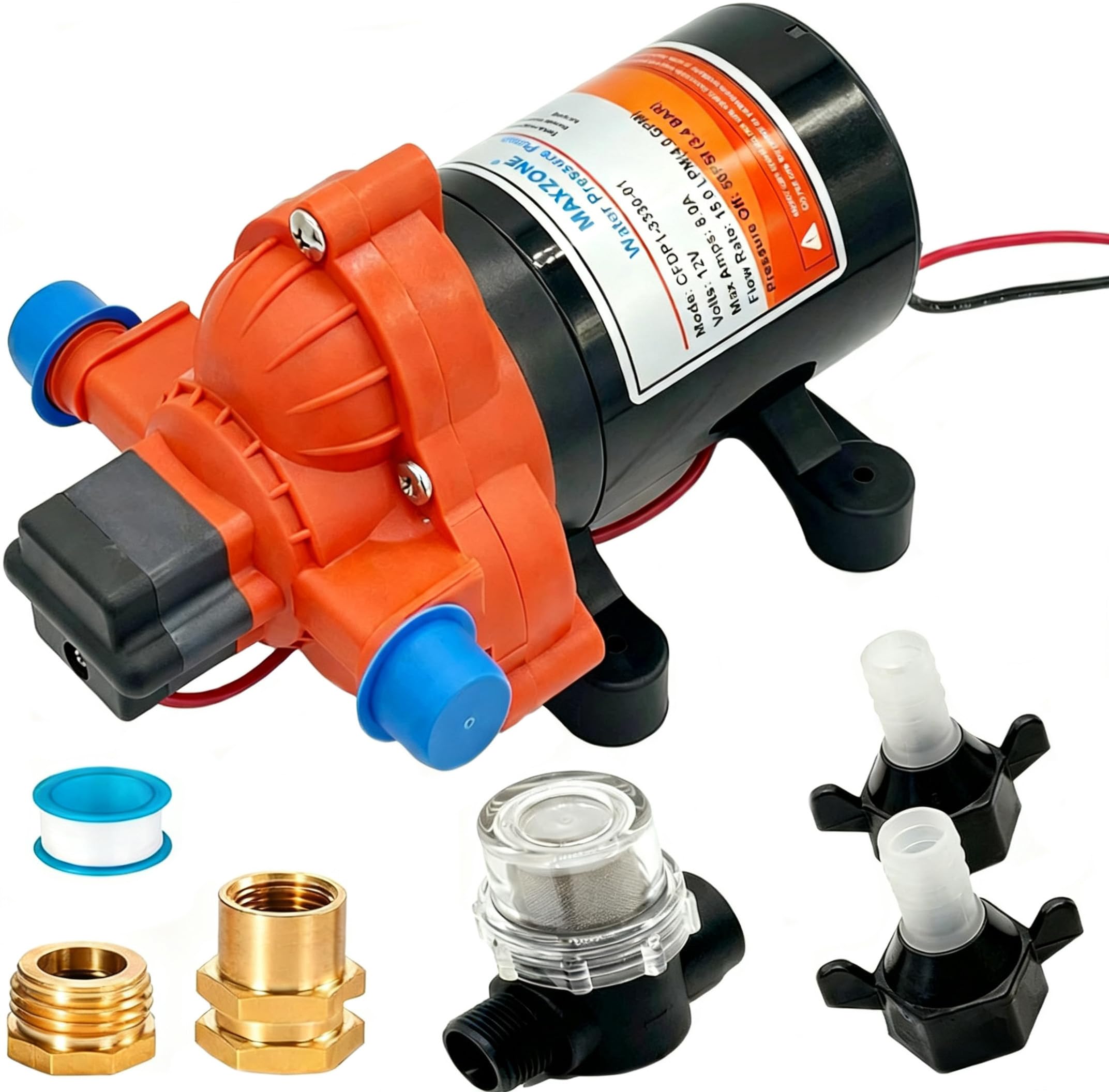
The long-distance mover that pushes water through fifty feet of pipe without fading.
When your water source sits far from where the water is going, this pump is built for the run. It moves 4.0 GPM at a 50 PSI shut-off, draws 8.0 amps at full load, and lifts water an impressive 102 feet. That lift number is why it suits courtyard washing, long garden runs, and cleaning jobs where the tank is well below the nozzle. A thermal overload cutout adds a safety layer, and it can run dry for a short time without burning out the motor.
Owners describe a pump that delivers steady pressure instead of the on-off hammering some cheaper units produce, because the internal design reduces cycling. In real use it keeps up with a sink, a toilet, and an outdoor shower running at the same time on a camping setup, and it holds up over a full season of weekend trips. The package includes two 1/2 inch barbed hose adaptors and a 50 mesh inlet strainer, so you are ready to plumb it without a second shopping trip. It also comes pre-set, which means you leave the pressure screw alone and just run it.
The one thing to respect is the inlet. This pump wants no more than 30 PSI of incoming pressure — in practice, run it from a tank rather than a pressurized city line. Avoid inlet pressure completely if you can. A few owners note it is physically larger than the stock pump it replaced, so measure your mounting bay before you commit. That is the honest cost of the bigger flow and higher lift.
The right call if: you are pumping water a long horizontal distance or up a steep grade and need pressure that holds all the way.
Look past it if: your mounting space is tight or you want to feed it from a pressurized line — it needs a gravity or tank feed and a bit of breathing room.
5. YOUNGTREE 12V RV Water Pump 3.5 GPM 45 PSI
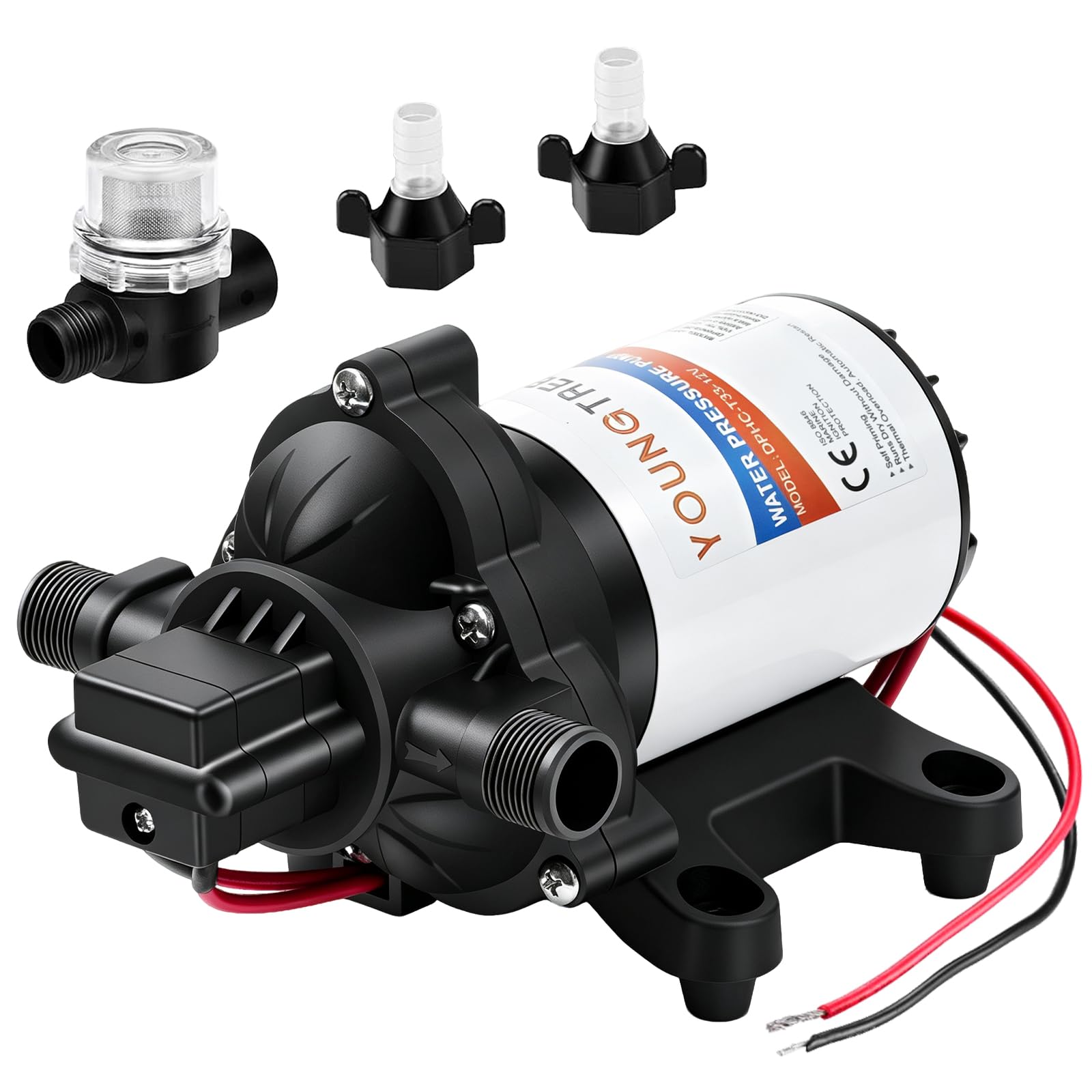
The tunable pump that pulls water from a deep tank and lets you set the pressure.
If lift is your bottleneck, this is the pump that reaches the deepest. It claims a 131-foot maximum lifting height — a huge reach compared with the SEAFLO’s 6-foot suction lift on the same 12V platform — and moves 3.5 GPM at a factory-set 45 PSI. It runs at 3.5 GPM against the DICMIC’s 3.0 GPM, so it edges ahead on raw flow. The build uses a rubber base and a pure copper motor to cut vibration, and it carries overheat protection that shuts the unit down automatically if it gets too hot.
What owners like most is how quietly it runs — the noise reduction from that rubber base and copper motor makes it a good fit for the tight, echo-prone spaces inside a camper or boat cabin. It also comes with an adjustable pressure switch, so you can dial the range between 40 and 80 PSI to suit your plumbing. That flexibility means the same pump can serve a gentle cabin faucet or a higher-pressure spray setup without swapping hardware. It is a direct replacement for most similar 12V diaphragm pumps, and it works across RVs, campers, boats, and food trucks.
Here is the honest fit note. Long-term reliability and pressure consistency are the areas owners are split on — some report smooth service, while others find the pump loses pressure or gives out well short of a year. The sensible approach is to keep it on a filter and give it clean water. Used for steady, moderate tasks like pumping from rain barrels to a garden or feeding a camper system, it is a value-packed option that punches above its size.
Why it stands out: 131 feet of lift and a pressure switch you can tune from 40 to 80 PSI — a rare combination at this tier.
The catch: reliability is the weak spot owners flag most. Keep the intake filtered and expect to treat it as a replaceable component rather than a lifetime buy.
Best fit: campers, boaters, and food-truck builders who want adjustable pressure and deep suction without paying a premium price.
Skip if: you need a pump you can install once and forget for a decade — reliability here is a coin flip.
6. Acquaer Water Transfer Pump DC 12V 1/10HP Portable Electric Water Removal Pump

A lightweight draining pump that empties a tank down to the last eighth of an inch.
This is a transfer pump, not a pressure pump, and it is honest about that. It moves water at up to 264 gallons per hour (4.4 GPM) and lifts it up to 46 feet, powered by a 1/10 HP motor on a 12V DC supply. It comes with an on/off switch and battery terminal clamps, plus a 6 foot suction hose and a replacement impeller in the box. The suction attachment pulls water down to a 1/8 inch level, which is the detail that makes it genuinely useful for water beds, aquariums, and rain barrels rather than just half-empty tanks.
The flow rate is the part owners single out as the balance. It fills drums faster than the naked flow rating suggests, and a camper owner moved water from 7-gallon jugs into a camper tank without lifting 56-pound containers up a ladder. The metal volute and metal connectors resist corrosion better than the plastic parts on cheaper pumps, and thermal overload protection watches the motor. Add a one-year warranty and it is a tidy package for the money.
Set expectations on two things. It is a slow-and-steady mover — at 1/10 HP it will not rush large volumes the way a higher-horsepower unit will, and a few owners found it too slow for big transfers. It also runs noticeably loud, as most utility pumps in this class do. Prime the pump head with water before the first run, keep the motor out of the water, and it does its job without fuss.
The engineering: all-metal volute and connectors, a 6 foot suction hose, a spare impeller, and a 1/8 inch suction pickup — a genuinely complete kit for water removal.
Be realistic: 1/10 HP means patience for bulk jobs, and the noise is the price of that metal build.
Ideal for: RV owners, boaters, and homeowners draining water beds, aquariums, or rain barrels where thorough pickup matters more than speed.
Not the one for: large-scale fast transfers — the 1/10 HP motor takes its time on big volumes.
7. VEVOR Water Transfer Pump 12V, Battery Powered Utility Pump 360 GPH

A compact, budget-priced drainer that clears a water heater faster than you would guess.
The appeal here is range and price at once. A 1/10 HP motor pushes water up to 360 gallons per hour and lifts it to 46 feet, running off a 12V DC supply through a start switch and battery clamps. It is made of aluminum alloy with an electrostatic-sprayed finish that resists stains and corrosion, and it comes with a 6 foot suction hose, a suction strainer, and a replacement impeller. The flat base keeps it stable on the ground and trims some of the vibration. This is a utility pump by nature: it moves water from point A to point B, it does not pressurize a faucet system.
Owners mention this class of pump to be genuinely powerful for its size. At 360 GPH, this pump empties a 40-gallon water heater in under nine minutes once primed, and it has the throughput for ponds, hot tubs, and flooded areas. The accessory kit means you are not hunting for adapters on day one, and the portability makes it easy to stash in a truck or garage between jobs.
Where it asks for care is reliability and heat. This is the most affordable draining pump in the group, and the trade-off is a shorter service life — running it hard and hot for long stretches is what wears it out. The aluminum housing also runs warm during use, so keep the suction hose free and the intake primed. Prime the inlet before the first run and never run it dry, and you get a lot of drain for the money.
Strongest case: the lowest-cost way to drain a water heater, pond, or flooded area at 360 GPH with a full hose kit in the box.
Hold up, though: reliability is a known weak point at this price, and the unit runs warm — treat it as a job tool you replace rather than a permanent fixture.
Reach for this one if: you want maximum draining throughput for the smallest outlay and you are comfortable replacing it when it wears out.
Look elsewhere if: you need long-term reliability or you would rather pay once for a pump that lasts — heat and short service life are the honest costs here.
8. Superior Pump 91012 12 Volt Utility Pump with 20-Foot Cord
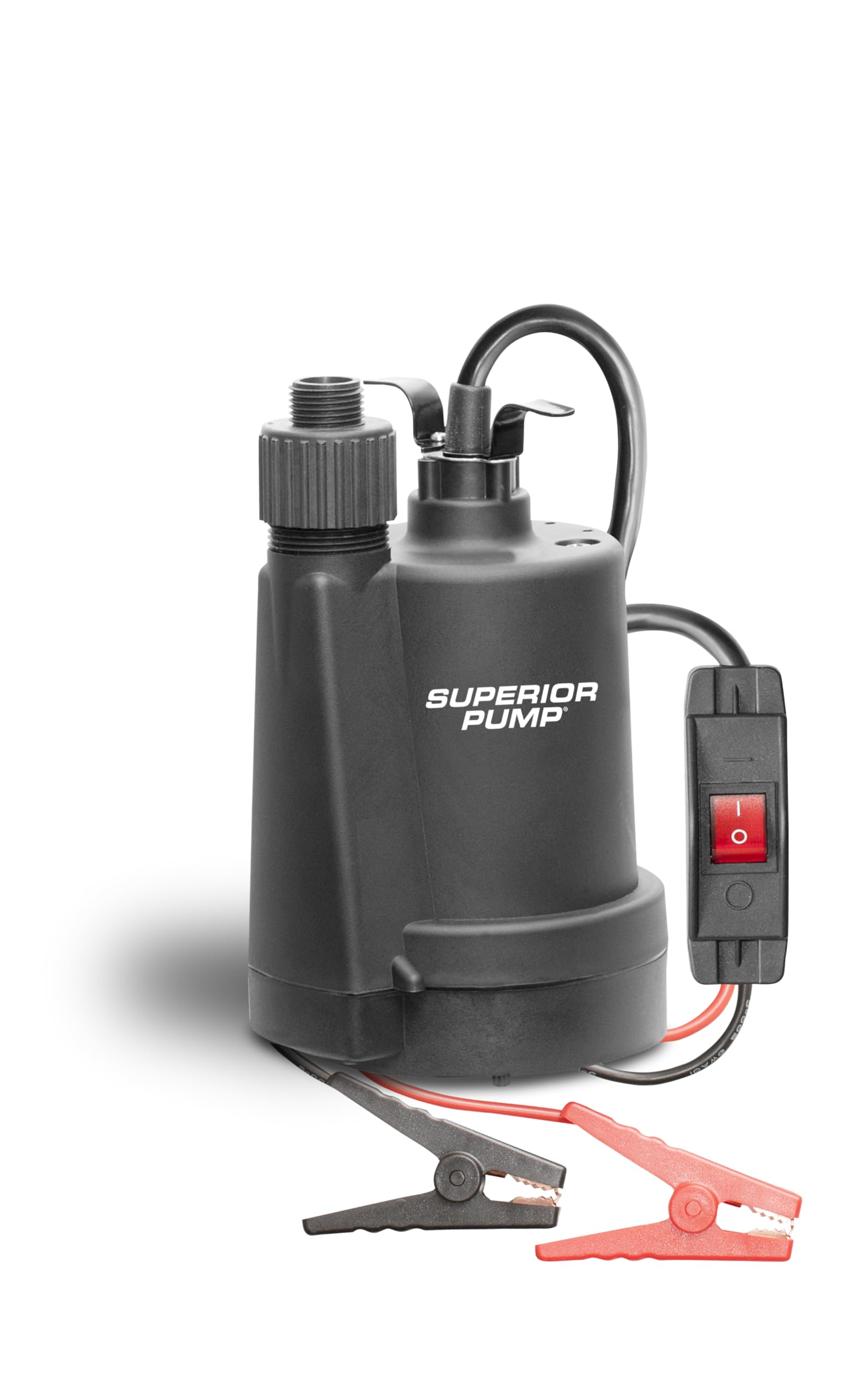
The high-capacity bruiser that out-pumps a garden hose from a car battery.
When raw volume is the whole point, this is the pump to beat. It moves up to 1380 gallons per hour and lifts water up to 20 vertical feet, drawing power through alligator clips on a generous 20 foot cord so you can keep the battery in the truck while the pump works down in the pit. The 1-1/4 inch discharge is made for high-capacity pumping and steps down to a 3/4 inch garden hose adapter. The oil-free motor design is a plus for anyone draining a pond or aquarium where aquatic life is a concern.
Owners are consistently impressed by the output. Filling a 65-gallon RV tank or watering trees from a 350-gallon tote becomes a fast job, and one buyer measured over 20 GPM through a 1-inch hose at a three-foot lift. It self-primes in about a second, and the heavily insulated wiring comes with a switch and battery clamps for a clean hookup. It is also a favorite as a backup sump pump when paired with a float switch and a deep-cycle battery.
Two honest notes. Like all utility pumps here, it should not run dry and it will not draw if the base is not submerged, so placement matters. And durability is a concern for some owners — a handful report failures after a modest number of uses, though the same owners often praise the manufacturer’s warranty response, which has sent replacements without a fight. Keep the intake submerged, keep the impeller clean of hard-water buildup, and this pump delivers serious volume for the price.
Standout spec: 1380 gallons per hour and a 20-foot cord that lets you power it from a vehicle battery without an extension.
Before you buy: it must stay submerged at the base and off dry runs, and longevity at this price is a known gamble — buy it for the flow, not a lifetime guarantee.
Pick this one for: filling tanks, moving water off a remote site, or backing up a sump pump when the grid goes down.
skip it if: you want a low-maintenance set-and-forget pump — this one wants supervision and clean water.
9. SEAFLO 22-Series Water Pump – 12V, 1.3 GPM, 100 PSI

A palm-sized pumper that trades flow for a high-pressure spray.
This pump is the specialist of the group, and its numbers make the trade-off obvious. It shuts off at 100 PSI — more than double the DICMIC’s 55 PSI in this list — but flows only 1.3 GPM against the DICMIC’s 3.0 GPM. That combination of high pressure and low flow is exactly what a sprayer wants: strong atomization at the nozzle rather than a gush of water. It runs on 12V, primes from a 6-foot suction lift, and is built with EPDM valves and a Santoprene diaphragm that the maker lists as meeting RoHS, SGS, and ISO standards. Its max recommended water temperature is 140°F.
What buyers praise is the strength of the spray and the small size. It fits tight mounting bays where a bigger pump simply will not go, and it works well in a range of jobs — powering a chemical sprayer, feeding a filtration or circulation line, or handling water transfer on a boat or in an off-grid setup. The internal bypass reduces the constant on-off cycling that wears pumps out, and the built-in pressure switch runs it automatically as demand changes. It comes with a pressure switch, quick-connect wiring, 3/8 inch hose barb fittings, and full instructions.
The honest limits are flow and durability. At 1.3 GPM it is not a fast-filler or a garden-hose mover — it delivers pressure, not volume, so it is the wrong tool for filling a big tank quickly. And while there is a run-dry-without-damage design, the durability picture is less settled, with some units reportedly giving out earlier than expected. Respect the 140°F temperature cap and keep it on clean water, and it serves its high-pressure niche well.
Made for: sprayer heads, filtration lines, and tight installations where 100 PSI of shutoff pressure and a small footprint beat raw flow.
Pass on it if: you need to fill tanks quickly — at 1.3 GPM this pump is all pressure and no speed.
Understanding the Specs
Flow Rate (GPM and GPH)
Flow rate is how much water a pump moves in a set time — GPM means gallons per minute, GPH means gallons per hour. A faucet or shower needs a steady flow; a tank drain wants the biggest number you can power. As a rough guide, a higher GPM suits draining and filling, while a lower GPM with high pressure suits spraying. Note that flow drops as the pump works harder. The WAYNE, for example, is rated at 350 gallons per hour with no lift but 310 GPH once the discharge climbs 10 feet. Always compare flow at the lift height you actually need, not the headline number.
Pressure (PSI) and Lift Height
Pressure, measured in PSI (pounds per square inch), is the push behind the water — it is what lets a faucet flow when you open it and what atomizes a spray. Lift height is how many vertical feet a pump can raise water above its intake, and it is the number that decides whether a pump works from a low tank. A pump like the YOUNGTREE lists 131 feet of lift; the SEAFLO lists 6 feet of suction. Match pressure to your fixtures and lift to your water source. Getting either wrong is the most common reason a transfer pump disappoints.
Voltage, Amps, and Power Source
Every pump here runs on 12 volt DC power, the same standard as a car battery, so you can run them from a vehicle battery, a deep-cycle battery, or a jump pack using alligator clamps. Amps measure how much current the motor pulls — the DICMIC draws 7.5 amps and the MAXZONE peaks at 8.0 amps — so check that your battery and wiring are rated for that draw over the time you plan to run it. Higher-amp pumps move more water but drain a battery faster, and you should size your fuse and wire to the pump’s rating before you connect it.
Priming and Dry-Run Protection
Utility pumps must be primed — filled with water at the inlet and pump head — before the first run, because they use the water itself to cool and seal the impeller. Running one dry can score the housing and cook the impeller, which is why the VEVOR and Acquaer both stress pre-filling. Diaphragm pumps built for faucet duty, by contrast, are usually rated to run dry without damage, like the DICMIC and the SEAFLO. Either way, keeping a suction strainer on the intake and clean water in the line is what makes any of these pumps last.
FAQ
What is the difference between a diaphragm pump and a utility transfer pump?
How do I power a 12 volt water transfer pump without an outlet?
Do I have to prime these pumps before the first use?
What does lift height mean and how much do I need?
Is a higher GPM always better for water transfer?
Can I run these pumps dry without damaging them?
What size hose and fittings do these pumps use?
Will a 12 volt transfer pump drain a large tank or flooded area fast enough?
Why does my water pump pulse at the faucet and can I fix it?
How long should a 12 volt water transfer pump last?
Final Thoughts: The Verdict
For most people, the 12 volt water transfer pump winner is the RV Water Pump, 12V DC 3.0 GPM 55 PSI because it drops into the original mounting holes, holds 3.0 GPM and 55 PSI at the tap, and runs dry without damage. If you need to pull water up a deep drop or tune your own pressure, grab the YOUNGTREE 12V RV Water Pump, which reaches 131 feet of lift and adjusts from 40 to 80 PSI. And for draining a flooded foundation, a deep tank, or a water heater, the WAYNE PC1-12V is the one to reach for with 350 gallons per hour and 35 feet of lift. Match the pump family to your job first, then the specs to your distance, and this choice stops being hard. If quiet faucet pressure is the whole goal, the Flojet and the DICMIC both deliver it; if raw volume is the goal, the Superior Pump and the WAYNE are the quickest hands in this list.
How We Picked
We do not accept paid placement. Every pick is matched to a real buyer and a real use-case; we do not hands-on test units.
Sources & Methodology
Specifications: manufacturer listings and product documentation. Review insights: verified customer reviews, as of September 2026. Pricing: not shown on this page (it changes often); check the current price via the retailer link.
As an Amazon Associate, Gadgets Feed earns from qualifying purchases. This does not affect which products we feature.