
Our readers keep the lights on and my morning glass full of iced black tea. As an Amazon Associate, I earn from qualifying purchases.
Specs are compiled from manufacturer listings and verified buyer reviews and can change over time — please confirm the key details on the product page before buying.
Your baby learns about the world through their mouth, hands, and ears — and the right toy puts all three to work at once. A good sensory toy gives a wobbly hand something to grab, sore gums something safe to chew, and a curious brain a new sound or texture to figure out. This guide walks you through nine picks that do that job well, sorted by who each one actually suits.
I’m Min — the founder and writer behind Gadgets Feed. This guide is built by comparing the manufacturers’ published specifications and the patterns across verified customer reviews, so you get each pick’s real strengths and trade-offs instead of marketing spin.
Some picks here are soft enough to double as a lovey, others are built around rattles, mirrors, and crinkle layers that reward pulling and tugging. The trick is matching the toy to your baby’s current stage rather than their birthday — because a three-month-old and a nine-month-old need very different things from the same shelf. Whether your little one is just starting to grab or already pulling everything out of containers, the right baby sensory toys can turn five minutes of fuss into half an hour of focused play.
Our Picks at a Glance

How To Choose The Best Baby Sensory Toys
The right sensory toy is the one your baby can physically use right now, not the one with the most features on the box. A toy that is too heavy, too slippery, or too loud ends up ignored. Here is what actually drives the decision.
Grab-ability before anything else
For babies under six months, the single biggest factor is whether their fingers can close around it. Looped tubes, thin limbs, and easy-grip handles let a wobbly hand succeed at grabbing. That first successful grab is what keeps a baby reaching for the same toy again. Look for something light enough to lift with one hand and simple enough to not overwhelm — textured or bumpy surfaces give more places to hold on.
Teething safety and material
Anything your baby mouths needs to be made from a material that won’t splinter, fray, or break apart. Food-grade silicone and BPA-free construction are the standard to look for, and toys tested to safety regulations like EN71 or CPSIA carry a verifiable mark. If a toy has soft sections meant for chewing, check that those parts are firmly attached and will not come loose with repeated use.
Sensory output that holds attention
A crinkle, a soft rattle, a mirror, a squeaker — these are what turn a simple object into something worth exploring. A toy with only one output — a rattle alone, a crinkle alone — loses a baby’s attention within minutes. A toy that combines a sound with texture and something visual holds attention much longer, because there is always a new detail to find on the next go-around.
Quick Comparison
| Model | Best For | Grab Design | Material | Teething Rated | Amazon |
|---|---|---|---|---|---|
| Manhattan Toy Winkel Rattle & Sensory Teether★ Best Overall | Newborns learning to grip | Looped BPA-free tubes | Polyurethane, BPA-free | Yes — refrigerable | Amazon |
| Moonkie Bunny Lovey with Silicone TeetherBest for Snuggles | Sleep-time comfort and cuddles | Slim lovey limbs | Minky velour, natural cotton | Yes — removable teether | Amazon |
| hahaland Silicone Tissue Box ToyBest Busy Box | Pull-and-discover play | 9 pull scarves | Silicone | Yes — silicone bunny teether | Amazon |
| 10-Piece Baby Rattles & Teethers Set | Variety and travel storage | Multiple shapes and handles | Food-grade silicone, wood | Yes — chewable stubs | Amazon |
| VTech Busy Learners Activity Cube | Interactive play with sounds | Gears, sliders, buttons | Plastic | No | Amazon |
| Weilim 3-in-1 Stacking Blocks Rings Sensory Ball | Open-ended building play | 24 pieces, varied sizes | Food-grade silicone, BPA-free | Yes | Amazon |
| JoyCat Mystery Soft Box | Surprise reveal and quiet play | 10 soft objects in a fabric box | Soft washable fabric | No | Amazon |
| hahaland Sensory Garden Plush Set | Garden-themed pretend play | 11 pieces with pull-out pocket | Plush | No | Amazon |
| Plunack 6-in-1 Sensory Learning Set | Growth-stage learning bundle | 28 pieces across 6 toy types | Food-grade silicone, ABS plastic | Yes | Amazon |
In‑Depth Reviews
1. Manhattan Toy Winkel Rattle & Sensory Teether Toy
Our pick — over 4.5★ from 42,000+ verified ratings; the strongest balance of quality and price.
A maze of soft teething tubes that turns wobbly grabbing into a win.
If your baby is three or four months old and just starting to close their fingers around things, this is the one to start with. The whole toy is a maze of soft, continuous teething tubes — no hard plastic shell, no sharp edges, just loops at every angle. That means no matter which direction a clumsy hand reaches, there is a spot to grab. The center cube sits between the loops with tapered corners and holds a quiet rattle inside, so shaking produces a sound without startling anyone.
Owner feedback is unusually consistent on one point: this stays interesting. Parents of four-month-olds describe it as the toy that finally worked for uncoordinated hands. A three-month-old owner’s parent put it plainly: “My baby’s favorite toy. Size is perfect for my 3 month old who is learning to grab. This has plenty of spots for her to grab ahold of and even chew on. It keeps her entertained for a bit.” You can refrigerate it for extra comfort when gums are sore, and at roughly 5 x 4 x 3.5 inches it drops straight into a diaper bag. It has also been on the market for over 25 years, which says something about how well the looped-tube design holds up.
Here is the catch you should know before buying: the manufacturer specifies surface wash only, and it should not be submerged in water. So if you want a toy you can toss in the dishwasher after a heavy chewing session, this is not it. A wipe-down is the routine, which is fine for most days but annoying on the messiest ones.
Where it wins
- Looped tubes give grab points at every angle — ideal for 3-4 month olds
- Refrigerable for extra teething comfort
- Quiet rattle is stimulating without being alarming
- Light enough to travel and tuck in a diaper bag
Where it asks patience
- Surface wash only — cannot be submerged or machine washed
- Single sensory type (tube texture plus rattle); no mirror or crinkle layers
Reach for this if: your baby is 0-6 months and still learning to grip — the loop design meets them where they are.
Hold off if: you want something dishwasher-safe or with moving parts for a toddler past the grabbing stage.
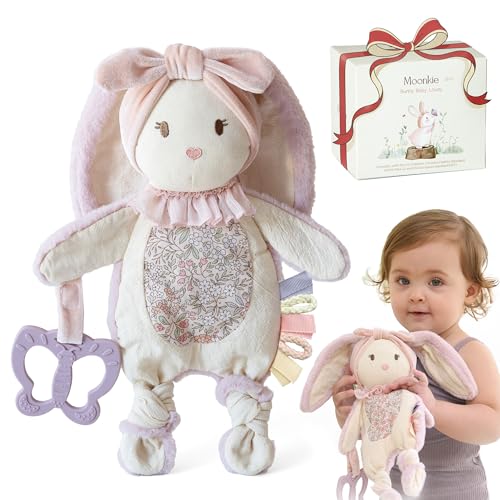
2. Moonkie Baby Lovey with Silicone Teether, Bunny Security Blanket
A cuddle companion that hides a full sensory toolkit in soft fabric.
This one targets a different need entirely: the baby who wants something to hold against their face, not just to wave around. It is a double-sided lovie made from minky velour on one side and natural cotton on the other, which means two completely different textures in one piece of fabric. The crinkle ears and soft rattle inside the head add sound to the mix, and sparkly hairbands and shawls give the eyes something to track. Slim limbs hang loose from the body, and those limbs are what newborns actually grab — they fit a tiny fist much better than a chunky block would.
Buyers often pick this as a baby shower gift, then call it the best thing at the party. One grandparent wrote: “This was the most fabulous baby gift. It was the softest, the most adorable baby cuddle toy ever!” Parents who bought two for newborn twins in pink and blue said both looked better than the photos and felt soft enough to rest against a baby’s skin. That minky velour and cotton softness matters for a lovey meant to be pressed against a cheek at naptime.
The silicone teether on the front is removable, so you can swap it for a different toy or clean it separately, and the whole thing wipes clean with a damp cloth. The trade-off you should plan for: because it is designed as a comfort object, it is not a rugged toy. It is not built for a toddler to hurl across a room day after day. It is built for a baby to hold, chew, and fall asleep against.
Best when: you want a gift that lands — someone can hand this over at a shower and it works immediately.
Think twice if: you need a toy that survives being thrown, dragged, and stomped on by a 2-year-old.
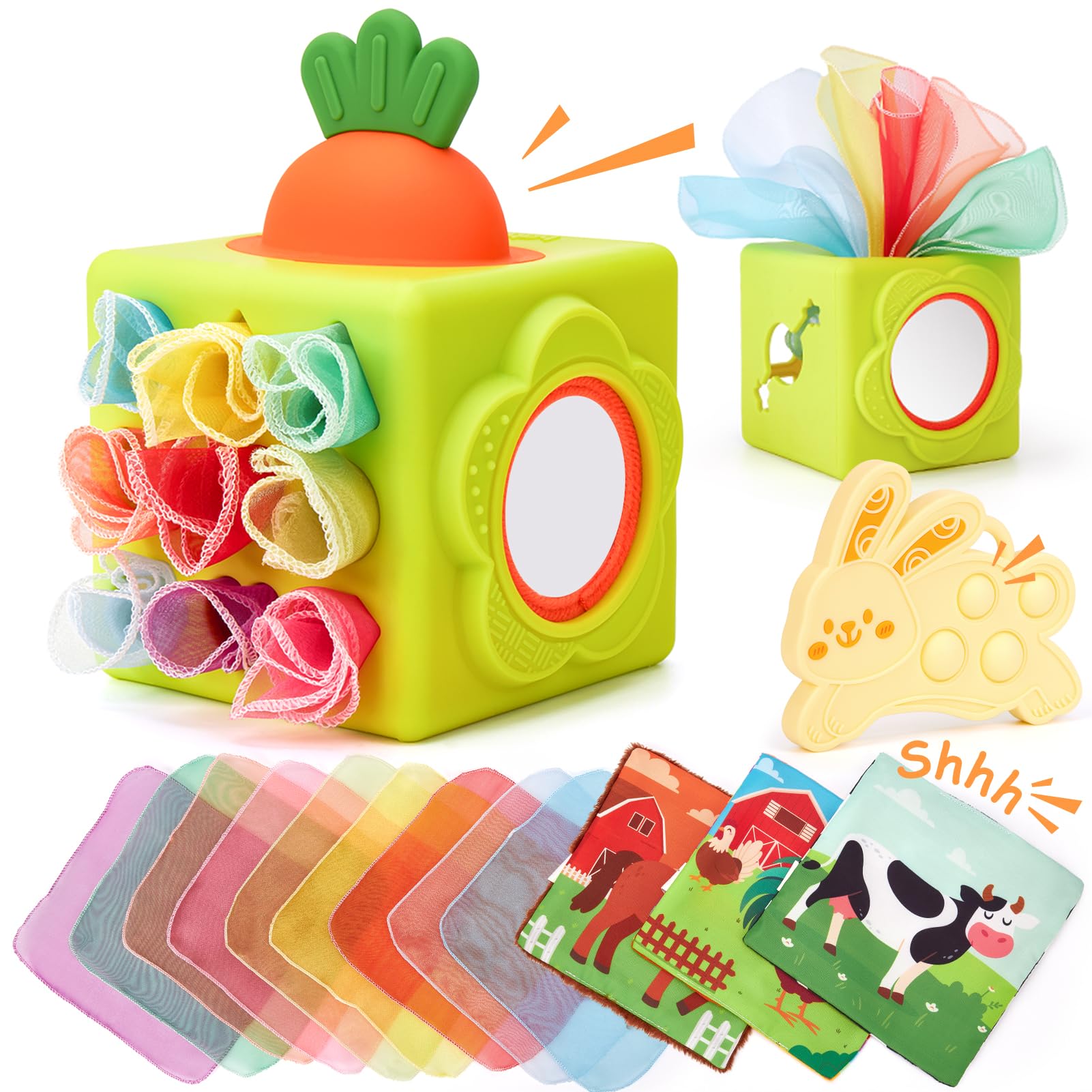
3. hahaland Silicone Baby Tissue Box Toy
Six sides of pull-and-discover play that survives real chewing.
If your baby is the type who yanks wipes out of the dispenser every chance they get, this is the toy that finally gives them a safe outlet for it. It is built from premium baby-safe silicone, firm enough to hold its shape like a real tissue box but soft enough that bumping into it is nothing. There are 9 colorful pull scarves, 3 crinkle tissues, and a silicone bunny teether with pressable bubbles in the set. Every side is a new activity: a tissue pull slot, a pushing and popping carrot, a large loading opening, shaped holes, a textured sheep, and a baby-safe mirror. The whole thing works on cause and effect, which is exactly the developmental job at 6-18 months.
Parents say this toy stays in rotation for months. Babies chew on it when they are very young, and toddlers who are about to walk keep pulling the scarves out. One parent said their daughter uses it at home and on the go, and liked that there was nothing sharp to worry about when their baby chews. The 3-in-1 soft design means no wood splinters and no fabric collapse, which is where cheaper tissue-box copies tend to fail.
One practical tip from reviews: the removable mirror is deliberately not fixed, and some parents worry at first before realizing it is meant to be handled. If you would rather it stay fixed, that is a small thing to manage. Otherwise, this is among the most complete single-toy activity sets here. It covers the mirror curiosity, the pulling urge, and the teething need in one cube.
What it nails: the 6-in-1 concept is not marketing padding — each side genuinely does something different, so the play value holds up well past the first week.
The one to plan for: the loose mirror is by design, not a defect, but it is worth knowing before you hand it over.
Pick this one: for the 6-12 month baby who lives to pull things apart — it gives them a safe, satisfying way to do it.
Rewind if: your baby is still in the lie-down-only stage and won’t sit up to reach the top slot yet.
4. 10-Piece Baby Rattles & Teethers Set
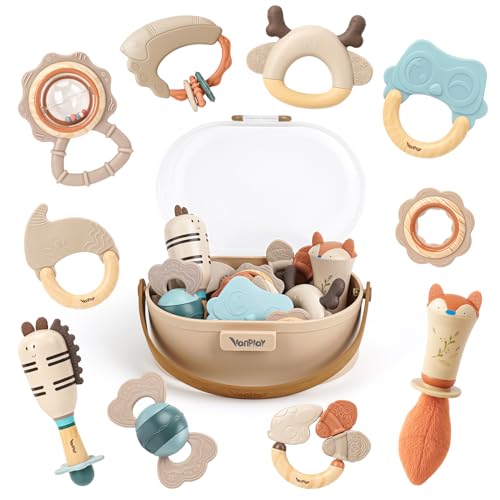
One box that swaps toys every week so nothing gets boring.
Ten pieces in one set, built specifically for the 0-12 month range that stretches across several developmental stages. There are soft silicone teethers shaped as rings, animals, and easy-grip handles — all chosen so tiny hands can find a hold that works. The gentle bell rattles add sound without being loud enough to rattle a parent’s patience. Because you get a whole assortment, babies rotate through them and something stays fresh even after a month.
That variety is what buyers bring up again and again — there is always another one to try when the current favorite loses its shine. The soft, muted pastel colors are a deliberate choice too: they are still visually interesting to a baby but fit whatever nursery you already have. Everything meets US safety standards (BPA-free, non-toxic), and the whole set is dishwasher-safe and can be sterilized by boiling or steam. There is a storage box with a carry handle so the pieces stay organized and dust-free whether you are at home or in the car.
The honest limitation: several of the toys are quite similar in shape and size, so if you were hoping for ten wildly different experiences, you will not get that. It is more like a good mix than a wildly diverse collection. That said, for a gift set that has real staying power across a baby’s first year, this is a solid bet.
What earns its place
- 10 pieces means you can rotate and keep interest alive
- Multiple handle sizes let a baby grow into them through the first year
- Dishwasher-safe and boil/steam sterilizable — genuinely easy to clean
- Carry-handle storage box for travel and tidy home use
Where it holds back
- Many of the ten pieces are similar in shape and size — less variety than the count suggests
- The storage box must be kept with the set to stay organized
Best for: parents who want a fully stocked first-year kit rather than buying one toy at a time.
Look elsewhere if: you already own several rattles and want distinctly different experiences from each piece.
5. VTech Busy Learners Activity Cube

Five sides, one motion sensor, and enough interaction to outlast a car trip.
This is the pick for the baby who has moved past simple grabbing and wants to make things happen. Five sides of play spread across 4 light-up buttons that introduce animal names, animal sounds, and shapes. There are 14 interactive features in total, covering colors, shapes, and fine motor work. A motion sensor fires off fun sounds when the cube is moved — a smart little detail because it rewards the baby for reaching, rolling, and eventually crawling toward it. And with 25 playful songs and melodies, plus adjustable volume for quieter play, it works as a sit-and-play toy rather than a background noisemaker.
Durability is the throughline in owner feedback here — this cube survives drops, throws, and the sitting-on-it phase that destroys weaker toys. Parents describe carrying it everywhere from the car to the bedroom, and one 2-year-old’s grandmother reported it still holds up after months of abuse. The size is a genuine bright spot: big enough for a baby to really sit and work all five faces, small enough to take along. It weighs around 1.4 pounds and runs on 2 AAA batteries included for demo purposes only.
If you have a low-noise home, this is not the pick for you — the noise and music are divisive, with some parents loving the songs and others finding them a lot. It also runs 6 months to 3 years, so it will still be in demand long after the newborn toys have been retired. For a baby who wants cause and effect with lights and sound, nothing here beats it.
What earns it a place: the motion sensor is the standout — it turns the whole cube into something the baby actively seeks out rather than something they sit beside.
Worth knowing up front: the noise and music are the polarizing feature; if you want a quiet toy, this is not it.
Go with this: for the 7-month-and-up baby who has figured out that pressing buttons does something.
Different pick if: you want a silent, chew-only toy for a newborn — this is too complex for that stage.
6. Weilim Montessori Baby Toys, 3-in-1 Soft Stacking Blocks Rings Sensory Ball

Twenty-four pieces, three ways to play, zero towers left standing.
You get three coordinated collections in one box: 12 embossed blocks, 6 stacking rings, and 6 textured sensory balls. Babies who are just discovering stacking will knock towers down, nest the rings, and roll the balls. Each action builds grip, coordination, and early problem-solving as they figure out why the tower fell. The blocks, rings, and balls all have raised textures and embossed numbers, animals, fruits, and geometric patterns, so there is always another detail to find on the next pass.
These pieces are made from food-grade silicone that is BPA-free, and the whole set is safe for teething. Many pieces can double as dedicated chew toys, and because they are silicone rather than plastic, the texture is soft enough to squeeze and press. Parents consistently describe the material as the reason this set works: it is soft enough for a baby to grip and chew without any give that would break it. The set meets CPSIA and ASTM F963 safety standards, and the printed gift box makes it an easy shower or birthday gift.
The thing to know before buying: some pieces have small openings, so surface cleaning with a damp cloth is the intended routine rather than submerging or machine washing. If water does get inside, you squeeze it out and air-dry the piece with the opening facing down. That is a slightly fiddly maintenance step compared to a fully sealed set — but it is the trade-off for the soft, squeezable play these pieces deliver.
What stands out
- Three play types (block, ring, ball) in one box for long shelf-life
- Raised textures and embossed shapes keep the exploration going
- Food-grade silicone, BPA-free, safe for chewing
- Open-ended — works for solo discovery or shared play
Where it needs attention
- Small openings in some pieces mean surface-clean only — no submerging
- Stacking is a bit tricky for the youngest babies because the rubber texture resists interlocking
Strongest for: parents who want open-ended building play that grows with a baby from chewing to stacking.
skip it if: you want a fully sealed, dishwasher-safe set with no maintenance caveats.
7. JoyCat Baby Toys 6-12 Months, Mystery Soft Box 10 Sensory Objects
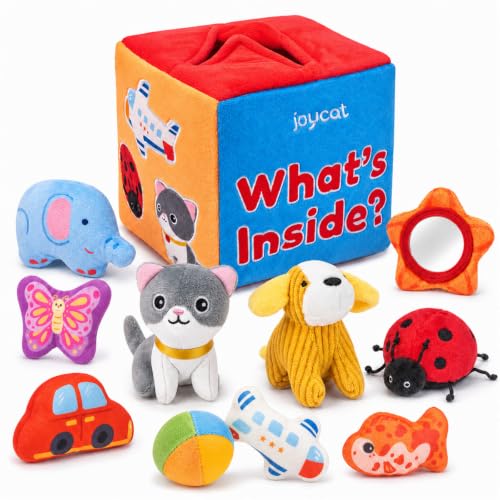
A soft box that turns every object into a small “what’s in there?”
The concept here is simple and effective: ten soft objects, each with its own texture and its own sound, living inside a squishy fabric box. The elephant and car make “bibi” sounds, the airplane and ball rattle, and the butterfly crinkles — so each pull delivers a different sensory surprise. That gives the set natural variety without needing any internal mechanisms or batteries. All the objects are sized for little hands to grab, and the whole set is machine washable, which matters when everything ends up in a baby’s mouth.
The squishy fabric box is the design, not a decorative extra. The box is squishy fabric with no rigid supports, so it holds its shape but is safe if a baby flops onto it during crawling. Parents describe babies going from needing coaxing at first to pulling the items out on their own within a week or two — a nice, low-pressure introduction to the game. The cat piece is stuffed and detailed, and the whole set works for word association as toddlers start naming the objects.
The honest note: the box is light, so if a baby grabs one edge and yanks, they may lift the whole box instead of pulling the toy out. It helps to hold a corner down until they figure out the rhythm. And a couple of the pieces, like the thin printed fish, are less plush than the others — the quality is not perfectly even across all ten. But that inconsistency lives alongside a genuinely strong concept, and the fussy babies seem not to notice at all.
Where it wins: the surprise factor. Every pull is different, which is exactly why this holds a baby’s attention longer than a single-purpose toy.
What to expect: the fabric box is light, so it needs a corner held down while a baby figures out the pull-out motion.
The match for: a 6-12 month baby who is motivated by discovery and “what comes next?”
Not the one if: you want a heavy, stay-put box toy — this one lifts when it is yanked.
8. hahaland Baby Toys 6-12 Months — Fruits Vegetables Garden Plush Set

A plush garden where every veggie crinkles, rattles, or squeaks.
Eleven pieces make up this sensory garden, and every one of them does something: squeaker, rattle, crinkles, rich textures, and a baby-safe mirror all show up across the set. The play pattern is built around reaching, pulling, and “planting” — a hidden pocket lets babies pull crinkle-tissue surprises out and learn cause and effect. Each plush flower, fruit, and veggie has a friendly face on it, which gives babies a way to spot expressions on the toy or in the mirror. It runs 6 months to 3 years and is made from soft plush with no small parts.
What keeps this one interesting as a baby grows is the layered identity: it works as a sensory toy first, then gradually shifts into pretend-play territory for toddlers who want to “cook” with the veggies. Parents of 6-month-olds describe babies loving the crinkly tissue pieces and the quiet mushroom rattle, while older toddlers keep coming back to it for imaginary play. The carry box keeps everything together and doubles as a play scene with a farm lid. Nothing needs batteries, which makes it a rare pick that is entertaining without any noise you cannot turn off.
The one thing to be aware of is that this set leans into plush, not into hard sensorimotor feedback. If your baby is looking for gears to turn, buttons to press, or textures that resist, this won’t scratch that itch. But for a toy that grows with a baby through teething, chewing, and into pretend play, that softness is exactly the point.
Why parents keep it
- 11 pieces with rattle, squeaker, crinkle, and mirror all built in
- Friends’ faces on the plush make it great for expression learning
- No batteries — nothing to recharge, nothing to turn off
- Grows from 6-month sensory play into toddler pretend play
Where it is softest
- All-plush design means no hard sensorimotor feedback like buttons or gears
- Some of the flat veggie pieces are thinner than others in plushiness
Made for: a baby you want to grow into pretend play — this keeps paying off well past the one-year mark.
Not for: a baby who has already moved on to buttons and mechanisms — this stays soft throughout.
9. Plunack Montessori Toys 6-in-1 Sensory Developmental Learning Set
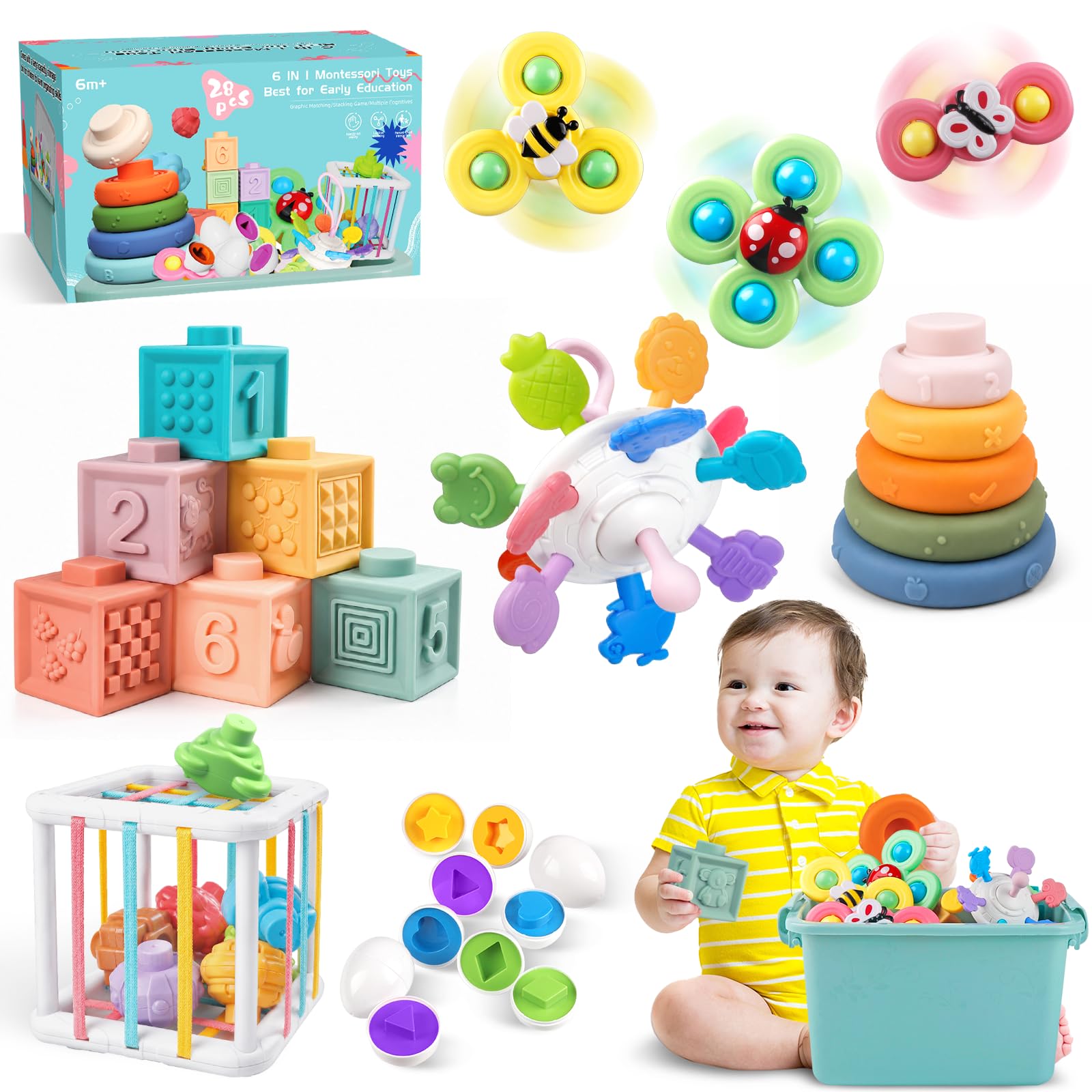
A full sensory curriculum in one box — 28 pieces covering every stage.
If you want one purchase that covers the entire 18-month to 8-year range, this is the set to look at. You get six toy types in one box: 6 soft stacking blocks, 5 stacking rings, 6 matching eggs, 3 suction cup spinner toys, 1 pull string sensory toy, and 1 explore sensory bin with 6 shape blocks. That is 28 pieces, each aimed at a different developmental milestone. The stacking rings teach size sequencing and color recognition, the shape sorter eggs build spatial reasoning across 12 colors and 6 shapes, and the pull strings strengthen grip — the kind of pulling motion that builds the pincer grasp used for everything from holding a spoon to turning a page.
Safety engineering is unusually thorough here. Every piece passes the choke tube test, the soft silicone blocks are food-grade and withstand 200°C, and the pieces are dishwasher-safe for easy sterilizing. The set is third-party lab tested and certified to US CPSC safety requirements, contains zero BPA, phthalates, or lead, and the entire set is tested to CPSIA and ASTM F963 standards. The suction cup spinners stick to highchair trays, bathtub walls, and car windows, while the pull string toy clips to strollers for on-the-go play. It also comes in a large storage bin that keeps all 28 pieces organized and portable.
The caveat: with 28 pieces and so much suction-cup sticking to surfaces, this is a set that needs some management. Parts end up in different rooms, and the bin becomes the lifeline that keeps everything together. Some parents find the included “toy cage” storage case less durable than the toys themselves. But that is a small thing against a set that genuinely delivers something for every stage from toddler onward.
What makes it work: six different toy archetypes in one box means the set keeps pace with rapid developmental changes without needing multiple purchases through the toddler years.
The real trade-off: 28 pieces means 28 things to keep track of — this set rewards organized households and frustrates those without a clean-up routine.
The full-bundle pick for: parents who want one comprehensive Montessori purchase to cover the toddler through early school years.
Maybe not if: you prefer a single-purpose toy with fewer pieces to manage.
Understanding the Specs
Material and safety ratings
Baby sensory toys get chewed on, thrown, and drooled on, so what they are made of matters more than any aesthetic feature. Food-grade silicone is the most common soft material — it is durable, has a gentle give, and is dishwasher-safe on most pieces. BPA-free construction means no bisphenol-A plasticizer, which matters because babies mouth everything. Look for EN71, CPSIA, or ASTM F963 safety-standard tags on the packaging — those are the marks that confirm independent testing, not just a claim in the marketing copy.
Age range and developmental stage
The recommended age range on the box is a starting point, not a strict rule. A toy marked 6-12 months may still be useful at 16 months if it grows with your baby’s skills. Toys locked to a single stage need to be replaced as the baby develops; open-ended toys keep paying off. Match toy to current skills — if a baby is grabbing, prioritize grab-ability; if they are pulling things out of boxes, prioritize containers with objects; if they are sitting and pressing buttons, prioritize cause-and-effect interactions.
Sensory outputs: sound, texture, and sight
Rattles, crinkles, and squeakers all fall under auditory stimulus, but they play different roles. A rattle rewards motion, a crinkle rewards a squeeze, and a squeaker rewards grip pressure. Combining outputs in a single toy tends to hold attention longer than a toy that does only one thing. Visually, high-contrast patterns and mirrors work for different reasons: patterns catch the eye, mirrors engage the sense of self and self-recognition as babies get older. Textures — bumpy, smooth, looped, plush — matter most for tactile development, and having multiple textures in one toy keeps the exploration fresh.
Cleaning and maintenance
Some pieces are dishwasher-safe, some are surface-wash only, and some have small openings that trap water if you submerge them. The safest universal rule is to check the manufacturer’s instruction, and when in doubt, wipe with a damp cloth. Silicone pieces that are dishwasher-safe can take a full sterilization cycle. Plush toys and fabric boxes usually wipe clean or machine wash on a gentle cycle. If a toy has openings, always dry it completely with the opening facing down before storing it.
FAQ
How do I know which baby sensory toy suits my baby’s age?
Is silicone or plush better for a teething baby?
Do baby sensory toys need batteries?
How often should I wash silicone baby toys?
What does CPSIA or EN71 certification actually mean?
Can a sensory toy be too loud for a newborn?
How long do baby sensory toys usually last before a baby outgrows them?
Are wooden baby toys safer than silicone ones?
What if my baby loses interest in a sensory toy after a few weeks?
Final Thoughts: The Verdict
For most families, the baby sensory toys winner is the Manhattan Toy Winkel Rattle & Sensory Teether Toy — it has been doing its job for over 25 years, holds the strongest owner satisfaction of the group at 4.8 stars across 42,000+ ratings, and the looped BPA-free tube design is genuinely hard to outgrow during those first grabbing months. If you would rather gift something cuddly that doubles as a keepsake, the Moonkie Bunny Lovey with Silicone Teether is the one that earns “best gift at the shower” status. And for the toddler who wants to press, pull, and shake everything in sight, the VTech Busy Learners Activity Cube keeps working through the first three years.
One honest nudge before you close the tab: if your baby is right at that three-to-four-month mark and starting to reach for things, the Winkel is the pick that will be useful the soonest — it is the one toy here where the very first grab is the whole point of the design.
How We Picked
We do not accept paid placement. Every pick is matched to a real buyer and a real use-case; we do not hands-on test units.
Sources & Methodology
Specifications: manufacturer listings and product documentation. Review insights: verified customer reviews, as of September 2026. Pricing: not shown on this page (it changes often); check the current price via the retailer link.
As an Amazon Associate, Gadgets Feed earns from qualifying purchases. This does not affect which products we feature.