
Our readers keep the lights on and my morning glass full of iced black tea. As an Amazon Associate, I earn from qualifying purchases.
Specs are compiled from manufacturer listings and verified buyer reviews and can change over time — please confirm the key details on the product page before buying.
You already own great wireless headphones — the problem is the airplane seatback screen, the hotel TV, and the gym treadmill still want to hand you a cable. A Bluetooth audio transmitter is the small gadget that plugs into any 3.5mm AUX or optical jack and turns that wired sound into a Bluetooth signal your own headphones can hear. The trick is picking one that pairs fast, keeps lip-sync tight, and lasts the whole flight. Below are nine that actually do it, ranked and compared on the specs that matter.
I’m Min — the founder and writer behind Gadgets Feed. This guide is built by comparing the manufacturers’ published specifications and the patterns across verified customer reviews, so you get each pick’s real strengths and trade-offs instead of marketing spin.
Some models here use Bluetooth 5.4, some carry aptX Low Latency for tighter sync, and a few run entirely off USB power with no battery at all. That spread is why the right bluetooth audio transmitter depends on where you plug in most.
Our Picks at a Glance
How To Choose The Best Bluetooth Audio Transmitter
Buying the wrong one is almost always a connection problem, not a sound problem. Your headphones are fine — the transmitter just has the wrong socket, the wrong battery plan, or the wrong mode. Here is what to check before you buy.
TX mode vs RX mode — and why it decides everything
TX (transmit) mode takes wired sound — a plane seatback, an older TV, gym equipment — and sends it out to your Bluetooth headphones over the air. RX (receive) mode does the reverse: it takes audio from your phone and pushes it into a wired speaker or car stereo with no Bluetooth built in. Most units on this list are 2-in-1 and do both, but check the fine print, because a few are transmitter-only. If you mainly want your TV in your AirPods, TX is your mode.
Latency and codec support — the lip-sync question
Latency is the delay between the picture moving on screen and the sound reaching your ears, measured in milliseconds (ms). Long delay looks like a badly dubbed movie; short delay is invisible. The fix is aptX Low Latency, which only works when BOTH the transmitter and your headphones support it. Plug a non-aptX set of earbuds into an aptX transmitter and it quietly falls back to standard Bluetooth, so sync gets looser. Check your headphone model before you count on it.
Power: rechargeable travel units vs USB-powered home units
Battery-powered units give you hours of wire-free use and are the ones you toss in a carry-on. USB-powered units skip the battery entirely and run off your TV’s USB port or a wall adapter — ideal for a permanent spot in the living room, since there is nothing to recharge. Match the power style to where the transmitter will actually live.
Connections: 3.5mm AUX, RCA, and optical
A 3.5mm AUX jack is the headphone-style socket you find on plane seatbacks, treadmills, and older TVs. RCA is the red-and-white pair on the back of a stereo. Optical (also called TOSLINK or SPDIF) is a small square port with a light inside, common on modern TVs. If your TV is HDMI-only with no AUX or optical output, none of these will help — you need a TV with a 3.5mm or optical audio out.
Quick Comparison
| Model | Best For | Bluetooth | Battery / Power | Inputs | Amazon |
|---|---|---|---|---|---|
| Avantree Voyager Airplane Bluetooth Adapter★ Best Overall | Flights with a screen you can read | Bluetooth 5.4 + Auracast | Rechargeable | 3.5mm AUX | Amazon |
| Nulaxy 2-in-1 Transmitter ReceiverBest Value | Sharing audio with a seatmate | Qualcomm chipset | 15 hrs TX / 20 hrs RX | 3.5mm AUX | Amazon |
| LAICOMEIN Pro Bluetooth 6.0 Transmitter ReceiverMost Versatile | One adapter for car, TV, and plane | Bluetooth 6.0 | 20+ hrs, 1.5 hr recharge | AUX, RCA, USB-C | Amazon |
| SOOMFON aptX-LL Transmitter Receiver | Low-latency TV and gaming | Bluetooth 5.3 + aptX-LL | 23 hrs TX / 17 hrs RX | 3.5mm AUX, USB-C | Amazon |
| LAICOMEIN Ultra Pro Transmitter Receiver | Dual-headphone movie sharing | Bluetooth 5.4 + aptX-LL | 20 hrs, 2 hr recharge | 3.5mm AUX, RCA | Amazon |
| Monster 2-in-1 Bluetooth Audio Adapter | Fixing up an old stereo console | Bluetooth, low-latency | USB-powered | 3.5mm AUX, Optical | Amazon |
| 1Mii Bluetooth 5.3 TV Transmitter | Fed-up TV viewers with a budget | Bluetooth 5.3, aptX AD/HD | USB-powered | AUX, Optical, RCA | Amazon |
| Twelve South AirFly Pro 2 Deluxe | Battery life that outlasts the flight | Bluetooth 5.3, aptX HD Adaptive | 25+ hrs claimed | 3.5mm AUX, USB-C | Amazon |
| Avantree Oasis Plus 2 | Private TV listening for couples | Bluetooth | USB-powered (Type-C) | Optical, 3.5mm AUX | Amazon |
In‑Depth Reviews
1. Avantree Voyager Airplane Bluetooth Adapter with OLED Display
Our pick — over 4.5★ from 300+ verified ratings; the strongest balance of quality and price.
A tiny screen kills the guesswork of pairing on a plane.
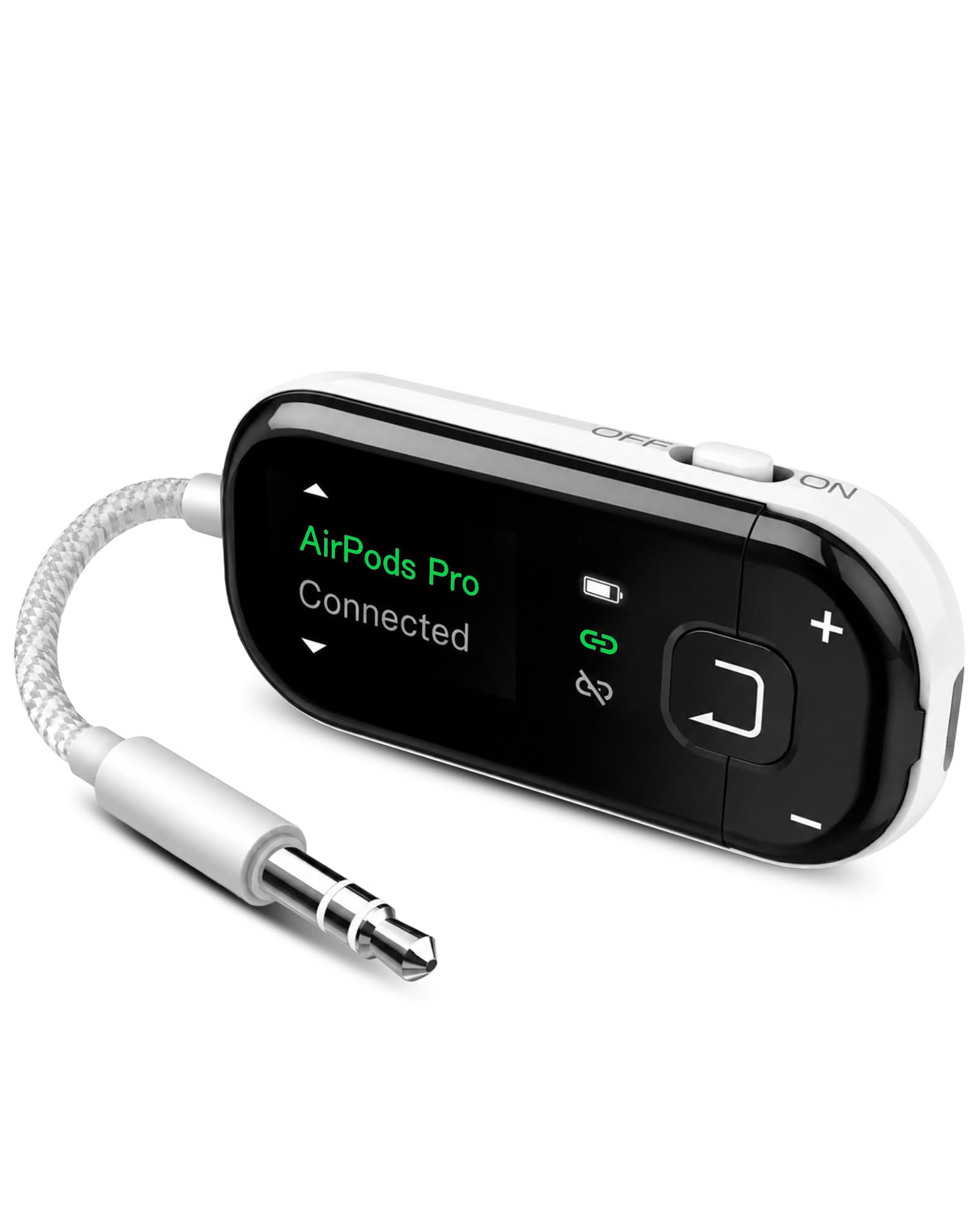
Most cheap transmitters leave you poking at a blinking light and hoping. This one puts a real OLED display (a small self-lit screen that shows text, not just a dot) right on the body. You can see the connected device name, the battery level, and the audio status at a glance. That display is why it tops this list, backed by a 4.6-star score across 300+ ratings.
The wireless spec is current too: Bluetooth 5.4, which is the newest mainstream version for stable connections, plus the connectivity to use it with AirPods, Bose, or Sony headphones. It also supports Auracast, the broadcast mode that feeds one audio source to many compatible earbuds at once. For a flight, you plug it into the seatback 3.5mm jack and your own headphones take over the movie. You are not tied to the airline’s tinny loaner set anymore.
What wins people over is how widely it just works. Buyers report it pairing reliably with a Stern pinball machine’s headphone jack where other adapters cut the sound, and connecting cleanly to Sony WH-1000XM4s with no lag. Owners mention solid Bluetooth range at roughly 30 feet indoors. Note the limits honestly: it pairs only one headset at a time, and tight low-latency requires headphones that support aptX Adaptive or aptX-HD, so a basic set will still sound fine but with looser sync. One owner summed up a London flight: “No lag at all.”
OLED status display
- OLED screen shows device name, battery, and status so you never guess at pairing
- Bluetooth 5.4 with Auracast-ready support for next-gen earbuds
- Fully confirmed works with AirPods, Bose QC35, and Sony headphones on plane systems
- Compact and portable — pocket-sized for a carry-on
bulky charging case
- Classic Bluetooth pairs one headset only — no dual connection
- Best low-latency audio needs aptX Adaptive or aptX-HD headphones
cabin crew pick: you fly often and want to see your own device name on a screen before you commit to the connection.
pass on bulk: you need two people listening from one seatback jack at the same time.
2. Nulaxy Airplane Bluetooth Adapter 2-in-1 Transmitter Receiver with Screen
The featherweight that shares a movie with your seatmate.
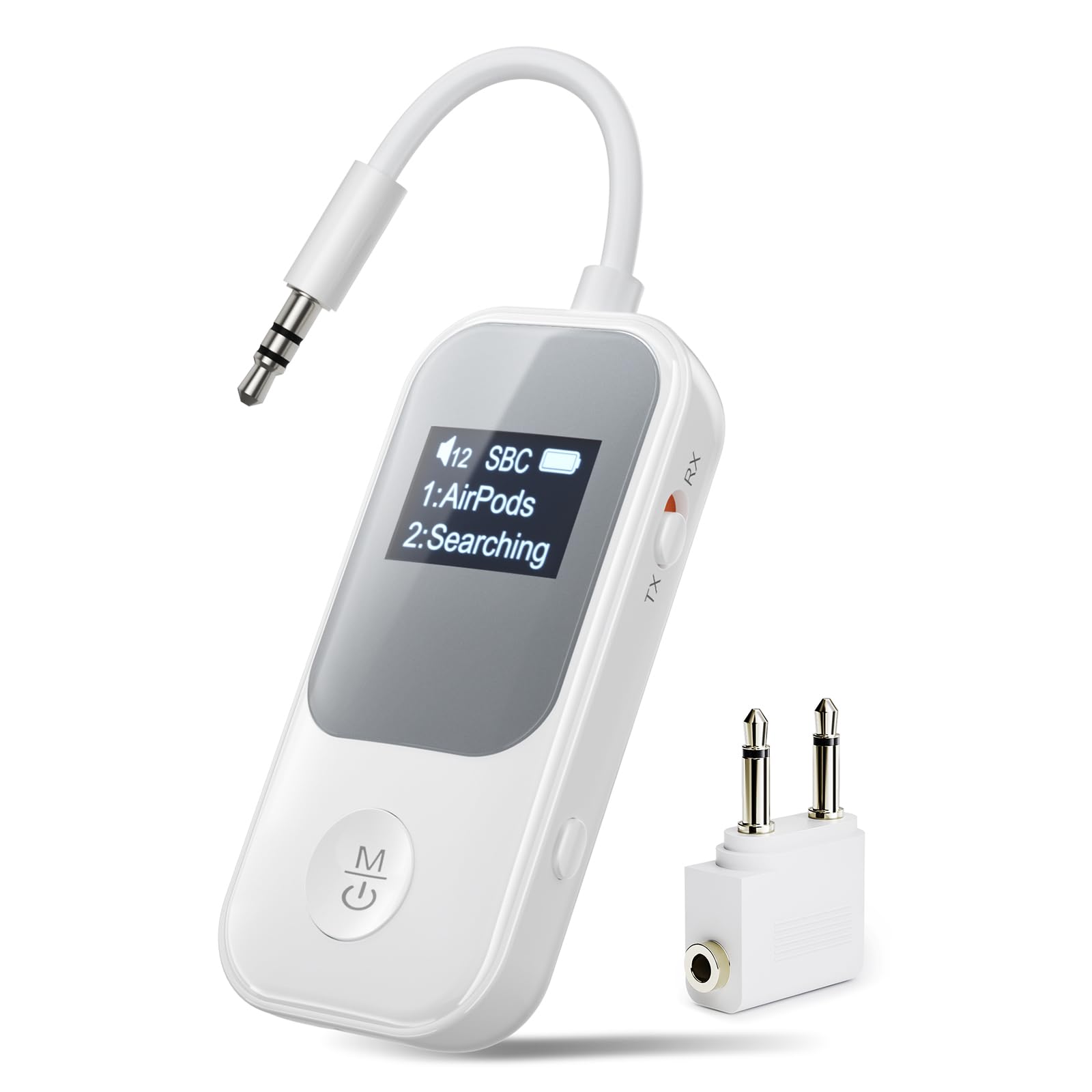
The headline number here is battery: up to 20 hours in RX (receive) mode and 15 hours in TX (transmit) mode. For a receiver that means music flowing from your phone into a wired speaker all day; for a transmitter it covers even a long-haul flight with charge to spare. Its 4.8 g battery also makes it the lightest battery unit here, well under the Avantree Voyager’s 8 g. If carry weight in your pocket matters, that is the difference you feel.
The dual-headphone sharing is the real draw. Connect two sets of Bluetooth headphones at once and a movie or playlist goes to both of you without an extra splitter or a jumble of wires. The Qualcomm chipset inside (Qualcomm makes the radio chips that drive most phones) is there for stronger compatibility and a more stable connection, and the low-latency tuning keeps audio closer to the picture. A clear screen shows the operating mode and device names so setup is quick — Mode gets you into the right TX or RX state without menu-diving.
One honest note: the unit has male connectors on both ends, so to wire it into older Bose headphones or certain gear you may need a small female-to-female 3.5mm adapter to bridge the gap. It also is not built for instruments or hearing aids. The recurring gripe among owners is a small share of units that disconnect every ten minutes or so — worth knowing, but the bulk of buyers are happily listening. It will not work on a TV lacking an audio output jack at all (USB or HDMI-only sets), so check your TV’s ports first.
dual-mode flyer: pairs of travelers who want to split one audio source and need genuine all-day battery.
recharge often: your TV has no 3.5mm output — this needs an actual audio port to plug into.
3. LAICOMEIN Pro Bluetooth 6.0 Transmitter Receiver – 2-in-1 Adapter
One adapter that follows you from car to TV to airplane seat.
Where the Avantree Voyager is tuned for the cabin, this LAICOMEIN unit is tuned for everything. It carries Bluetooth 6.0, a step past the 5.3 on several models here, and it accepts AUX, RCA, and USB-C, so the same device handles a plane seatback, an older TV’s red-and-white RCA jacks, and a car stereo. It also has a built-in microphone, which most transmitters in this class lack, so you can take a call through it instead of yanking your headphones off. Recommendation is what owners praise most by a wide margin, ahead of connectivity and sound.
Battery leans to the travel side: over 20 hours of playback, and a fast USB-C recharge to full in about 1.5 hours, and you can keep using it while it tops up. Setup is close to instant — power it on and it grabs a remembered connection, so your AirPods, Bose, or Sony gear reconnects quickly. In TX mode it can drive two sets of headphones at once for shared in-flight entertainment, and in RX mode it can pair two smartphones for switching between them. There is even a dual-prong airplane adapter in the box, the AirFly-style plug for older twin sockets.
A couple of honest edges: the battery status indicator is basic — just LEDs, no digital percentage readout, so you are reading pips, not numbers. A small number of owners also found it slow to make that first connection and reported a bit of background static when the TV goes silent, though adjusting the source volume tends to clear it. It is not meant for live instruments or karaoke. Certified to FCC, CE, RoHS, and BQB safety standards, with cable storage built in to keep things tidy.
Bluetooth 6.0 chipset: AUX, RCA, and USB-C inputs plus a microphone mean this single adapter can replace a drawer of cable-specific gadgets — the plain reason it earns the versatility tag.
future-proof buy: you want one transmitter to cover your car, your TV, and your next flight without buying three.
fragile handling: the battery readout is pip-style LEDs, so an exact percentage before a long trip is not on the table.
4. SOOMFON aptX-LL Bluetooth 5.3 Transmitter Receiver for TV to 2 Headphones
Built to hold picture and sound together for movie night.
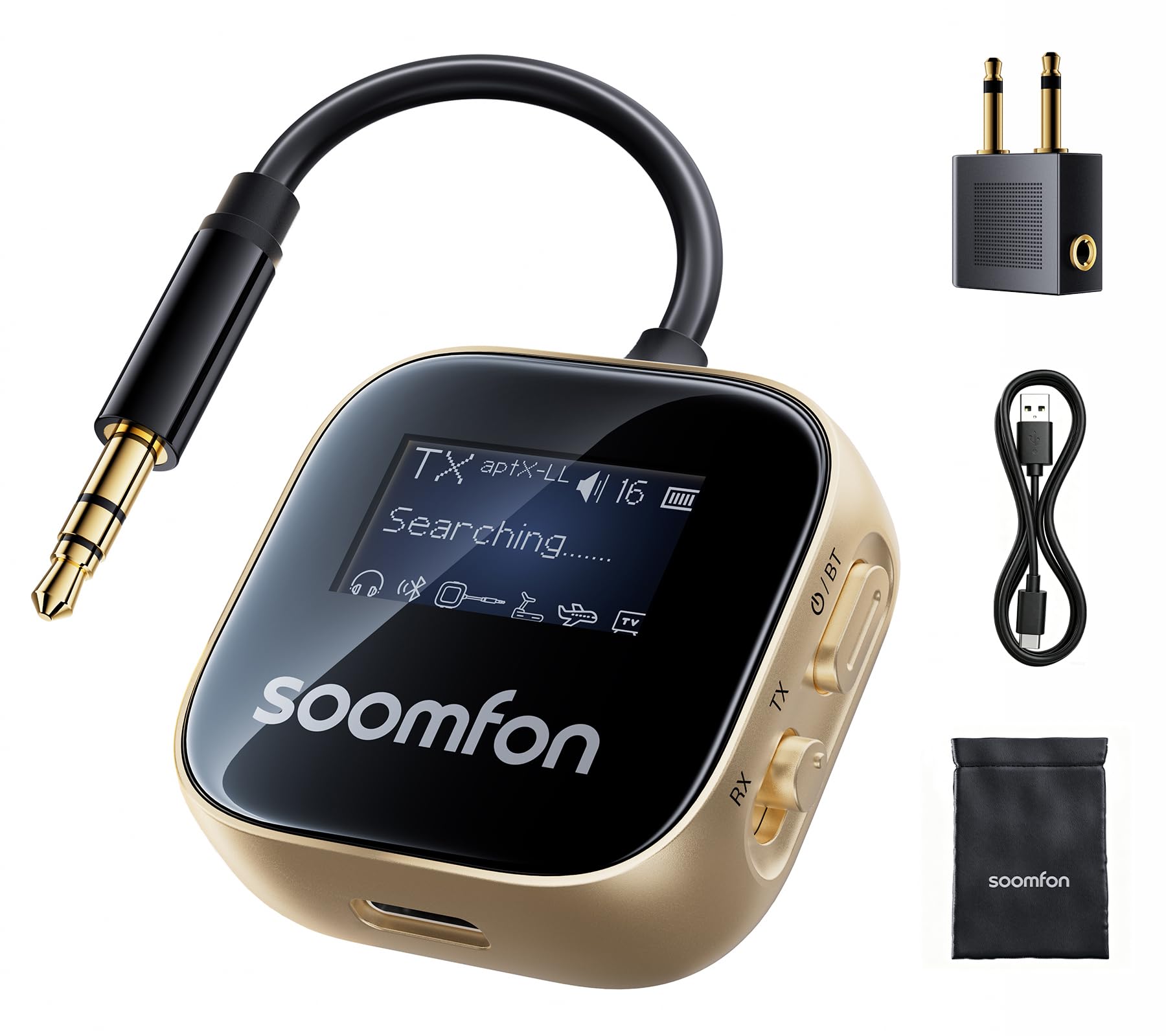
If lip-sync is your worry, this is the spec to look at: aptX Low Latency (called aptX-LL) with audio delay as low as 40ms. Forty milliseconds is roughly a single video frame — short enough that most eyes never notice it. That is the tightest latency figure on this whole list, handily tighter than the general “minimal delay” units that skip naming one. It runs Bluetooth 5.3 for a stable link and works both ways: TX to send TV, plane, or gym audio out to headphones, RX to add Bluetooth to wired speakers, car stereos, and sound systems.
Battery is generous for a travel unit: up to 23 hours in TX mode and 17 hours in RX mode, with fast USB-C charging. That beat the Nulaxy’s 20-hour RX figure and tops the Dual-pairing covers two headphones at once in TX, the same shared-movie trick, and two smartphones in RX for easy switching. The LCD display shows pairing status, connected devices, and the current mode, so you can watch the connection settle instead of guessing. An LCD (liquid crystal display) is the readable panel that shows text — the same tech as an old digital watch face, but here it names your device and mode.
The honest constraints are worth stating: it has no microphone, so it is not for phone calls. In dual-connection mode you cannot adjust each headphone’s volume separately, and in RX mode only one of the two connected devices plays at a time. It does not support Dolby audio and will not pair with devices that demand a PIN code. For the target jobs — a plane screen, a TV, a drive — owners lean positive, with flight use and low film delay both showing up as praise. In a 2021 Toyota Highlander a driver ran audiobooks on a long trip, and the recurring minor note was an occasional slow connect that resolves after a beat.
aptX low latency
- 40ms aptX-LL latency — the tightest figure here — keeps audio glued to the screen
- 23 hrs TX / 17 hrs RX, charged over fast USB-C
- LCD shows mode, pairing status, and connected devices
- Dual TX pairing for two headphones at once
limited range indoors
- No microphone — not for calls
- No Dolby support, and RX mode plays one device at a time
- Separate volume per headphone is not available in dual mode
gamer sync: anyone who catches lip-sync lag and cannot unsee it, especially for TV and gaming.
range limited: taking phone calls — there is no mic on board.
5. Ultra Pro Bluetooth Transmitter Receiver, Wireless Adapter for Airplane/TV
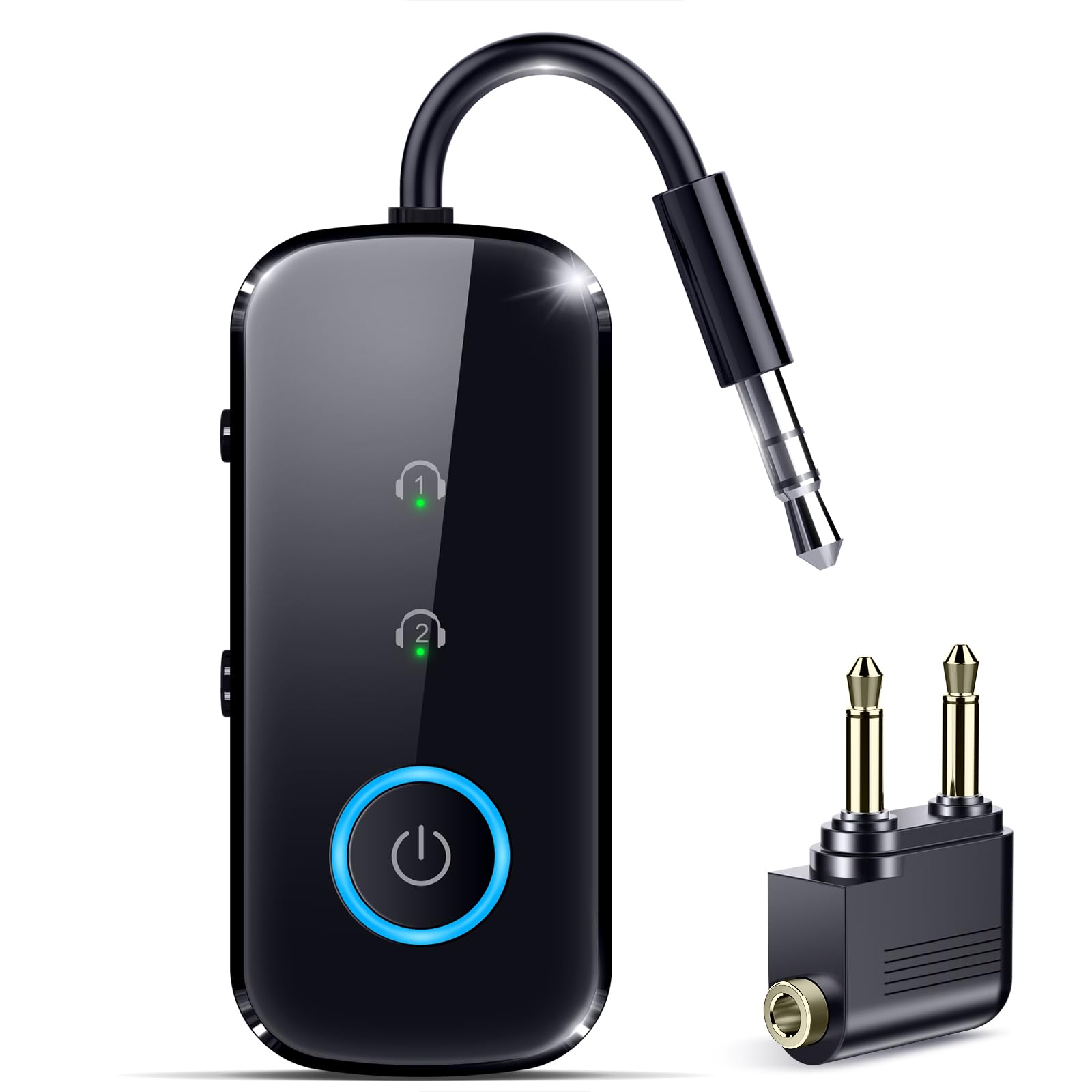
Older aircraft ports and modern jacks, handled by one box.
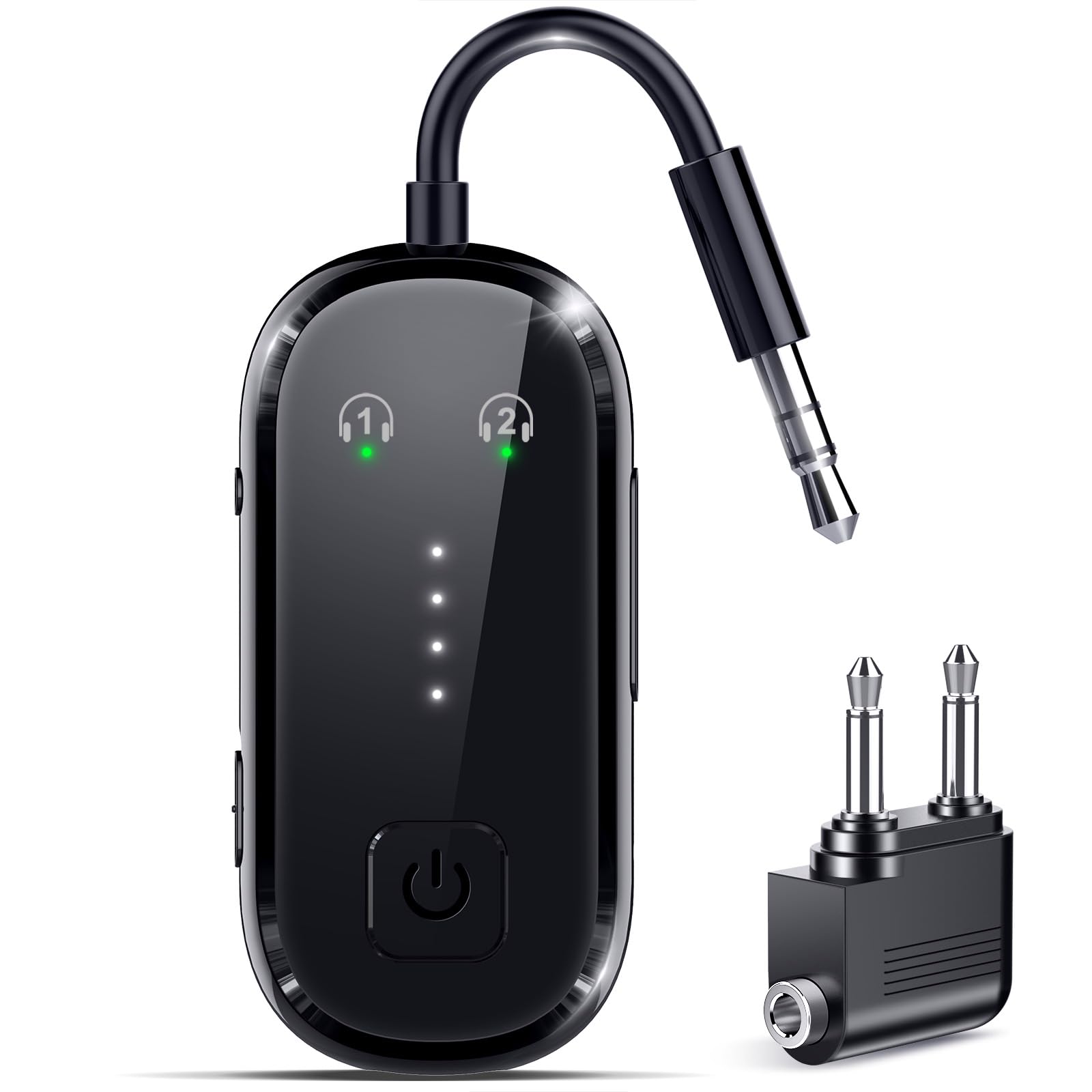
The kit idea is what separates this one: it ships with a dual-prong adapter that fits both modern single 3.5mm jacks and the older twin armrest sockets still found on plenty of planes. That small piece is the difference between a transmitter that works on your next flight and one that sits useless in your bag because the seat used a different plug. Owners praise its overall function above everything else, ahead of connectivity and sound.
Dual pairing happens fast, with the maker claiming two pairs of wireless headphones connect in under three seconds, and dedicated ‘1’ and ‘2’ LED indicators to show each one is linked. A practical catch: the second device only pairs after the first is connected, so it is sequential, not simultaneous. Battery covers 20 hours with a two-hour USB-C recharge to full, and the maker suggests charging before each flight for the best run. The wireless spec is Bluetooth 5.4, and the maker states it improves stability and trims latency, with a 33-foot (10m) range for moving around a room without dropouts.
The size is a genuine plus — lipstick-slim, so it disappears into a tech pouch. It works as both a transmitter (planes, hotel TVs) and a receiver (car stereos, home speakers), and it carries FCC, CE, RoHS, and BQB certification. The recurring honest note from owners is that it can need a nudge — one mentioned needing to hold the power button to reboot it, and a few reported minor glitches that a wiggle fixes. It is not built for Bluetooth hearing aids or 2.4G-sync devices. For the target jobs it stays a dependable pick, and owners call it excellent value.
carry-on companion: someone who lands on mixed aircraft and wants one adapter that fits both seat port styles.
codec miss: dual pairing is sequential — the second headphone waits on the first.
6. Monster Bluetooth Transmitter & Receiver, 2-in-1 Audio Adapter

The fixer for a stereo old enough to remember the Beatles.
You set this one down and forget it — it is for a fixed spot, not a carry-on. It runs off USB power, so there is no battery to charge, ever: plug it into a TV’s USB port, a wall adapter, or a laptop and leave it there. That suits a permanent living-room setup where you want zero recharge routine. Its quality score is the standout, praised more than any other trait. It takes both a 3.5mm AUX cable (the standard round headphone jack) and a digital optical input (a fiber-optic audio cable, often labeled SPDIF), so it bridges a wide range of gear including TVs, PCs, tablets, home stereos, car audio, and non-Bluetooth speakers.
The adaptable streak is real. Owners have used it to convert a 60-year-old Philco stereo console into a Bluetooth receiver, and another long-term owner kept it running for years converting a TV’s optical output to Bluetooth headphones. For TV use, set the source audio to PCM format rather than Dolby or DTS, or the connection will not behave. It pairs up to two headphones or speakers at once, though the maker notes it works best when both devices share similar Bluetooth versions and codecs. Range is stated at 33 feet for wandering around the room.
Here is the honest part, and it matters: connectivity is the mixed area. Some owners connect easily, while others describe failed attempts. Audio latency is the most common complaint — around 100 to 150ms in one account, which is noticeable in fast games but easy to overlook for TV and music. Instructions are on the thin side, and some owners had to hunt down a video to get going. Treat it as a home workhorse with the patience for a learning curve, not a plug-and-play-and-forget gadget — but where it locks in, it locks in for a long time.
Monster audio tuning: USB power plus optical and AUX inputs make it a set-and-leave option for a stereo or TV that has no Bluetooth of its own.
pricey for basics: latency here sits around 100–150ms per one owner’s read, so keep it away from reflex-heavy gaming and reserve it for TV, music, and vintage gear.
home stereo fit: reviving an older stereo, TV, or speaker system in a fixed spot where battery life is a non-issue.
budget buster: competitive gamers or anyone who wants it working perfectly within five minutes of opening the box.
7. 1Mii Bluetooth 5.3 Transmitter for TV to 2 Wireless Headphones/Speakers

Roam the house while the TV keeps talking to your ears.
The number that separates this pick is range: up to 100 feet (30 meters) in an open area, which is far past the 33-foot reach of several rivals here. That is the difference between staying chained to the couch and making tea in the kitchen without the audio dropping. It runs Bluetooth 5.3 for a steady link, and connects to your non-Bluetooth TV or PC over AUX, optical, or RCA, so it slots into almost any setup. It also reads its codec on a display, which is a real help if you or a family member need to see what mode is active.
The codec support is the strong suite: aptX Adaptive, aptX Low Latency, and aptX HD, giving clearer, more detailed audio and tighter audio-video sync when your headphones support the same. One caveat the maker spells out — when two aptX Low Latency or aptX HD devices connect at the same time, the codec drops to standard aptX, so shared listening trades a little polish for the second pair. There is no built-in battery; it needs its own 5V/1A USB power adapter. Setup is quick, and owners typically have it running in about ten minutes.
Customers note that it simply functions, and setup is close behind in praise. A share of owners give a mixed note on connectivity and sound quality — some call the audio clear, others hit snags. So pair your headphones to the transmitter before turning on the TV, and disconnect your headphone from your phone first so it does not grab the wrong source. The one real head-scratcher for newcomers: it powers on at full volume, so lower your headphones before the first blast.
dual headphone pairing
- Up to 100 ft / 30 m open-area range — the longest reach on this list
- aptX Adaptive, aptX Low Latency, and aptX HD codec support
- AUX, optical, and RCA inputs cover most TVs and PCs
- Readable codec indicator for confident setup
no receiver mode
- No built-in battery — needs its own 5V/1A USB adapter
- Two simultaneous aptX-LL or aptX-HD devices drop to standard aptX
- Powers on at full volume, so pre-lower your headphones
- Connectivity and sound quality draw mixed feedback from some owners
two-headset home: if you want to walk the house while the TV streams to your headphones, this reach is hard to match.
one-way only: you must supply a 5V/1A USB power adapter — there is no internal battery.
8. Twelve South AirFly Pro 2 Deluxe, Wireless Bluetooth Adapter
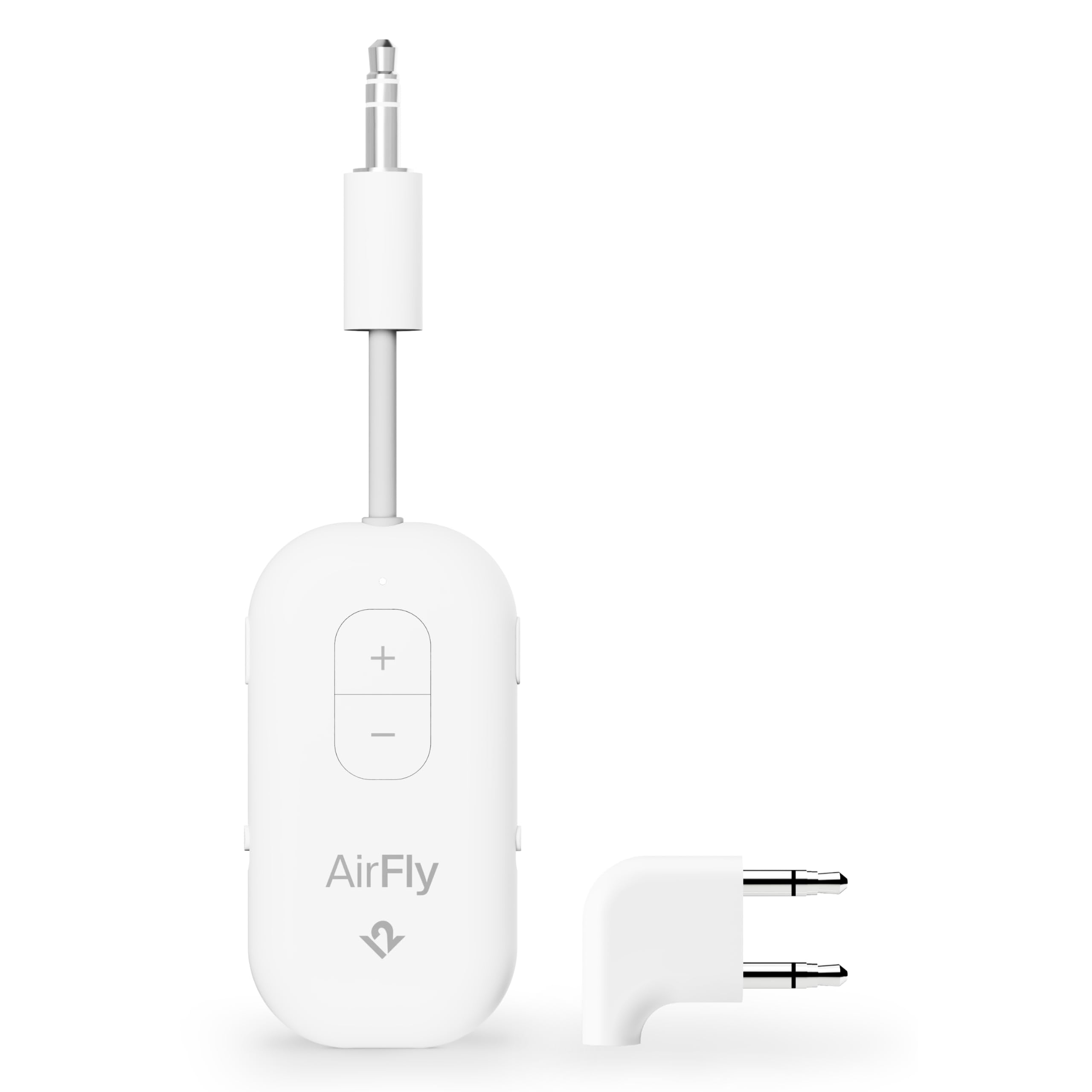
Outlasts the longest flight, then keeps going at home.
Battery is the whole point with the AirFly Pro 2 Deluxe, and it is stated as over 25 hours of listening — the longest figure here. That gap between charging sessions is what carries it through multi-leg trips and everyday home use without a mid-flight scramble. It skips an onboard display on purpose to stretch the battery further, and the trade is simple: fewer things to read, more hours to listen. It runs Bluetooth 5.3 with aptX HD Adaptive support for a stable, higher-quality link, and a quick-access button lets you adjust or mute the volume on the spot.
Two use cases define it. First, flights: it turns a seatback entertainment jack into a Bluetooth transmitter so your own AirPods or other wireless headphones take over the movie. Second, home and car: flip it to receive mode and music from your phone plays through a car or boat’s AUX port wirelessly. Dual pairing lets two sets of headphones connect at once, useful for sharing a movie on an iPad, music, or games in the car. Portability is what owners prize most, with the smooth setup close behind — it fits a tech pouch or carry-on pocket without a second thought.
The honest wrinkle is on the functionality and connectivity side, which draws mixed owner feedback — some glide through setup, while a few cannot get it to connect at all. Frequent flyers love it for seatback entertainment paired to AirPods Pro with noise cancellation and no movie lag, but an occasional random static can appear that needs a power cycle. One owner tested about six hours on a charge against the claimed 25-plus. It is not cheap, and it is the kind of device where a good first pairing setup makes or breaks the whole experience.
Apple loyalist: long-haul travelers and home listeners who would rather charge once a week than every night.
cost concern: you want a battery readout or expect a guaranteed instant connection every time — some units need a reset now and then.
9. Avantree Oasis Plus 2 – Bluetooth TV Transmitter with Remote Volume Control

Two listeners, two volumes, one screen — without waking anyone.
This one is built around the living room, not the plane cabin. It plugs into a TV’s optical (SPDIF, a fiber-optic audio cable) or AUX output and beams the audio to Bluetooth headphones or speakers, so you can watch with the sound off to the room. The feature that separates it is dual listening: connect up to two Bluetooth headphones at once, giving two people their own private audio while sharing one screen. Setup is the most-praised trait here, ahead of its sound quality — it turns on and off with the TV, so there is no second remote to juggle for the basic job.
The remote control is the premium touch worth the extra. You can raise or lower TV audio volume right from the included remote or the buttons on the unit, without digging into TV settings or getting up. Optical passthrough lets the TV audio play through an optical soundbar and your Bluetooth headphones at the same time, so the room keeps its speakers while you keep your ears on. That passthrough is optical only — HDMI ARC or eARC passthrough is not supported. It also suits households where two people want very different volume levels, and apartment dwellers who do not want to disturb neighbors.
Now the caveat that matters most: connectivity is the mixed area, and it is the highest-count topic for a reason. Some owners pair instantly, while others hit snags that take a support call to clear — sometimes just setting separate volumes for the headphones and the TV. It pairs with common headphones including AirPods-style models in transmit mode, but only reaches the lowest latency when your headphones also support aptX-LL. It is not for HDMI-only TVs, AV receivers, or Bluetooth hearing aids, and it does not support Auracast. Setup when it works is genuinely quick — the two-headphone connection is the calling card owners love.
home theater hub: couples or roommates watching one TV with two sets of headphones and wanting easy volume control from the couch.
shelf hog: an HDMI-only set or an AV receiver setup — this needs optical or AUX out.
Understanding the Specs
TX vs RX (Transmit vs Receive)
TX mode takes sound from a wired source — a plane seatback, a TV, gym equipment — and sends it wirelessly to your Bluetooth headphones. RX mode does the opposite: it receives audio from your phone or tablet and pipes it into a wired speaker or car stereo. Most transmitters here are 2-in-1 and switch between the two, but the fine print matters. Some limit RX to one playing device at a time, and a unit can be great at TX and only passable at RX. Decide which direction you actually need before buying.
Latency (Measured in ms) and Codecs
Latency is the gap between the picture moving and the sound arriving, measured in milliseconds. Standard Bluetooth can run long enough to look out of sync; aptX Low Latency trims it dramatically — one unit here cites as low as 40ms. The catch: low latency only engages when BOTH the transmitter and your headphones support it. Plug non-aptX headphones into an aptX transmitter and it falls back to standard Bluetooth, so check your model before counting on tight sync. When two aptX Low Latency or aptX HD devices connect at once, some units drop to standard aptX.
Bluetooth Version (5.3, 5.4, 6.0)
The version number is the wireless system your device uses to talk to your headphones. Newer versions generally mean a more stable link and better range, and this list spans 5.3 up to 6.0. A higher number is a good sign, but it is not the whole story — a solid 5.3 unit with aptX support can beat a basic newer one for real-world audio. Think of it as the foundation, with codec support layered on top.
Battery vs USB Power
Rechargeable units run for hours untethered — figures here range from 15 to 25-plus hours depending on mode — and they are the ones you pack for travel. USB-powered units have no battery at all and draw power from a TV port, wall adapter, or laptop. For a permanent living-room spot, USB power means never charging; for a carry-on, the battery is what keeps you listening on a long flight. Some USB-powered units need their own 5V/1A adapter rather than a TV’s own port.
FAQ
Will a Bluetooth audio transmitter work with my AirPods on a plane?
What is the difference between a transmitter and a receiver mode?
Do I need aptX Low Latency to avoid lip-sync issues?
Can a Bluetooth audio transmitter connect two headphones at once?
Will it work with an older TV that has no Bluetooth?
How long does the battery last on a Bluetooth transmitter?
Can I use a Bluetooth transmitter with my car stereo?
Does a Bluetooth transmitter add noticeable audio delay on aTV?
Is a Bluetooth transmitter the same as a Bluetooth adapter?
Can I use a Bluetooth transmitter with hearing aids?
Final Thoughts: The Verdict
For most people, the strongest pick in this roundup is the Avantree Voyager because that OLED display (a small screen that shows text) removes the guesswork that trips up almost every cheap transmitter — you see the device name and battery before you trust the connection, and it carries Bluetooth 5.4 plus Auracast support (a newer Bluetooth feature for sharing one audio stream to many listeners) to stay current. If you and a seatmate want to split one audio source, the Ultra Pro handles two headphones and covers both modern and older aircraft ports. And for fixing a TV or older stereo in one fixed spot, the USB-powered Monster 2-in-1 gives you a battery-free, set-and-leave solution with both AUX and optical inputs.
How We Picked
We do not accept paid placement. Every pick is matched to a real buyer and a real use-case; we do not hands-on test units.
Sources & Methodology
Specifications: manufacturer listings and product documentation. Review insights: verified customer reviews, as of September 2026. Pricing: not shown on this page (it changes often); check the current price via the retailer link.
As an Amazon Associate, Gadgets Feed earns from qualifying purchases. This does not affect which products we feature.