
Our readers keep the lights on and my morning glass full of iced black tea. As an Amazon Associate, I earn from qualifying purchases.
Specs are compiled from manufacturer listings and verified buyer reviews and can change over time — please confirm the key details on the product page before buying.
If your tap water tastes like a swimming pool or leaves a chalky film on your glass, the fix is simpler than you think. A good water filter pitcher or under-sink system removes the chlorine, the sediment, and the off-flavours that make you reach for bottled water instead. The tricky part is picking the right type: a fridge pitcher, a countertop gravity tank, or a hidden under-sink unit. This guide walks you through all three so you stop guessing and start drinking better water.
I’m Min — the founder and writer behind Gadgets Feed. This guide is built by comparing the manufacturers’ published specifications and the patterns across verified customer reviews, so you get each pick’s real strengths and trade-offs instead of marketing spin.
Some filters chase every dissolved particle to zero, others simply make your tap water taste clean again. The difference matters, so here is the honest breakdown of the 1 water filter options worth your money.
Our Picks at a Glance
How To Choose The Best 1 Water Filter
The biggest mistake buyers make is assuming every filter does the same job. They don’t. Some are built to make tap water taste clean by removing chlorine and odour, while others strip dissolved solids down to nearly nothing using a multi-stage process. Knowing which problem you actually have saves you from buying the wrong system.
Start With Your Water Problem
If your water smells like chlorine, a standard carbon filter handles it. If you have hard water with high mineral content, you may want a filter that removes dissolved solids — but check whether that also strips the minerals you want to keep. For those concerned about PFAS or fluoride, look for systems that specifically list those contaminants on their certification. Note that a TDS meter measures dissolved solids but is not a reliable indicator of overall water quality on its own.
Pitcher, Gravity Tank, or Under-Sink
If you want clean-tasting water without any installation, a pitcher is the easiest start: fill it, put it in the fridge, and pour. Pitchers suit one or two people and small kitchens. Gravity tank systems sit on the counter and hold more water, so they fit families who cook and drink a lot. Under-sink systems connect to your cold water line and hide completely — no refilling, no counter space used — but they need some installation work and only filter cold water. Pick based on how much water you use and if you want to see the unit at all.
Filter Life and Replacement Cost
Filter life is measured in gallons or months, and your water hardness changes both. A cartridge rated for 2,000 gallons will not last that long on very hard water — the dissolved minerals clog it faster. Always factor in how often you’ll need to buy replacements, because a cheap unit with frequent, pricey cartridges ends up costing more than a system with longer filter life.
Quick Comparison
| Model | Best For | Filter Life | Capacity | Certification | Amazon |
|---|---|---|---|---|---|
| Brita Large 10 Cup Pitcher★ Best Overall | Everyday fridge pitcher for 1-2 people | 40 gallons / 2 months | 10 cups | WQA & NSF/ANSI | Amazon |
| ZeroWater 10-Cup PitcherBest Dissolved-Solid Removal | Removing dissolved solids down to near zero | TDS-dependent | 10 cups | IAPMO Certified | Amazon |
| Culligan Under Sink US-600AHidden Install Pick | Hidden filtration on existing faucet | 1,000 gallons / 12 months | Under-sink inline | IAPMO NSF/ANSI 42 | Amazon |
| AQUA CREST WF28 | GE GXULQR and GXK140TNN owners | 2,000 gallons / 6 months | Replacement cartridge | NSF/ANSI 42 & 372 | Amazon |
| WINGSOL Under Sink WS-QC-001 | Fast-flow under-sink with dedicated faucet | 8,000 gallons / 12 months | 2.5 GPM flow | NSF/ANSI 42 & 53 | Amazon |
| Clearly Filtered Pitcher Filter | Broad contaminant removal in a pitcher | 100 gallons / ~4 months | 200 pitcher refills | NSF/ANSI 42 & 372 | Amazon |
| Epic Water Filters Pure Pitcher | Families wanting 150-gallon filter life | 150 gallons / 90 days | 10 cups | NSF/ANSI 42, 53, 401, P473 | Amazon |
| Purewell 2.25G Gravity System | Countertop gravity for families | 6,000 gallons total (2 filters) | 2.25 gallons | 0.01μm UF membrane | Amazon |
In‑Depth Reviews
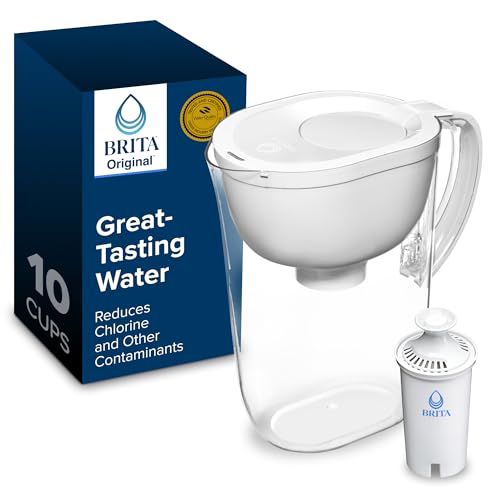
1. Brita Large 10 Cup Water Filter Pitcher, Includes 1 Filter, Bright White
Our pick — over 4.5★ from 60,000+ verified ratings; the strongest balance of quality and price.
The fridge pitcher that turns tap water drinkable without you thinking about it.
The Brita Large 10 Cup is the crowd favourite for a reason: it just works, consistently, without fuss. It holds 10 cups of water — enough to fill three 24-ounce reusable bottles before you need to refill. The locking lid makes filling easy and the whole pitcher fits neatly on a refrigerator shelf at 10.7″ long, 5.4″ wide, and 10.1″ high. Compared to the ZeroWater 10-Cup, the Brita is 5.93″ narrower at the base and 0.9″ shorter, which matters when your fridge shelf is already packed. What wins people over is the taste — water comes out clean and fresh, free of the chlorine edge that makes plain tap water hard to drink.
The filter lasts 40 gallons, or roughly every 2 months, and the system is compatible with both Longlast and Standard cartridges. The Longlast filter stretches that to 120 gallons or about 6 months, which cuts down how often you’re ordering replacements. It’s WQA and NSF/ANSI certified for reducing chlorine, mercury, copper, zinc, and cadmium. One practical note: the water reservoir and lid design may vary depending on the batch you receive, so don’t be surprised if the lid looks slightly different from a friend’s.
The recurring gripe is durability — some pitchers develop cracks or a handle that breaks off over time. Treat the handle gently and you’re unlikely to run into it.
What buyers keep coming back for
- Water tastes clean and free of chlorine — the thing people bring up most
- Easy-fill locking lid and a compact footprint that slides onto fridge shelves
- Filter swaps take seconds and cartridges are widely available everywhere
The honest trade-off
- Some units develop hairline cracks or handle wear over years of use
- The 10-cup body can feel heavy when full — refilling takes a bit of effort
Reach for this if: you want a reliable everyday fridge pitcher for one or two people that makes tap water taste good from day one.
Look elsewhere if: you need to strip dissolved minerals — that job belongs to a multi-stage system.
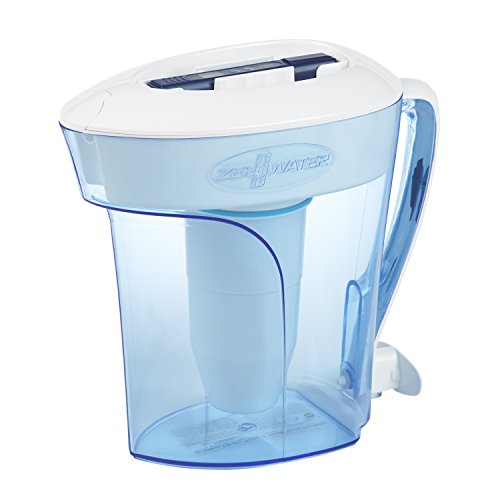
2. ZeroWater 10-Cup Pitcher Water Filter Removes PFOA/PFAS
A five-stage filter that reads your water on the spot and pulls dissolved solids down to near zero.
ZeroWater takes a different approach to the Brita above. Instead of just improving taste, its 5-Stage Ion Exchange Filter removes virtually all dissolved solids — the dissolved metals, minerals, salts, and ions that a standard carbon filter leaves behind. The kit ships with a TDS meter so you can test your water before and after and see the reading drop. In hard-water areas, users describe their tap water at several hundred parts per million dropping to near zero after filtering. It’s IAPMO certified to reduce PFOA/PFOS, lead, chromium, and mercury, and everything is BPA-free.
The “crisp, clean” flavour here is unmistakable — water comes out tasting soft and stripped of the metallic or rubbery edge some municipal supplies carry. Coffee and ice especially benefit. Owners chasing purity for drinking and ice describe it as the cleanest-tasting option they’ve tried, and the built-in meter takes the guesswork out of when to change the cartridge.
The catch is filter life. Because the filter works so hard on high-TDS water, cartridges deplete faster in hard water areas, and some buyers report them going off in weeks rather than months. You need to weigh that ongoing cost against the purity. The pitcher is also top-heavy when full, so handle it carefully when pouring.
Where it wins: if your goal is to reduce dissolved solids to near zero, no pitcher in this roundup comes close — the included meter lets you verify it yourself.
What to budget for: filter replacements come around more often than on a simple carbon pitcher, so factor that into the total cost of ownership.
Best suited to: anyone who wants measurable proof their filter is working and doesn’t mind replacing cartridges more often.
Consider something gentler if: you’re on a tight replacement budget or prefer to keep beneficial minerals in your water.
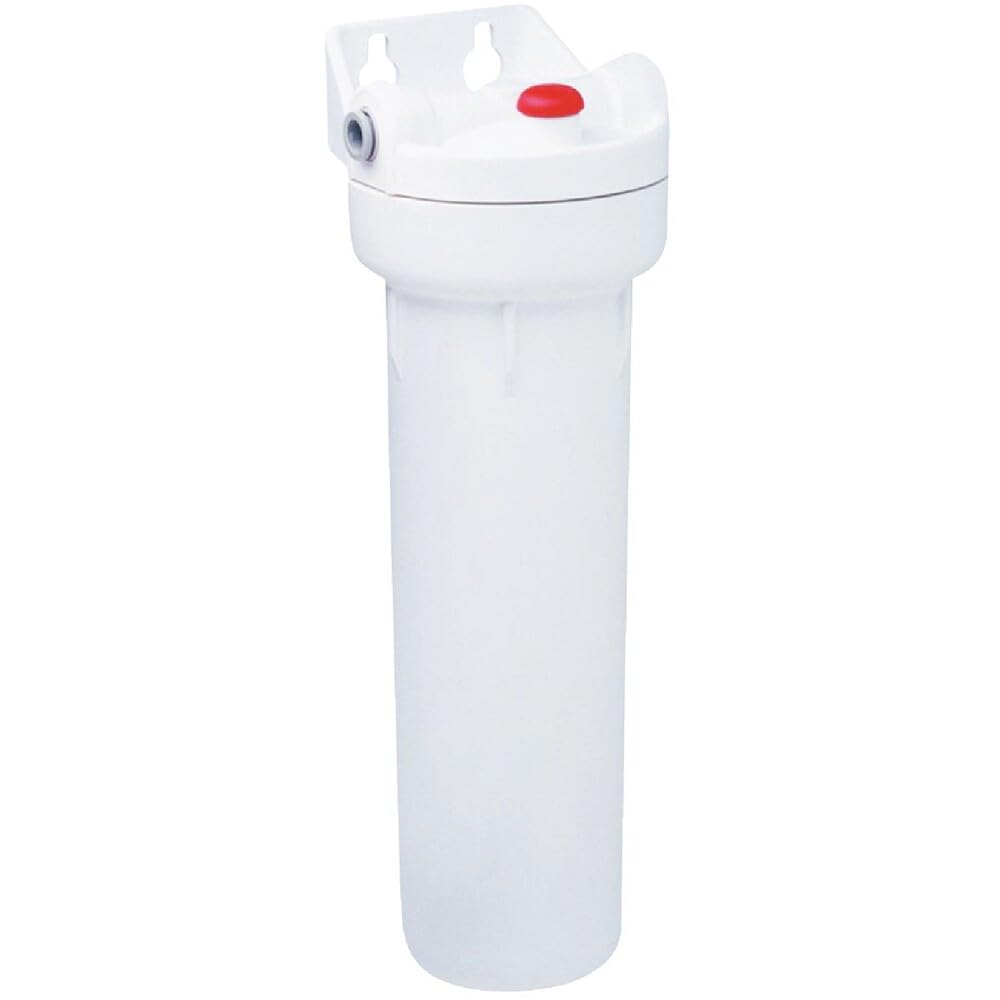
3. Culligan Under Sink Water Filter System – Existing Faucet, Filter Included
Filters your existing kitchen faucet from a hidden unit, no second tap and no drilling.
Most people shopping for cleaner water expect a pitcher. This Culligan unit lives under the sink instead and connects straight to your existing cold water line on a 3/8″ fitting — no second faucet, no hole cut in your countertop. It ships with everything you need to install it: a D-20A cartridge, mounting bracket, tubing, quick-connect elbows, and a housing wrench. The D-20A filters up to 1,000 gallons or about 12 months, depending on your usage.
What stands out is how invisible it becomes. Because it treats all cold water on the line, you get filtered water every time you turn on the tap — no pitcher to refill, no jug in the fridge. The filtration is IAPMO certified to NSF/ANSI Standard 42 for chlorine taste and odour, and it knocks out the pool-water note that ruins a glass of tap water. It also takes both the D-20A and the higher-tier D-40A cartridge, so you can step up to lead, mercury, and asbestos reduction later without changing the housing.
The honest trade-off: installation isn’t plug-and-play for everyone. Owners mention push-connect fittings need firm insertion until they click, and the included tubing is short, so factoring a small hardware run into your plan is sensible. Some also mention a broken upper flange appearing after several years of use.
Why it earns its spot
- Filters cold water at the source — every pour is clean without you lifting a pitcher
- Compatible with both D-20A and D-40A cartridges, so you can upgrade filtration later
- Fits behind the cabinet out of sight and doesn’t slow your water pressure noticeably
Before you commit
- Push-connect fittings need careful seating — an initial drip means it’s not fully in
- The included tubing runs short, so a quick trip for extra line is often needed
The right call for: anyone with basic DIY skills who wants filtered water from the sink without a countertop unit taking up room.
Pass on it if: you’d rather not touch plumbing under the cabinet — a pitcher skips the install entirely.
4. AQUA CREST FQK1R, GXULQR Water Filter Replacement for GE FQK1R, GXULQR

A drop-in cartridge for GE owners who want the same clean water for less per gallon.
This is a replacement cartridge, not a full system — it slots into GE GXK140TNN and GXULQK filtration systems as a stand-in for the GXULQR and FQK1R filters. Its natural coconut carbon block cuts 99.5% of chlorine, bad taste, odour, sediment, and rust, and it’s IAPMO R&T certified to NSF/ANSI 42 and 372. The housing is food-grade plastic that won’t leach BPA, and it’s lead-free. Filter life runs to 2,000 gallons or about 6 months, whichever comes first.
The flow stays steady — no obvious pressure drops, so you’re not stuck waiting for a slow trickle at the tap. For refrigerator and sink setups, it’s a sensible refill choice.
Fitting is where you need to pay attention. This cartridge is designed for the hexagon-head GE GXULQR, not the pentagon-head version, so check your old filter’s joint before ordering. Even with the right head, the connection sometimes needs firm upward pressure before it twists into place — a few owners describe it taking real effort, and at least one conversion went wrong on a mismatched housing.
The value story: if you already run a compatible GE system, this delivers the same taste and chlorine reduction for a lower per-cartridge outlay.
The one check to make: confirm your existing filter is the hexagon-head type, because the pentagon version won’t accept this cartridge.
Made for: GE GXK140TNN and GXULQK owners who want an affordable, certified refill without switching systems.
Not your pick if: your system uses the pentagon-head filter — this cartridge simply won’t seat.
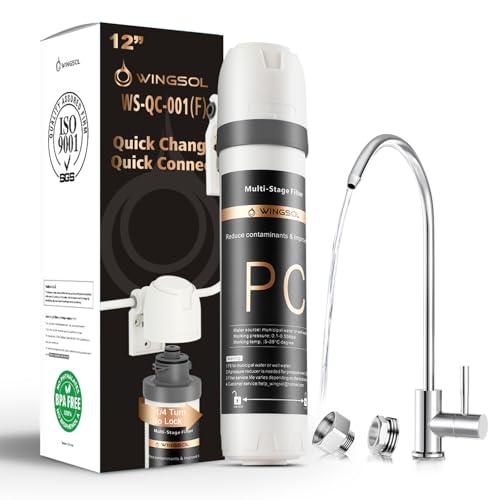
5. WINGSOL Under Sink Water Filter System with Chrome Faucet
Under-sink filtration with a dedicated chrome tap and water that pours as fast as you turn the handle.
Where the Culligan above filters through your existing tap, the WINGSOL gives you its own dedicated faucet — and a fast one. It delivers up to 2.5 GPM at 60 psi, filling a cup in seconds rather than the slow drip you get from many gravity and pitcher systems. The compact housing tucks away undersink, and the multi-stage filter is certified to NSF/ANSI 42 and 53, reducing PFAS, PFOA/PFOS, chlorine, heavy metals, nitrate, sand, and sediment. The filter life runs to 8,000 gallons or 12 months, which is the longest interval in this roundup next to the Purewell.
The chrome faucet swivels 360 degrees and fits both steel and thick stone sinks, so filling a stockpot is easy. The anti-clog pleated filter design keeps flow consistent between changes. What owners talk about most is how quick the install is — most describe it ready in about 30 minutes with basic tools, no plumber needed. The water tastes clean and chemical-free, and the unit disappears under the counter so your kitchen looks the same.
One honest note: the included plastic valve adapters aren’t the strongest. A few installs needed a swap to better hardware when an O-ring wouldn’t seat. Running the connection directly inline with the faucet fittings solves it.
The reasons to install one
- Fast 2.5 GPM flow at 60 psi — no waiting for slow filtration
- Certified to NSF/ANSI 42 and 53, catching PFAS and heavy metals
- Quick 5-minute install with 1/2″-3/8″ converters and no plumber needed
What to watch
- The included plastic adapters can leak if the O-ring isn’t seated — swapping them out solves it
- It doesn’t reduce TDS — it keeps beneficial minerals instead
Install this if: you want hidden, high-flow filtered water with a dedicated tap and a year between filter changes.
Think twice if: you’re specifically trying to strip TDS, since this system deliberately retains minerals.
6. Clearly Filtered Water Filter Pitcher Replacement, 1 Count
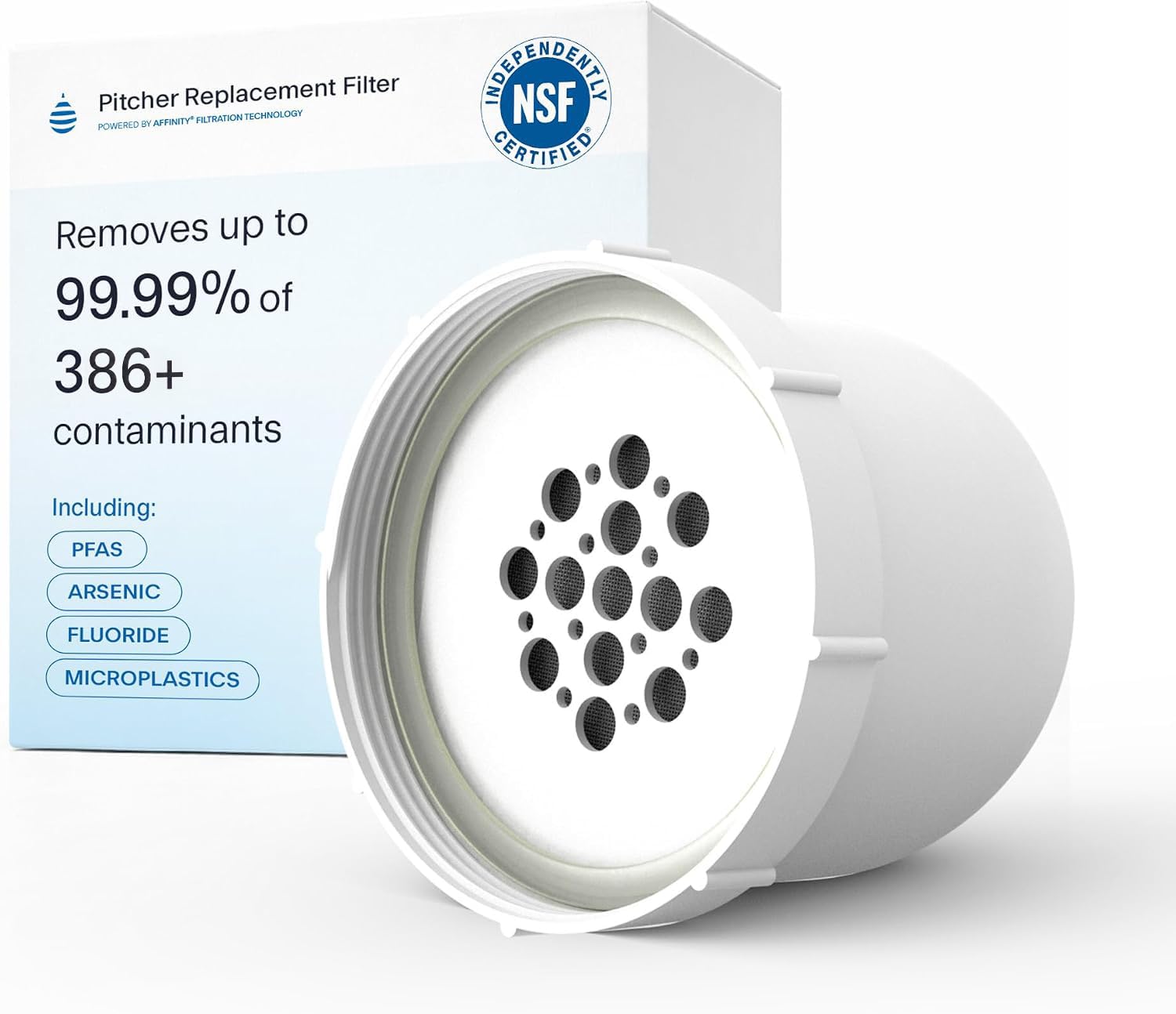
A pitcher cartridge that goes after 386+ contaminants while leaving your minerals alone.
Clearly Filtered’s claim to fame is the sheer list of what it targets. Its proprietary system targets up to 99.9% of 386+ contaminants — fluoride, lead, BPA, PFAS/PFOA, HAA5, arsenic, microplastics, perchlorate — while leaving beneficial minerals in. The cartridge is made from medical-grade, BPA-free recycled plastic and is certified to NSF/ANSI 42 and 372. Each filter lasts 100 gallons, or roughly 200 pitcher refills (about 4 months).
For households worried about specific contaminants — fluoride and lead especially — this is the broadest safety net in the pitcher category. Owners rate the taste highly and describe flushing and swapping the cartridge as straightforward, fitting the Clearly Filtered pitcher without hassle. The brand also publishes its third-party test results openly, which is a real point in its favour if you want to see the numbers behind the claims.
The trade-offs are predictable. Filtering speed is on the slow side, so don’t expect to fill a large bottle in seconds. And it sits at the premium end of the pitcher-cartridge category, so those replacement costs add up over a year. If speed and low running cost are your priorities, a simpler carbon pitcher serves you better.
Why pay more here: no other pitcher in this roundup carries a 386+ contaminant target list with NSF certification and openly published test data.
What you’re trading away: filtering takes its time, and the cartridges cost more per gallon than a basic carbon option.
The obvious fit for: households with known contaminants like fluoride or lead who want the widest removal list a pitcher can offer.
Better served elsewhere if: you measure value in speed and cheap refills rather than breadth of filtration.
7. Epic Water Filters Pure Filter Pitcher, 10 Cup 150 Gallon Filter
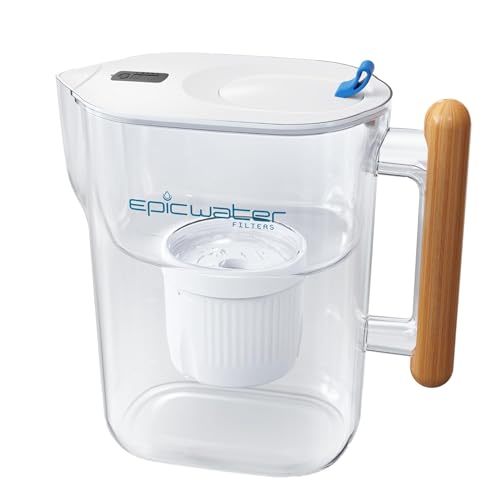
A 10-cup pitcher built around a 150-gallon carbon block that keeps minerals in and contaminants out.
The Pure Pitcher’s headline is its filter life. The 6mm-thick solid carbon block is rated for 150 gallons — far longer between swaps than a standard pitcher filter — and it’s designed to remove fluoride, lead, chlorine, and forever chemicals like PFOA, PFOS, and PFC. It’s tested against NSF/ANSI standards 42, 53, 401, and P473. The 10-cup body is made from Tritan, is 100% BPA-free, and has a smart filter media that keeps healthy trace minerals such as calcium and magnesium in your water. There’s an LED timer integrated into the lid that counts down from 90 days as a nudge to change the filter.
There’s also a 90-day filter life cycle alongside the 150-gallon rating, so in practice the timer and the volume rarely finish together. It suits families who want fewer filter changes, better-tasting water, and minerals kept intact rather than stripped to zero.
The honest catch is quality control. Some owners find it the best pitcher they’ve owned in decades, with a lid that stays secure and a solid feel. Others describe the lid coming off too easily during pouring, causing unfiltered water to spill, and a filter that wears out faster than the 90-day cycle suggests. It sits at the premium end of the pitcher category, so the higher initial outlay is only worth it if the long filter rating holds up for you.
Where it genuinely delivers
- 150-gallon filter life means fewer replacements through the year
- Tested against four NSF/ANSI standards including P473 for PFOA/PFOS
- Keeps trace minerals like calcium and magnesium in the water
Where experiences split
- Lid design is the weak point — some pour spills when it lifts unexpectedly
- Filter wear varies; some cartridges don’t reach the 90-day mark
The one to grab if: you want a long-rated filter that keeps minerals in your water and don’t mind paying premium for it.
Think carefully if: you want a pitcher with a lock-tight lid you can pour one-handed — this one needs a steady hand.
8. Purewell 2.25G Gravity Water Filter System with Water Level Window

A no-electricity stainless tank that filters as water trickles down, no plumbing and no plug.
If your kitchen goes through a lot of water, this is the jump up from pitcher life. The Purewell holds 2.25 gallons and works entirely on gravity — no electricity, no installation into your plumbing. You fill the top chamber with tap water and it drips down through a composite filter into a lower chamber with a spigot. The 3-stage filtration uses a 0.01-micron hollow fibre UF membrane, a silver ion membrane, and an activated carbon block to reduce chlorine and intercept rust, sediment, organic matter, and heavy metals. A transparent water-level window lets you see how much you have left without opening the lid.
The two included black carbon filters give up to 6,000 gallons total, with each element rated for up to 3,000 gallons. Owners love the taste — water comes out crisp and free of the chlorine note that hangs around municipal supplies, which is why families using it for coffee, tea, and ice rate it highly. It’s a genuinely durable-feeling stainless unit, and with no power requirement it works as well on a countertop as it does off-grid.
The honest notes: filtration is slow by design — you won’t be filling bottles instantly — and the water can taste slightly flat compared with bottled spring water. The silicone washers come with vague instructions, which slows the first assembly a little. And a handful of customers note leakage issues, so seating the washers properly at setup matters.
Why it stands out: 6,000 gallons of filtration across the two included filters, all without ever plugging it in or touching your plumbing.
The part to plan around: gravity-fed systems are slow, and the instructions for the silicone washers leave you guessing at first.
The right size for: families and larger households who want a countertop tank that keeps hundreds of gallons of clean water flowing without electricity or installation.
Stick with a pitcher if: you want fast pours or a system you can tuck into the fridge.
Understanding the Specs
Filter Life Rated in Gallons
The gallon number on a filter tells you how much clean water it makes before you swap the cartridge — a 100-gallon pitcher filter runs through a few hundred refills, while a 2,000-gallon under-sink cartridge stretches to around 6 months. Be realistic: hard water with high mineral content clogs a cartridge faster than soft water, so a 2,000-gallon rating often means fewer gallons in practice. Match the rating to your household’s daily water use to estimate how often you’ll reorder.
What TDS Means For Your Water
TDS stands for Total Dissolved Solids — the minerals, salts, metals, and ions suspended in your water. A reverse-osmosis-style or ion-exchange filter can pull TDS down toward zero, while standard carbon filters keep dissolved solids in the water. Neither approach is wrong; they solve different problems. A TDS meter tells you the dissolved-solid level but is not a reliable standalone measure of water quality, so treat it as one piece of information rather than a verdict.
NSF/ANSI Certifications Explained
NSF/ANSI 42 covers taste and odour reduction (mostly chlorine). Standard 53 covers health-related contaminants such as lead and some metals. Standard 372 confirms the materials are lead-free. If a filter reduces PFAS, look for it listed explicitly on the certification rather than assuming it’s covered. A filter carrying 42 and 372 covers chlorine taste and odour plus lead-free materials — the baseline for daily drinking water.
Flow Rate and Filtration Speed
Under-sink systems rated at 2.5 GPM fill a glass in seconds, while gravity and pitcher filters can take minutes per cycle. Faster flow usually means you’re getting water the moment you want it, but it doesn’t automatically mean better filtration. Gravity systems trade speed for simplicity and no electrical hookup, while pressurised under-sink units give you both speed and dedicated-faucet convenience. Match the flow rate to how much water you actually pour in a day.
FAQ
Will the Brita Large pitcher fit on my fridge shelf?
Does the ZeroWater pitcher remove minerals I want to keep?
Why does my filter run out faster than the rated gallons?
Is an under-sink filter better than a pitcher?
What is the difference between NSF/ANSI 42, 53, and 372?
Does the WINGSOL under-sink filter reduce TDS?
How long does a water filter cartridge actually last?
Can I use the AQUA CREST WF28 in any GE water filter system?
Is the Purewell gravity system worth it over a pitcher?
Do water filters remove fluoride?
Final Thoughts: The Verdict
Rated 4.6 stars by 60,000+ owners, the Brita Large 10 Cup Pitcher is the sensible everyday pick for one or two people who just want tap water that tastes clean without any installation. If dissolved solids are your concern, the ZeroWater 10-Cup Pitcher gives you measurable purity and a built-in meter to prove it works. And if you’d rather never lift a pitcher again, the fast-flowing WINGSOL Under Sink System is the one to reach for — it hides beneath the counter and pours at 2.5 GPM.
How We Picked
We do not accept paid placement. Every pick is matched to a real buyer and a real use-case; we do not hands-on test units.
Sources & Methodology
Specifications: manufacturer listings and product documentation. Review insights: verified customer reviews, as of September 2026. Pricing: not shown on this page (it changes often); check the current price via the retailer link.
As an Amazon Associate, Gadgets Feed earns from qualifying purchases. This does not affect which products we feature.