
Our readers keep the lights on and my morning glass full of iced black tea. As an Amazon Associate, I earn from qualifying purchases.
Specs are compiled from manufacturer listings and verified buyer reviews and can change over time — please confirm the key details on the product page before buying.
You buy earphones for “great sound” and end up with muddy bass and buried vocals. The fix depends on one part: the driver inside. A single dynamic driver (a moving coil attached to a diaphragm) pushes air like a tiny speaker cone. A balanced armature driver (a tiny reed vibrating inside a coil) works more like a precision tuning fork. This guide skips the driver-count marketing and names nine wired and wireless earphones that deliver the clarity, separation, and balance audiophiles chase.
I’m Min — the founder and writer behind Gadgets Feed. This guide is built by comparing the manufacturers’ published specifications and the patterns across verified customer reviews, so you get each pick’s real strengths and trade-offs instead of marketing spin.
You will learn how driver type, impedance, and frequency range shape what you hear, and how to match a pair to your source gear. By the end, you will know which of these audio quality earphones fits your ears and your listening habits.
Our Picks at a Glance


How To Choose The Best Audio Quality Earphones
Sound quality is not one thing. It is a stack of choices: the driver inside the shell, how well it seals your ear canal, and how much power your phone or player can push into it. Get those three right and a modest pair can beat a pricier one that fights your setup.
Driver Type: The Engine Under The Hood
A dynamic driver (a moving coil attached to a diaphragm) moves air like a small speaker cone, giving you natural warmth and physical bass. A balanced armature driver (a tiny reed that vibrates inside a coil) is more precise and efficient, which is why it dominates detail and vocal clarity. Planar magnetic drivers (a flat diaphragm driven by a magnetic field) split the difference with speed and low distortion. Hybrid designs combine types to cover the full range. None is automatically better — each has a personality, and the tuning matters as much as the technology.
Impedance And Sensitivity: Can Your Phone Drive Them?
Low-impedance earphones are easy to drive from a phone or laptop headphone jack. Higher-impedance models need more voltage and often benefit from a dedicated amplifier or DAC. Balanced armature models can be extremely sensitive, meaning they get loud easily but may pick up hiss from noisy sources. If you plan to plug straight into a phone, favor lower impedance and moderate sensitivity. If you run a desktop setup or portable DAC, you have more freedom.
Fit And Isolation: Where Half The Sound Quality Lives
A loose ear tip leaks bass and lets outside noise in, which forces you to turn the volume up. Deep-sealing tips raise both fidelity and isolation at the same time. This is why the same earphones can sound thin to one person and rich to another. Before judging any pair, try all three or four tip sizes, and experiment with the two nozzle types some models include. Small ears may need smaller tips; large canals often want the largest flange for a full seal.
Quick Comparison
| Model | Best For | Driver Type | Frequency Range | Connectivity | Amazon |
|---|---|---|---|---|---|
| Fosi Audio IM4 Open-Back IEM★ Best Overall | Open, airy listening and gaming | 10mm Dynamic | 20Hz – 20,000Hz | Wired 3.5mm | Amazon |
| Linsoul KZ AS16 Pro 16BABest Value | All-BA detail at a low entry | Balanced Armature (8 per side) | 20Hz – 40,000Hz | Wired | Amazon |
| KZ ZAR 7BA+1DDBest For Musicians | Musicians and stage monitoring | Hybrid (7BA + 1DD) | — | Wired | Amazon |
| Letshuoer S12 Ultra | Planar detail on a mid-range buy | 14.8mm Planar | 20Hz – 20,000Hz | Wired 3.5mm / 4.4mm | Amazon |
| Etymotic ER4XR | Deep-seal reference accuracy | Single Balanced Armature | — | Wired | Amazon |
| Linsoul THIEAUDIO Hype 4 | Portable studio monitoring | Hybrid (2DD + 4BA) | — | Wired | Amazon |
| Bowers & Wilkins Pi8 | Premium wireless with a streaming case | 12mm Carbon Cone | — | Bluetooth 5.2 | Amazon |
| Shure SE846 Gen 2 | Tunable pro-grade monitoring | Quad Balanced Armature | — | Wired | Amazon |
| Technics EAH-TZ700 | Reference listening for critical ears | 10mm Dynamic | — | Wired (balanced + unbalanced) | Amazon |
In‑Depth Reviews
1. Fosi Audio IM4 Open-Back IEM Wired Earbuds
Our pick — over 4.5★ from 200+ verified ratings; the strongest balance of quality and price.
The open-back bud that lets your music breathe instead of boxing it in.
Spend hours at a desk mixing, gaming, or just listening, and an open-back design (earcups that let air escape) spreads sound out in front of you instead of inside your skull. The IM4 earns its spot with a 10mm beryllium-coated diaphragm — a rigid metal-coated driver that stays controlled when the music gets busy — plus a dual-chamber structure and an N52 dual-magnet circuit that keeps bass natural instead of bloated. The payoff is a wide, airy presentation where each instrument sits in its own space, so vocals never feel crammed against your eardrums. Buyers report the soundstage is what wins them over.
At 7g per bud with a full-aluminum alloy shell, these barely register after the first few minutes. The housing is CNC-machined and sand-blasted for a smooth finish that feels far more expensive than the price tag suggests. A large ear-shape database guided the fit, so they sit naturally even for smaller ears. You can also fine-tune the tuning with three sets of ear tips across three sizes — balanced, bass, and deep-bass — plus two nozzle types in brass and aluminum alloy. Swapping the nozzles moves the treble and bass balance, which means you can dial in brightness or warmth without an equalizer.
Not everyone hears them the same way. The balance gets honest disagreement — some listeners call them spot-on, others find the tips have too much treble, so start with the bass tips if you want more low end. A few owners also wished for better imaging at this price. Want an even more open, speaker-like feel without the treble edge? Reach for the brass nozzles first. They also make a strong companion for gaming and video where the spaciousness of an open back genuinely helps you place sounds.
The case for these
- Wide, airy soundstage that spreads instruments out instead of cramming them together
- 7g-per-bud aluminum shell stays comfortable for hours
- Three tip sets and two nozzle types let you tune the sound without an app
- Detachable 2-Pin 0.78mm connectors let you swap in a cable of your choice
Where they pinch
- Bass is clean and tight rather than deep — not a basshead’s pick
- Open-back mesh lets sound both in and out, so they leak and don’t block noise
- Treble can feel bright with the balanced tips, so try the bass tips first
Grab these if: you want a fatigue-free, wide-open listen for long sessions at a desk and value tuning options over thumping bass.
Then again: for commutes or noisy offices, their open design lets everything through — a sealed, isolating pair will serve you better.
2. Linsoul KZ AS16 Pro 16BA Balanced Armature Wired Earbuds
Eight balanced armature drivers per side for the price of a cheap pair of earbuds.
Here is a number that changes the conversation: eight balanced armature drivers in each ear. Four 31736 high-frequency units handle the top end, two 29689 mid-frequency units keep vocals and instruments distinct, and a 22955 low-frequency unit adds the mellow bottom. Because the drivers cover low, mid, and high separately, the crossover stays smooth instead of blurring where one driver hands off to the next. The frequency response climbs all the way to 40kHz — well past what most people hear but a sign the treble has room to extend cleanly.
Detail is the selling point here: eight armatures per side keep vocals and cymbals separated even on dense tracks. A three-channel conduit structure with electronic frequency division pushes air through each channel at a calculated rate, so nothing smears. The metal-inlaid resin shell adds a bit of visual flair without bulking up the weight. The AS16 Pro’s passive noise cancellation reaches beyond 26dB, which is modest next to the KZ ZAR’s 35dB, so if you play loud stages or ride noisy trains, the ZAR holds the edge on blocking sound.
The catch is the stock ear tips. They run uncomfortable, and swapping to aftermarket foam or a different-silicone tip tightens the fit and bass considerably. A closed-back shell also keeps the stage narrow, so don’t expect the expansive feel of the open-back IM4. In practice the tuning leans bright and detailed; if you want a big, thumping low end, look elsewhere.
What you actually hear: crisp separation and extension you would normally pay far more for, as a working drummer found these outplay well-known name brands at a fraction of the cost.
One thing to plan for: budget a few dollars for replacement tips — the included set is the most-complained-about part of the package.
the balance: a listener chasing maximum detail and driver count on a tight budget, especially for critical listening or band practice. skip it if you need noise isolation on a commute — the open-back design lets outside sound in.
Pass on these if: you want deep, room-shaking bass or a wide open soundstage — a hybrid or open-back design will satisfy you more.
3. KZ ZAR in-Ear Monitor 7BA+1DD Wired Earbuds
A stage-ready monitor that shuts out the room so you hear only your mix.
Play live or mix on the move, and isolation stops being a bonus and becomes the point. The ZAR’s hybrid design pairs seven balanced armature drivers with a single 10mm dynamic driver, and its physical seal blocks up to 35dB of outside noise — the strongest in this lineup, well ahead of the 26dB rating on the KZ AS16 Pro. On a loud stage or a roaring train, that means you keep the volume low and hear the details instead of fighting the room. The hybrid layout gives you the dynamic driver’s physical low end plus the armatures’ pinpoint highs, so bass has weight while vocals stay articulate.
The aluminum billet shells are milled precisely and, despite carrying more drivers than the ZS10 Pro, the ZAR weighs less. The aluminum billet shells are milled precisely, and despite carrying more drivers than the ZS10 Pro, the ZAR weighs less — no small feat when you wear them for hours. An 8-strand high-definition cable resists wear and tangling, and the 2-pin detachable connectors mean you can replace or upgrade the cord without replacing the earphones. Latency sits at just 0.01 milliseconds, which is negligible enough for live monitoring or gaming where every beat needs to line up.
Here is the honest trade-off: fit and comfort split buyers right down the middle. Some get a secure, painless seal; others find the shells press or fall short of a comfortable grip, and the cable can feel short on stage. A quick tip rotation often fixes pressure, and trying the medium silicone tips is the first move if the seal feels off. Treble also leans slightly subdued, so EQ helps if you like extra sparkle.
Why it works: the sound quality is what pulls people in — this hybrid plays with detail and imaging well beyond its class, and musicians in this bracket treat it as a genuine step up.
If fit fights you: half the complaints are about shell pressure or cable length, so order with an eye on trying a couple of tip sizes right away.
Made for the stage: musicians, drummers, and anyone who needs to silence a loud room and hear their own mix with reliable detail.
Better choices exist if: you have very small ear canals and prefer a featherweight fit — the lighter IM4 or a low-profile design will sit easier.
4. Letshuoer S12 Ultra 14.8mm Planar Driver IEM

Planar-magnetic speed that teases apart even the busiest tracks.
Planar magnetic drivers are prized for their speed: a flat diaphragm moves almost instantly, so fast drum fills and busy passages stay distinct instead of smearing together. The S12 Ultra’s 14.8mm planar driver leans on that speed to deliver airy highs and tight, precise bass. Owners describe a deep, vast soundstage and excellent instrument separation, with treble that stays detailed without the metallic edge that ruins some planar designs. It is a genuinely layered listen — the kind where you catch a backing vocal you missed a hundred times before.
Two connectors stand out in daily use. The housing rotates on 3.5mm and 4.4mm interchangeable plugs, so the same earphones work with a phone dongle and a balanced desktop amp. Better still, the box includes a DT01 Pro 3.5mm-to-Type-C DAC amplifier cable, meaning you can plug straight into a phone’s USB-C port without buying extra gear. A 392-core silver-plated copper cable keeps the signal clean and lets micro-details through. The metal-and-high-quality-plastic housing has a matte finish that users call out for looking sharp.
The one real compromise is sensitivity. These planars need a bit more drive than a balanced-armature set, so a clean dongle or amp brings out their best while a weak source leaves them sounding flat. There is also a genuine wear note: some units lose their gunmetal paint at the corners over a couple of months, revealing the silver underneath. Mids can also lean scooped with the balanced tips — the small vocal tips reshape them into something more even.
The strength to lean on: sound quality leads everything here, and the broad consensus is that these planars punch well past their price for detail and staging.
Small heads-up: the stock balanced tips can sound bright and hollow, so swap to the vocal tips before you form an opinion.
A strong call for: anyone who wants planar detail and a 4.4mm balanced option with source gear to match.
Think twice if: you only listen from a bare phone jack — the lower sensitivity means a basic source won’t reveal what these can do.
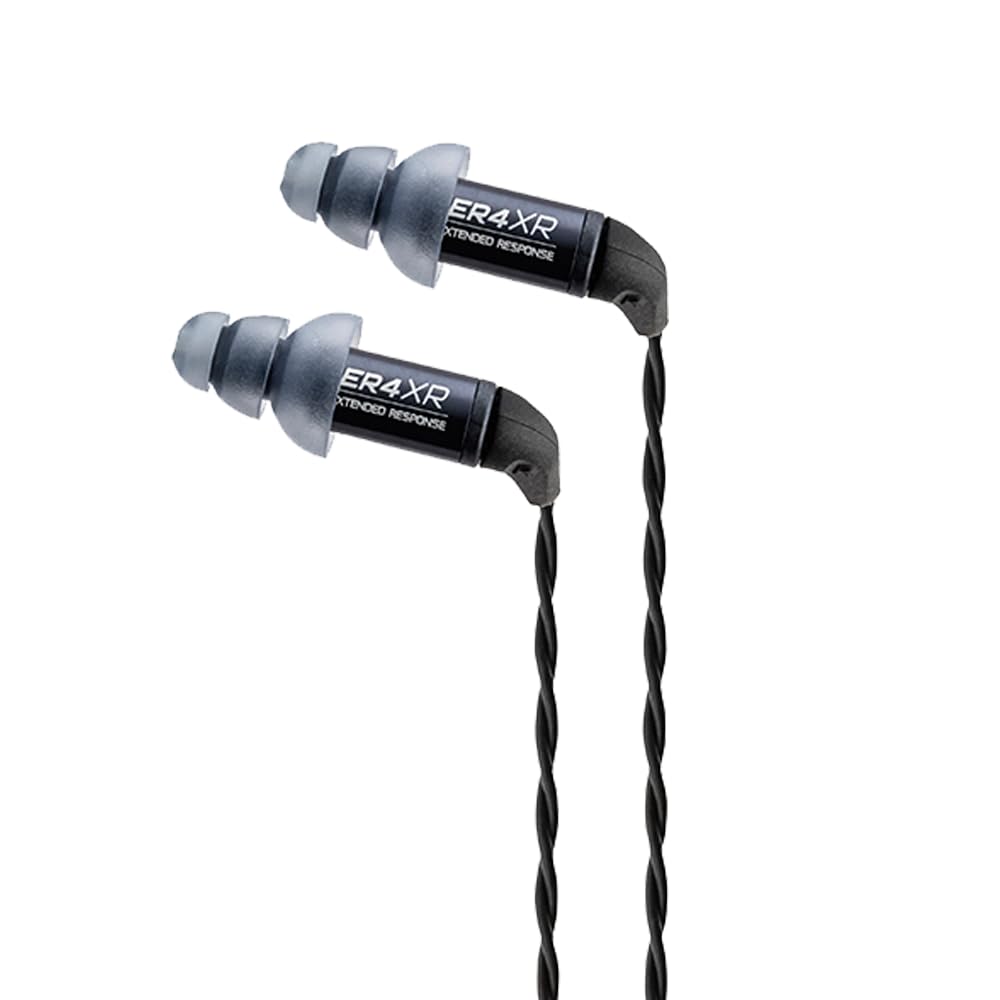
5. Etymotic ER4XR Extended Response Earphone
The deep-fit reference pair that turns the world down to a whisper.
Etymotic built its name on hearing accuracy and the ER4XR shows why. A single balanced armature per channel is precision-matched to within 1 dB, which is the tight tolerance that keeps left and right channels identical so imaging stays stable. Passive isolation ratings reach 35–42dB with a max output of 122 dB — enough that many owners compare it favorably to active noise cancellation without needing to charge a battery. They are wired and battery-free, so you plug them in, and they simply work.
The tuning is deliberately reference-flavored: flat mids and highs, with a touch more low-end presence than the standard ER4. Owners describe detailed, smooth, natural vocals and a treble bite that stays honest instead of bright. Voices and instruments sit distinctly apart. The anodized aluminum body with laser-etched detailing and a braided reinforced 5ft detachable cable with custom MMCX connectors feels built to survive real use. Replacement filters are included to keep earwax off the driver — a small detail that protects the sound over the long haul.
This is not a casual-listen pair, and the physics are the reason. The deep-canal fit reaches well inside the ear, so they arrive feeling unusual and can take days to adapt to. After a year, one owner’s cable wore through where it was stressed — treat the cable gently and the seal, and they last. Bass is present only when the seal is right; moisten the tips and adjust for the deep fit, and the low end fills in. If you want a thumping, roomy presentation, a hybrid or dynamic design suits you better.
Why it earns its spot: sound quality is the anchor — accurate, revealing, and remarkably clean across the whole range.
Be ready to adapt: the deep insertion is a skill you build over the first week, so give them real time before you judge the comfort.
Ideal for the precision seeker: someone who wants reference accuracy, rock-solid channel matching, and the deepest isolation here.
Not the pick for you if: you dislike deep-seated ear tips or want generous, punchy bass from the start.
6. Linsoul THIEAUDIO Hype 4 2DD+4BA in-Ear Monitor

A portable studio monitor with sub-bass so controlled it feels engineered, not tuned.
What sets the Hype 4 apart is the IMPACT2 subwoofer — two 10mm composite diaphragm drivers in an isobaric arrangement, which means they run in tandem inside a sealed chamber to keep the bass powerful yet stable. The result is a sub-bass that stays deep and controlled rather than bloated. Sonion’s E50 “Hummingbird” dual tweeter armature handles the top end, and a stacked 26A mid driver keeps vocals thick and layered. This is a hybrid engineered for people who mix, game, or study music closely enough that small tuning shifts matter.
The tuning follows the THIEAUDIO house sound built from models like the Monarch MKII: a strong sub-bass presence that cuts off around 200Hz, a flat midrange, and a gentle roll-off all the way to 20kHz. Vocals sit forward but never shouty, treble stays detailed without fatigue, and staging is wide enough to place instruments. A silver-plated OCC cable comes standard, adding a little clarity over the previous generation. Comfort is good, though the shells run large — fine ears may want a smaller shell like the S12 Ultra’s housing.
Two honest cautions. First, the bass shelf is generous enough that pure-neutral fans may find it too much, while treble reaches slightly higher than some prefer. Second, a small number of buyers reported driver failures and slow support, so treating them gently and buying from a solid seller pays off. If you want a bright, hyper-neutral tuning, the Etymotic ER4XR is a steadier reference; if you want a fuller sub-bass without losing clarity, this is where the Hype 4 shines.
Where it delivers: controlled, textured low end that keeps notes distinct instead of muddy, paired with clear, unstressed vocals.
Plan your accessories: the included tips are mediocre and the case is bulky, so a good set of aftermarket tips improves both comfort and seal.
Go for it if: you mix or listen critically and want a sub-bass-forward neutral monitor that doubles as a gaming earphone.
Look elsewhere if: you want a flat, bass-light reference or dislike a large shell pressing against the ear.
7. Bowers & Wilkins Pi8 Bluetooth Wireless Earbuds

Wireless buds with a case that streams lossless audio straight into your ears.
Most wireless earbuds stop at a solid Bluetooth signal. The Pi8 goes further: its charging case retransmits audio from a laptop, in-flight entertainment, or TV wirelessly, and it also takes USB-C and a 3.5mm jack input — handy when the source you want to hear has no Bluetooth at all. Its 12mm carbon cone drivers are adapted from Bowers & Wilkins Px8 headphones, and Qualcomm’s aptX Lossless and aptX Adaptive (codecs that carry high-resolution audio over Bluetooth) handle the transmission. If your listening lives on a phone or laptop, that combination is the real draw.
Fast charging keeps them usable: a 15-minute top-up gives 2 hours of playback, and the buds themselves run up to 8 hours per charge. Three built-in mics handle calls, while bespoke adaptive noise cancellation adjusts to your surroundings. The multipoint pairing lets them switch between two devices — phone and laptop, say — without re-pairing each time. The companion app streams directly from major services like TIDAL and Qobuz, and the earbuds feel light and comfortable enough that owners wear them for hours without soreness.
Where the Pi8 earns criticism is consistency. Comfort lands consistently well, but the audio and connection split opinion: some users find the sound and ANC solid, while others report dropped connections in crowded spaces and wish the cancellation were stronger. The app also frustrates by being slow to auto-connect and limited in its customization. If you value rock-solid wireless stability above all, keep expectations realistic — but if streaming lossless from a laptop or TV matters, few wireless options match this one.
The reason to buy: the retransmitting case turns any laptop or TV into a high-quality wireless source — a real convenience no wired pair can offer.
Set your expectations right: ANC is adequate rather than class-leading, and connectivity can flake in crowded areas, so a wired set still wins for pure reliability.
Right for the wireless-first listener: someone who wants premium sound without a cable and will use the case’s streaming to feed from a TV or laptop.
Skip if: you need the strongest noise cancellation or unwavering connection in a crowded commute — a wired pair sidesteps both issues.
8. Shure SE846 Gen 2 Sound Isolating Wired Earphones

Four drivers and swappable filters give you four different earphones in one shell.
Four precision drivers — two for low end, one for mids, one for highs — split the work so each handoff stays clean, delivering detailed highs, clear mids, and extended low response at the same time. What makes the Gen 2 unusual is the interchangeable sound-signature filters: pop in one set for balanced, another for warm, another for bright, and another for extended. You physically reshape the tuning instead of relying on an app, which matters for anyone who wants to match a sound to a genre or a mixing job.
Long-time Shure users hear the upgrade clearly. The sub-35Hz bass outperforms the brand’s own earlier models, mids and highs are more enjoyable, and the low-profile shell stays comfortable and secure enough for hours of monitoring or gaming. The detachable 3.5mm cable system means the cord is replaceable if it wears, and the sound-isolating sleeves cut outside noise while keeping the fit snug. Compared with the Etymotic ER4XR, this one leans warmer and fuller; the ER4XR stays leaner and more clinical, so the choice is really about taste.
The reality check is price and diminishing returns. This costs roughly double the next-most-expensive model here, and one honest owner bluntly says it’s “not worth.” A DJ found it perfect for studio work but too neutral for bass-heavy DJing. A few owners say the jump from a mid-range pair like the Etymotic ER4XR is smaller than the price gap suggests. Treat the SE846 as a long-haul investment for the tunable accuracy, not as a guaranteed night-and-day leap over every cheaper set.
The engineering story: quad drivers plus interchangeable nozzles deliver real tonal versatility without software.
Mind the source: these reward a balanced cable and an outboard DAC or amp, so plan the whole chain rather than just the earphones.
For the audiophile investor: someone who wants to tweak their sound signature physically and values a durable, serviceable flagship that lasts.
Choose differently if: you want the least expensive path to great sound — a mid-range pair like the Hype 4 or S12 Ultra gets you close for far less.
9. Technics EAH-TZ700 Premium in-Ear Monitors

A single 10mm driver with magnetic fluid technology chasing distortion-free purity.
The TZ700 takes a different road than multi-driver designs. It relies on one 10mm dynamic driver with an original diaphragm and magnetic fluid technology — magnetic fluid is a liquid that surrounds the voice-coil gap to damp unwanted vibration, which helps flatten distortion across the frequencies. An Air Control Chamber inside the housing precisely manages internal airflow, balancing the individual frequency bands. Owners describe sound that is natural and accurate, with cymbals and snare tones that ring true rather than bright or blurred.
Two included cables — one balanced, one unbalanced — plus MMCX connectors let you recable or match the TZ700 to your gear. Two sets of cables are included — one balanced and one unbalanced — so you can match the connection to your gear, and the MMCX connector lets you recable later. The graphite-black finish with knurled gold-plated MMCX terminals feels jewel-like, and both round and oval ear tips arrive in four sizes each, giving you a genuine range for comfort and seal. On a good DAC, listeners report more space and detail than colored competitors, and the tone stays neutral into the midrange.
The trade-offs are real and worth saying plainly. Some listeners still find the TZ700 needs a capable DAC or amplifier to shine — a bare phone can leave it feeling flat. One owner even felt it didn’t justify its premium against a rival that costs less. It is also a wired pair, so there is no wire-free convenience. If you want reference accuracy for vocal-heavy music like opera, this is its niche; if you want plug-and-play ease, a more sensitive set will suit you better.
Where it shines: a neutral, resolved midrange that keeps voices and instruments distinct, praised by owners for exactly that clarity.
Feed it well: the TZ700 wants a proper DAC or amp in front of it, so budget for the source, not just the earphones.
The top-tier terminal: critical listeners chasing neutral accuracy and premium build, especially for classical and vocal recordings.
Rethink it if: you want a bare phone to drive your earphones — the Etymotic ER4XR is easier to run and more forgiving.
Understanding the Specs
Driver Type and Count
A dynamic driver (a moving coil attached to a diaphragm) moves air like a small speaker, delivering natural bass weight. A balanced armature driver (a tiny reed vibrating inside a coil) is more precise and efficient, which is why it handles detail and vocals so well. Planar magnetic drivers (a flat diaphragm driven by a magnetic field) add speed and low distortion. Hybrid designs combine types — the KZ ZAR pairs seven balanced armature drivers with one dynamic driver, while the Hype 4 uses two dynamic subwoofers plus four armatures — so each type covers the frequency range it handles best. More drivers can mean more detail, but tuning matters just as much as the count.
Frequency Range, Impedance, and Isolation
Frequency range tells you the span of sound an earphone can reproduce — the KZ AS16 Pro reaches up to 40kHz, while the ER4XR focuses on measured accuracy within a tighter band. Wider range can signal cleaner treble extension, but it never guarantees better sound on its own. Impedance and sensitivity decide whether your phone can drive them well; low-impedance, sensitive models run loudly from a bare jack, while planars and higher-power models want a DAC or amp. Noise isolation in decibels — up to 35dB on the KZ ZAR and 35–42dB on the ER4XR — measures how much outside sound the seal blocks, which directly raises perceived fidelity because you can listen at lower volume.
FAQ
What driver type actually gives the best audio quality?
Do I need a DAC or amplifier to get good sound from wired earphones?
How much noise do wired earphones actually block?
Why do my earphones sound different from someone else’s review?
Are detachable cables worth the extra cost?
What does the noise-isolation rating in decibels mean for real listening?
Is a hybrid driver design better than a single driver?
Why do reviewers mention replacing the included ear tips?
Can I use wired in-ear monitors for gaming and calls on a phone?
How do wireless audiophile earbuds compare to wired in-ear monitors?
Final Thoughts: The Verdict
For most listeners, the audio quality earphones winner is the Fosi Audio IM4, because its open-back soundstage and tunable nozzles deliver an airy, fatigue-free listen that suits long sessions without any special gear. If you want maximum detail on a modest budget, reach for the Linsoul KZ AS16 Pro and its eight balanced armature drivers per side. And for anyone who needs to shut out a loud room on stage or on the move, the KZ ZAR is the one to reach for, with the strongest isolation and a hybrid tuning that keeps detail intact. Whatever your budget, start with the earphones whose driver type matches how you listen, then get the tip fit right — the sound quality follows the seal.
One last nudge before you commit: the Etymotic ER4XR and Technics EAH-TZ700 reward patience most, since both need a deep seal or a proper DAC before their accuracy shows. Seal the tips before you judge any of these nine, or you will hear leakage instead of the driver.
How We Picked
We do not accept paid placement. Every pick is matched to a real buyer and a real use-case; we do not hands-on test units.
Sources & Methodology
Specifications: manufacturer listings and product documentation. Review insights: verified customer reviews, as of September 2026. Pricing: not shown on this page (it changes often); check the current price via the retailer link.
As an Amazon Associate, Gadgets Feed earns from qualifying purchases. This does not affect which products we feature.