
Our readers keep the lights on and my morning glass full of iced black tea. As an Amazon Associate, I earn from qualifying purchases.
Specs are compiled from manufacturer listings and verified buyer reviews and can change over time — please confirm the key details on the product page before buying.
If you want the short answer: the JUGS PS50 is the machine to beat in this lineup. It throws both baseballs and softballs, hits speeds up to 50 mph, and holds the highest owner score of the group at 4.5 stars. Everything below explains who each of the other seven picks actually fits, and what you give up when you pick them.
I’m Min — the founder and writer behind Gadgets Feed. This guide is built by comparing the manufacturers’ published specifications and the patterns across verified customer reviews, so you get each pick’s real strengths and trade-offs instead of marketing spin.
You will see two very different machine families here: heavy steel wheel machines that fire real balls at real speeds, and spring-loaded trainers built for backyards and young kids. The trick is matching the machine to your player, not to the biggest spec number — which is why I wrote this around baseball softball pitching machine picks and the drills each one handles honestly. Read the speed range first, then the ball type, and the right machine picks itself.
Our Picks at a Glance


How To Choose The Best Baseball Softball Pitching Machine
The single biggest mistake buyers make is buying on brand name alone. Two machines from the same brand can behave completely differently depending on whether the ball is fed by hand or by an automatic feeder, and whether the throwing wheel is rubber or urethane.
Decide who is actually throwing
If your player is 12 or under, a 10-70 mph range covers everything they will ever face in a season, and the lower end of that range matters more than the top. Machines that start at 30 mph and climb are fine for Little League through travel ball. Machines that start at 45 mph are built for players who have already seen live pitching and need to sharpen reaction time.
Choose a feeder, not just a machine
An automatic ball feeder is the difference between hitting 20 balls in ten minutes and hitting 80. Machines that require you to hand-drop every ball into the chute force a parent or coach to stand next to the machine for the whole session. If you are running solo practice, put the feeder at the top of your must-have list.
Match the ball type before anything else
Some machines throw real leather baseballs and softballs without complaint. Others are calibrated only for the lighter balls the maker sells, and using anything else is explicitly called out as a warranty issue in their own documentation. If you already own a bucket of real game balls, check that your machine is designed for them before you buy.
Plan for where the machine sits
A 110-pound steel machine does not move around by itself. A 27-pound spring-loaded trainer can be picked up with one hand. If your practice field changes every week, or you have to get the machine in and out of a car, weight and the included transport kit are the specs that decide whether you actually use it or leave it in the garage.
Quick Comparison
| Model | Best For | Speed Range | Balls Thrown | Weight | Amazon |
|---|---|---|---|---|---|
| JUGS PS50★ Best Overall | All-around backyard and Little League practice | Up to 50 mph | Baseballs and softballs | 50 lb | Amazon |
| Franklin Sports Total PitcherLightest Option | Entry-level backyard reps with no power outlet | Spring-loaded, no motor | Baseballs, softballs, teeballs | 12.84 kg | Amazon |
| MOXOW Sagitta 3-in-1Best Bundle | Complete home setup with screen and caddy | Adjustable speed dial | Baseballs and softballs | 18.48 kg | Amazon |
| PowerNet Launch F-lite | Breaking-ball and fielding drills on the go | Calibrated wheel speed | Launch F-lite balls only | 13.45 kg | Amazon |
| Heater Sports Combo | High-volume team practice with feeder | Up to 60 mph | Baseballs and softballs | 70 lb | Amazon |
| Heater Blaze | Youth through travel ball, wide speed control | 10-70 mph | Baseballs and softballs | 55 lb | Amazon |
| BSN Sports Bulldog | Long cage sessions with an outlet nearby | 30-60 mph | Baseballs, 11″ and 12″ softballs | 50.6 lb | Amazon |
| Mound Yeti | Full fielding and pitch-variety drills for older players | 45-95 mph | Baseballs and softballs | 102 lb | Amazon |
In-Depth Reviews
1. JUGS PS50 Baseball and Softball Pitching Machine
Our pick — 4.5★ from 70+ verified ratings; the strongest balance of quality and price.
The one-wheel workhorse that puts strikes right where your kid swings.
The PS50 throws regulation baseballs and softballs at speeds up to 50 mph, and it will also arc slowpitch tosses if you need them. That single-machine coverage is exactly why it sits at the top — you are not buying a baseball toy that gets shelved when softball season starts. A digital readout shows your speed setting, so you can dial in a number and repeat it next session instead of guessing.
Owners describe setup as genuinely easy, with the machine arriving preconfigured for baseball and a softball bracket included in the box. The patented “Always see the ball” delivery system lets the hitter track the ball from release, and the Quick-Snap legs and grip-and-go handle make it portable enough to move between the backyard and the diamond. If you are comparing footprints, this machine measures 42 x 42 x 48 inches against the 31.25 x 24 x 37.5 inches of the Franklin Total Pitcher — a 34% bigger stance, which buys you a heavier, steadier base.
The catch worth knowing before you buy: the motor runs warm and the wheel needs occasional maintenance. Owners recommend powering down between batters, sanding the pitching wheel after use, and cleaning dimpled balls before feeding them. Real leather balls wear fast against this wheel, so a set of dimpled or reduced-flight balls pays for itself. Hardly a dealbreaker — it is a 50 lb steel machine with a 1-year guarantee, and it behaves like one.
What Earns Its Spot
- Throws baseballs, fastpitch softballs, and slowpitch arcs from one machine
- Digital readout makes speed settings repeatable between sessions
- Quick-Snap legs and grip-and-go handle for moving between yard and field
- Preconfigured for baseball from the start, softball bracket included
What Demands Attention
- Motor warms up — power down between batters as owners advise
- Wheel needs sanding and balls need cleaning to keep throws consistent
- Real leather balls wear faster against this wheel than dimpled ones
- At 50 lbs it takes two hands and some effort to reposition
If you want one machine that will outlast your kid’s current age group and cover both sports without a second purchase, this is the pick. Buyers report it throws up to 50 mph from 50 feet, with the motor louder near max speed but not above speaking volume — so you can coach while it runs.
Reach for this if: you want a single dual-sport machine that covers backyard practice, Little League, and travel ball without replacing it as your player grows.
Look elsewhere if: you are practicing indoors or in a space where a 50 lb steel frame and a warm motor are impractical.
2. Franklin Sports Total Pitcher Baseball + Softball Training Aid
A spring-powered trainer that needs no outlet, no feeder, and no second adult.
This one is a different animal entirely from the motorized machines on this list. A spring-loaded arm launches the ball, which means zero batteries, zero cords, and zero extension cables to trip over in the yard. It handles baseballs, softballs, and teeballs, and the settings adjust to throw ground balls and pop flies so fielders can work on forehands and backhands in the same session.
The physics trade-off is real and worth saying plainly: a spring arm is slower and less precise than a spinning wheel, and this pick does not publish a mph range the way the motorized machines here do. Reviewers report pitches landing in the strike zone roughly 80% of the time after calibration, which is fine for mechanics work but not for simulating a live arm. A detachable ball basket with handles is included so you are not bending to scoop balls between reps — a small detail that matters when you are running solo practice for an hour.
Durability is the honest question mark. Owners mention the weld can break right off the throwing arm — one owner put roughly 40 pitches to their daughter through it before the arm gave out on the first use, and the throwing arm on another unit snapped at the rotating joint after three sessions. A 90-day limited warranty covers the machine, but that is a short window for a piece of training gear. Plenty of owners get good, stable reps from it and recommend it for coaches running batting cages — the split in experiences is wide, not universal.
The no-power appeal: if your practice happens in a park with no outlet and no extension cord within reach, a spring-loaded trainer is the only machine that works, and this one also throws teeballs for the youngest hitters.
Where it comes up short: it does not have a published mph range, so anyone chasing live-speed reps should look at the motorized picks instead.
The included ground stakes and detachable basket round it out as a genuine coaching tool for simple batting practice and backyard reps.
Best for: parents of young players who need a portable, cord-free trainer for tee work, soft toss, grounders, and pop flies.
Skip if: your player has moved past mechanics work and needs pitches at live-pitcher speeds — a spring arm will not get you there.
3. MOXOW Sagitta Baseball & Softball Pitching Machine 3-in-1 Bundle
Everything in one box: launcher, ball caddy, and a full L-screen to stand behind.
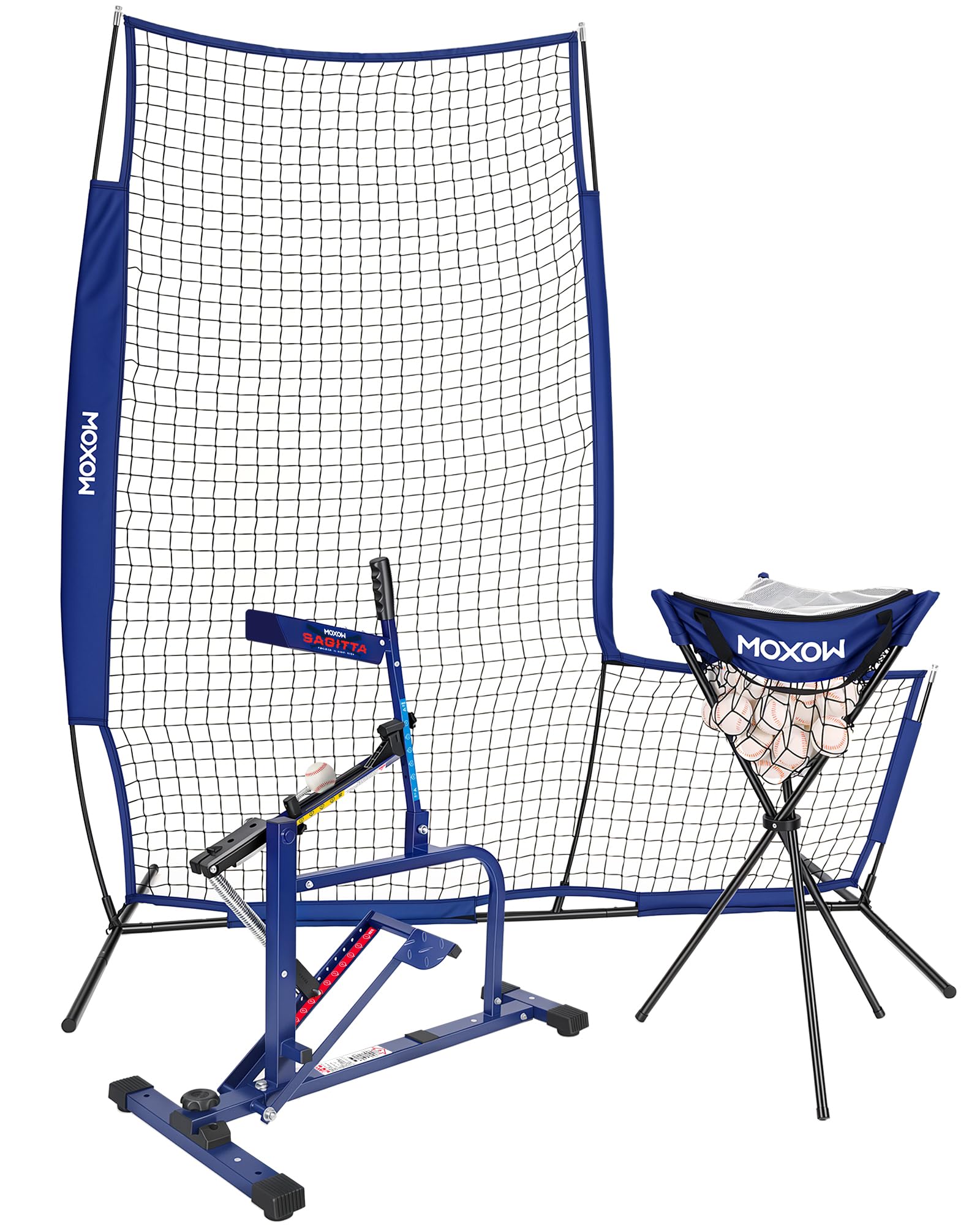
The Sagitta’s pitch is simple — it is the only pick here that arrives as a complete training station rather than just a machine. You get the launcher, a ball caddy that holds up to 50 baseballs or 30 softballs, and a 7×6 ft L-shaped screen that protects the person feeding the machine from line drives coming back at them. Nothing on this list ships with a protective screen except this one, and that alone changes how comfortable a parent feels standing ten feet in front of a live hitter.
The frame does double duty: a reinforced beam keeps the machine stable during faster throws and also serves as a carrying handle, so you can move the whole rig without a cart. A color-coded speed guide lets you adjust launch, trajectory, and power with three labeled controls, and an anti-tilt bar keeps each pitch on target even on uneven grass. The caddy spares your back — no bending to collect balls between reps, which is the difference between a 15-minute session and a 45-minute one.
The limits are worth knowing. Feedback on the Sagitta is that it feeds balls in slower than league pitching and is best suited to players 12 and under, so travel-ball hitters chasing reaction speed should look at the higher-mph machines on this list. Assembly takes some upfront time, and the frame weighs in at roughly 41 lbs. Neither is a surprise at this tier, and the 90-day limited warranty is short — but owners running it for 300+ pitches describe it as solid, with the steel frame staying stiff on uneven ground after repeated moves.
Everything You Actually Get
- Pitching machine, ball caddy, and 7×6 ft L-screen in one purchase
- Caddy holds up to 50 baseballs or 30 softballs
- Steel frame with anti-tilt bar stays stable on uneven ground
- Color-coded controls adjust launch, trajectory, and power
Set Your Expectations
- Feed rate is slower than live league pitching
- Best matched to players 12 and under
- Assembly takes some upfront time and effort
- 90-day limited warranty is on the short side for this tier
Pick this if: you are setting up a home practice station from scratch and do not want to shop separately for a screen and a ball caddy.
Not the right fit if: your player is already hitting against 40+ mph live pitching and needs a machine with a higher top speed.
4. PowerNet Launch F-lite Softball & Baseball Pitching Machine Bundle
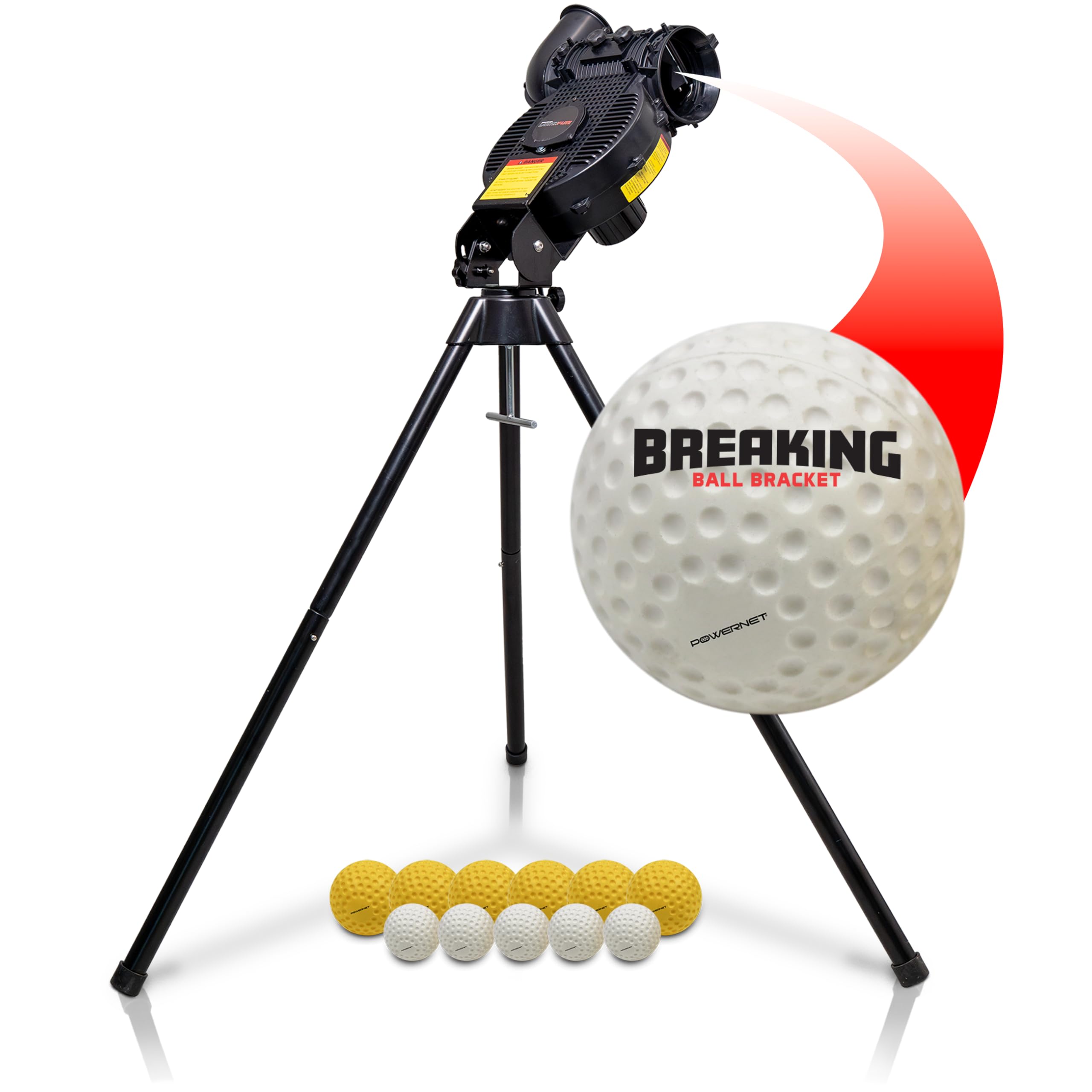
The only pick here that throws a coach-angled sweeper, and it moves like a tripod.
What sets the Launch F-lite apart is the breaking ball bracket. It angles the machine to throw left- or right-handed sweeper pitches, so you can build reps against movement rather than a straight fastball — a drill almost none of the wheel machines on this list handle from the start. Two interchangeable sets of tripod legs change the pitch height, and the package includes both baseball and softball sized chutes plus six of each ball.
The tripod base makes setup fast and the whole thing portable enough to move between the yard and the diamond. Owners consistently describe it as accurate and stable once running, with one key habit: give it about 30 seconds to reach full wheel speed before the first ball, then roughly 5 seconds between pitches. Skip the warm-up and your first pitch drops short. There is a real break-in quirk too — the outgoing ball speed is affected by the time gap between pitches, so rushed reps mean inconsistent throws.
Two honest catches. First, this machine is calibrated for the PowerNet Launch F-lite balls only — using game leather balls or other brands is explicitly called out by the maker as something that voids the product warranty, so your ball budget needs to include a steady supply of their spec balls. Second, the cord is short enough that you will likely need an extension cord if the nearest outlet is not right at the machine. Owners also note the balls are good for batting and catching drills across age groups, from 10-year-old baseball players up to 6-year-old softball players.
There is a bag included for storage and transport, which rounds it out as a genuinely grab-and-go option.
Choose it when: you want breaking-ball and fielding drills in a package you can throw in the trunk and set up on a tripod in minutes.
Think twice if: you plan to pitch real leather game balls — this machine is calibrated for its own spec balls and other balls are not covered.
5. Heater Sports Combo Pitching Machine with Auto Ball Feeder
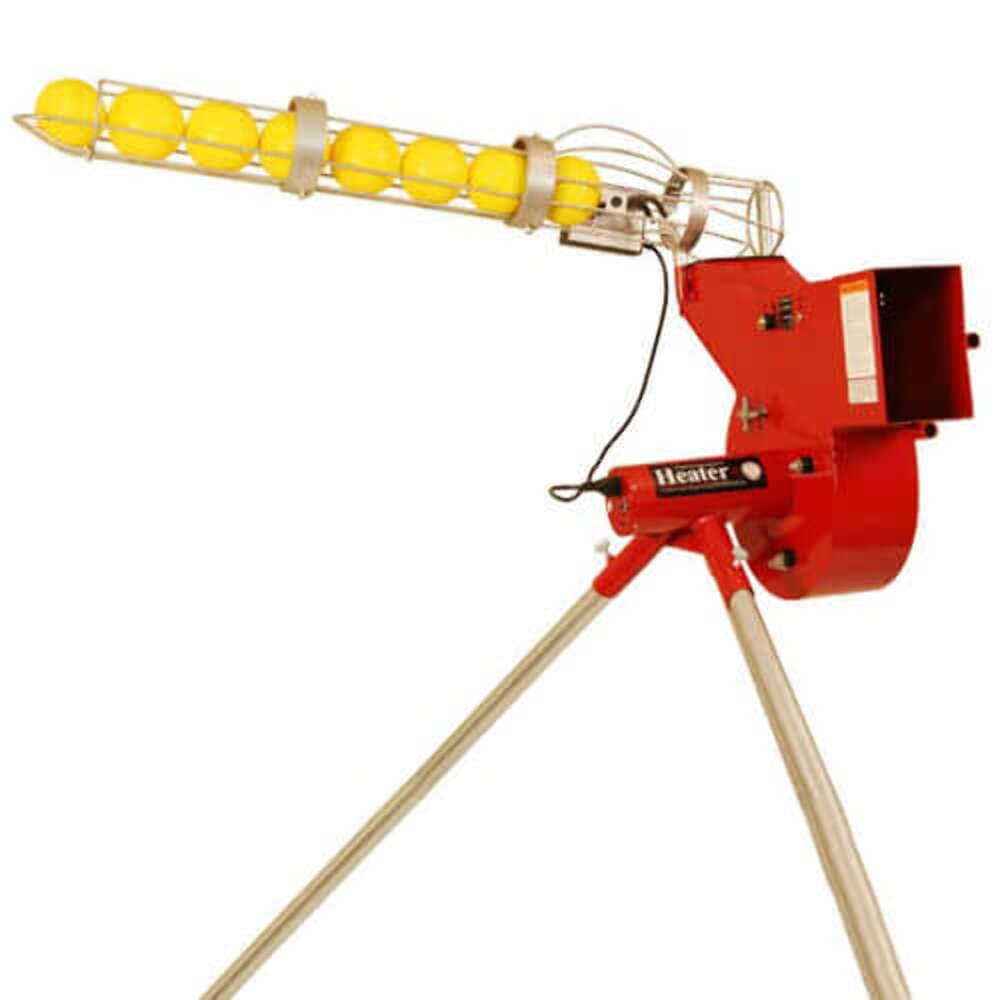
An auto feeder that turns one coach into a full pitching machine in a cage.
The automatic ball feeder is the entire point here, and it is what separates the Combo from the hand-loaded machines above it. Pitches arrive without anyone standing beside the chute dropping balls in, which means you can run a station on your own and keep a lineup of hitters moving through it. Speed adjusts for 11-inch and 12-inch softballs (up to 56 mph) and regulation baseballs (up to 60 mph), and the pitch height adjusts for grounders and pop flies.
The 70 lb frame is the heaviest on this list short of the Mound Yeti, so pick a spot you do not need to move it from. Owners running it three times a week at 150-200 pitches report it holding up without complaint, and the company’s service record shows in the reviews — a Sunday email response, technician help, and a next-day replacement after shipping damage all show up. That level of support matters for a machine in this tier.
The honest caveats. This machine has a narrow ball appetite: raised-seam balls do not fit the feeder, and synthetic softballs with soft covers or prominent seams can jam it, so owners wind up sticking to flat-seam balls in the.47 cor / 375 compression range. The feeder itself dents easily if it takes a hit. And you need a real power source — regular household outlets and undersized battery packs will not drive it; customers note needing a minimum 1000W portable supply if you are running it off a battery.
Why the feeder wins: solo coaches get hundreds of quality reps without a second set of hands, and the machine is built for a 3x-per-week schedule.
The ball caveat: check your ball stock against the flat-seam requirement before you commit — raised-seam balls simply do not feed.
Built for: coaches and parents running team practice stations who need reps without a helper and have a full outlet or 1000W power supply nearby.
Wrong pick if: your practice happens in a park with no power, or your ball bucket is full of raised-seam balls that will jam the feeder.
6. Heater Team Sports Blaze Pitching Machine

The 10-70 mph knob that follows your player from tee-ball to travel ball.
Widest published speed range of any machine here: 10 to 70 mph from a single twist knob, which is a span you can grow into rather than out of. Lite baseballs, real baseballs, lite softballs, and real softballs all work, and the 90-degree ball path adjustment handles grounders, line drives, pop flies, and pop ups from the same setup. That versatility is the whole selling point, and it is why this pick lands in the premium tier.
Where the Blaze really earns its spot is consistency once you dial it in. Reviewers point out very accurate strikes and speeds that hold true to the knob setting — you set 50 and you get 50, which sounds obvious until you try a machine with a drifting calibration. Parents running it for youth baseball and 11-inch softball describe it as a solid entry-level machine with an internal “max” knob that, once adjusted, pushed top speed up to 60+ mph; half speed covered most of their actual practice.
The honest trade-off: no advanced pitches. Reviewers are clear that the Blaze throws fastballs, grounders, and pop flies and nothing beyond that — no curveballs, no breaking balls, no changeups. For pure fundamentals work, that is all most young players need, and the machine stays predictable, which is a virtue. It is not a machine anyone buys for mound realism.
Where the Blaze Wins
- Widest published speed range on this list at 10-70 mph
- Throws lite or real baseballs and softballs from four ball categories
- 90-degree pitch angle handles grounders, line drives, and pop flies
- Shoppers say speeds staying true to the knob setting
What It Does Not Do
- No curveballs, breaking balls, or changeups — fastballs only
- Internal “max” knob needs adjusting from the start
- 55 lb unit is not portable in the one-hand sense
- Best for fundamentals work, not game-simulation reps
Reach for this if: you want one machine that will follow a player from tee-ball age through travel ball with speed range to spare.
Skip if: you are buying specifically for curveball or breaking-ball practice — the Blaze sticks to straight pitches.
7. BSN Sports Bulldog Baseball/Softball Pitching Machine

A cage regular that converts between baseballs and both softball sizes on the fly.
The Bulldog is built around a convertible leg system: swap between baseball and softball positions and the machine throws baseballs, 11-inch softballs, and 12-inch softballs from one unit. Speed runs 30-60 mph, and the durable urethane wheel removes the air-pressure headaches that rubber wheels can bring. It runs on standard 110-volt AC or a generator, driven by a 1/4 HP DC motor.
Where the Bulldog shines is repeatability in a cage setting. Owners running it eight hours a week in a 40-foot cage for kids ages 7 and 10 report accurate throws with same-weight Jugs Sting Free balls, and the speed and height adjusters hold their position without drifting between pitches. The league’s older red-and-white-tire machine was described as far less accurate by comparison. That is a long-term reliability picture you rarely get from a machine at this tier.
Two real caveats. First, this machine is hard on real leather balls and bats — the rubber wheel marks both and wears balls quickly, so owners who want real-ball reps run reduced-flight balls (McGregor dimpled balls get a specific mention) for most of their practice. Second, wheel replacement is the single biggest long-term cost: it is a genuine expense when the time comes, roughly half the cost of a new machine by the owner’s own math. The 50.6 lb frame stays put, and quality of throw depends on loading smoothly — ball placement in the chute changes what the pitch does.
Best for: a dedicated cage setup with an outlet nearby where the machine sits mostly in one place and runs multiple sessions per week.
Look elsewhere if: you need true portability or you intend to pitch real leather balls every session — the wheel takes a toll on both.
8. Mound Yeti Baseball Softball Pitching Machine
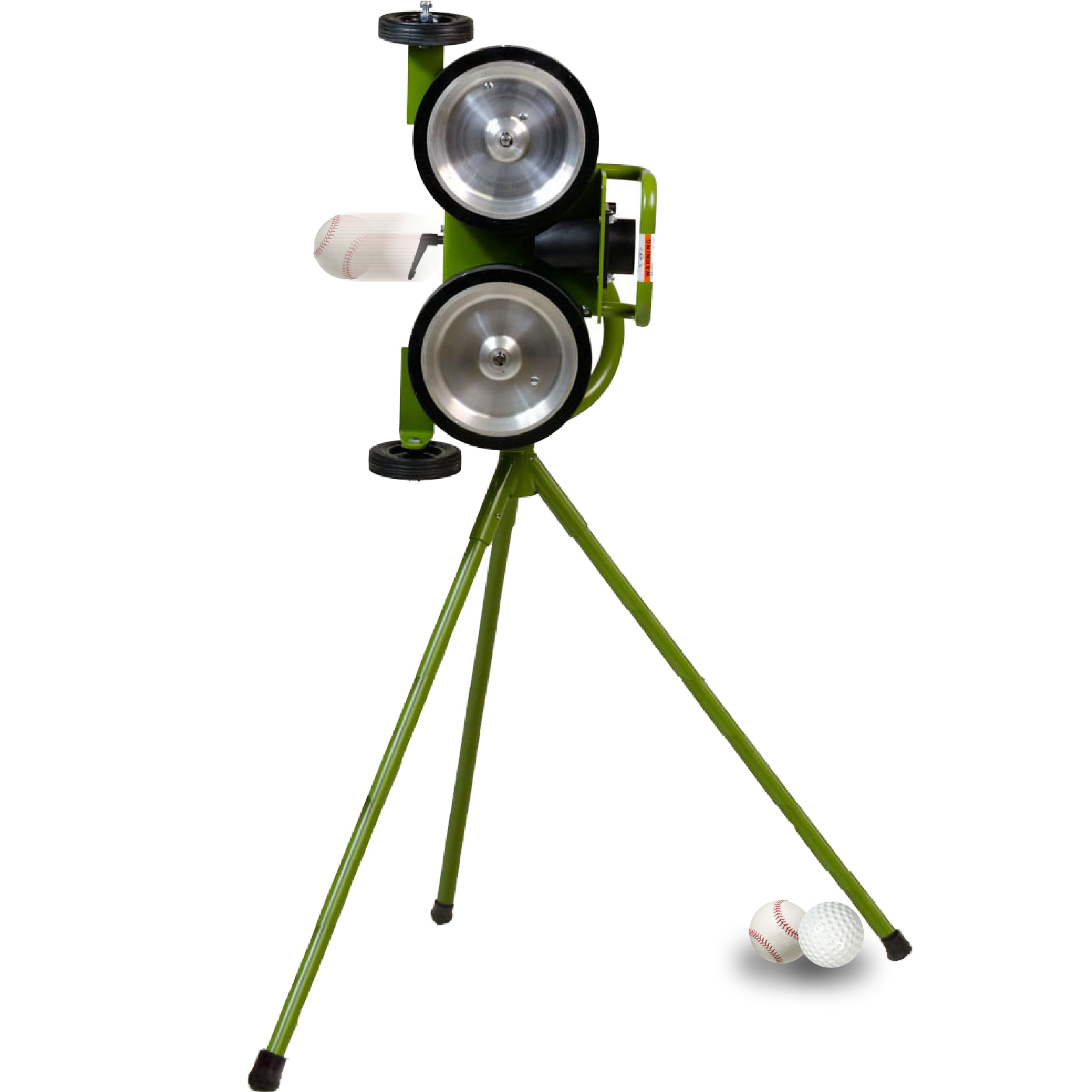
Two wheels, 95 mph, and every pitch a real pitcher actually throws.
The Mound Yeti is in a different class from everything above it. It uses a two-wheel delivery system to throw fastballs, sliders, curveballs, knuckleballs, left- and right-handed breaking balls, pop flies, and grounders — the widest pitch menu on this list by a wide margin. Speed adjusts from 45 to 95 mph, which covers high-school and college-level reaction training. Two chutes let you alternate between baseballs and softballs, and a set of shorter and taller legs changes release height between 48 inches for baseball and 30 inches for softball.
At 102 lbs this is the heaviest machine here, but Mound Yeti includes a transport kit to move it around the field or facility. Buyers report it as easy to set up for a machine this size, with accuracy they describe as great once the speed is dialed. The one quirk worth knowing: the speed knob is touchy, so you turn it slowly to land on the number you want. It plays nicely with a portable power bank — owners using it with a Jackery power bank for field sessions away from an outlet — and it carries a 2-year limited warranty, the longest on this list.
What you are actually buying at this tier is pitch variety and staying power. Coaches using it for fly-ball and grounder training describe it as worth the money, and one owner purchased a pair for a facility’s fielding drills with speeds limited to around 55 mph for that use. There is one honest ergonomic note: the machine is not tall enough to line up with every batting cage opening, and taller adjustable legs would improve the fit for indoor cage work.
For parents of older players, the 2-wheel pitch variety is the difference between practicing against a fastball and practicing against a pitcher.
Built for: high-school and travel-ball players, coaches running fielding drills, and anyone who needs breaking pitches and changeups in a live practice setting.
Not the right fit if: you are practicing in a standard batting cage with a lower opening, or your player is still working on timing against straight pitches.
Understanding the Specs
Speed Range in mph
Speed range tells you the fastest this machine can throw, measured in miles per hour — the higher the top end, the more advanced the hitters it can test. A 10-70 mph range covers tee-ball age through travel ball. A 45-95 mph range is high-school and college territory. Beginners should look at the LOW end of a machine’s range — if the slowest setting is still too fast, you cannot use it. So check both ends of the range, not just the headline number.
Ball Compatibility
Ball compatibility is the machine’s appetite — some pitch baseballs and softballs only, some also take teeballs, and others are calibrated for a specific brand’s balls only. Feeding a machine the wrong ball is not just a performance issue; on some models it explicitly voids the warranty. If you already own a bucket of one ball type, match the machine to your bucket before you buy.
Feed Method
Feed method is how balls reach the throwing wheel — either hand-loaded one at a time, or automatic from a hopper. A hand-fed machine keeps you tied to the chute and requires a second person for solo practice; auto-feed machines run continuous reps without anyone standing beside them. For a parent running solo sessions, the difference between 20 hand-dropped balls and continuous auto-feed reps is significant.
Weight and Transport
Weight is the honest measure of how much you will actually use the machine — heavy machines are stable but stay where they are put, while lighter machines move with you. Steel-bodied machines fit a fixed backyard or cage spot; lighter frames with a transport kit or carrying handle suit a family that practices in different locations. Look for Quick-Snap legs, a grip handle, or an included transport kit if portability matters.
Pitch Variety
Pitch variety is what the machine can simulate beyond a straight fastball — ground balls, pop flies, line drives, and on the higher-end machines, breaking balls and changeups. A 90-degree angle adjustment lets you train headers, grounders, and flies; a spinning-wheel mechanism adds movement. Basic machines throw straight pitches only, which is fine for timing and contact work but not for teaching hitters to recognize breaking balls.
Power Source
Power source is what the machine needs to run — 110-volt AC, a 1/4 HP DC motor, a battery pack, or no power at all in the case of spring-loaded trainers. If your backyard or park has no outlet, spring-loaded or battery-powered options widen your choices. Machines with high draw (the Combo runs on a 1000W-minimum supply in the field) need bigger power banks than a machine that runs on household current.
FAQ
Can a pitching machine throw both baseballs and softballs?
Is a 50 mph machine fast enough for travel ball?
Do I need an electrical outlet for a pitching machine?
What kind of balls can I feed a pitching machine?
How much setup is required to switch between baseballs and softballs?
How long should a pitching machine last?
Can I use real leather baseballs in a pitching machine?
How many pitches per session can a machine handle?
What is the difference between a one-wheel and two-wheel pitching machine?
Can a kid use a pitching machine alone without an adult?
Final Thoughts: The Verdict
For most families, the baseball softball pitching machine that wins is the JUGS PS50 — because it throws baseballs, fastpitch softballs, and slowpitch arcs at up to 50 mph from one 50 lb steel frame, and it holds the highest owner rating in this lineup. It is the machine you buy once and use through multiple seasons and both sports.
If you want a home training station that arrives complete with a screen and a ball caddy, grab the MOXOW Sagitta 3-in-1 Bundle.
One last nudge for anyone on the fence: all eight of these machines have earned their spot on the list from real, verified owner use, so pick the range and the feeder that match your player and your practice space, and the choice gets simple fast.
How We Picked
We do not accept paid placement. Every pick is matched to a real buyer and a real use-case; we do not hands-on test units.
Sources & Methodology
Specifications: manufacturer listings and product documentation. Review insights: verified customer reviews, as of September 2026. Pricing: not shown on this page (it changes often); check the current price via the retailer link.
As an Amazon Associate, Gadgets Feed earns from qualifying purchases. This does not affect which products we feature.