
Our readers keep the lights on and my morning glass full of iced black tea. As an Amazon Associate, I earn from qualifying purchases.
Specs are compiled from manufacturer listings and verified buyer reviews and can change over time — please confirm the key details on the product page before buying.
Your prints fail in two places: the nozzle and the bench. A clogged hot end ruins a twelve-hour job, and no set of pliers means you are prying a finished model off the plate with a kitchen spatula. This guide covers the nine supply picks that fix both problems — tool kits that keep your machine running and filament bundles that actually print clean.
I’m Min — the founder and writer behind Gadgets Feed. This guide is built by comparing the manufacturers’ published specifications and the patterns across verified customer reviews, so you get each pick’s real strengths and trade-offs instead of marketing spin.
You can lose a print to a dull scraper or a spool that has soaked up moisture. The right 3d printing supplies fix both problems before they start.
Our Picks at a Glance

How To Choose The Best 3D Printing Supplies
Supplies split into two camps: the tools that maintain your machine and the filament that feeds it. Get either wrong and you will spend more time troubleshooting than printing. Focus on the specs a normal buyer can check before hitting the buy button.
Tool kits: count the pieces that actually get used
A 68-piece kit and a 74-piece kit sound similar on paper, but what matters is whether the set includes a deburring tool (a hand tool that shaves off sharp edges), nozzle cleaning needles in the sizes your printer uses, and scrapers thin enough to slide under a print without gouging the bed. Look for 0.2mm to 0.4mm needle sizes — those cover most common 1.75mm filament machines. A storage case is not a luxury; it keeps the blades sharp and prevents the rust that ruins cheap steel after a few months.
Filament: match the spool size to your setup
Standard 1kg spools fit everything. Smaller 250g and 200g spools are ideal for sampling colors, but they often need an adapter to work with a Bambu Lab AMS or AMS Lite. Check the spool hub diameter before you buy — a 53mm hub hole is common, and 3D-printable adapters are widely available on maker platforms. Also verify the diameter tolerance: ±0.02 mm is tighter than ±0.03 mm, which means more consistent extrusion and fewer surprises mid-print.
Material choice: PLA, PETG, or glow
PLA is the beginner default — low warping, low odor, easy to dial in. PETG takes more heat (240-260°C nozzle, 60-70°C bed) but handles impact and outdoor exposure far better. Glow-in-the-dark filament adds phosphorescent material that charges under sunlight or UV and is abrasive enough that a 0.6mm nozzle is a smart precaution. Pick the material for the job, not the color you like best.
Quick Comparison
| Model | Best For | Type | Spool / Pack Size | Diameter Tolerance | Amazon |
|---|---|---|---|---|---|
| 68Pcs 3D Printer Tools Kit★ Best Overall | Complete starter toolkit | Tool kit | 68 pieces | — | Amazon |
| iSANMATE Matte PLA BundlePremium Pick | Matte multi-color printing | PLA | 8 × 250g | ±0.02 mm | Amazon |
| SUNLU 250g Filament BundleBest Value | Color sampling on a budget | PLA | 8 × 250g | ±0.02 mm | Amazon |
| Creality 74Pcs Tool Kit | Precision finishing and repairs | Tool kit | 74 pieces | — | Amazon |
| YOUSU Glow in The Dark Bundle | Novelty and cosplay prints | Glow PLA | 4 × 250g | ±0.03 mm | Amazon |
| ELEGOO PLA Black 4KG | High-volume everyday printing | PLA | 4 × 1kg | ±0.02 mm | Amazon |
| SUNLU PETG 4KG | Functional and outdoor parts | PETG | 4 × 1kg | ±0.02 mm | Amazon |
| Creality PLA 4KG | Four-color prototyping | PLA | 4 × 1kg | ±0.02 mm | Amazon |
| RAMBERY PLA+ 200g×16 | Maximum color variety | PLA+ | 16 × 200g | ±0.02 mm | Amazon |
In‑Depth Reviews
1. 68Pcs 3D Printer Tools Kit with Storage Case
Our pick — over 4.5★ from 550+ verified ratings; the strongest balance of quality and price.
The one box that covers every scraping, trimming, and nozzle-clearing job your printer hands you
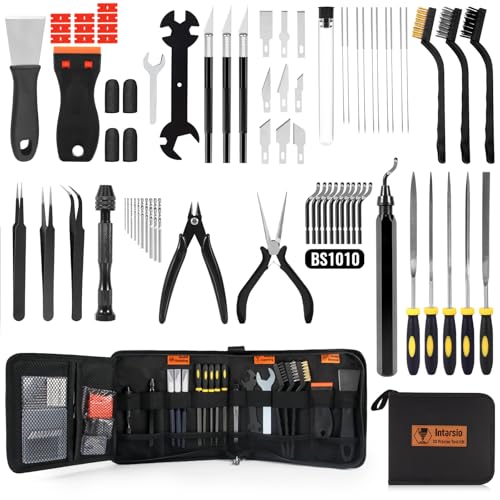
Begin with the number that matters: 68 separate tools in a single zippered case. That includes a stainless steel removal scraper with a 15-degree angled edge that is 0.5mm thick and 1.57 inches long — thin enough to slide under a finished print without gouging your build plate. You also get a high-quality hand drill with 10 drill bits and 5 types of metal files, which widens what you can finish by hand after a print comes off the bed.
The deburring tool is the standout for edge cleanup. It has a 360° swivel head that follows uneven shapes, and it ships with 10 extra BS1010 blades made of tempered high-speed steel — a material the maker notes lasts 80% longer than regular steel. For clog prevention, there are 5 cleaning needle sizes (0.2mm, 0.25mm, 0.3mm, 0.35mm, and 0.4mm) that fit most 1.75mm PLA and ABS printers, plus brass, stainless steel, and nylon brushes for different cleaning conditions.
The 900D Oxford fabric case is sturdier than the soft pouches most kits ship in. Inside, orange tags label each tool slot so you can grab the right scraper without dumping the whole case on your bench. One honest catch: durability on the smaller hand tools splits buyer opinion — the wrenches and tweezers are the pieces to treat gently, while the files, deburring tool, and blades hold up fine. It weighs 2.27 pounds, which is light enough to grab with one hand but heavy enough that you know the steel is real. Its 4.8-star rating is the highest in this lineup, driven by the 68-tool coverage and the 900D Oxford case.
What buyers keep praising
- 5 cleaning needle sizes (0.2mm to 0.4mm) cover most standard nozzles
- 10 extra HSS BS1010 swivel blades for the deburring tool
- 15-degree angled scraper (0.5mm thick) slides under prints cleanly
- Zippered 900D Oxford case keeps blades organized and sharp
Where it asks for care
- Wrenches and tweezers are the pieces most likely to bend under force
- Skips sandpaper — you will want a small sheet for post-processing
Reach for this if: you want one purchase that covers every scraping, trimming, and nozzle-clearing job without buying tools piece by piece.
Look elsewhere if: you only need a scraper and a pair of pliers for occasional light printing.
2. iSANMATE 250g*8 Colors Matte PLA Filament Bundle
Eight matte spools that hide layer lines without hiding your color choices
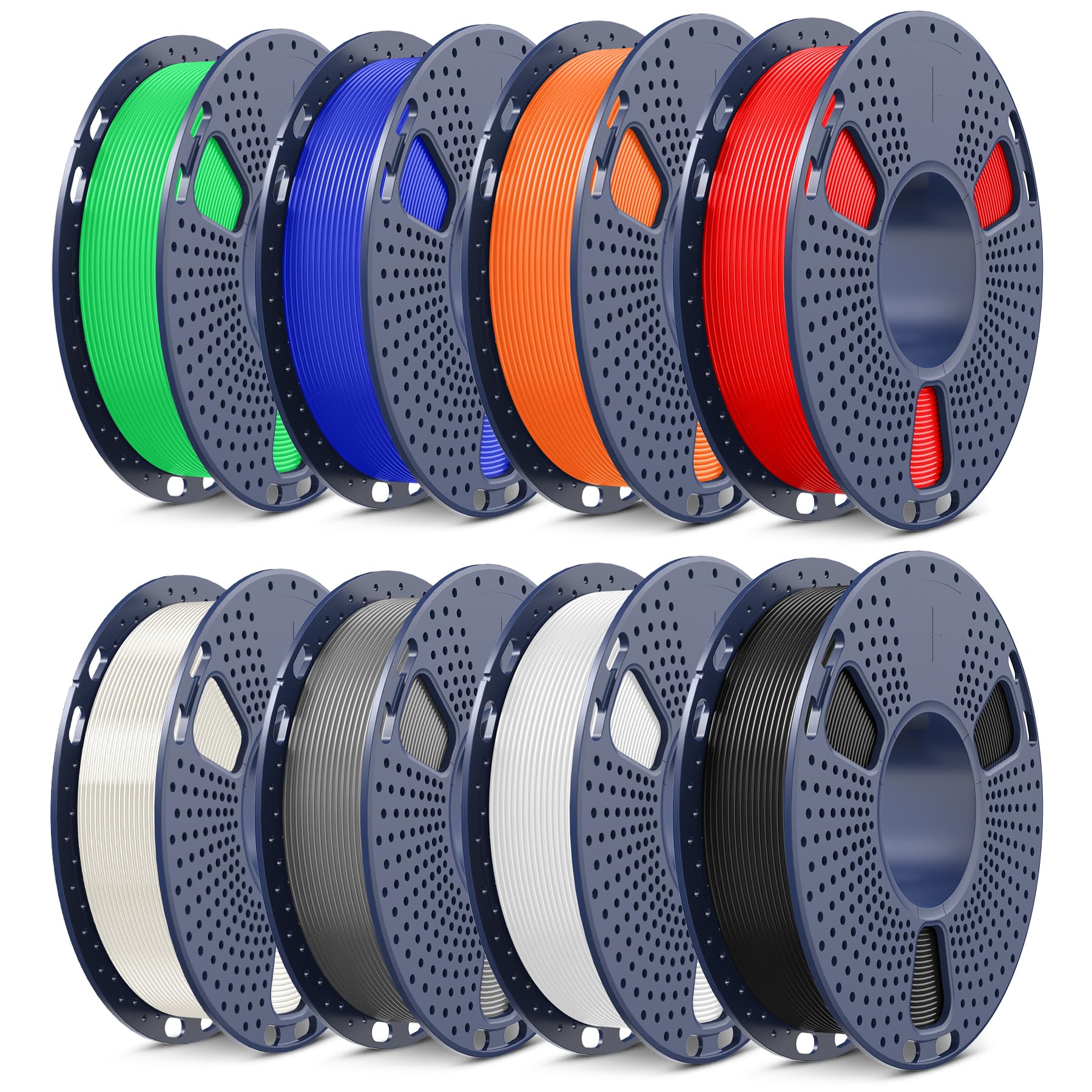
If you own a Bambu Lab printer, this bundle was built for it. The 8 spools of 250g matte PLA are pre-tuned to the Bambu Lab matte PLA preset, so you skip the parameter guessing. On any other FDM machine you just select generic PLA and go. The diameter sits at 1.75mm with a ±0.02mm tolerance, and each spool runs 30-300mm/s depending on your printer’s capability.
What wins people over is the finish itself. The non-reflective matte surface diffuses light and hides layer lines naturally — a subtle upgrade over glossy PLA that makes display models, vases, and geometric pieces look deliberately finished rather than obviously printed. The color range spans Black, White, Grey, Beige, Skin, Chocolate, Navy Blue, and Army Green. Support material peels away easily, which matters more than most buyers expect on intricate shapes.
The honest caveat: a few buyers hit initial feeding friction in tighter extruders with high retraction settings, and the cardboard spools shed a little dust over time. Feed tension adjustment usually clears it up. Compared to the SUNLU bundle lower on this list, the iSANMATE spools hold a tighter ±0.02mm tolerance versus ±0.02mm — same figure, but the Bambu Lab preset tuning is the real differentiator. Every spool runs fully mechanical winding and 24-hour drying before vacuum sealing, so you can print straight out of the bag.
Color range that delivers: 8 matte colors (Black through Army Green) each in a 250g spool — enough for accent parts and test prints without committing to a full 1kg roll per color.
Fit note on tension: the spools may jam in tight extruders with aggressive retraction settings — a feed-path adjustment typically resolves it, but budget a few minutes of tuning on first use.
The Bambu owner’s shortcut: preset-tuned spools that print clean without parameter hunting.
Benchmark to know: standard spool sizing fits 99% of FDM printers plus filament dryers and 3D pens.
3. SUNLU 250g Filament Bundle 1.75mm, Multicolor
Eight mini spools that let a curious kid pick a different color every single print
Here is the math that makes this bundle appealing: 8 spools of 250g in Black, White, Grey, Transparent, Red, Klein Blue, Sunny Orange, and Green, totaling 2kg of PLA. That works out to roughly 68m of filament on each spool. Recommended print settings are 200-210°C nozzle, 50-65°C bed, and 50-100mm/s speed — the standard PLA range that most printers handle without special tuning.
The color library approach is the real benefit. Instead of committing to a 1kg roll for one accent color, you get eight 250g spools that each handle small prints, multicolor models, and test runs without leaving half-empty reels cluttering your shelf. Each spool comes individually vacuum-packed from a production line that runs mechanical wire winding plus manual inspection to keep the line neatly arranged. The diameter tolerance is ±0.02mm, which is tight enough that feed inconsistencies are rare.
The catch buyers hit most: the 250g spool hub diameter is 53mm, and that size will not fit a Bambu Lab AMS Lite directly. You need a 250g spool adapter — the listing notes you can print one from Makerworld. Once adapted, it works fine. The other honest limit is print size: 250g rolls cap how big a single piece you can create before swapping spools, which the listing itself acknowledges as the trade-off for the color variety. It averages 4.4 stars across 879 ratings, and the brand’s PETG sibling holds 4.6 stars across 480.
Why the color library wins
- 8 distinct colors (Black through Green) in 250g spools each
- ±0.02mm diameter tolerance for consistent feed
- Individually vacuum-packed with professional winding
- Standard PLA temperature range (200-210°C / 50-65°C bed)
What to plan around
- 250g spools need an adapter for Bambu Lab AMS Lite
- Each spool caps how large a single print runs before a swap
Built for color experimenters: worth it if you want eight colors to play with without committing to a full roll of any single one.
Not for the AMS Lite owner: unless you are prepared to print the adapter first.
4. Creality 3D Printer Tool Kit, 74Pcs

A 34-bit screwdriver set tucked inside a printer toolkit — the repair-kit angle most rivals skip
Here is what sets this one apart from the 68-piece kit above: 34 chromium-vanadium steel nickel-plated screwdriver bits packed into a toolkit that also handles scraping, cutting, and nozzle cleaning. That combination makes it the better pick if you actually take your printer apart for maintenance rather than just clearing jams. The kit includes a multifunctional wrench, open-ended wrench, socket wrench, and a 100mm long metal extension rod for reaching recessed fasteners.
The model-handling side covers a chamfer knife with a 360° rotatable blade for refining edges, an engraving knife with 5 blades and 1 handle, 3 files, and a nipper for removing supports and burrs. For nozzle maintenance you get a 150mm φ1.5mm needle plus ten 0.38mm nozzle cleaners — two different scalings for different debris sizes. A magnetic mat and a suction cup round out the package, and the whole set fits in a book-sized case at 2.8 pounds.
The honest flaw is the clipper. Its spring-steel mechanism is the piece most likely to bend or pop out on first use, and the tweezers can bend under heavy force. It is a genuine quality split: most of the set feels solid, but the cutting springs are the weak link. Still, for the money this is one of the more complete kits out there — the 4.7-star rating across roughly 500 ratings reflects a user base that is overwhelmingly satisfied with the overall package, with the attachment quality being the one aspect that draws mixed feedback. If you plan to use clippers heavily, keep a spare pair on the bench.
The screwdriver advantage: 34 chromium-vanadium bits plus a socket wrench and 100mm extension rod — the most repair-capable kit in this lineup.
The spring-steel watch: the clipper mechanism is the tool most reported to fail on first use, so treat it as a replaceable spare rather than a lifetime piece.
Pick this if: you maintain and disassemble your printer regularly and want a full screwdriver set in the same case.
Skip the overlap if: you already own a 68-piece kit — the tool profiles mostly duplicate each other.
5. YOUSU 3D Printer Filament Bundle, Glow in The Dark

Four glow spools for cosplay props and Halloween decor, provided you accept the trade-offs
This bundle has 4 × 250g spools in Glow Green, Blue, Purple, and Rainbow. The listed diameter tolerance is ±0.03 mm — notably looser than the ±0.02 mm on most other filaments here, which is a real consideration for high-precision models. The glow aspect is genuinely inconsistent across colors: the green charges well and holds a bright glow after sunlight exposure, the blue is acceptable, and the purple struggles to show much luminescence at all. Buyer consensus matches that pattern, so treat the glow as a bonus effect rather than the headline feature.
Where this bundle earns its keep is print quality. Owners printing cosplay unicorn horns and party decorations report smooth layers, consistent extrusion, and good bed adhesion with minimal stringing — the glow feature is the variable, not the printing. The filament is vacuum-sealed with desiccant to keep it dry, and the 250g spools are ideal for the small decorative pieces this material suits best. Charging under sunlight or a UV light source for about 30 minutes is the listed method for the brightest effect.
Two things buyers should plan for: the abrasive phosphorescent material can wear nozzles faster than standard PLA, so a 0.6mm nozzle is a smart precaution, and the glow quality varies spool to spool. A few buyers found no glow at all even after charging, though most report at least a faint effect. The 4.0-star rating tracks that split: smooth prints for most buyers, glow strength varying by color. If you want consistent bright glow, stick with the green spool; purple may disappoint.
The green spool story: green is the brightest glow performer, and blue comes in second — purple is the color with the weakest visible glow by most user accounts.
Nozzle pre-plan: glow filament is abrasive, and printed props last longer when you switch to a 0.6mm nozzle before the first spool goes in.
The cosplay and party choice: 4 glow spools for props, decorations, and gifts where the glow is a bonus, not the point.
Wrong pick if: you need a strict ±0.03 mm tolerance replaced by the ±0.02 mm tighter spec on the filament picks above.
6. ELEGOO PLA 3D Printer Filament 1.75mm Black 4KG
Four kilos of black PLA for the print farm that never wants to think about color again
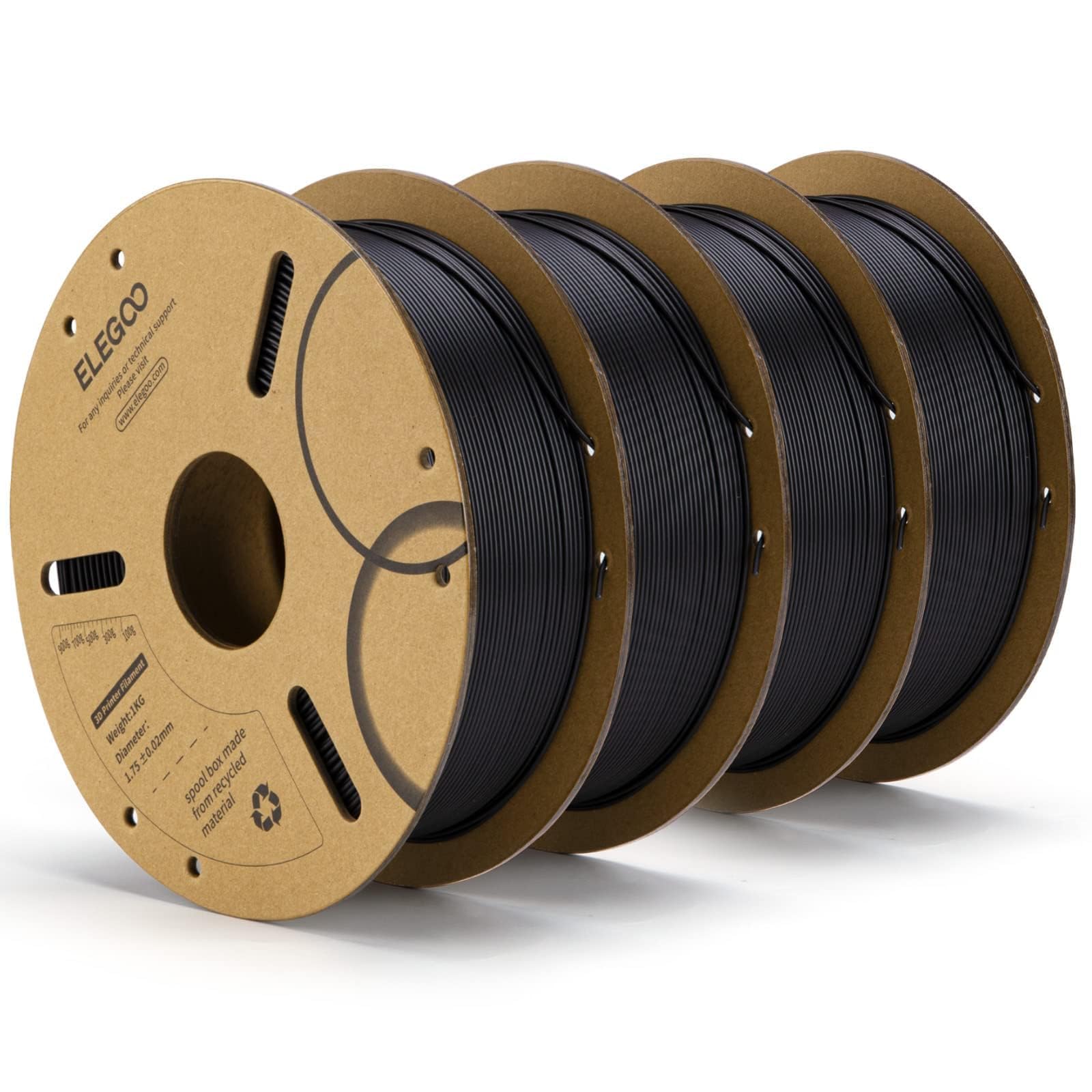
Black, black, black, and black. If most of what you print is functional — brackets, enclosures, replacement parts, prototypes — you do not need color variety, you need a stack that never runs out mid-project. Each spool is 1kg (2.2lbs), and each is individually shrink-wrapped with a desiccant pack so you can open them one at a time and leave the rest sealed. The diameter runs 1.75mm with ±0.02mm accuracy, and the larger spool inner diameter design makes loading and feeding easier on your extruder.
Owners running this on an AMS-fed Bambu P1S and on older machines like the CR-10 and Ender 3 Pro report no clogs and consistent color across all four spools. The material dries completely before vacuum sealing, and the low-warp, low-shrink PLA formula keeps the odor down while you print. If you need to run a batch of the same part ten times without swapping spools, this is the bundle for the job.
The fair warning: bed adhesion failures can happen on roughly one in a dozen prints, especially in the first twenty minutes, and about one in five rolls can arrive with minor self-fixable tangling. Both are simple to handle — watch the first layer carefully and pause to untangle if the feed drags — but they are worth knowing in advance. Its 4.6 stars across roughly 500 ratings come from buyers running it as a repeat-order workhorse. Not a filament for color experimentation; a filament for getting work done.
Where it holds up
- 4 × 1kg spools each shrink-wrapped with a desiccant pack
- ±0.02mm diameter tolerance for consistent feed
- Runs without clogs on AMS-fed and older Ender 3 Pro setups
- Low-warp and low-shrink PLA keeps color consistent across spools
What to watch for
- Bed adhesion can fail around once per dozen prints — monitor the first 20 minutes
- Occasional minor tangling on roughly one in five rolls, usually self-fixable
Made for the everyday producer: the four-kilo black bundle that keeps a functional print queue running without restocking.
Step away if: your prints need visible color variety — four blacks is four blacks.
7. SUNLU PETG Filament 1.75mm, 4kg, 2 Black+2 Black

When a part has to take a hit and live outside, this is the kind of filament you reach for
PLA is fine until a printed part cracks under stress or fades in the sun. PETG sits in the middle ground: it handles impact and outdoor exposure far better than PLA while staying easier to print than ABS. This SUNLU bundle ships 4kg of PETG in 4 × 1kg spools, with the same ±0.02mm diameter tolerance and full mechanical winding you would expect from the brand. Recommended settings are 240-260°C nozzle, 60-70°C bed, and 50-200mm/s speed.
The standout property is layer adhesion. PETG fuses layers strongly enough that warping and cracking under stress are rare, which is why owners put it to work on functional parts, drone frames, and heavy-duty household items. It is also UV- and moisture-resistant, so garden planters, car accessories, and outdoor fixtures are the sort of jobs it handles that PLA will not. Each 1kg spool is individually baked and vacuum-sealed with desiccants before packing — the material pulls moisture out of the air fast, so this sealing is a real functional benefit rather than marketing fluff.
The honest complexity is in the tuning: PETG (a tougher filament that handles heat and stress better than PLA) strings more than PLA if your settings are off, and it wants a slower print speed in most cases than the same model in PLA. A few buyers report the spools arrive wound too tightly, causing jams and gear chewing mid-print. Dry at 65°C for around 16 hours and store under 20% relative humidity and the material behaves as intended. Its 4.6-star rating reflects a filament that prints strong once dried and tuned, and strings when it is not.
Strength pick for functional parts: PETG offers impact resistance and UV weather resistance that standard PLA cannot match, which is what makes it the outdoor and mechanical choice.
Drying is not optional: PETG absorbs moisture quickly — bake at 65°C for around 16 hours and store under 20% humidity to avoid popping and poor extrusion.
Best for functional builds: if your parts need to survive stress, weather, or impact, PETG earns its place over PLA on your shelf.
Skip if speed is everything: PETG prints slower than PLA and strings more if your tune-up is not dialed in.
8. Creality PLA 3D Printer Filament 4KG, Black & White & Red & Blue

Four full kilos in the colors that actually get used — black, white, red, blue
When four is the right number, these four are the right colors. Black and white carry most functional work; red and blue cover the accents and small-batch visible parts. Diameter is 1.75mm with ±0.02mm tolerance, and each spool is 1kg (2.2lbs) with the larger inner-diameter design that makes feeding smooth. Full mechanical winding keeps the strand neatly arranged, and strict manual inspection catches the tangles mechanical winding misses.
Owners running these through Bambu Lab PS1 AMS units (a multi-spool feeder that swaps colors automatically) report no clogs, tangles, or feed issues — the filament prints crisp with good layer bonding and consistent diameter. Older Ender 3 v3 SE owners also get good results with a purple Elmer’s glue stick on the bed. The four-color bundle works as a working library rather than a sampler, and buyers who run small print businesses or make lots of colorful pieces find the mix of black, white, red, and blue covers the practical range without leaving spools sitting unused.
One mixed-topic: batch-to-batch color consistency can drift. Some buyers get vibrant, identical reds and blues; others find the tone shifts noticeably from roll to roll. Winding overlaps occur in roughly one in ten to fifteen rolls, requiring a pause-and-cut to fix — annoying but recoverable. Its 4.5-star rating reflects dependable print behavior, with color batch consistency the main complaint. If you need an exact-match red across two rolls, order them together.
Color-set practicality: four functional colors (black, white, red, blue) in 1kg spools each — a working library rather than a novelty sampler.
Batch variance to plan for: color tone can shift between manufacturing runs, so matching an exact red across two separate orders is a gamble.
Matches the working printer: a solid everyday PLA bundle for hobbyists and small shops where four colors cover nearly every job.
Not the pick if: you need guaranteed color consistency across repeated batches.
9. RAMBERY 200g×16 PLA+ Filament Bundle
Sixteen little spools for the printmaker who wants every color on the shelf
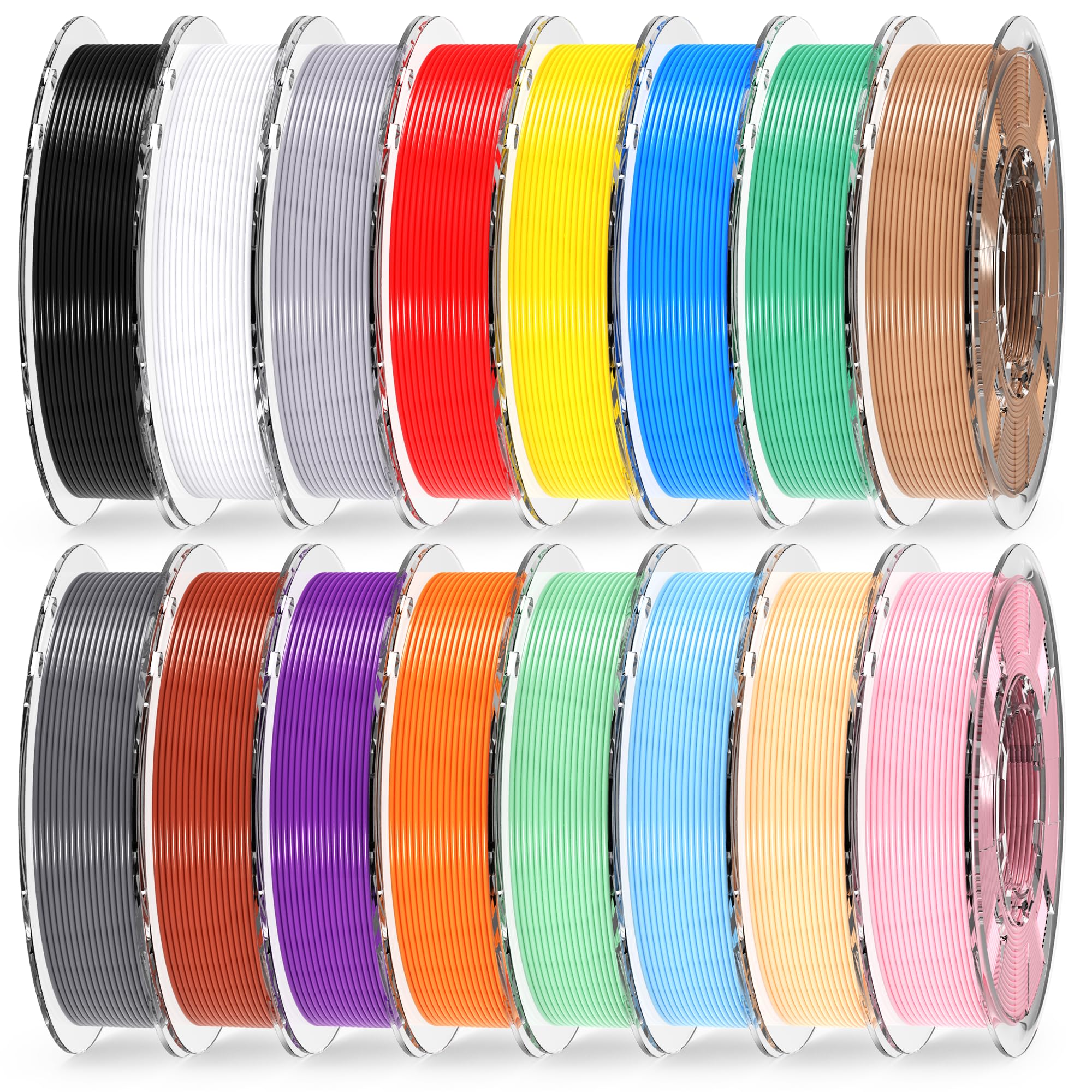
Sixteen colors, 200g each, ±0.02mm tolerance, PLA+ material. The color list runs Black, White, Grey, Silver, Wood, Coffee, Skin, Sky Blue, Red, Orange, Yellow, Blue, Cherry Pink, Green, Bright Green, and Purple — the widest single-bundle palette in this lineup. PLA+ is a blend that aims for slightly tougher prints than standard PLA without changing the print settings much. Recommended temperatures are 200-230°C nozzle, 40-60°C bed.
The color variety is the whole point. If you print decorative parts, toys, or small-batch items where each piece wants a different shade, this bundle saves you from buying sixteen separate spools at once. The 200g spools are also 200g, not 250g — you are getting 3.2kg total rather than 4kg, which matters if you are comparing by weight. The listing is upfront that these spools do not fit a Bambu Lab AMS without a 3D-printed 200g spool adapter.
The variable buyers should know about: print consistency is not uniform across the spools. Some rolls feed cleanly with no tangling and impressive detail; others clog or tangle mid-print. Color transitions on the specialty shades — especially the green — happen slowly enough that you need a large print to see the shift. One tangled roll is the most common complaint; rare, but worth unwinding before a critical print. That spool-to-spool inconsistency is why its 4.3-star rating sits below the tighter PLA bundles here. If you value color range over pinpoint reliability, it is still the widest palette here.
Why variety hunters love it
- 16 distinct colors in one bundle (Black through Purple)
- ±0.02mm diameter tolerance for consistent feed
- PLA+ formulation for slightly tougher prints than standard PLA
- 200-230°C nozzle / 40-60°C bed settings suit most FDM printers
Where it wants patience
- 200g spools need a 3D-printed adapter to fit a Bambu Lab AMS
- Print consistency varies across spools — some rolls tangle mid-print
Ideal for the color-maximalist: 16 shades for makers whose prints are visible and varied rather than hidden functional parts.
Weigh the trade-off: variety and reliability pull in opposite directions here — this bundle favors the first.
Understanding the Specs
Diameter accuracy (±0.02mm vs ±0.03mm)
A spool’s tolerance tells you how much the filament thickness can vary from the stated 1.75mm. Tighter tolerances mean smoother feeding and fewer print artifacts. The tighter ±0.02mm spools in this lineup hold steadier extrusion under load, while looser ±0.03mm material can produce occasional under- or over-extrusion on high-detail work.
Spool size and AMS compatibility
Standard 1kg spools fit nearly every FDM printer and every AMS unit without modification. Compact 200g and 250g spools let you sample many colors, but most small spools require a 3D-printed adapter before they sit properly in a Bambu Lab AMS or AMS Lite. Check your printer’s spool hub clearance before ordering a small-spool bundle.
Material type: PLA vs PETG
PLA is the beginner default — it prints at low nozzle temperatures (typically 200-210°C), warps less, and produces minimal smell. PETG handles impact and outdoor weather far better, but wants a hotter nozzle (240-260°C) and a slower first layer. Choose PLA for display and general work; choose PETG for parts that will be stressed, dropped, or left outside.
Nozzle size for abrasive filament
Glow-in-the-dark, wood-fill, and similar specialty filaments often carry harder particles that wear a standard brass nozzle faster. Switching to a larger, hardened nozzle before the first spool goes on is a small upfront step that prevents clogs and extends nozzle life on abrasive material.
FAQ
Will a 250g spool fit my Bambu Lab AMS?
Is ±0.02mm better than ±0.03mm filament tolerance?
Do I need a 0.6mm nozzle for glow-in-the-dark filament?
How long does PLA filament last in storage?
Is PETG harder to print than PLA?
Do I really need both a tool kit and a filament dryer?
Can I mix PLA and PETG in the same print session?
How many hours does a 1kg PLA spool last?
What is the difference between PLA and PLA+ filament?
How often should I clean my 3D printer nozzle?
Is matte PLA harder to print than standard PLA?
Final Thoughts: The Verdict
For most people just getting started with 3d printing supplies, the 68Pcs 3D Printer Tools Kit is the best first purchase because it covers every scraper, file, and cleaning needle you need in one 900D Oxford case — and it holds the highest customer score in this lineup at 4.8 stars. If you print mostly on a Bambu Lab machine, the iSANMATE 250g Matte PLA Bundle is the filament pick that needs zero setup, with 8 pre-tuned matte colors. For functional and outdoor parts, the SUNLU PETG 4KG bundle handles stress, UV, and weather in a way PLA cannot. If you want every color on a single shelf, the RAMBERY PLA+ 200g×16 bundle stretches 16 shades across your printer bench. And for a high-volume black PLA workhorse, the ELEGOO 4KG PLA never makes you swap spools mid-project. Pick the tool kit first if you own no maintenance gear at all — that single case saves more wasted prints than any single filament choice.
How We Picked
We do not accept paid placement. Every pick is matched to a real buyer and a real use-case; we do not hands-on test units.
Sources & Methodology
Specifications: manufacturer listings and product documentation. Review insights: verified customer reviews, as of September 2026. Pricing: not shown on this page (it changes often); check the current price via the retailer link.
As an Amazon Associate, Gadgets Feed earns from qualifying purchases. This does not affect which products we feature.