
The gap between a muddy, noisy recording and a broadcast-ready track often boils down to two things: the preamp’s gain range and the ADC’s fidelity. For anyone building a home studio on a strict budget, the search for a clean signal path can feel like a gamble—where one interface introduces a hissy noise floor while another captures every transient with clarity. The wrong pick leaves you fighting with noise gates and EQ fixes before you’ve even laid down a take.
I’m Min — the co-founder and writer behind Gadgets Feed. I’ve sifted through countless product sheets, customer reports, and technical breakdowns to isolate which preamp designs, converter chips, and bus-power configurations actually deliver measurable performance without sending you into debt.
After analyzing the market across key metrics like gain staging, sample rate handling, and I/O versatility, the shortlist for the best audio interface under 200 is surprisingly competitive, offering features once reserved for gear triple its cost.
How To Choose The Best Audio Interface Under 200
The sub- tier is crowded, but the real differentiators aren’t brand logos or color schemes. You need to evaluate the I/O count, preamp gain ceiling, converter resolution, and whether the unit supports your operating system without proprietary bloatware that hampers plug-and-play use.
Input Channels and Combo Jacks
A 2-in/2-out interface is the baseline for solo podcasters or singer-songwriters, but the type of input matters. Combo jacks accept both XLR and ¼-inch TRS/TS connectors, letting you plug in a condenser mic and a guitar simultaneously without adapters. If you plan to record a guest or dual-source an instrument, look for two independent combo inputs rather than a single mic channel paired with a dedicated instrument input.
Preamp Gain and Phantom Power
Dynamic mics like the Shure SM7B or Rode PodMic require significant gain—around 60 dB or more—to reach a healthy level without external boosters. High-gain preamps also reduce the noise floor, so check the maximum dB spec. Dedicated +48V phantom power switches let you use condenser mics without draining the circuit when not needed.
Sample Rate and Bit Depth
Most modern interfaces offer 24-bit/192 kHz conversion, but the practical benefit depends on your use case. For spoken word podcasting, 24-bit/48 kHz is sufficient and reduces file size. For music production involving heavy pitch-shifting or time-stretching, the higher headroom of 192 kHz becomes useful. The quality of the actual converters, however, often matters more than the maximum rate.
Connectivity and Bus Power
USB-C is now standard for data and power, but not all ports deliver equal current. Some interfaces draw power solely from the host and fail with iPads or older USB-A ports without a powered hub. If you want mobile recording with a smartphone or tablet, check whether the unit can run on AA batteries or requires an external power supply.
Quick Comparison
On smaller screens, swipe sideways to see the full table.
| Model | Category | Best For | Key Spec | Amazon |
|---|---|---|---|---|
| Universal Audio Volt 2 | Premium | Vintage preamp tone | 24-bit/192 kHz, Vintage 610 mode | Amazon |
| Focusrite Scarlett Solo 3rd Gen | Mid-Range | High-headroom instrument input | 24-bit/192 kHz, Air mode | Amazon |
| Focusrite Vocaster Two | Mid-Range | Dual-person podcasting | 70 dB gain, Auto Gain, Enhance | Amazon |
| PreSonus Studio 24c | Mid-Range | MIDI integration | 24-bit/192 kHz, XMAX-L preamps | Amazon |
| Shure MVX2U Gen 2 | Premium | Desktop/tablet portability | 60 dB gain, Auto Level, Denoiser | Amazon |
| Zoom AMS-24 | Mid-Range | Streaming/recording switch | 48 kHz, 2 XLR/TRS, loopback | Amazon |
| Zoom U-24 Handy | Mid-Range | Field/battery operation | 24-bit/96 kHz, 2 AA power | Amazon |
| M-Audio M-Track Duo HD | Budget | Zero-latency monitoring | 24-bit/192 kHz, Crystal preamp | Amazon |
| Behringer U-PHORIA Studio Bundle | Budget | Complete entry-level kit | 24-bit/192 kHz, includes mic+headphones | Amazon |
In‑Depth Reviews
1. Universal Audio Volt 2

The Volt 2 brings Universal Audio’s analog heritage to the sub- tier by integrating a Vintage mode that emulates the UA 610 tube preamp circuit. This single switch adds harmonic richness to vocals and acoustic instruments, noticeably reducing the sterile digital sheen common in budget converters. The 24-bit/192 kHz resolution paired with crystal-clear converters ensures that every transient retains its natural attack, making it a prime candidate for singer-songwriters who track with a single microphone.
Build quality is exceptional for this price point—the metal chassis feels dense and roadworthy, unlike the hollow plastic enclosures found on some competitors. The 2-in/2-out configuration outputs through balanced TRS jacks, and the headphone amplifier drives 300-ohm loads without audible distortion. It ships with LUNA DAW and a suite of UAD plugins, giving new users access to studio-grade reverb and compression without additional cost. USB-C bus power works reliably with Mac and Windows, though iOS use requires an external power supply and a Camera Connection Kit.
Where the Volt 2 truly stands out is in low-noise performance: the preamps measure exceptionally clean even at higher gain settings, meaning you can push a dynamic mic without introducing floor hiss. The only caveat is the single dedicated instrument input, so recording a stereo synth requires using the second mic input. For most solo artists and podcasters, however, this interface delivers professional-grade sonics in a compact footprint.
Why it’s great
- Vintage preamp mode adds analog warmth to recordings
- Metal chassis feels premium and durable
- Low noise floor even at high gain settings
Good to know
- Requires external power for iOS/iPad use
- Only one dedicated instrument input
2. Focusrite Scarlett Solo 3rd Gen

The Scarlett Solo 3rd Gen is the industry standard for a reason—its XLR preamp delivers a gain range sufficient for most dynamic mics without external boosters, and the switchable Air mode emulates the input stage of Focusrite’s larger consoles, adding a high-frequency presence boost that brightens dull-sounding microphones. The instrument input is a high-headroom design that handles hot pickups without clipping, a crucial spec for bassists and high-output guitarists who need clean DI tracks.
At 24-bit/192 kHz, the converters provide ample headroom for detailed recording and post-processing. The Gain Halos—green for valid signal, amber for optimal, red for clipping—remove the guesswork from setting input levels, which is especially helpful for beginners who haven’t yet developed an ear for gain staging. The metal enclosure is lightweight (0.77 pounds) yet sturdy, and the USB-C to USB-A cable in the box ensures backward compatibility with older computers.
The included Hitmaker Expansion suite offers a library of plug-ins from Softube, Brainworx, and Antares, covering everything from Auto-Tune to guitar amp sims. One limitation is the single XLR input paired with a single instrument input—you cannot record two microphones simultaneously. For vocal-plus-guitar or single-mic podcasting, however, the Scarlett Solo is an exceptionally reliable workhorse that has proven its longevity through years of customer feedback.
Why it’s great
- Air mode adds clarity to vocal and acoustic recordings
- Gain Halos provide intuitive visual level feedback
- Three-year warranty covers manufacturing faults
Good to know
- Cannot record two XLR sources simultaneously
- Separate instrument input conflicts with second mic use
3. Focusrite Vocaster Two

The Vocaster Two is designed specifically for the podcasting workflow, with inputs labeled “Host” and “Guest” and dual independent headphone outputs with separate volume controls—meaning both hosts can monitor their own mix. The over-70 dB of gain is enough to drive power-hungry dynamic mics like the Shure SM7B without an external preamp, and the Enhance button applies one of four preset EQ/compression curves that polish the voice in real time.
Auto Gain is a standout feature for live scenarios: press the button, speak at your normal volume for ten seconds, and the interface sets the optimal recording level automatically. This removes the panic of conducting a soundcheck before a livestream. Bluetooth connectivity allows you to bring phone calls into your session wirelessly or play music from your phone as a cue feed, and the dedicated mute button on the front panel lets you kill the mic instantly. The Show Mix knob blends both inputs into a single stereo output for guests who want to hear the full conversation.
Build quality is plastic but rugged, and the unit is powered over USB-C. Customer reports note that the mute button uses a rubber membrane that may feel less durable than mechanical switches. Additionally, phantom power resets on power-off, so you must re-engage it after each session when using a condenser mic. For a straightforward podcasting setup that prioritizes ease of use over esoteric tweaking, the Vocaster Two is hard to beat.
Why it’s great
- Over 70 dB gain eliminates need for external boosters
- Auto Gain sets levels instantly for live use
- Bluetooth phone integration for remote guests
Good to know
- Phantom power resets after power cycle
- Rubber mute button may wear over time
4. PreSonus Studio 24c

The Studio 24c distinguishes itself from the competition by including MIDI In/Out ports, a rarity in the sub- category. This feature alone makes it the ideal partner for synth owners who want to sequence external gear directly from their DAW without buying a separate MIDI interface. The XMAX-L preamps deliver a rating of 24-bit/192 kHz with a claimed -129 dBu equivalent input noise, and the mixer knob on the front panel lets you blend the direct input signal with the computer playback for zero-latency monitoring during overdubs.
Four ladder-style LED meters (two for input, two for main output) provide precise visual feedback, helping you avoid clipping before you hit the record button. The package includes both USB-C to USB-C and USB-C to USB-A cables, ensuring immediate compatibility with modern and legacy hardware. It ships with Studio One 6 Artist Edition, which is a fully functional DAW rather than a cut-down demo, plus Ableton Live Lite and several VST instruments.
Some users report that the single USB-C connection underdelivers power to an iPad, requiring a powered USB hub for stable mobile recording. The XLR inputs are on the rear panel, which keeps the cable management tidy but makes fast cable swaps more awkward. Over six years of field reports indicate exceptional reliability—several users report continuous 24/7 operation without failure. For the synth-heavy studio or the producer who needs MIDI connectivity, the Studio 24c punches well above its price bracket.
Why it’s great
- MIDI In/Out for external synth control
- Ladder LED meters for precise level monitoring
- Comes with Studio One 6 Artist DAW
Good to know
- May require powered hub for iPad operation
- XLR inputs located on rear panel
5. Shure MVX2U Gen 2
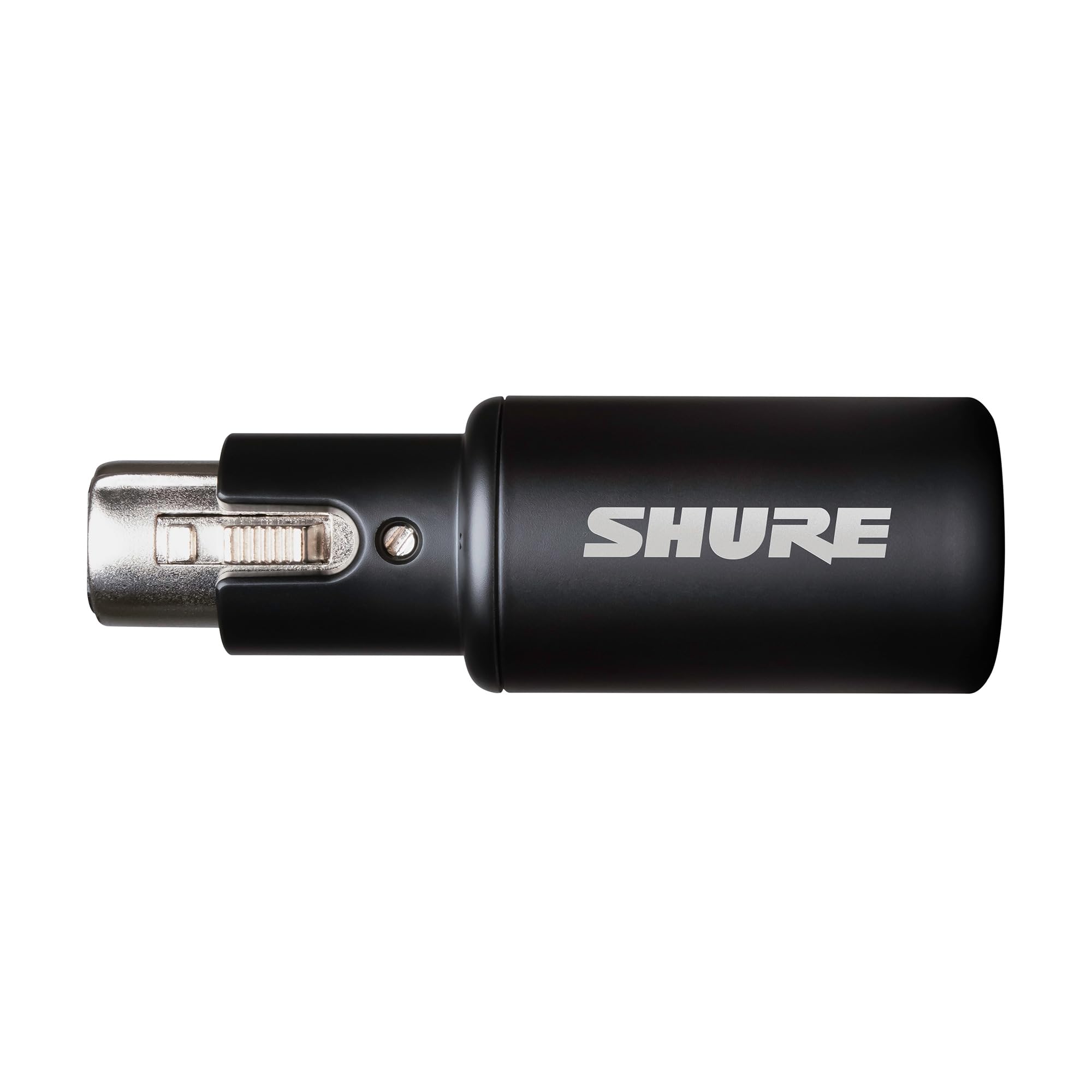
The MVX2U Gen 2 is a single-channel XLR-to-USB-C adapter that packs onboard DSP processing, making it a unique hybrid between a traditional interface and a standalone processor. The Real-Time Denoiser reduces background hum and room echo before the signal reaches your computer, while Digital Popper Stopper catches plosives without a foam windscreen. The Auto Level Mode adjusts gain on the fly and lets you choose between Dark, Natural, and Bright tonal presets—a massive convenience for livestreamers who cannot stop mid-broadcast to adjust knobs.
With 60 dB of clean gain and +48V phantom power, it drives both dynamic and condenser mics without needing an external booster. The unit is Apple MFi certified and works plug-and-play with iPhone and iPad via USB-C, making it the most portable solution here at just 100 grams. The MOTIV companion app gives you manual control over EQ, compressor, and limiter thresholds, and the settings persist across power cycles—so your customized tone is always ready.
The trade-off is a single mono input, which inherently limits you to one microphone or instrument at a time. There is no direct headphone jack on the unit itself; monitoring is handled through your device’s headphone output, which adds unavoidable latency. For mobile journalists, streamers on the go, or creators who value portability and built-in processing over multi-channel recording, the MVX2U Gen 2 is an exceptional value.
Why it’s great
- Onboard DSP denoiser and plosive reduction
- Plug-and-play with iPhone/iPad via USB-C
- Three tonal presets for instant voice shaping
Good to know
- Single-channel input only
- No dedicated headphone monitoring jack
6. Zoom AMS-24

The AMS-24 dedicates itself to the dual life of content creation with an innovative Music/Streaming switch that reroutes the audio path. In Music mode, the interface sends individual tracks to your DAW for multi-track recording and provides two independent headphone mixes. In Streaming mode, it merges all inputs—including computer audio—into a single stereo feed for platforms like Twitch, YouTube, or Zoom, eliminating the need for virtual routing software.
The unit features two combo XLR/TRS inputs with discrete gain controls, two headphone outputs, and balanced TRS main outputs. It runs on USB-C bus power and is compatible with Mac, Windows, iOS, and Android without external power. The loopback function is activated via a hardware switch on the side, meaning you don’t have to hunt through driver settings to route system audio into your broadcast. This makes it the most straightforward streaming interface for gamers and video podcasters who need to switch between recording and live commentary on the fly.
Build quality is entirely plastic, which keeps the weight down to 280 grams but raises long-term durability concerns compared to metal-chassis units. The maximum sample rate is 48 kHz, which is lower than the 192 kHz offered by most competitors—though perfectly adequate for streaming and spoken word. Customer feedback notes that the USB-C implementation can be picky with cables not supplied in the box, so using the included cable is essential for stable performance.
Why it’s great
- Hardware Music/Streaming switch simplifies routing
- Two headphone outputs with independent mixes
- Runs on AA batteries for field recording
Good to know
- Maximum 48 kHz sample rate
- Fully plastic housing may feel less durable
7. Zoom U-24 Handy
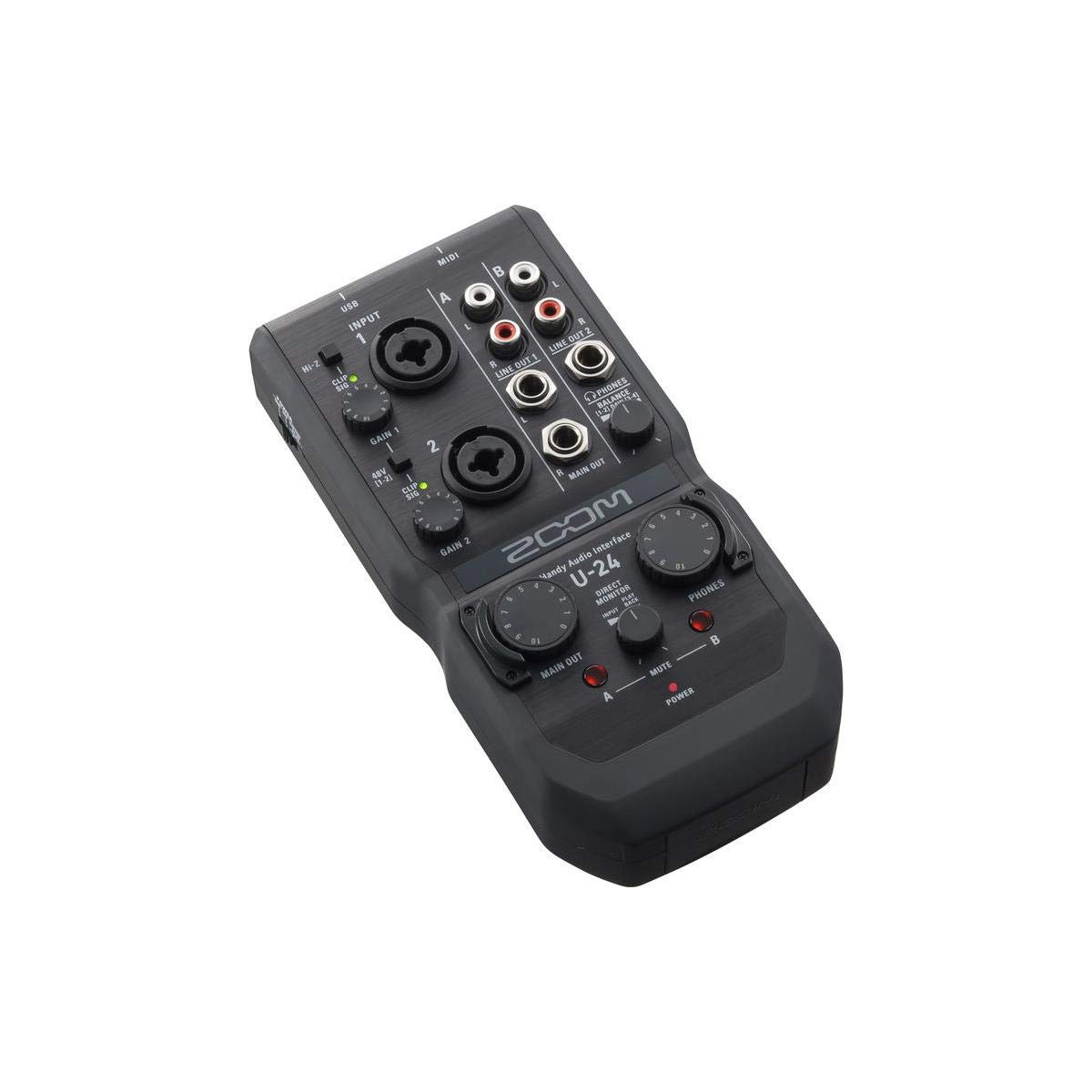
The U-24 Handy is uniquely suited for mobile recording scenarios where AC power is unavailable. It operates on two AA batteries in addition to USB bus power, allowing field recordists to capture stereo audio away from a computer. The two combo inputs feature high-performance mic preamps that deliver 24-bit/96 kHz resolution—slightly below the 192 kHz standard, but more than sufficient for location sound for video or ambient music capture.
Connectivity includes MIDI In/Out, a pair of balanced ¼-inch outputs, and RCA stereo outputs that connect easily to consumer stereo systems or older DJ mixers. The compact plastic chassis weighs only 0.63 pounds, and the included Ableton Live 9 Lite and Pro Tools First software give you a starting point for editing and mixing. Battery life is rated at several hours of continuous use, making it a legitimate option for remote interviews or documentary work where running a laptop is impractical.
The primary limitation is the 96 kHz ceiling, which matters less for spoken word but could be a factor for high-detail music work. Some customers have reported headphone output failure after extended use—a risk with plastic jacks that endure frequent plugging and unplugging. The U-24 is not designed for streaming or low-latency monitoring, but for the niche purpose of battery-operated multi-track capture, it occupies a space no other interface on this list fills.
Why it’s great
- Runs on two AA batteries for true field recording
- MIDI I/O for synth control in portable rigs
- RCA outputs for consumer audio systems
Good to know
- 96 kHz maximum sample rate
- Plastic chassis and jacks may wear over time
8. M-Audio M-Track Duo HD
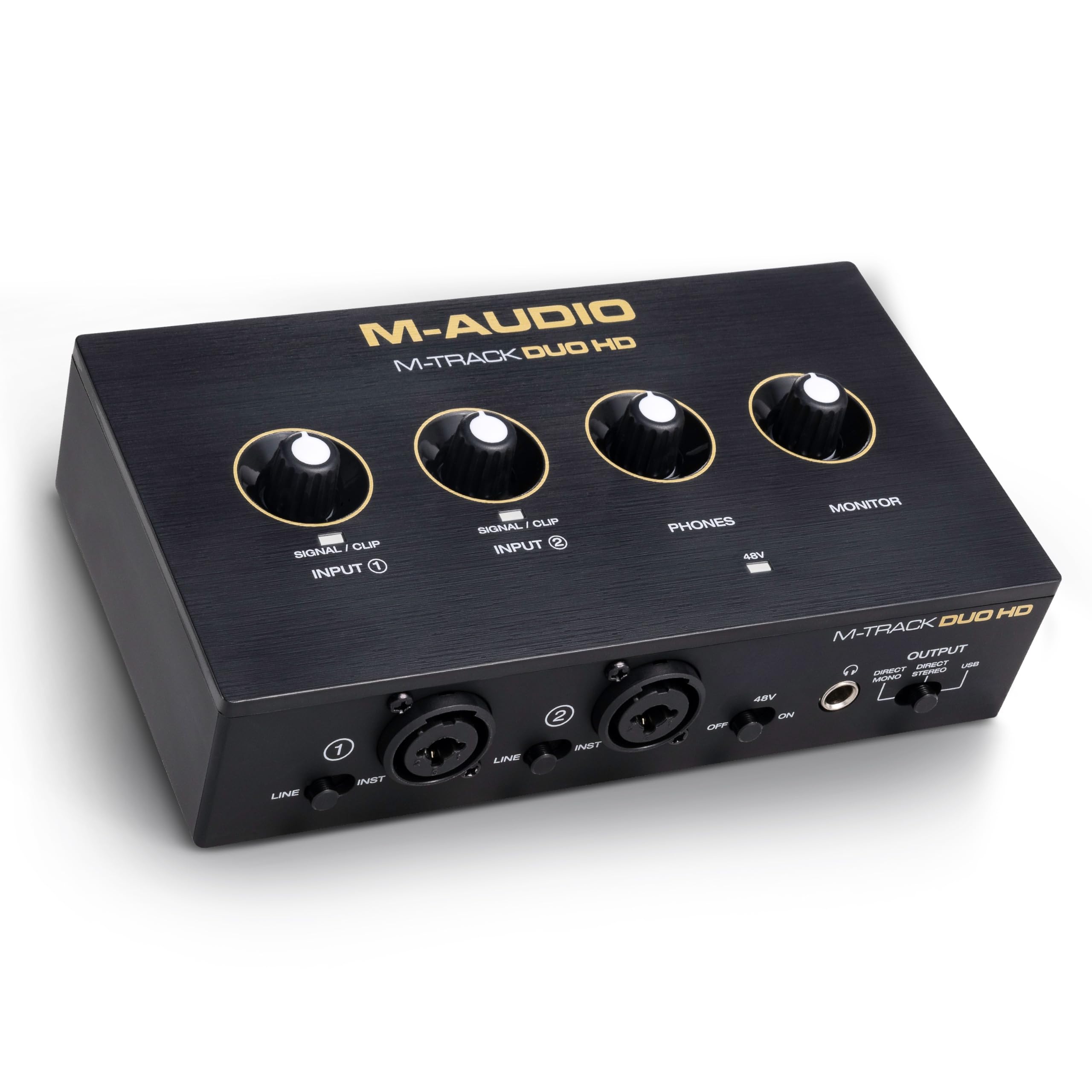
The M-Track Duo HD provides a 2-in/2-out configuration with Crystal preamps rated at 55 dB of gain and 24-bit/192 kHz conversion—specs that match interfaces costing twice as much. The two combo inputs accept XLR, ¼-inch TS instrument, and balanced TRS line sources, giving you flexible input options for microphones, guitars, and synths. The Direct/USB monitor switch lets you toggle between zero-latency input monitoring and full USB playback blend, a critical feature for vocalists who need to hear their own voice without delay.
Setup is straightforward across Windows, macOS, iOS, and Android, and the included USB-C cable provides both power and data. The physical size—7.5 inches wide by 4.4 inches deep—fits easily into a backpack or gig bag alongside a laptop. M-Audio bundles Ableton Live Lite, Reason+, MPC Beats, and a two-month Splice subscription, which offers a generous software package for beatmakers and electronic music producers who want to start creating immediately.
Customer feedback is largely positive for the price, though some users have reported driver issues under Windows 11, specifically with missing DLL files causing the control panel to fail detection. The preamp quality is good but exhibits a slightly higher noise floor than premium units, which may be noticeable if you record quiet sources like spoken word. For beginners and producers on a tight budget who need two inputs and high sample rate capability, the M-Track Duo HD is a reliable starting point.
Why it’s great
- Two combo inputs with 192 kHz support
- Zero-latency monitoring switch for vocal recording
- Generous software bundle for beat production
Good to know
- Driver issues reported on some Windows 11 systems
- Noise floor slightly higher than premium preamps
9. Behringer U-PHORIA Studio Bundle

The U-PHORIA Studio Bundle is the most comprehensive entry-level package available, including a USB audio interface, a condenser microphone, studio headphones, and all necessary cables. The interface itself provides two input channels with 48V phantom power and 24-bit/192 kHz conversion, matching the ceiling specs of many standalone units. For someone who owns absolutely no gear and wants to start podcasting or recording vocals immediately, this bundle removes the friction of buying components separately.
The included condenser mic delivers surprisingly clear audio for its tier, with a cardioid pattern that rejects room reverb well enough for untreated spaces. The headphones provide decent isolation but have been widely panned for poor comfort—the headband is too small for many adult users and the earpads lack adequate padding. The audio interface preamps, while functional, exhibit a hum or buzz on the mic input in some copies, though this is often correctable through software noise gating or grounding fixes.
Build quality across the bundle is cost-conscious: the interface is plastic, the mic is lightweight, and the headphones feel fragile. This is not a professional setup, but it is a functional one for learning the basics of microphone placement, gain staging, and DAW recording. If you plan to upgrade components over time, the interface can serve as a secondary mobile unit while you invest in a better microphone and headphones separately. For the absolute lowest cost of admission to XLR recording, this bundle delivers.
Why it’s great
- All-in-one package includes mic and headphones
- 192 kHz sample rate for detailed recording
- Lowest barrier to entry for XLR recording
Good to know
- Headphones are uncomfortable for most adults
- Interface may introduce mic input hum in some units
FAQ
Do I need an audio interface if I have a USB microphone?
What is latency and why does it matter for recording?
Can I use a 2-channel interface for live streaming?
Is 48 kHz sample rate good enough for professional music production?
Final Thoughts: The Verdict
For most users, the best audio interface under 200 winner is the Universal Audio Volt 2 because its Vintage preamp mode delivers analog warmth that transforms budget recordings into fuller, richer captures. If you want dedicated podcasting features like Auto Gain and dual headphone outputs, grab the Focusrite Vocaster Two. And for portable battery-powered recording in the field, nothing beats the Zoom U-24 Handy.