
Our readers keep the lights on and my morning glass full of iced black tea. As an Amazon Associate, I earn from qualifying purchases.
Specs are compiled from manufacturer listings and verified buyer reviews and can change over time — please confirm the key details on the product page before buying.
You want a 3-inch V-band clamp that actually fits your flange, holds without galling, and seals without a gasket. Get any of those wrong and you are back under the car next weekend. Before you scroll, note: this list uses flexible matching for the 3-inch diameter, so a few picks accept 3 inch as a selectable size rather than being stamped 3 inch on the nose. The nearest same-type size serves the same purpose, and every pick below is a genuine V-band clamp — never a hose clamp dressed up as one.
I’m Min — the founder and writer behind Gadgets Feed. This guide is built by comparing the manufacturers’ published specifications and the patterns across verified customer reviews, so you get each pick’s real strengths and trade-offs instead of marketing spin.
V-band clamps are unforgiving hardware: a flange that is a hair too wide or a thread that seizes on the second removal turns a twenty-minute job into an afternoon. That is why the specs below matter more here than in almost any other garage purchase, and why this breakdown focuses on flange diameter, bolt strength, and material above all else.
Our Picks at a Glance


How To Choose The Best 3 Inch V Band Clamp
Most people buying a V-band clamp for the first time get the size wrong, and it is not their fault. The number on the box refers to the pipe, not the ring you are staring at. Fix that one misunderstanding and the rest of the decision gets much easier.
Match the flange outer diameter, not the pipe
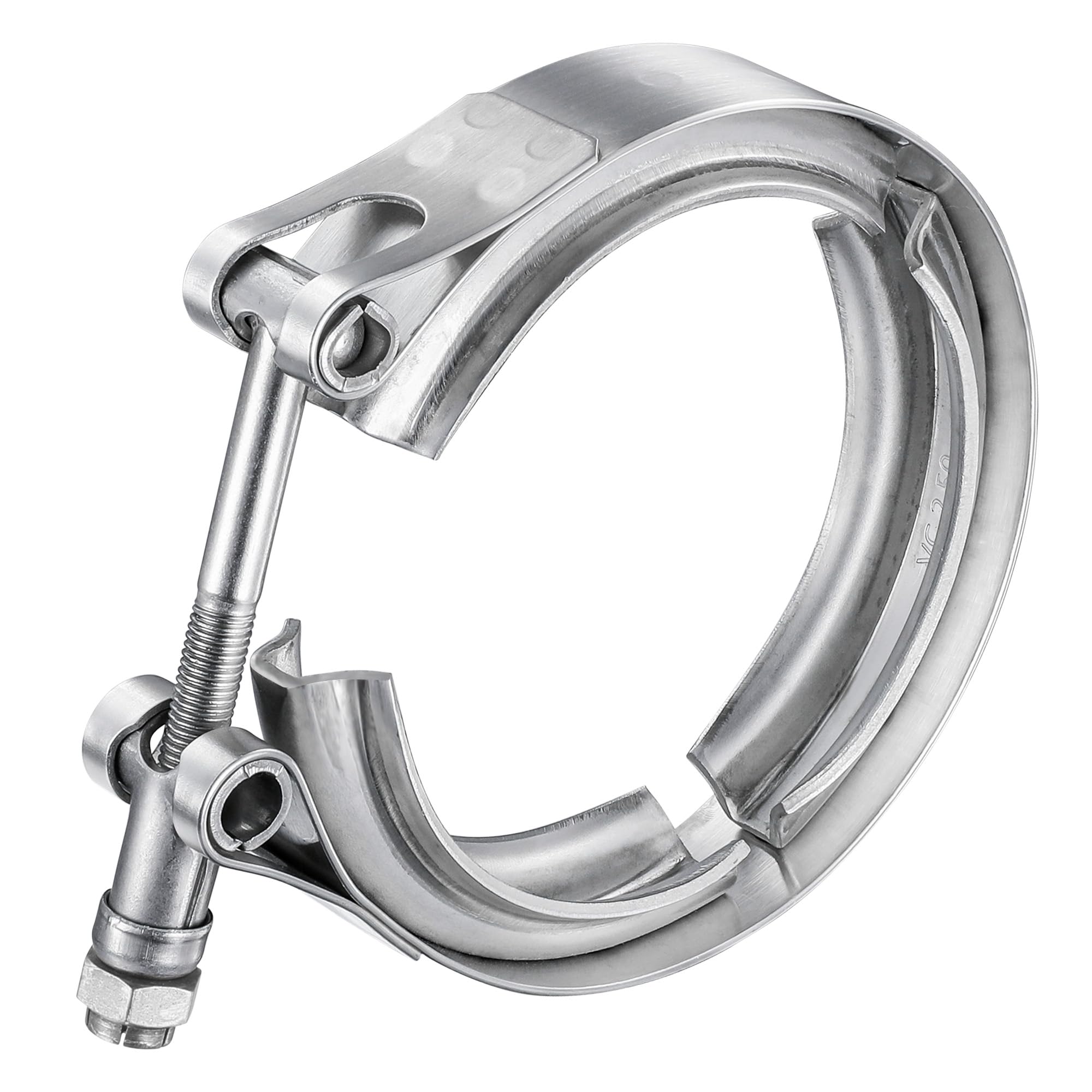
The clamp wraps around the two flanges you weld to your pipe ends, so the ring has to be wide enough to close over them. A 3-inch clamp generally fits flanges with a 3 5/8 inch outer diameter, and one pick here accepts flanges up to a 3.74 inch outer diameter. Measure the ring on your existing flange with a caliper before you order anything. If you go by the pipe diameter alone, you will order the wrong clamp — which is exactly the trap that catches most first-timers.
Decide if you need flanges at all
Some listings sell the clamp by itself. Others bundle the male and female flanges you weld onto your pipes. If your existing flanges are cracked, warped, or the wrong profile, buy the kit. If you are only replacing a stretched or seized clamp on a sound flange, buy the bare clamp and save the welding time.
Look hard at the bolt, because that is what fails
The clamp body rarely lets go. The T-bolt and nut do. A 304 stainless clamp with a matching stainless fastener will gall — meaning the threads cold-weld themselves together and the nut locks solid — unless you lubricate the threads with anti-seize before assembly. Chromoly steel fasteners and fine-thread studs with a locking nut are the two approaches that handle repeated removal best, and both appear on the picks below.
Check the tensile strength number
Tensile strength tells you how much pulling force the hardware handles before it breaks. You will see it listed in pounds or in psi, and the two are not interchangeable — a clamp rated in pounds and a clamp rated in psi are quoting different things. Higher is generally better for boosted applications where the joint sees heat cycling and pressure. For a naturally aspirated exhaust, most of the clamps below are already well past what the joint will ever see.
Quick Comparison
| Model | Best For | Item Diameter | Flanges Included | Item Weight | Amazon |
|---|---|---|---|---|---|
| POWERWORKS 2 Pack 3″ Stainless Steel V-Band Bolt Clamp & Male Female Flanges★ Best Overall | Complete weld-in kit with spares | 3 inches | Yes — 4 flanges | 1.14 kg | Amazon |
| EVIL ENERGY 3 Inch V Band Clamp 304 Stainless Steel (NoFlanges)Budget Champion | Fast single-clamp replacement | 3 inches | No | 0.28 kg | Amazon |
| WYSIWYKA 3 Inch V Band Clamp 304 Stainless SteelRacer’s Pick | Tight-space turbo and wastegate work | 3 inches | No | — | Amazon |
| JDMSPEED 3″ V-Band Flange & Clamp Kit | Rotational alignment on custom exhaust | 3 inches | Yes — 2 flanges | 0.49 kg | Amazon |
| GaeaAuto 3 inch V Band Clamp 304 Stainless Steel, 2 Pack | Budget two-clamp top-ups | 3 inches | No | 0.38 kg | Amazon |
| Ticon Industries 3″ Stainless Steel V-Band Clamp | Boosted builds under real pressure | 3 inches | No | — | Amazon |
| AA Ignition Stainless Exhaust V-Band Clamp Set of 3 | Doing three joints in one pass | 3 inches | Yes — CNC-machined flanges | 1.23 pounds | Amazon |
| HFS V Band Clamp Stainless Steel 304 with Male Female Flange | Quick-release service access | 3 inches | Yes — male and female | 1.4 pounds | Amazon |
| Mishimoto MMCLAMP-VS-3 Stainless Steel V-Band Clamp, 3″ | Lifetime-warranty confidence | 3 inches | No | 0.45 kg | Amazon |
In‑Depth Reviews
1. POWERWORKS 2 Pack 3″ Stainless Steel V-Band Bolt Clamp & Male Female Flanges
Our pick — over 4.5★ from 400+ verified ratings; the strongest balance of quality and price.
Two 3-inch clamps and four 304 stainless flanges in one box — a complete weld-in kit for building from bare pipe.
Building an exhaust or intercooler run from scratch? This box removes the guesswork. You get two 3-inch V-band clamps plus four 304 stainless flanges — a matched male and female pair for each clamp — so every joint you make is a complete, sealable assembly rather than a clamp hunting for a flange. The 304 stainless construction is the same alloy exhaust shops reach for because it shrugs off corrosion and the extreme temperature swings a turbo or downpipe throws at it. Nobody has to weld a gasket into place either: the V-band profile draws the two flange faces together evenly across the whole circle.
What wins people over here is how cleanly the parts go together. The flanges come out dimensionally accurate and weld without fussing, and the kit holds up over repeat orders — a set bought a year apart arrives as the same well-made product. The 1500-pound tensile rating sits on the clamp hardware, well above what a street exhaust joint will ever ask of it. The one thing to plan for: the fasteners are stainless, and stainless threads gall — meaning they seize and cold-weld together — if you dry-fit them and tighten hard. Put a dab of anti-seize on the threads the first time and the nut will still turn freely a year later.
Here is the honest trade-off. Weighing 1.14 kg, this pack is roughly four times the heft of a bare single clamp — you feel it the moment you pick up the box, because four flanges plus two clamps is a lot of stainless. That weight is the point, but it does mean this is the wrong pick if you only need to replace one stretched clamp on an otherwise healthy flange. It also expects welding. This is a fabrication kit, not a bolt-on: if your pipes are already flanged and in good shape, the bare EVIL ENERGY clamp further down saves you the welding entirely.
Where it earns its keep
- 304 stainless clamp and flanges resist corrosion and extreme temperature swings
- 1500-pound tensile rating on the upgraded bolt
- Getting all four flanges means both joints on a run are matched
- No special tools — one nut releases the whole assembly
What to know before ordering
- Requires welding the flanges to your pipes
- Stainless threads gall without anti-seize
- At 1.14 kg it is a heavy box — overkill for a single-clamp swap
Reach for this if: you are welding up a fresh exhaust, turbo, or intercooler run and want two matched clamp-and-flange assemblies in one box.
Look elsewhere if: your flanges are already welded and sound — you are paying for four flanges you will never use.
2. EVIL ENERGY 3 Inch V Band Clamp 304 Stainless Steel (NoFlanges)
The bare 304 stainless clamp you buy when the factory ring fails and the truck has to move by Monday.
A factory clamp lets go on a Friday and suddenly the whole weekend is about getting the truck back on the road. That is the exact scenario this clamp handles. At 0.28 kg it is a fraction of the weight of the flange kits — roughly a quarter of the POWERWORKS pack — because there are no flanges in the box at all. It is the clamp alone, built from 304 stainless with a chromium-molybdenum steel T-bolt that measures M8 by 1.25 across a 2.63-inch length. What you are really buying is a reusable joint: undo one nut and the section comes apart, which matters enormously on a downpipe you expect to pull more than once.
The material mix is why this one has earned its following. Owners run these across multiple vehicles — the same clamp finds homes on a Mini Cooper R56, an R55, and an R60 in one garage — and the sentiment that keeps coming back is simple: it seals up tight without the drama. Buyers report that it fits an aftermarket downpipe where the stock clamp failed, installs easily, and that two of these cost about what one competitor charges. One owner put it plainly after overnight delivery rescued a weekend build: the clamp “was a perfect fit” for their downpipe. That overnight availability is the quiet superpower here.
Be deliberate about size, because this is where the clamp divides people. It is built for a specific flange outer diameter, and depending on what you are replacing, it can land noticeably larger or smaller than the stock ring you pulled off. The bolt length also runs short for some setups. If you know your flange measurement and your pipe outer diameter, you are in good shape; if you are guessing from the pipe size alone, measure first. And as with any 304 stainless fastener, a little anti-seize keeps the nut moving freely on the second and third removal rather than the first.
The material story: 304 stainless for the clamp body and chromoly steel for the T-bolt is a smart pairing — the chromoly handles the torque, the stainless handles the heat and corrosion. It is rated to the same 1500-pound tensile figure as the pricier kits above, which tells you the hardware is not where the cost was cut.
Who it fits best: anyone replacing a failed stock clamp on a known flange. It is the fast, low-commitment fix that gets a vehicle moving again — the kind of part you keep a spare of in the toolbox.
The short version: the smartest same-day replacement if your flange is already welded and you just need the ring and bolt.
Hold off if: you do not have a caliper reading of your flange outer diameter — order the wrong ring and you will be shipping it back.
3. WYSIWYKA 3 Inch V Band Clamp 304 Stainless Steel for Turbo Exhaust Downpipe
Built for the tight corner behind a turbo where a bulky clamp simply will not fit.
The spec sheet on this one tells you who it is for. The clamp body is 304 stainless, but the T-bolt steps up to 420 stainless — a harder alloy that resists deforming under repeated torque — and the hardware is rated at 60000 psi. That rating is quoted per square inch rather than in pounds of pulling force, so do not line it up against the 1500-pound figures on the kits above; they are measuring different things entirely. What matters is this is a serious clamp aimed squarely at turbo, wastegate, and blow-off valve plumbing, and the 3-inch version connects 3-inch outer diameter pipes.
Read the fitment guide before you click, because this listing is unusually specific about it. No flange is included. The clamp fits 3-inch flanges with a maximum outer diameter of 3.74 inches, and the manufacturer recommends keeping the joined flange thickness at or below 0.25 inches. There is a dimension table in the listing for exactly this reason. The single most useful warning in the reviews comes from a buyer who ordered wrong and came back to say it: go by the outer diameter of the tube, not the outer diameter of the flanges. That one line saves more returns than anything else on this page.
Installation reads like a fabrication guide: polish the pipe incision, weld the male and female flanges in place, then tighten the clamp over the flange. Disassembly is the payoff — undo the clamp and the component comes off, which is the whole argument for V-band hardware on charge piping, intake pipes, and intercooler plumbing. Wastegate replacement is where this one keeps showing up, fitting with no drama where the old clamp had seen better days.
One caution worth taking seriously: because the clamp is compact, it gives you less room for a thick weld bead or an oversized flange stack. If your flanges are already on the thick side, verify against that 0.25-inch recommendation before ordering, not after.
Value read: a single clamp at an entry-level price point, with the 420 stainless bolt being the upgrade you are quietly paying for. For a wastegate or charge-pipe joint that gets removed regularly, that harder fastener is worth having.
Worth grabbing when: your flange stack is thin and your space is tight — turbo outlets and wastegates are where this clamp makes sense.
Wrong pick for: anyone who has not confirmed the pipe’s outer diameter with a tape measure first.
4. JDMSPEED New 3″ V-Band Flange & Clamp Kit Stainless Steel
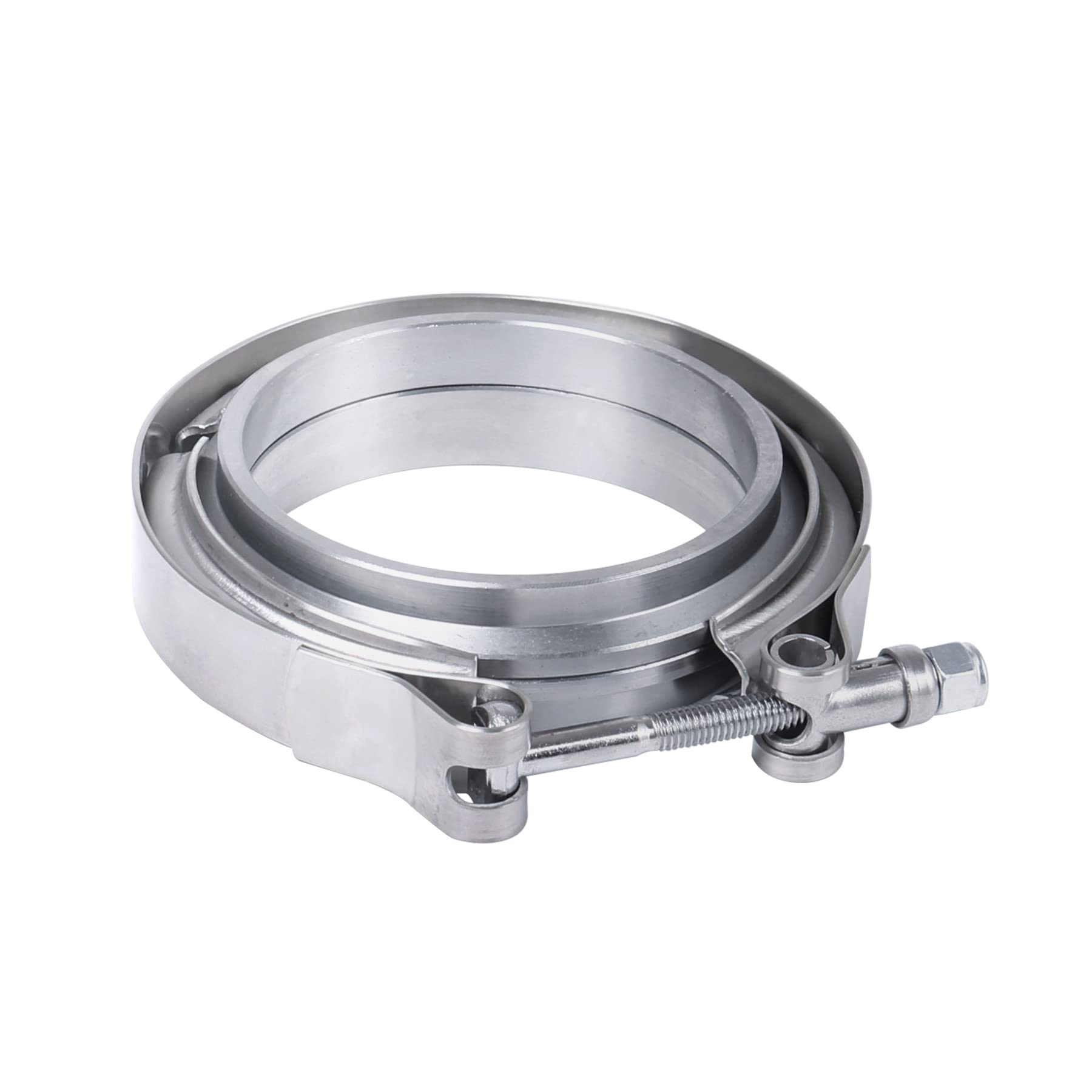
A clamp-and-flange kit that lets you clock the joint to any angle before you tighten the nut.
Rotational alignment is the feature that separates a V-band from a three-bolt flange, and it is the reason this kit keeps landing in custom exhaust builds. The V-band ring clamps evenly around the whole circumference instead of pulling at three fixed points, so you can rotate one side of the joint until the pipe angles exactly where you want it, then tighten. Nothing needs locating, nothing drifts as you torque. The box gives you one clamp plus two flanges measuring 3 inches inner diameter, both stainless, at a mid-range price that sits between the bare clamps and the premium names.
What buyers keep returning to is how well the parts take a weld. The clamp is stainless and the flanges are built thick enough to weld up cleanly and resist rusting out down the line. That thickness is a feature you feel during fabrication — thin flanges pull and warp under heat, thick ones hold their shape around the pipe. The kit also carries the standard V-band advantage: no hard-to-reach bolts and no special tools. Undo the clamp, pull the component, get to whatever vital part was buried behind the pipe, put it back together.
Owners mention a specific reason they chose this over the alternatives: where three-bolt flanges were the plan, this kit came in with a smaller footprint and won on flexibility once rotational alignment entered the picture. That is the real story — the slight cost difference buys you a joint you can adjust, re-clock, and service without cutting anything loose.
What it does well
- Rotational alignment lets you clock the joint before tightening
- Stainless clamp and flanges weld cleanly and resist corrosion
- Thick flange material resists warping under weld heat
- No special tools, and easy teardown for service access
Before you add to cart
- One clamp and two flanges is a single joint — plan for how many you need
- Flange welding is required, same as any V-band kit
- The stainless threads still want anti-seize before first assembly
Pick this one if: you want the joint to be adjustable after welding, not locked into a fixed clock position.
Skip the kit and buy bare clamps if: your flanges are already in place and only the ring needs replacing.
5. GaeaAuto 3 inch V Band Clamp 304 Stainless Steel for Turbo Downpipes, 2 Pack

Two 304 stainless clamps and a one-year warranty, for builds where you want a spare on the shelf.
This is the entry-level two-clamp option, and it makes most sense when you are outfitting more than one joint or want a spare in the drawer. The clamp fits 3-inch ID V-band flanges with a 3 5/8 inch flange outer diameter, and it also fits 3-inch outer diameter pipes. The body is 304 stainless with the corrosion and high-temperature resistance that alloy brings. The hardware is rated at 71000 psi, the highest psi figure on this list, though again that is a per-square-inch measure rather than the pound-based tensile figures you see on the kits — the two do not compare directly. Each box holds two clamps, with a one-year warranty covering replacement or refund.
The weight tells the real story. At 0.38 kg for the pair, this is the lightest multi-clamp option here, and the buyer feedback points at the same conclusion from a different angle: the metal runs thin compared to the beefier clamps on this list. Thinner material still seals a low-pressure exhaust joint perfectly well, and the fact that you get two clamps in the box is the quiet insurance policy — if one joint gives trouble, you have a second ring ready to go rather than a second shipping wait.
Where it asks for patience is the fastener. The threaded shaft on this clamp runs smaller than what you may be used to from other brands, and stainless threads of any size will gall if you cinch them down dry. One buyer found a nut seized on the shaft, and several noted the smaller bolt diameter as a surprise. Lubricate the threads before assembly, do not gorilla-tighten, and this clamp seals a standard exhaust or intercooler joint without complaint.
The value math: two clamps at a budget-tier price is the headline — you are effectively getting a spare for the cost of one from several competing brands. The thinner gauge and smaller bolt are where that value comes from, and for a naturally aspirated exhaust joint that is a fair trade.
Buy it when: you need two clamps for a light-duty exhaust or intake job and want a warranty backing the pair.
Think twice if: this is going on a high-boost joint where you want the thickest material and the largest bolt you can get.
6. Ticon Industries 3″ Stainless Steel V-Band Clamp with Heavy Duty Bolt

A two-nut locking clamp that stays torqued on a boosted engine where a single-nut ring backs off.
Two nuts instead of one is the detail that sets this clamp apart. A single locking nut can back off under heat cycling and vibration; the second nut on this Ticon clamp gives the joint a locking pair that keeps tension where it belongs. The clamp fits 3-inch flanges with a 3 5/8 inch outer diameter and handles flange outer diameters from 3.5 to 3.8 inches — that quarter-inch of adjustability covers a lot of real-world flange variance. It also fits a typical T4 turbo outlet with a 3-inch V-band discharge, and the heavy-duty bolt is built for exactly that environment. What owners keep coming back to is how solid it feels in the hand — a thick, substantial ring with a nice finish that does not give out early the way the cheapest clamps will.
The application range tells you how much headroom this clamp carries. It shows up in turbo builds — a turbocharged Acura Integra running these because they are beefier than most of what the market offers. It shows up replacing a downpipe-to-exhaust clamp on an LMM Duramax, where it is still slim enough not to crowd a tight space. And the joint does not just seal; it holds a seal against pressure and heat that would make cheaper hardware weep, with the leak-proof quality being one of the things buyers consistently call out. The combined flange apex width is 1/4 inch, so the clamp is looking for a specific flange profile — measure that before you order.
The flip side lives in the fasteners. The nut has a tendency to seize during tightening, which is why a drop of penetrating lubricant earns its place on installation day — that single step is the difference between a clamp you can service and a clamp you cut off. The small loops that retain the bolt are on the flimsy side, and a pair of vise grips helps hold things steady while you thread. Long-term, customers note the locking nut corroding more aggressively than the rest of the stainless clamp, so a swap to a standard nut or one with a locking washer is a sensible upgrade. None of that touches the clamp body itself, which is doing its job.
Why boosted builds like it
- Two-nut locking pair resists backing off under heat and vibration
- Fits flange outer diameters from 3.5 to 3.8 inches
- Sized to a typical T4 turbo outlet with a 3-inch V-band discharge
- Thick, substantial body with a quality finish
What to budget time for
- The locking nut seizes without penetrating lubricant
- Bolt-retaining loops are light — a second set of hands or vise grips helps
- The locking nut corrodes faster than the rest of the clamp
The right call for: anyone running boost who wants a clamp that stays torqued without constant re-checks.
Frustrating if: you install it dry and try to remove the nut later — lubricate first, every time.
7. AA Ignition Stainless Exhaust V-Band Clamp Set of 3, 3 Inch
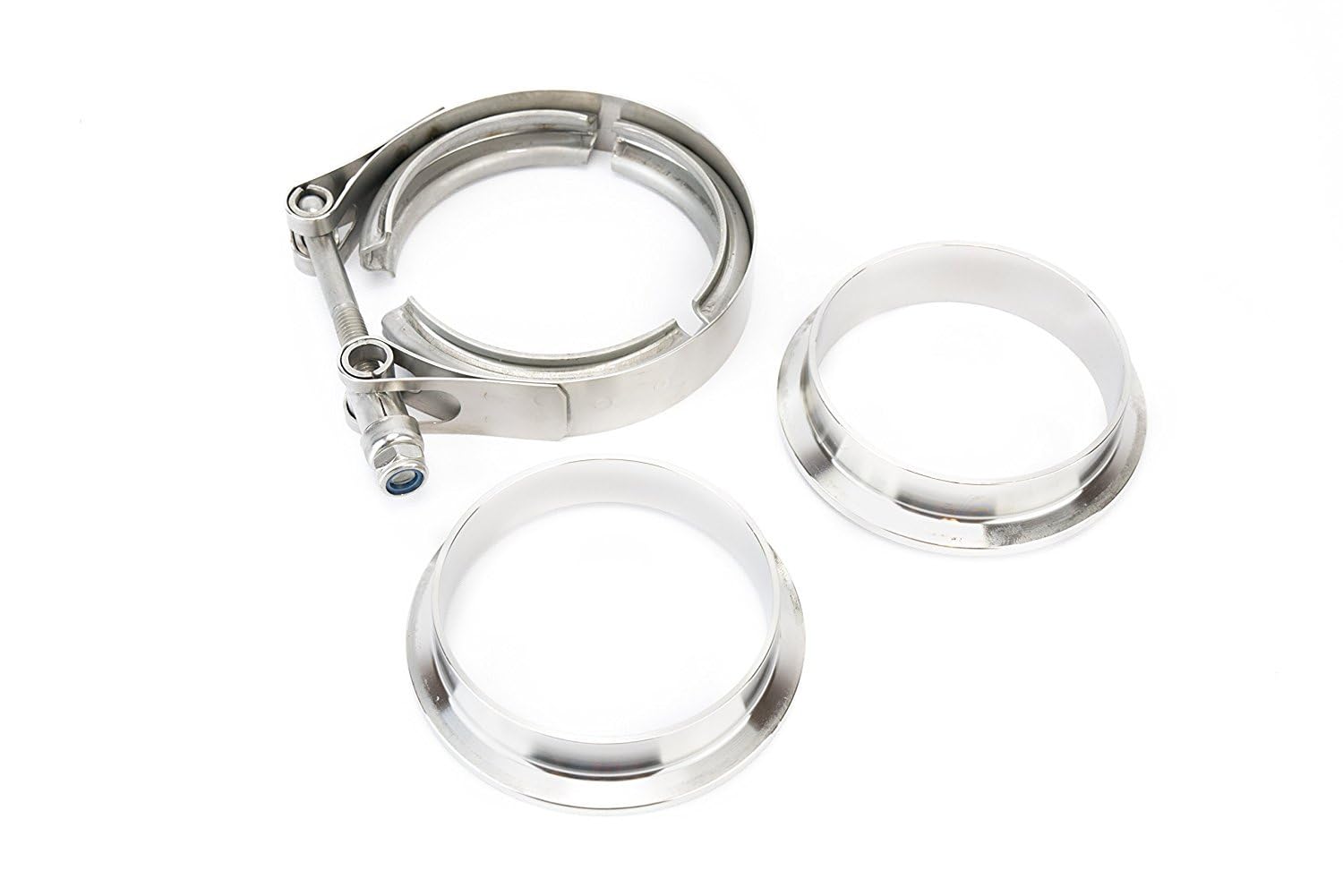
Three CNC-machined flange-and-clamp joints in one box, for a full exhaust rebuild rather than a single patch.
When the plan is a whole section of exhaust rather than one repair, buying joints one at a time gets tedious fast. This set hands you three of them — CNC-machined stainless steel flanges and matching clamps, sized for 3-inch pipe, at a premium-tier price that reflects the machining and the three-in-one capacity. The complete set weighs 1.23 pounds, so you are not exactly carrying a single spare ring. The flanges are male and female — one side indexes into the other — which locks the two halves together and gives you a mating step that aligns everything before the clamp ever goes on. That alignment feature is the one buyers call out as the nicest part of the design: the joint almost finds its own alignment, and the seal follows.
The flanges are cut thick, which matters once a torch is involved. Thin flange stock warps under welding heat; thick stock holds its shape, which is why the welds on these come out clean and the seal stays true. The clamp hardware is a fine-thread stud with a locking nut, a pairing that holds tension well on exhaust tubing, and the joint is sized so it will take a 3-inch pipe either butted or slipped. If you are dealing with an install where access is tight and the pipe is already in place, plan your welding order — one reviewer noted the post-weld install was the difficult part of an otherwise smooth job. Warping is the thing to watch: clamp the flange to something solid while you weld and let it cool before you torque the bolt.
The fastener warning is the same stainless-versus-stainless lesson that runs through this entire category. The supplied stainless lock nuts will seize on the T-bolt, anti-seize or not, and the fix that keeps coming up is swapping them for a pair of 8mm by 1.25 brass nuts — brass on stainless will not gall. Do that at assembly and this set behaves for years; skip it and the first removal becomes a wrestling match.
Where the money goes: CNC-machined flanges and a male-female indexing design are the two upgrades over the cheaper kits here. If you are welding three joints, that indexing step pays for itself in alignment time alone.
Sizing honesty: these flanges run slightly large so they slide over the pipe, which is deliberate — it leaves room for the weld. Confirm your pipe’s outer diameter is genuinely 3 inch before you commit to a set of three.
Made for: a full exhaust or header-back build where three joints come together at once.
Overkill for: a single clamp replacement — you would be buying two joints more than you need.
8. HFS V Band Clamp Stainless Steel 304 with Male Female Flange, 3 IN

A male-and-female flange kit that seals by overlap with no gasket, for parts you pull often.
Every assembly in this kit is the same three pieces: a male flange, a female flange, and a 304 stainless V-band clamp to draw them together. That complete-pair approach means you get a gasket-free seal from the start — the two flange faces meet as an overlap seam rather than compressing a gasket between them, so there is nothing to blow out and nothing to replace. For anyone who has chased a leaking exhaust gasket, that design choice is the whole argument. The kit is built specifically for 3-inch exhaust pipes, and the whole assembly weighs 1.4 pounds.
Two details make this one pleasant to actually use. First, the threaded piece detaches from the clamp, which opens up room to thread it on and line everything up before you commit — that is the kind of small design decision that saves knuckles on a job with no clearance. Second, the flanges interlock, and the interlocking profile is what buyers point to when they say the seal beats the cheaper clamps. The flange rings also run longer than most, protruding further than the typical set, which does two useful things: it gives you more surface to weld against, and it lets you clamp the rings down while welding to hold them flat and resist warping. If you are replacing a cut-off bolted flange, that extra length helps you restore the original pipe length rather than building a spacer.
The clamp does its job with real conviction. Owners put these on wastegate connections and report the weld takes beautifully, and the body arrives beefier than the quick-disconnect form factor would suggest. It is the same idea as the well-known quick-release V-bands, doing the same work, at a mid-range price. The one downside worth naming: the retaining bolt can work loose over time, so check the torque periodically and use that drop of anti-seize the listing recommends on the retaining nut to keep it serviceable.
what separates it
- Detachable threaded piece makes installation and alignment easier
- Interlocking male and female flanges create a gasket-free seal
- Longer flange rings give more weld surface and resist warping
- 304 stainless body is sturdier than the quick-release look suggests
The honest caveats
- The retaining bolt can loosen over time — recheck torque
- Welding the flanges is required for the seal to work
- The overlap-seam design leaves no room for a gasket if you wanted one
Land on this if: you service the joint often and want a gasket-free seal you can pop apart in seconds.
Look past it if: you prefer the security of a gasket in the joint — this design seals by overlap instead.
9. Mishimoto MMCLAMP-VS-3 Stainless Steel V-Band Clamp, 3″ (76.2mm)
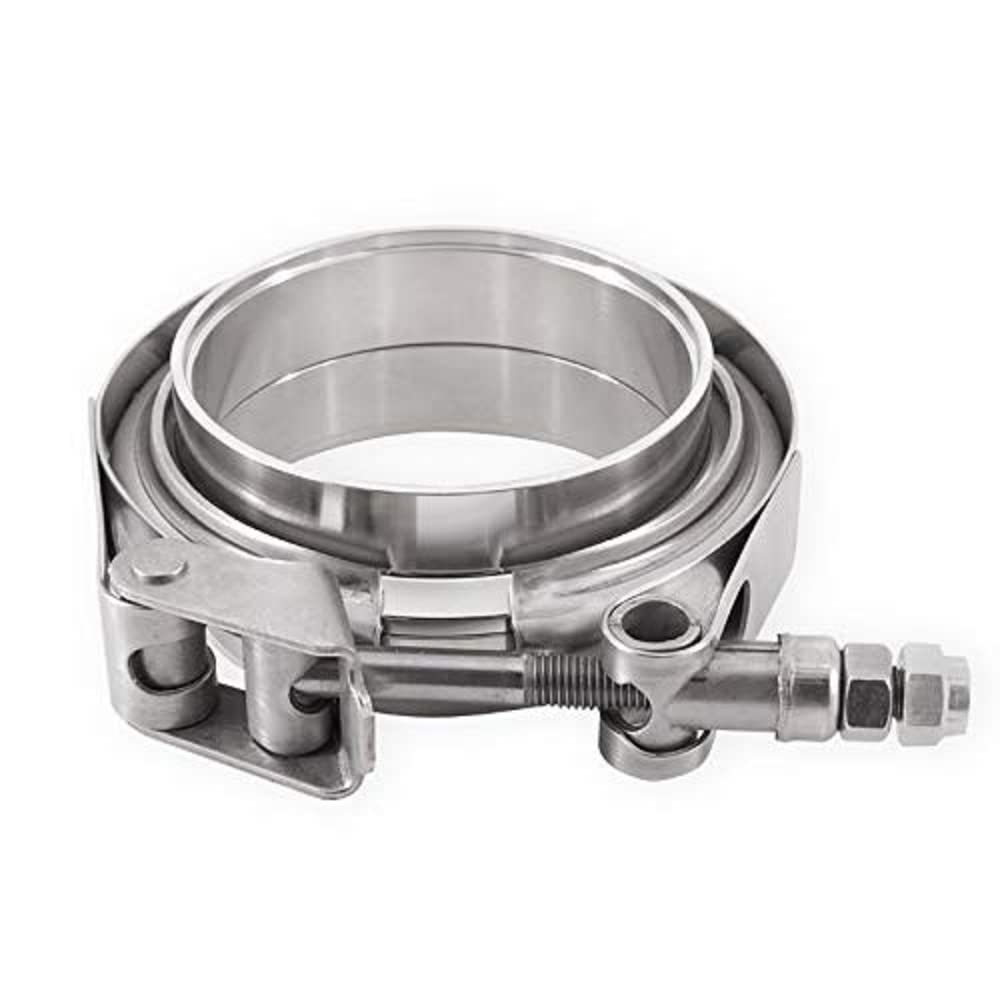
A 304 stainless clamp for 3-inch pipe, backed by a lifetime warranty and a reusable fabrication nut.
Mishimoto backs this clamp for life, and the construction explains why a manufacturer would offer that. The clamp provides a rigid, secure connection between 3-inch pipes — 76.2mm in the metric figure the listing quotes — and the stainless steel body resists rust and corrosion in the harshest environments. The reusable fabrication nut and quick-release design exist for one reason: holding the joint together while you weld without permanently committing the clamp to the pipe. That matters when you are tacking up a system in one position and need the alignment to still be true after the torch comes off.
The environment this clamp gets asked to survive runs from intercooler piping to intake tubing to full stainless exhaust, and the recurring theme from real builds is shape retention. Weld it in sections around the pipe diameter rather than all at once and the flange stays flat. One owner applying these to a 3.5-inch stainless exhaust rebuild noted the flange retained its shape and the assembly went together easily. Another installed it on an LMM Duramax as a downpipe-to-exhaust replacement during a starter job, and the reason this one got picked over the alternatives was simple: it was better quality than stock, not so bulky it crowded a tight engine bay, and the lifetime warranty settled the decision.
The counterintuitive part is the price position. This is the premium pick here, yet owners who shop these regularly will tell you the assemblies come in well under what comparable brands charge for the same job. A buyer fitting one to a motorcycle exhaust — admittedly a low-pressure application — reported easy welding and no warping, and a clean seal afterward. That is a lot of clamp for the money, with the warranty stretching the value further still. The practical note that applies to every 304 clamp on this list applies here too: lubricate the threads before assembly and you will never fight the nut on a future removal.
The standout claim: a lifetime warranty on a clamp is unusual in this category, and it is the single strongest reason to pick this one over the mid-range options if you plan to keep the vehicle long-term.
Fit note: confirm your flange’s outer diameter and pipe size when ordering — the clamp is built for 3-inch pipe, but flange dimensions vary enough between brands to matter. If your build needs rotational alignment instead of a bare clamp, the JDMSPEED kit above solves a different problem.
For the long haul: a build you intend to keep and service for years, where the lifetime coverage and shape retention matter more than the entry price.
Not the one if: you are doing a single low-stakes replacement and want the lowest entry cost instead.
Understanding the Specs
Item Diameter and Flange Outer Diameter
Every clamp here is listed as 3 inches, which refers to the pipe it is built for. What actually determines fit is the flange outer diameter — the width of the ring the clamp closes around. A 3-inch clamp commonly fits flanges with a 3 5/8 inch outer diameter, and some listings accept up to 3.74 inches. Measure your existing flange with a caliper before ordering rather than trusting the pipe size alone.
Tensile Strength: Pounds vs psi
Tensile strength describes how much force the hardware handles before it fails, and the units on this list are not interchangeable. Some clamps quote a figure in pounds — the POWERWORKS and EVIL ENERGY clamps both sit at 1500 pounds. Others quote psi, a per-square-inch measure. A clamp listing 60000 psi and a clamp listing 1500 pounds are measuring different things, so compare like for like.
304 Stainless Steel and Thread Galling
304 stainless is the alloy used across nearly every clamp on this list because it resists corrosion and handles high heat without flaking apart. Its weakness is galling: stainless threads rubbing against stainless threads can cold-weld together and seize solid. A dab of anti-seize on the fastener before first assembly is the standard fix, and it is the difference between a clamp you can remove later and one you cut off.
T-Bolt, Chromoly, and Locking Nuts
The bolt is the part that actually fails on a clamp, so its material matters. Chromoly steel T-bolts handle torque without stretching; 420 stainless bolts resist deforming; fine-thread studs with a locking nut hold tension against vibration. Clamps with a two-nut locking pair, like the Ticon clamp, fight back-off under heat cycling better than a single nut.
Flange Kits vs Bare Clamps
A bare clamp replaces the ring on an existing, sound flange — less work, less welding, less cost. A flange kit also gives you the male and female rings you weld onto the pipe ends, which is what you need when building from scratch or replacing a cracked, warped flange. Match the buy to the job.
Gasket-Free Sealing and Weld Warping
V-band joints seal by drawing two flange faces together evenly around the entire circumference, which is why many need no gasket at all. That even clamping is also why they resist warping better than a three-bolt flange, which pulls at fixed points. Clamping the flanges together while you weld helps them stay flat, and welding in short sections around the diameter limits heat build-up.
FAQ
How do I know which size V-band clamp fits my exhaust?
Do I need flanges, or can I buy just the clamp?
Why did my stainless clamp threads seize up?
What does tensile strength actually mean on a V-band clamp?
Do V-band clamps need a gasket to seal?
Can I install a V-band clamp without welding?
How many times can I remove and refit a V-band clamp?
Will a 3-inch V-band clamp work on a turbo downpipe?
Is a three-bolt flange better than a V-band clamp?
How do I stop my flanges from warping when I weld them?
Final Thoughts: The Verdict
If you are starting from bare pipe, the POWERWORKS 2 Pack 3″ Stainless Steel V-Band Bolt Clamp & Male Female Flanges is the one to put in the cart — two clamps and four 304 stainless flanges in a single box, rated at 1500 pounds, so a full run gets built without a second order. For something you pull apart regularly, the EVIL ENERGY 3 Inch V Band Clamp is the fast, low-commitment fix that seals tight the first time. And when the joint has to hold under boost for years, the Ticon Industries 3″ Stainless Steel V-Band Clamp and the lifetime-backed Mishimoto MMCLAMP-VS-3 are the two that reward the extra spend. Whatever you choose, put anti-seize on the threads before you tighten a single nut.
How We Picked
We do not accept paid placement. Every pick is matched to a real buyer and a real use-case; we do not hands-on test units.
Sources & Methodology
Specifications: manufacturer listings and product documentation. Review insights: verified customer reviews, as of September 2026. Pricing: not shown on this page (it changes often); check the current price via the retailer link.
As an Amazon Associate, Gadgets Feed earns from qualifying purchases. This does not affect which products we feature.