
Our readers keep the lights on and my morning glass full of iced black tea. As an Amazon Associate, I earn from qualifying purchases.
Specs are compiled from manufacturer listings and verified buyer reviews and can change over time — please confirm the key details on the product page before buying.
If you live far from your local broadcast towers, the biggest question is simple: which outdoor antenna actually pulls in the channels you want — and which one leaves you staring at a frozen screen? This guide walks through nine outdoor TV antennas that mount on a roof, attic, or mast, and it explains in plain language what each one does well and where it struggles. The goal is not a pile of spec sheets. It is helping you pick the one that fits your distance from the towers, your terrain, and if you need to turn it by hand or from the couch.
I’m Min — the founder and writer behind Gadgets Feed. This guide is built by comparing the manufacturers’ published specifications and the patterns across verified customer reviews, so you get each pick’s real strengths and trade-offs instead of marketing spin.
Antenna marketing loves huge range claims, but real reception depends on tower distance, terrain, and if you need VHF or just UHF. The picks below range from a fringe-area specialist that pulls distant High-VHF signals to a compact omni that never needs aiming, so pick the one that matches your towers and how much effort you want to put in — this roundup of the best outdoor antenna options covers every setup from budget yagis to premium long-range rigs.
Our Picks at a Glance


How To Choose The Best Outdoor Antenna
Choosing the right outdoor antenna is less about picking the highest number on the box and more about matching the antenna type to your broadcast situation. Distance from the transmitters, the terrain between you and the towers, and whether your must-have channels sit on VHF or UHF all change which design works best. Here is what actually matters.
Directional vs. omnidirectional: the biggest decision
A directional yagi antenna focuses its reception in a narrow beam toward the towers you point it at. That focus is what lets it pull in weak, faraway signals — but it means you have to aim it, and stations spread far apart can force trade-offs. An omnidirectional antenna grabs signals from every direction at once, so you never aim it, but it trades away some raw long-range reach. If your towers are clustered in one direction and far away, a yagi usually wins. If your stations are scattered around you, an omni keeps life simple.
Reading the range claim honestly
Manufacturers quote maximum range under ideal conditions, and real-world results depend on hills, trees, and building height. A claimed long range means the antenna is designed for fringe reception — it is a capability signal, not a guarantee. Raising the antenna higher and removing obstacles does more for reception than any single spec.
VHF-Low, VHF-High, and UHF
Broadcast channels live on three bands: VHF-Low, VHF-High, and UHF. Most antennas handle UHF and High-VHF well, but VHF-Low channels are the hardest to pull in and often need a design built specifically for them. Check whether any must-have local channel broadcasts on Low-VHF before you buy.
Quick Comparison
| Model | Best For | Max Range | Directional Design | Cable Included | Amazon |
|---|---|---|---|---|---|
| Televes DAT BOSS Mix LR 149884★ Best Overall | Fringe-area long-range reception | Up to 80 miles | Directional (stacked triple-boom) | Power supply included | Amazon |
| McDuory TV Outdoor Yagi AntennaBest Value | Budget roof or attic setup | Up to 70+ miles | Directional (Yagi) | Cable included | Amazon |
| CEKAY Outdoor Yagi TV AntennaBest for Attic | Attic install with included J-pole | Up to 70 miles | Directional (Yagi) | 40 ft RG6 included | Amazon |
| CEKAY 150-Mile Motorized Outdoor Antenna | Scattered stations, remote aiming | Up to 150 miles | Motorized 360° rotation | 40 ft RG6 included | Amazon |
| GE Outdoor HD Digital TV Antenna | All-in-one kit with mounting hardware | Up to 80 miles | Directional (Yagi) | Not included | Amazon |
| Channel Master Omni+ 50 | No-aim 360° reception | 50+ miles | Omnidirectional (360°) | Not included | Amazon |
| Five Star Outdoor HDTV Antenna | Multi-TV install, ATSC 3.0 ready | Up to 200 miles | Directional | 40 ft coax included | Amazon |
| Winegard Classic Series Yagi YA7000C | Low-VHF channel reception | Up to 70 miles | Directional (Yagi) | Not included | Amazon |
| Winegard HD8200A Platinum | Heavy-duty rural long-range install | 65+ miles | Directional (Yagi) | Not included | Amazon |
In‑Depth Reviews
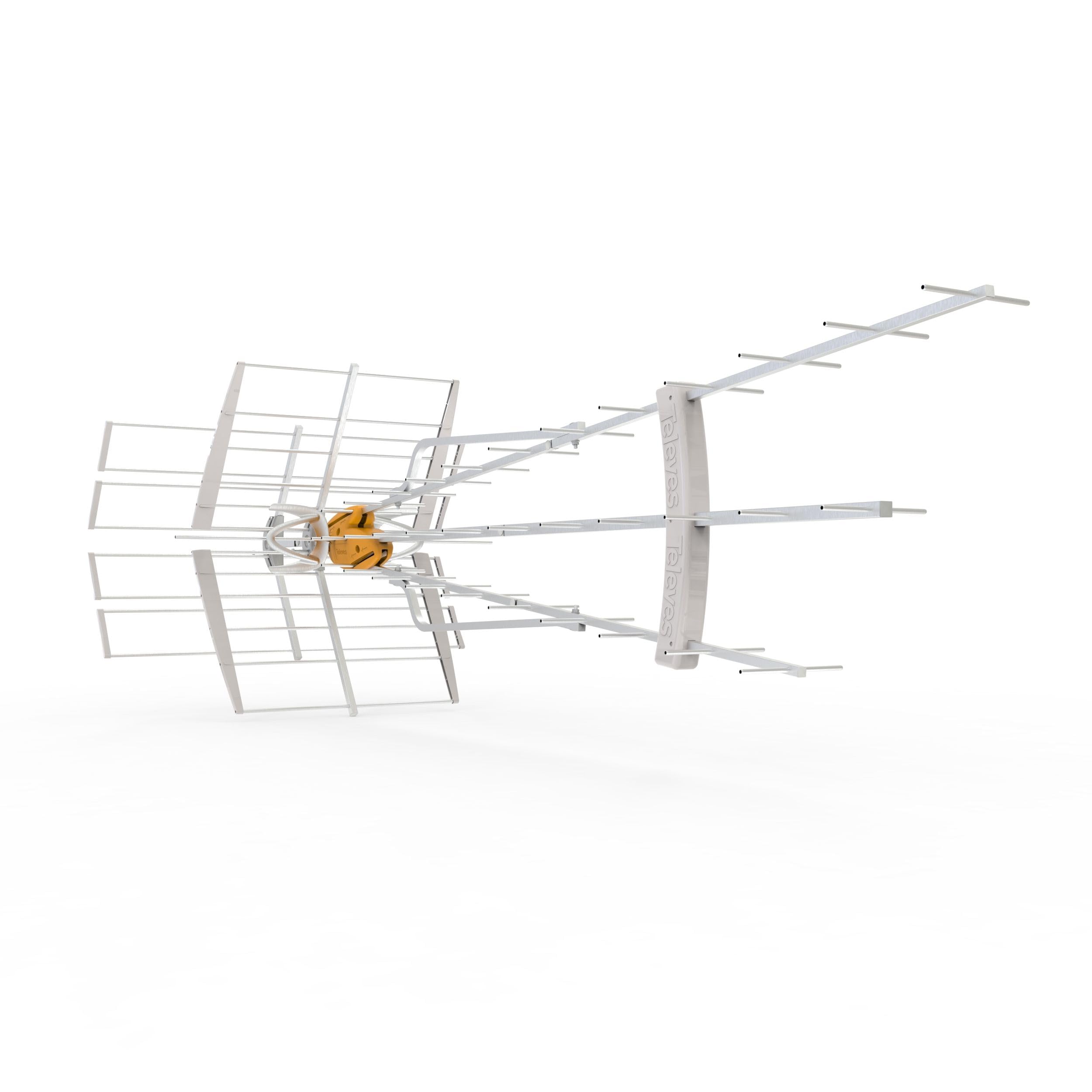
1. Televes DAT BOSS Mix LR 149884 HDTV Antenna
Our pick — over 4.5★ from 450+ verified ratings; the strongest balance of quality and price.
The fringe-area workhorse that pulls distant High-VHF stations most antennas cannot reach
If your towers sit 50 to 80 miles out, behind trees, or down in a valley, this is the antenna built for exactly that fight. The signal-boosting amplifier (a TForce preamp) is built right into the antenna itself rather than sitting down at the TV, so it lifts the incoming signal before cable loss can degrade it. That built-in design, alongside the dedicated FM and cellular filtering, is what separates this from simpler passive yagis. Buyers report it working in some serious fringe spots — one buyer pulled 29 channels from a 32-foot mast in a low, tree-filled area about 60 miles from the Dallas/Ft Worth towers. What wins people over most is raw build and reception quality; the rugged metal construction and stable signal are the things owners keep coming back to in their write-ups.
That performance comes with a demanding setup. This is a directional antenna with a deliberately narrow reception field, so small aiming errors cost you channels. Expect to spend real time getting the bearing right, and plan for tricky assembly — some owners found it fiddly. The reward is real, though: multiple rural buyers who had tried five or more antennas finally locked a strong signal, and the amplifier’s automatic gain control keeps output steady when conditions shift. It handles both High-VHF and UHF bands, and the LTE/5G filtering keeps nearby cell towers from muddying your picture.
Versus the budget McDuory pick below, the Televes covers far more channel territory — its 29-channel capacity versus the McDuory’s 2 shows this is built for a much wider broadcast load. It also carries a 4.6 rating, the strongest score in this roundup. The trade-offs are real: an 84.13-inch span means a sturdy mast is a must, and the assembly fussiness is a genuine barrier if you want a plug-and-play afternoon job.
Built-in amplification
- TForce preamp sits inside the antenna, so signal is boosted before cable loss — the biggest edge over passive yagis.
- Dual-band design (38 dBi High VHF, 46 dBi UHF) handles both bands separately and auto-adjusts when conditions change.
- LTE/4G/5G filtering built in, which reduces interference from nearby cell towers.
- High-quality construction — aluminum elements, stainless steel hardware, ABS plastics.
- Runs in passive mode if power is unavailable, so a power cut does not kill your reception.
What to plan around
- Narrow reception field — you must aim it carefully or you lose channels.
- Assembly is the recurring gripe; it takes patience.
- At 84.13 inches long, it needs a solid mast and a clear mounting spot.
Best for: Rural or fringe-area homes 50-80 miles from towers, where pulling weak distant stations is the whole point.
Look elsewhere if: You want a simple no-aim or budget install — a passive yagi or an omni will suit you better.
2. TV Outdoor Yagi Antenna with Long Range Reception Capacity
The budget yagi that surprises owners by beating antennas that cost several times more
For anyone within about 50 miles of their towers who wants maximum channels for minimum fuss, this is the dollar-per-signal champion of the list. It is a passive yagi antenna, meaning no amplifier — and owners mention it holding a solid signal through bad weather without one. Multiple owners who upgraded from indoor amplified antennas saw their channel count jump dramatically, with one buyer going from roughly 65 pixelated channels to 101 clean ones.
Give yourself an hour for the install. The assembly is straightforward but not tool-free in practice — the long tynes can fit loosely in their plastic sockets, and pop rivets are a common DIY fix. The passive design means it leans on height and a clean cable run instead of amplification, so mounting it high in an attic or on a roof makes a real difference. It covers UHF and High-VHF well and handles 1080i broadcasts, though low-VHF channels are outside its balance.
Against the Televes above, the McDuory trades raw long-range muscle for wide availability — its 2-channel capacity shows it is built for a tighter broadcast load, while the Televes handles 29. It also gives up built-in amplification, so you have to rely on elevation. Still, for a modest setup close to the towers, few options deliver this much usable signal for the money.
The upside: A passive antenna that owners say holds a clear signal in bad weather, installs in about an hour, and costs a fraction of amplified models — no power run or amplifier to wire in.
The honest catch: It is a passive design, so it depends on height and good coax more than amplification, and the antenna rods sometimes need extra-firm seating or a rivet to stay put.
Grab it if: You sit within about 50 miles of your towers and want the most channels for the least money, with no amplifier to power.
Think twice if: Your stations are beyond 60 miles or you need low-VHF channels — you will want amplification and a low-VHF design.
3. CEKAY Outdoor Yagi TV Antenna
The all-metal yagi that ships with everything, including the J-pole and 40 ft of cable
What stands out here is how complete the kit is: this CeKay yagi arrives with a 40-ft RG6 coax cable and its own J-pole mount, so you are not hunting down extra hardware before you climb up. It is designed to work in an attic, on a roof, or even on an RV, and the all-metal build is meant to shrug off heat, rain, wind, and snow. Customers note strong results in practical setups — one buyer ran it in their basement and still saw 90 to 100 percent signal on every channel, then got full strength plus 30 extra channels when moved to the attic with towers about 20 miles out.
The naming quirk is worth flagging: despite “70 miles” on the spec sheet, owners consistently report it performing best within about 30 to 50 miles. That is a range-honesty point rather than a flaw — treat it as a solid regional antenna, not a deep-fringe specialist. Assembly is mostly done for you, requiring only minor steps, and the printed instructions are clear. It also covers a wide frequency range, 170 to 860 MHz, and includes ATSC 3.0 compatibility for future broadcasts.
Compared with the McDuory, the CeKay throws in the mount and cable, which saves a separate purchase and a return trip to the store. It also picks up more of the broadcast range in one device — CeKay’s spec cites up to 100 channels versus the McDuory’s more limited capacity. The recurring caution is durability: the plastic rod holders may not love intense UV and extreme weather, and owners using it outdoors suggest gluing the rod connections to keep them tight long-term.
What the kit gives you: A ready-to-install package — antenna, J-pole, and 40 ft of RG6 — with easy, mostly pre-assembled setup and a low-VHF-capable frequency range of 170-860 MHz.
Worth knowing: It performs best within roughly 30-50 miles despite the 70-mile spec, and the plastic rod holders can degrade with heavy sun and weather, so treat it as a regional solution.
Reach for this if: You want a complete, all-in-one install — mount and cable included — and sit within about 50 miles of your towers.
Pass if: You are deep in fringe territory and need a true long-range performer, or you want a mount that needs no gluing for outdoor life.
4. CEKAY 150-Mile Motorized Outdoor TV Antenna
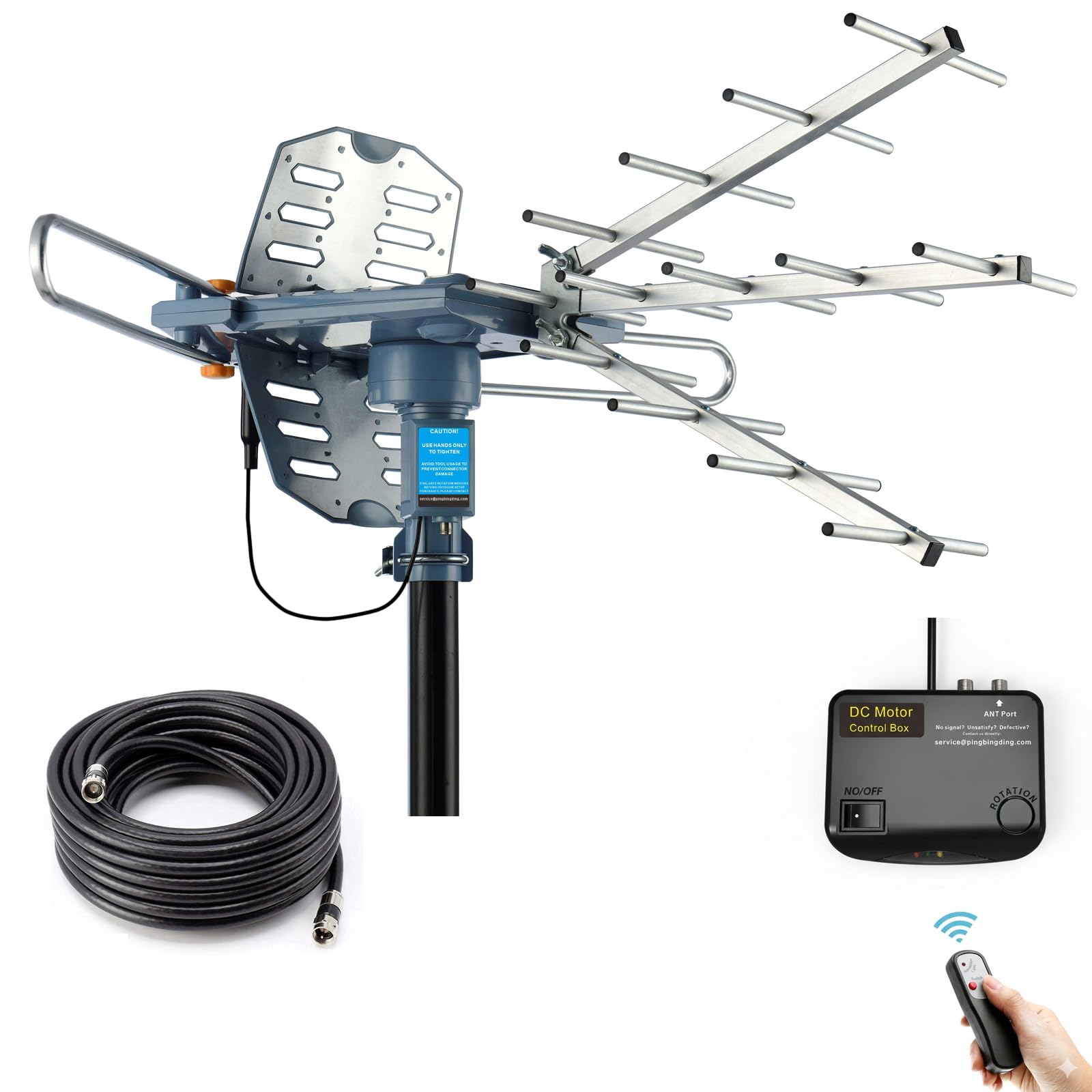
Point it at different towers without ever leaving your couch, thanks to the wireless remote
When your local stations sit in two or three different directions, a fixed antenna forces you to compromise. This motorized CeKay solves that by letting you steer the antenna by remote — a small DC motor rotates it smoothly, and you tune direction from indoors instead of climbing to the roof. Reviewers point out pointing it NNE and picking up channels from both the north and south-southwest at once, and several note it pulls in more channels than their neighbors’ larger units, with one rooftop install scanned roughly 70 stations about 50 miles from the Mt. Wilson towers in LA.
The build is where expectations need managing. It is a mostly plastic design, and while that keeps it light and easy to mount, the housing material is the most-discussed concern in this model’s reviews. Owners who have run it for a few years report the plastic degrading under winter, wind, and UV, sometimes with reflectors coming loose over time. It requires its own mast (a 1-inch galvanized pipe works), and the included 40-ft RG6 cable gives you flexible placement. Tuning by hand takes patience — expect to spend up to an hour fine-tuning across several rescans.
Compared with the passive McDuory, this CeKay adds both amplification and directional control, which matters when your towers are scattered or far apart. Its 69-channel spec and built-in high-gain amplifier cover more ground than a fixed budget yagi. The trade you accept is the plastic housing’s shorter outdoor life versus an all-metal design.
Why it earns a spot
- Motorized rotation with a wireless remote — adjust direction without re-climbing on the roof.
- Built-in high-gain, low-noise amplifier improves weak signals and reduces interference.
- Supports 720p through 4K and covers both VHF (170-230 MHz) and UHF (470-860 MHz).
- Ships complete — 40-ft RG6 cable and mounting accessories included.
Before you mount it
- Mostly plastic housing; long-term outdoor durability is the recurring owner concern.
- Needs a sturdy mast (1-inch galvanized pipe) that is not included.
- Fine-tuning by hand can take up to an hour across multiple channel scans.
Suits you if: Your stations come from different directions and you would rather aim from indoors than climb the roof.
Skip if: You want a set-and-forget metal antenna built to outlast years of harsh weather.
5. GE Outdoor HD Digital TV Antenna

A name-brand yagi that arrives with the bracket, mast clamp, and J-mount already in the box
If you would rather not piece together hardware from three different orders, this GE model is the tidy option: it ships with a weather-resistant mounting bracket, mast clamp, and J-mount for wall, roof, or standard mast mounting. It is a yagi design good for up to 80 miles, handles VHF and UHF, and is ATSC 3.0 compatible for when NextGen TV arrives in your area. Shoppers say it pulling strong channel counts from realistic distances — one buyer in rural Appalachia at 3,000 feet elevation and 40-plus miles from the broadcast cities got 34 free stations from a roof-ridge install, and an attic setup under a concrete tile roof at 35 miles delivered no pixelation, which owners say beat their old cable.
Word of warning on the setup: the instructions are the weak point here, and the most frequent assembly complaint is a confusing screw-placement diagram that has sent more than one owner back to reassemble. Once it is up and aimed, though, it is a durable performer. Aiming is critical — you are pointing a directional antenna at your towers — and an inexpensive signal meter makes that job much easier than guessing. Owners appreciate that the included hardware is genuinely usable rather than an afterthought.
Against the CeKay above, the GE gives you the mounting hardware in the kit — the CeKay gives you the cable, so it depends which you would rather not buy separately. The GE also spec-lists up to 200 channels versus the CeKay’s 100. Neither one is a deep-fringe specialist, so if you are within about 40 miles and want a clean, complete roof install, the GE makes the job simple.
The strong point: Everything mounts in one box — bracket, mast clamp, and J-mount — with an 80-mile yagi covering VHF and UHF and a limited-lifetime replacement pledge behind it.
The one snag: Assembly instructions are genuinely confusing, so plan for a slow first attempt and give yourself time to aim the directional beam accurately.
Ideal for: Anyone within roughly 40 miles of the towers who wants a name-brand kit with all the mounting pieces included.
Reconsider if: You are well into fringe territory where a true long-range antenna with amplification will serve you better.
6. Channel Master Omni+ 50

Grabs signals from every direction at once, so you never point it — ideal for scattered stations
Every other antenna on this list wants to be aimed; this one does not care. The Omni+ 50 is omnidirectional, pulling 360 degrees of reception without a bearing to dial in, and buyers report it simply works — one setup mounted to the side of a fireplace streamed to every TV in the house using existing cable. It covers roughly 50-plus miles of range, works with any HDTV or 4K TV, and is compact enough for an attic, roof, or RV. What buyers praise most is channel count, and it is built to grab the widest spread of stations available.
Where it shines brightest is low-VHF reception and simplicity. Owners in the low-VHF band report clear pickup of channels other antennas miss, and the no-aim design means a quick install even when your towers are spread around you. Multiple owners mention it outperforming directional antennas when stations sit in different directions — exactly the scenario a fixed yagi struggles with. The real-world reach tops out around 60 miles, so treat the 50-mile spec as the honest working range rather than a floor.
Compared with the directional Televes above, the Omni+ trades raw long-range pull for zero aiming — you give up fringe-distance reach but gain low-maintenance placement in every direction. Its compact 28.75-inch form makes it far easier to mount than the big-boom designs. The honest limit is distant fringe: for towers past about 60 miles, a directional antenna will outperform it, and owners relying on far signals often pair it with an amplifier.
Where it wins: A true 360° omni that needs no aiming, handles low-VHF well, and mounts almost anywhere — roof, attic, or RV — in a compact 28.75-inch package.
The limit to plan for: Distance, not direction. Reception is best within about 60 miles, and fringe stations near the edge of that range usually need an amplifier to stay reliable.
Pick this one if: Your stations are scattered in different directions and you want a compact antenna you never have to aim.
Choose directional instead if: Your towers are far away in one direction and you need every bit of long-distance reach.
7. Five Star Outdoor HDTV Antenna

A multi-TV antenna that splits its signal to four sets, with the longest reach claim on the list
The standout feature here is whole-house coverage: this Five Star antenna ships with a TV splitter and is built to feed up to four TVs from one unit, so you are not buying a separate antenna for every screen. It handles both VHF and UHF, supports 1080p and 4K, and pairs an extended antenna length with its design for stronger reception. Owners in challenging spots report big wins — one buyer in the woods who could never lock stations before says it now grabs channels they had given up on, and another rural setup about 50 miles from the towers scanned 77 channels on the porch on the first try.
This is modern-broadcast-ready, with ATSC 3.0 compatibility and 4K support so it keeps working as local stations upgrade. The kit is generous — antenna, mounting bracket, J-pole, TV splitter, and instructions — and can mount on a roof, attic, chimney, eave, or mast. The recurring kicker is wind: owners note it can shift in strong gusts and lose some channels, and it wants careful aiming because of its directional design.
Against the Omni+ above, the Five Star leans directional and long-range rather than no-aim simplicity — its spec-listed 100-channel capacity and 200-mile claim sit well above the Omni’s 50-plus miles. The catch is realism: owners consistently report the 200-mile figure as optimistic and land closer to 75-90 miles on flat terrain, which is still a strong result for the money.
what separates it
- Feeds up to four TVs with the included splitter — one antenna, whole house.
- Supports 1080p and 4K and is ATSC 3.0 ready for future broadcasts.
- Extended antenna length designed for more stable, stronger signal capture.
- Complete kit with J-pole and mounting bracket for roof, attic, or mast.
The fine print
- The 200-mile claim is optimistic; realistic performance is closer to 75-90 miles.
- It can shift in strong wind and lose a few channels until re-aimed.
- Directional beams need careful pointing to hold fringe stations.
Worth it for: Households running several TVs off one antenna, especially in rural areas 40-90 miles from the towers.
Not the pick if: Your stations sit in different directions and you want to avoid aiming, or you are a die-hard fringe chaser who needs proven 100-plus-mile reach.
8. Winegard Classic Series Yagi YA7000C Outdoor TV Antenna
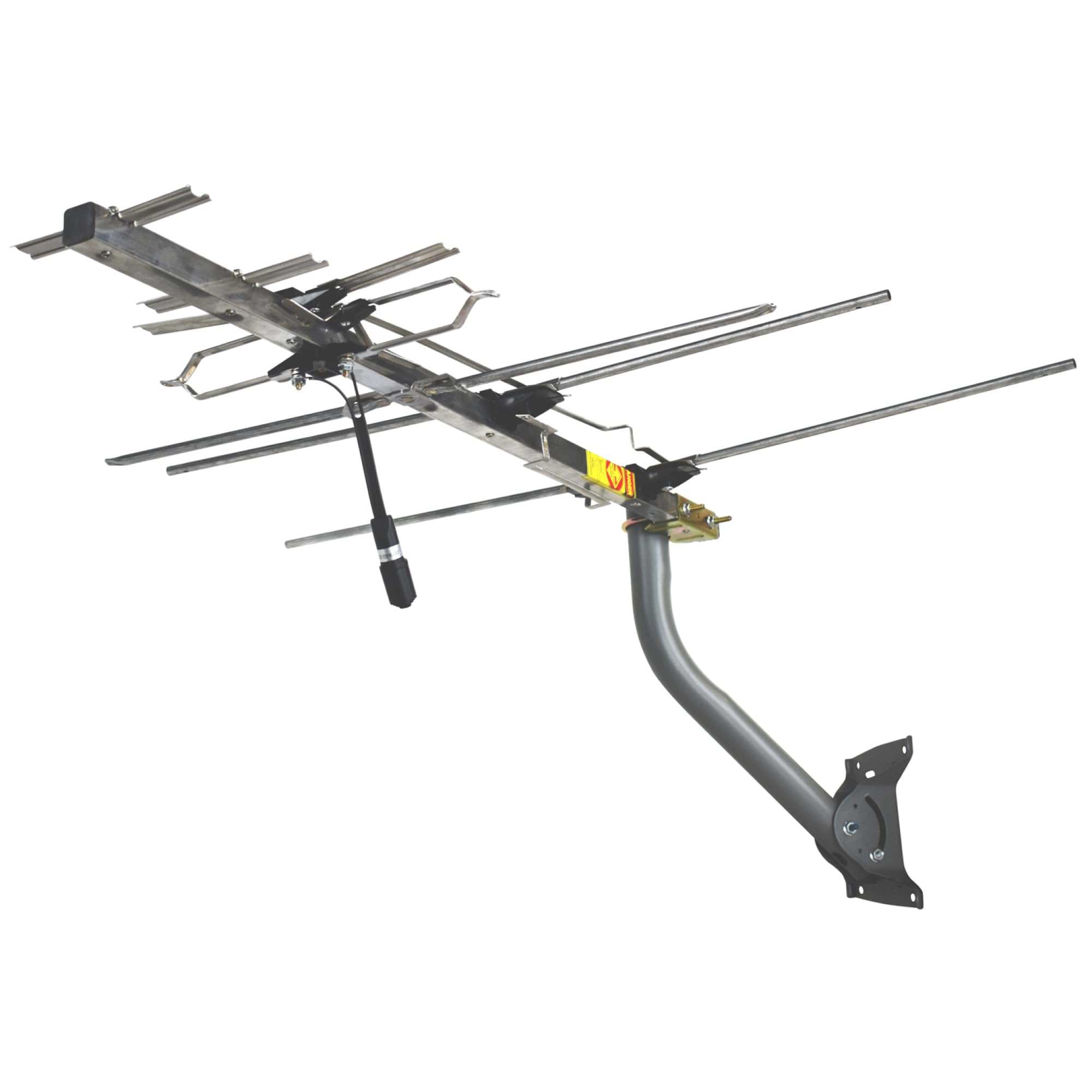
If a local station broadcasts on low-VHF, this is the antenna that actually pulls it in
Low-VHF channels — the old channel 2 to 6 range — are the hardest to receive, and most antennas simply ignore them. This Winegard YA7000C is built specifically to handle them, with low-band VHF extensions that let it pick up channels fewer antennas can manage. Owners confirm the advantage: an attic install near Roanoke pulled in a PBS station broadcasting on channel 3 clearly, and another setup reported a station 68 miles out coming through clean. Its fold-and-lock elements speed up assembly, and it works with a universal mount for pole, siding, or attic installs.
Two things to have ready. First, aiming matters — this is directional and needs to point at your towers, and its directionality is loose enough that you can accidentally grab stations in the opposite direction, which is worth knowing when you scan. Second, an amplifier helps at distance: owners 40 miles from Philadelphia needed a preamp to lock stations, choosing a low-gain amp because a high-gain one overloaded the signal. The element count is designed for VHF and UHF, and quality RG6 coax is important for holding signal over the run.
Compared with the Omni+ above, the Winegard adds dedicated low-VHF capability that the omni only partially covers, and its folded elements make it easier to assemble than many multi-piece yagis. It also pairs with the Winegard mobile app to help with placement and channel scanning, a convenience few antennas offer.
The specialty: Dedicated low-VHF extensions handle channels 2-6 that most antennas skip, plus fold-and-lock elements that simplify assembly and a mobile app to guide placement.
Keep in mind: It is directional with a fairly wide beam, so it can pick up stations behind it, and it usually wants a preamp to hold stations at 40 miles.
Right choice when: A must-have local channel broadcasts on low-VHF, or you want app-guided aiming and a quick fold-and-lock build.
Not ideal if: All your stations are UHF and you just want raw long-distance reach without an amplifier.
9. Winegard HD8200A Platinum Heavy-Duty Outdoor Yagi TV Antenna
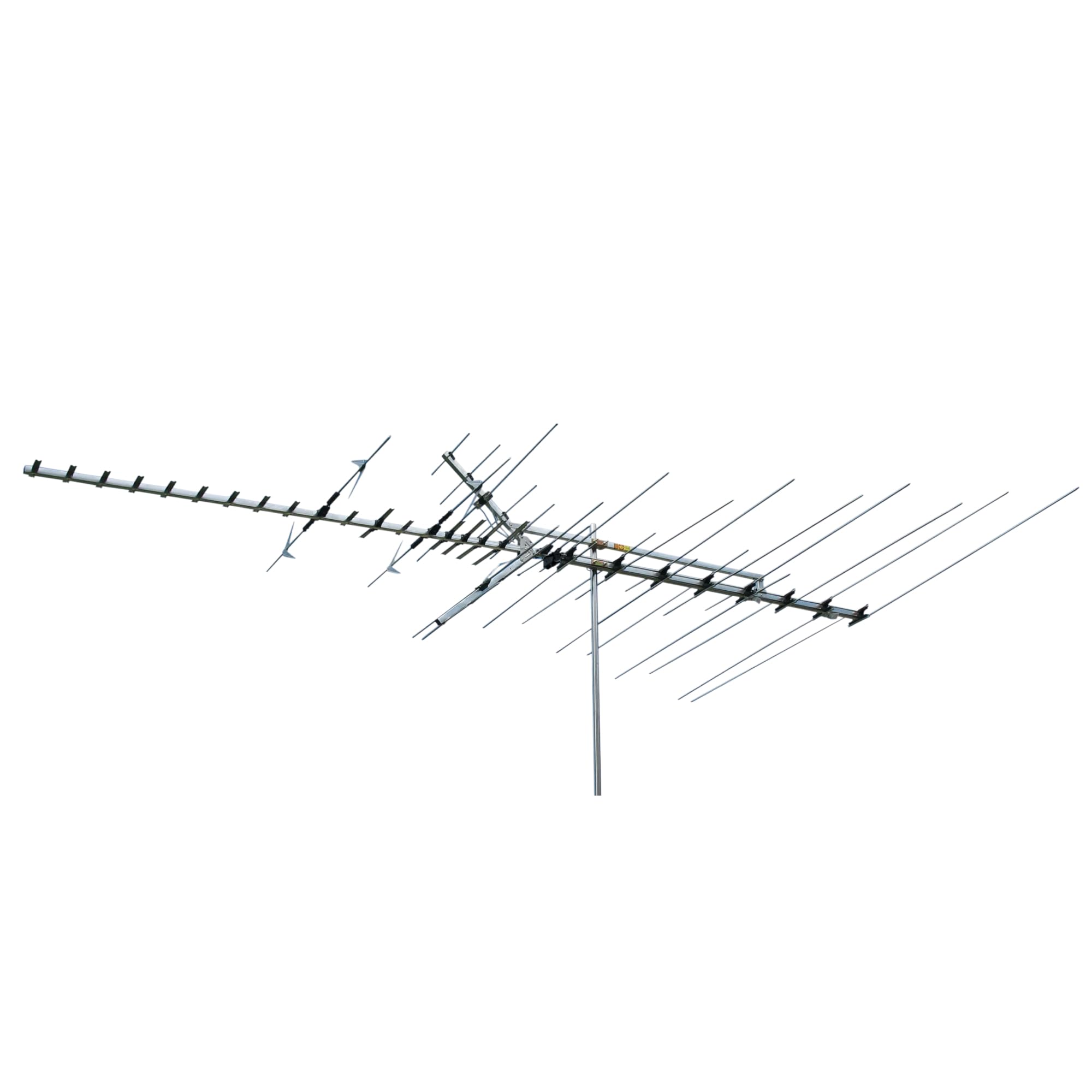
A full-size steel yagi that pulls every band — including low-VHF — from deep in the countryside
This is the no-holds-barred option: an 8-pound, zinc-plated steel yagi covering high-VHF, low-VHF, and UHF, designed for rural homes where every station is a fight. Customers note it doing exactly that — one rural setup among tall trees that got only 3-4 channels with a cheap antenna and about 14 with a mid-tier one pulled in 30-plus with this unit, and 80-plus when rotated. Another buyer in Cookeville, Tennessee, scanned roughly 50 Nashville channels from a roof mount. It works without an amplifier, though owners often add a preamp for the toughest fringe cases.
Be ready for its size. This is a large antenna — owners describe it as roughly 10 feet by 6 feet once assembled — and more than one buyer found it needed two people to mount safely. On a mast with a rotor and proper eave mount, though, the wide beam is an advantage: owners note it grabs more stations without the precise aim a narrow-beam yagi requires. It is NextGen TV compatible and works with 4K and streaming devices.
Compared with the smaller YA7000C above, the HD8200A steps up to full heavy-duty steel construction and a bigger capture area for rural fringe work, at the cost of a much larger physical footprint and more involved mounting. It is the antenna to choose when reception, not convenience, is the priority.
Built for the sticks
- Zinc-plated steel construction resists oxidation and takes harsh weather.
- Covers all three bands — high-VHF, low-VHF, and UHF — in one unit.
- Wide beam locks more stations with less precise aiming than a narrow yagi.
- NextGen TV compatible and works with modern tuners and streaming devices.
Sizing and setup notes
- Very large — owners describe it as roughly 10 ft by 6 ft assembled and needing two people to mount.
- Weighs 8 pounds, so it wants a strong mast and solid eave mount.
- Non-amplified by design, so deep-fringe owners usually add a preamp.
Made for: Rural homes with tall trees or long distances to the towers, where you want every band and are ready to dedicate a sturdy mast.
Too much if: You have a small roof, want a one-person install, or only watch UHF stations close to home.
Understanding the Specs
Range (miles)
Range is the headline number on every box, but it describes an antenna’s best-case capability, not a promise. Real reception depends on tower distance, terrain, and mounting height. A claimed long range simply means the antenna is engineered for fringe work — it gives you a chance at distant signals, especially when you mount higher and clear obstacles. Two antennas with the same range figure can perform very differently in the same yard.
Directional vs. omnidirectional
A directional antenna (often a yagi) concentrates reception in one direction, which is what lets it pull weak distant signals — but you have to aim it, and stations far apart can force trade-offs. An omnidirectional antenna receives from 360 degrees, so it needs no aiming and handles scattered stations, but it gives up some long-range reach. Choose based on whether your must-have towers cluster in one direction or spread around you.
VHF-Low, VHF-High, and UHF
Broadcast channels sit on three bands. UHF and VHF-High are the easiest to receive; VHF-Low (roughly channels 2-6) is the hardest and needs a design built for it, like the Winegard models above. Before buying, check whether any must-have local channel broadcasts on low-VHF — if so, an antenna without low-VHF support may miss it entirely.
Amplifiers and cable runs
An amplifier (preamp) boosts a weak signal before cable loss degrades it. Some antennas, like the Televes and the motorized CeKay, have the amplifier built in; others are passive and rely on height and a clean cable run. Long coax runs lose signal, so use quality RG6 cable and keep cable as short and direct as practical. Never place splitters upstream of a powered amplifier or rotor.
FAQ
How far from the towers can an outdoor antenna realistically reach?
Do I need a directional or an omnidirectional antenna for my location?
How do I know if I need an antenna that supports VHF-Low?
Can one outdoor antenna feed more than one TV?
Do I need an amplifier or is a passive antenna enough?
What kind of coax cable should I use with an outdoor antenna?
Will an outdoor antenna work with a streaming DVR like Tablo or HDHomeRun?
How high should I mount an outdoor antenna for the best reception?
Are these outdoor antennas ready for ATSC 3.0 and NextGen TV?
How long do outdoor TV antennas typically last?
Final Thoughts: The Verdict
For most rural and fringe-area homes, the outdoor antenna winner is the Televes DAT BOSS Mix LR 149884 because its built-in TForce amplifier, dual-band gain control, and 29-channel capacity make it the strongest performer for pulling distant High-VHF and UHF signals through a serious fringe situation. If you would rather not spend anything near the pricey end and sit within about 50 miles of your towers, grab the McDuory TV Outdoor Yagi Antenna — it is the value standout and the crowd favorite here, and its higher rating count compared with the Televes reflects how many cord-cutters rely on it. And for scattered stations you never want to aim by hand, the Channel Master Omni+ 50 is the one to reach for. One last note: check whether any must-have local channel broadcasts on low-VHF before you decide, because only the Winegard models here specialize in that band.
How We Picked
We do not accept paid placement. Every pick is matched to a real buyer and a real use-case; we do not hands-on test units.
Sources & Methodology
Specifications: manufacturer listings and product documentation. Review insights: verified customer reviews, as of September 2026. Pricing: not shown on this page (it changes often); check the current price via the retailer link.
As an Amazon Associate, Gadgets Feed earns from qualifying purchases. This does not affect which products we feature.