
Our readers keep the lights on and my morning glass full of iced black tea. As an Amazon Associate, I earn from qualifying purchases.
Specs are compiled from manufacturer listings and verified buyer reviews and can change over time — please confirm the key details on the product page before buying.
Most AI dash cams fail in the same boring way: they beep at everything and record nothing useful. Lane warnings scream at parked cars, “collision alerts” fire when you change lanes with your blinker on, and the one clip you actually need — the plate, the face, the impact — is either overwritten or too dark to read. The picks below solve that specific problem, and each one solves it differently: one is a dual-channel 4K front and 1080P rear unit with dual Sony STARVIS 2 sensors (the light-gathering chips that decide whether a plate is legible at night), one rotates 340° to watch your cabin and your blind spots from a single camera, and one uses radar to wake up before an impact instead of after it. Which one fits depends on if you need night-readable plates, all-day parking surveillance, or quieter ADAS alerts.
I’m Min — the founder and writer behind Gadgets Feed. This guide is built by comparing the manufacturers’ published specifications and the patterns across verified customer reviews, so you get each pick’s real strengths and trade-offs instead of marketing spin.
Sorting real driver-assist cameras from glorified beepers depends on four things: night clarity, how the AI filters false alarms, where footage lives, and whether parking mode asks for a subscription. This breakdown of the ai-powered dash cam field covers sensor choice, ADAS behavior, and storage so your next camera earns its place.
Our Picks at a Glance

How To Choose The Best AI-Powered Dash Cam
The “AI” label on a dash cam box covers three very different jobs, and mixing them up is how people end up with a camera that nags them for six months and then gets unplugged. Before you compare models, know which of the three you actually want.
Three kinds of AI, three very different cameras
The first kind watches the road ahead and warns you — that’s ADAS, short for advanced driver assistance, the system behind forward collision, lane departure, and “the car ahead of you just moved” alerts. The second kind watches the driver, flagging fatigue or a glance at a phone, which is what a Driver Monitoring System does. The third kind watches your parked car, using motion detection to separate a real threat from a passing shadow. A camera that does all three well is rare; most are strong at one and shaky at the others, so decide which job you’re buying for first.
The sensor decides your night footage, not the resolution number
Two cameras can both say “4K” and produce wildly different night clips. What separates them is the image sensor and the lens aperture — the size of the opening that lets light hit the sensor. A Sony STARVIS 2 sensor paired with an F1.7 aperture (a wider opening that gathers more light) is the combination that keeps licence plates readable under streetlights and low beams. Chunky file sizes are the price you pay: 4K clips are large, so most owners end up on a 128GB or 256GB card rather than the 32GB that ships in the box.
Where your footage lives matters as much as how it looks
Local microSD recording is the baseline and it works with no plan at all. Cloud backup and remote live view are the features that usually require a subscription or a SIM card with a data plan. If you want to check your parked car from your phone at work, read the fine print first — some cameras make you pay monthly for the app features, while others include remote access free once you add the matching hardwire or 4G kit.
Quick Comparison
| Model | Best For | Front / Rear Resolution | Field of View | Storage Support | Amazon |
|---|---|---|---|---|---|
| 70mai A810S★ Best Overall | Best all-round dual-channel value | 4K front / 1080P rear | 150 degrees | microSD up to 512GB | Amazon |
| Volam 4G LTECellular Pick | Cellular remote monitoring | 1080P dual (front + interior) | — | 32GB card included | Amazon |
| KAWA D10Best Value | Budget 4K with a free card | 4K front / 1080P rear | 360 degrees | microSD up to 256GB | Amazon |
| TQZNK 4K + 2.5K | Sharpest rear channel in the mid tier | 4K front / 2.5K rear | 170 degrees | microSD up to 256GB | Amazon |
| Nexar Pro Dual | Cloud-first rideshare drivers | 1080p front + interior | 135 degrees | SD up to 32GB | Amazon |
| HUPEJOS V8PLUS | Four-angle 360° coverage | 4K front / 1080P rear | 360 degrees | SD up to 256GB | Amazon |
| Vantrue S1 Pro | Smooth 60fps highway footage | 1440P@60fps front / 1080P rear | 160 degrees | microSD up to 1TB | Amazon |
| TYPE S T400 PLUS | Loud, active safety alerts | 4K front / 1080p rear | 230 degrees | microSDHC up to 512GB | Amazon |
| 70mai Omni X800 | Rotating 360° single-camera coverage | 4K@60fps front / rear cam | 146 degrees | microSD up to 512GB | Amazon |
| DDPAI Z90 Max 3CH | Triple-channel rideshare coverage | 4K front / 2K rear / 2K cabin | 160 degrees | microSD up to 512GB | Amazon |
| THINKWARE U3000 PRO | Radar parking surveillance | 4K front (single channel) | 147.2 degrees | microSDXC up to 512GB | Amazon |
In‑Depth Reviews
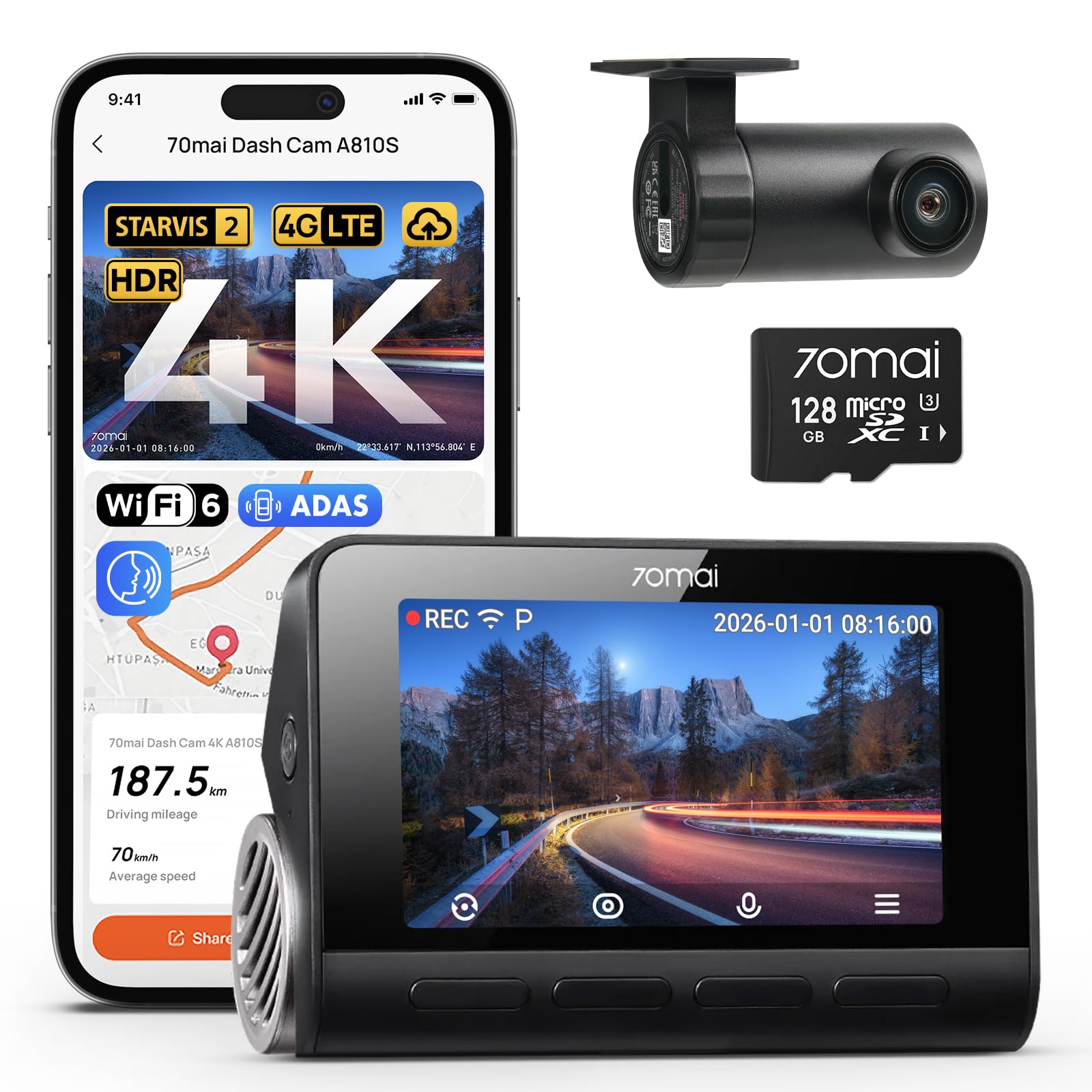
1. 70mai 4K Dash Cam Front and Rear (A810S)
Our pick — over 4★ from 1,500+ verified ratings; the strongest balance of quality and price.
The dual-STARVIS camera whose night clips are the whole reason it sits at the top.
If your worst-case scenario is a dark rear-end collision on an unlit road, this is the camera built for exactly that. It runs a Sony STARVIS 2 sensor up front (an IMX678) and another STARVIS 2 chip out back (an IMX662), with an F1.7 aperture on the front lens — a wide opening that pulls in more light than most cameras at this tier. The result is 4K recording up front and 1080P behind, covering a 146° front view and a 130° rear view, which is enough to catch the car in the next lane starting to drift toward you.
Night performance is what wins people over here. The combination of back-light full-color technology and the Night Owl Vision algorithm keeps street signs, headlights, and plates legible when the sunlight is long gone. Owners on the dual-band Wi-Fi 6 connection move 4K files to a phone noticeably faster than the older single-band cameras manage. There’s no subscription and no account requirement to view footage on the camera’s own screen, and the unit hangs on an electrostatic anti-static film rather than an adhesive pad, so the front camera lifts off and goes with you if you switch cars.
The catch is what owners actually grumble about: the AI safety alerts. Lane departure warnings pick up your own turn signal as a lane change and beep at you, and the emergency recording lock triggers more eagerly than most people want. Reliability also draws mixed feedback — a few cameras arrive finicky about how they talk to a phone, and people upgrading from older models report the occasional app reconnect issue. Pair it with a 128GB or 256GB card, because 4K files eat space fast, and budget in a hardwire kit if you want the 24-hour parking mode rather than just the front-and-rear driving coverage.
What earns it the crown
- Dual Sony STARVIS 2 sensors — one front, one rear — for genuinely legible night footage
- 4K front and 1080P rear at the same time, no resolution trade-off between channels
- Wi-Fi 6 transfers plus 5-mode GPS (GPS, BDS, GALILEO, GLONASS, QZSS) logging speed and route
- Glass static-cling mount lets you pull the front camera off without buying new adhesive
What to know before buying
- ADAS lane warnings fire on turn signals — expect to tune or ignore them
- Emergency lock is quick to trigger, so clips pile up until you prune them
- 4K files are big; a 32GB card fills in a day
- Cloud features live in the optional 4G hardwire kit, not the box
Reach for it if: your priority is being able to read a licence plate on a dark road, and you want front-and-rear coverage without a monthly cloud plan.
Think twice if: you want the AI warnings to be silent until they matter — this camera is chatty, and a calmer ADAS tune is what the TYPE S and Vantrue do differently.
2. Volam 4G LTE Cellular Dash Cam with Live Streaming
The camera you install once and then check from a phone three states away.
Here’s the thing most dash cam listings dance around: Wi-Fi cameras only talk to your phone when you’re sitting in the car. This one uses 4G LTE cellular (a direct mobile data connection, not a short-range radio), so the live view works from anywhere with cell coverage. That’s the whole pitch, and it hands you a real feature — checking the driveway while you’re at work, or seeing exactly where your teenager’s car is parked. Dual 1080P cameras record front and interior at once, and the in-car lens rotates 180° so you can aim it at the cabin, the back seat, or the side window.
Setup is genuinely easier than most. It plugs into the OBD-II port (the diagnostic socket under your dash, standard on cars built after 1996), which means no fuse tapping and no hardwiring. That same OBD connection runs the parking sentry mode around the clock and includes automatic voltage protection that cuts power if the battery drops too low — so the camera watching your car doesn’t kill the car. Quality, easy setup, and connectivity are the three things owners mention most, and the radar-plus-AI sentry is described as filtering out the false alerts that plague cheaper cellular cams.
The honest trade-off is the subscription model, and it’s worth understanding before you buy. Live remote view and the cloud event clips need an active 4G plan, with a 7-day free unlimited trial included on activation, and cloud backup carries a 30-day trial before monthly pricing kicks in. Local recording works with the included 32GB card and needs no plan at all — but that limits you to the old-fashioned habit of pulling the card. A few drivers hit reliability gaps where the camera dropped offline for stretches, and support responses were inconsistent. If you want true anywhere-access without a recurring charge, this isn’t that product.
Why rideshare and fleet drivers gravitate here: dual camera audio, GPS trip logging, and remote live view mean a driver can check in on their own car during a shift without leaving the cabin.
The catch no listing hides well: the camera is cheap to start and the ongoing cellular and cloud service is where the real cost sits — it’s a connected security system, not a set-and-forget recorder.
Good match for: anyone who genuinely needs eyes on their car while away from it and is fine paying for a data plan to get there.
Poor match for: drivers who want to record their commute, back it up on a card, and never touch a subscription screen.
3. KAWA 4K Dash Cam Front Rear (D10)
A 4K dual-channel setup that arrives with the memory card already in the box.
KAWA’s D10 pairs a 4K front lens with a 1080P rear and a Sony STARVIS sensor, then throws in a 64GB microSD card so there’s nothing extra to buy on day one. That’s a real convenience — the 4K cameras above all want a fast card, and this one ships with one. You also get a 3.16-inch IPS screen on the camera body itself, which matters if you’d rather scrub through footage on the device than pull out your phone and wait for a Wi-Fi handshake.
The build uses a supercapacitor instead of a lithium battery. That’s the safer, longer-lived option for a camera that bakes on a windshield in summer, and KAWA backs it with a lifetime warranty and free replacement within the first 12 months. The GPS logs driving routes and speed for use as evidence, and the continuous loop recording overwrites the oldest footage automatically while keeping emergency clips in their own locked folder. You can set recording blocks of 1, 2, or 3 minutes to suit your card size.
Be realistic about the review picture here: this is a smaller, newer listing with a modest number of ratings, and the feedback splits. Some owners simply report it works — “Works as described,” one wrote — while others ran into a rear camera that never responded and a unit that stopped saving. Those complaints are not the consensus, but they’re worth knowing when you compare against the 70mai’s larger track record with the same 4K dual-channel idea. Night footage is the stated focus, with WDR brightness balancing and 3D DNR noise reduction doing the heavy lifting in dim light.
Worth grabbing if: you want true 4K front and rear coverage on a tight budget and value the included card plus a lifetime warranty over a big review history.
Look past it if: proven long-term reliability matters more to you than the price — a heavier review base is the safer bet there.
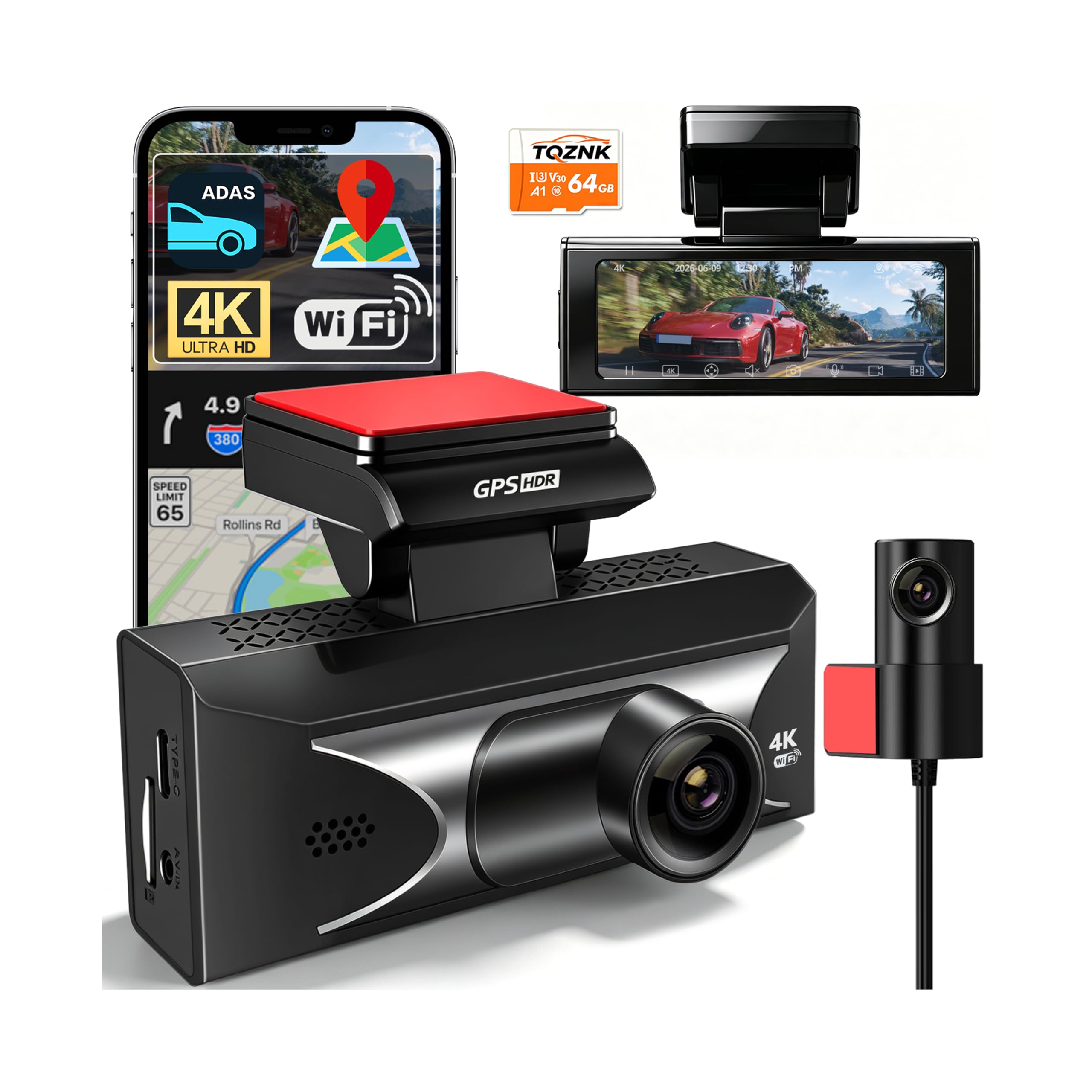
4. TQZNK 4K Front + 2.5K Rear Dash Cam
The one that treats the rear camera as a real camera, not an afterthought.
Most dual dash cams give the back of your car a 1080P sensor and call it done. This one records the rear at 2.5K — a 2560×1440P resolution that keeps more detail than the 1080P rear channels on the 70mai and KAWA above. The front is 4K at 3840×2160P, and the two lenses cover 170° front and 160° rear, which is the widest front angle in this entire lineup and genuinely helpful for catching a merge from the far lane. There’s a nice extra: reverse guidelines appear automatically on screen when you shift into reverse, once you connect the rear camera’s red wire to the reverse light.
The connectivity is where this one punches up. Dual-band Wi-Fi running both 5.8GHz and 2.4GHz lets you pull video off at up to 20MB/s — that dual-band setup is a step above the single-band radios on several rivals, and it means a 4K clip lands on your phone faster. GPS logs speed, route, and location, and the app handles live view and playback. Powering it is a supercapacitor rated from -22°F to 158°F, which is a wider temperature window than most cameras here, and it auto-locks footage before a collision so the critical clip survives loop recording.
The ADAS set covers voice alerts for forward collision, lane departure, and front-vehicle-start — the same trio the 70mai and Vantrue offer — and here the alerting reads calmer in owner reports. The real wrinkle is physical: the rear camera can be mounted upside down depending on your car, and you have to flip the image afterward, which one owner had to do after completing the install. The rear cable is long enough for most vehicles, but routing it takes care, and people who rushed it reported having to redo the run. Get the routing right the first time and this is a satisfying install.
Where it pulls ahead
- 2.5K rear channel — a sharper second camera than the 1080P rear units here
- 170° front lens, the widest field of view in this roundup
- 5.8GHz + 2.4GHz dual-band Wi-Fi for up to 20MB/s transfers
- Reverse guidelines pop up automatically once wired to the reverse light
- Supercapacitor rated for -22°F to 158°F
Worth knowing first
- Rear camera installs upside down on some cars and needs an image flip
- Rear cable routing is fiddly; a careless first pass may need a redo
- Parking mode still depends on the G-sensor and a 64GB card that fills fast
Pick this for: a car where you want the rear view to be nearly as useful as the front — parking lots, highway tailgaters, and backing out of a tight driveway.
Skip past it for: a car where you’d rather snap a camera on the glass and never think about wire routing again.
5. Nexar Pro Dual Dash Cam 1080p Front and Interior

Two cameras and a cloud locker, with the app doing most of the work.
Nexar’s angle is different from everyone else on this list: the camera is the hardware, but the app is the product. You get a 1080p front camera and a second interior camera watching the cabin, recording at 60fps — a smoother frame rate that keeps moving objects crisp — across a 135° exterior angle using Bosch technology. For rideshare drivers and anyone who wants a record of what happened inside the car as well as in front of it, that front-and-cabin pairing is the point.
The headline feature is unlimited cloud storage, which is unusual in this category. With a subscription — included free for the first year at purchase — your incident clips back up automatically, and the app handles AI crash detection, parking-mode alerts, and easy clip sharing. As one owner put it: “I love this camera I love the cloud storage I never have storage issues.” The cloud is the reason this camera stays in the conversation even though its specs are years behind the 4K crowd.
Here’s the honest split. Day and night video quality draws praise — it’s the single most-praised aspect of this camera — but reliability is the mixed bag, and it’s the biggest one in this lineup. Buyers report the app can be picky about connecting, and some units developed Wi-Fi pairing failures or stopped recording when it mattered. The rear-cabin mount changed from a stick-on pad to a suction cup in later units, and a couple of drivers would rather have the adhesive back. It works best on phones that keep Wi-Fi free — in one driver’s experience, USB-C audio with a wired connection was the only way it played nicely with CarPlay.
The case that wins people over: turnkey cloud backup with a year included, plus an app that actually helps when you need to send a clip to insurance.
The reason some move on: the connection to your phone is the weak link — riders who need it to just record without drama have found more dependable options.
Best suited to: rideshare and delivery drivers who want a cabin camera and a cloud archive more than they want 4K detail.
Less suited to: anyone whose main goal is sharp night plates — the higher-resolution rivals on this page top it there.
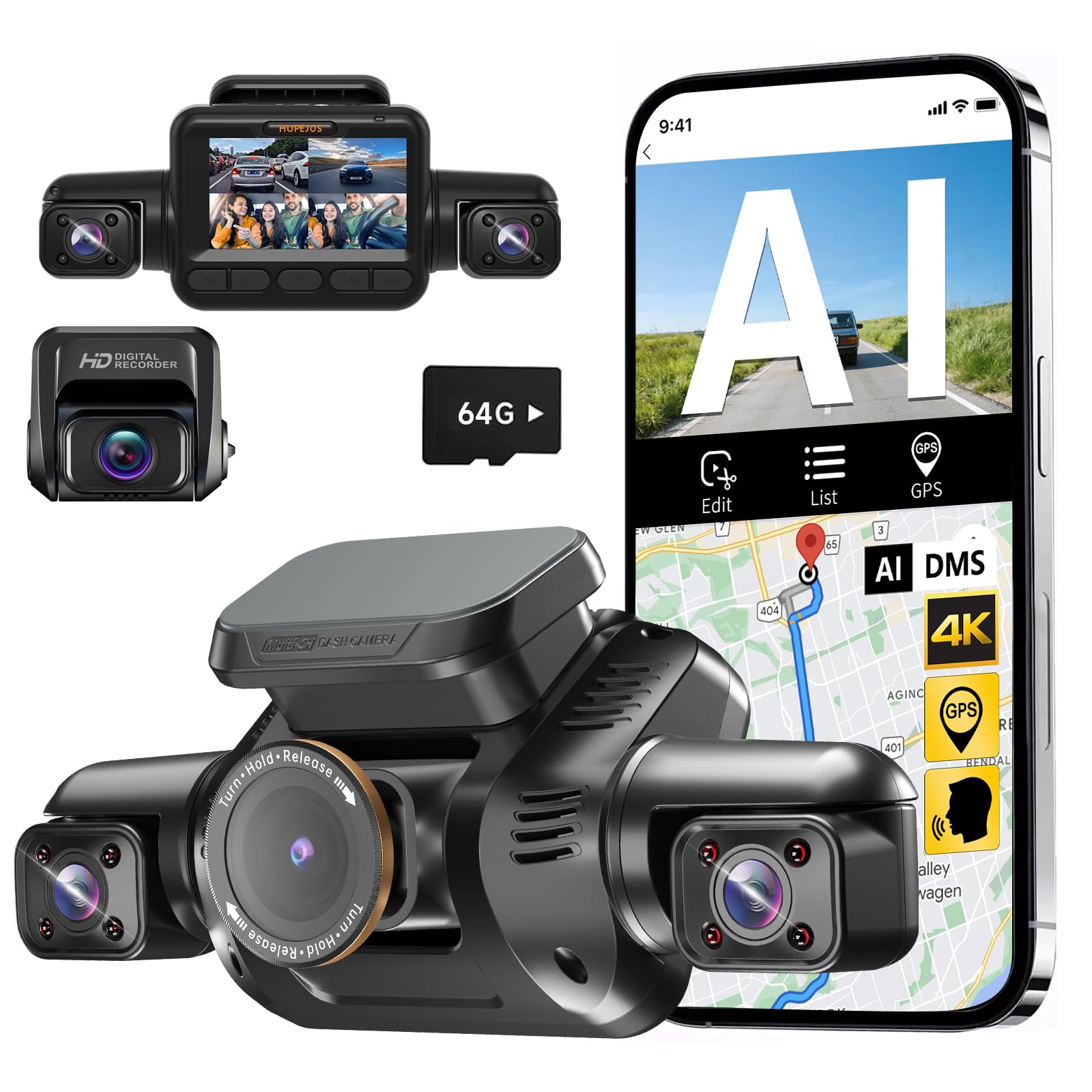
6. HUPEJOS AI 4K Dash Cam 4-Channel 360°
Four lenses, one camera, and a grid that shows every angle of the car at once.
Nothing else here covers as many directions from a single unit. HUPEJOS uses four independently adjustable 150° lenses to film front, left, right, and rear simultaneously, which is what you want if your commute involves blind-spot merges or you drive for a living. You can run it two ways: 4K on the front with two 1080P channels, or 3K on the front with three 1080P channels. The 64GB card comes pre-installed so it records right from the start.
The AI side here is a Driver Monitoring System — an in-cabin camera that watches the driver rather than the road. It flags distracted driving, yawning, a glance away, phone use, and smoking, and the system only activates once you’re moving past a set speed so it’s not nagging you at a red light. A CPL filter is included, and it cuts the glare that washes out dash footage on sunny days, while the six glass lenses and eight IR lamps handle low-light with an automatic exposure shift.
Coverage and voice control are what owners single out as the standouts — the 360° view and the English voice commands (which let you take a photo, start or stop recording, or lock a clip hands-free) are the two most-praised things about it. The honest picture is that functionality draws mixed feedback: some find it works well for the money, a few hit a unit that simply wouldn’t power on, and stability complaints are the most-mentioned negative. The field of view is a hard 360° figure in the spec — but expect to spend real time positioning the four lenses, because each one has to be aimed by hand.
The standout reasons to buy
- Four 150° cameras cover front, left, right, and rear in one device
- Driver Monitoring System watches the driver, not just the road
- Included CPL filter tackles windshield glare and colour vividness
- 64GB card already installed; supercapacitor rated -20°F to 140°F
Straight talk on drawbacks
- Reliability is the most-documented concern — stability beyond expectation on some units
- Four adjustable lenses mean real setup time to aim each one
- No built-in 4G; remote features need the optional hardwire kit
A strong fit for: high-mileage commuters and fleet drivers who need a single device to see all four sides of the car.
A weaker fit for: someone who wants a fixed, forget-it mount — the movability that makes 360° work is also the fiddly part.
7. Vantrue S1 Pro 60fps Dash Cam Front and Rear
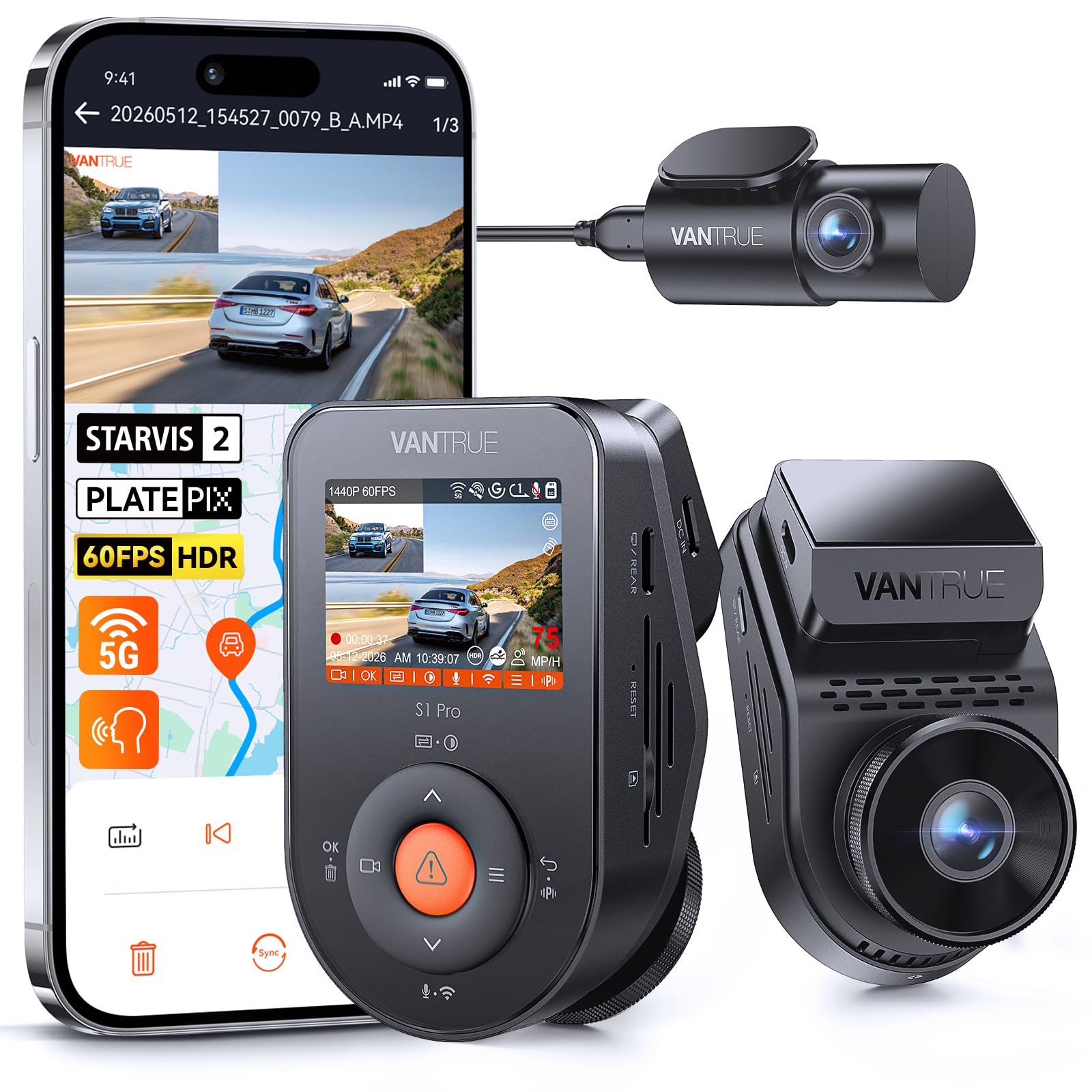
Sixty frames a second turns a blurry plate into a legible one at highway speed.
Frame rate is the argument this camera makes, and it’s a fair one. Vantrue runs the front camera at 1440P and 60fps — twice the frames per second that most 4K cameras shoot — which is specifically better at freezing fast motion so a plate doesn’t smear as you close on it. You can also drop to 1944P front with a 1080P rear at 30fps if you’d rather have the higher resolution than the smoother motion. The 160° lenses cover multiple lanes without heavy distortion, and an optional CPL filter (sold separately) is cited as cutting 90% of glare from rain and sunlight.
Low-light is handled by STARVIS 2 sensors and an F1.8 aperture lens paired with Vantrue’s PlatePix technology, and both front and rear cameras run dual HDR to balance a bright sky against a dark road. That’s a meaningful edge over the older single-HDR setups — headlights and shadows don’t blow out as easily. The 5GHz Wi-Fi with the Vantrue app handles playback, OTA firmware updates, and downloads, and the built-in GPS logs route, location, and speed, with a zoom-in player feature for reading plate details. No subscription required.
Two things worth flagging honestly. First, the ADAS and rear blind-spot detection are the practical draw for family drivers — collision alerts for school drop-offs and lane-change warnings in packed lots — but the alerting isn’t perfect, and one owner found the front-camera angle difficult to aim where they wanted it. Second, this camera records at 1440P, not full 4K, and a couple of reviewers list that as their one regret. It also needs the separate hardwire kit (not included) before the parking guard works, and several owners found the default G-sensor sensitivity too eager — a quick menu adjustment fixes that.
The 60fps payoff: when you’re doing 70 on the freeway and the car ahead sheds a piece of trim, this is the camera that reads the plate instead of the blur.
The one thing to reconcile: you’re choosing motion smoothness over outright 4K detail — if that trade bugs you, the 4K duals on this list are the other side of the coin.
Made for: highway commuters and anyone who values smooth, blur-free footage over the biggest resolution number.
Overkill for: city-only drivers who rarely push past 30mph — you won’t feel the 60fps benefit as much.
8. TYPE S T400 PLUS AI-Powered Dash Cam
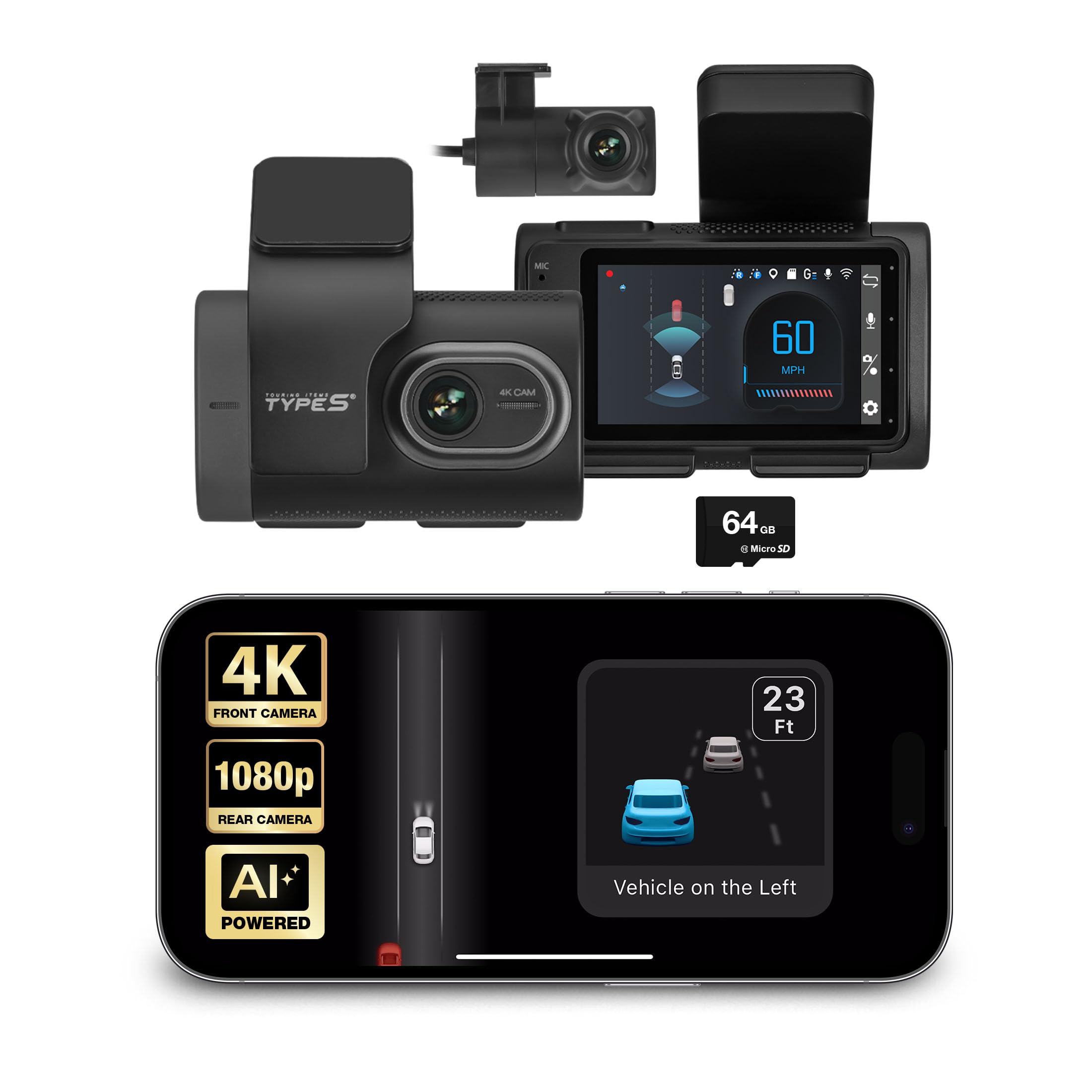
The safety-first camera that wants to talk to you while you drive.
If you want your dash cam to be an active co-pilot rather than a silent witness, this is the one built for that. The T400 PLUS runs a full AI safety suite: blind-spot warning, front and rear collision alerts, lane departure warning, a stop-and-go reminder for when the car ahead pulls away, and pedestrian detection for the front of your vehicle. That’s the widest alert menu in this lineup, and its 230° field of view is the broadest single-lens figure here — a front lens covering that much angle is designed to see a pedestrian stepping out before you do.
Recording tops out at 4K front with a 1080p rear, and the built-in G-sensor locks incident clips into a separate folder so loop recording can’t overwrite them — footage that stays available months later if you need it for an insurance claim. The Park & Record mode wakes the camera on an impact and captures a 20-second clip when hardwired. Everything routes through the Type S Drive app over built-in Wi-Fi, so you can review and download without pulling the card.
The honest read: this camera’s hardware is solid and its video quality is genuinely good, but its AI alerting is the loudest and least precise system in this roundup. On busy freeways it can beep so often that drivers turn it off, and owners mention the forward-collision warning firing late, a lane-departure false beep even when signalling, and motorcycles misread as pedestrians. The blind-spot indicator lights sit on the center device rather than near the side mirrors. If you drive in light traffic or an older car with no factory warnings, that chatter is the feature; if you drive packed highways, prepare to mute it.
Right for you if: you’re upgrading an older car with no built-in safety warnings and want the most alert types of any camera here, at the widest view.
Wrong for you if: false alarms would drive you up the wall — the higher-rated picks on this page keep quieter company with the driver.
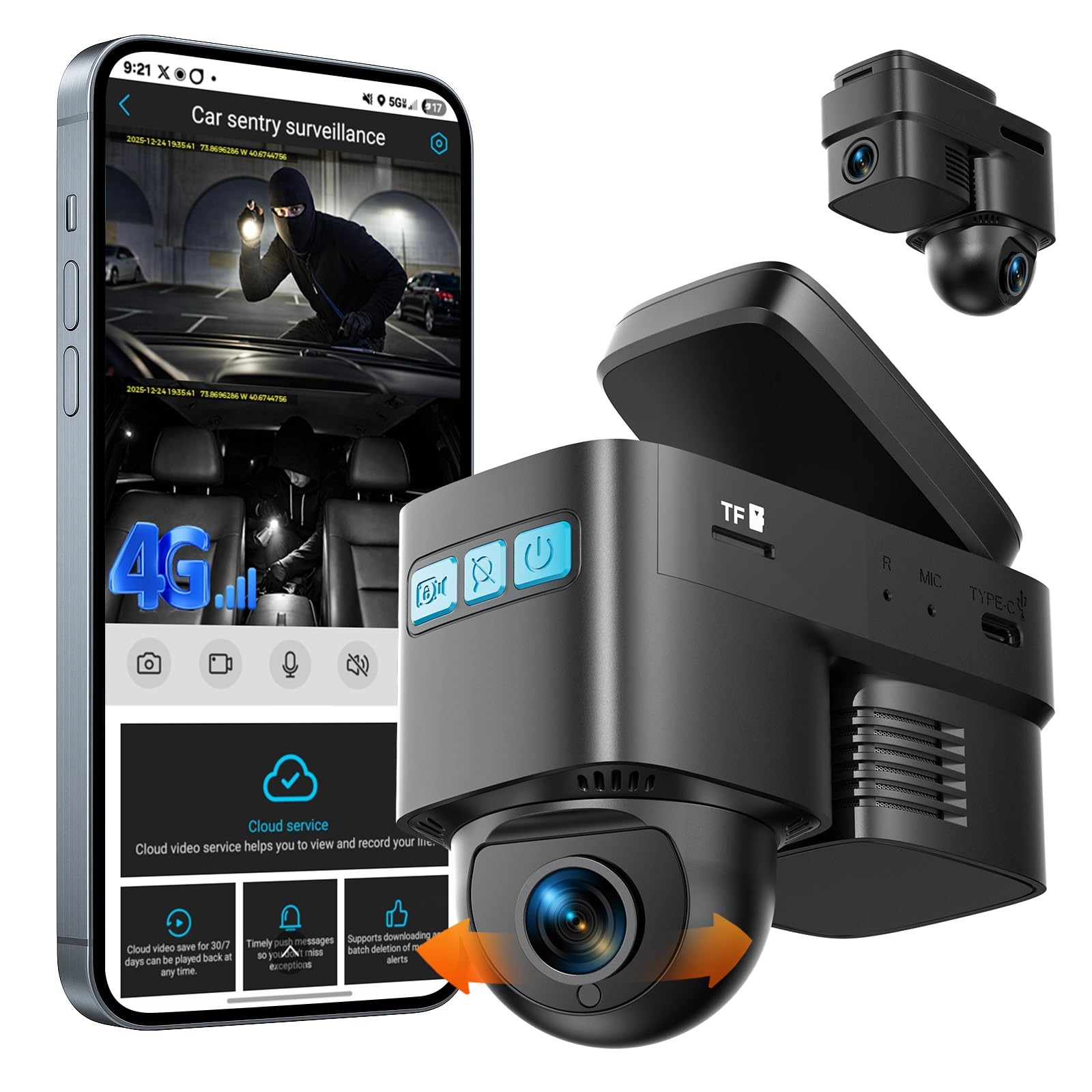
9. 70mai Dual Dash Cam 4K Omni X800

One camera that swivels from the road to the cabin, so the cabin cam lives inside the front unit.
The trick here is mechanical. The front camera body rotates on a 340° mechanism to swing toward your cabin, your side windows, or wherever you point it, so you get cabin coverage without adding a second camera to the glass. It records true 4K at 60fps up front with ROI technology that intelligently boosts the licence plate region for readability — an unusually direct way to sharpen the thing you actually need to read. A 146° lens covers eight lanes of width, and the AI motion detection 2.0 rotates the camera to follow moving objects during sentry mode.
The numbers behind it are the STARVIS 2 story again but with a twist: this sensor captures 88% more light than the previous generation, and the Lumi Vision system delivers full-colour recording in parking conditions — near-total darkness without the usual green-and-grey night-vision look. Wi-Fi 6 on 5GHz moves 4K files at up to 20MB/s, and the GPS tracks speed and route. On the safety side there are ADAS collision and lane-departure alerts plus speed-limit reminders, and voice control supports 15+ spoken commands so you can take a photo or start recording without reaching for anything.
Before you commit, the parking and reliability picture deserves a look. The sentry mode that tracks movement and lights up requires the separate UP05 hardwire kit (not in the box) — plenty of owners skipped it and then found the parking features unreachable, and one found the tracking only worked after re-aiming the camera out the front window. Reliability draws mixed feedback: a few cameras reportedly stopped working a short time in, and the 360° rotation has its own mixed feedback. The supercapacitor handles 14°F to 140°F, and the 128GB card comes included, which is a genuine convenience.
what separates it: a single rotating lens that does what the two-camera setups do with one discreet unit — cabin access without a second windshield mount.
The recurring caveat: the best parts of the parking package live behind an extra purchase, so factor that in when you weigh it against the simpler fixed cameras.
Best pick for: drivers who want cabin and blind-spot coverage from one clean install and don’t mind adding the hardwire kit for full parking duty.
Not for: buyers who want the parking features switched on straight from the box — a fixed two-channel camera delivers that immediately.
10. DDPAI Z90 Max 4K 3-Channel Dash Cam

Three separate cameras filming front, rear, and cabin — all at once, all in high resolution.
This is the most serious multi-channel setup on the list. The Z90 Max runs three cameras simultaneously: 4K at 30fps up front, 2K at 30fps at the rear, and 2K at 30fps for the interior. The front and rear use Sony STARVIS 2 sensors (IMX678 and IMX675 respectively), and the cabin camera adds an infrared LED with AI IR Night Vision 2.0 that produces clear back-seat footage in total darkness — the feature rideshare and taxi drivers care about most, since it’s what records a passenger in a dark car at 2am.
All three channels run HDR, so each camera balances bright highlights against deep shadow independently — that’s the reason front and rear plates both stay readable at highway speed. You also get high-precision quad-mode GPS (GPS, BeiDou, Galileo, GLONASS) stamping location, speed, and timestamp into all three feeds, Wi-Fi 6 at up to 40MB/s for downloads, and over-the-air firmware updates so the camera stays current without a cable. The 24/7 parking protection runs on a six-stage power management system that cuts power before it drains your battery.
Two honest notes. First, the mount is adhesive and not removable or tiltable, so aim it right the first time — and the camera also carries a few on-screen emojis that some find distracting. Second, the 4G LTE remote access needs a separately sold cloud box and hardwire kit, so true remote monitoring is an add-on here, not a stock feature. And the unit is bulkier than the slim single-camera designs on this list, so measure your windshield behind the mirror before you commit.
What makes it a specialist
- Three cameras record at once — 4K front, 2K rear, 2K cabin
- IR night vision lights up the interior cabin in total darkness
- All three channels run HDR for balanced highlights and shadows
- Quad-mode GPS and Wi-Fi 6 up to 40MB/s
Before you buy
- Adhesive mount isn’t removable or tiltable — no second chances on placement
- 4G remote access needs the extra cloud box, sold separately
- Bulkier footprint than single-camera designs behind the mirror
The right buyer: rideshare and night-shift drivers who need cabin footage in the dark as much as front and rear road coverage.
The wrong buyer: someone who wants to reposition the camera after install — this one mounts once and stays put.
11. THINKWARE U3000 PRO Dash Cam 4K Front
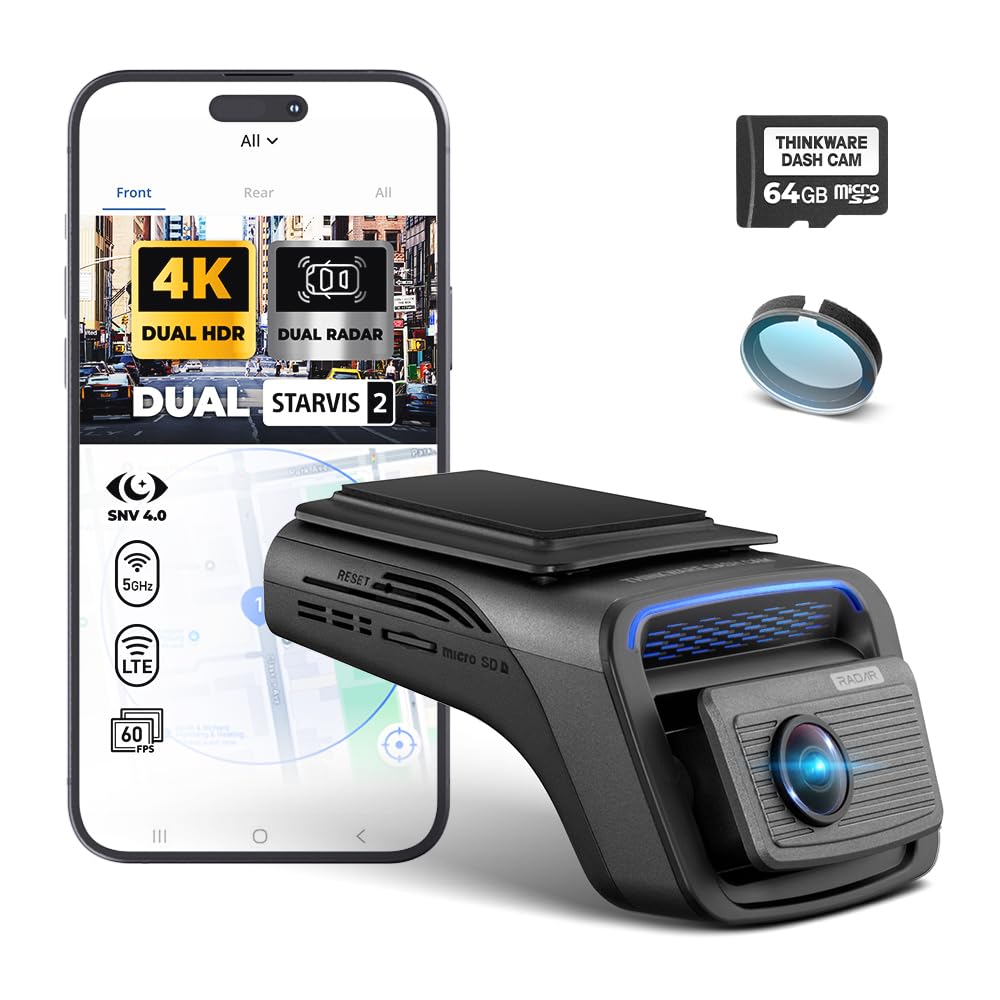
The parking sentry that wakes on a radar ping, so your car battery isn’t the price of watching.
Everything about this camera is built around parking surveillance, and the mechanism is the interesting part. A radar sensor watches for motion while the car sits, drawing ultra-low power so it doesn’t flatten your 12V battery over days of parking — then wakes the camera to record a 20-second clip when it senses movement or impact. Customers note going days parked without a drained battery, and that’s the payoff of the radar design over the constant-motion-detection cameras elsewhere on this list. A 4K front camera running Sony STARVIS 2 with an Ambarella processor captures plates day or night, and the adjustable bitrate lets you trade file size for detail.
It’s a front-only camera by design — the U3000 PRO in this configuration is a single-channel unit, so if you need rear coverage this isn’t the pick. What you get instead is a low-profile, no-screen body that tucks behind the mirror almost invisibly, plus an included 64GB microSD card, windshield mount, CPL filter, and hardwiring cable in the box. Setup is quick, and the Bluetooth connection makes pairing convenient. Video quality is the single most-praised quality of this camera, and drivers describe it as the best they’ve owned, with sharp 4K front footage and Super Night Vision 4.0 reading plates in low light.
Reliability is the mixed note here, and it lands on the rear radar and the app. In owner accounts, the rear-camera radar feature doesn’t work at all for some, and the app can be finicky about connecting — enough that people describe it as the frustrating part of an otherwise strong camera. There’s also a two-app registration step that some find awkward, and setup isn’t intuitive without the manual. Watch that too: the default Wi-Fi password should be changed on day one.
Buy it if: long-term parking protection with minimal battery drain is your top priority, and you want a camera that disappears behind the mirror.
Hold off if: you need front-and-rear coverage in one box — this is a front-only unit, and the multi-channel picks above cover both ends.
Understanding the Specs
STARVIS 2 Sensors and Aperture
STARVIS 2 is the name of a Sony image-sensor family built to gather more light, which is why it’s the single most important spec for night footage. A larger aperture number in the other direction — an F1.7 or F1.8 lens — means a wider opening that lets in more light than a typical F2.0 or higher. Together they’re what let a camera read a plate under streetlights. A 4K sticker without this pairing is just a resolution promise, not a night-vision one.
ADAS, Radar, and Supercapacitors
ADAS (advanced driver assistance) covers the warning suite — forward collision, lane departure, front-vehicle-start. A radar sensor is different: it’s a low-power motion detector used mainly in parking mode, so the camera can watch without running a constant recording loop. The supercapacitor is the power store inside the camera. Unlike a lithium battery it tolerates heat without swelling, which matters for a device that sits on a windshield in summer sun.
FAQ
Will an AI dash cam work with Apple CarPlay or Android Auto?
Do I need a subscription for an AI dash cam to work?
What size microSD card should I put in a 4K dash cam?
Is a supercapacitor better than a lithium battery in a dash cam?
Will parking mode drain my car battery?
Do I need a hardwire kit for 24-hour parking mode?
How accurate are lane departure and collision warnings?
How long does the cable between the front and rear cameras reach?
Can a dash cam film the inside of the car as well as the road?
Does high frame rate matter more than resolution?
Final Thoughts: The Verdict
For most drivers, the ai-powered dash cam that makes the most sense is the 70mai A810S, because its dual Sony STARVIS 2 sensors keep both front and rear footage usable after dark, and it needs no subscription for local recording. If your camera has to watch the car from anywhere, the Volam 4G LTE is the one to reach for, as long as you accept the data plan it runs on. And for cabin footage at night, the infrared third camera on the DDPAI Z90 Max is the most purpose-built for rideshare and night shifts.
If you want one clean pick from this shortlist, the 70mai A810S is the highest-rated multi-channel camera here.
How We Picked
We do not accept paid placement. Every pick is matched to a real buyer and a real use-case; we do not hands-on test units.
Sources & Methodology
Specifications: manufacturer listings and product documentation. Review insights: verified customer reviews, as of September 2026. Pricing: not shown on this page (it changes often); check the current price via the retailer link.
As an Amazon Associate, Gadgets Feed earns from qualifying purchases. This does not affect which products we feature.