
Our readers keep the lights on and my morning glass full of iced black tea. As an Amazon Associate, I earn from qualifying purchases.
Specs are compiled from manufacturer listings and verified buyer reviews and can change over time — please confirm the key details on the product page before buying.
Here is the short answer you came for: to run your US gadgets on foreign 220V power, you need a converter that actually steps the voltage down to 110V, not a plug adapter that only reshapes the pins. The wattage rating is the number that decides which appliances a converter can safely carry. Every pick below is a real step-down unit confirmed to take 220–240V down to 110–120V.
I’m Min — the founder and writer behind Gadgets Feed. This guide is built by comparing the manufacturers’ published specifications and the patterns across verified customer reviews, so you get each pick’s real strengths and trade-offs instead of marketing spin.
You will see which converter handles hair tools, which one runs a CPAP, and which heavy transformer powers appliances. Every pick below is a real step-down unit rated for 220V input, so your US devices run safely abroad; that is what makes each a genuine 220v to 110v adapter rather than a simple travel plug.
Our Picks at a Glance

How To Choose The Best 220V To 110V Adapter
The mistake most first-time buyers make is grabbing a cheap travel plug and assuming it will “convert” the power. It will not. A plug adapter only changes the shape of the pins so the plug fits the foreign wall socket — the voltage coming out is still 220V, and plugging a US appliance built for 110V into that is how devices get ruined. You need a converter that lowers the voltage itself.
Wattage Is The Number That Matters Most
Every appliance draws a certain number of watts (the rate at which it uses electricity). A phone charger pulls a trickle; a hair straightener pulls a rush. The converter’s wattage rating is the ceiling of what it can pass through without overheating. Match the converter to your highest-power appliance, not your lowest.
Heating appliances are the hardest to feed. Straighteners, curling irons, hair dryers, and kettles all pull a heavy, steady current, and many converters are explicitly not built for them. Read the notes on each unit carefully — several here are rated for heating tools up to a set wattage, and several are not.
Step Up, Step Down, And Dual Voltage
A step-down transformer takes 220V in and gives 110V out. A step-up does the reverse. Most travelers need step-down. A few transformers on this list do both, which is handy if you split time between countries. Separately, some electronics are “dual voltage” and need no conversion at all — but you cannot assume that without checking the label.
Match The Plug To The Country
Countries use different pin shapes: Type G in the UK, Type C in much of Europe, Type I in Australia, and so on. The right converter comes with the plug adapters for your destination, so figure out where you are going before you buy. Bringing a Type A US device and a 220V wall together without the correct adapter leaves you stuck at the outlet.
Quick Comparison
| Model | Best For | Max Wattage | USB Ports | Type | Amazon |
|---|---|---|---|---|---|
| BESTEK USB C 35W Converter★ Best Overall | Straighteners and chargers | 300W | 2 | Step-down | Amazon |
| DOACE 350W ConverterTop Performer | CPAP and travel electronics | 350W | 4 | Step-down | Amazon |
| BESTEK 2000W ConverterBest Value | Hair dryers and kettles | 2000W | 3 | Step-down | Amazon |
| TESSAN 220 to 110 Converter | European travel | 2000W | 4 | Step-down | Amazon |
| Ceptics 200W Converter | Curling irons and CPAP | 200W | 4 | Step-down | Amazon |
| HYTED 1600W Converter | Dyson tools and appliances | 1600W | — | Step-down | Amazon |
| ELC T Series 2000W Transformer | Home appliances abroad | 2000W | — | Step up/down | Amazon |
| Yinleader 5000W Transformer | High-draw equipment | 5000W | — | Step up/down | Amazon |
| VEVOR 5000W Transformer | Workshop and home | 5000W | 1 USB, 1 Type-C | Step up/down | Amazon |
In‑Depth Reviews
1. BESTEK 220v to 110v Converter with USB C 35w, 300W AC Peak Voltage Converter US to Europe
Our pick — over 4.5★ from 650+ verified ratings; the strongest balance of quality and price.
The quiet 300W pick that runs straighteners and charges phones on one block.
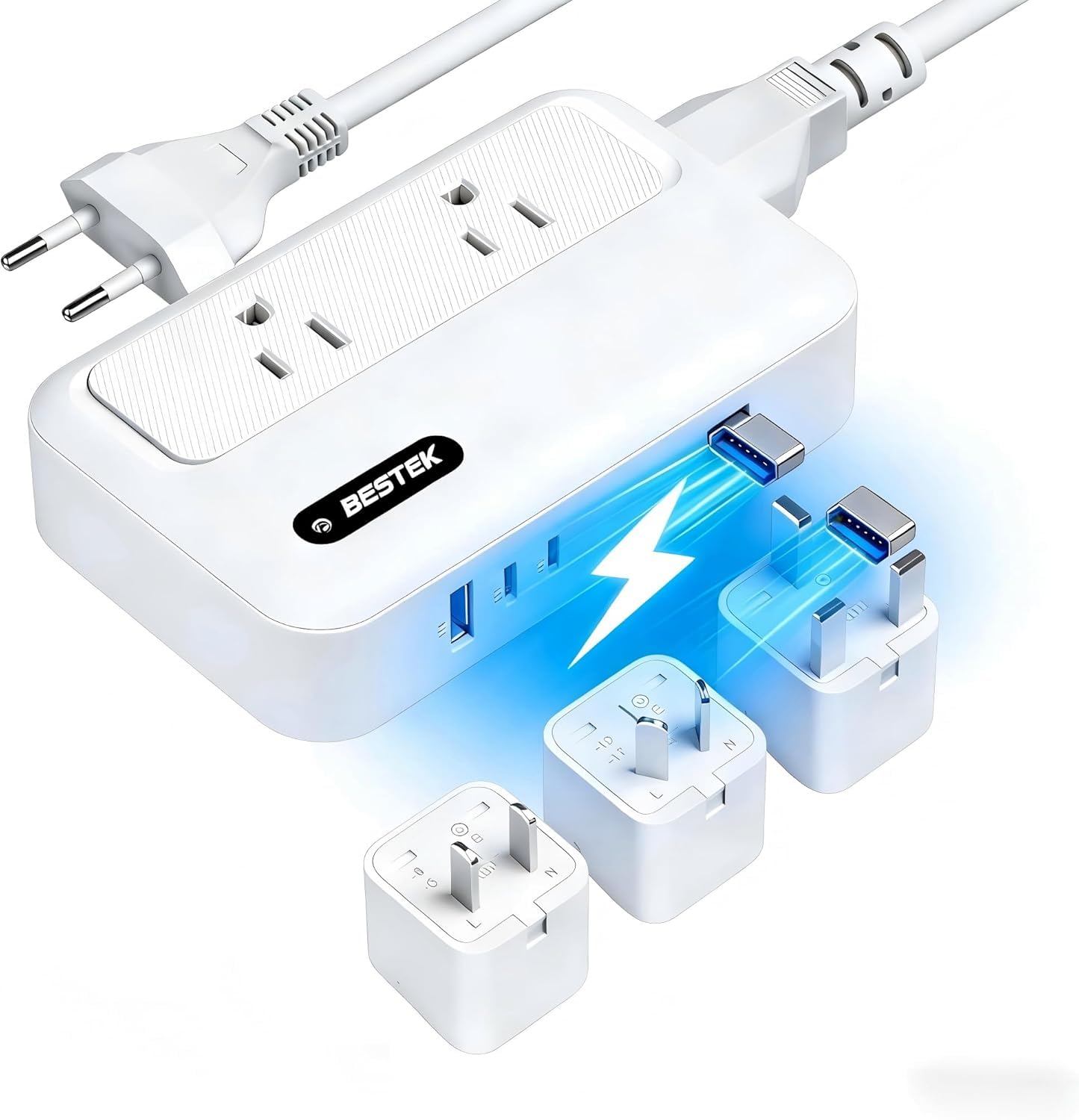
For most travelers this is the smartest buy on the list. It steps 220V down to 110V for US-standard devices and keeps the wattage sensible at 300W AC, which is enough for the appliances people actually pack — curling irons, straighteners, small fans, cameras, electric toothbrushes, shavers, phones, laptops, and tablets. What seals it is the port spread: a 35W USB-C PD output (PD means Power Delivery, a fast-charging standard) plus a USB-A port for older gear. Compared to the 12W USB-C port of traditional adapters, that is a real jump in charging speed, and it means your phone tops up fast while the AC outlet runs your straightener.
The name says it: this unit is 50% quieter than BESTEK’s old model, and the fanless design is the point — after a long travel day you are not kept awake by cooling noise. It also shrinks the transformer footprint by 30% versus the bulky norm, coming in around the size of a phone so it earns its space in the luggage. Plug coverage is broad: European cord plus Type G, Type A, and Type I adapters cover the UK, Hong Kong, Singapore, Australia, New Zealand, China, and Japan. Note plainly that it will not run hair dryers, irons, coffee makers, kettles, juicers, or rice cookers, and nothing over 300W.
What earns its spot
- Runs straighteners and curling irons up to 300W AC plus phones on 35W USB-C PD
- Half as loud as BESTEK’s older fan-cooled units, so it stays quiet overnight
- Ships with European cord and Type G, A, and I adapters for wide country coverage
Where it draws the line
- Hair dryers, irons, kettles, coffee makers, and anything over 300W are off-limits
Reach for this if: you carry heating tools and phones and want one quiet block that does both.
Keep looking if: your trip depends on a hair dryer or kettle, which needs a high-wattage converter instead.
2. DOACE 350W Voltage Converter US to Europe for Hair Straightener Curling Iron CPAP
The 350W pick that runs a CPAP and charges seven devices at 7.9oz.
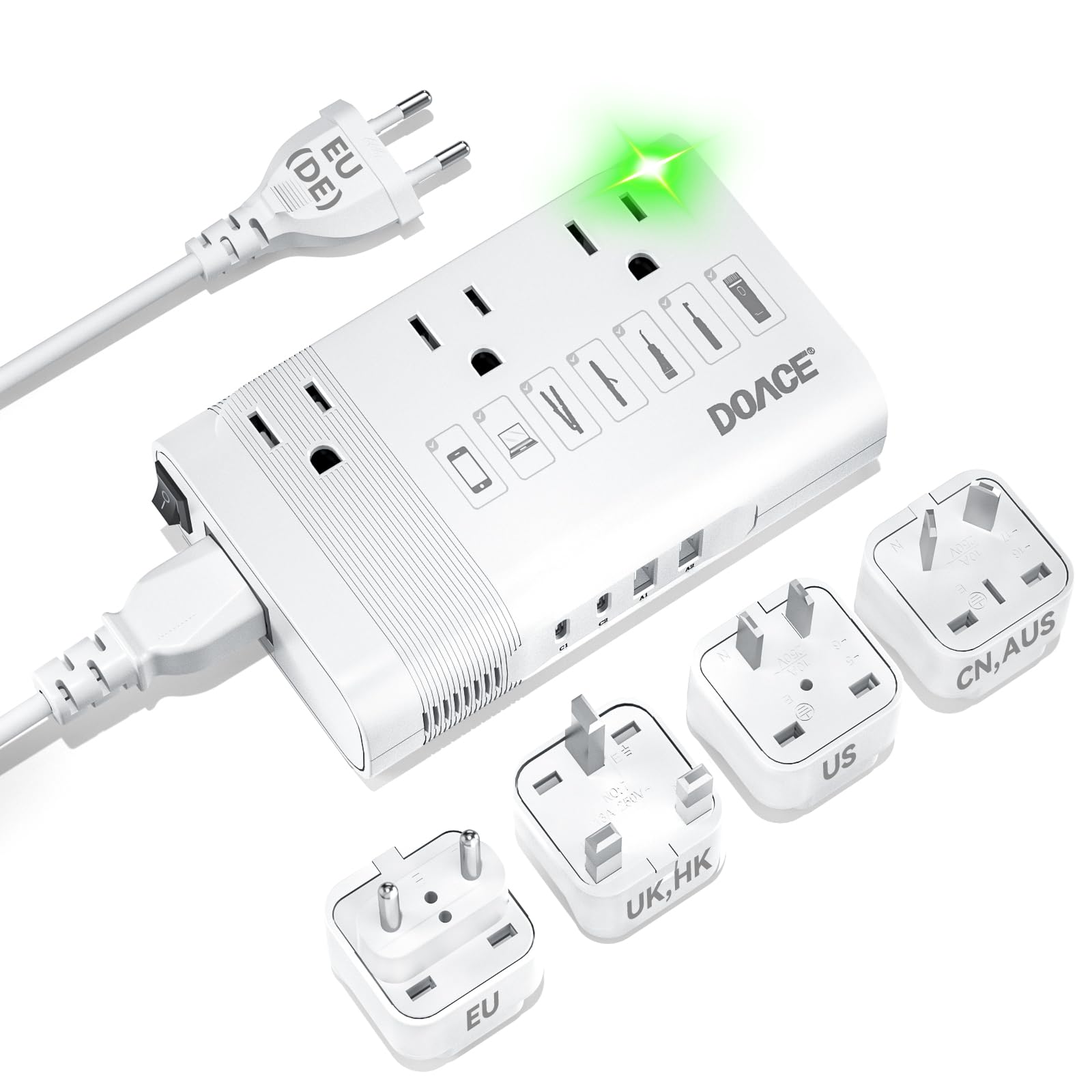
Here is the number that decides it: 350W. Because this unit runs at 350W rather than the 230W of standard converters, it powers 30% more devices — laptops, tablets, an Xbox, CPAP machines, nebulizers, breast pumps, and hair straighteners or curling irons. If you are the traveler who brings a CPAP and wants the whole family’s phones charged, this is the unit that juggles it. The auto-conversion chip (a small processor that reads the incoming voltage for you) takes 100-240V and 50/60Hz and hands your devices a US-standard 110V/60Hz, so it is plug and play.
Weight is where it disappears into your bag. At only 7.9oz it is 20% smaller and lighter than others in its class, and it runs 10% quieter, so it earns its carry space without becoming a chore. The 7-in-1 layout charges up to seven devices at once — 3 US AC outlets, 2 PD USB-C, and 2 QC USB-A ports — which means no more fighting over a single hotel outlet. It ships with an EU power cord and four travel plug adapters for a claimed 190-plus countries, so it covers the big trips. Per buyers: “It works smoothly for ac appliances but seemed to charge my IPad slowly on the USB-c connection,” and the recurring note is that the instructions for the two-prong cord into the adapter are unclear — a genuine setup snag worth reading twice. This unit will not run hair dryers, kettles, or steam irons, and if you overload it the green and red lights flash alternately until you switch it off and back on.
The setup wrinkle: the two-prong cord pairing can feel like a coin flip, so take a moment to line up the orientation before you plug in — it clears up fast.
Who it is built for: anyone who packs a CPAP plus a straightener and needs one compact block for both, with an automatic conversion chip handling the guesswork.
Choose it if: you run a CPAP, charge several devices at once, and want the lowest travel weight here.
Pass it over if: you plan to run a hair dryer or kettle, which sit above its wattage comfort zone.
3. BESTEK 220V to 110V Voltage Converter US to Europe, 2000W Universal Travel Adapter
The 2000W pick that takes 220V down to 120V for hair dryers and kettles.
If you need to run something that actually gulps power, this is the pick. The 2000W AC outlet converts 100V-240V at 50/60Hz down to 120V at 60Hz, which is enough for hair dryers, electric kettles, and electric irons — the appliances most travel converters refuse to touch. Pair that with a second 200W outlet that runs straighteners, curling irons, shavers, and toothbrushes, and a 5-in-1 charging layout, and you have one block covering both the heavy and the light jobs. Over here the wattage is a different world: this 2000W unit runs 6.7x the ceiling of the BESTEK USB-C 300W model above, so the ordinary travel tasks are simple for it.
Charging is generous too, with 2 PD 35W USB-C ports and 1 QC 18W USB-A port handling a phone, tablet, and the rest. Safety-wise it carries over-current, over-load, over-heat, and short-circuit protection, plus an 18-month warranty. The trade-off is the appliance list: it will not work with a Ninja waffle maker, Ninja blender, hair straighteners, or curling irons on the big outlet, and it is not compatible with Dyson or Shark hair tools or anything rated over 2000W. Read the fine print and match it to your device before you pack.
The catch: the 2000W outlet is built for a specific device class, not a free-for-all — hair dryers and kettles yes, a Ninja blender or Dyson tool no.
Best for: the international traveler who needs to power a hair dryer or kettle without dragging a separate transformer.
Think twice if: you carry Dyson or Shark hair tools, which this unit is not built to run.
4. TESSAN Voltage Converter US to Europe, 220 to 110 Voltage Converter

The 2000W pick with six international adapters for multi-country Europe trips.
TESSAN’s strength is coverage. Its 2000W AC outlet converts 220V-240V at 50/60Hz down to 110V at 60Hz for household appliances like kettles, while a separate 200W module handles laptops and smartphones on their native 100V-240V. The 7-in-1 layout gives you 3 AC outlets and 4 USB ports (1 USB-C), so you can charge seven devices at once — the USB-A ports run 2.4A and the USB-C port runs 3A. What wins people over here is the adapter set: a DE plug plus six international adapters (Type C, G, I, L, D, M) cover Europe, the UK, Italy, Australia, India, South Africa, Germany, China, Dubai, Greece, and New Zealand.
Portability and safety are handled: the compact, lightweight body includes built-in protection against overcurrent and short-circuits, and a silent fan that will not disturb your sleep. The honest wrinkle is in the fine print. The 2000W outlet is made for simple mechanical motors and is not suitable for low-wattage devices from 0-5W such as electric shavers or toothbrushes, and it will not convert voltage for dual-voltage devices. Before you plug in, confirm your device is not over 200W where that applies.
What clicks for travelers
- Ships with six international adapters and a DE plug covering Europe, UK, Italy, Australia, India, and more
- 7-in-1 layout runs 3 AC outlets and 4 USB ports (1 USB-C) at once
- Silent cooling fan keeps the room quiet overnight
Read before you pack
- Its 2000W outlet is not suited to low-wattage devices from 0-5W like shavers or toothbrushes
- It converts voltage but not the plug shape on its own, so you may still need a matching adapter
The right call for: travelers doing multi-country Europe trips who want one kit that covers most plug shapes on the itinerary.
Not the pick if: you mainly charge shavers and toothbrushes, which the 2000W outlet is not built to feed.
5. Ceptics Voltage Converter 220 to 110, 200W, 6 SWadAPt Plugs, 4 USB
The 200W pick built for curling irons, with four USB ports and a plug that stays put.
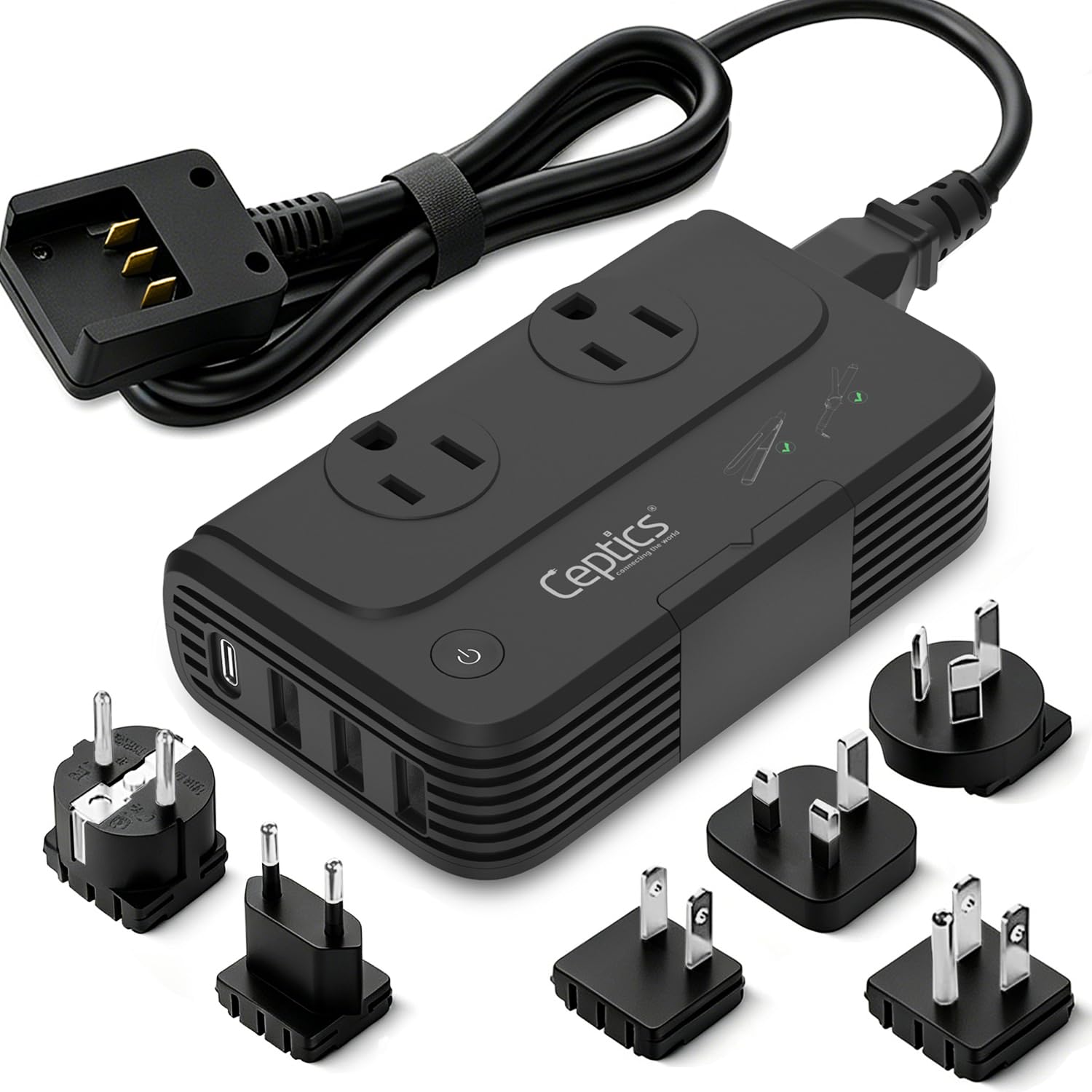
Ceptics built this one around heating tools. Its patented design runs your curling iron or straightener up to 200W in 220V countries, converting 220V from Europe, Asia, Australia, or Africa down to 110V, and it charges almost anything else alongside. The 6-device layout means 2 USA inputs plus 4 USB ports with PD 18W fast charging, so a CPAP, electric toothbrush, fan, nebulizer, or game console can charge together. The outlet technology outputs 6.4A max and matches the current your device draws, so nothing is starved or overfed.
Plug coverage is world-ready: Type A for Japan, the US, Canada, and Mexico; Type I for China, Australia, and New Zealand; Type C for Europe, South America, and Asia; and Type G for the UK, Ireland, Singapore, and Hong Kong. It is compact at 4.8 by 3.1 by 1.5 inches with a 5-foot cable, and the silent fan plus auto-shut-down surge protection, over-current, over-temperature, and short-circuit guards keep things calm. Buyers rave that tools did not overheat and that the lightweight plug stays secure in loose hotel sockets where heavier adapters fall out. Two things to keep straight: it will not run a hair dryer, coffee maker, or anything over 200W, and some owners found it slightly heavier than expected and that a heating pad did not work through it.
Standout detail: the plug is light and small enough to grip loose foreign outlets that heavy adapters slide out of — a small thing that saves real frustration.
Pick it for: trips where a curling iron or straightener leads the packing list and you also need several USB chargers.
skip it if: you need to run a hair dryer or anything that pulls more than 200W.
6. 1600W 220V to 110V Converter Power Any U.S. Appliance in 220-250V Countries
The pure sine wave pick that powers US appliances up to 1600W.
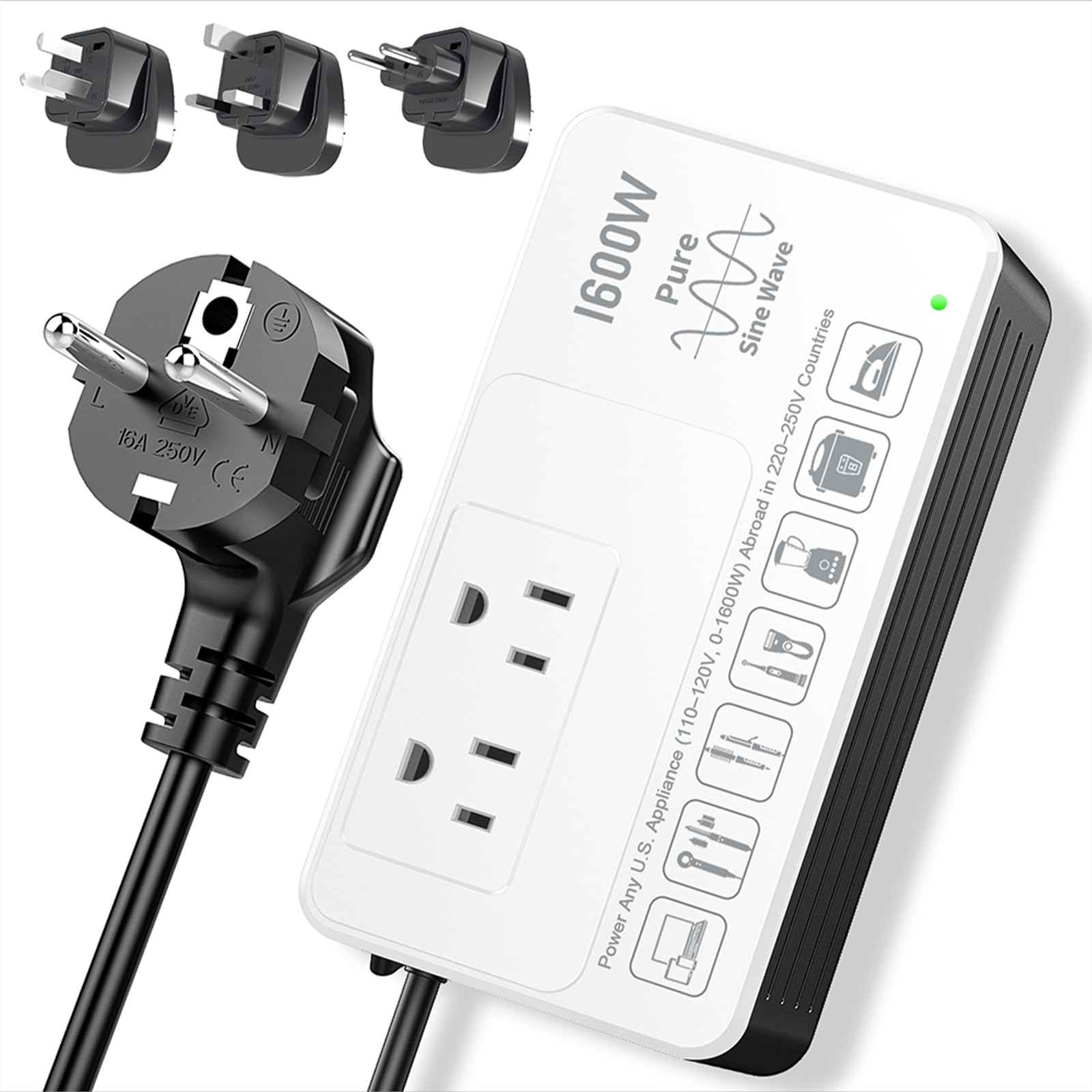
The headline here is the waveform. This is billed as the first pure sine wave voltage converter — pure sine wave means the electricity comes out as a smooth, clean wave rather than a choppy approximation, which is the kind of current delicate electronics prefer. It converts 220-250V down to a stable 120V and is suitable for any Amercan appliance running 110-120V from 0 to 1600 watts, from CPAP machines and hair straighteners to hair dryers, coffee makers, blenders, and electric toothbrushes. Four international adapters (Type C, G, I, and E/F) cover Europe, Israel, the UK, Spain, Italy, France, China, Australia, Iceland, and Ireland.
Safety is where it earns the premium label. Over-temperature, over-current, overload, surge, and short-circuit protections all watch the line, and it has passed CE safety certification and UL safety testing. If it detects a problem it disconnects power and flashes its indicator instead of blowing a fuse, so a simple restart resumes normal function — a fuseless design that saves you the fiddle of replacing parts. The honest caveat is weight and size: at 1.6 pounds it is portable enough for travel, but some find it a bit bulky, and the cooling fan is audible briefly after you switch off a heavy appliance. One buyer did note a Dyson tool had a startup delay that cleared after an off-on cycle, and the vendor sent a replacement right away.
Why the premium is fair: pure sine wave output and a fuseless auto-reset design make this the safest home for sensitive devices like CPAP machines and laptops.
Worth it for: travelers and expats who run sensitive appliances and want clean power plus automatic protection instead of fuse swaps.
Weigh the trade-off if: you want the lightest possible packer — this carries more bulk than the compact travel units.
7. ELC T Series 2000 Watt Voltage Converter Transformer

The silent toroidal transformer that lives in one spot and just works.
This is a different breed from the travel blocks above — it is a sit-down transformer for people living abroad or running foreign appliances at home. It handles up to 2000 watts in both directions, stepping 220V to 110V and 110V to 220V, so it serves US appliances on foreign power or foreign appliances on US power. New toroidal transformer technology (a donut-shaped core that runs cooler and quieter) keeps it 20% lighter than traditional transformers, at 12.5 pounds and 10.25 by 8 by 4.5 inches. Buyers who run an Italian espresso machine, a Korean rice cooker, and a Samsung printer through it report it just works.
Quiet is the recurring theme. This transformer makes no hum in use — owners describe a unit so silent they have to press an ear to it to hear anything — which is why it shows up in music studios and bedrooms alike. Dual circuit breakers protect each voltage (120V and 220V) separately, and it holds up over time; users report running it for five years and counting. The honest limits: it only works with European or Asian 220V single-phase power and is not built for American 220V (dual phase), and one buyer found their steam iron kept tripping it. The power switch sits on the back, so if you wall-mount it you may have to pull it forward to reach the switch.
Why residents keep it
- Steps both ways, 220V to 110V and 110V to 220V, up to 2000 watts
- Runs silent with no hum, ideal for a studio or bedroom
- Dual circuit breakers protect each voltage separately
Set your expectations
- Not built for American 220V dual-phase power, only single-phase European or Asian 220V
- The rear-mounted power switch is awkward to reach if you wall-mount the unit
Made for: expats and home users who want a quiet, durable transformer parked in one spot to run foreign appliances.
Look elsewhere if: you need something that packs into a carry-on — this is a stay-put unit.
8. Yinleader 5000 Step Up/Down Transformer Converter 110/120Volt-220/240Volt

The 5000W transformer that turns one wall outlet into two power worlds.
When you need real capacity, this is the heavy hitter. It runs up to 5000 watts and converts 110V up to 220V or 220V down to 110V, built for appliances with a maximum power consumption within 3000 watts — rice cookers, hot water pots, food mixers, and blenders. The high-efficiency toroidal transformer delivers a stable output with low consumption for 7×24 hours of continuous run, and the 28A current rating tells you it is meant for serious draws. It offers 3 US standard sockets for 110-120V appliances and 3 universal sockets for 220-240V appliances, so 220V and 110V gear can run side by side.
This unit works in countries running 110V-120V or 220V-240V such as the US, Europe, the UK, and China, with dual circuit breakers for overheat and overload protection. Owners have used it to run a 110V welder off a 220V outlet with excellent results, and to convert 120V to 240V for a commercial fridge compressor that barely warms. Understand the fine print before buying: it ships with a US power cord, so in a 220V country you must add a plug adapter; it converts voltage but not frequency, so a device incompatible with 50/60Hz will be affected; it is not built to charge a Tesla EV car; and one buyer flagged that the input cable felt light for a full load. The unit is heavy at 13.6 pounds, meant to be set in place.
Pro tip from the spec sheet: the maker recommends a transformer rated at least 50% higher than your appliance’s watts, so leave real headroom on the line.
Best for: a home or workshop running high-draw equipment like welders or mixers that need real wattage behind them.
Handle the limits: it is not for EV charging and needs a separate plug adapter in 220V countries.
9. VEVOR 5000W Voltage Converter Transformer Step Up/Down 220V-110V 110V-220V
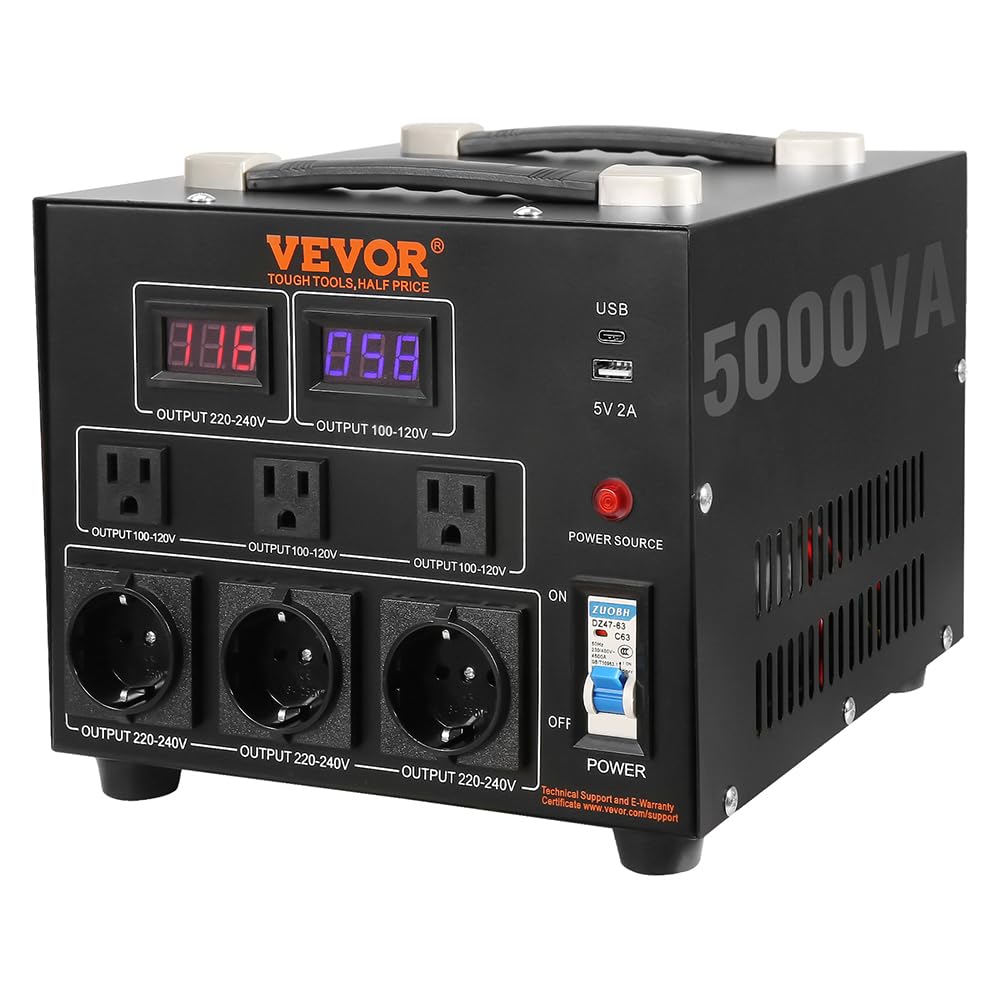
Six AC plugs, dual LCD readouts, and a handle for moving real power around.
VEVOR packs a lot of outlets into one 5000W box. It steps 110V up to 220V or 220V down to 110V by adjusting the input voltage switch, and gives you 3 US NEMA 5-15R three-pin sockets, 3 European Schuko sockets, 1 5V USB port, and 1 Type-C jack — six AC plugs total. The reason those dual LED displays matter: they show the current output voltage in real-time, so you can spot an overload before it becomes a problem. It is the same class of capacity as the Yinleader above, but where the Yinleader has 28A, this one carries a 15A current rating — worth knowing if you are planning a heavy single load.
Quiet operation comes from high-quality toroidal coils rated for 7×24 hours of continuous run, which cuts noise, odor, and weight compared to older designs. It arrives with CE and FCC certification along with internal overload, overcurrent, and short-circuit protection. Practically, it uses a universal power wiring slot so you can buy the cord that matches the wall jack in your country. Watch the fine print: it is designed only for European or Asian 220V single phase and will not work with American 220V, and the maker suggests buying a converter with a load power at least 25% higher than your device’s total. It is heavy at 28.2 pounds, but a handle makes it movable rather than stuck where you set it.
What stands out
- Six AC plugs plus a 5V USB port and Type-C jack on one 5000W unit
- Two LED displays read live output voltage to help you avoid overload
- CE and FCC certification with overload, overcurrent, and short-circuit protection
Know before buying
- Single-phase European or Asian 220V only — not for American 220V dual phase
- Its 15A current rating is lower than the Yinleader’s 28A, so check heavy single loads carefully
The one to grab if: you want the widest outlet mix plus live voltage readouts to catch overloads early.
Check your amperage first if: you are planning one very demanding appliance that needs more current headroom.
Understanding the Specs
Wattage Rating
Wattage is the ceiling on how much power a converter can pass through. A “200W” unit carries up to 200 watts; a “2000W” unit carries up to 2000. Match the rating to your biggest appliance, then leave headroom. The maker of one unit here suggests choosing a converter with a load power at least 25% higher than your device’s total, while another recommends at least 50% higher — either way, do not run at the ceiling.
Step Up vs Step Down
A step-down transformer takes 220V from the wall and outputs 110V for your US device. A step-up reverses that, feeding 110V in to give 220V out — useful for running foreign appliances on US power. Some transformers here do both. Note that a plug adapter alone never changes voltage; it only reshapes the pins, so 220V still reaches a device expecting 110V and can damage it.
Pure Sine Wave vs Approximated
Pure sine wave means the output electricity is a smooth wave, the same clean shape as wall power, which sensitive electronics prefer. Many cheaper converters approximate that wave. If you are feeding a CPAP machine, laptop, or other delicate device, a pure sine wave converter gives you the safest current shape of the two.
USB-C PD And USB Ports
USB-C PD (Power Delivery) is a fast-charging standard that pushes more power than standard USB, so a 35W USB-C port charges phones and tablets far quicker than a 12W one. QC (Quick Charge) is a similar fast-charging standard for USB-A ports. These ports let you top up everyday electronics while AC outlets handle your heavier appliances.
FAQ
What is the difference between a plug adapter and a voltage converter?
Can these converters run my hair dryer?
Will a 220V to 110V adapter work in Europe and the UK?
Can I use a voltage converter with a CPAP machine?
Do I need a step up transformer or a step down transformer?
How much wattage headroom should I leave on a converter?
Can a converter power a coffee maker or kettle?
Do voltage converters change the hertz or frequency too?
Is a heavier transformer better than a compact travel converter?
Can I plug a US appliance into a foreign 220V outlet with just an adapter?
Final Thoughts: The Verdict
If you want the safest all-rounder for travel, the BESTEK 220v to 110v Converter with USB C 35w earns the top spot — it runs straighteners and phones quietly on one compact block, and its 35W USB-C PD port beats the old 12W standard. For CPAP users and families charging many devices at once, grab the DOACE 350W Voltage Converter with its 7-in-1 layout and 7.9oz weight. And if you need to run a hair dryer or kettle on foreign power, the BESTEK 2000W Universal Travel Adapter is the one to reach for, with its220V step-down output. Check your device’s wattage against the converter’s rating before you buy, and you will never fry a gadget abroad.
How We Picked
We do not accept paid placement. Every pick is matched to a real buyer and a real use-case; we do not hands-on test units.
Sources & Methodology
Specifications: manufacturer listings and product documentation. Review insights: verified customer reviews, as of September 2026. Pricing: not shown on this page (it changes often); check the current price via the retailer link.
As an Amazon Associate, Gadgets Feed earns from qualifying purchases. This does not affect which products we feature.