
Thin enough to route through cramped engine bays and door panels, yet thick enough to handle 12V accessory circuits, 18 gauge automotive wire is the universal sweet spot for car audio, LED lighting, and sensor wiring. The problem is that most listings mix PVC, silicone, and CCA without clearly stating which insulation can survive under-hood heat or which stranding count actually resists vibration fatigue.
I’m Min — the co-founder and writer behind Gadgets Feed. I’ve spent hundreds of hours cross-referencing UL certifications, stranding counts, temperature ratings, and real owner feedback to separate the wires that hold up in daily driving from those that crack or corrode within a season.
After analyzing 7 top-selling spools on Amazon, I’ve ranked them by build quality, insulation durability, and value. Read on to find the best 18 gauge automotive wire for your next electrical project.
How To Choose The Best 18 Gauge Automotive Wire
Automotive wire lives in a hostile environment — engine heat, UV exposure, oil, moisture, and constant vibration. The right 18 AWG wire for your car or truck depends on where it runs and how much current it carries. Here are the three factors that matter most.
Conductor Material: Oxygen-Free Copper vs CCA vs Tinned Copper
Oxygen-free copper (OFC) delivers the lowest resistance and best conductivity for sensitive audio equipment, but it costs more per foot. Copper-clad aluminum (CCA) is lighter and cheaper, but its higher resistance means you need a thicker gauge for the same current — never use CCA for long power runs to amplifiers. Tinned copper adds corrosion resistance essential for marine, off-road, and salt-belt vehicles where moisture is constant.
Insulation Type: PVC vs Silicone — Temperature and Flexibility
PVC insulation is common and inexpensive, rated typically from -20°C to 80°C. It works fine inside the cabin for speaker wires or LED strips, but under the hood near exhaust manifolds, PVC can melt or become brittle. Silicone insulation handles 200°C continuous and stays flexible down to -60°C, making it the clear choice for engine bays, battery boxes, and any location exposed to extreme heat or cold.
Stranding Count: How Many Strands for Flexibility and Fatigue Life?
A 13-strand 18 AWG wire is stiff enough to hold its shape when routed, but it can fatigue and snap if bent repeatedly near door hinges or moving seats. A 52-strand or 150-strand wire behaves like a wet noodle — it drapes into tight corners without fighting back and survives thousands of vibration cycles. For permanent installs inside panels, higher stranding is always better.
Quick Comparison
On smaller screens, swipe sideways to see the full table.
| Model | Category | Best For | Key Spec | Amazon |
|---|---|---|---|---|
| BNTECHGO 18 Gauge Silicone Wire | Premium Silicone | Under-hood high heat | 150 strands, 600V, 200°C | Amazon |
| ANAMIA 18 AWG Silicone Wire 200ft | Silicone Twin Spool | Flexible dual-color runs | 150 strands, 200°C, 600V | Amazon |
| NOVINO 18 Gauge Marine Wire | Marine Grade | Boats, salt, outdoor | Tinned copper, UL 1426 | Amazon |
| Tyumen 100ft OFC Speaker Wire | OFC Audio | Car stereo clarity | 99.95% OFC, 52 strands | Amazon |
| GS Power CCA 400ft Bonded Wire | CCA Budget Bonded | High-volume budget wiring | 200ft each red/black, bonded | Amazon |
| Striveday 18 AWG Hook Up Wire Kit | Multi-Color Kit | Prototyping & repairs | 5 colors, 82ft total, UL 1007 | Amazon |
| NAOEVO 18/2 CCA Wire 100ft | CCA Twin Conductor | 12V accessory & LED | CCA, 2-conductor bonded | Amazon |
In‑Depth Reviews
1. BNTECHGO 18 Gauge Silicone Wire Spool 100 ft Black

BNTECHGO’s 18 AWG silicone wire uses 150 strands of 0.08mm tinned copper, giving it a 600V rating and an extreme temperature range of -60°C to 200°C. That ultra-high stranding count makes the wire feel like a wet noodle — it snakes around tight engine bay corners without fighting back, and the silicone jacket won’t melt or crack near exhaust manifolds or battery terminals.
Real owners confirm its UV resistance holds up after years on ham radio antennas, and the tinned strands resist corrosion better than bare copper in humid climates. The 100-foot continuous spool is enough for a full car stereo power run or multiple accessory circuits, and the 2.3mm outer diameter fits standard 18 AWG crimp connectors without forcing the insulation.
The only trade-off is that silicone insulation is softer than PVC — it can nick more easily if you drag it across sharp metal edges. Use a grommet or split loom in high-abrasion zones, and this wire will outlast the vehicle. No other spool at this price point matches the temperature ceiling and flexibility.
Why it’s great
- 150-strand tinned copper is supremely flexible and fatigue-resistant
- 200°C silicone jacket survives under-hood heat without melting
- 600V rating covers everything from 12V accessory circuits to solar arrays
Good to know
- Silicone jacket is soft and can tear on sharp metal without conduit protection
- Single-color spool — you’ll need a second color for polarity runs
2. ANAMIA 18 AWG Stranded Copper Wire 200ft
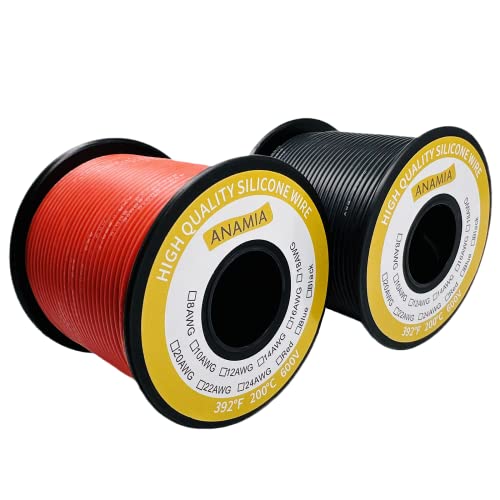
ANAMIA bundles 100 feet of red and 100 feet of black 18 AWG silicone wire in one package — perfect for maintaining polarity consistency without buying two separate spools. Each conductor uses 150 strands of 0.08mm tinned copper, identical in spec to the BNTECHGO above, and the silicone insulation is rated for 200°C continuous and 600V. That means you can run both positive and negative legs through the same engine-bay conduit without worrying about insulation breakdown.
Owners specifically highlight how easily this wire strips and solders for 12V LED projects inside 3D-printed enclosures and for wiring lawn tractor electrical systems. The -60°C low-temperature rating also matters if you live in a freezing climate where PVC stiffens and cracks. The twin spool format eliminates guesswork: red for power, black for ground, both with identical flexibility and heat tolerance.
The catch is the conductor diameter — 0.08mm strands are so fine that some buyers initially mistake them for aluminum because the tinning masks the copper color. A quick burn test (the silicone jacket chars, the tin melts, and bright copper appears) confirms it is genuine tinned copper. If you need a dual-color silicone solution for a full vehicle rewire, this is the most convenient spool set available.
Why it’s great
- 200 total feet split evenly between red and black for polarity wiring
- Identical 150-strand tinned copper and 200°C silicone as premium spools
- Excellent low-temperature flexibility down to -60°C
Good to know
- Extremely fine strands can be mistaken for CCA without a burn test
- Silicone jacket is prone to nicks if pulled past sharp edges
3. NOVINO 18 Gauge Marine Wire 100ft Red + 100ft Black
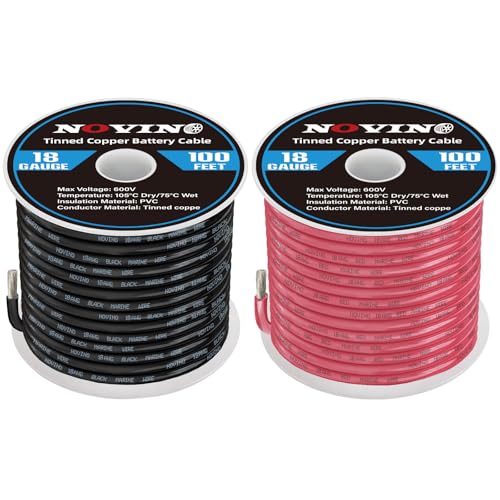
NOVINO’s 18 AWG marine wire is the only entry on this list built to UL 1426 and ABYC standards, with a thick tinned copper conductor and a special outer jacket formulated for saltwater, UV, and constant moisture exposure. The 105°C dry / 75°C wet rating means it handles engine-room heat while resisting electrolysis that quickly destroys bare copper in a boat bilge or truck underbody.
Owners installing dual batteries in bass boats and rewiring fish finders report that the jacket feels noticeably thicker and more abrasion-resistant than standard PVC or silicone wires. The tinning extends the lifespan in salt-air environments dramatically — one owner confirmed it outperformed cheaper wire that corroded in a single season. The 100-foot red and 100-foot black spools give you enough footage to run both battery banks and accessory circuits on a mid-sized boat or RV.
The trade-off is price per foot: this is the most expensive 18 AWG wire in the lineup, and the extra jacket thickness makes it slightly stiffer than high-strand silicone wire. For lake boats, off-road trailers, or any vehicle that sees road salt, the premium over standard automotive wire is justified by corrosion prevention alone.
Why it’s great
- UL 1426 / ABYC certified for marine and outdoor use
- Tinned copper conductor resists saltwater corrosion and electrolysis
- Thicker jacket provides superior abrasion resistance in harsh environments
Good to know
- Higher cost per foot compared to PVC or standard silicone wire
- Less flexible than 150-strand silicone due to thicker jacket
4. Tyumen 100ft 18 AWG 2 Conductor Speaker Wire

Tyumen’s 18 AWG wire uses 99.95% oxygen-free copper with 52 strands per conductor — not the highest strand count, but the OFC material purity gives it the lowest resistance per foot of any wire in this roundup. For car stereo enthusiasts, that translates to cleaner signal transfer to speakers and less voltage drop on long runs from the head unit to rear door speakers. The bonded red/black jacket makes polarity identification instant, and the numbered markings on the jacket help with documentation during complex installs.
Real buyers consistently mention using this wire for dashboard-to-battery runs on golf carts, LED strip extensions, and whole-home audio distribution. The 100-foot spool on a hard plastic dispenser pays out smoothly without tangling. The OFC strands also resist oxidation better than standard copper — the jacket stays flexible after years coiled in a toolbox or routed inside door panels.
Note that 52 strands is stiffer than a 150-strand silicone wire, so routing through tight grommets takes a bit more effort. And the PVC jacket is rated only for interior use (70°C max) — do not run this under the hood or near exhaust. For its intended job of delivering clean audio signal inside the cabin, this is the best-sounding 18 AWG option available.
Why it’s great
- 99.95% oxygen-free copper delivers superior conductivity for audio
- Bonded 2-conductor design with numbered markings for easy polarity
- Hard plastic spool dispenses cleanly without bird-nesting
Good to know
- PVC jacket limited to 70°C — not suitable for under-hood or high-heat locations
- 52 strands are less flexible than high-strand-count silicone alternatives
5. GS Power CCA 400ft 18 Gauge Bonded Wire
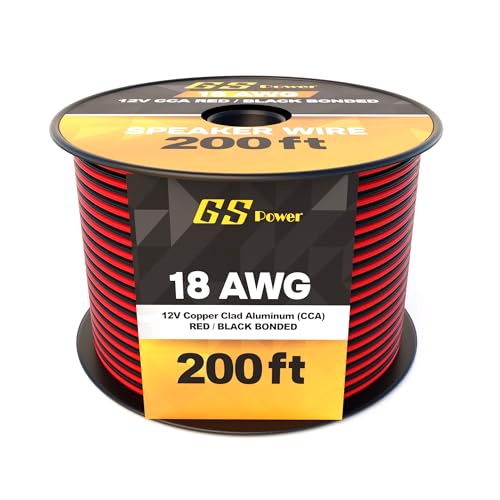
GS Power offers the highest footage-per-dollar ratio in this comparison: 400 total feet of bonded 18 AWG wire split evenly between red and black. The conductor is copper-clad aluminum (CCA) with 13 strands, and the PVC jacket is rated at 105°C. For non-critical applications like Christmas LED decorations, trailer marker lights, or RC toys where weight matters more than maximum conductivity, this spool provides enough wire for multiple projects without breaking the budget.
Owner feedback confirms it works well for power-injecting holiday lights and wiring low-voltage yard path lights. The bonded design keeps positive and ground wires paired neatly, reducing the mess of loose parallel runs. The 105°C rating is higher than standard PVC, so it can live inside a vehicle cabin or under a dashboard without softening.
The major limitation is CCA’s higher resistance — for a car audio amplifier drawing 8–10A on an 18 AWG circuit, the voltage drop over 15 feet will be measurably higher than with pure copper. Also, 13 strands make this the stiffest wire on the list; it can fatigue and snap if bent repeatedly in a door-jamb pass-through. Keep this for fixed, low-current, low-vibration installations, and you’ll get tremendous value.
Why it’s great
- 400 total feet — highest footage-per-dollar of any wire reviewed
- Bonded red/black design simplifies polarity management on large projects
- 105°C PVC jacket is better than basic 80°C wire for interior use
Good to know
- CCA conductor has higher resistance than pure copper — not ideal for audio or long power runs
- 13-strand construction is stiff and prone to work-hardening under repeated bending
6. Striveday 18 AWG Hook Up Wire Kit 82ft

Striveday’s 82-foot kit packs five separate colors (red, blue, green, yellow, black) of UL 1007-rated 18 AWG tinned copper wire into a single box dispenser. The UL 1007 standard means the PVC insulation is recognized for 300V and 80°C operation — fine for interior automotive circuits, model railways, robotics, and DIY electronics where color-coding multiple signal or power lines saves troubleshooting time.
Buyers who repaired rodent-chewed engine harnesses and rewired arcade control panels appreciated having five colors on hand without buying separate spools. The tinned copper strands resist corrosion and solder easily. The 300V rating provides a comfortable safety margin for any 12V or 24V DC vehicle circuit.
The packaging is the weak point — the box dispenser allows the spool to unwind internally, creating tangles that require manual re-spooling. Several owners simply threw the box away and stored the wire loose. Also, at 82 total feet split across five colors, you get only about 16.4 feet per color — enough for small repairs and prototypes, but not for a full car stereo or trailer rewire. Best for the toolbox of a hobbyist who needs quick color-coded leads.
Why it’s great
- Five distinct colors enable clear circuit identification without tags
- Tinned copper core resists corrosion and solders easily
- UL 1007 certification provides a verified 300V / 80°C rating
Good to know
- Box dispenser tangles easily — most owners discard the packaging
- Each color provides only ~16 feet, limiting use for large-scale projects
7. NAOEVO 18 Gauge Wire 100ft 2 Conductor
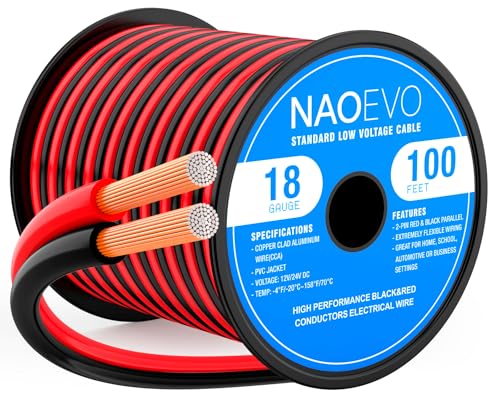
NAOEVO’s 18 AWG bonded wire uses copper-clad aluminum conductors with PVC insulation rated from -20°C to 70°C. It is designed specifically for 12V/24V DC low-voltage circuits — think single-color LED strips, door speakers, and basic automotive accessory wiring where the current draw stays under 5A. The bonded 2-conductor format saves time on parallel runs, and the numbered markings help verify polarity during installation.
Owner reviews consistently note the wire is true to gauge, flexible enough for threading through tight spaces during 12V car USB charger installs, and delivers good value for the 100-foot length. The PVC jacket is moisture-resistant and anti-aging, suitable for interior or dry under-chassis use where temperatures stay moderate.
The limitations are the same as any CCA wire: higher resistance than pure copper means you cannot push the full 12A ampacity rating over long distances without voltage drop. And the 70°C ceiling is the lowest on this list — keep it away from engine heat, exhaust, and any location where summer under-hood temps exceed 150°F. For simple cabin LED accent lighting or a backup camera power feed, it gets the job done at a entry-level price.
Why it’s great
- Bonded 2-conductor design with numbered markings for clear polarity
- Flexible PVC jacket works well for routing inside dashboards and door panels
- 100-foot spool provides sufficient length for most small 12V accessory projects
Good to know
- CCA construction limits current capacity on long runs compared to pure copper
- 70°C max temperature — unsuitable for under-hood or high-heat environments
FAQ
Can I use 18 AWG wire for car audio amplifier power?
Is silicone wire always better than PVC for automotive use?
What does tinned copper do for automotive wire?
Final Thoughts: The Verdict
For most users, the best 18 gauge automotive wire overall is the BNTECHGO 18 Gauge Silicone Wire Spool because its 150-strand tinned copper and 200°C silicone insulation handle both interior and engine-bay environments without compromise. If you want a dual-color silicone set for a full vehicle rewire, grab the ANAMIA 18 AWG Silicone Wire 200ft. And for saltwater boats, off-road trailers, or any corrosion-prone application, nothing beats the NOVINO 18 Gauge Marine Wire with its UL 1426 certification and tinned copper conductor.