
Our readers keep the lights on and my morning glass full of iced black tea. As an Amazon Associate, I earn from qualifying purchases.
Specs are compiled from manufacturer listings and verified buyer reviews and can change over time — please confirm the key details on the product page before buying.
An 18,000 BTU window air conditioner is the biggest cooling step most homes can take without calling an HVAC crew — and the one detail that sinks more installations than any other is the outlet. Every unit at this cooling size runs on 208/230 volts, not the ordinary 115-volt wall socket your lamp uses. So the real question is not which machine blows coldest; it is which one fits your window, your wiring, and your electric bill. This guide walks through nine real 18,000 BTU window units, what each one does well, and who each one actually suits.
I’m Min — the founder and writer behind Gadgets Feed. This guide is built by comparing the manufacturers’ published specifications and the patterns across verified customer reviews, so you get each pick’s real strengths and trade-offs instead of marketing spin.
Below you’ll find how to match BTU to room size, why the plug type matters before you buy, and a straight comparison of nine window units. Whether you are cooling a converted attic, a ranch house, or a two-room apartment, this breakdown of the best 18000 BTU window air conditioner covers the outlet, window fit, and running cost for each pick.
Quick Picks
- Midea 18,000 BTU Smart Inverter Window Air — Best Overall
- Frigidaire 18,000 BTU Smart Window Air — Best Value
- LG 18,000 BTU Window AC, Dual Inverter — Most Efficient
- BLACK+DECKER Window Air Conditioner 18000 BTU — Widest Fit
- Keystone 18,000 BTU Window Air Conditioner — Best for Damp Rooms
- ROVSUN 18000 BTU Air Conditioner Window Unit — Heats and Cools
- LG 24,500 BTU Smart Window Air Conditioner — Biggest Coverage
- Whirlpool 18,000 BTU Window Mounted Inverter — Quietest Pick
- Friedrich Chill Premier Inverter 18 — Flexible Install
How To Choose The Best 18000 BTU Window Air Conditioner
Buying at this cooling size is a three-part decision: the voltage your home can supply, the window opening you actually have, and how much you care about noise and running cost. Get those three right and almost any unit here will cool the room. Get them wrong and you will be hauling a heavy box back to the post office.
The 230-volt outlet is non-negotiable
Every 18,000 BTU window unit in this roundup needs a 208/230V outlet — the kind used for an electric range or a heavy appliance, not the standard 115V socket on your bedroom wall. Some use a 6-15P plug with sideways prongs, others differ. Before you order anything, check whether your home already has a dedicated 230V outlet within reach of the window, or budget for an electrician to add one. This single point trips up more first-time buyers than any spec on the box.
Match BTU to your room’s square footage, not to a bigger number
An 18,000 BTU unit is built for large spaces, and the models here cover roughly 1,000 to 1,020 square feet. Oversizing the cooling for a small room makes the compressor short-cycle, which wastes power and leaves the air clammy. Undersizing it means the unit runs flat out and never quite catches up on a 100°F afternoon. Measure your room’s square footage, then pick a model whose listed coverage matches it.
Inverter vs single-speed compressors
A regular compressor is either full on or full off, so the room warms and cools in waves. An inverter compressor varies its speed to hold the temperature steady, which is gentler on power draw and usually quieter. Several units below use inverter technology, and they tend to cost more up front while being easier to live with over a long summer.
Quick Comparison
| Model | Best For | Coverage | Voltage / Plug | Key Control | Amazon |
|---|---|---|---|---|---|
| Midea 18,000 BTU Smart Inverter | Attics and hot rooms | 1,000 sq ft | 208/230V | App, voice, remote | Amazon |
| Frigidaire 18,000 BTU Smart Window AC | Drop-in replacements | 1,020 sq ft | 230V 6-15P | App, remote | Amazon |
| LG 18,000 BTU Dual Inverter Window AC | Low running cost | 1,000 sq ft | 208/230V | ThinQ app, voice | Amazon |
| BLACK+DECKER BD18WT6 | Wide window openings | 1,000 sq ft | 208/230V | Remote | Amazon |
| Keystone 18,000 BTU Window AC | Dehumidifying damp rooms | 1,000 sq ft | 230V | Smart remote | Amazon |
| ROVSUN 18,000 BTU with Heat | Year-round use | 1,000 sq ft | 208/230V | Remote, buttons | Amazon |
| LG 24,500 BTU Smart Window AC | Whole-floor cooling | 1,560 sq ft | 230/208V | ThinQ app, voice | Amazon |
| Whirlpool 18,000 BTU Inverter | Quiet napping | 1,000 sq ft | 230V/15A | Remote | Amazon |
| Friedrich Chill Premier Inverter | Window or wall install | — | 230/208V | Remote | Amazon |
In‑Depth Reviews
1. Midea 18,000 BTU Smart Inverter Window Air Conditioner

The attic-killer that turns a baking top floor into a normal room.
If your cooling problem is a room that bakes — a converted attic, a top-floor apartment, a room that faces full sun all afternoon — this is the pick that earns its spot. It covers 1,000 square feet, and owners describe it pulling a 120°F-plus attic apartment down from a single room, cooling fast in minutes. The 48 dBA operating noise is low enough that it fades into background, and because the variable-speed inverter compressor ramps up and down instead of slamming on and off, the temperature holds steady rather than swinging.
Control is the other strong suit. You get four modes (Auto, Cool, Dry, Fan) and three fan speeds, a 24-hour timer, and Eco mode, all reachable from the LED panel, the remote, the SmartHome app, or by voice through Alexa and Google Assistant. The washable filter pops out from the front panel for cleaning. It is Energy Star certified, and the inverter design is rated for more than 40% energy savings against the Energy Conservation Standard.
Here is the catch you need to settle first: this unit runs on 230V and needs a dedicated 208/230V outlet with sideways prongs, not a standard household plug. That plugs into nothing in a typical bedroom wall, so confirm your outlet situation before ordering. Buyers report it weighs in heavy — around 92 lb — meaning two people to lift it into the window. The recurring gripe is the manual and mounting screws, which some found confusing or the wrong size. Once it is in and running, though, the cooling performance is what carries it.
What makes it the top pick
- Inverter compressor with 18,000 BTU and 48 dBA quiet operation
- Four modes, three fan speeds, 24-hour timer, and Eco mode on board
- SmartHome app plus Alexa and Google Assistant voice control
- Energy Star certified; inverter rated above 40% savings vs. standard
What to plan around
- Requires a dedicated 208/230V outlet — not a standard 115V socket
- Around 92 lb, so two people are needed to lift it in
- Manual and mounting screws drew complaints about clarity and sizing
Reach for this if: you have a genuinely hot large room and an existing 230V outlet nearby.
Think twice if: your only wall socket is a standard 115V one and running new wiring is not in the plan.
2. Frigidaire 18,000 BTU Smart Window Air Conditioner with Wi-Fi
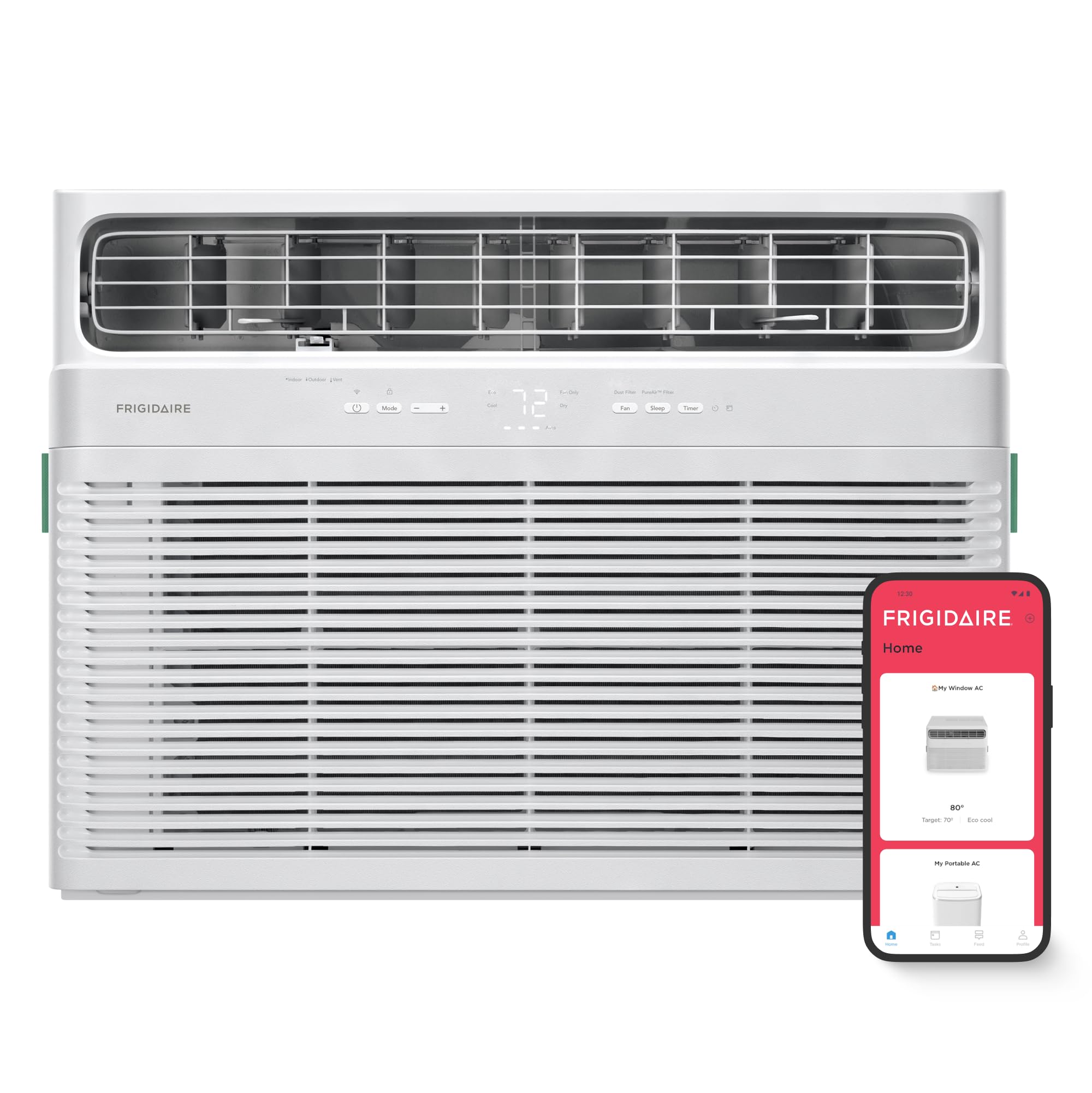
Swap-in convenience that reuses your old window frame.
The standout here is coverage and simplicity. This model cools up to 1,020 square feet, and the build quality is what owners notice first — a well-made unit that feels solid in the frame. The 6-way directional airflow lets you steer the cold air exactly where you sit, and three fan speeds let you dial the volume of air up or down. Clean Filter alerts tell you when the washable dust filter needs a rinse, so it keeps running at peak efficiency without you guessing.
The best real-world story about this one is the drop-in replacement. An owner replaced a six-year-old Frigidaire 18,000 BTU unit that finally died in the Central California heat, and the new one fit the old outer case — making installation a 20-minute job. Over a month in, they found it quieter and smarter than the old one. That kind of fit-and-forget swap is the whole reason to pick a same-brand replacement. On the efficiency side, it sips 1,144 kilowatt hours per year, a low figure for this cooling size, versus the Midea’s 2,760 watts — a big gap if running cost matters to you over a long summer.
The honest caveats are small but real. Some owners mention the Wi-Fi struggles to connect until you finally get it paired, then occasionally drops and needs reconnecting. The app’s temperature reading can run a few degrees off the actual room, and the display dims after a short stretch, so you tap a button or open the app to see the settings again. The plug is a 230V 6-15P, another reminder this needs the right outlet. For a DIY-friendly replacement in a large living room, the trade-offs stay minor.
The efficiency angle: at 1,144 kWh per year this is one of the lighter-running units in the group — lower ongoing cost than the Midea, which lists 2,760 watts.
The install win: if you already own an 18,000 BTU Frigidaire, this commonly slots into the existing outer case instead of demanding a full reinstall.
Best fit for: someone replacing an older same-brand unit or who wants Wi-Fi control without extra fuss.
Not the pick for: a buyer who needs rock-solid app reliability, since the Wi-Fi pairing and display timeout need patience.
3. LG 18,000 BTU Window AC, Dual Inverter, WiFi & Remote
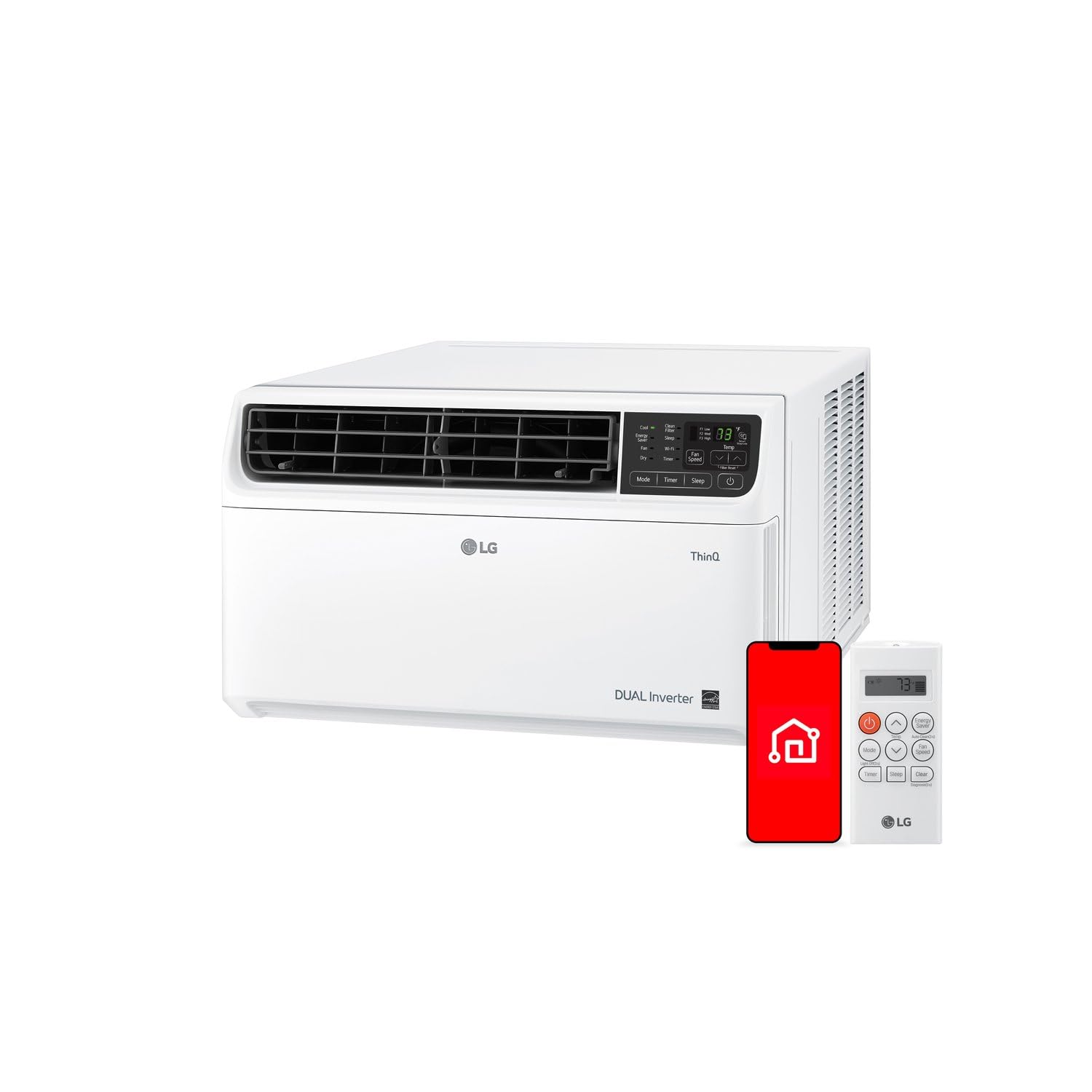
The power-sipping inverter that keeps a big room at a steady cool.
Here is the head-to-head that matters most on running cost: the LG’s dual inverter draw comes in at 1,590 watts of annual energy consumption, against the Midea’s 2,760 watts. If you run a window unit hard all summer, that is the difference between a manageable bill and a painful one. The dual inverter compressor varies its speed to hold the set temperature instead of thumping on and off, and it carries a 5 Star BEE rating. It covers 1,000 square feet — sized for a large room, roughly 25 feet by 40. Low-mode noise sits at 52 dB, quiet enough to sleep beside.
Control is straightforward. The LG ThinQ app puts the unit on your phone so you can start cooling before you get home, and it works with Google Assistant and Amazon Alexa for hands-free changes. You get three cooling and fan speeds plus Auto Cool, and the removable washable filter lifts out for cleaning. An owner with a 1,500 square-foot shop called the cooling strong, the install easy, and the noise quieter than expected — solidly built and dependable. Against the Frigidaire, the LG is the efficiency champion; against the BLACK+DECKER, it is in a different class on reliability.
The sticking point is the physical install. This unit is heavy, and it needs a platform or firm support underneath because the back end is weighty. Owners describe it as a two-person job, with instructions that are slightly hard to follow. Some report the thermostat has to be set lower to feel as cold as an older unit, which eats into the energy savings. And a minority have had units quit working after a stretch of use. Weight it as a who-should-skip, not a dealbreaker — the vast majority run cool and quiet for years.
Why the power bill likes it
- Dual inverter at 1,590 watts annual consumption — far below the Midea’s 2,760
- 5 Star BEE energy rating with Auto Cool and three fan speeds
- 1,000 sq ft coverage, 52 dB low-mode quiet, ThinQ app and voice control
Where it asks for effort
- Heavy build needs a support platform and two people to install
- Instructions are tricky to follow for a first-time installer
Worth it when: your priority is a low monthly running cost in a large, mostly open room.
Consider elsewhere when: you want a one-person, ten-minute install with no support bracket.
4. BLACK+DECKER Window Air Conditioner 18000 BTU, BD18WT6
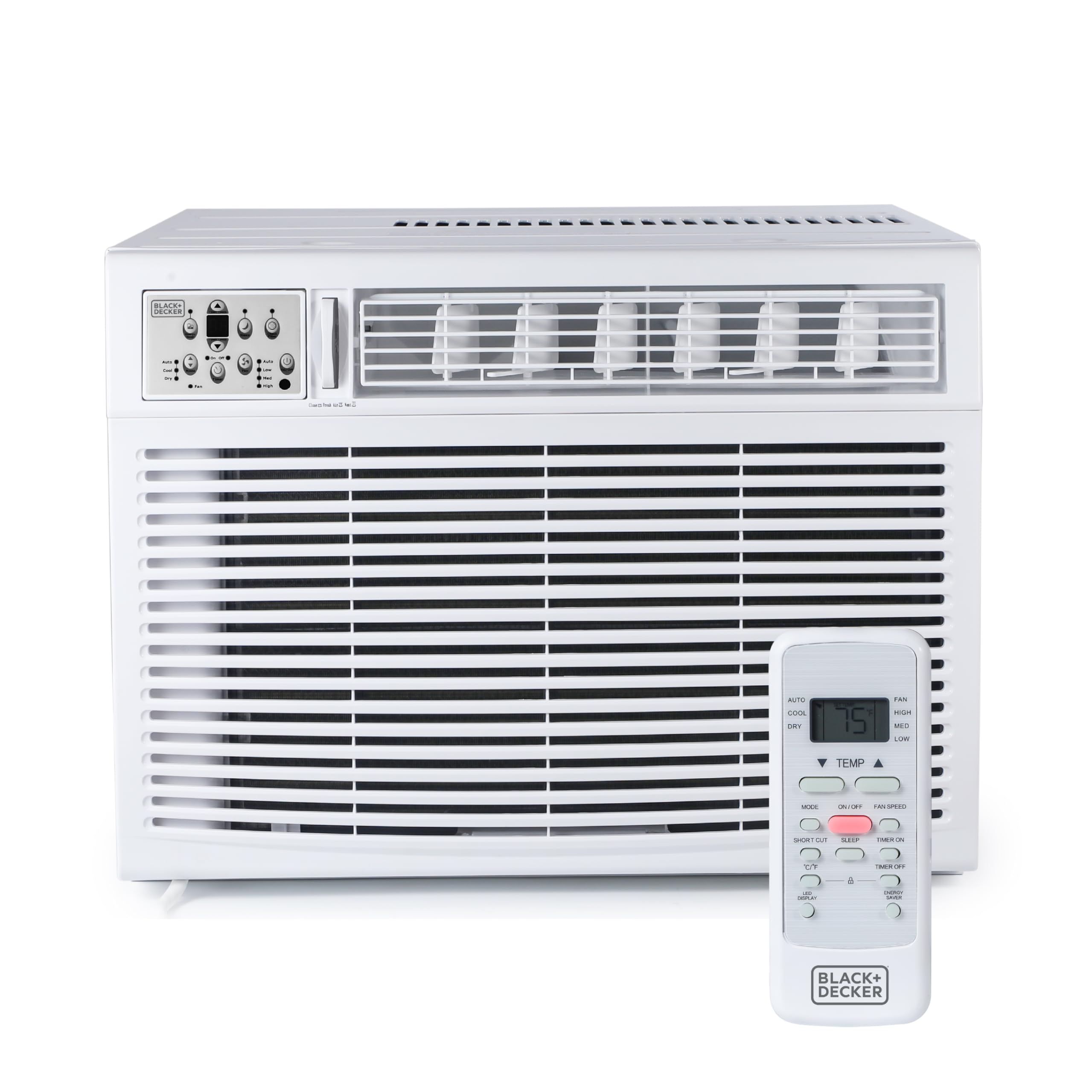
Accordion side panels that squeeze into windows most units will not.
The defining feature here is the fit. Accordion-style side panels let this unit slot into standard double-hung windows from 28 inches wide up to 40.5 inches wide, and windows as low as 18.5 inches tall. If you have an oddball window opening and have been worried nothing will work, that range is the number to check against your own frame. It cools up to 1,000 square feet and runs at four levels (auto, low, medium, high), with a full-function remote covering every setting, plus sleep mode, energy saver, and a 24-hour timer.
It also uses R32 refrigerant, which the maker states has zero impact on the ozone layer and is energy efficient. Annual energy consumption is 1,091.58 kilowatt hours per year — on the leaner side for this cooling class. There is a HEPA filter in the airflow path, a step up from the plain washable filters on most competitors, and it draws only a remote to control rather than an app. For a buyer who wants a wide-window fit and simple physical controls, that combination is the draw.
Be realistic about the brand’s track record at this size, though. This unit has fewer reviews than most, and the pattern in the handful of reviews leans toward short service life — a few customers note it cooling for about a year and then failing, and the controls arriving labeled in Chinese with labels that are hard to decipher. Installation packing is heavy on styrofoam that takes work to remove. If you buy it, register the compressor warranty early and keep the receipt. It earns a spot on this list for the window fit and the R32 efficiency (a refrigerant that has lower global warming potential than older types), not for long-haul durability.
Fit-first reasoning: the 28″ to 40.5″ width and 18.5″ minimum height range covers windows many fixed-frame units cannot enter.
Efficiency note: 1,091.58 kWh per year and R32 refrigerant make it a leaner runner than several pricier options here.
Pick this if: your window is an awkward size and fit is your deciding factor.
Look past it if: you want a long proven service life and English-labeled controls from the start.
5. Keystone 18,000 BTU Window Air Conditioner and Dehumidifier, 230V

A dual-purpose unit that pulls muggy air dry while it cools.
In humid parts of the country, cooling alone is not enough — you want the moisture pulled out too. This Keystone does both, removing 3.8 pints of moisture from the air every hour through its built-in dehumidifier while it cools up to 1,000 square feet. That combination is the reason to pick this one over the cooling-only units on this list, especially for a damp basement-adjacent living room or a coastal apartment. It has three cooling modes, three fan speeds, adjustable four-way air louvers, and a programmable timer.
The remote is smarter than most: it reads the temperature of the room you are standing in, shows it on an LCD screen (a small digital display), and signals the AC every three minutes to keep the cooling accurate to where you actually are. Energy Saver and Sleep modes trim running costs when you are not actively using the room.
Setup has quirks. The assembly calls for installing screws from inside the unit before it goes into the window, which one frustrated buyer found poorly designed. A few report the top-rail screws not matching, forcing improvisation, and one unit arrived with a broken air louver. It also runs on 230V, so the usual outlet check applies. These are install-day annoyances rather than running problems — once it is in and sealed, the humid-climate performance is why it stays on the shortlist.
Humidity handling: the dehumidifier removes 3.8 pints per hour, a real edge in muggy climates where cooling alone leaves the air clammy.
Service record: the theme that keeps coming back is longevity — multiple owners count years of reliable summer cooling.
Made for: humid, muggy rooms where you want cooling and moisture removal from one unit.
Skip the hassle if: you want a no-tools install — the screw-together assembly takes real patience.
6. ROVSUN 18000 BTU Air Conditioner Window Unit with Heat & Remote, 208/230V

Cool in July, warm in January, from the same window slot.
What separates this unit from every other pick in the group is the heat. It is an air conditioner and heater combo, so it covers winter as well as summer and gives you year-round value instead of a machine that sits idle for six months. It delivers 18,000 BTU of cooling for rooms up to 1,000 square feet and runs the thermostat range from 61°F to 88°F. Fan speed, a 24-hour timer, ECO mode, automatic mode, and fan mode all sit on the LED display or the included remote.
The install is where this one wins easy points. The included side panels and mounting parts are designed to cut assembly time, and the detailed manual makes it a short job for a competent DIYer — just verify your window size and voltage first. The 208/230V, 60Hz compressor is rated by the maker for efficient cooling and longer service life. Noise sits as low as 56 dB, gentle enough for watching TV or sleeping through the night, and button lights can be switched off for dark sleeping per owner reports.
Set fair expectations on cooling depth. While it has thousands of reviews behind it, the cooling performance draws split feedback — some reviewers point out it cools effectively and even handles a whole three-bedroom house when paired with another unit, while others report it not blowing cold air at all, with slow support when something goes wrong. The honest read is that it performs well for a bedroom or a mid-size room and less predictably when you ask it to carry a whole floor. Buy it for the heat-and-cool flexibility, not as a sole solution for a very large space.
The year-round case: heating plus 61°F-to-88°F cooling makes it the only unit here that earns its keep in winter.
The install story: included side panels and a clear manual make it one of the easier setups, once you confirm window size and 208/230V service.
Choose it for: a room that needs both a summer AC and a winter top-up heater from one install.
Hold off if: you need guaranteed deep cooling for a whole floor — its cooling feedback is split.
7. LG 24,500 BTU Smart Window Air Conditioner, 230/208V
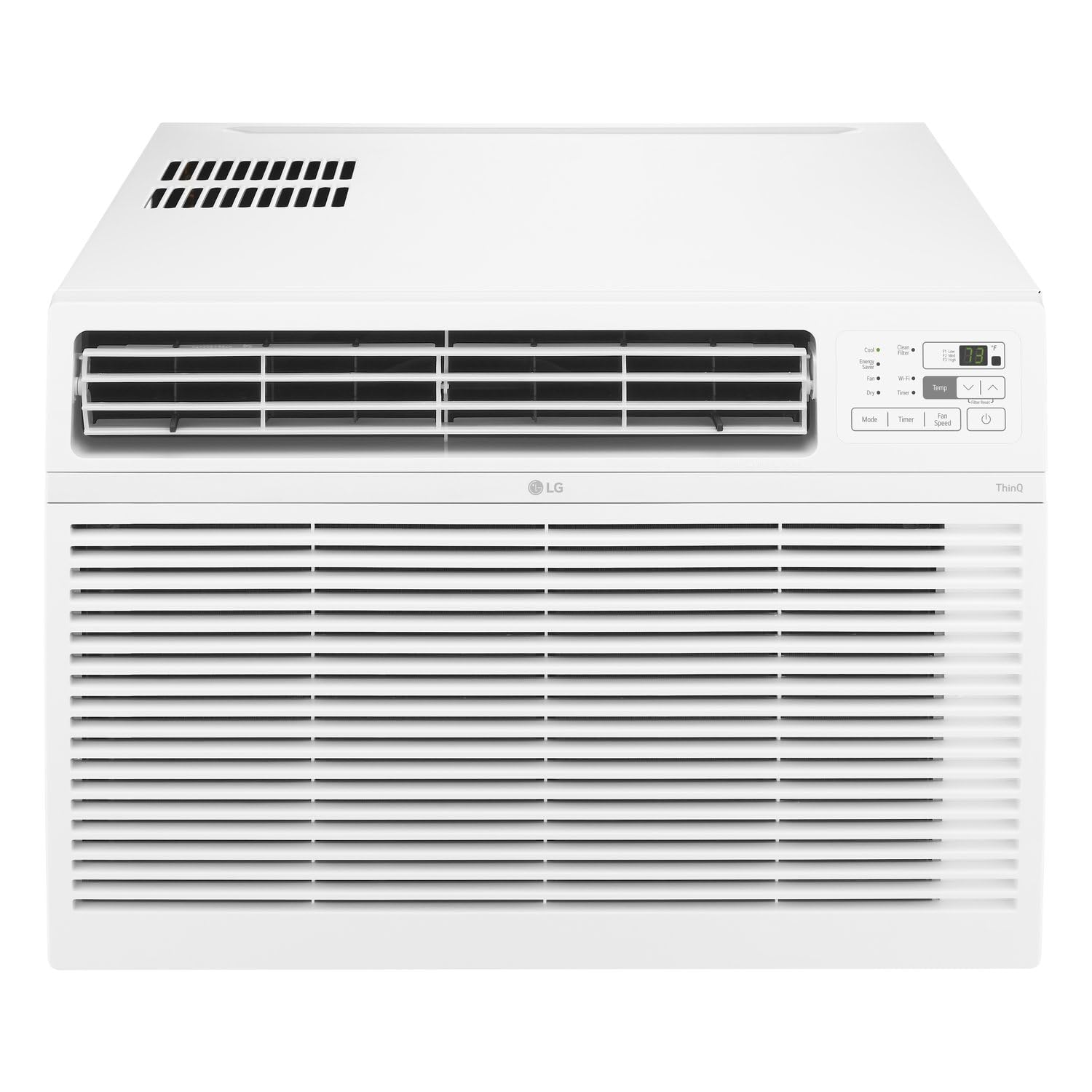
Overkill on paper, a whole-floor freezer in practice.
This unit is included here because it does the 18,000 BTU job and then some — it puts out 24,500 BTU and covers up to 1,560 square feet, roughly a 39-by-40-foot space. When you need to cool more than one room from a single window, that extra capacity is the difference between a cool corner and a cool floor. Owners back it up: a 1,100 square-foot first floor turned into a freezer in minutes, and another unit kept a 1,798 square-foot farmhouse with original windows at a steady 68°F. Those are real numbers from people living in old, leaky houses.
The efficiency is the other reason to step up. Airflow efficiency is 530 cubic feet per minute per watt, the highest here, and the annual energy figure is 2,370 watts — meaning it uses less power per unit of cold air than smaller rivals. LG ThinQ tech runs the show from your phone anywhere, and it works with Alexa and Hey Google. There are three cooling and fan speeds, dehumidification up to 1.8 pints per hour, a filter-check reminder, power-failure auto restart, and a 24-hour timer. Low-mode noise is 50 dB.
Not every story is a happy one. Reliability feedback is split — some units run for years while others report stopping after a stretch of use or developing a rattle or loud fan. One unit arrived damaged and rattled from a rubbing fan. Take the usual precautions: inspect on delivery, let it stand upright before first use, and register the warranty. For a big open floor or a leaky old house, the raw cooling muscle and efficiency still make it the pick when one 18,000 BTU unit is simply not enough.
Raw capacity: 24,500 BTU over 1,560 square feet is a whole different scale from the 18,000 BTU pick, with 530 cubic feet per minute per watt of airflow efficiency to match.
The real-world proof: shoppers say cooling a 1,798 square-foot farmhouse to 68°F and turning a 1,100 square-foot floor into a freezer in minutes.
The one to buy if: you have a large or leaky home and one 18,000 BTU unit cannot keep up.
Overrated for you if: you are cooling a single normal-sized room — the extra capacity is wasted there.
8. Whirlpool 18,000 BTU Window Mounted Inverter Air Conditioner

The bedtime unit that drops to 43 dB and gets out of your way.
When noise is the thing that keeps you from sleeping or watching TV, this is the unit built around exactly that. Its Mute function drops the fan speed and the noise down to 43 dB — the lowest figure in this roundup and about as quiet as a window AC gets. Inverter technology varies the motor speed to match the power actually needed to hold the temperature, so it is not constantly ramping to full blast. It cools 18,000 BTU across rooms up to 1,000 square feet, with three fan speeds and dehumidification up to 2.6 pints per hour.
In real homes it holds up well. Owners describe it staying quiet on auto through a 100-degree heat wave in a 1,000 square-foot house, and one unit cooling an entire one-story ranch house on a 90-degree-plus day. The louver panel on the front moves air up and down for even coverage, and Eco mode, sleep mode, and a 24-hour programmable timer let you tune it to your schedule. A clean-filter alert nags you when the washable filter needs a rinse, keeping airflow strong. It needs a 230V/15A outlet.
One heads-up that catches a lot of buyers: it does not plug into a standard USA socket, and that requirement is easy to miss before the box arrives — a few people have had to send it back for exactly that reason. There is also a report of it not pushing cold air far enough across a very large 20-by-40 room, and one arrival that tripped the power. Those are the outliers, though. For quiet, steady cooling in a normal large room with the right outlet, this is a strong sleep-friendly choice.
Where it earns its keep
- Mute mode drops noise to 43 dB — the quietest here — for napping and TV
- Inverter motor matches power draw to the cooling needed
- Cools 1,000 sq ft with 3 fan speeds, Eco, sleep, and 24-hour timer
Details to settle first
- Requires a 230V/15A outlet, not a standard USA socket
- A report of weak cold-air reach across an unusually large room
Tailor-made for: a bedroom or living room where low noise is the deciding factor.
Double-check before buying: that you have a 230V/15A outlet, since the plug will not fit a standard socket.
9. Friedrich Chill Premier Inverter 18,000 BTU 230/208V Window & Wall Unit

Sits in a window or cuts into a wall — your choice, not the box’s.
Most units here lock you into a window. This Friedrich can go in a window or be mounted through a wall, which matters if you want a permanent, cleaner-looking install or your window setup will not work. It is cooling-only at 18,000 BTU, energy certified, and uses inverter technology, running on 230/208V with an activated carbon filter in the airflow path. The defining trait is quiet: it is the unit owners describe as so silent you forget it is on, with one comparing it favorably to a 35-year-old machine it replaced.
Installation is friendlier than most at this size. Buyers report it lighter than the unit they were replacing and not difficult to fit, with control options like a sweep feature that distributes air to cool a room more evenly. Build quality is the theme that keeps coming back — the consensus leans toward solid equipment that cools fast and runs quietly. The inverter compressor keeps it running at lower speed rather than blasting on and off, which is where that quiet and steadiness come from. It is the premium option here, aimed at buyers who want a durable, low-noise unit and are willing to pay for it.
The one thing to watch is the delivery. There is a report of a unit arriving defective and shutting down permanently after a short run, and sending a large, heavy unit back is a hassle. Inspect it immediately on arrival, let it sit upright before the first start, and keep the packaging until you know it runs. If it powers up and holds, this is the quietest, most install-flexible pick in the group — the trade for the higher upfront cost.
what separates it
- Installs in a window or through a wall for a permanent setup
- Inverter technology with activated carbon filtration
- Owners describe it as extremely quiet and easy to install
The one risk to manage
- A report of an out-of-box defect, and returns mean shipping back a large unit
The call for you if: you want a wall-or-window install and priority on low noise.
Think it over if: you would rather not risk a bulky return, and want the lowest entry cost.
Understanding the Specs
BTU and square-footage coverage
BTU (British Thermal Unit) is the measure of how much heat a unit can pull out of a room — think of it as cooling muscle. An 18,000 BTU window unit is built for large open spaces, and the models here cover roughly 1,000 to 1,020 square feet, while the larger LG stretches to 1,560 square feet. Pick a coverage that matches your actual room. Oversize it for a small room and the compressor short-cycles; undersize it and the unit never catches up on a hot afternoon.
Energy draw and inverter compressors
Annual energy consumption tells you roughly what the unit sips over a year of typical use, usually listed in watts or kilowatt hours per year. Lower is gentler on your bill. Inverter compressors — found in several picks here — vary their speed to hold the temperature steady instead of switching full on and off, which usually means steadier cooling and less noise. If running cost is your priority, compare these annual figures directly; the gap between a lean unit and a thirsty one is real money over a long summer.
Voltage and plug type
Every 18,000 BTU window unit here runs on 208/230V, not the standard 115V household socket. Some use a 6-15P plug, others need dedicated 230V service with sideways prongs. Check your outlet and distance to the window before ordering. If you do not have a suitable outlet within reach, plan for an electrician — this is the single biggest logistical hurdle at this cooling size.
Noise level in decibels
Decibels (dB) measure how loud the unit runs, and the range here spans 43 dB on the quietest to 56 dB on the loudest. The lower the number, the less it intrudes on sleep, calls, or TV. Some units list their quiet figure in a low mode only, and the compressor kicking on will be louder than the fan. If you are noise-sensitive, favor an inverter model and a low-Mute or low-dB figure.
FAQ
Why do 18000 BTU window air conditioners need a 230V outlet?
How many square feet will an 18000 BTU window AC cool?
Is an inverter window air conditioner worth it over a standard one?
What window size does an 18000 BTU window unit fit?
How loud is an 18000 BTU window air conditioner?
Can an 18000 BTU window AC also heat a room?
Do these units dehumidify the air as well as cool it?
Can I control an 18000 BTU window AC from my phone?
Are 18000 BTU window air conditioners hard to install?
What is the difference between 18,000 and 24,000 BTU window units?
Final Thoughts: The Verdict
For most buyers, the strongest all-rounder on this list is the Midea 18,000 BTU Smart Inverter Window Air Conditioner, because its inverter compressor (a variable-speed motor that adjusts cooling output), broad smart control, and 48 dBA quiet operation (about as loud as a quiet conversation) handle a genuinely hot 1,000 square-foot room with ease. If running cost is your priority, the LG 18,000 BTU Dual Inverter sips power at 1,590 watts versus the Midea’s 2,760, making it the efficiency name to know. And for a room that needs both summer cooling and winter warmth, the ROVSUN 18,000 BTU with Heat is the one to reach for. Whichever you choose, confirm your 208/230V outlet and window opening first — those two checks decide whether the install is a 20-minute job or a return.
How We Picked
We do not accept paid placement. Every pick is matched to a real buyer and a real use-case; we do not hands-on test units.
Sources & Methodology
Specifications: manufacturer listings and product documentation. Review insights: verified customer reviews, as of September 2026. Pricing: not shown on this page (it changes often); check the current price via the retailer link.
As an Amazon Associate, Gadgets Feed earns from qualifying purchases. This does not affect which products we feature.