
Our readers keep the lights on and my morning glass full of iced black tea. As an Amazon Associate, I earn from qualifying purchases.
Specs are compiled from manufacturer listings and verified buyer reviews and can change over time — please confirm the key details on the product page before buying.
If your house runs on AA and AAA batteries — remotes, controllers, toys, flashlights — the question is which charger-and-battery bundle actually saves money instead of dying after a few months. The short answer sits in three specs. You want a charger that fills each slot on its own (so one dead cell doesn’t hold up the others), a battery chemistry rated for hundreds or thousands of refills, and a bundle that includes real batteries rather than making you buy them separately.
I’m Min — the founder and writer behind Gadgets Feed. This guide is built by comparing the manufacturers’ published specifications and the patterns across verified customer reviews, so you get each pick’s real strengths and trade-offs instead of marketing spin.
What follows separates the bundles that hold up from the ones that fade fast, so you can pick the right battery rechargeable charger once.
Our Picks at a Glance


How To Choose The Best Battery Rechargeable Charger
A battery charger is only as good as the two things it has to do: fill each cell properly, and not cook it in the process. Everything else — slot count, display style, cable type — is a convenience layer on top of those two jobs.
Independent slots versus paired charging
Cheap chargers fill batteries in pairs, so a half-empty AA next to a dead one gets treated identically. That mismatch is what shortens battery life over time. A charger with independent circuits fills each cell to its own state, which is why you see it called out again and again in the models below.
Capacity in mAh, and what it buys you
Milliamp-hours (mAh) is the battery’s fuel tank. A 2000mAh AA holds roughly what a standard alkaline holds, while a 2800mAh AA runs noticeably longer between fills. Higher capacity usually means a slightly longer charge time, so pick based on how often you want to swap cells.
Low self-discharge and storage
NiMH batteries lose charge sitting in a drawer. Low self-discharge cells hold far more of theirs over months of storage, which matters if you keep spares for seasonal gear or emergency flashlights.
What the lights and screens actually tell you
A single-color blinking light tells you almost nothing. Multi-stage indicators — or a full LCD readout — show whether a cell is at 20%, 80%, or finished. Some chargers also flag a dead or faulty battery outright, which saves you from chasing a problem that isn’t the charger’s fault.
Charging current and heat
Faster is not automatically better. Higher current fills a cell quickly but generates heat, and heat is what ages a rechargeable battery. A 3-hour quick charge is fine for occasional use; a slower, cooler cycle is gentler for cells you plan to refill for years.
Quick Comparison
| Model | Best For | Charger Slots | Charge Time | Included Batteries | Amazon |
|---|---|---|---|---|---|
| Eneloop Panasonic K-KJ55MBS66A★ Best Overall | Whole-house AA and AAA replacement kit | 4 | ~3 hours (4 AA) | 6 AA + 6 AAA | Amazon |
| Duracell Ion Speed 1000Budget Champion | Budget starter bundle for a family | 4 | 6 hours | 4 AA | Amazon |
| POWEROWL 12 BayMost Versatile | Bulk-charging a drawer full of batteries | 12 | 30–60 min per brand | None | Amazon |
| BEVIGOR 8 Bay Smart Charger | High-capacity AA and AAA bundle | 8 | 4 hours | 4 AA + 4 AAA | Amazon |
| Amazon Basics 8 Count | An entry-level plug-in starter kit | 4 | 3.5–7 hours | 4 AA + 4 AAA | Amazon |
| Energizer Recharge Pro | Fast top-ups for controllers and flashlights | 4 | 3 hours | 4 AA | Amazon |
| Panasonic BQ-CC63SBA eneloop | Large households filling 8 cells at once | 8 | 5 hours (AA) | None | Amazon |
| Tenergy T9688 Universal | Mixed battery sizes, AA to D and 9V | 4 + 2 (9V) | Automatic selection | None | Amazon |
| Opus BT-C3100 V2.2 | Testing and reclaiming cells, not just charging | 4 | Variable (200–1000mA) | None | Amazon |
In‑Depth Reviews
1. Eneloop Panasonic K-KJ55MBS66A Power Pack; 6AA, 6AAA, and Advanced Battery 3 Hour Quick Charger
Our pick — over 4.5★ from 600+ verified ratings; the strongest balance of quality and price.
Twelve batteries and a charger that fills four AAs in about three hours — the whole house covered.
This is the bundle for the person who has already done the math. You get six AA and six AAA eneloop batteries plus the CC55 quick charger, and the AAs deliver up to 2000mAh typical (1900mAh minimum) while the AAAs deliver up to 800mAh typical (750mAh minimum). That capacity is why these outlast bargain-brand rechargeables in a TV remote or a gaming controller.
The charger is the quieter star here. It charges each of the four bays individually, so one tired battery next to three full ones doesn’t get overfilled. Four separate LED lights tell you where each cell stands: red for 20% or less, orange for 20–80%, green for 80% and above. Fully drained, four AAs take roughly three hours, and a single AA or AAA pair tops out in about 1.5 hours.
Durability is the number that changes the math over years: these cells are rated to recharge up to 2100 times, and they arrive pre-charged at the factory using solar power, holding up to 70% of their charge after 10 years in storage. Owners consistently report the batteries outlasting disposable alkaline brands, and the three-hour charge time is the second-most-praised feature of this kit. The catch is weight and size on the road: this pack tips the scale at 13.44 ounces and measures 2.69 x 1.13 x 4.75 inches, while the Duracell bundle below weighs 8.48 ounces at 4 x 1.22 x 9 inches. If you pack a charger for travel and every ounce counts, the Duracell form factor is the lighter, slimmer one. At 4.7 stars across 600+ ratings, it’s the highest-rated bundle in this lineup.
Where It Wins
- Charges each battery individually in its own bay, so mismatched charge levels never share a circuit
- 2100-recharge rating on the cells — the refill ceiling that makes the upfront cost pay itself back
- Four LED stages (red/orange/green) tell you exactly where each cell stands instead of a single blink
- Arrives pre-charged with solar power and holds up to 70% of charge after 10 years of storage
Where It Compromises
- At 13.44 ounces and 2.69 x 1.13 x 4.75 inches, it’s the bulkier, heavier bundle to pack
- Only four bays, so filling all 12 included batteries takes multiple passes
- Some owners find the color-coded LED system less intuitive than a plain on/off light
Buy this if: you want one purchase that retires disposables across the whole house — the 6AA/6AAA count plus 2100 refills is the value play.
Think twice if: you need a charger that packs into a carry-on without the bulk; the Duracell’s 8.48-ounce frame is the travel-friendlier build here.
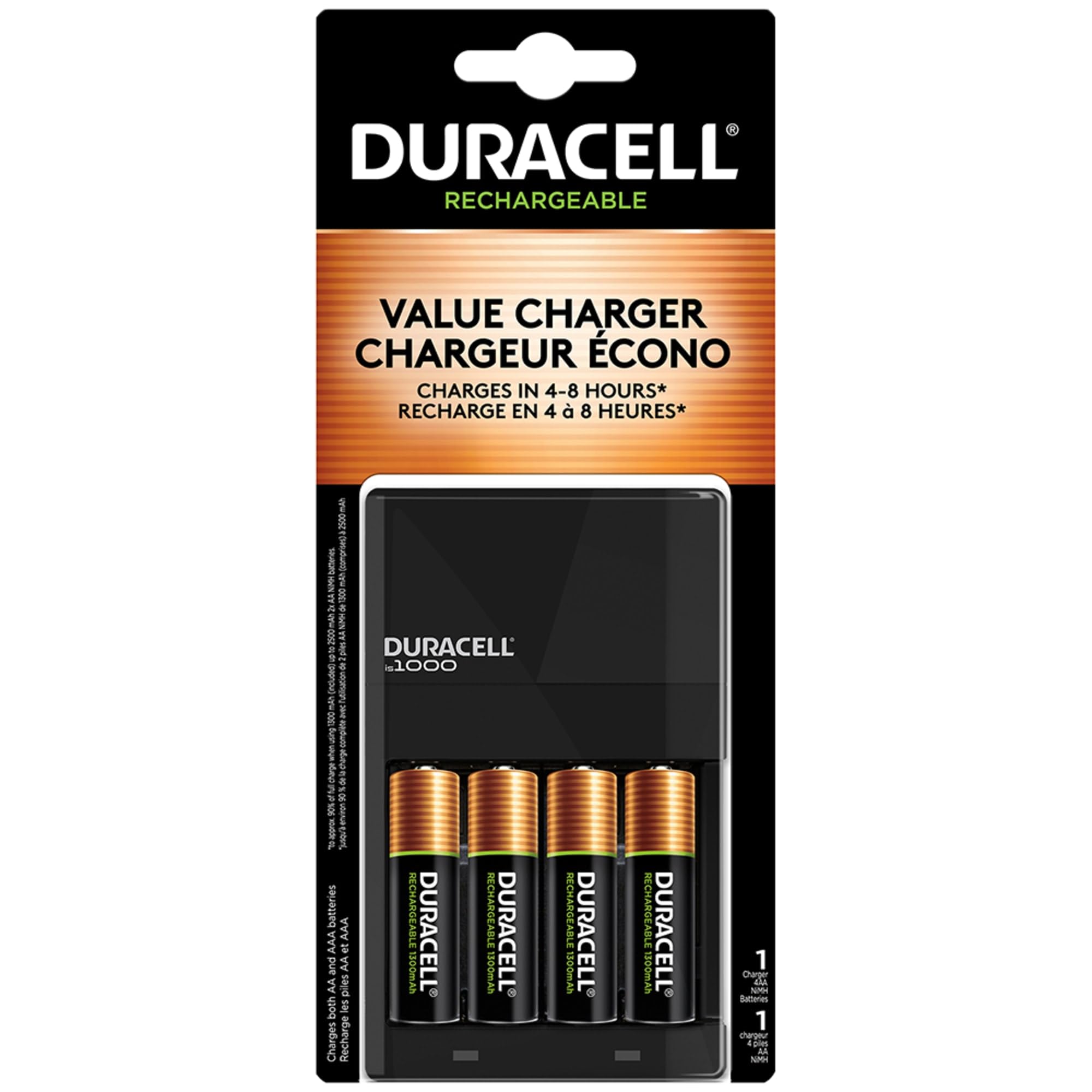
2. Duracell Ion Speed 1000-Battery-Charger for AA and AAA-Batteries, Includes 4 Pre-Charged AA-Rechargeable-Batteries, for Household and Business Devices
The entry ticket to rechargeables: four bays, a folding plug, and a bundle that costs less than a two-pack of disposables.
Duracell’s Ion Speed 1000 is the classic starter charger, and the reason it has stayed popular is simple arithmetic: it fills four AA or AAA batteries at once, and it will refill other brands’ NiMH cells too, not just its own. The included four AAs arrive pre-charged with Duralock Power Preserve Technology and are guaranteed for three years in storage, which means you can take it from the start and use it the same afternoon.
Charging runs on independent channels with overcharge protection, auto shutoff, and a trickle charge stage — the gentle top-up that keeps a finished battery from losing ground. The full cycle takes around six hours, with red, green, and blinking-red indicators covering charge state and fault detection. It’s Energy Star Certified and folds flat for storage, and at 8.48 ounces and 4 x 1.22 x 9 inches it’s the slimmer, lighter bundle compared with the eneloop kit above at 13.44 ounces and 2.69 x 1.13 x 4.75 inches. In short: the Duracell is the lighter, slimmer bundle to pack.
What wins people over is the cost-per-battery calculation — buying the charger with included cells beats buying individual packs, and the compatibility with any AA or AAA NiMH battery is the second thing that keeps buyers coming back. The honest caveat: battery capacity itself is the most-discussed and most-mixed topic in the feedback, with some owners reporting the cells hold less than expected over time. That’s a fit note, not a defect — this is a budget charger for family devices, not a long-term cell-collection starter.
The plug design earns its keep: the folding wall plug means no adapter cable to lose and no wall-wart footprint, and the storage guarantee on the pre-charged AAs means you can stash batteries for months and still use them.
Worth knowing: six hours to full is deliberate rather than impatient — the slower, cooler cycle is what keeps the included cells usable across many refills rather than cooking them like a hotter charger would.
The call: this is the lowest-risk way to test out rechargeables for the first time — the bundle includes everything you need from the start.
Not your charger if: you want capacity headroom above a stock AA cell or you’re hunting a cell-collection starter; jump to the eneloop kit or the BEVIGOR bundle for higher-capacity cells.
3. POWEROWL 12 Bay AA AAA Battery Charger, USB High-Speed Charging, Independent Slot, for Ni-MH Ni-CD Rechargeable Batteries
Twelve bays, twelve independent circuits — the charger for emptying the junk drawer into one session.
Slot count is the whole pitch here: twelve AA and AAA positions, each on its own charging circuit, so every battery gets exactly what it needs and nothing is wasted on a slot holding a full cell. The case is compact for what it holds at 7.2 x 3.1 x 1.08 inches, and it runs off USB input at 5 volts — plug it into a wall adapter, a laptop, or a power bank, and you’ve got a charger that works wherever you happen to be. Output is 1.2 volts, matching the NiMH standard.
Build quality is the thing buyers rave about most, with charging speed close behind. The rate varies by brand of battery — normally 30 to 60 minutes to fill a batch — and there’s a diagnostic bonus: a faulty or unrecoverable battery triggers a flashing red light, so a dead cell announces itself instead of silently dragging down a slot. In the same charger, mixed AA and AAA loads are fine.
One owner’s day-one story is worth quoting directly, because it captures the volume pitch perfectly: as owners put it, they “charged 67 of 86 batteries in ~8 cycles of 2-3 hrs each within 18 hrs.” The trade-offs are equally real: the charger needs a USB power source (wall adapter not included), and there’s no third color on the lights, so once a cell is charging you can’t tell how far along it is. At 4.6 stars across 300+ ratings, it’s the pick for a full battery drawer, not a quick top-up.
Reasons It Stands Out
- Twelve independent circuits — the highest slot count under forty dollars in this lineup by a wide margin
- USB-powered at 5 volts, so a power bank or laptop can run it away from an outlet
- Flashing red light flags faulty batteries, saving you from chasing a dud cell through every device
- Compact footprint (7.2 x 3.1 x 1.08 inches) despite holding twelve cells
Where It Falls Short
- Requires a USB power source — the wall adapter is not in the box
- Two-color indicators only; you can’t tell charge percentage mid-cycle
- Highest-capacity cells take longer than the fast-charge competition at the same slot density
Best for bulk duty: households with dozens of loose AA/AAA batteries that need to be filled in one pass instead of two or three.
Look elsewhere if: you want per-battery percentage readouts — a two-color LED charger won’t give you that clarity.
4. BEVIGOR Rechargeable AA and AAA Batteries with 8 Bay Smart Charger, 4 Pack AA 2800mAh & 4 Pack AAA 1100mAh Low self Discharge NiMH Battery
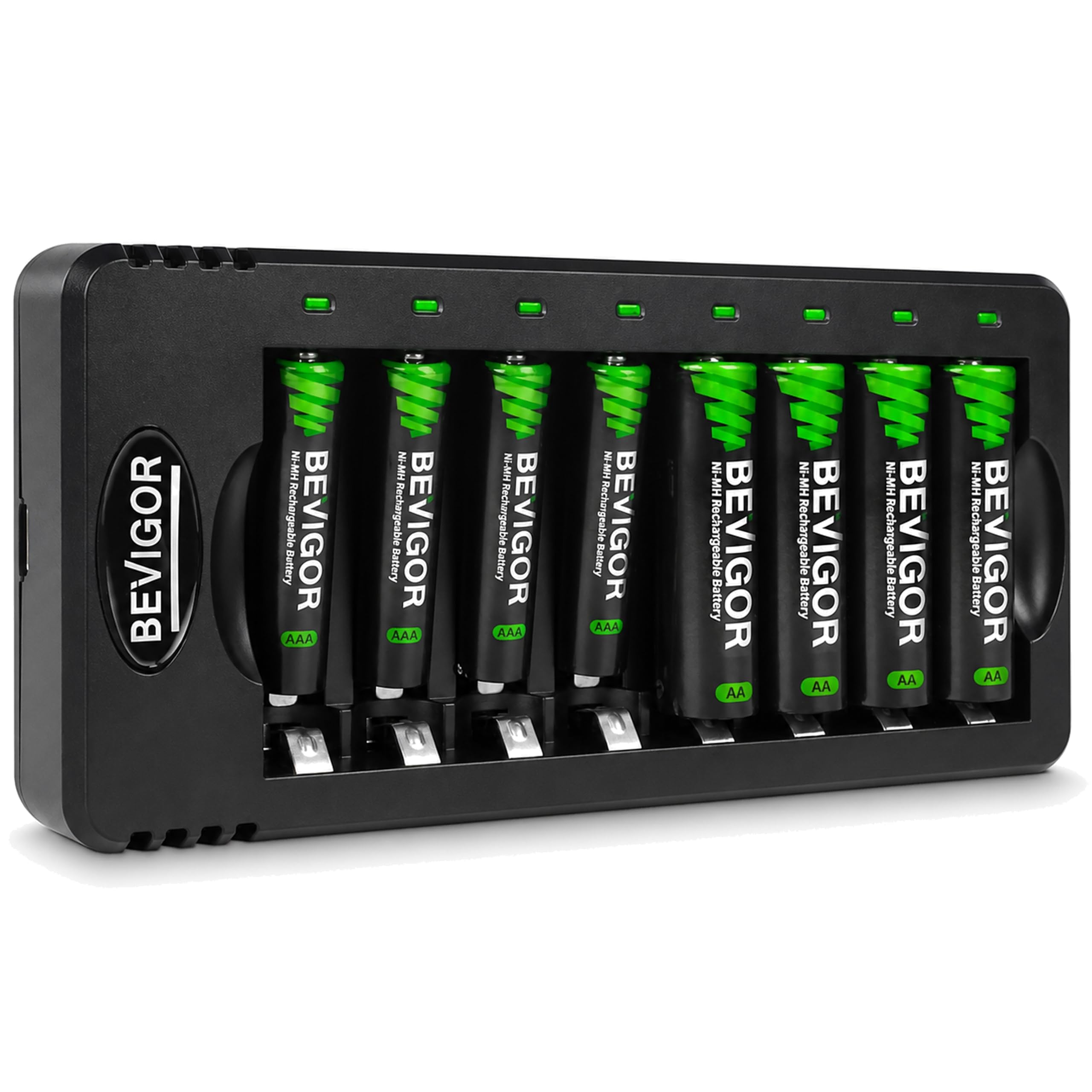
The high-capacity bundle: 2800mAh AAs paired with an eight-bay charger that fills them in about four hours.
If the Duracell bundle above is the stock-capacity starter, this is the upgrade path. The included AAs are rated 2800mAh and the AAAs 1100mAh — noticeably above the 2000mAh/800mAh baseline most bundles ship — and five of the eight bays fill AA or AAA cells simultaneously on their own isolated circuits. Charge time runs about four hours. Thermal protection and automatic power-off handle the safety end, and red/green LEDs report charge state, with a trickle charge stage keeping finished cells topped up rather than draining them.
The longevity story is the headline: cells are rated for up to 1500 recharge cycles and are designed to retain 80% of their capacity after three years of storage. That’s the low-self-discharge chemistry working in your favor — stash a spare pair in the drawer for months and it’s still substantially there when you pull it out. Build quality and functionality — how well the charger does its one job — are what buyers single out most, with value close behind.
The catch is capacity versus lifespan balance. Some buyers report the cells don’t hold a charge as long as premium name-brand rechargeables before needing a swap, a pattern clearly visible in the feedback across the AA/AAA cell side. It’s an honest trade: 2800mAh capacity with 1500 cycles is a strong rating for the price, and at 4.6 stars across 400+ ratings, most owners aren’t hitting that ceiling in normal household use.
What stands out: 2800mAh AA capacity is the biggest tank in this lineup, and the eight independent bays mean you don’t wait to pair cells — you charge however many are empty.
One fair caveat: if you’re the type to leave batteries in a drawer for a year, the low-self-discharge design holding 80% across three years is genuinely useful; a generic NiMH would be substantially flatter.
Buy it if: you want more mAh per battery and lower per-cell refill anxiety than a starter bundle gives you in one preassembled kit.
Pick a different one if: you primarily need the charger (no batteries required) — check the POWEROWL or Panasonic BQ-CC63SBA, both sold as bare chargers.
5. Amazon Basics 8 Count Rechargeable NiMh Batteries (4 AA & 4 AAA) with 4-Bay Battery Charger, Low Self Discharge, Pre-Charged, Type A (American) Plug, Black

The no-frills starter kit — 4 AA, 4 AAA, and a wall-plug charger that takes the guesswork out of family devices.
This is the entry-level bundle to hand a household that just wants to stop buying disposables. You get 4 AA 2000mAh cells, 4 AAA 800mAh cells, and a four-bay charger with a Type A (American) plug — no cable, no adapter, no wall wart to lose. The pre-charged cells are rated for up to 1000 recharges and hold 80% of their capacity for up to 12 months in storage, which is plenty for a drawer of spares.
The LED light scheme is the most specific of any charger here: slow blink means charging, solid white means fully charged, fast blink flags a defective battery or — usefully — an alkaline cell someone tried to recharge by mistake. That last one saves you a wasted slot. Full charges run 3.5 hours for two AAs and 7 hours for four, or 2 hours for two AAAs and 4 hours for four.
What stands out is versatility — the charger handles both AA and AAA, indoors and out, and it doesn’t insist on pairs the way some competitor chargers do. The honest complication: cell quality itself is the most-discussed and most-mixed subject in the feedback, with some owners noting shorter life than standard disposables. Battery capacity and charging behavior each earn their own share of conflicting reports. It’s the entry price of admission to rechargeables, and at 4.4 stars across 900+ ratings, plenty of households stick the landing — just don’t expect premium cell longevity at the tier below that.
Why It Works
- Plug-in Type A charger — no USB cable to lose, no adapter to buy
- Slow blink / solid white / fast blink scheme also catches accidental alkaline insertions
- Charges single batteries independently, not in locked pairs (a common competitor limitation)
- Pre-charged cells hold 80% of capacity for up to 12 months, and are rated for up to 1000 recharges
Trade-Offs to Weigh
- Cell longevity draws more mixed feedback than the premium bundles in this lineup
- Full 4-bay AA cycle runs 7 hours — one of the slower rates here
- Only four bays, versus eight or twelve on the mid-range and bulk chargers
Reach for this: if the goal is a low-risk first taste of rechargeables for toys, remotes, and controllers.
Skip if you already: have premium cells and just need a small trickle charger — this bundle’s value is in the cells more than the bay count.
6. Energizer Recharge Pro Rechargeable AAA and AA Battery Charger With 4 NiMh Rechargeable AA Batteries, Provides a Full Charge in 3 Hours
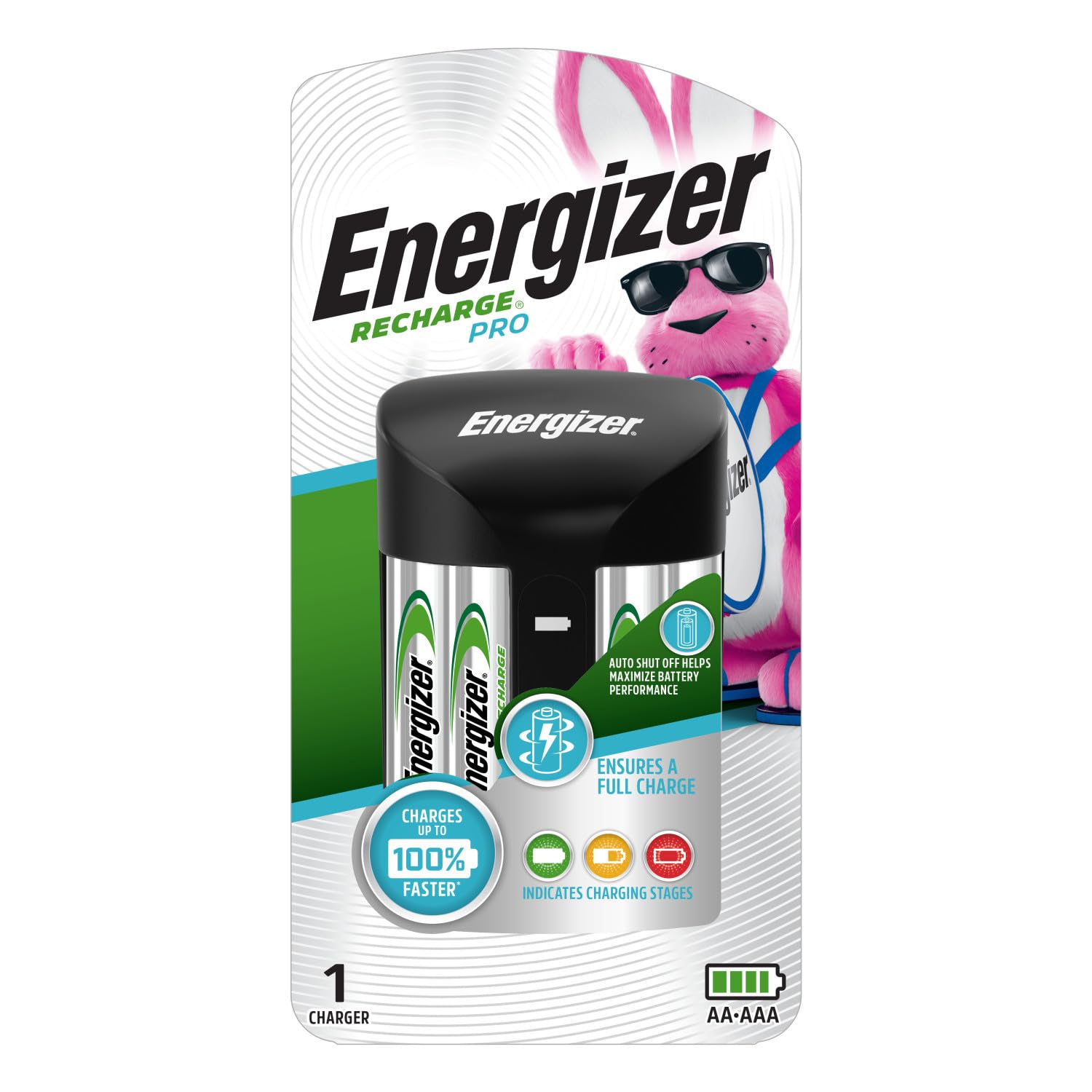
Four bays, three hours to full, and a piece of feedback that has drawn tens of thousands of buyers.
Speed is the headline here. The Recharge Pro fills two or four AA or AAA cells in just three hours, and Energizer advertises it as charging up to 100% faster than its own Recharge Basic NiMH charger — a direct brand-to-brand difference, not a vague claim. Auto shutoff and overcharge protection are built in, so a forgotten charger doesn’t cook the cells. The current rating sits at 500 milliamps, and the four included NiMH AAs ship with the unit.
The indicator scheme is where this charger separates itself from cheaper alternatives: red, yellow, and green lights show progress stage by stage, with audible beeps alerting you when charging starts and finishes. If it detects a dead cell, a red X lights up with repeated beeps — a fault signal you can hear from the next room. The plug itself is a US two-prong AC connector that folds away, so it stores flat without a cable trail.
What earns this bundle its huge feedback footprint is the basic math — the included cells plus the charger eliminate disposable purchases, and owners consistently report the charge holding up across normal device use. At 4.6 stars across tens of thousands of ratings, it’s the most-reviewed pick in this lineup.
Best-in-show trait: the audible beep-and-red-X alert system is the only audible fault detector in this lineup — you never have to stare at the blink pattern to diagnose a dead cell.
Consider the fit: for clocks, remotes, and toys the 3-hour fill is exactly right; for a camera flash or a power tool, you’ll want the higher-capacity 2800mAh cells in the BEVIGOR bundle instead.
The case for it: fastest refill in the lineup, with an audible diagnostic no other pick in this list offers.
Where it doesn’t fit: extended heavy-drain sessions — a 500mA current rating prioritizes turnaround speed over per-charge runtime.
7. Panasonic BQ-CC63SBA Advanced eneloop 8-Position Individual Rechargeable Battery 5-Hour Quick Charger with 8 LED Charge Indicator Lights
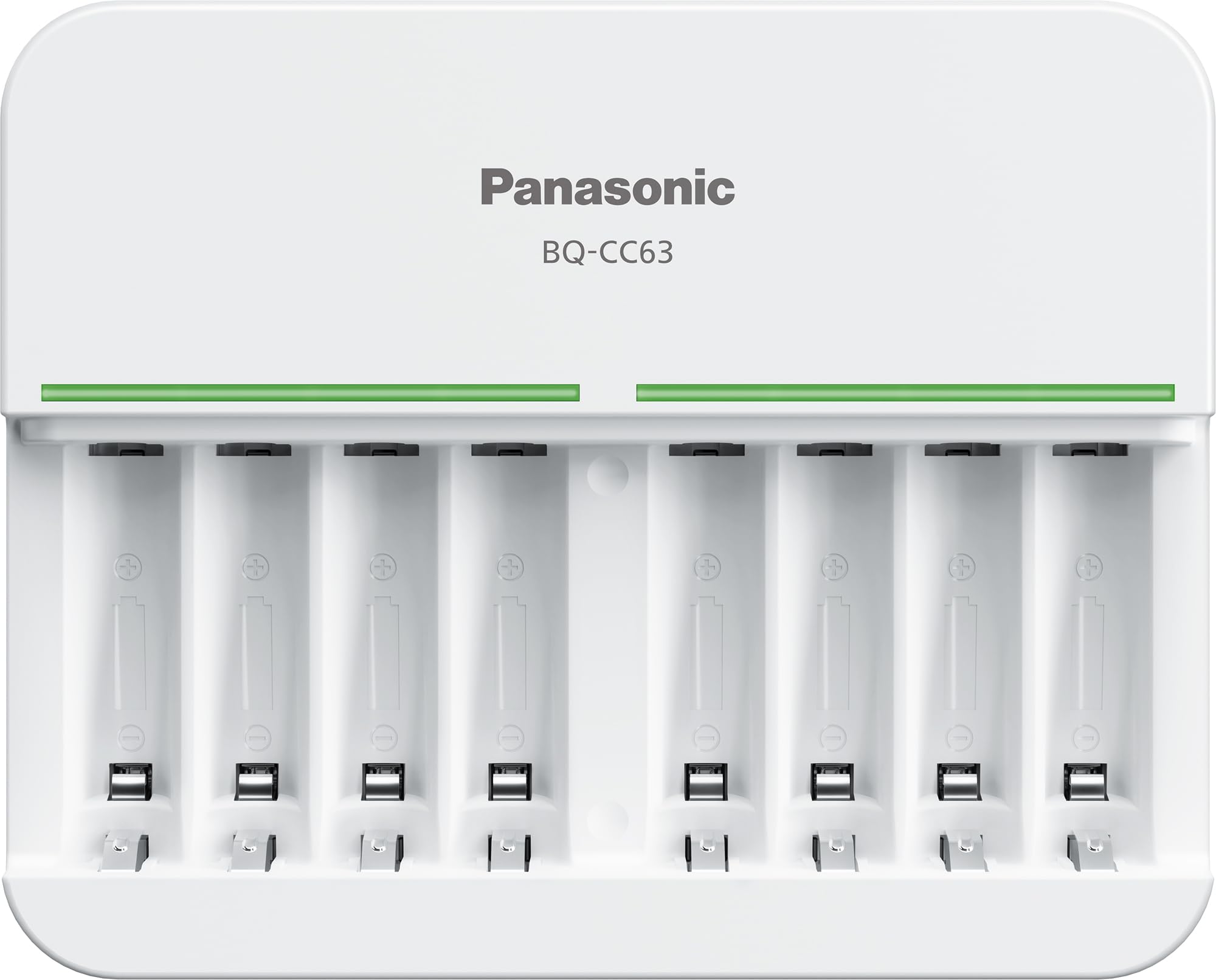
Eight bays, eight LEDs, and Smart Charge that stops at peak capacity to protect the cells inside it.
This is Panasonic’s premium charger — sold as a bare unit (batteries not included) and built around the Smart Charge system that reads each battery’s voltage individually and halts charging the moment that cell hits peak capacity. That behavior is what protects long-term battery life. If you already own good eneloop cells, this is the charger that keeps them alive longest, whether they’re standard or eneloop pro.
The numbers: it fills any combination of up to eight AA or AAA eneloop cells in as little as 5 hours for AA and 3 hours for AAA, with a single green LED per bay that lights while charging and goes dark when done. Eight separate indicators at once means eight separate reports, not one shared status. The included 6-foot AC power cord runs from a wall outlet — no adapter brick — and the unit itself is UL, CE, and FCC listed.
Charging is cool: temperature is a named positive in the feedback, and cells come off the charger warm at worst, with the charger itself staying essentially cold. Build quality is what draws the highest marks. The honest catch is the indicator lights: this model uses a simple on/off green scheme rather than the red/orange/green level indicators found on some Panasonic models, which buyers who like knowing exact percentage find a downgrade. At 4.7 stars across 100+ ratings, it’s the pick for owners who care more about the cells inside the charger than the label on the display.
What the price buys: Smart Charge per-battery voltage detection and a stop-at-peak design — the two features that extend the life of expensive eneloop cells over years of refills.
A word on the display: the green-light scheme trades the level indicators of cheaper Panasonic models for a cleaner on/off readout — a design choice, not a missing capability.
Best for eneloop owners: when your battery drawer is stocked with quality cells and you want the gentlest, smartest charger holding them.
Skip if you need: percentage readouts per bay — a red/orange/green indicator charger will tell you more at a glance than this one will.
8. Tenergy Smart Battery Charger for NIMH/NICD AA/AAA/C/D/9V Batteries, LCD Universal Rechargeable Battery Charger with Automatic Charge/Discharge Function & 5V USB Port for Digital Devices

The one charger that handles every battery in the drawer — AA, AAA, C, D, and two 9V cells.
Most chargers in this lineup speak one battery language. The Tenergy T9688 speaks five: it takes up to four AA, AAA, C, or D cells plus two dedicated 9V channels, all on one unit. Sizes are automatically detected, and charging current adjusts itself accordingly, so you don’t fiddle with switches to move from a AA to a C cell. A backlit LCD shows individual battery icons with capacity levels and status — charging, discharging, or full.
There’s also a feature most chargers in this line skip: a discharge mode. Cycling a battery down and back up is the standard way to wake up cells that have sat dead for years, and it’s the reason one owner reports reviving three or four errored batteries on day one. Built into the back is a 5V DC 500mA USB port that can charge a phone or other small device — but only when the charger itself isn’t busy filling batteries.
Build quality and pure charging capability (that is, actually bringing cells back to working order) are what buyers praise most. The honest downsides are real and worth weighing: the LCD’s viewing angle is narrow — clear from the front, washed out from above — and the same mechanism that holds batteries tightly makes smaller AA and AAA cells fiddly to seat. Charging speed splits the room too, with some owners noting it takes much longer than expected. At 4.4 stars across 600+ ratings, this is the charger for people with a mixed battery drawer, not just AA/AAA.
Features Nobody Else Has
- Charges AA, AAA, C, D, and 9V cells on one unit — the only charger in this lineup covering all five
- Discharge cycle revives long-dead cells that other chargers reject as errors
- Automatic current selection matches itself to each battery size, no settings to adjust
- Built-in 5V DC 500mA USB port charges a phone or earbuds while the charger is idle
The Honest Trade
- LCD display has a narrow viewing angle — sharp from the front, hard to read from above
- Firm spring contacts make smaller AA and AAA cells fiddly to seat and remove
- Charging speed is divisive — some owners find it dramatically slower than expected
Buy this for: a mixed battery drawer — the only pick here that also handles C, D, and 9V cells.
Pick differently if: your load is pure AA/AAA and fast turnarounds matter; the narrower chargers in this list charge those faster and with a clearer display.
9. Opus BT – C3100 V2.2 Universal Battery Charger Speedy LCD Display Smart Battery Charger for Rechargeable Batteries Ni-MH Ni-Cd AA AAA,3.7V Li-ion 18650 26650 17670 14500 18490 (4-Slot)

The spec-sheet charger: five modes, a full LCD, and the ability to tell you exactly how much capacity each cell still has.
This is the pro-tier pick for anyone who cares about the cells themselves, not just whether the light turns green. It handles Ni-MH, Ni-Cd, and 3.7V Li-ion chemistries across AA and AAA plus a long list of lithium sizes (10440, 14500, 16340, 17335, 17500, 18490, 17670, 18650). Charging current is user-selectable across 200mA, 300mA, 500mA, 700mA, and 1000mA, with 1500mA and 2000mA reserved for slot 1 or 4 alone; discharge defaults to 500mA. Thermal monitoring steps the fan up and shuts the unit down when temperature climbs too far — an upgrade over the earlier revision.
Five modes make it a testing instrument, not just a charger: Charge, Discharge, Test, Quick Test, and Refresh. The Test mode runs a full charge-discharge-charge cycle and reports the cell’s actual capacity against its published rating — the feature that lets you catch a fading battery before it fails you in the field. Four independent slots mean a mixed load of AA, AAA, and 18650 cells can be tested side by side, each on its own circuit.
Build quality and pure functionality are what buyers rave about most, with battery compatibility next in line. The trade-offs map cleanly to the pro feature set: the cooling fan runs audibly during discharge cycles, the controls take some practice (there’s no memory of your last test, and current is awkward to change mid-charge), and some early units failed within a few months while later revisions held up. At 4.5 stars across 800+ ratings, this is the pick for cell collectors and heavy users — a bit overbuilt for someone who just needs a TV remote topped up.
The testing-instrument angle: Test mode reports real mAh capacity so you can grade recovered cells and spot the weak ones, a capability no other pick in this list offers.
One consideration: fan noise during discharge cycles and the lack of test memory are the honest cost of the feature depth — you trade quiet simplicity for real measurement data.
Best for power users: anyone testing, reclaiming, or grading rechargeable cells — especially 18650 and Li-ion collections.
Overkill if: you only need to fill AA/AAA cells for remotes and toys; the simpler bundles will get you there for less complexity.
Understanding the Specs
mAh capacity (battery runtime)
mAh stands for milliamp-hours — the size of the battery’s fuel tank. Higher mAh means longer runtime between charges. A 2000mAh AA and a 2800mAh AA look identical, but the higher one runs noticeably longer in high-drain devices like game controllers or camera flashes. Higher capacity also takes a bit longer to charge from empty, so pick based on whether you prefer runtime or turnaround speed.
NiMH vs Ni-Cd chemistry
NiMH (nickel-metal hydride) is the modern household rechargeable chemistry — no memory effect issues, higher capacity, and the one most low-self-discharge batteries use. Ni-Cd (nickel-cadmium) is an older chemistry still supported by some universal chargers for legacy tools and cell packs. If you’re buying new cells, NiMH is what you want; Ni-Cd support is a nice-to-have if you already own old gear.
Independent slots vs paired charging
A paired charger fills batteries in fixed groups, so a half-empty cell next to a dead one gets treated identically. An independent-slot charger gives each bay its own circuit, so every cell fills to its own state. Over years of use, independent charging is the gentler option — it avoids overcharging the fuller cell in a pair.
Trickle charge and overcharge protection
Trickle charge is a low-current top-up that runs after a battery hits full, keeping it from slowly draining on the shelf. Overcharge protection cuts the current when a cell reaches peak, and works with trickle charge to avoid damaging the battery. Both features matter for cells you plan to refill hundreds of times.
FAQ
Can a battery charger work with any brand’s rechargeable AA or AAA batteries?
What does mAh mean on a rechargeable AA battery and does higher mean better?
How long do rechargeable AA and AAA batteries last before they need replacing?
Do I need independent charging slots or will paired charging work fine?
Can I charge 9V, C, and D batteries on the same charger as AA and AAA cells?
Is it safe to leave batteries in the charger after they are full?
What is the difference between trickle charge and fast charge?
Why do some rechargeable batteries lose their charge sitting on a shelf?
Can a smart charger repair or revive old or dead rechargeable batteries?
Do faster chargers shorten battery lifespan?
Final Thoughts: The Verdict
For most homes buying their first rechargeable setup, the battery rechargeable charger to pick is the Eneloop Panasonic K-KJ55MBS66A Power Pack — it ships twelve batteries (six AA, six AAA), charges four AAs in about three hours on independent slots, and the cells are rated for up to 2100 recharges with 70% charge retained after ten years in storage. That combination covers the whole house without a second purchase. If your budget is tighter and you just want to test whether rechargeables fit your household, the Duracell Ion Speed 1000 is the lower-risk entry with a folding plug and four pre-charged AAs included. And if you’re building a battery drawer rather than just topping up remotes, the POWEROWL 12 Bay is the one to reach for — twelve independent slots means you empty the drawer into one session instead of three.
The one honest nudge: this category is a rare one where the best-selling pick and the best pick are the same thing. The eneloop bundle holds the highest rating in this list and the largest single-battery-per-charger refill ceiling, so if you’re only buying once, buy the one most owners don’t replace.
How We Picked
We do not accept paid placement. Every pick is matched to a real buyer and a real use-case; we do not hands-on test units.
Sources & Methodology
Specifications: manufacturer listings and product documentation. Review insights: verified customer reviews, as of September 2026. Pricing: not shown on this page (it changes often); check the current price via the retailer link.
As an Amazon Associate, Gadgets Feed earns from qualifying purchases. This does not affect which products we feature.