
Our readers keep the lights on and my morning glass full of iced black tea. As an Amazon Associate, I earn from qualifying purchases.
Specs are compiled from manufacturer listings and verified buyer reviews and can change over time — please confirm the key details on the product page before buying.
You walk out the door for a weekend trip or a two-week vacation, and your fish still eat on schedule — that is what an automatic feeder buys you, and it removes the “did anyone feed them?” panic. The category splits two ways. A wheel-and-drum feeder drops food at set intervals. A programmable unit lets you set exact clock times and portion control. Get that choice right and everything else falls into place.
I’m Min — the founder and writer behind Gadgets Feed. This guide is built by comparing the manufacturers’ published specifications and the patterns across verified customer reviews, so you get each pick’s real strengths and trade-offs instead of marketing spin.
You will also hit a recurring theme in owner feedback: these feeders work brilliantly with pellets and struggle with flake unless you break it up first. That single habit explains most of the frustration people report. If you want a dependable aquarium auto feeder that simply drops the right amount at the right time, the picks below cover every tank size and budget tier.
Our Picks at a Glance

How To Choose The Best Aquarium Auto Feeder
Buying a feeder is really a question of how long you leave your tank alone and what you feed it. Answer those two things and the shortlist gets very short.
Match the feed type first, before anything else
Pellets and granules flow through a drum or auger opening reliably. Flakes are the problem child — they are light, they bridge across an opening, and they hold moisture. If you feed flake, either break it into small pieces or expect to test and adjust the opening more than a pellet user would.
Decide between interval modes and exact clock times
Some feeders rotate on a fixed interval — every 12, 24, or 48 hours — which is easy to set with one button and impossible to get wrong. Others let you program exact times of day, and that suits keepers who want feeding locked to a schedule. Neither is better; they solve different habits.
Check drum size against your trip length
A 200 ml drum holds a lot of pellets for a small community tank, but the same drum empties in days for large fish eating three times a day. If your vacation runs long or your fish are big eaters, budget for a larger drum or a second chamber.
Plan the mount before you need it
Bracket-and-clamp mounts fit rimmed and rimless tanks, hooded tanks need a funnel or sticker mount, and thick tank walls can rule out suction cups. Getting the mount right matters as much as the timer, because a feeder that tilts will dump food on the rim instead of the water.
Quick Comparison
| Model | Best For | Drum Capacity | Feeding Interval Options | Power Source | Amazon |
|---|---|---|---|---|---|
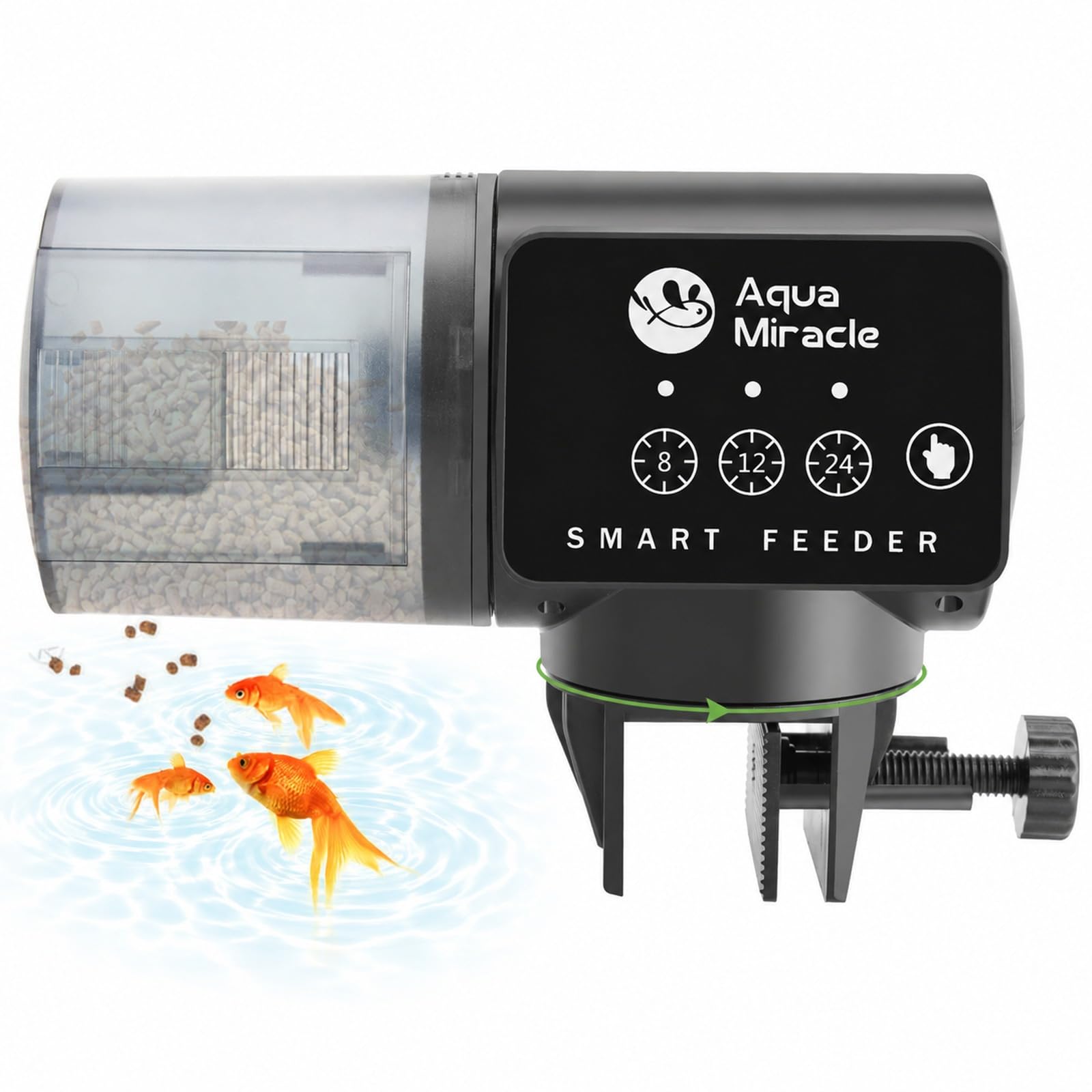
| AquaMiracle Automatic Fish Feeder★ Best Overall | Rimless tanks and hooded setups | 200 ml | 8 / 12 / 24 hours | Battery | Amazon |
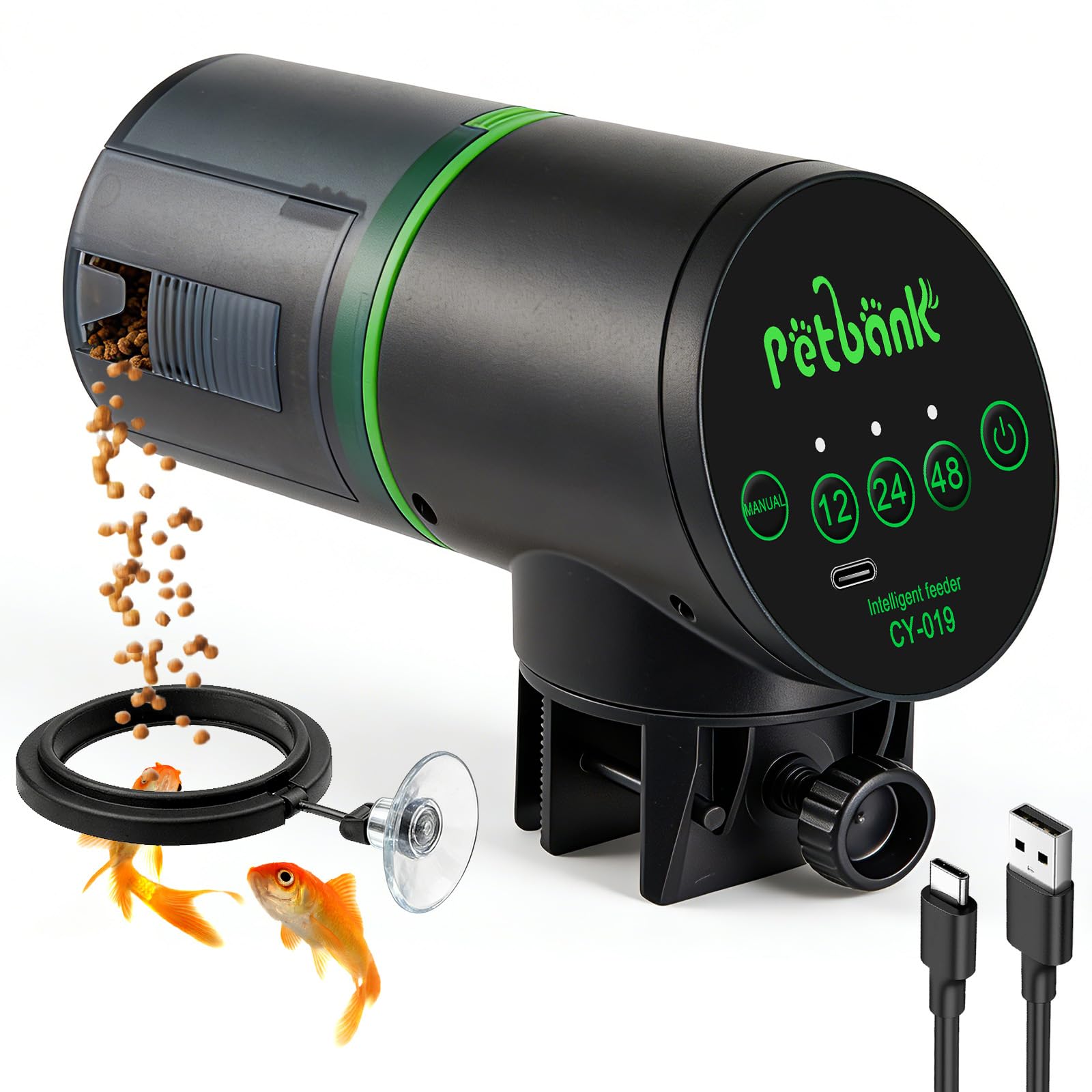
| Petbank Automatic Fish FeederBest Value | Long trips with one charge | 200 ml | 12 / 24 / 48 hours | USB-C rechargeable | Amazon |
| FISHNOSH Auto Feeder Model-MLSimplest Setup | Simple one-button operation | 200 ml | 8 / 12 / 24 hours | Battery | Amazon |
| TOPBRY Digital Auto Feeder | Four exact feeding times | 200 ml | Up to 4 exact times daily | USB rechargeable | Amazon |
| Papettly Auto Feeder CY-109 | Short trips and quiet rooms | 30 g | Up to 3 daily feedings | USB rechargeable | Amazon |
| FISHNOSH Feeder with Thermometer | Tanks that need a temp check | 200 ml | Up to 3 times daily | Battery | Amazon |
| DXOPHIEX WiFi Fish Feeder | App scheduling from anywhere | 200 ml | Up to 6 meals daily | 2 AA batteries or USB | Amazon |
| EHEIM TWIN Automatic Feeder | Two foods, two chambers | 80 ml | 1–3 daily runs, 1–9 turns | Battery | Amazon |
| Eheim Feed-Air Fish Feeder | Long absences, dry food | 4 liters | 24-hour schedule | Battery | Amazon |
In‑Depth Reviews
1. AquaMiracle Automatic Fish Feeder for Aquarium
Our pick — over 4★ from 450+ verified ratings; the strongest balance of quality and price.
One push of a button sets the whole schedule — no screen, no manual, no fuss.
If your tank rim is an awkward shape, or you run a hood that leaves almost no room, this is the feeder that stops arguing with your setup. The bracket mount rotates a full 360 degrees, so you can point the drop opening directly over open water instead of the rim. A double-sided sticker handles hooded tanks when a bracket will not fit. Both mounting paths are included in the box, which is why owners of rimless and framed tanks both end up here.
Timing is the other reason it leads. Press once and you cycle through feedings every 8, 12, or 24 hours — three choices, one button, done. There is a manual feed button too, so you can top up by hand before a trip or give a treat when you are home. The 200 ml drum opens by sliding the lid, and the dispensing opening faces upward after each rotation so food stays dry between drops. Buyers who test pellets in a cup for a few days report flawless operation over a two-week vacation.
Here is the honest part, and it is the most repeated note in the feedback: this feeder runs generous on the default opening. Guppy keepers tape part of the opening to shrink each drop. It also prefers pellets, granules, and strips — flakes need breaking up first, and even then the volume can swing. Treat it as a pellet feeder that tolerates flake, not the other way round. On the hardware side, the small plastic tabs that hold the opening plate are the piece to treat gently; they are the flimsiest part of an otherwise solid build.
What Wins People Over
- Three interval choices — 8, 12, or 24 hours — set with one button, no screen to program
- 360-degree bracket rotation lets you aim the drop over water on odd rim shapes
- Two mount types included: bracket for rimmed or rimless tanks, sticker for hoods
- Fits granules, pellets, strips, and flakes, and works for turtles as well as fish
- Slim profile slips into tight gaps above the water line
Where It Asks For Patience
- First drops usually run heavy — expect tape or a smaller opening for nano fish
- Flake food needs crushing, and volume can still vary between drops
- The little plastic opening tabs are the weak point; handle the drum lid gently
The call: the easiest feeder here to set up cold, and the most forgiving on awkward tank rims.
Think twice if: you keep a single small fish on flake, where a chamber-style feeder gives you tighter control.
2. Petbank Automatic Fish Feeder for Aquarium
Recharge it once and forget the batteries — this one runs for months on a single top-up.
A USB-C port is the practical difference here. Instead of hunting for AA cells before every trip, you plug in the included cable and get a claimed 3 to 6 months of runtime per charge. That matters most for people who travel on short notice. The schedule covers the usual ground — rotate every 12, 24, or 48 hours — with a manual button for an instant feed. Mounting is a clamp on the tank rim or the included sticker on a lid, and buyers report it sitting stably on top without shifting.
What keeps this in the top two is how consistently it delivers on schedule. The 200 ml container takes pellets, granules, and powders, and the slide controls how much falls per rotation. Compared with the AquaMiracle above, the drum capacity is identical at 200 ml, but the power approach is the swing factor. At 0.29 kg it carries a bit more heft than the AquaMiracle at 0.25 kg, which reads as sturdier in the hand but is still light enough to sit on a rim without bowing.
The catch is dosing. Reviews describe the trap door dropping inconsistent amounts — a setting meant to release eight pellets can deliver anywhere from six to fourteen. Single-fish keepers on flake have the hardest time; the door tends to release more than one small fish needs, and the common fix is taping part of the opening. Battery reports are split too: some owners see a charge last far longer than expected, others find it stops holding. Most people simply refill the drum and set the interval, and it quietly feeds for months.
Charge-and-forget: the USB-C battery removes the last-minute battery run, and the 12/24/48-hour modes are simple to set on the unit itself.
Dose it carefully: pellets come out evenly, but measured portions with flake or a single fish need tape over part of the opening.
Reach for this if: you want cordless USB-C charging and a schedule you set in seconds.
Look elsewhere if: you keep one betta and need a very precise tiny portion every time.
3. FISHNOSH Automatic Fish Feeder Model-ML
No screen, no menu tree — just a button, a slide, and a tank that gets fed.
This is the feeder for someone who has never owned one and does not want to learn a menu system. There is no display at all; you press a button to start an 8, 12, or 24-hour interval, and the first feeding happens right away. That immediate first drop is worth knowing before you mount it — it is not plug-and-play, and a dry test run on a paper plate the day before you leave tells you everything about portion size. The drum opens through a clear window for refills, which keeps the lid out of the way during top-ups.
The 200 ml drum suits flakes and pellets, and owners run it for months on a single set of batteries, with feedback pointing to at least a month of life between changes. On capacity it beats the EHEIM TWIN above — that twin chamber holds 80 ml, while this one holds 200 ml in a single drum. If you keep one food and want simple, that gap is the whole argument.
The trade-offs show up in two places. Portion control is the most mixed part of the feedback: some owners dial the feed hole down and get consistent drops, others find flakes bridge and dump unevenly. And there is no on-off switch, which several owners note would be a welcome addition for pausing during maintenance. Neither is a reason to skip it — they are the questions to answer with a test run before you rely on it.
Built for non-techies: press, cycle, walk away. The manual feed hole adjustment takes one or two tries to lock in.
One food, one drum: ideal for a single-community tank. Two foods at once means two of these, or a dual-chamber feeder instead.
Best fit: first-time feeder owners and anyone who finds instructions annoying.
Skip if: you need to pause feeding without unplugging or removing the unit.
4. TOPBRY Digital Auto Aquarium Feeder

Four exact clock times a day — the closest thing here to a real feeding timetable.
Interval feeders rotate on a timer; this one lets you set actual times on a 24-hour clock, up to four per day, with one to three rotations each. For keepers who feed at breakfast and lights-out, that precision is the whole reason to buy it. Programming takes a little patience the first time. Owners who set it up a week early to fine-tune the output describe it as easy enough, and the payoff is a schedule that matches how you already feed.
Refilling works from the top without removing the drum, which is a genuinely useful detail when the feeder is clamped in place. The pedestal rotates 360 degrees so you can swing the opening over the water once it is mounted. Both mount options are there — pedestal or double-sided sticker. The 200 ml drum takes flakes, pellets, powders, and strips, and there is enough room that the rechargeable battery reportedly holds charge for months between top-ups. Compared with the single-button FISHNOSH above, this trades that simplicity for four precise feeding times, which is exactly the kind of control a multi-tank keeper wants.
Portion size is where you will spend your setup time. The feedback is consistent on one point: for a lone fish like a betta, the smallest opening can still feel generous, and the common fix is a small drilled hole in the slot center. Once dialed in, the math works out over a day even if individual rotations vary slightly. The other thing to know is that the clock runs on military time, so 18:00 means 6 p.m.
Precision where it counts: up to four timestamps and one to three rotations per feeding give real control over a daily routine.
Setup rewards patience: run a week of tests, dial the opening small, and consistency follows. Rush it and the first drops run heavy.
Suits: keepers who feed on a set daily rhythm and want the feeder to match their clock, not replace it.
Not for: anyone who would rather press one button and never think about military time again.
5. Papettly Automatic Fish Feeder CY-109

A chamber feeder that ticks quietly through its slots — ideal for tanks in bedrooms and offices.
This works differently from a drum feeder. Instead of a rotating barrel, it uses 15 compartments you load by hand, and each feeding session releases up to three portions — a system that gives you measured control over exactly what goes in the water. It runs at under 30 dB, which is quieter than normal conversation and won’t disturb a bedroom tank. The ports close automatically between feeds, so the food stays dry and does not clump.
Programming goes through an LCD display: up to three daily feedings, with customizable frequencies and alternating-day feeding for tanks fed every other day. Portion control is capped at up to 2 grams per feeding, so you can dial in a small serving without taping an opening. The drum is advertised at 30 grams of food, and the compact body — 4.52 inches across — mounts cleanly on a lid, by suction cup or stand. For tanks that are fed while you are at work, this is a neat fit.
The limit is trip length. With six chambers in use per day across 15 total, the drum holds roughly two and a half days of food, so it is built for weekends and short absences rather than a two-week vacation. It also is not designed for flake or shrimp food, which have different flow characteristics in a compartment system. Owners of thick-walled tanks have needed to use the suction cup mount because the clamp was too short.
Silent by design: under 30 dB and auto-closing ports mean it works invisibly in a living space.
Short-trip tool: the 30 g compartment capacity covers a weekend, not a fortnight — plan around it.
Ideal for: weekend trips, office tanks, and anyone who wants a feeder they never hear running.
Not the one if: you need two weeks of hands-off feeding or you feed shrimp and flake.
6. FISHNOSH Automatic Fish Feeder with Digital Thermometer

Two jobs in one box — feed on schedule and get told when the water runs warm.
Most feeders only handle food. This one adds a digital thermometer with a built-in temperature sensor and a display: you set a target temperature range, and if the water climbs above it, an audible alert sounds. That is a real safety net for a tank sitting in a sunny room during a summer trip. The feeder side of the package is a 200 ml drum with two feeding windows in different sizes, so you can pick the smaller or larger opening for different food types instead of taping a single hole.
Feeding goes up to three times a day, with one to nine portions per feeding according to the listing, and the included clip and stand give you mounting options. Owners mention it fits a 36-gallon bow front and runs about four months per charge. It handles flakes, pellets, and blood worms, which is broader food range than most single-drum feeders here.
The honest caveat is the thermometer. The temperature readout is the most debated part of the feedback; some owners find it accurate, while others say the reading drifts or recalculates oddly after the alert threshold is set. It is a bonus feature rather than the reason to buy. The feeder itself earns its spot on dosage consistency and food range.
Value-dense package: a capable 200 ml feeder plus a temperature alert you would otherwise buy separately.
Trust the feeder, verify the thermometer: check the temp readout against a second thermometer before relying on the alert.
Worth it if: you want one device that covers feeding and a rough temperature check for a warm room.
Buy it for the feeder: if accurate temperature logging is the priority, pair a feeder with a dedicated thermometer.
7. DXOPHIEX WiFi Fish Feeder

Set six different meals a day from your phone — from the couch or from another state.
You want to control feeding from your phone, and this pick goes furthest on that. You schedule meals through a mobile app — up to six meals a day, with one to twelve portions per meal — and you can vary the schedule by weekday, so three meals every Monday and two every Sunday is fine. A feeding record lets you check back weekly, monthly, or yearly. If you travel often and want proof that feeding happened, that log is the feature that matters.
Power is handled two ways: two AA batteries (not included) or a USB cable, and the included cable runs 6.6 feet so it reaches an outlet without an extension. The clever part is that both can be active at once — if the home power cuts out, the batteries take over automatically, which is exactly the protection you want during a storm while you are away. Owners on battery-only seven-day trips report it held up.
The honest asterisk is WiFi. The connectivity is the most mixed part of the feedback: many owners get a clean connection and use it with smart-home platforms, while others find it refuses to connect at all, and the app itself gets split reviews. Two drum sizes ship in the box — 100 ml and 200 ml — plus a 4-inch feeding ring, which softens the blow for anyone who has to fall back on the physical buttons. At 5.5 by 3 by 3.9 inches it is the most compact of the WiFi-capable options here.
Remote flexibility: six meals a day, per-meal portions up to twelve, and a schedule that varies by day of the week.
Connection variable: the app is the star when WiFi cooperates, but the physical controls still let you feed the tank if it does not.
Made for: frequent travelers who want to check a feeding log and adjust the schedule remotely.
Think twice if: your tank sits far from the router — a button-based feeder sidesteps the connection question entirely.
8. EHEIM TWIN Automatic Feeder

Two augers, two foods, two schedules — the feeder for mixed-species tanks that need both.
Two separate food chambers are the point here. Each drum holds granulate, sticks, pellets, or flakes, and each runs on its own program — so you can feed sinking pellets to the bottom dwellers on one auger and floating crisps to the surface fish on the other, on separate schedules. Aerated chambers (air vents that keep the food dry) protect the contents, and a random mode varies feeding timing for more natural conditions. Each auger supports one to three runs a day, one to nine turns per run, with an optional pause on the seventh day.
Build quality is where this feeder has genuinely earned its reputation. Customers note consistent dispensing with no over- or under-feeding, and batteries still full after six months. It handles pellets and crisps smoothly — Tetra Crisps are frequently named as the food it works best with — and the large LCD with four buttons makes the settings visible at a glance. For a two-food schedule, nothing else here splits the workload this cleanly.
Two things to plan around. The 80 ml chamber is smaller than the 200 ml drums on the budget picks, and owners feeding large fish three times a day report it running out within a handful of days — a supplemental food reservoir is the common workaround. The programming interface is also a multi-step process that some owners find long the first time, and the manual runs dozens of pages. Once configured, it runs. Flakes and moisture are the real hazards: owners warn it clogs on large flakes, and it needs to stay dry, so mount it where splashes cannot reach.
Why It Earns Its Spot
- Two independent chambers and schedules for tanks with different fish eating different foods
- Consistent auger dispensing — owners describe it working flawlessly once set up
- Aerated chambers plus a random feeding mode for more natural conditions
- Batteries reportedly last six months
The Trade-Offs
- 80 ml chambers are small — large fish on three feedings a day will empty it in days
- Multi-step programming has a learning curve; budget time for the first setup
- Flakes clog the augers, and any moisture contact risks the electronics
Right pick for: mixed-species tanks that need two foods on two independent schedules.
Wrong pick for: a single-food nano tank, where one 200 ml drum is simpler and holds more.
9. Eheim Feed-Air Fish Feeder Everyday Unit

A four-liter food store that kept one tank fed for five straight weeks.
Capacity is the headline. A 4-liter drum holds an enormous pile of food compared with the 200 ml feeders, and that is exactly what makes this the pick for long absences. Reviewers point out five weeks of use in a humid room with no caking, thanks to the canister’s ventilation.
The design is a drum-based feeder with a 24-hour scheduling setup and a waterproof food canister. Setup is consistently described as simple, and the battery life holds up over multi-week runs. This is a purpose-built feeder for one job — leaving food reliably while you are gone — and it does that job without app pairing or a complex screen. At 12 ounces it is among the lightest units here, so it sits on a tank edge without strain.
Two honest notes. The drum dispersal is uneven from drop to drop, which owners say evens out fine over a long trip but makes precision feeding impossible — for a single fish you’d want the smaller chamber feeders instead. And the opening is fiddly with pellets; several owners tape half the hole to reduce each serving. It also prefers a placement above an open water area with good clearance, since food can catch on a narrow tank opening. Set it up a week early and test placement, and it runs quietly for the trip.
Long-haul champion: 4 liters of food and a waterproof, ventilated canister — the natural pick for trips measured in weeks.
Not a precision tool: dispersal varies between drops, so dial portions loosely and let the long average do the work.
Choose it if: your trips stretch for weeks and you feed a reasonable amount of pellets to a community tank.
Keep looking if: you need exact daily portions for one small fish.
Understanding the Specs
Drum Capacity — How Much Food You Can Load
Capacity is usually listed in milliliters or grams, and it decides how long the feeder runs before you refill. A 200 ml drum holds a lot of pellets for a small community tank but empties in days for large fish fed several times a day, while a 4-liter drum is built for multi-week absences. Match the drum to trip length and your fish’s appetite, not to the biggest number on the page.
Feeding Interval vs Exact Clock Times
Two scheduling types dominate. Interval feeders rotate every set number of hours (commonly 8, 12, 24, or 48) and are set with one button — hard to get wrong. Programmable feeders let you assign exact clock times per day, which suits keepers who feed on a fixed daily rhythm. The right choice depends on if you want simplicity or control.
Power Source — Battery vs USB Rechargeable
Battery units are the safest during power cuts and can run months on a set of cells. USB rechargeable models skip the battery run before a trip but need a top-up first. A few run both at once, so batteries cover a power outage while plugged in. If you leave during storm season, dual power is a real advantage.
Food Type and Opening Size
Pellets and granules flow smoothly through an opening and give consistent portions. Flakes are lighter, bridge across openings, and hold moisture, so they need to be broken up and the opening widened or taped to suit. Most frustration owners describe traces back to feeding flake through a feeder tuned for pellets — a test run before you leave sorts it out.
Mounting and Placement
Bracket and clamp mounts suit rimmed and rimless tanks; hooded tanks need a funnel or sticker mount; thick tank walls can make suction cups unreliable. Placement matters as much as the mount — the drop opening needs to sit over open water with clearance so food lands in the tank and not on the rim, especially on tanks with narrow lid openings.
Moisture Control and Ventilation
Food sitting above a warm tank can absorb humidity and clump, jamming the feeder. Designs that face the drop opening upward between rotations or use aerated chambers keep food dry. On a humid setup or a long trip, that feature decides whether the feeder works cleanly for weeks or clogs partway through.
FAQ
Will an automatic fish feeder work with flakes?
How long can a feeder run before I need to refill it?
Do I need a battery feeder or a rechargeable one?
Can I use one feeder for both fish and turtles?
Will my automatic feeder fit my tank?
Is an interval feeder or a programmable one easier to set up?
How do I stop the feeder from overfeeding my fish?
What food types work best in an automatic feeder?
Do I need to test the feeder before I leave for vacation?
Will flake food block the feeder if I do not break it up?
Final Thoughts: The Verdict
For most tanks, the AquaMiracle Automatic Fish Feeder is the best overall choice — rated 4.4 stars by 400+ owners — because its one-button 8/12/24-hour timing, 360-degree mount, and 200 ml moisture-proof drum handle the widest range of tanks without a learning curve. If you want to refill less often and skip the batteries, the Petbank Automatic Fish Feeder is the value pick with USB-C charging and a 12/24/48-hour schedule. For a two-food mixed-species tank on independent schedules, the EHEIM TWIN is the one to reach for — just plan for its smaller 80 ml chambers. Whatever you choose, test it for several days first, dial the portion down until the drops look right, and you can walk out the door with your fish still eating on schedule.
How We Picked
We do not accept paid placement. Every pick is matched to a real buyer and a real use-case; we do not hands-on test units.
Sources & Methodology
Specifications: manufacturer listings and product documentation. Review insights: verified customer reviews, as of September 2026. Pricing: not shown on this page (it changes often); check the current price via the retailer link.
As an Amazon Associate, Gadgets Feed earns from qualifying purchases. This does not affect which products we feature.