
Our readers keep the lights on and my morning glass full of iced black tea. As an Amazon Associate, I earn from qualifying purchases.
Specs are compiled from manufacturer listings and verified buyer reviews and can change over time — please confirm the key details on the product page before buying.
If your basement smells like a wet towel left in a bucket, the fix is almost always airflow — not another dehumidifier. A good exhaust fan pushes that trapped, damp air outside instead of just stirring it around. This guide covers nine real options, from a plug-and-play crawl-space unit to a heavier wall-mounted workhorse for a large shop. You will see which one fits your space, your noise tolerance, and how much air you actually need to move.
I’m Min — the founder and writer behind Gadgets Feed. This guide is built by comparing the manufacturers’ published specifications and the patterns across verified customer reviews, so you get each pick’s real strengths and trade-offs instead of marketing spin.
The biggest mistake buyers make is sizing by room, not by cubic feet of air that has to leave. Below you will find the specs that actually matter for best basement exhaust fans.
Our Picks at a Glance
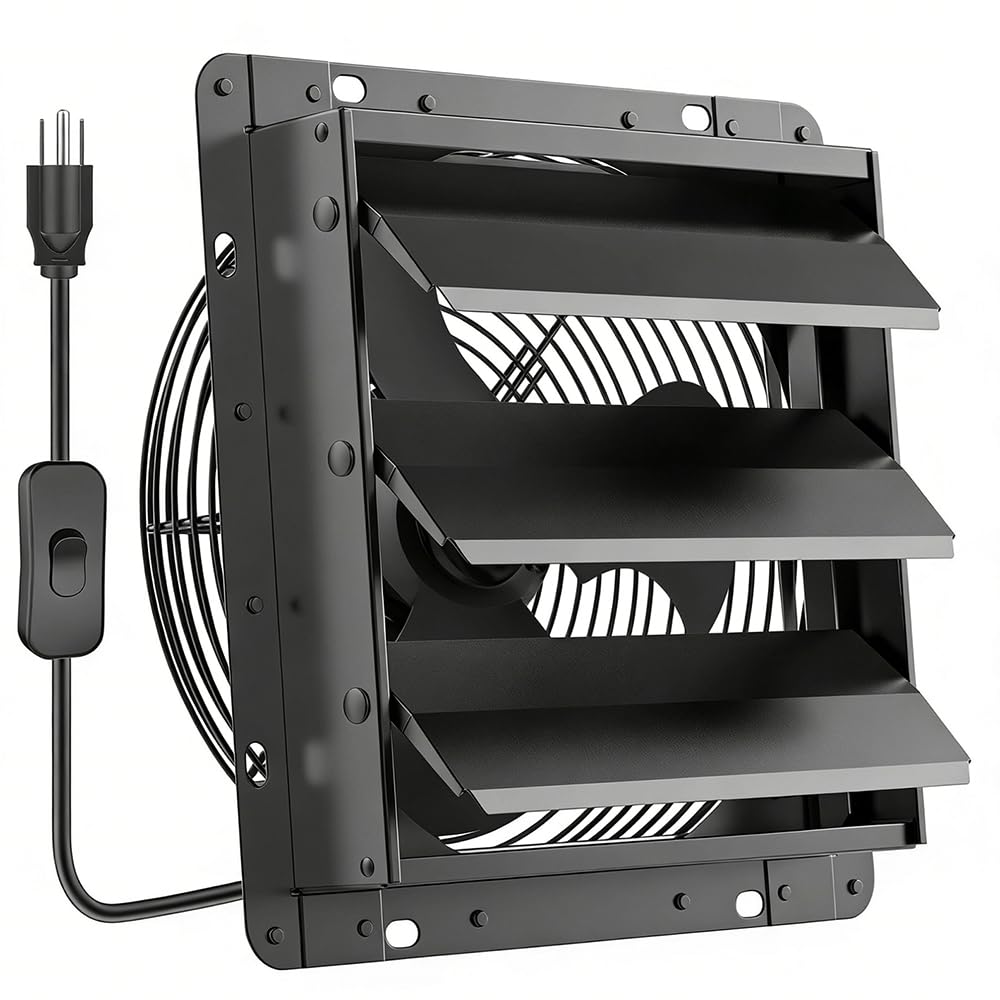


How To Choose The Best Basement Exhaust Fans
The right fan is the one that moves enough air to empty your space without driving you out of the room with noise. Everything else — the shutters, the controller, the cord — is a detail you sort out after you know your number.
Start With Your Cubic Feet, Not The Room Size
Multiply your basement’s length by its width by its height to get cubic feet. A fan rated at 240 CFM (cubic feet per minute — the volume of air it pushes each minute) is built for a crawl space or a small closet-type area, not a full open basement. If you are fighting real heat as well as damp, look at the higher-CFM wall models instead of a low-volume crawl-space unit.
Quiet Matters More Than You Think
A fan running all day in a space you also use for laundry or a workshop gets annoying fast. Sound is measured in dB (decibels — a scale where higher numbers mean louder). A unit rated around 32 dBA disappears into the background; a large industrial fan near 69 dB is audible as soon as you enter the room. If the basement shares a wall with a bedroom above, lean toward the lower number.
The Shutter Is Your Weather Guard
Automatic louvers are flapping panels that open when the fan powers on and drop shut when it stops. That seal keeps rain, cold drafts, and insects out of a below-grade wall opening. Without it you would need a separate cover, which means getting up to open and close it by hand every time.
How You Want To Control It
A plain on/off switch is simple and cheap to live with, but someone has to flip it. A thermostat or humidity probe (a sensor that switches the fan on by itself once the air hits your set point) lets the fan run itself, so on a damp summer day the air still clears while you are out.
Quick Comparison
| Model | Best For | Airflow (CFM) | Control | Blade Size | Amazon |
|---|---|---|---|---|---|
| HG Power 10 Inch Shutter Exhaust Fan★ Best Overall | Coops, sheds and small basements | 647 cfm | Touch / switch cord | — | Amazon |
| KEN BROWN 12 Inch Shutter Exhaust FanBest Value | Greenhouses and workshops | 1400 cfm | Button control | 12 inches | Amazon |
| VEVOR 16 Inch Shutter Exhaust FanWidest Airflow | Attics, garages and barns | 2000 cfm | Button control | 16 inches | Amazon |
| Amico 12″ Shutter Exhaust Fan | Two-car garages and large sheds | 1282 cfm | Thermostat | 12 inches | Amazon |
| VEVOR 20” Exhaust Fan | Big garages and shops | 3000 cfm | Push button / variable speed | 20 inches | Amazon |
| iLIVING 14″ Wall Mounted Shutter Exhaust Fan | Attics up to 1800 sq ft | 1200 cfm | Digital / app control | 14 inches | Amazon |
| AC Infinity AIRTITAN T8 | Crawl spaces and basements | 240 cfm | App / WiFi | — | Amazon |
| AC Infinity AIRTITAN T7 | Crawl spaces and basements | 240 cfm | App / WiFi | 12 inches | Amazon |
| iLIVING 20″ Wall Mounted Shutter Exhaust Fan | Warehouses up to 5000 sq ft | 3368 cfm | Thermostat / variable speed | 20 inches | Amazon |
In‑Depth Reviews
1. HG Power 10 Inch Shutter Exhaust Fan, 647CFM Quiet Garage Exhaust Fan
Our pick — over 4.5★ from 600+ verified ratings; the strongest balance of quality and price.
A whole-metal ten-inch fan that moves serious air and still keeps quiet about it.
This is the pick to buy if your basement is smaller than a full open floor and you want it dry without a lot of fuss. It moves 647 CFM (cubic feet per minute — how much air it pushes every minute), which is enough to cycle the air in a compact basement, a workshop, or a walk-out shed. The blades are aluminum, not plastic, and the grille is a 12.6-inch powder-coated steel panel, so the whole thing feels like a tool rather than a toy. An automatic 10.6″x10.6″ louver seals the opening shut when the power is off, which keeps rain and dust from sneaking back in through the wall.
Two things make it easy to live with. First, you install the entire unit from inside the room — you set the louvered side facing out and screw it in from where you are standing, so you are not hanging off a ladder outside. Second, included in the box are the cord, the fan, a mesh screen, and the manual. The mesh screen acts as a bug filter over the intake, and buyers report it is simple to fit into a window opening. One barn owner runs theirs on a timer to pull damp, musty air out, calling it “perfect for removing musty smells.”
What wins people over most here is the quality of the build — it is the single most-praised trait in the feedback. The catch is the louver itself. A few owners mention the flap stopped closing on its own after a while, and one noted the bug screen arrived without pre-drilled holes, which made the four bolts fiddly to reinstall. Both are small things you can work around with a wipe-down and a drill. It is not a fan for a giant open basement; step up to a higher-CFM model for that.
What You Get
- 647 CFM of airflow from a 10-inch aluminum-bladed fan
- Shutter seals shut when off to block rain and dust
- Installs entirely from inside, no outdoor ladder work
- Steel grille, mesh screen, cord and manual all included
Worth Knowing
- A few customers note the louver stopping on its own over time
- Bug screen ships without pre-drilled holes for the bolts
- Best for smaller rooms, not a full open basement
Buy it if: you want a quiet, all-metal fan for a compact basement, shed, or coop.
Step up if: your space is large enough that 647 CFM feels light.
2. KEN BROWN 12 Inch Shutter Exhaust Fan Wall Mounted, Aluminum
Twelve inches of aluminum shutter that plugs straight into a wall socket and gets to work.
For a greenhouse, workshop, or mid-size basement, this is the workhorse. It runs on 120 volts at 60Hz and moves 1400 CFM through its aluminum blades. The shutters are gravity-operated — they swing open as soon as the fan spins up and drop closed when it stops — and both blades and shutters are made from high-grade aluminum that resists moisture and rust. It arrives with a pre-installed 1.65m power cord, which works out to about 5.4 feet of reach, so there is no wiring and no assembly. You mount it, plug it in, and it ventilates.
Set that install story next to the HG Power above and the trade is clear: the KEN BROWN is a fixed wall-mount that covers more square footage, while the HG Power unit is lighter and easier to drop into a window. One buyer’s cigar-smoke test — fan at the top of a window — sent the smoke straight up and out, earning it a “Sensitive wife approved.” Another says theirs has run in a greenhouse for six months straight with no problems at all.
The honest catch is air movement. It is the most-discussed topic in the feedback, and it cuts both ways — some owners say it moves a huge amount of air, others feel it is not quite as powerful as the rating suggests. The louvers have also been known to stop seating fully over time. What everyone seems to agree on is that it runs quieter than expected for its size and cools a room by a couple of degrees. Add a thermostat if you want it to turn itself on and off, since it does not ship with one built in.
On The Airflow Debate: The rating says 1400 CFM; the feedback says results vary by how you mount it and how big your space is, so match it to a room that size or smaller.
The Practical Move: Run it off a plug-in thermostat so it cycles on its own — buyers who did this reported better results and less hands-on fiddling.
My pick for: greenhouse and workshop owners who want a plain, plug-and-go wall fan with auto shutters.
Think twice if: you need guaranteed high airflow or built-in temperature control.
3. VEVOR 16 Inch Shutter Exhaust Fan Wall Mounted, Steel Housing
When you need to shove a basement’s worth of stale air out in a hurry, this is the one.
Airflow is the number that decides how fast your basement dries out. This 16-inch fan is rated at 2000 CFM (cubic feet per minute — how much air it moves each minute), and against the HG Power 10-inch at 647 CFM that is a 3.1x gap — the same job in a fraction of the time, or the same time across a much larger space. A motor spinning at 1500 r/min and pulling 77W drives it, pushing air at up to 7.3 m/s (metres per second). The housing is steel rather than plastic, so it holds its shape and stands up to damp air and rain far better than a molded shell would.
What owners rave about is simply that it functions exactly as promised — that is the single highest-scoring trait in the feedback, followed closely by how much air it moves. A greenhouse owner reports that on a 90°F day their space peaked at 115°F, and with the fan cycling on a thermostat set to 105°F it pulled the temperature back to around 100°F. They note it works flawlessly after ten-plus days of continuous running.
Now the catch, and it is a big one to plan around: this fan does not come with a power plug or a speed controller. It ships with bare wires, so you will need to buy a plug end and wire it yourself, or pair it with a separate speed controller. Buyers flag the power connection as the most common frustration, and it is a five-star fan otherwise. It also has no built-in thermostat. If you would rather not touch wiring at all, look at the iLIVING 14-inch further down instead.
Why It Stands Out
- 2000 CFM — 3.1x the airflow of the HG Power 10-inch
- Tough steel housing handles damp and rain
- Shutters open and close automatically to keep debris out
- Runs quietly for the volume of air it moves
What To Plan For
- Ships with bare wires, no plug end included
- Speed controller sold separately
- No built-in thermostat
Pick this for: attics, garages and barns where airflow is the whole point and you are fine doing a little wiring.
Pass if: you want plug-and-play from the start.
4. Amico 12″ Shutter Exhaust Fan, Thermostat, 1282 CFM

The fan that turns itself on the moment your garage gets too hot.
If you want to stop thinking about ventilation entirely, this is the pick. It runs a 25W brushless DC motor — the maker claims that cuts energy use compared to a traditional AC fan — and delivers 1282 CFM. It carries an eight-speed control so you can dial the airflow from a light pull to full blast. Best of all, an intelligent probe on a three-foot wire watches your temperature and kicks the fan on automatically once it hits your set point. A power-off memory function even remembers your settings after an outage. It arrives pre-wired with a standard 120V plug and an extra-long cord, so install is genuinely plug-and-play.
Owners describe it doing exactly what it should, with build quality close behind as the most-praised trait. Several mention using it on chicken coops and in sheds. One buyer runs theirs in an eight-by-twelve coop at near-max setting, moving good air without the noise bothering the birds. Another describes installing it in a low-circulation shed and completely changing how the interior felt, running it up in a window with a plastic board and letting the thermostat do the work.
The honest trade-off is the thermostat control. Several owners find the control unit finicky — one notes you have to long-press the temperature button until the display blinks to set it, or the fan either runs constantly or resets. There is one report of a controller failing after about a month and a half. Value opinions split, too. Treat this as a fan worth owning if you are happy to spend a few minutes learning the thermostat, and look at the AC Infinity T8 instead if you would rather set humidity through an app.
Where It Shines: That auto-on thermostat is the whole appeal — your workshop cools itself while you are inside doing something else, and the eight speeds let you match airflow to the day.
Reach for this if: you want a garage or shed fan that manages its own temperature without your input.
Look elsewhere if: you want simple, simple to use controls or app-based humidity monitoring.
5. VEVOR 20” Exhaust Fan, Wall Mounted with Variable Speed Controller
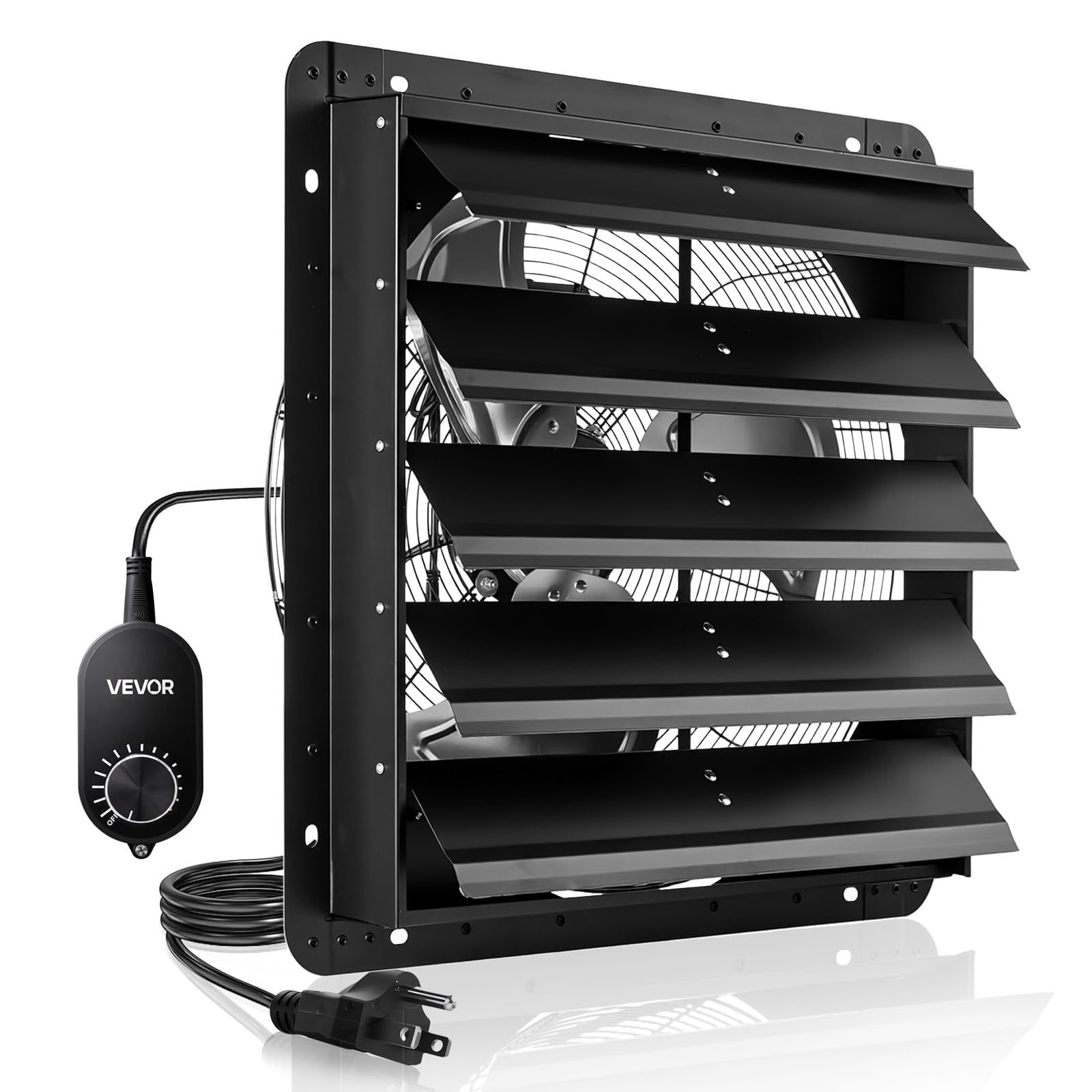
Twenty inches of steel that empties a large shop of hot air without a second thought.
Big rooms need big fans, and this one is rated at 3000 CFM (cubic feet per minute — how much air it moves each minute), driven by a motor spinning 1500 r/min and pulling 127W. what separates it is the stepless variable-speed controller included in the box — you turn a dial and go from a gentle breeze all the way to a full blast, matching the airflow to the moment. The housing is heavy-duty steel that resists deformation and handles damp and rain better than plastic. A built-in rain guard lets the shutters open when powered and seal shut when off. It ships with four M8.0x50 expansion bolts for mounting.
What owners value most is the overall quality of the unit, followed by how well it functions. One describes setting the whole thing up in a garage in 45 minutes. Another reports using it to keep a set of solar batteries cool, saying it has good airflow with no defects and every part included. The 20-inch size is the point — paired against the 16-inch VEVOR above, it is built to push air across a much wider span.
Be ready for the trade-offs. Noise is the most-discussed and most-divisive topic — some call it considerably quiet, others call it noisy, so it depends on your tolerance and where you mount it. The speed control draws complaints from a slice of buyers, and one notes the controller defaults to high on startup when they would prefer starting low. A few also mention the fit is slightly smaller than a true 10×10 opening on sibling models. None of that stops it from doing the job in a big space.
Why Big-Space Owners Like It
- 3000 CFM of airflow for garages and shops
- Stepless variable-speed dial from gentle breeze to full blast
- Heavy-duty steel housing and rain-guard shutters
- Mounting bolts included in the box
Where It Falls Short
- Noise is the most split opinion among owners
- Controller defaults to high on startup
- Oversized for anything smaller than a large room
Best for: owners of large garages, shops and greenhouses who want dial-in airflow control.
Skip if: your basement is small or noise next door is a dealbreaker.
6. iLIVING 14″ Wall Mounted Shutter Exhaust Fan with Temperature and Humidity Controls

A fourteen-inch fan with a brain — it watches temperature and humidity and adjusts itself.
For anyone who wants the fan to run the show, this is the cleverest controller in the lineup. It moves 1200 CFM — enough to exchange the air in spaces up to 1800 square feet — through 14-inch aluminum blades pitched at a deep angle to grab maximum air. The digital controller lets you set speeds and regulate temperature anywhere from 50 to 99°F, with up to 12 adjustable speeds and a 24-hour timer. It responds to both temperature and humidity changes on its own. An EC motor and OSHA-compliant wire guards round out the build, and it arrives fully assembled with a 5.6-ft plug-and-play cord.
One detail worth knowing: the controller can be extended with a Type A USB cable (not included) so you can mount it inside the house and still control the fan. That matters when the fan is in a basement or crawl space and you would rather not climb down to adjust anything. Performance is what owners praise most — several report the fan keeping their spaces noticeably cooler and moving lots of air. In a poorly insulated 1200-square-foot barndo, one buyer reports the fan held the interior near the thermostat’s set temperature most of the day.
The caution here is reliability, which draws more mixed reports than the other picks in this range. It also has one quirk: every time the power is interrupted, the controller drops its settings, so owners recommend putting it on a battery backup. If your area gets frequent outages, factor that in. Setup and day-to-day operation, meanwhile, are the easiest of the bunch.
The Controller Extension Trick: Run the USB control cable to a room you actually use, and you never have to duck into the basement to tweak the temperature or speed.
Small US company behind it, ETL-certified motor, and a plug-and-play cord that removes the electrician from the equation entirely.
Go for it if: you want fine temperature and humidity control with a controller you can relocate indoors.
Look past it if: your power flickers often and you do not plan to add a backup.
7. AC Infinity AIRTITAN T8, Crawlspace Basement Ventilator Exhaust Fan

Built from the ground up for the damp, cramped, forgotten spaces under your house.
This is the fan to buy if your problem space is a crawl space or a low-clearance basement. It is designed specifically for ventilation and moisture control in those exact spots. It moves 240 CFM while running at a low 32 dBA, and it is rated IP55 — a rating that means it is sealed against dust and protected from water spray. The backplate measures 18 x 9 x 1.6 inches, so it fits where a full wall fan simply will not. It offers dynamic temperature, humidity and VPD programming, plus timers, cycles, scheduling and a minimum speed setting. You can connect through WiFi or Bluetooth to program automation, see your climate data, and get alerts.
The build quality is what owners single out most, with functionality right behind it. An external temp probe means you are measuring the actual air, not the unit’s own heat. Reviewers point out the controllers and sensors work better than they expected, and that it is quiet even at high speed. The app handles the programming well, and one owner reports a noticeable drop in their electric bills. Another says it replaced an old timer fan that was “crazy loud,” and now they can log in any time to check or adjust the settings.
It is also not designed to be reversed on the fly; you have to unscrew the fans to change airflow direction, according to feedback. For crawl spaces and small basements, though, the low noise and always-on moisture control are hard to argue with.
Made for: crawl spaces and low-clearance basements where you need moisture pushed out silently.
Not the tool for: large open basements that a higher-CFM fan would clear faster.
8. AC Infinity AIRTITAN T7 Ventilation Exhaust Fan 12″ Temp Humidity Control

The twelve-inch twin-fan unit for owners who want to see their basement’s climate in a graph.
Where the T8 above is the compact crawl-space model, this twelve-inch version is the one to reach for when you want a bit more face area and the same smarts. It moves 240 CFM through a heavy-duty anodized aluminum frame and an IP-55-rated fan, so it resists liquids and dust. Like the T8, it handles dynamic temperature, humidity and VPD programming, with timers, cycles, scheduling and a minimum speed. You can remotely connect through the WiFi app to run advanced programs, view climate data, and set automation. It ships with a cord and a remote.
What owners rave about is performance — how quietly and effectively it moves air. One notes it cannot be heard from inside the room even at full tilt. In a musty sunroom with a raised floor, one buyer reports the digital humidity and fan-speed controls sit right in the room and the airflow is impressive for its size. In an HVAC closet during summer humidity, another reports the app logs humidity, temperature, VPD and fan level minute-by-minute with full history and remote viewing.
What you are paying for here is the controller and app, not raw power. The airflow is fine for a small space — a closet, garage, or shed — but owners note it is not built to clear a large basement, and it needs a good air return to work well. One points out the controller only runs temperature or humidity at a time, not both together. If you want sheer volume instead of monitoring, the KEN BROWN or VEVOR options above move far more air.
The Real Value: It is the data and automation you are buying — minute-by-minute logging, remote access, and set-and-forget programming that a bare switch could never match.
Pair It Right: It expands well — owners add a second fan to the same setup when one unit is not quite enough for their space.
Perfect if: you want app-based monitoring and don’t mind sacrificing raw airflow for control.
Wrong choice if: your space is large or you want one controller handling temperature and humidity together.
9. iLIVING 20″ Wall Mounted Shutter Exhaust Fan with Thermostat

Twenty inches of galvanized steel moving 3368 CFM across spaces up to 5000 square feet.
This is the biggest, most capable fan on the list, built for warehouses, large garages, and serious workshops. It moves 3368 CFM on 115V at 2.2A, spins at 980 RPM, and is rated to cover up to 5000 square feet. It pairs with the included Thermospeed controller, which handles variable speed and thermal regulation with a temperature range from 32 to 130°F. The frame is industrial-grade galvanized steel with aluminum shutters and blades, and it carries a UL listing with a permanently lubricated motor and OSHA-compliant wire guards. It has a rated noise level under 69 dB.
Owners praise how well it functions above everything else. One owner says it pulls a door closed in a 30x20x10 uninsulated metal garage. Another reports the temperature dial and speed control working exactly as needed. The aluminum gravity shutters are described as reliable, though a couple of owners note they are lightweight and can let a little rain in during high-wind gusts, and insects can slip through small gaps.
The most consistent gripe is rattle. A few shoppers say needing to add weight to the aluminum dampers or frame the unit with wood strips to quiet the vibration. Someone who added tire weights to the louvers found they opened more fully afterward. It also does not include mounting screws or washers, so have those ready. Frame it carefully to dampen noise and this fan is quiet in the attic and impressively effective for its size.
What Impresses Owners
- 3368 CFM covering up to 5000 square feet
- Thermospeed controller with 32-130°F range
- Galvanized steel frame, aluminum shutters, UL listed
- Rated under 69 dB with OSHA-compliant guards
Small Things To Handle
- Occasional rattle needs framing or a weight to calm
- Lightweight dampers can let gusting rain past
- Mounting screws and washers not included
The pick for: warehouse, factory and large-workshop ventilation where maximum airflow and coverage win.
Overkill if: your space is a standard residential basement — its coverage dwarfs the job.
Understanding the Specs
CFM (Airflow Capacity)
CFM stands for cubic feet per minute — literally how much air the fan pushes every minute. Higher numbers empty a space faster. A 240 CFM unit suits a crawl space; step up through the 600s and 1200s for mid-size rooms, and the 3000s only if you are ventilating a large garage or shop. Match the number to your actual cubic footage, not to the fan’s physical size, since a small fan with a high rating can beat a bigger, weaker one.
Noise Level (dB / dBA)
Noise is measured in decibels — bigger numbers mean louder sound. A fan rated around 32 dBA vanishes into the background, while anything closing in on 69 dB is clearly audible the moment you walk in. If your basement sits under a bedroom, prioritize a low-dB model. Keep in mind that rattle from a loose frame can add noise even on a quiet fan, so mounting it firmly matters as much as the rating.
Thermostat & Humidity Probes
A thermostat or humidity probe is a sensor that switches the fan on by itself once the air hits your set point. That means the fan handles a damp afternoon while you are at work, instead of you remembering to flip a switch. Some units program temperature only or humidity only at a time; a few handle both together. If your basement problem is seasonal, a probe is the difference between spot-checking and automatic.
IP Rating & Shutter Sealing
An IP rating tells you how well the fan resists dust and water — IP55 means it is sealed against dust and protected from water spray, which is worth having below grade. Automatic shutters add another layer: the louvers open when the fan runs and drop closed when it stops, blocking cold drafts, rain, and insects from the wall opening. Together they are what keep a below-grade vent from letting the weather back in.
FAQ
How many CFM do I need for my basement?
Will a basement exhaust fan get rid of musty smells?
Do these shutters keep rain out when the fan is off?
Can I plug a basement exhaust fan into a normal wall outlet?
Is a thermostat or humidity control worth having?
What is the difference between the AC Infinity AIRTITAN T8 and T7?
How loud will a basement exhaust fan be?
Can I mount these fans in a window instead of the wall?
Do basement exhaust fans remove moisture as well as heat?
What size basement exhaust fan fits a standard wall opening?
Final Thoughts: The Verdict
For most basements, the winner here is the HG Power 10 Inch Shutter Exhaust Fan because it balances 647 CFM of airflow with a genuinely quiet, all-metal build and an install you do entirely from inside. Its build quality is the trait owners praise most, and the louver seals shut to keep rain and dust out. If your space is a crawl space or a low-clearance basement where silence matters, grab the AC Infinity AIRTITAN T8 for its 32 dBA operation and IP55 rating. And if you are ventilating a large garage, shop or greenhouse, the iLIVING 20″ Wall Mounted Shutter Exhaust Fan is the one to reach for with 3368 CFM across up to 5000 square feet. One honest nudge: whenever you finally pull the trigger, double-check your cubic-foot math and your wall opening against the specs above — the right number, not the biggest fan, is what keeps a basement dry.
How We Picked
We do not accept paid placement. Every pick is matched to a real buyer and a real use-case; we do not hands-on test units.
Sources & Methodology
Specifications: manufacturer listings and product documentation. Review insights: verified customer reviews, as of September 2026. Pricing: not shown on this page (it changes often); check the current price via the retailer link.
As an Amazon Associate, Gadgets Feed earns from qualifying purchases. This does not affect which products we feature.