
Our readers keep the lights on and my morning glass full of iced black tea. As an Amazon Associate, I earn from qualifying purchases.
Specs are compiled from manufacturer listings and verified buyer reviews and can change over time — please confirm the key details on the product page before buying.
If your lawn drinks water and stays dry anyway, the fix is usually a roller full of weight — and the right one depends on if you want plug holes or spike holes. This guide covers nine lawn aerator rollers built for real yards: manual push models you fill with rocks, and tow-behind units that hook to a riding mower. The big decisions are spike versus plug, drum capacity, and whether the soil is soft enough to let the tines in.
I’m Min — the founder and writer behind Gadgets Feed. This guide is built by comparing the manufacturers’ published specifications and the patterns across verified customer reviews, so you get each pick’s real strengths and trade-offs instead of marketing spin.
You will see which rollers pull deep cores on clay, which free you from bending over, and where each design struggles, all in one place. Whether you are fighting compacted clay or overseeding a fresh patch, this breakdown shows what each drum’s weight capacity and tine type can do for your soil.
Our Picks at a Glance


How To Choose The Best Lawn Aeration Roller
The roller you buy should match your soil type and the size of your yard. A compacted clay lawn needs a heavy drum and sharp tines, while a small garden patch works fine with a lighter push model you control by hand.
Spike versus plug: what you actually want from your lawn
Spike aerators push narrow holes into the turf. They are fast and cheap, but a spike can slightly compact the soil around the hole as it enters. Plug rollers pull small cores of soil up and out, which opens the ground without pressing it tighter. Many owners use spikes as a quick monthly touch-up and save plugging for the start of the growing season.
Drum capacity decides your depth
Depth is not a function of tine length alone — it is the total weight sitting on those tines. A drum you fill with stone, sand, or water lets you dial in pressure. Owners of one plug model used 120 lbs to bite into hard clay. Most entry-level spike rollers have small drums that top out well under that figure, so read the weight tray figure carefully before ordering.
Tow behind or push it yourself
If you own a riding mower or lawn tractor, a tow-behind saves your back and covers a lot of ground quickly. Push models suit smaller yards and give precise control, but they demand real effort — manual aerators are genuinely a workout, and a few owners note the friction adds up over a large lawn. Match the machine to your mower’s hitch and the physical effort you are willing to take on.
Quick Comparison
| Model | Best For | Aeration Type | Tow or Push | Working Width | Amazon |
|---|---|---|---|---|---|
| Brinly Tow Behind Plug Aerator, 40″★ Best Overall | Deep core aeration on tough lawns | Plug | Tow behind | 40″ | Amazon |
| Seeutek 23Inch Rolling Lawn AeratorBest Value | Manual touch-ups with water or sand | Spike | Push | 23″ | Amazon |
| Walensee Rolling Lawn AeratorMost Forgiving | Lightweight spike rolling on moist soil | Spike | Push | — | Amazon |
| Suchtale 18-Inch Push Spike Aerator | Replacing spiked shoes around the yard | Spike | Push | 18″ | Amazon |
| BlumeTrec 40-Inch Tow Behind Spike Aerator, 10 Tines | Wide swaths behind an ATV or tractor | Spike | Tow behind | 40″ | Amazon |
| Suchtale 40-Inch Tow Behind Spike Aerator | Hitching a 40″ drum to a lawn tractor | Spike | Tow behind | 40″ | Amazon |
| Brinly SAT2-40BH-P Spike Aerator, 40″ | Monthly aeration with 3-D tine strength | Spike | Tow behind | 40″ | Amazon |
| Seeutek 40Inch Tow Behind Spike Aerator | Maximum added ballast on a rolling drum | Spike | Tow behind | 40″ | Amazon |
| Craftsman 40 Inch Tow Behind Lawn Plug Aerator | Deep coring plus vertical storage | Plug | Tow behind | 40″ | Amazon |
In‑Depth Reviews
1. Brinly Tow Behind Plug Aerator with Universal Hitch, 40″ – Flat Black
Our pick — over 4★ from 950+ verified ratings; the strongest balance of quality and price.
The core-pulling heavy hitter that lifts soil plugs instead of just poking holes
You want the deepest holes and the least turf damage, which is exactly what a plug roller is for. This Brinly uses 24 heat-treated, 16-gauge steel spoons to pull soil cores up to 3 inches deep and drop them behind the drum, so water, seed, and fertilizer reach the root zone instead of running off. Its design runs narrower with sharpened ends, so the spoons enter compacted ground without needing to be overloaded with extra weight.
Out back, a fully enclosed weight tray swallows up to 150 pounds, and the long towing unit throws 63.9 pounds onto the hitch — you will want a lawn tractor, not a hand push. That 63.9 lb hitch weight is what drives the spoons into hard ground, unlike the 11.82 lb Walensee push roller. Three independently rotating welded tine sections keep the drums turning through corners, and a single transport lever lifts everything onto the 10-inch tires so you can cross the driveway without tearing turf.
Owners speak warmly of the build and the plug distribution, but the honest catch is assembly. Amazon’s own read puts assembly as the most-discussed topic, and it skews mixed — some find it quick while others battle mislabeled bolts and incomplete directions for a couple of hours. The tines are sharp enough to cut bare hands, so this is a gloved job. Buy it if you have a riding mower and clay; skip it if a two-hour assembly is a deal-breaker.
Where this roller wins
- Pulls 3-inch soil cores for deep root feeding
- 150 lb weight tray plus 63.9 lb heft for hard ground
- Narrow sharpened spoons penetrate without excess weight
- Single transport lever handles driveway crossings
What to expect putting it together
- Assembly runs to a couple of hours and directions have gaps
- Tow weight demands a tractor, not a walking push
- Sharp tines need gloves during the build and use
Best for: Anyone with a riding mower and a compacted lawn who wants real soil cores pulled, not just holes poked.
pass on it if: You want something you can pick up and push by hand — this is a towed tool that wants a tractor behind it.
2. Seeutek 23Inch Rolling Lawn Aerator – Upgraded Heavy Duty Aerators
A hand-pushed star-spike roller you load with water to dial in how deep it bites
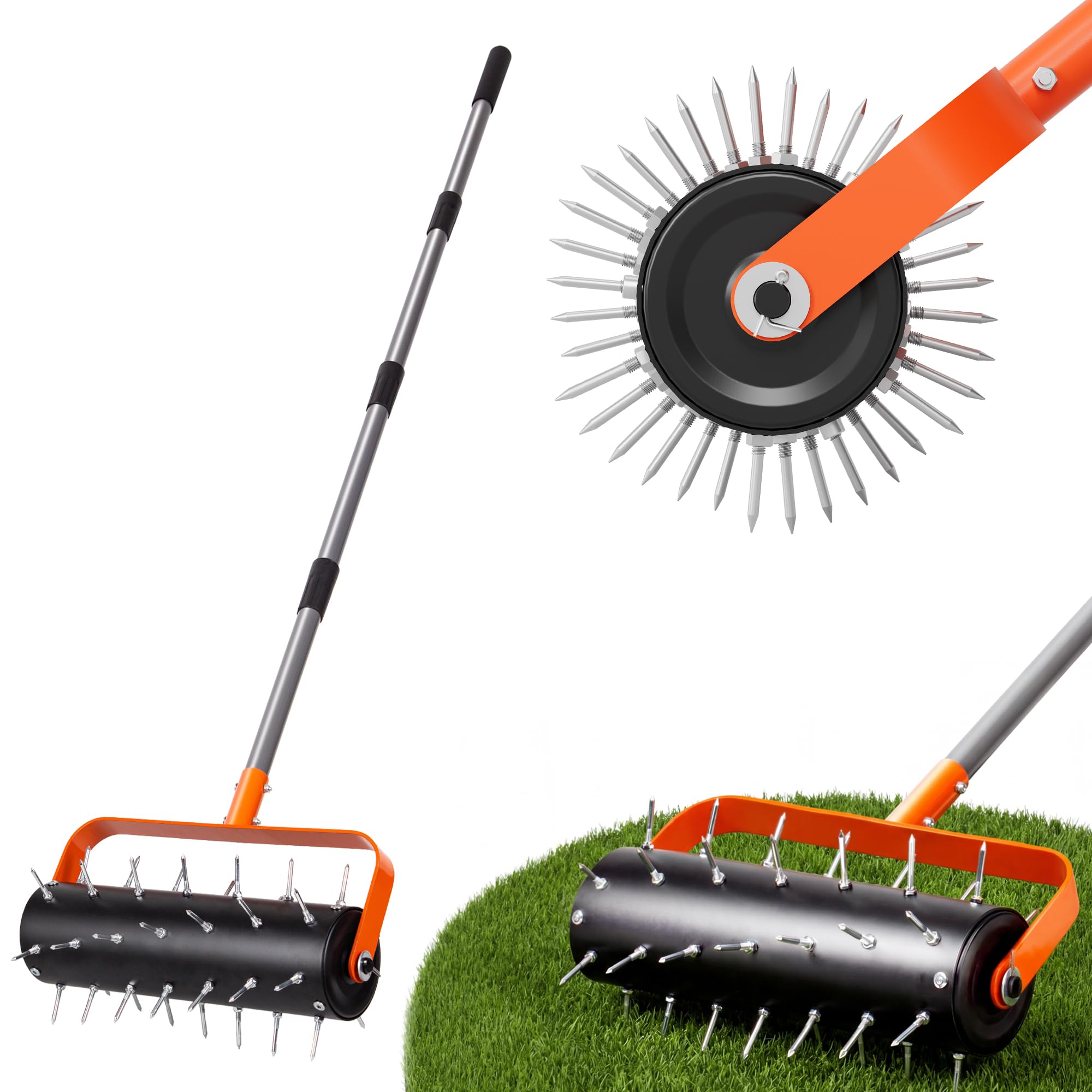
Load the drum and roll — that is the whole idea here, and the 23-inch working width keeps it manageable for a normal suburban yard. The 2-inch star-shaped spikes are laser-welded to a tripod structure, and a side port takes water or sand to add weight and push the spikes deeper. You get three height settings on the padded T-bar, so you are not forced into a back-breaking stoop while you work.
Here is where the physics matters: fill it to 60 lbs and buyers report dragging it through wet, tall grass becomes a real slog. Drop it to around 30 lbs and it rolls far more freely while still biting in. That same report recommends you run this between your annual rental aeration jobs rather than instead of them. It is a maintenance tool, not a replacement for a pro plugging.
Cut the power off the drum and it becomes a lightweight machine at 24 pounds, which keeps storage and one-hand setup simple. The trade-off is that you are the engine — this is described plainly as intense manual work, and it likes a freshly mowed lawn underfoot. If you want a low-cost spike roller for spring touch-ups without a mower hitch, this is the one to reach for.
Who it suits: Small-to-mid yards where the owner is happy to trade sweat for a lower upfront cost and can skip the pro service between pluggings.
The real limit: Water filling is a fiddly chore compared to just dropping bricks on a tray, and wet tall grass makes the loaded drum genuinely heavy to drag.
Reach for this if: You want a low-cost spike roller you can weight precisely with water for light spring touch-ups.
Look elsewhere if: You own a riding mower — a towed model will save your shoulders the punishment.
3. Walensee Rolling Lawn Aerator, Heavy Duty Manual Aerator with 42 Spikes
The featherweight spike roller that glides over turf wheelbarrow-light
At 11.82 pounds empty, this frame is the opposite end of the spectrum from that heavy plug tow-behind — the whole point of the Walensee is that you fill the drum yourself rather than buying weight upfront, then roll it flat with barely any drag. The 42 reinforced 2-inch heat-treated tines sit in a spiral pattern that traces a perfect circle from the side, which cuts the vertical bouncing you get from straight-set spikes. Where the Brinly plug spoons want a tractor, this one is happy to be nudged by hand across grass.
Function and ease of use are what win people over — this is the spike roller you bring out for small yards, and reviewers report it handling a third of an acre with ease. The drum takes stone to add depth. No power, no trailer hitch, and it stores in a narrow corner of the shed.
Two honest notes. First, this must be filled with stone, not sand — dry sand pours and settles and will not give you the mass you need, and reviewers who ignored that were disappointed. Second, the end caps can develop a small gap that lets the fill escape; a little silicone caulk solved it for the buyers who found it. Otherwise this remains the most forgiving spike roller on the list.
what separates it: Non-slip rubber grip on an adjustable four-section handle, with all spikes pre-installed, so you are rolling almost immediately.
The catch: Because it is so light empty, it depends entirely on how much stone you pour in — pack it heavy for clay, and treat dry sand as a waste of effort.
Fits best: Gardeners who want a genuinely light spike roller for small lawns where a powerful tug is not required.
Not ideal if: You expect to punch through deeply compacted clay on a single pass — fill it with stone and work it after rain.
4. Suchtale 18-Inch Push Spike Aerator, Heavy Duty Rolling Lawn Aerator with Steel Handle

Five steel stars that spin independently — if you are willing to sweat for it
Five steel star wheels, each 8 inches across and studded with 10 uneven spike tips, sit at the front of this roller. They spin on their own axles so they keep turning through a corner, and they are built to punch up to 2 inches into compacted ground. A high-weight tray across the top takes a 16-inch brick, and the whole thing rolls on bearing-supported wheels with nylon spacers between the stars so it holds up over repeated pulls.
This is where honesty matters more than enthusiasm. Owners widely report that pushing this machine is hard work — you are looking at two to three times the effort of walking a mower across the same grass. One owner even compared it to pushing a full barrow up a hill. Add a cinder block and it bites deeper, but the handle then grows heavy fast; several note the physical toll is real, especially for anyone with back trouble. Pulling instead of pushing is easier, but the spikes do not dig as well that way.
Set expectations accordingly: this is a small-lawn, willing-to-grind pick. On a quarter acre or less, it is a bargain. On a wide lawn, you will wish you owned a towed model. The 3.8 overall star impression reflects that split — happy on small plots, frustrated on big ones.
What makes it work: Five independently rotating 18-inch-wide star tines with a weight tray for a brick, so you can tune the bite on small lawns without an axle hitch.
The trade-off: It is a workout on wheels — owners consistently describe pushing it as much harder than mowing, and the short handle can put strain on your lower back.
Buy it for: Compact suburban plots and garden beds where a hand-pushed roller is enough and a towed unit would be overkill.
Pass on it for: Large open lawns or anyone with a weak back — the physical effort is the defining cost of this design.
5. BlumeTrec 40-Inch Tow Behind Spike Aerator, 10 Galvanized Steel Tines
A wide towed drum that eats big lawns in fewer laps behind an ATV
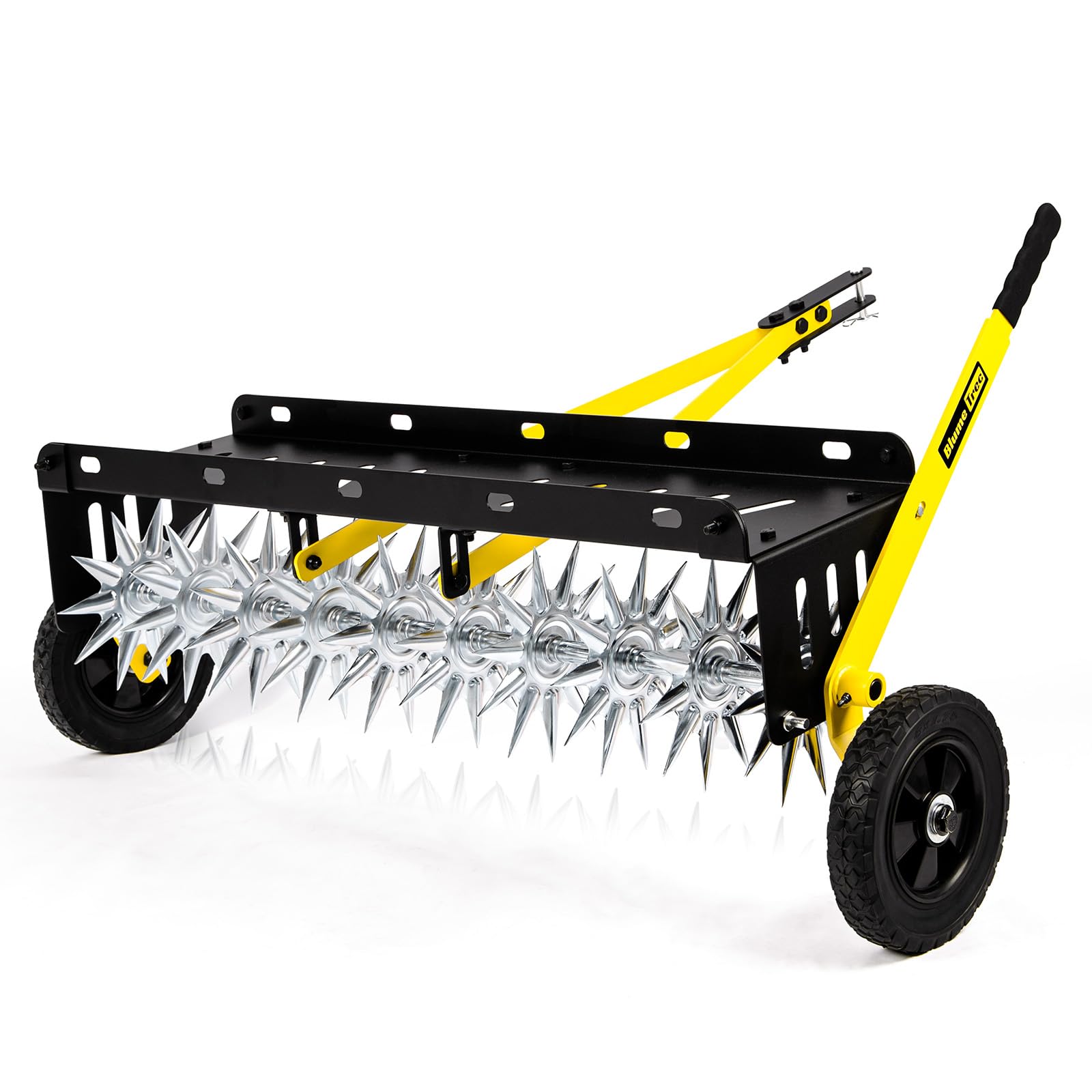
Ten galvanized 3D tines ride a 40-inch tow bar, each carrying 11 irregular tips that rotate independently to push up to 2 inches into the soil. That rotating layout keeps the tines turning through turns so you miss fewer patches, and the wide channel-shaped bar does not sag under load. A steel frame with reinforced side plates and a solid steel axle stands up to regular pulling, and a powder-coat finish resists rust.
The 110 lb weight tray is where this design earns its keep. Load it with cement blocks and the tines dig noticeably deeper than an unweighted drum, which is the difference between scratching the surface and actually reaching the root zone. The dual-mode lever also swaps between a working position and a raised transport position so you can cross a driveway without dragging spikes.
Owners mention a fairly quick setup for a towed unit — one notes an hour with proper tools — and the pin-style hitch attaches to ATVs and riding mowers without extra hardware. The recurring note is the wheels. Load two cinder blocks and the wheel assembly feels a touch flimsy under that weight, so if you plan a lot of lap miles across a bumpy field, keep the pressure reasonable. At 19.26 kg it is towable by almost any riding mower.
Where it excels: Wide 40-inch coverage with a weight tray that takes 110 lb, so you can tune depth from a light spring pass to a heavy autumn bit.
Worth watching: The wheels cop a flimsy tag once bricks go on the tray, so moderate your ballast if your ground is uneven.
Right for: Larger properties where you tow behind an ATV or riding mower and want to cover more ground per pass.
Think twice if: Your ground is rough and rocky — the lighter wheel assembly is the soft spot under heavy ballast.
6. Suchtale 40-Inch Tow Behind Spike Aerator with Galvanized Steel Tines

The towed spike roller with the reinforced axle and the thicker adjustment handle
Ten steel star tines, each 8 inches across and carrying 10 uneven tips, spin independently to push up to 2 inches into compacted ground while continuing to revolve through a turn. That continuous rotation means fewer missed strips and fewer passes. The all-steel frame gets reinforced side plates and a solid steel axle for strength, and the powder-coat finish fights rust through wet seasons.
One detail separates this unit from its lighter cousins: the adjustment handle is 6 mm thick rather than the 4 mm common to the design, and that thicker bar resists bending under pressure. The 110 lb weight tray takes cement blocks or other heavy items to increase penetration on stubborn soil, and a pin-style hitch attaches to ATVs or riding mowers with no extra gear.
Owners tend to like the towing manners and the way the spikes work without flinging plugs across the lawn, but durability is the honest theme. The steel can bend under heavy pressure, and a handful of customers note wheel wobble. Most buyers who keep the setup sensible and reverse carefully are content, and the maker stands behind it with a satisfaction guarantee.
Why it earns a spot: The 6 mm adjustment handle and reinforced axle put it a step above the flimsiest towed spikes, and the 110 lb tray lets you dial in penetration.
Fair warning: Some reviewers point out metal that bends under hard use and the occasional wheel rub, so run it as intended rather than pushing it to its limit.
Pick this if: You want a 40-inch towed spike roller with a sturdier build than the bargain units and clear instructions for a fast hitch-up.
Consider another if: You plan to abuse it on rocky ground — treat it as a home-use tool, not a commercial one.
7. Brinly SAT2-40BH-P Tow Behind Spike Aerator with Transport Wheels, 40″ – Hammered Black

Patent-pending 3-D tines built to resist the bend that kills cheap spike rollers
Eleven tine stars, each 8 inches across with 12 spike tips, ride this 40-inch roller and push up to 2 inches into the soil. The headline is the tine construction: Brinly’s patent-pending 3-D tines are pressed from galvanized steel so they resist both rust and the bending that shortens the life of thinner spikes. A 5/8-inch solid steel axle and nylon spacers between each star add to the durability, and the double tow bar refuses to flex as you pull.
Up top, a rigid weight tray holds up to 150 pounds of extra ballast for deeper penetration, and a single lever drops the turf-tread transport wheels so you can roll across a driveway without gouging it. Buyers use it monthly for seeding and fertilizing, and they report that regular passes improve how well the lawn holds water. Owners running monthly passes report the lawn holds water better within a season.
Assembly is where the reviews split — some sail through it, others wrestle confusing instructions for a couple of hours, and a few add extra spacers to settle tine wobble. Tines are sharp enough to demand gloves, and a reported wheel weakness under hard use is worth knowing before you load the tray. Overall it is a sturdy, well-priced towed spike roller for the money-conscious lawn owner who wants the best tines in the bracket.
The case for these tines
- 3-D galvanized tines resist bending and rust better than standard spikes
- 150 lb tray for deep penetration on tough ground
- Single-lever transport wheels make driveway crossings simple
Honest notes
- Assembly is mixed — some find it easy, others muddy through confusing diagrams
- Wheel durability comes up as a soft point under hard use
- Follow the instructions and wear gloves; the tines are genuinely sharp
Ideal for: Lawn owners who want a towed spike aerator with tine construction tough enough to shrug off compacted ground and repeated seasonal passes.
Only if: You are comfortable spending an hour or two assembling it carefully with the right tools at hand.
8. Seeutek 40Inch Tow Behind Spike Aerator – Heavy Duty Rolling Lawn Aerators
The ballast champion — a 330 lb tray for anyone chasing maximum tine depth
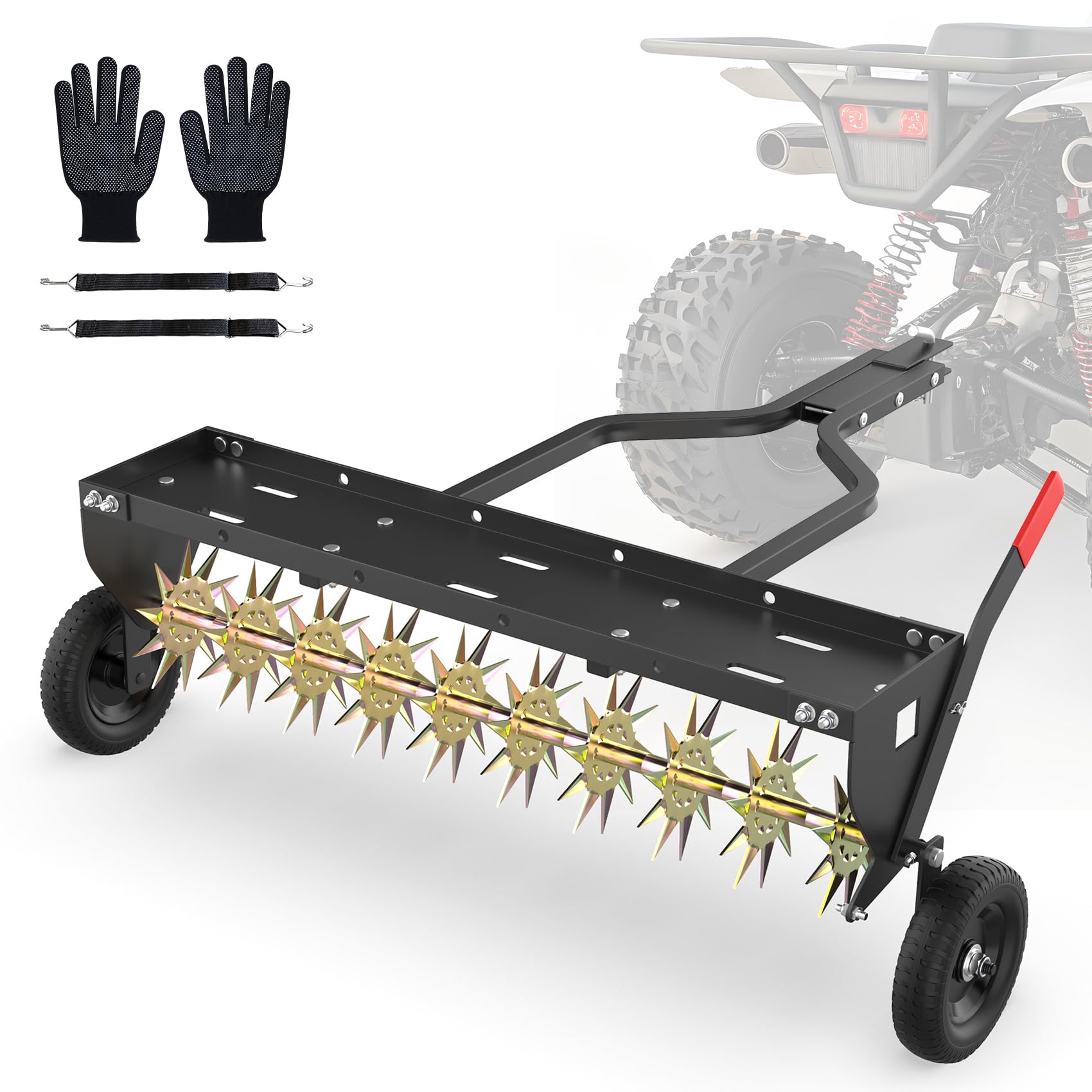
Ten 8-inch 3D star tines, each with 10 sharp irregular tips, sit on this 40-inch towed drum and rotate independently to push up to 2 inches into the soil. The reinforced heavy-duty tray is the differentiator: it accepts up to 330 pounds of cement blocks or weights, so you can add far more downward pressure here than on most rivals when the ground fights back. Thickened galvanized steel gives the tines 2× strength, and a reinforced square-tube rear bracket resists bending.
Set-up is refreshingly short for a towed unit — just the handle and two wheels go on, and the four-wheel base rolls smoothly across driveways and sidewalks. The hook design adapts to different tractor heights so it hitches to most riding mowers or ATVs without hassle, and two cement-brick straps plus a pair of gloves come in the box to keep the load steady and your hands safe.
With only a modest pool of reviews, the early picture is positive — functionality and quality lead the feedback and owners describe it as working well and building solidly. One note is that the wheel base is the light spot: a single owner reports one side wobbling with no easy fix. Owners suggest tightening bolts after step five during assembly rather than saving it for the end, which locks the frame up square before you run it.
The standout spec: A 330 lb weight tray — the biggest ballast rating in this lineup — paired with 10-inch-diameter star tines for aggressive depth on stubborn turf.
The catch: Wheel stability comes up as its soft point, and reviewers recommend snugging all bolts mid-build rather than at the finish.
Choose this if: You want to load serious ballast and cover a large lawn behind a riding mower without stopping to re-fill a lighter drum.
Skip the extra weight if: Your wheels are your priority — the base is the part to watch on uneven ground.
9. Craftsman 40 Inch Tow Behind Lawn Plug Aerator with 24 Galvanized Steel Coring Points

Craftsman’s coring drum digs the deepest holes of anything on this list
If you want plugs, not just holes, this is the pick. Twenty-four galvanized steel coring points pull soil cores up to 3 inches deep, opening the ground so air, water, and nutrients reach the root zone — the same soil-opening job the other plug aerator handles, but here built to store against a wall between uses. A wide tray holds up to 140 pounds of ballast to drive the points deeper in tough soil, and flat-free tires carry it across lawn terrain as it hitches to most lawn and garden tractors.
That 140 lb tray is a touch lighter than the 150 lb figure on the Brinly plug roller, so if you really need maximum weight you may want to add a little more on top — but the deeper 3-inch coring depth here matches that same reach. Owners praise the build quality and the opening action. The reversible handle lets the unit tip up on end for tight storage, which is a real help if your shed is crowded.
Honestly, expect an afternoon on the floor. Owners frequently describe assembly as tedious, with several hours of careful work and the odd unclear diagram, though once it is together, the results land firmly on the good side of the scale. It is backed by a three-year limited warranty and made with global materials in Sullivan, Illinois by Agri-Fab.
What you pay for: Deep 3-inch coring with a vertical-storage frame and a heavy-duty build — a serious plug tool for a serious lawn.
Patience required: Assembly is the most-discussed topic, and it skews toward “grab a proper wrench set and set aside an afternoon.”
Suited to: Homeowners with a tractor hitch and a genuine need for deep core aeration who value a brand name and a vertical-storage frame.
Not suited to: Anyone who wants to unbox and roll within the hour — the build eats into your weekend.
Understanding the Specs
Spike vs plug tines
A spike roller punches narrow cones into the soil. It is fast, it runs on any turf, and it leaves no cores to rake up. A plug roller takes hollow tines that pull actual soil cores, so it opens the ground without pressing the surrounding soil tighter — a real difference on clay. Most lawns benefit from plugging once or twice a season and spikes in between, which is why knowing your soil type first points you to the right roller.
Weight capacity and depth
Depth comes from pressure, so the weight tray figure is the spec that decides how deep your tines reach. Heavy units can run up to 330 lb on the tray; lighter ones ask you to fill the drum with stone. For hard or dry ground, watering beforehand softens the surface and helps the tines bite; on compacted clay, a heavier drum with more ballast is the difference between a scratched surface and a real opening.
Working width and coverage
Working width is measured across the drum. Narrow push models suit small plots where you can walk the whole lawn quickly; wide 40-inch towed units cover more ground per pass and cut the number of laps on large properties. Match the width to your mower’s path and yard size so you are not re-walking the same strip.
Tine material and durability
Heat-treated and galvanized steel resists the bending that kills cheaper spikes. Some designs use independently rotating star tines that keep turning through corners and miss fewer patches, while others use fixed sections that stay put. Check whether the axle is solid steel and whether spacers sit between tines, since those details tell you how long the roller will last.
FAQ
Do I need a plug aerator or a spike aerator for my lawn?
How much weight should I add to my lawn aeration roller?
Should I water the lawn before aerating?
Can I fill a lawn aerator roller with sand instead of stone?
Will a lawn aerator roller work on clay soil?
How do I stop a tow-behind aerator from damaging the lawn on turns?
Is a manual push aerator or a tow-behind aerator easier to use?
How long should I wait between aerating passes with my roller?
Do these lawn aerators come assembled?
Final Thoughts: The Verdict
The strongest overall pick is the Brinly Tow Behind Plug Aerator because it pulls 3-inch soil cores and its 150 lb tray plus 63.9 lb weight drive the tines on hard ground — it holds 4.4 stars across 900+ ratings, and its three independently rotating tine sections resist turf damage on turns. If deep coring and vertical storage matter most, the Craftsman Plug Aerator is the one to grab, matching that 3-inch reach with a fold-away frame. And for wide spike coverage behind an ATV, the Seeutek 40Inch Tow Behind Spike Aerator leads on ballast with its 330 lb tray. Whatever your soil, water the lawn well before you roll — that step does more for penetration than any spec on the page.
How We Picked
We do not accept paid placement. Every pick is matched to a real buyer and a real use-case; we do not hands-on test units.
Sources & Methodology
Specifications: manufacturer listings and product documentation. Review insights: verified customer reviews, as of September 2026. Pricing: not shown on this page (it changes often); check the current price via the retailer link.
As an Amazon Associate, Gadgets Feed earns from qualifying purchases. This does not affect which products we feature.