
Our readers keep the lights on and my morning glass full of iced black tea. As an Amazon Associate, I earn from qualifying purchases.
Specs are compiled from manufacturer listings and verified buyer reviews and can change over time — please confirm the key details on the product page before buying.
If you came here hunting one exact bar, read this first: not every pick on this list is a literal 1-1/2 inch leg. Some are the nearest same-type size that does the same job, and every one of them is called out honestly so you know exactly what shows up at your door.
I’m Min — the founder and writer behind Gadgets Feed. This guide is built by comparing the manufacturers’ published specifications and the patterns across verified customer reviews, so you get each pick’s real strengths and trade-offs instead of marketing spin.
The four bars here split cleanly along two lines: how thick the wall is and how well the steel shrugs off rust. Pick wrong and you either pay 316 prices for an indoor bench or watch a plain steel bar rust through its first winter outdoors. Below is the honest breakdown of the best 1 1/2 Angle Iron for welding, framing, and marine work.
Our Picks at a Glance

How To Choose The Best 1 1/2 Angle Iron
Angle iron is a length of steel bent into an L shape, and the leg length is the measurement of each side of that L. When someone shops for 1-1/2 inch angle iron, they want a bar where each leg measures 1.5 inches across. That size is the everyday workhorse: stiff enough for brackets and frames, small enough to cut on a bench saw and drill with a hand drill.
Start With The Job, Not The Spec Sheet
Start with what the bar has to survive. An indoor welding table frame never sees salt; a bracket bolted to a dock piling sees it every tide. Indoor fabrication only needs strength and clean weldability, so plain hot-rolled steel does the job and costs the least. Anything near water, fertilizer, or food equipment needs a stainless grade instead, because plain steel will rust once its surface protection wears through.
Next, decide how much the bar can bend under load. That depends on wall thickness — how thick the steel itself is. A thicker wall resists flexing far better than a thin one at the same leg length, so heavy structural work almost always calls for the chunky stuff.
Wall Thickness, Grade, And Cut Length
Wall thickness is usually written in fractions of an inch. A 1/8 inch wall suits light brackets and trim, while a 0.25 inch wall is what you reach for when the bar has to hold something up without sagging. If the listing omits wall thickness, assume 1/8 inch or thinner and size your load accordingly.
Steel grade tells you what the metal is made of. ASTM A36 is a common structural carbon steel that welds easily and holds paint well. The 304 and 316 designations are stainless alloys, and the higher number resists corrosion in harsher places — marine air, chemical splash, food processing. Finally, check cut length: a 12 inch bar makes one backer plate, a 48 inch bar makes four brackets.
Quick Comparison
| Model | Best For | Leg Size | Wall Thickness | Length | Amazon |
|---|---|---|---|---|---|
| National Hardware Solid Angle Iron★ Best Overall | General welding and repair | 1-1/2 in | — | 48 in | Amazon |
| 304 Stainless Steel Angle (OnlineMetals) | Above-water boat and food gear | 1-1/2 in | 1/8 in | 12 in | Amazon |
| Hot Rolled Steel ASTM A36 Angle (MSP Metals) | Heavy structural brackets | 1.5 in | 0.25 in | 36 in | Amazon |
| 316 Stainless Steel Angle (OnlineMetals) | Marine and corrosive environments | 1-1/2 in | 0.1875 in | 12 in | Amazon |
In‑Depth Reviews
1. National Hardware Solid Angle Iron, 1-1/2 in x 48 in, Steel, Plain Steel
Our pick — over 4.5★ from 550+ verified ratings; the strongest balance of quality and price.
The long plain-steel bar that welders keep reaching for, because nothing fights the arc.
For anyone building a workbench, a support frame, or a repair bracket, this is the bar that covers the most ground. It measures 1-1/2 inches by 48 inches, and at 4.8 pounds it is the heaviest piece here — noticeably heftier than the 1.2-pound 304 stainless bar in this same list. That weight is strength you can feel before you even fire up the welder.
The steel is hot-rolled plain steel made to ASTM A36 specifications, an industry standard for structural carbon steel. Plain means it arrives untreated, with no oil coating to burn off or fight while you weld. That is the whole appeal: the bar takes a bead cleanly, bends and forms with ordinary tools, and holds paint when you are done. Buyers report exactly this experience — one owner putting it to work said, “Needed some angle iron to reinforce weight mount on my tractor. Found this as a warehouse deal at a great price. Great untreated steel for welding.”
The catch is rust. Plain steel has no corrosion protection built in, and the finish on arrival is rough — a few owners have found the bar dusty with black residue that a hardware store version would have been cleaned of already. Outdoors, you must prime and paint it yourself or accept that it will oxidize. The other thing to know is that the listing claims 1-1/2 inch by 1 inch dimensions in places, so measure what you receive before you cut. For a bar this long and this weldable, most builders will call it a fair trade.
What Earns The Top Spot
- 48 inches of bar — the longest here, and the 304 stainless option is only 12 inches.
- Untreated plain steel welds, bends, and takes paint with zero prep hassle.
- 4.8 pounds of ASTM A36 stock that stays put under load.
Before You Order
- No corrosion protection — outdoor jobs need primer and paint.
- Arrives with a rough, dusty mill finish that you clean yourself.
- Rated for industrial use, not a finished-look trim piece.
Reach for this if: you are welding an indoor frame, bench, or tractor bracket and want a long, clean-burning bar.
Look elsewhere if: the bar has to face weather or salt water uncoated — the stainless picks below handle that.
2. 304 Stainless Steel Angle, Unpolished (Mill) Finish, Annealed, ASTM A276, Equal Leg Length, Rounded Corners, 1-1/2″ Leg Lengths, 1/8″ Wall Thickness, 12″ Length, OnlineMetals

Short, light, and rust-shrugging — the bar for backers, trim, and anything near water.
Here is the one to buy when the job involves water. It is 304 stainless steel, the most common stainless alloy, which gives it high strength plus good corrosion resistance without the premium 316 carries. That makes it the sensible middle choice for boat hardware, food and beverage equipment, architectural trim, and anything that lives where splash happens.
Measure it carefully before you plan a build, because this bar is 12 inches long — a third the length of the 36 inch A36 option above. The trade-off for that shortness is weight: at just 1.2 pounds it is easy to hold in one hand while you position a backer plate. The wall runs 1/8 inch thick, which suits mounting, bracing, and trim much better than heavy load-bearing structure.
Owners mention using these for exactly that kind of repair. One boat owner dealing with a leak wrote: “Perfect for above water line boat projects. Needed a backer place for my captains call that was only bolted into the fiberglass…and resulted in leaks. Replacing the sealant I wanted a backer plate that this angle stock was perfect for.” The one recurring gripe is cosmetic — the unpolished mill finish (the raw surface straight from the mill, with no smoothing) arrives rough, and dressing it up takes a pass with a bead blaster (a machine that fires tiny glass beads to smooth metal).
Where It Wins: this is the shortest and lightest bar in the lineup, and the only 304-grade pick — so it hits a niche the longer plain-steel bar simply cannot fill.
The Honest Trade-Off: 12 inches does not go far, so measure your project before assuming one piece is enough.
Buy it for: backer plates, small boat fittings, or trim that gets wet and must not stain.
Skip it for: full-length frames or anything structural — you need the longer bars for that.
3. Hot Rolled Steel ASTM A36 Angle 1.5″ x 1.5″ x 0.25″ Wall Thickness, 36″ Cut Length, Equal Legs, Mild Carbon for Structural Supports, Frames, Braces, and Fabrication
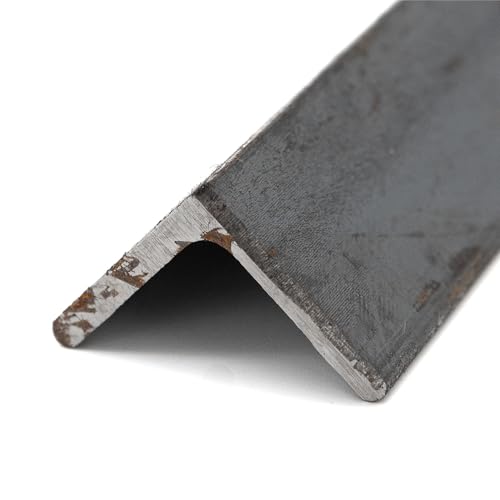
A quarter-inch wall of A36 carbon steel, built to carry weight without asking questions.
If your project needs the bar to hold something up, this is the stiffest option on the page. The wall measures 0.25 inches thick — roughly double the 1/8 inch wall on the 304 stainless bar, and about a third thicker than the 0.1875 inch wall on the 316 stainless at the bottom of this list. More steel in the wall means less flex when you load it, which is precisely what structural brackets, frames, and braces demand.
The material is hot-rolled ASTM A36 carbon steel with equal legs, meaning both sides of the L are the same 1.5 inch length. That symmetry keeps your corners true and your cuts simple, whether you are building a table base or a set of braces. The low carbon content gives it excellent welding characteristics, so it joins cleanly with common methods and does not fight you at the torch.
Word from buyers backs up the heft. The most common praise is that it feels solid and welds nicely — the phrase “Very heavy duty perfect for the 4 brackets I made” captures the mood. One recurring annoyance is worth checking before you buy: the product photos show two bars, but you receive a single piece, and at least one buyer found that pricing misleading. Measure twice, order the quantity you actually need.
Why It Holds Its Ground
- 0.25 inch wall — the thickest here, so it resists bending under real load.
- Equal 1.5 inch legs keep fabrication square and predictable.
- A36 carbon steel welds easily thanks to its low carbon content.
Worth Knowing
- Ships as one bar, not the pair some photos suggest.
- Plain carbon steel needs paint or primer to survive outdoors.
- Heavier and stiffer than trim work needs — it is built for strength.
Match this to: structural supports, frames, and braces where bending is simply not an option.
Pick something lighter if: you only need a small backer or trim piece and want easier handling.
4. 316 Stainless Steel Angle, Unpolished (Mill) Finish, ASTM A276, Equal Leg Length, Rounded Corners, 1-1/2″ Leg Lengths, 0.1875″ Wall Thickness, 12″ Length, OnlineMetals
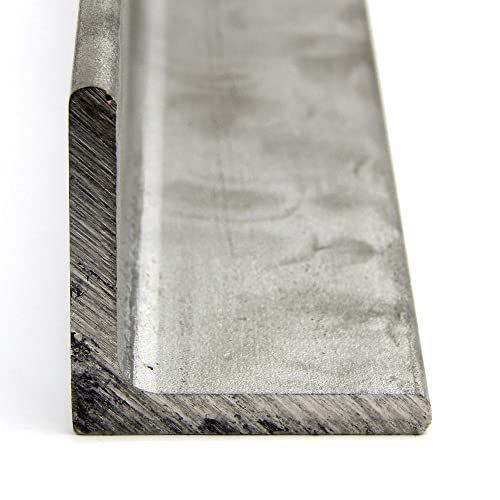
The salt-air specialist — 316 stainless for the jobs where rust is not negotiable.
This bar solves one problem better than anything else here: corrosion in brutal environments. It is 316 stainless steel, the alloy that holds up in marine or extremely corrosive settings, which is exactly why it shows up in oil and petroleum equipment, food processing, and pulp and paper plants. If your bracket lives on a boat, a dock, or near chemical splash, this grade is the one that keeps its surface.
Physically it mirrors its 304 sibling — 1-1/2 inch legs, 12 inches long, unpolished mill finish with rounded corners — but the wall is 0.1875 inches thick, heavier than the 304 bar’s 1/8 inch. Despite the steelier build, it still weighs only 1.8 pounds, so it is easy to hold steady while you fit a backer or trim piece. Both bars share the same rounded-corner profile that keeps edges from snagging hardware.
There is a real caveat here, and it is a dimensional one. At least one owner measured their angle and found the outer corner reading 91.3° rather than a true 90°, noting it sat within industry tolerance but was unsuitable for a structural bracket that needed to be perfectly square. That buyer returned it. If your job needs a precision right angle, verify the corner before you commit; if you just need a strong, rust-resistant backer, the slight variance rarely matters.
Strength To The Right Buyer: the 316 alloy is the corrosion champion of this group, and it is the extra insurance for marine and food-grade work where 304 would eventually pit.
The Square-Corner Question: mill tolerance means the corner may not be dead-on 90°, so this is a backer and trim bar more than a precision structural one.
Choose this when: the bar faces salt, chemicals, or constant moisture and has to keep looking like metal.
Steer clear if: your build demands a guaranteed square corner or a longer run than 12 inches.
Understanding the Specs
Wall Thickness
Wall thickness is how thick the steel itself is, and it decides how much the bar flexes under load. Thin walls around 1/8 inch suit brackets and trim, while a 0.25 inch wall is what you want for supports and braces. Thicker walls add weight and stiffness together, so match the wall to the job rather than always buying the heaviest bar.
Steel Grade And Alloy
The grade tells you what the steel is made of and how it behaves. ASTM A36 is a structural carbon steel that welds and forms easily, ideal for indoor fabrication. Stainless grades like 304 and 316 trade weldability for corrosion resistance, with 316 built for the harshest environments. Pick the grade that matches the conditions your project will actually face.
Leg Length And Profile
Leg length is the measurement of each side of the L. A 1-1/2 inch leg is the common middle size — strong enough to bear load, small enough to cut and drill by hand. Equal-leg bars keep both sides the same, which makes squaring corners simpler, while rounded corners on stainless bars keep edges from snagging.
Cut Length
Cut length is how long the bar arrives. A 12 inch piece covers small backers and trim, a 36 inch piece handles a frame or set of braces, and a 48 inch bar gives you room to cut multiple brackets from one length. Always plan your cuts and order the length that matches your project.
FAQ
What does 1 1/2 inch angle iron actually measure?
Which angle iron is best for welding?
Is 304 or 316 stainless better for a boat?
What is the difference between 1/8 inch and 0.25 inch wall?
Will plain steel angle iron rust outdoors?
Why does the A36 angle iron arrive as one bar instead of two?
Is the 316 stainless angle perfectly square at the corner?
How long is each angle iron bar on this list?
What is ASTM A36 steel used for?
Do I need stainless if my project stays indoors?
Final Thoughts: The Verdict
For most workshops, the 1 1/2 angle iron winner is the National Hardware Solid Angle Iron because its 48 inch length of hot-rolled ASTM A36 steel welds cleanly, holds paint, and covers the widest range of indoor builds. If your project sits near water or weather, grab the 304 Stainless Steel Angle for its rust resistance and lighter 1.2 pound handling. And when the bar has to carry real weight without flexing, the heavy-wall Hot Rolled Steel ASTM A36 Angle with its 0.25 inch wall is the one to reach for. Match the grade to the environment — A36 indoors, 304 near splash, 316 in salt — and one bar covers the job.
How We Picked
We do not accept paid placement. Every pick is matched to a real buyer and a real use-case; we do not hands-on test units.
Sources & Methodology
Specifications: manufacturer listings and product documentation. Review insights: verified customer reviews, as of September 2026. Pricing: not shown on this page (it changes often); check the current price via the retailer link.
As an Amazon Associate, Gadgets Feed earns from qualifying purchases. This does not affect which products we feature.