
Kids don’t use binoculars like adults do. They swing them by the strap, drop them on rocks, and test every knob for its break-point. The real challenge isn’t choosing a pair with high magnification — it’s finding a model that delivers a clear, usable image while surviving the relentless physics of a child’s backpack. If the focus wheel is too stiff or the image too dim, the binoculars end up abandoned in a toy bin.
I’m Min — the co-founder and writer behind Gadgets Feed. I’ve spent weeks combing through technical specifications, reading through hundreds of parent reviews, and dissecting the real-world durability of optics built for small hands. This guide focuses on the models that deliver sharp views and genuinely hold up to daily outdoor exploration.
After evaluating dozens of models, these seven picks represent the best real binoculars for kids that balance optical performance with the rugged features young explorers actually need.
How To Choose The Best Binoculars For Kids
Selecting the right pair requires looking past the colorful packaging and focusing on three factors that determine whether your child actually uses them. Kids need binoculars that are easy to operate, durable enough to survive drops, and equipped with optics that deliver a clear picture without straining their eyes.
Focus Mechanism: Center Focus vs. Fixed Focus
Center focus models use a single wheel to adjust both barrels simultaneously, which works well for older children who can coordinate the motion and refine the sharpness. Fixed focus binoculars are preset at the factory for a specific distance range — typically 50 to 200 feet. For children under six who lack the fine motor control to twist a knob, fixed focus models provide a frustration-free “point and look” experience that keeps them engaged.
Magnification and Lens Size
The standard 8×21 configuration — 8x magnification with a 21mm objective lens — hits the sweet spot for kids. It offers enough reach to spot birds and wildlife without the image shaking so much that it becomes disorienting. Lower 4x magnifications reduce shake further and suit toddlers, while 10x models require a steady hand and a tripod for usable results. The 21mm lens diameter gathers sufficient light for daytime use, though larger lenses above 30mm add noticeable weight that can tire small arms.
Durability and Safety Features
The most important spec on a pair of kids’ binoculars isn’t magnification — it’s the rubber armoring. A thick shock-absorbing coating protects the internal lenses when the binoculars hit concrete. Soft rubber eyecups are equally vital; they prevent scrapes around the eyes and provide a comfortable seal against light intrusion. A breakaway neck strap adds a layer of safety, releasing under pressure to prevent strangulation if the binoculars get caught on playground equipment.
Quick Comparison
On smaller screens, swipe sideways to see the full table.
| Model | Category | Best For | Key Spec | Amazon |
|---|---|---|---|---|
| LeapFrog Magic Adventures | Digital | Interactive Learning & Night Vision | 2.4″ LCD screen, 10x zoom | Amazon |
| Living Squad Focus-Free | Fixed Focus | Toddlers & Preschoolers | 8×21, shockproof armor | Amazon |
| BeBison 8×21 | Center Focus | Older Kids & Beginners | Center focus, metal mount | Amazon |
| OBUBY 8×21 | Compact | Travel & Bird Watching | 8×21, BAK4 prisms | Amazon |
| Carson Wild Cat 7×18 | Fixed Focus | Short-Distance Exploring | 7×18, 4.8 oz weight | Amazon |
| Wow in the World Kit | STEM Kit | Nature Scavenger Hunts | Includes compass & specimen box | Amazon |
| Yunsailing 6 Pack | Multi-Pack | Party Favors & Classrooms | 4×30, 6 binoculars per pack | Amazon |
In‑Depth Reviews
1. LeapFrog Magic Adventures Binoculars

LeapFrog breaks the traditional binocular mold by integrating a 2.4-inch video screen that displays what the lenses see in real time. The digital camera captures still images and video clips, and the built-in library of 340 BBC-licensed videos and photos about animals, plants, and fungi transforms outdoor exploration into a self-guided biology lesson. The night vision mode extends the fun past sunset, letting kids spot nocturnal creatures with up to 10x optical zoom — a feature no conventional kids’ binocular offers.
The interactive adventure game guides children through different habitats, asking them to find specific animals on the screen and rewarding correct identifications with facts. The Field Guide Quiz reinforces learning with multiple-choice questions about the natural world. Parents report that the device survives repeated drops onto hardwood floors, though the demo mode requires a specific button sequence to exit before regular use begins.
The optical system uses a manual focus with a +/-5 diopter adjustment range, which gives older kids precise control over sharpness. The field of view measures 6 degrees, which is narrower than the 7.2-degree standard of many 8×21 models, but the digital screen and educational content more than compensate for this trade-off. This is the most premium and feature-rich option on the list, ideal for tech-savvy families who want binoculars that also function as a learning console.
Why it’s great
- Built-in night vision and 10x zoom extend usability into evening hours
- BBC video library and quiz mode make it a STEM powerhouse
- Sturdy build handles drops from waist height reliably
Good to know
- Requires 4 AA batteries; screen battery life limits extended field trips
- Digital focus means no traditional optical viewfinder experience
2. Living Squad Focus-Free Binoculars

Living Squad designed these binoculars around the most common frustration parents face: children who can’t operate a focus wheel. The fixed-focus system eliminates the adjustment knob entirely — kids simply raise the binoculars to their eyes and see a sharp image instantly. The optical path relies on real glass multi-coated lenses, not the dim plastic found in toy-grade options, delivering an 8x magnification that brings distant tree branches and birds into crisp view.
The rubber armoring is thick enough to absorb the impact of a drop onto pavement, and the soft eyecups create a comfortable seal around smaller faces. The breakaway neck strap releases under excessive force, which is a critical safety feature for active toddlers who might get the strap caught on playground equipment or furniture. The included carrying case and microfiber cleaning cloth keep the lenses protected between adventures.
The fixed focus is calibrated for a viewing range of roughly 50 to 200 feet, which aligns perfectly with how young children explore — they look at birds in the yard, animals at the zoo, or interesting objects across a playground. Because there is no moving diopter, there is nothing to misalign or break, and the 0.3-kilogram weight ensures a 3-year-old can hold them steady. For parents wanting a no-fuss pair that works the moment it comes out of the box, this is the top choice.
Why it’s great
- Focus-free design requires zero instruction for 3-year-olds
- Real 8x glass optics produce a brighter image than plastic lenses
- Thick shockproof armor and breakaway strap enhance safety
Good to know
- Fixed focus doesn’t work well for objects closer than 15 feet
- No center focus knob limits use by older kids who want precise control
3. BeBison 8×21 Binoculars

BeBison’s 8×21 binoculars bridge the gap between entry-level toys and adult-grade optics with a center focus mechanism that children ages 4 and up can master. The metal mount within the chassis adds rigidity that prevents the barrels from shifting out of alignment during rough play — a weak point on many all-plastic competitors. The anti-reflective multi-coated glass lenses deliver a 7.2-degree field of view, which is wide enough to track moving birds without losing the target.
The rubber exterior and soft eyecups provide standard impact protection, but the +/-3 diopter adjustment range is a standout feature for this price tier. It allows each barrel to be fine-tuned independently, compensating for the slight differences in vision between a child’s left and right eye. This level of optical customization is rare in kids’ binoculars under the mid-range threshold and makes these suitable for older siblings who are ready to graduate from fixed-focus models.
The 7.68-ounce weight is manageable for a 7-year-old’s neck, and the included cotton carrying bag and wide neck strap promote proper storage habits. Parents of young birders report that the image clarity is sufficient to identify common backyard species at distances of 50 to 100 yards. For families seeking one pair that can serve a 5-year-old now and still satisfy a 10-year-old later, the BeBison offers the best balance of optical capability and durability.
Why it’s great
- Center focus with +/-3 diopter adjustment fits kids with different vision needs
- Metal mount construction prevents alignment shifts during drops
- Wide 7.2-degree field of view helps track fast-moving wildlife
Good to know
- 10mm eye relief is shorter than some competitors, may be tight for glasses wearers
- Focus wheel can be stiff for a 4-year-old’s fingers initially
4. OBUBY 8×21 Binoculars

OBUBY packs serious optical hardware into a package weighing only 7.5 ounces, making these the most travel-friendly real binoculars for kids on the list. The BAK4 prisms and fully multi-coated broadband green lenses control internal light reflection with precision, producing images that are noticeably brighter and more color-accurate than standard BK7 prism designs. The 7.2-degree viewing angle gives a generous sweep of the landscape, and the 8x magnification resolves feather details and distant trail markers clearly.
The 13 color options — from classic green and camo to sky blue and rose — let children choose a pair that feels like their own, which significantly increases the likelihood they’ll grab them before heading outside. The ergonomic grip is contoured for smaller palms, and the non-slip rubber coating provides a secure hold even in damp conditions. The foldable design collapses to 3.5 x 2.3 x 1.5 inches, small enough to slide into a backpack side pocket alongside a water bottle.
The kit includes a hard carrying bag, a drawstring velvet pouch, a lens cleaning cloth, and a lanyard-style neck strap. Reviewers consistently note that the image quality rivals entry-level adult binoculars, making these a viable long-term tool rather than a disposable toy. The one-year manufacturer warranty provides additional reassurance for parents who worry about durability. For serious young birders or frequent travelers, the OBUBY delivers the best optical clarity in the compact category.
Why it’s great
- BAK4 prisms and multi-coated lenses produce superior brightness and color
- Ultra-compact folded size fits easily in any backpack
- 13 vibrant color options let kids personalize their gear
Good to know
- Thin nylon lanyard can feel uncomfortable during extended wear
- Rubber eyecup can arrive slightly bent from packaging; fixable with heat
5. Carson Wild Cat 7×18 Binoculars
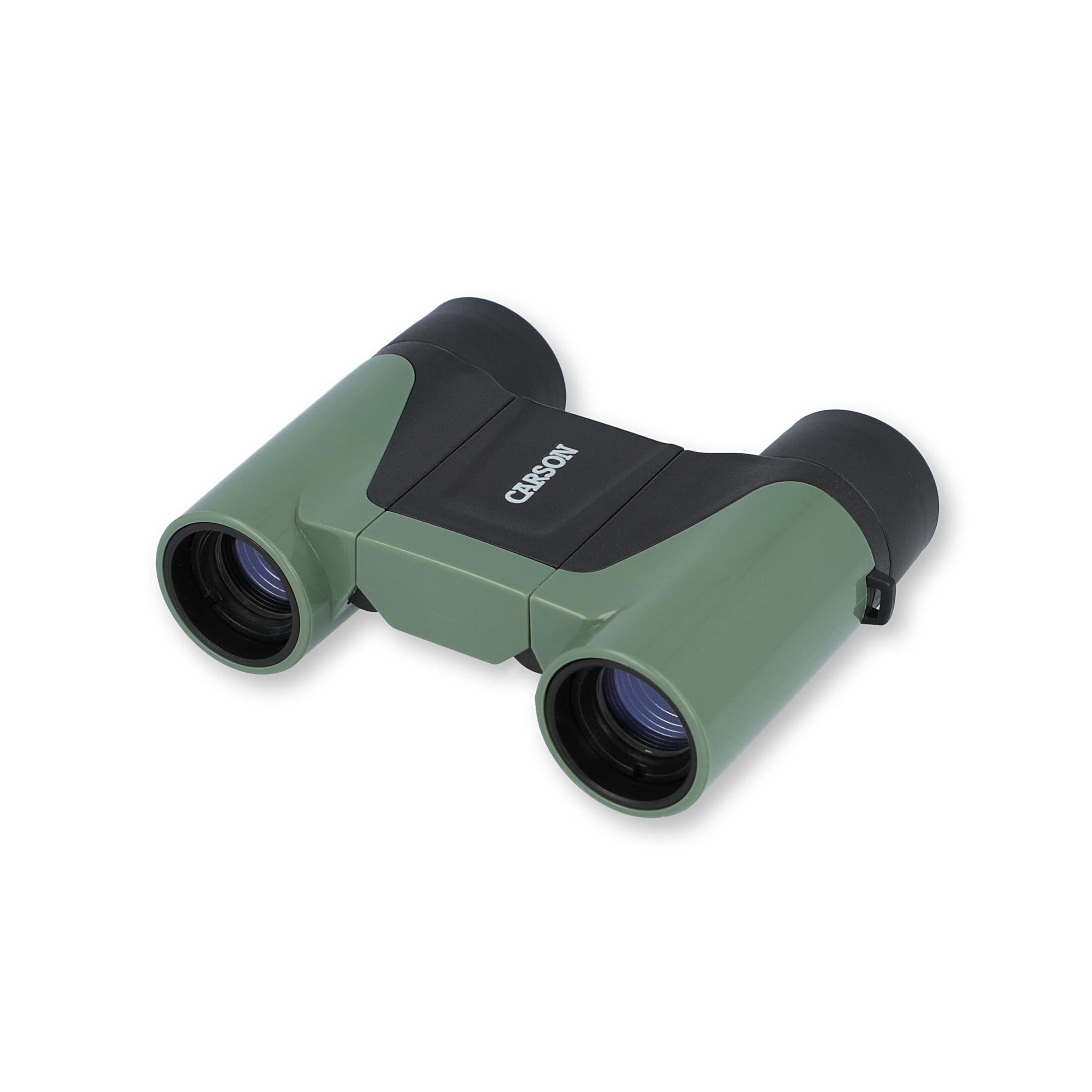
Carson targets the youngest adventurers with the Wild Cat 7×18, a fixed-focus binocular that weighs just 4.8 ounces — light enough that a 5-year-old can hold it steady for extended periods without fatigue. The 7x magnification is lower than the 8x standard, but this works in a child’s favor: the reduced power minimizes image shake and keeps the field of view wider at 430 feet per 1,000 yards. The 18mm objective lens is smaller, which keeps the binoculars compact and the weight down, but still gathers enough light for sunny-day exploring.
The fixed focus is preset for an optimal viewing range of 50 to 100 feet, which is exactly the distance at which kids spot squirrels, birds at a feeder, or landmarks during a nature walk. The recessed front lenses reduce glare from overhead sunlight, and the adjustable bridge lets the two barrels fold inward to fit a child’s interpupillary distance. The neck strap is included but can be tricky to attach, and there is no storage case — a minor omission given the price.
Parents appreciate that these are “not toy-grade,” as one reviewer put it, noting that the plastic housing and rubber coating are tough enough to handle being tossed into a camping bin. The BK7 prisms produce sharp, high-contrast images that outperform what the sub-1-ounce weight suggests. For parents who want the absolute lightest option that still qualifies as real optical equipment, the Carson Wild Cat is the clear leader in this niche.
Why it’s great
- Extremely lightweight at 4.8 oz, ideal for small hands and long walks
- Fixed focus eliminates frustration for kindergarten-age kids
- Recessed lenses reduce glare and improve visibility in bright sun
Good to know
- No carrying case included, which reduces portability protection
- Fixed focus does not allow manual sharpening for close-up objects
6. Wow in the World Kids’ Binoculars & Nature Explorer Kit

The Wow in the World kit from Thames & Kosmos goes beyond simple magnification by bundling a pair of durable binoculars with a magnetic compass, a plastic specimen collection box, and a sticker sheet for customization. The binoculars themselves feature adjustable width and a center focus wheel, soft eyecups, and a quality strap — but the real value lies in the 8-page illustrated “Wow-To Guide,” which contains a nature scavenger hunt with clues for trees, birds, insects, and geological features. Exclusive audio content from the popular Wow in the World podcast is accessible through a QR code printed inside the guide, adding a narrative layer to the exploration.
The specimen box clips onto the binocular strap, giving children a designated place to store leaves, pebbles, or interesting bugs during their walk. This organizational feature encourages systematic observation and collection rather than random grabbing. The educational objective focuses on exploratory skills, observation, and STEM learning, making this kit a strong choice for parents who want outdoor play to double as a science lesson.
The binoculars are built from plastic with large chunky parts that are easy for 4-year-old hands to manipulate. The image quality is adequate for daytime exploration but does not match the optical clarity of the BeBison or OBUBY models, which use higher-grade prism materials. Still, the complete package — binoculars, compass, specimen box, audio content, and guided scavenger hunt — creates a structured adventure that keeps children engaged far longer than binoculars alone would. For families who value activity kits over standalone gear, this is the top pick.
Why it’s great
- All-in-one kit includes compass, specimen box, and guided scavenger hunt
- Exclusive audio content from the Wow in the World podcast adds narrative engagement
- Chunky, ergonomic design is easy for 4-year-olds to grip and use
Good to know
- Optical quality is functional but not as crisp as BAK4 prism models
- Specimen box is small; large findings like pinecones won’t fit
7. Yunsailing 6 Pack Binoculars

Yunsailing takes a quantity-over-spec approach with this six-binocular pack, providing enough units for a classroom, playdate, or party favor bag. Each binocular features a 4x30mm configuration — 4x magnification with a 30mm objective lens — which prioritizes a wide, stable field of view over long-distance reach. The lower magnification means almost no image shake, making these suitable for children as young as 2, and the 30mm objective lens gathers more light than the typical 21mm kid’s model, improving visibility in shaded woods or overcast skies.
The rubber armoring and fixed-focus design mirror the durability-focused approach of more expensive models, but the optical quality reflects the budget-friendly tier. The plastic lenses and BK7 prism produce a softer image than glass-lens competitors, and the 4x magnification means objects at 500 feet appear significantly smaller than they would through an 8x pair. The strap and canvas carrying bag for each unit are appreciated, though one reviewer correctly notes that there is no actual zoom adjustment — just a fixed magnification.
Where this pack excels is in group scenarios. Whether for a kindergarten nature walk, a birthday party with six guests, or a classroom activity station, having six matching pairs eliminates arguments and sharing logistics. The vivid colors — blue, green, yellow, red, orange, and purple — make it easy to assign each child a unique pair. For parents organizing a group event or teachers building a classroom kit, the Yunsailing pack provides the most cost-effective way to equip a crowd with functional binoculars.
Why it’s great
- Six binoculars in one box are perfect for group activities and parties
- 4x magnification eliminates shake, great for toddlers and preschoolers
- 30mm lenses gather more light than standard 21mm kid models
Good to know
- Plastic lenses and 4x power limit long-distance wildlife viewing
- No zoom or focus adjustment — purely fixed magnification
FAQ
What is the ideal magnification for a 4-year-old?
Are fixed-focus binoculars better for young children?
Final Thoughts: The Verdict
For most users, the binoculars for kids winner is the LeapFrog Magic Adventures because the digital screen and BBC video library turn outdoor exploration into an interactive learning experience that no traditional binocular can match. If you want a focus-free design built for toddlers, grab the Living Squad Focus-Free. And for the best optical clarity in a compact, travel-friendly frame, nothing beats the OBUBY 8×21.